
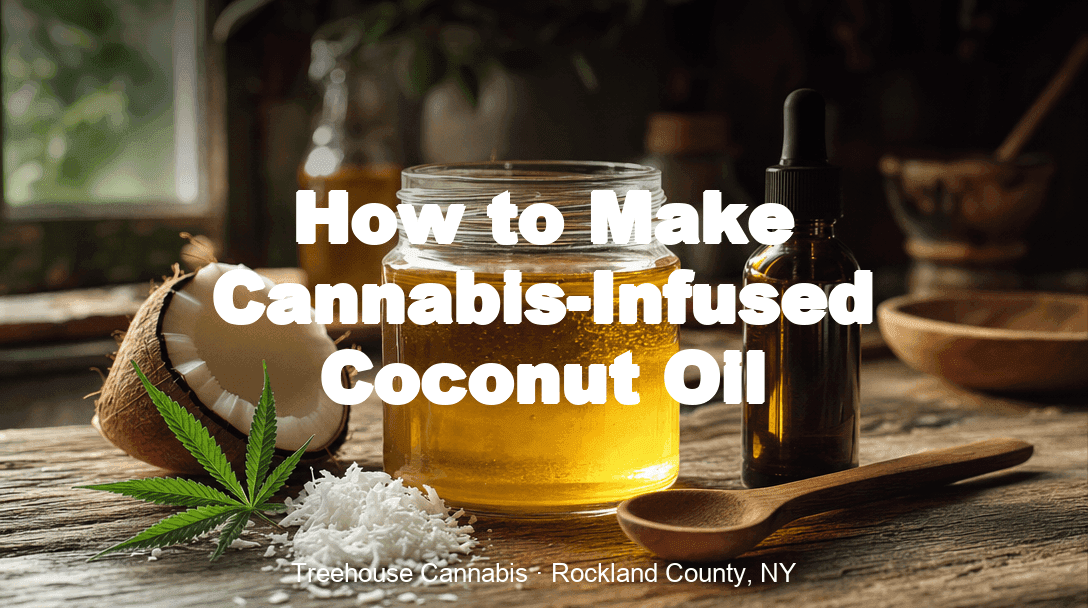
How to Make Cannabis-Infused Coconut Oil
How to Make Cannabis-Infused Coconut Oil
What Is Cannabis-Infused Coconut Oil and Why Use Coconut Oil?
Cannabis coconut oil is a fat-based carrier that binds activated THC and CBD so the body can absorb them. Coconut oil is more than 80% saturated fat, and those long-chain triglycerides grab onto cannabinoids far more efficiently than polyunsaturated fats can. That is the same basic chemistry that lets a single teaspoon of infused coconut oil feel stronger than the same volume of infused butter or olive oil. How to Choose Your First Cannabis Product: A Complete Guide for Beginners [1]
The finished oil can be used three ways: as a baking base for brownies and cookies, stirred into coffee or tea as a daily dose, or applied topically as a carrier for cannabinoid skincare. Project CBD also documents coconut oil as a primary carrier for cannabinoid infusions, including a 1-cup base-oil recipe for topical use. [7]
A note on terminology: the recipe below works just as well with a CBD-rich hemp flower for readers who want the cannabinoids without the high. The same decarb-and-simmer method applies; only the starting material changes.
- Use cannabis coconut oil as a baking base for brownies and cookies
- Stir a measured dose into coffee or tea for a daily edible
- Apply topically as a carrier for cannabinoid skincare
- Substitute CBD-rich hemp flower for a non-intoxicating version
What Equipment and Ingredients Do You Need to Make Cannabis Coconut Oil?
The ingredient list is short: 1 cup of virgin coconut oil, 7 to 10 grams (about a quarter ounce) of decarboxylated cannabis flower, and optionally 1 teaspoon of sunflower lecithin to help the cannabinoids bind to the fat. The lecithin is optional, but it is widely cited as a small potency boost that costs almost nothing. Adult consumers at every experience level can follow this same ingredient list, which is why the method also shows up in beginner-friendly guides like this one for first-time customers picking a starting product. How Seniors Are Using Cannabis in New York
The equipment is also minimal. A candy thermometer is the single most important tool, since the infusion temperature window is narrow and a guess will either undercook the batch or scorch it. Beyond the thermometer, you will need a baking sheet, parchment paper, a slow cooker or double boiler, a fine mesh strainer lined with cheesecloth, and a glass storage jar with a tight lid. A small digital kitchen scale helps with the 7 to 10 gram flower measurement.
- Baking sheet and parchment for decarbing
- Slow cooker or double boiler for infusion
- Candy thermometer for the 160 to 200°F window
- Cheesecloth-lined strainer and glass storage jar
Pick organic, unrefined coconut oil if you plan to use the finished product for skincare as well as edibles; refined coconut oil works for baking but loses some of the plant compounds that make a topical carrier feel smooth on the skin.
How Do You Decarboxylate Cannabis Before Infusing?
Decarboxylation is the heat step that converts non-intoxicating THCA into the THC that produces an edible effect. Skipping it is the most common reason a homemade cannabis coconut oil batch comes out weak, so this step is non-optional. Heat converts the non-intoxicating THCA in raw flower into psychoactive THC, which is exactly the reaction the recipe depends on. What Is Terpinene in Cannabis? An Educational Overview [2]
The home oven method is straightforward. Preheat the oven to 245°F (about 118°C). Spread the broken-up flower in a single layer on a parchment-lined baking sheet, cover loosely with foil, and bake for 30 to 40 minutes. The flower should turn a lightly toasted golden brown and smell faintly nutty when it is ready.
The chemistry behind the timing is well documented. A peer-reviewed study indexed through NIH's PubMed Central shows that THCA begins converting to THC at around 100°C and runs to completion at higher oven temperatures, validating the 245°F home recipe that home infusers have used for years. [3]
- Preheat oven to 245°F (about 118°C)
- Spread flower in a single layer on parchment-lined baking sheet
- Cover loosely with foil and bake 30 to 40 minutes
- Cool the decarbed flower fully before moving it into the oil
What Temperature Should You Infuse Cannabis Into Coconut Oil?
The safe infusion window is 160°F to 200°F held for 2 to 3 hours. That range is hot enough to pull THC, CBD, and terpenes out of the plant material and into the fat, and cool enough to keep those compounds intact.
Above roughly 340°F, cannabinoids start to degrade, and a rolling boil will scorch the oil and give the finished product a bitter, burnt-plant taste. The window itself comes from published home-method guides that map out a slow-cooker approach running at 180 to 190°F and a stovetop double-boiler approach held on the lowest burner setting with a candy thermometer. [4]
For readers who would rather skip the kitchen work entirely, finished oil-based topical products from a licensed dispensary offer an alternative route into the same cannabinoids without the decarb step. Oil Topicals
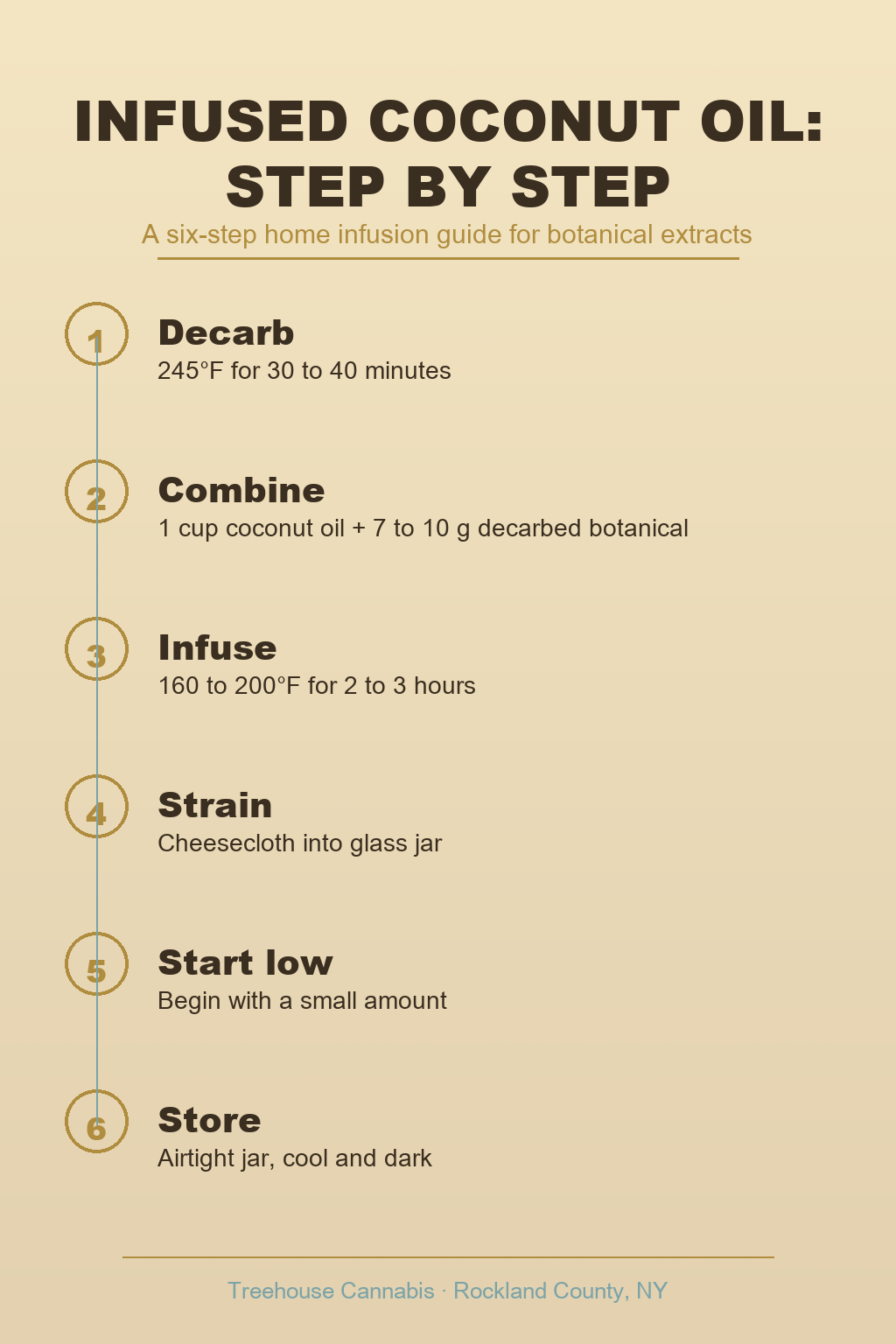
A slow cooker set to low is the easiest way to hold the 160 to 200°F range, typically landing around 180°F to 190°F on its own. For stovetop work, use a double boiler or a saucepan on the lowest possible setting with a candy thermometer clipped to the side; do not trust the dial on a stove burner.
- Hold the infusion between 160°F and 200°F for 2 to 3 hours
- Use a slow cooker on low (180 to 190°F) or a double boiler on the lowest burner
- Never let the oil boil or exceed roughly 340°F
- Stir once or twice per hour to prevent clumping and keep temperature even
Combine the coconut oil and decarbed flower in the slow cooker, stir gently to coat the plant material, and let the mixture cook uncovered for 2 to 3 hours.
How Do You Strain and Store Cannabis-Infused Coconut Oil?
Straining is the step that separates the finished oil from the spent plant material. Line a fine mesh strainer with two layers of cheesecloth and set it over a clean glass jar. Pour the warm oil through slowly, then gather the cheesecloth into a bundle and press gently with the back of a spoon to extract the last of the oil; do not squeeze hard enough to push plant fines through the cloth. Infused Pre_rolls
Discard the spent flower in the trash; composting it can leave active cannabinoids in the soil. Wipe the rim of the jar, seal it with a tight lid, and label the jar with the date it was made and the estimated potency per teaspoon.
Storage is forgiving. Coconut oil solidifies below about 76°F, which is normal and does not affect potency; the oil will return to a clear golden liquid when warmed. Stored in a cool, dark pantry, infused coconut oil stays fresh for at least two months, and refrigeration can extend that to six months or longer. Keep the jar away from direct sunlight and any heat source, since both degrade THC over time.
- Line a fine mesh strainer with two layers of cheesecloth over a glass jar
- Pour warm oil through slowly, then press gently with the back of a spoon
- Discard spent flower in the trash, not the compost
- Store in an airtight glass jar in a cool, dark place for up to two months
- Refrigerate to extend shelf life to six months or longer
How Do You Dose Homemade Cannabis Coconut Oil Safely?
Because homemade infused oil is not lab-tested, every batch needs its own back-of-the-envelope potency estimate. A simple rule: divide the estimated total milligrams of THC in the flower by the number of teaspoons in the finished batch. For a 1-cup batch made with 7 grams of 15% THC flower, the math works out to roughly 10 to 12 mg of THC per teaspoon. Pre-ground flower labeled with a THC percentage gives the most reliable starting number, and a dispensary menu page like Treehouse Cannabis's infused flower selection lists both the potency and the form factor. Infused Bud Flower
Harm-reduction guidance from clinical sources recommends a first serving of 2.5 to 5 mg of THC for an adult who is new to edibles, with 10 mg considered a standard single dose and 40 mg per day the upper limit most clinicians suggest staying under. [5] State-level consumer guidance mirrors that range, defining the standard adult-use serving as 5 mg of THC per serving and 50 mg per package. [6]
- Start at 2.5 to 5 mg THC for a first serving
- Wait at least two hours before taking more
- Stay under 40 mg of THC in a single day
- Never combine with alcohol or other sedatives
Always dose by the level teaspoon, not the heaped spoonful. A heaped tablespoon of infused oil can easily deliver two to three times the intended amount, and the effect takes longer to build than most people expect.
Coconut Oil vs. MCT Oil vs. Butter: Which Is the Best Cannabis Carrier?
Not every infusion fat performs the same way. The right carrier depends on what you plan to do with the finished oil, and the same trade-off applies to commercial concentrate products that use one of these fats as their carrier base. Insane Pound Cake Rosin VS Iced Sangria Live Resin | Box | 1g
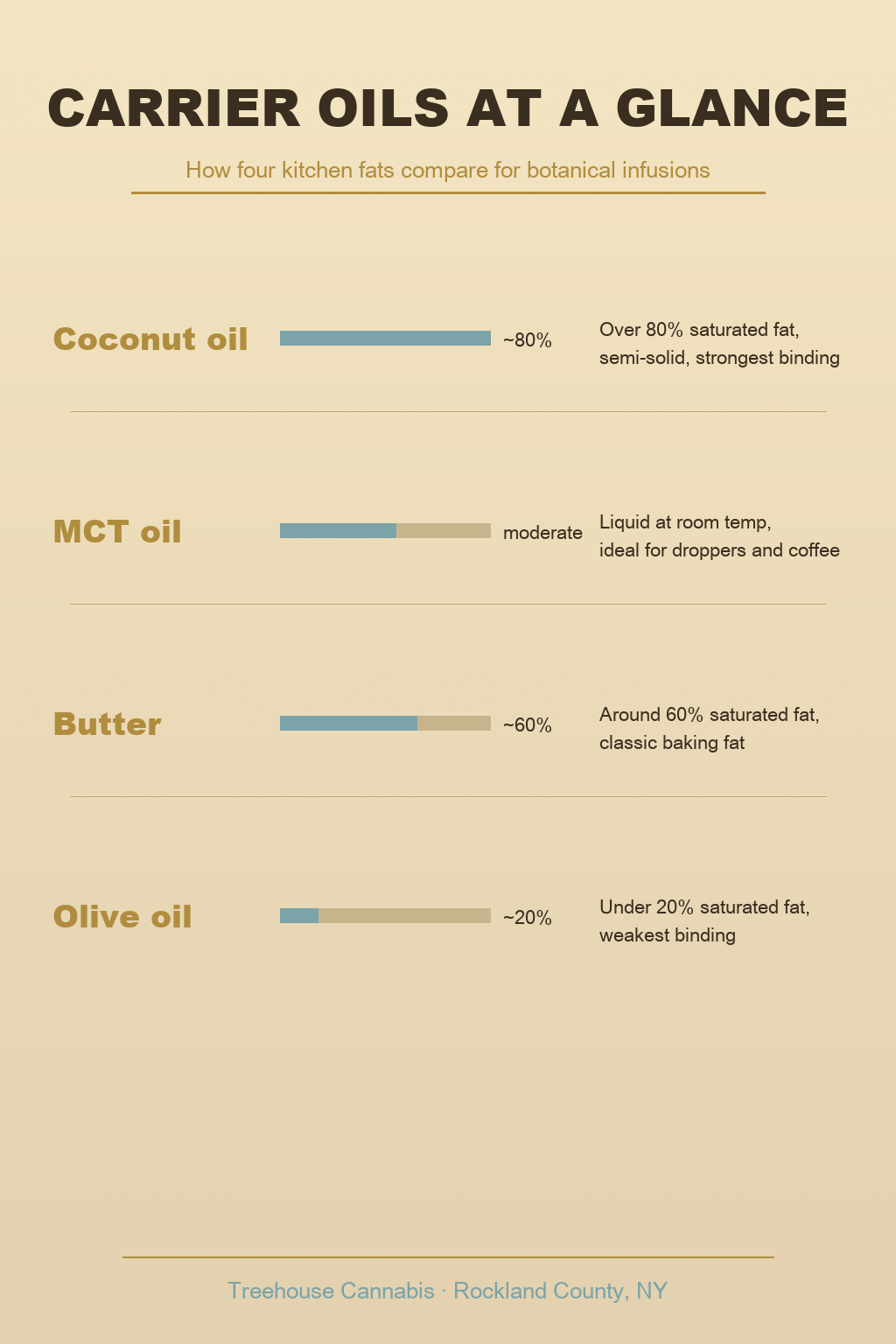
| Carrier | Saturated fat | Texture at room temp | Best for | Cannabinoid binding |
|---|---|---|---|---|
| Coconut oil | >80% | Semi-solid | Baking, topicals, general infusion | Strongest of the common options |
| MCT oil | High (fractionated coconut) | Liquid | Droppers, coffee, salad dressings | Slightly lower than whole coconut oil |
| Butter | ~60% | Solid | Classic brownies and cookies | Lower yield per batch |
| Olive oil | <20% | Liquid | Savory dishes | Weakest binding of the four |
Quick picks by use case:
- Baking brownies or cookies: butter for flavor, coconut oil for potency
- Droppers, coffee, or salad dressings: MCT oil stays liquid and measured
- Strongest edible per teaspoon: coconut oil (>80% saturated fat)
- Topical skincare carrier: coconut oil or MCT oil both work
- Savory dishes where olive flavor fits: olive oil is acceptable
Coconut oil is more than 80% saturated fat and is semi-solid at room temperature, which gives it the strongest cannabinoid binding of the common options. It is the standard choice for baking and for topical use, and it is the most forgiving fat for a first infusion.
MCT oil is the fractionated liquid portion of coconut oil, and it stays pourable at room temperature. That makes it easier to measure into droppers, stir into coffee, or drizzle on a salad, though its slightly lower saturated-fat content means it binds marginally less cannabinoid per teaspoon than whole coconut oil.
Butter sits at around 60% saturated fat and is the classic baking fat. It produces a familiar taste in brownies and cookies, but its lower saturated-fat content yields less cannabinoid extraction per batch. For pure potency per teaspoon, coconut oil still wins.
Olive oil is the weakest of the four, with less than 20% saturated fat. It is a reasonable choice for savory dishes where the olive flavor fits, but it will produce a milder infused oil than coconut or MCT.
All four carriers follow the same infusion method: decarb the flower, simmer with the fat at 160°F to 200°F for 2 to 3 hours, then strain and store. The differences come down to texture, flavor, and how much saturated fat the carrier brings to the binding step.
Sources
- Leafly — Defines the standard home infusion recipe: 1 cup coconut oil to 7-10 grams of de
- Leafly — Explains the chemistry of decarboxylation - heat converts non-intoxicating THCA
- National Center for Natural Products Research, University of Mississippi (NIH PubMed Central) — Peer-reviewed study showing THCA decarboxylates to THC starting around 100°C and
- Verilife — Provides two parallel home methods (stovetop simmer at 160-200°F for 2-3 hours,
- GoodRx Health — Clinical harm-reduction dosing reference: experts recommend starting at 2.5 mg T
- Minnesota House of Representatives — State public-sector document defining the standard adult-use edible serving limi
- Project CBD — Documents coconut oil as a primary carrier for cannabinoid infusions, including
About Treehouse Cannabis
Cannabis is for adults 21 and older. Keep all cannabis products out of reach of children and pets. Do not drive or operate machinery while under the influence of cannabis. Consult a qualified professional before using cannabis if you are pregnant, nursing, or taking other medications. The content in this article is for educational and informational purposes only and is not medical or legal advice.

Shop our products

Shop All

Flower

Pre-rolls
Vaporizers

Edibles

Drinks

Concentrates
Tinctures

Topicals

CBD

Pet CBD

Accessories