How to Make Cannabis-Infused Honey
How to Make Cannabis-Infused Honey
Cannabis honey is ordinary honey infused with cannabinoids, and you make it by decarboxylating flower first, moving those cannabinoids through a fat, then blending that fat into honey and keeping it suspended. There are two routes: simmering decarbed flower directly into honey, or emulsifying a measured cannabis oil into it.
Cannabis honey looks like a farmers market impulse buy and behaves like an edible with no label. That gap is the whole problem. A jar of it will dissolve into tea in seconds, taste like honey, and carry a dose you cannot read off the side of the jar.
The technique is not difficult, but the order of operations matters more than the recipe does: decarboxylate first, move the cannabinoids through a fat, then get that fat into the honey and keep it there. This guide covers both routes home cooks actually use, the arithmetic that makes a teaspoon meaningful, and the storage and legal details that decide whether the jar is a good idea or a liability.
What Is Cannabis-Infused Honey?
Cannabis honey is ordinary honey infused with cannabinoids, either by simmering decarboxylated flower in it and straining the plant material out, or by blending a measured cannabis oil into it with an emulsifier so the oil stays suspended.
The name describes the infusion, not the origin. A home batch starts with a jar of store-bought honey and the cannabis goes in afterward. No hive is involved, and no bee has ever produced a cannabinoid.
The two routes diverge almost immediately:
- Method one: decarboxylated flower is simmered directly in honey over gentle heat, then strained through cheesecloth while warm [13]
- Method two: a measured cannabis oil is whisked or blended into honey with sunflower lecithin so the fat stays dispersed [14]
- The first route depends on heat and time to pull cannabinoids out of plant material
- The second route depends on the oil's own label, because the cannabinoids were already extracted before the honey entered the picture
What changes in the finished jar is mostly predictable. Direct flower infusion leaves a botanical, slightly weedy carry-over and a cloudier look, because fine plant particles survive even a careful straining. The oil route tastes cleaner and pours evenly, which is why it is easier to sell to people who intend to eat honey off a spoon.
The more consequential split is dose. Cannabinoids are lipid soluble, and honey has no fat phase to hold them, so a flower batch gives you an estimate at best [4]. An oil batch inherits whatever number was printed on the oil.
That distinction decides which method suits you, and it is worth settling before you buy anything. If you have already worked through How to Make Cannabis-Infused Coconut Oil, you own the hard part of method two.
Why Must Cannabis Be Decarboxylated Before It Goes Into Honey?
Raw flower carries THCA and CBDA, acidic cannabinoids that produce little effect until heat removes a carboxyl group and converts them into THC and CBD. Skip that step and the honey is weak no matter how long it simmers.
The conversion has been measured, not guessed. A 2016 kinetic study tracked THCA-A, CBDA and CBGA across a range of temperatures and found THCA converted to THC in roughly 30 minutes at 110 degrees Celsius, about 9 minutes at 130 degrees Celsius and about 6 minutes at 145 degrees Celsius [1]. The same work found conversion below 100 degrees Celsius was still incomplete after 60 minutes, and that an oxidation byproduct, CBN, appeared once temperatures reached 160 and 180 degrees Celsius.
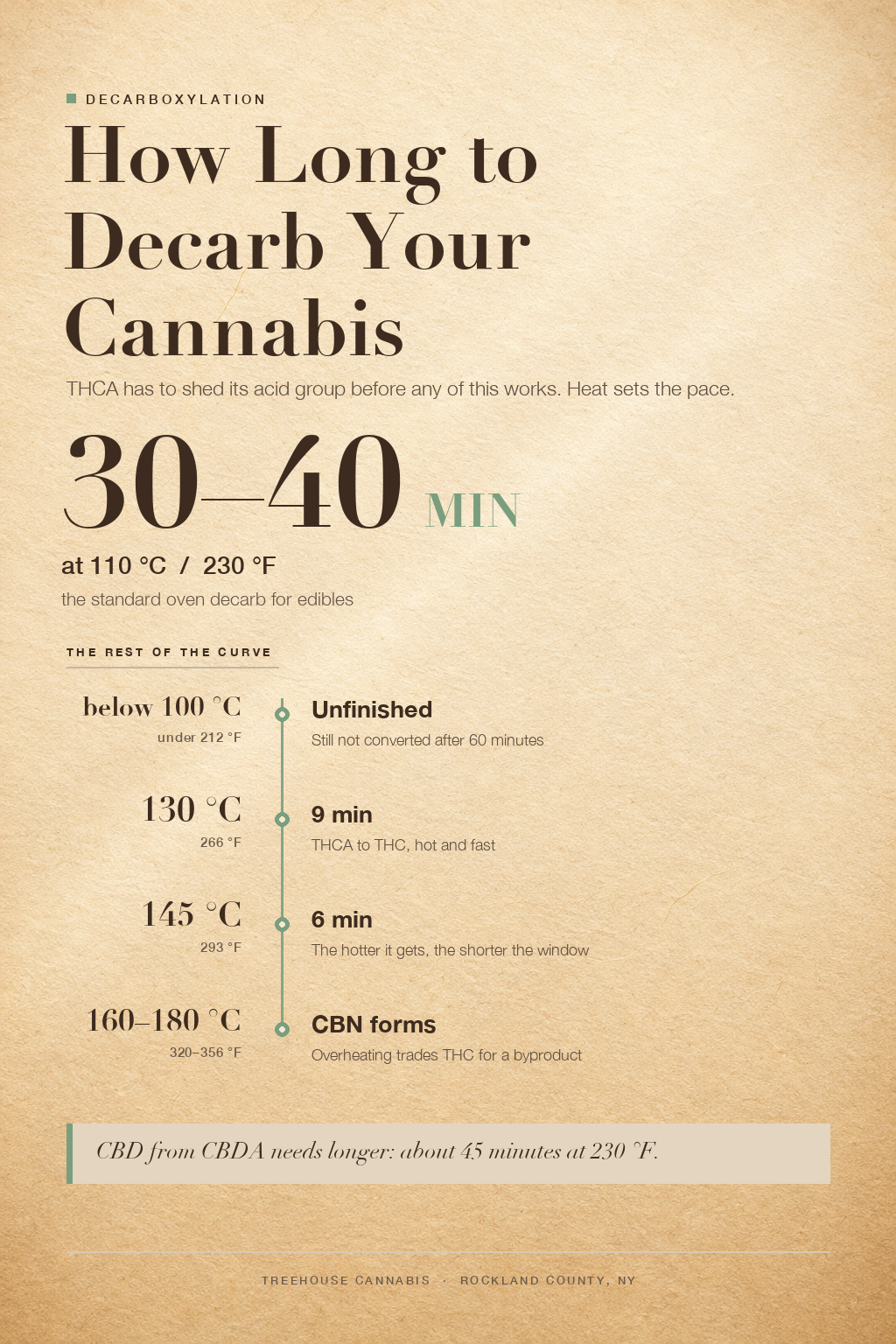
The practical takeaway from that data:
- Below 100 degrees Celsius, an hour was not enough to finish the job
- At 110 degrees Celsius, conversion ran about 30 minutes
- At 130 and 145 degrees Celsius, it ran about 9 and 6 minutes
- Above 160 degrees Celsius, CBN starts appearing as THC oxidizes
- CBDA is slower than THCA, taking about 45 minutes at 230 degrees Fahrenheit to become CBD [3]
Home practice sits on the conservative end of that curve. Project CBD recommends preheating an oven to 230 degrees Fahrenheit and baking for 40 minutes, noting that 25 minutes is usually enough when only THCA-to-THC conversion matters [2]. Leafly places the working window between 200 and 245 degrees Fahrenheit and recommends 220 degrees Fahrenheit for 30 to 40 minutes for edibles [3].
Honey itself never gets hot enough to do this work. A gentle simmer keeps the pot well under the temperatures where conversion happens at any useful rate, which is why decarboxylation belongs in the oven on a baking sheet, before the honey is opened. The same logic governs How to Make Cannabutter: A Beginner-Safe Guide and the gummy batches in How to Make Cannabis Gummies at Home — the flower is always heat-treated first, then combined.
Two cautions. No single time and temperature guarantees complete conversion, so treat any chart as a target rather than a certificate. And decarboxylation does not create potency; it unlocks what the flower already carries, minus whatever is lost to heat and time.
Why Doesn't Cannabis Dissolve Straight Into Honey?
Cannabinoids are highly lipid soluble, and honey is almost entirely sugar and water, so there is no fat phase to hold them. Stir flower into honey and the cannabinoids have nowhere to go.
The extraction side of this is well measured. Researchers working with lipid carriers found cannabinoid extraction efficiency of 95.87 to 97.46 percent across the formulations they tested [7]. That number is the reason every reliable method routes the cannabis through a fat first. The fat does the dissolving; the honey is only the delivery vehicle.
Without a carrier, two things go wrong at once:
- Cannabinoids cling to plant material that ends up in the cheesecloth and gets thrown away
- Whatever does make it into the honey sits on the surface as an oily sheen rather than dispersing
That second failure is why the emulsifier step exists. A crossover study comparing a self-nanoemulsifying THC and CBD formulation against standard oil-based drops found the emulsified version more than doubled relative bioavailability [8]. Emulsification changes absorption and suspension, not content — the same oil carries the same milligrams either way — but a fat phase broken into fine droplets mixes far more evenly into a sugar syrup than a slick of oil does.
One teaspoon of sunflower lecithin is enough to do that job in a one-cup batch [14]. Whisk it into the oil before the oil meets the honey, not after, or you will spend ten minutes chasing slicks around the pot.
Honey's own chemistry is a separate matter and worth knowing for storage. Water activity in honey runs 0.562 to 0.62, low enough that bacterial growth is limited [9].
That protects the honey, but it says nothing about whether cannabinoids will stay dissolved in it. It also does not make the jar shelf-stable once you have added oil and plant material. Anyone weighing a low-dose spoonful against a capsule or a tincture should read How Seniors Are Using Cannabis in New York before assuming the gentler format is the simpler one.
How Do You Make Cannabis-Infused Honey Step by Step?
You make cannabis honey by decarboxylating flower, then either simmering it into honey and straining the plant material out, or emulsifying a measured cannabis oil into honey with sunflower lecithin. Both methods below are written for a one-cup batch, which is about 48 teaspoons and far more than most households need in a month. Halve either recipe if you are testing.
Gather the same equipment for both:
- A double boiler, or a heavy saucepan with a heat diffuser
- A kitchen thermometer that reads low temperatures accurately
- Cheesecloth or a fine mesh strainer, for the flower method
- A clean glass jar with a tight lid, sterilized and fully dry
- A whisk, and a blender if you are going the emulsified route
Method One: Direct Flower Infusion
- Decarboxylate 3.5 grams of cannabis flower at 220 to 230 degrees Fahrenheit for 30 to 40 minutes [3]
- Grind the cooled flower coarsely. Fine powder is harder to strain and turns the honey muddy.
- Combine the flower with 1 cup of honey in a double boiler over gently simmering water [13]
- Hold it at a bare simmer for at least 40 minutes, stirring often, and never let it reach a rolling boil
- Strain through cheesecloth while the honey is still warm, then squeeze the bundle to recover what you can
- Jar it, label it with the date and the amount of flower used, and let it settle before the first taste
The pot should look like it is thinking about simmering, not actually doing it. Honey handled at high heat darkens and develops a cooked, slightly bitter edge, and 5-hydroxymethylfurfural rises with heat treatment and again with prolonged storage [10]. Low and slow is not fussiness here. It is the difference between honey that tastes like honey and honey that tastes like caramel gone wrong.
Method Two: Emulsified Oil Blend
- Measure 1 tablespoon of a cannabis oil whose label states total THC. A 240 milligram oil is the reference point used below.
- Whisk that tablespoon of oil with 1 teaspoon of liquid sunflower lecithin until it looks uniform [14]
- Warm 1 cup of honey gently in a double boiler until it flows easily, then take it off the heat
- Whisk the oil and lecithin mixture into the honey, or blend the whole batch for about two minutes
- Jar it and let it settle for 24 hours before judging the texture
- Label the jar with the oil's milligrams, the batch date, and your calculated milligrams per teaspoon
This method takes roughly ten minutes of actual work, most of it measuring. There is no simmer, so there is no window in which the honey scorches and no plant material to strain.
Which Method Should You Use?
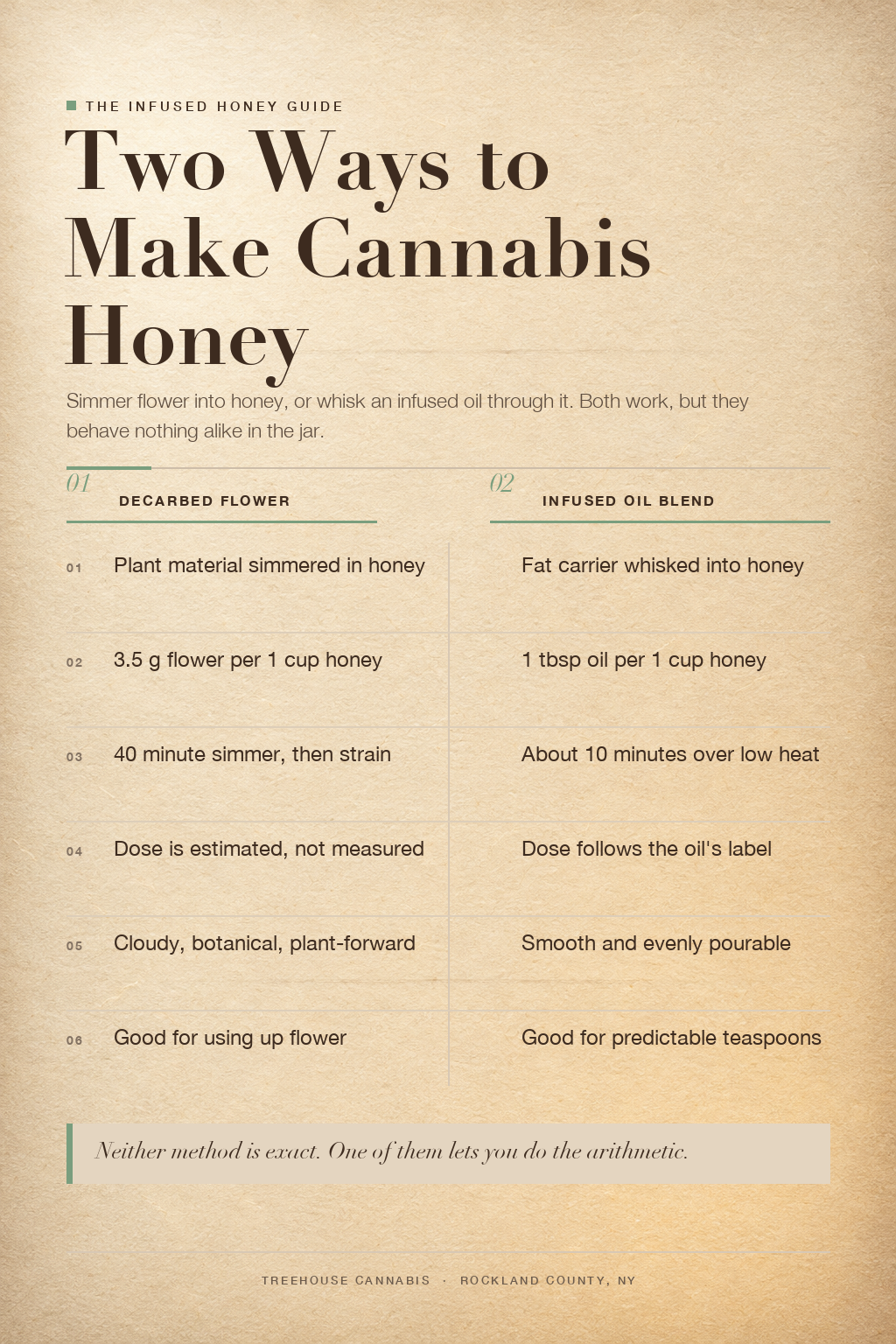
| Feature | Direct flower infusion | Infused oil blend |
|---|---|---|
| Carrier | Plant material simmered in honey | Fat carrier whisked into honey |
| Ratio | 3.5 g flower per 1 cup honey | 1 tbsp oil per 1 cup honey |
| Hands-on time | 40 minute simmer, frequent stirring | About 10 minutes over low heat |
| Dose control | Estimated, never measured | Follows the oil's printed label |
| Texture and flavor | Cloudy, botanical, plant-forward | Smooth and evenly pourable |
| Best for | Using up flower you already have | Predictable teaspoons |
The texture trade-off is real and worth naming. Flower honey tastes like what it is, and some people like that. Oil honey is the version you can put in tea without explaining it to a guest.
If you would rather not run a stove at all, the dispensary shelf sells the finished version of the same idea, and Infused Pre_rolls is one place to compare formats before committing an afternoon to a pot of honey.
Troubleshooting
Separation is the most common complaint with the oil method. A thin oily ring at the top means the emulsion did not hold; warm the jar gently in a water bath and whisk it back together. Re-blending is normal maintenance for a home emulsion, not a sign the batch failed.
Crystallization is different. Real honey crystallizes on its own schedule depending on its sugar balance, and infused honey is no exception. A warm water bath restores it. Do not microwave it, and do not assume crystals mean spoilage.
If the honey tastes burnt or has darkened sharply, the heat was too high and the batch is worth remaking rather than salvaging. Neither method produces an exact milligram per teaspoon, and straining does not remove every trace of plant material — plan around that rather than expecting precision that home equipment cannot deliver.
How Do You Dose and Store Cannabis Honey Safely?
Ten milligrams of THC per serving is the ceiling New York sets for packaged cannabis products, and it is the number edible makers target [17]. Start there, not with a tablespoon.
The arithmetic that makes that usable is simple. One tablespoon of a 240 milligram oil blended into 1 cup of honey works out to roughly 5 milligrams per teaspoon, because a cup holds about 48 teaspoons [14]. That makes a teaspoon a sensible test unit and two teaspoons the practical ceiling. Write those numbers on the jar, because nothing else in the kitchen will.
Home batches are not uniform, and the published testing is blunt about it. Total THC content in 83 percent of medicinal edibles tested differed from the labeled amount by more than 10 percent, and home extraction is rarely complete [6]. A flower batch cannot be dosed precisely at all, which is why it deserves a smaller test spoon than an oil batch does.
Timing matters as much as the number:
- Onset typically runs 30 to 60 minutes after ingestion [5]
- Effects peak between 90 and 180 minutes
- Return to baseline takes about 6 to 8 hours
- Time to maximum blood concentration runs 2 to 3 hours
- Wait a full hour before a second taste, because the first one has not finished arriving
That slow start is the whole reason people overdo edibles. Nothing happens for forty minutes, so they take another spoonful, and then both land at once.
For storage, seal the jar and keep it cool and dark. Infused honey keeps roughly 1 to 2 months that way [13]. Heat and long storage both raise 5-hydroxymethylfurfural, so do not reheat a finished batch to soften it [10]. Discard it if the aroma turns, the color darkens sharply, or it smells fermented.
Two safety points sit on top of the dosing ones. Honey carries Clostridium botulinum spores — recovered from 4 percent of honey samples worldwide in one review — and it should never be given to a child under 12 months, with or without cannabis [11]. The CDC and the American Academy of Pediatrics both recommend against honey for infants for exactly that reason, and cooking does not reliably destroy the spores [12]. The cannabis jar itself belongs locked away from anyone under 21.
If you want a format with a printed milligram number instead of an estimate, a measured edible such as Pillow Talk 2:1 | 10 Pack | Gummies | THC: 100mg, CBN: 50mg removes the arithmetic from the equation.
Comparing your own jar against a labeled product is instructive. A package like Pillow Talk 2:1 | 10 Pack | Gummies | THC: 100mg, CBN: 50mg states THC and CBN per package and per serving, which is the level of detail a home batch can only approximate. If infused flower is what you would rather cook with, Infused Bud Flower shows what licensed producers are selling under that label.
Is It Legal to Make Cannabis Honey at Home in New York?
Yes, if the cannabis is your own home-grown flower. Since June 26, 2024, New York adults 21 and older may cultivate cannabis at home for adult use, and turning part of that harvest into honey falls inside the personal-use allowance [15].
The limits from the Office of Cannabis Management:
- 3 mature and 3 immature plants per person
- 6 mature and 6 immature plants per private residence
- Up to 5 pounds of harvested flower kept at home
- Cultivation only at a single designated site in or on the grounds of a private residence
- Plants and the cannabis produced from them must be stored securely, out of reach of anyone under 21
- Selling the result is prohibited [16]
That last line is the boundary that matters most for a kitchen batch. Home infusions are personal use only. They carry no testing, no potency verification, and no child-resistant packaging, none of which a licensed product can skip. Buying infused flower such as Infused Buds Flower does not change that rule either — the licensed version is tested and labeled, and the jar you make at home is neither.
The retail standard shows the contrast. Packaged cannabis must be labeled with milligrams of total THC per serving and per package, along with the number of servings and the recommended serving size, and no single serving may exceed 10 milligrams of total THC [17]. Your jar has a sticky note.
So make the sticky note a good one: date, flower or oil used, batch size, and estimated milligrams per teaspoon. It is the only record that will exist, and it is the only thing standing between a guest and a very long afternoon.
This is general information about New York's rules, not legal advice. Local rules and future changes to the regulations are worth checking directly with the Office of Cannabis Management.
Frequently Asked Questions
What is cannabis-infused honey?
It is ordinary honey that carries cannabinoids. One route simmers decarboxylated flower directly into honey and strains the plant material out. The other blends a measured cannabis oil into honey with an emulsifier so the oil stays suspended. Either way you end up with a jar you can spoon, drizzle, or stir into a drink.
Do I have to decarboxylate cannabis before making infused honey?
Yes. Raw flower contains THCA and CBDA, acidic cannabinoids that produce little effect until heat converts them into THC and CBD. Measured conversion took about 30 minutes at 110 degrees Celsius and 6 minutes at 145 degrees Celsius, and home recipes typically call for 220 to 230 degrees Fahrenheit for 30 to 40 minutes.
Why does the cannabis not just dissolve straight into the honey?
Because cannabinoids are lipid soluble and honey is almost entirely sugar and water, with no fat phase to hold them. Extraction into lipid carriers measured 95.87 to 97.46 percent efficiency, which is why every reliable method moves the cannabis through a fat first, then suspends that oil in the honey.
How much THC should one serving of cannabis honey contain?
Ten milligrams of THC is the ceiling New York applies to a single serving of packaged cannabis, and it is the number most edible makers target. One tablespoon of a 240 milligram oil blended into 1 cup of honey works out to roughly 5 milligrams per teaspoon, so a teaspoon is a reasonable test unit.
How long does cannabis-infused honey take to work?
Plan on 30 to 60 minutes before effects start, with a peak between 90 and 180 minutes and a return to baseline 6 to 8 hours later, based on measured oral cannabis pharmacokinetics. Time to maximum blood concentration runs 2 to 3 hours. The slow start is why people accidentally take too much.
How should cannabis honey be stored, and how long does it last?
Seal the jar and keep it in a cool, dark place away from heat and light. Infused honey keeps roughly 1 to 2 months that way. Heat and long storage both raise 5-hydroxymethylfurfural in honey, so avoid reheating a finished batch. Discard it if the aroma turns or it smells fermented.
Is cannabis-infused honey safe for children?
No. It is an adult-use product and belongs locked away from anyone under 21. Honey also carries a separate risk for infants: Clostridium botulinum spores were recovered from 4 percent of honey samples worldwide, and honey should never be given to a child under 12 months, with or without cannabis.
Can I legally make cannabis honey at home in New York?
Adults 21 and older may cultivate cannabis at home in New York as of June 26, 2024, with limits of 3 mature and 3 immature plants per person and 6 of each per residence, plus up to 5 pounds of harvested flower at home. Home infusions are personal use only and cannot be sold.
Sources
- Cannabis and Cannabinoid Research (Wang et al.) — Measured decarboxylation kinetics of THCA-A, CBDA and CBGA across 80-145 degrees
- Project CBD — Explains that decarboxylation rate is a function of heat and time, recommends pr
- Leafly — Places decarboxylation between 200 and 245 degrees F, recommends heating flower
- The Permanente Journal (Chayasirisobhon et al.) — Documents that THC is highly lipid soluble and rapidly taken up by fat tissue wh
- Journal of Analytical Toxicology (Vandrey et al.) — Measured oral cannabis effects and found subjective onset typically occurs 30 to
- RTI Press (Barrus et al.) — Documents the dose accuracy problem in edible cannabis, finding that the total T
- Molecules (Ramella et al.) — Measured cannabinoid extraction into lipid carriers and found extraction efficie
- Journal of Cannabis Research (Hermush et al.) — Ran a crossover comparison of a self-nanoemulsifying THC/CBD formulation against
- Saudi Journal of Biological Sciences (Almasaudi et al.) — Reviews the antibacterial mechanisms of honey and reports that water activity in
- Chemistry Central Journal (Shapla et al.) — Explains that 5-hydroxymethylfurfural forms from reducing sugars in honey throug
- Current Microbiology (Harris and Dabritz) — Confirms honey as the most well-known risk factor for infant botulism, with Clos
- Michigan State University Extension — Reports that the CDC and the American Academy of Pediatrics both recommend again
- Leafly — Gives a direct-infusion cannabis honey method using 1 cup of honey and 3.5 grams
- The Herb Somm (Jamie Evans) — Describes the emulsification route to cannabis honey, combining 1 tablespoon of
- New York State Office of Cannabis Management — States that since June 26, 2024 individuals over 21 can cultivate cannabis at ho
- New York State Office of Cannabis Management (9 NYCRR 115.3) — Sets the operative New York home cultivation rules, including that only persons
- New York State Office of Cannabis Management — Requires that cannabis products be labeled with milligrams of total THC per sing
About Treehouse Cannabis
If you would rather start from a product that already carries a measured label, Treehouse Cannabis serves Rockland, Orange, and Westchester Counties with tested edibles, tinctures, and flower for your own kitchen batches. A tincture like High Dose "UP" | Tincture | 1000MG gives you a dropper and a printed milligram count, which is the closest thing to a guaranteed dose in the store. Ask the team what the milligrams per serving actually mean before you decide.
Cannabis is for adults 21 and older. Keep all cannabis products in their original child-resistant packaging or a locked container, store them out of reach of children and pets, and never drive or operate machinery while impaired. This article is educational and is not medical advice.
Shop our products

Shop All

Deals
Flower
Pre-rolls
Vaporizers

Edibles
Drinks

Concentrates
Tinctures

Topicals
CBD

Pet CBD

Accessories