Cannabis and Headaches: Triggers, Relief Claims, and Evidence
Cannabis and Headaches: Triggers, Relief Claims, and Evidence
A research-first look at what cannabis actually does for migraine and headache pain, why some people get headaches from weed, and where the documented risks sit.
Cannabis and headaches connect in both directions, and the evidence on each direction is uneven. A 2025 randomized trial found that THC-containing flower outperformed placebo for acute migraine, while separate research documents a cannabis withdrawal headache and much higher rates of medication overuse headache among frequent users. The honest answer depends on which direction you are asking about.
What Does the Evidence Say About Cannabis and Headaches?
The evidence on cannabis and headaches is mixed and uneven rather than empty. Some studies report large reductions in migraine frequency, one randomized trial found a real effect against placebo, and a separate body of work documents cannabis making headaches worse for some people.
Three figures frame the discussion, and they pull in different directions:
- Headache disorders affect roughly 40% of the global population, about 3.1 billion people in 2021, and migraine ranked third worldwide among causes of disability-adjusted life years [1].
- Survey data show 49% of people with migraine have already used cannabis or cannabinoid derivatives, which is part of why relief claims circulate so widely [4].
- A 2022 systematic review of 12 publications covering 1,980 participants found medical cannabis reduced monthly migraine headaches from 10.4 to 4.6, while aborting attacks in only 11.6% of users [2].
The third bullet is the crux. A drop from about ten migraines a month to under five sounds transformative, and it is the number most likely to be repeated in a dispensary or a forum thread. The same review, working from the same data, concluded the evidence base was too weak to recommend cannabis for migraine with confidence [2]. Both statements come from one paper, and the tension between them is the honest starting point.
What is not in dispute is why anyone is looking. The proposed mechanisms are plausible rather than proven: the endocannabinoid system interacts with the glutamate and serotonin pathways implicated in migraine, which gives researchers a reason to keep testing [4]. A plausible mechanism plus widespread use is an argument for studying something.
It is not an answer, and that same gap between mechanism and demonstrated outcome runs through most cannabis-and-symptom questions, including the gastrointestinal side covered in Cannabis and Gastritis: What the Research Says.
Pulled together, the studies do not point in one direction:
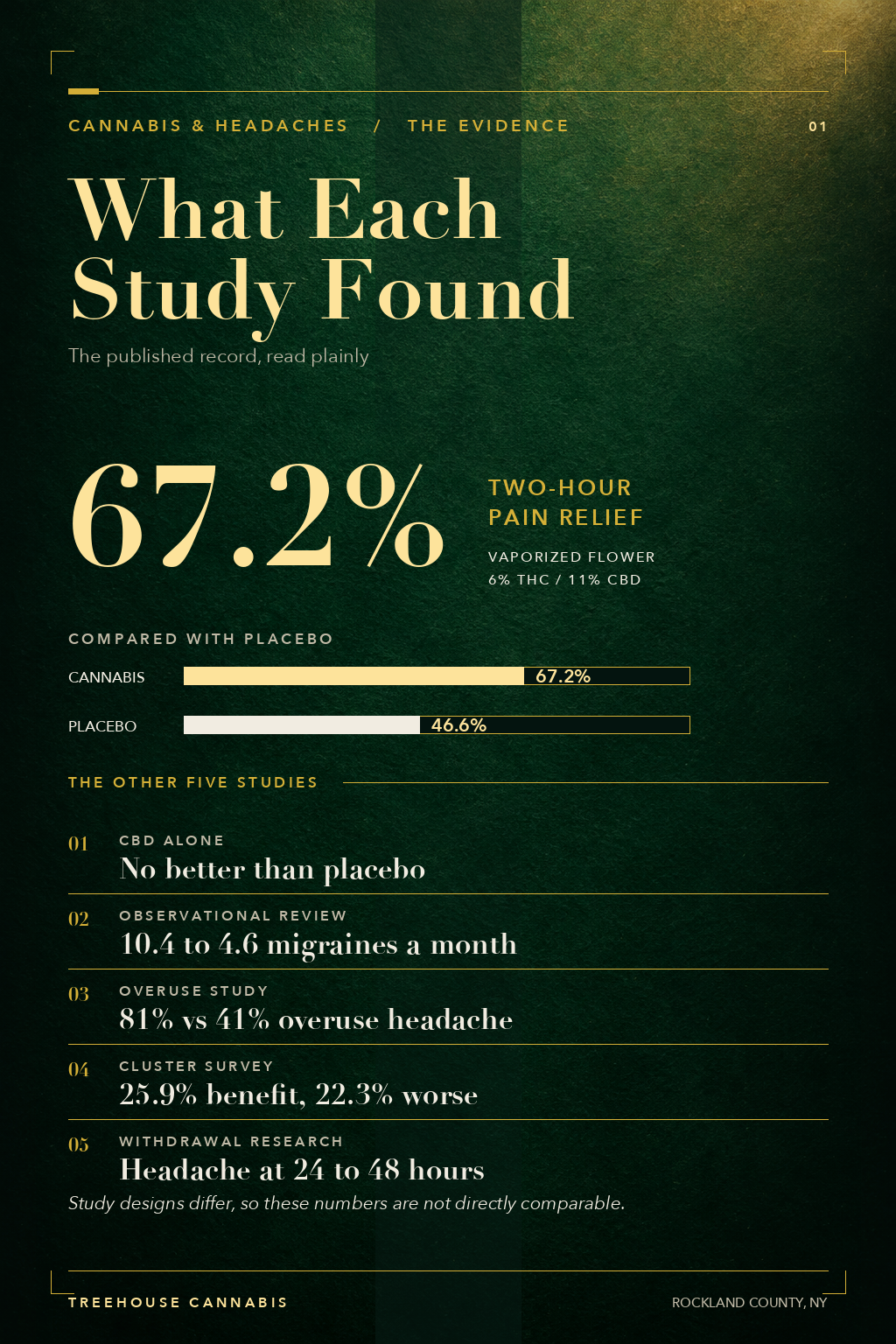
The rest of this article follows that map in three parts. First, the relief claims and what each study design can actually support. Second, the trigger side, including weed headache, withdrawal headache and medication overuse headache. Third, what the first randomized trial changed, because that one study is the reason the conversation shifted.
What Did the First Randomized Trial of Cannabis for Migraine Find?
It is the strongest single study in this literature, and its result was positive. Vaporized flower at roughly 6% THC plus 11% CBD beat placebo on acute migraine pain, while CBD-dominant flower did not.
The design is what separates it from everything before it. A 2025 randomized, double-blind, placebo-controlled crossover trial randomized 92 participants and analyzed 247 treated attacks, testing vaporized flower at roughly 6% THC plus 11% CBD against placebo [6]. A placebo comparator and blinding are what separate a drug effect from an expectation effect.
The results break down by endpoint, and the endpoints are not interchangeable:
- The trial randomized 92 participants and analyzed 247 treated attacks, testing vaporized flower at roughly 6% THC plus 11% CBD against placebo [6].
- Two-hour pain relief reached 67.2% on active flower versus 46.6% on placebo, an odds ratio of 2.85 [6].
- Complete pain freedom at two hours, the stricter endpoint, reached 34.5% versus 15.5% on placebo [6].
- Symptom freedom, meaning relief of the associated nausea and light sensitivity rather than the pain alone, also favored the active flower [6].
- CBD-dominant flower performed no better than placebo on any endpoint [6].
The gap between the second and third bullets is where most public discussion goes wrong. Pain relief and pain freedom are different claims. A customer who reads "67%" and hears "two-thirds of migraines stopped" has been misled by a rounding of language, not by the data.
The trial also tested one chemotype, not a strain. That distinction is easy to lose and matters more than most shoppers expect, because indica and sativa labels describe plant shape and marketing categories as much as they describe cannabinoid content, a point covered in Indica vs Sativa: Why the Labels Are Mostly Meaningless. What predicted the result here was the ratio of THC to CBD in the vaporized material, not the name on the jar.
The limits are real and worth stating plainly:
- This is one trial, in a supervised setting, with a single chemotype.
- It used a crossover design in which every participant eventually received both the active flower and the placebo.
- It establishes that a THC-containing cannabis flower can outperform placebo for acute migraine under those conditions.
- It does not establish that any retail product works, because retail potency, terpene content and delivery method all vary.
- It is not the multicenter, double-blind, placebo-controlled evidence that headache medicine expects before a treatment guideline changes, which is exactly the gap a 2021 review described when it found no such trial existed [5].
There is also the practical question of what else the flower does while it relieves pain. Cannabis affects attention and short-term memory in the hours after use, covered in Can Cannabis Affect Memory? What Current Research Shows, which is worth weighing if the alternative is a prescribed acute treatment that leaves you functional.
Why Do Observational Studies Report Stronger Results Than Trials?
Because the two designs answer different questions. Observational studies follow people who already chose cannabis and record what they report, while a trial compares cannabis against a placebo.
Lay the claims out at full strength first, because they are genuinely striking. The 2022 review found monthly migraine headaches fell from 10.4 to 4.6 across 1,980 participants [2]. Individual observational studies are more dramatic still: Rhyne 2016 reported 85.1% of 121 participants reduced migraine frequency over an average 21.8 months, and Cuttler 2020 reported a mean 49.6% reduction in severity across 653 participants [3].
Longer follow-up adds detail rather than certainty. In registry data covering 203 people followed for up to 24 months, cannabis-based medicinal products were associated with improvement in headache impact, migraine disability, anxiety and sleep quality, higher THC doses predicted greater improvement, and 15.27% reported adverse events that were mostly mild or moderate [11].
So why does the trial literature look so much weaker? The gap comes down to what each design can and cannot rule out:
- Observational numbers are large: 10.4 to 4.6 migraines per month across 1,980 participants, 85.1% of 121 reducing frequency, and a 49.6% severity drop across 653 participants [2][3].
- Registry data add a 24-month window, with improvement in headache impact and sleep, and 15.27% reporting mostly mild or moderate adverse events [11].
- Most of this literature is retrospective or survey-based self-report, with no control arm at all [5].
- Self-selection, expectation effects, natural fluctuation in attack frequency, and unblinded self-report can each produce a large apparent benefit without any drug effect.
- The registry finding that higher THC doses predicted better outcomes is a pattern inside one cohort, not a reason to use more THC.
That last point deserves emphasis. In an unblinded cohort where people choose their own dose, the people who take more also tend to be the people who expect more, can afford more, and are working harder at managing their condition. The dose-outcome association could reflect pharmacology, or it could reflect who chooses the higher dose.
The design difference, side by side:
| Feature | Randomized controlled trial | Observational and registry data |
|---|---|---|
| Control group | Yes, a placebo comparator | None |
| Blinding | Yes, participants and investigators unaware of assignment | No, everyone knows what they are taking |
| What it can establish | Whether a product outperforms placebo under controlled conditions | Patterns and associations in real-world use over months or years |
| Main limitation | Small samples, single site, one chemotype, results do not transfer automatically to retail products | Self-selection, expectation, natural fluctuation and unblinded reporting can all mimic benefit |
Neither column is worthless. Trials tell you whether an effect is real under controlled conditions. Observational data tells you what happens to people who are actually buying and using products over a year or two, including the adverse events a short trial would miss. The mistake is reading the second column as if it carried the first column's certainty.
The cannabinoid comparison most readers arrive with, THC against CBD, has the same structural problem, and the pharmacology behind it is covered in CBD vs THC: The Science Behind the Two Most-Discussed Cannabinoids.
What Is a Weed Headache and Can Cannabis Trigger One?
A weed headache is a headache that appears after using cannabis, either within hours of use or the next day after heavy use. The next-day version is better documented, and it usually reflects withdrawal rather than the drug itself.
Conflating those two experiences is why advice online contradicts itself so often. The first is a headache that begins shortly after consuming cannabis, while the second is a dull next-day headache after heavy use.
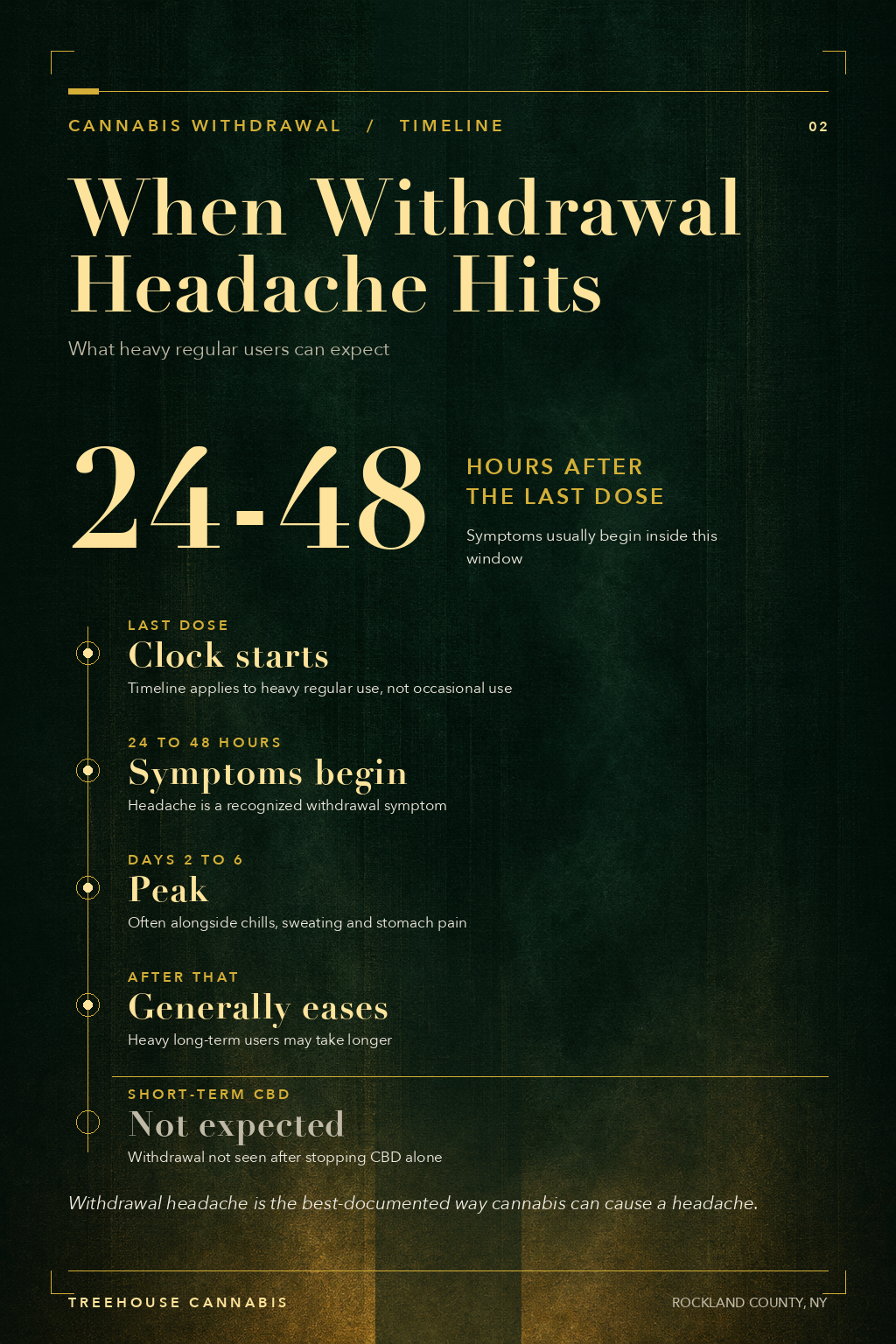
Withdrawal headache is the clearest version of the story. Headache is a recognized physical symptom of cannabis withdrawal, which typically begins 24 to 48 hours after stopping heavy regular use, peaks between days two and six, and does not appear to occur after stopping short-term CBD [10].
The timeline is consistent enough to be useful:
- After the last dose the clock starts, though this timeline applies to heavy regular use rather than occasional use.
- Symptoms typically begin 24 to 48 hours after stopping [10].
- They peak between days two and six [10].
- Headache usually arrives alongside other physical symptoms such as chills, sweating and stomach pain [10].
- Stopping short-term CBD does not appear to produce withdrawal at all [10].
The mechanism evidence is preclinical and should be read that way. In rats, repeated dosing with delta-9-THC produced periorbital allodynia, a pain response around the eyes, that resolved within about three weeks but left the animals hyper-responsive to bright-light stress afterward. The authors read that as latent sensitization of the trigeminal pain pathways [7].
It is a coherent story that fits the human epidemiology. It is also rat data, and nobody has established the same chain in people.
For the immediate post-use headache, the honest answer is that the evidence is thin. The contributors usually suggested are high THC doses, dehydration, smoke irritation and frequent use, and most of the support for cannabis as an acute trigger is case reporting rather than controlled study. Plausible is not the same as proven, and this is a case where the plausible list is doing most of the work.
There is a practical, non-medical move available to anyone who wants a real answer for themselves. Track use and headache timing in writing for a few weeks, note the product, potency and amount, then take a break and compare.
If the headaches cluster in the 24 to 48 hours after stopping rather than after using, that points at withdrawal. If they follow use within hours, that points somewhere else. Either way the log is more informative than any general claim, because group averages do not predict individual response.
Does Cannabis Cause Medication Overuse Headache?
Possibly. The association is much stronger than the causal evidence, and a case-referent design cannot establish which way the effect runs.
Start with the concept, because medication overuse headache is unfamiliar to most people who get migraines. Using an acute treatment more often than a certain threshold can make attacks more frequent rather than less, and the pattern is well established for triptans, simple analgesics and opioids. The treatment that ends an attack, used too often, starts manufacturing them.
Cannabis now sits in that conversation. In a case-referent study of chronic migraine patients, medication overuse headache occurred in 81% of cannabis users versus 41% of non-users, an adjusted odds ratio of 6.3 [8].
The preclinical finding pairs with it neatly. Repeated cannabinoid exposure sensitized trigeminal pain pathways to bright-light stress, a known migraine trigger, in the rat model described earlier [7]. If that mechanism holds in humans, it would explain the epidemiology: frequent use lowers the threshold for attacks instead of raising it.
What the design can and cannot support:
- Medication overuse headache means frequent acute treatment is making attacks more frequent, a pattern already established for triptans, analgesics and opioids.
- In chronic migraine patients, overuse headache occurred in 81% of cannabis users versus 41% of non-users, an adjusted odds ratio of 6.3 [8].
- The preclinical sensitization finding offers a possible mechanism, but it is animal evidence [7].
- A case-referent study shows association, not causation, and reverse causation is entirely plausible: people whose migraine is already worse are more likely to reach for cannabis.
- The pattern worth catching early is use frequency climbing at the same time attack frequency climbs.
Reverse causation is not a technicality here. Chronic migraine is miserable, and the people most likely to have tried cannabis for it are the people whose standard treatments were already failing. That alone could produce a 6.3 odds ratio without cannabis doing anything to the headache.
The useful implication is about frequency rather than guilt. Someone using cannabis a few times a month has a different risk profile from someone using it several times a week, and the signal to watch for is not any single headache but a trend where both numbers rise together.
Keeping the input consistent makes that trend easier to see, which is one argument for Pre Ground Flower over hand-broken buds when the point is comparing week to week, since a uniform mill leaves frequency as the only variable.
Does Cannabis Help Cluster Headaches?
Probably not. The only survey available gives cannabis poor marks for cluster headache, and roughly a quarter of respondents said it made attacks worse.
Separate cluster headache from migraine before going further, because readers routinely treat them as one condition and the evidence diverges sharply. Cluster headache is a distinct trigeminal autonomic disorder with its own treatment pathway, and it is not simply a worse migraine.
There is no controlled trial of cannabis for cluster headache. What exists is a survey of 139 cluster headache sufferers: 45.3% had a history of cannabis use, but among those who tried it for attacks only 25.9% reported benefit, 51.8% found the effects variable or uncertain, and 22.3% reported negative effects or worsening [9].
That distribution is the finding:
- Cluster headache is a separate trigeminal autonomic disorder, not a severe migraine, and it has its own treatment pathway.
- Of 139 surveyed, 45.3% had used cannabis at some point [9].
- Among those who tried it for attacks, only 25.9% reported benefit [9].
- 51.8% found the effects variable or uncertain, and 22.3% reported negative effects or worsening [9].
- No controlled trial supports cannabis for cluster headache, which makes this the weakest use case covered in this article.
Read the third and fourth bullets together. Roughly as many people reported getting worse as reported getting better, and half landed in "variable or uncertain." A treatment where the modal response is unclear and the downside touches a quarter of users is not a strategy, it is an experiment run one person at a time during some of the worst pain a human being can experience.
One hypothesis for why cannabis might trigger rather than abort these attacks is that cannabis is a vasodilator, and cluster headache involves vascular and autonomic changes. That is a hypothesis offered to explain the negative reports. It is not a mechanism established for cluster headache, and it does not explain the 25.9% who did report benefit.
Label transparency is the only thing shopping can improve here. Listings on Whole Flower Flower state cannabinoid content per item, which at least removes the guesswork about what was actually consumed. It does not change the survey result. Cluster headache warrants specialist care, and cannabis is not a substitute for that.
Is THC or CBD Better for Headaches?
Neither wins outright on the current evidence, but the ratio appears to matter more than either compound alone. THC-containing flower beat placebo in the randomized trial, while CBD-dominant flower matched placebo on every endpoint.
Start with the asymmetry. CBD-only evidence for migraine is markedly weaker than THC evidence, despite heavy CBD marketing aimed squarely at headache sufferers [4]. In the randomized trial, CBD-dominant flower was no better than placebo on any endpoint, while the combined product at roughly 6% THC and 11% CBD beat placebo on pain relief, complete pain freedom and symptom freedom [6].
That pattern points at two conclusions at once:
- CBD-only evidence for migraine is much weaker than THC evidence, however it is marketed [4].
- CBD-dominant flower matched placebo on every endpoint in the randomized trial [6].
- The 6% THC plus 11% CBD flower beat placebo on pain relief, complete pain freedom and symptom freedom [6].
- A null CBD result in one migraine trial is not a claim that CBD does nothing for every condition.
- In the registry cohort, higher THC doses predicted greater improvement across 203 participants, alongside a 15.27% adverse event rate that was mostly mild or moderate [11].
Put the last two together and the practical reading is that potency cuts both ways. More THC predicted more improvement in one unblinded cohort, and the same cohort recorded adverse events in about one person in seven. More THC is not a free lever, and the registry result is a pattern inside a self-selected group, not an argument to push potency upward.
| Product type | Trial result | Pain relief evidence | Main caveat |
|---|---|---|---|
| THC-dominant | Not tested as a standalone arm in the randomized trial | Observational and registry data report improvement, with higher THC doses associated with greater improvement [11] | Higher doses also came with more adverse events, 15.27% in one registry cohort |
| Balanced THC plus CBD (about 6% THC, 11% CBD) | Beat placebo on pain relief, complete pain freedom and symptom freedom [6] | The strongest single result in this literature | One trial, one chemotype, supervised setting |
| CBD-dominant | No better than placebo on any endpoint [6] | Weak for migraine specifically [4] | Does not mean CBD is useless across all conditions |
The middle row is what most people are actually looking for, and it is also the row with the thinnest evidence base. One trial is a real advance over zero trials. It is not a buying guide, and it does not tell you whether the ratio in a given product matches the ratio that was tested.
The randomized trial used flower, which is one reason label reading matters more than brand loyalty, and a Honeycrisp • T-pro Disposable Vape • 2G listing states cannabinoid content per cartridge, so the ratio is printed rather than implied.
The same caution applies to concentrates and infused formats. Label data on Single Infused Pre Roll Pre_rolls states cannabinoid content per item, which is useful for a log and irrelevant to the question of whether the product helps a headache. Recording what you took is not the same as knowing what it will do.
How Should You Approach Cannabis If You Get Headaches?
Track your attacks in writing, keep any prescribed treatment in place, and watch whether use frequency and attack frequency rise together. That is the short version, and the five points below spell it out.
This is harm awareness, not medical advice. Everything below follows from the evidence cited above, and none of it tells you how much to use.
- Keep a simple log of attack timing, product, potency and amount. Individual response does not follow group averages, and a few weeks of written record tells you more than any population statistic will.
- Talk to a clinician before replacing any prescribed acute or preventive treatment. Cannabis has far less evidence behind it than triptans, gepants or CGRP antibodies, and a headache specialist should be part of any substitution decision.
- Watch for the overuse pattern where use frequency and attack frequency rise together, since that is the signal the 81% versus 41% finding points at [8].
- Choose products with stated potency and a consistent serving size, which removes one variable from an experiment you are already running on yourself.
- Set expectations from the safety data: 15.27% of registry participants reported adverse events, mostly mild or moderate, and withdrawal headache is a real consequence of heavy daily use [11][10].
Two of those deserve a second pass. The first is the substitution question. The published numbers for cannabis are group averages from small, often unblinded studies, while standard acute and preventive migraine treatments have behind them the kind of evidence base that changes guidelines.
Swapping one for the other is a decision for a clinician who knows your history, not a decision to make from a blog post.
The second is that the more useful question is not whether cannabis helps headaches in general but whether it helps or hurts yours in particular. That question has an answer, and it is empirical.
Log the attacks. Note what you used and how much. Try a break and compare. The pattern that emerges is yours, and it will be more reliable than any percentage on this page.
Keeping the log honest starts with the label, and a listing like Pineapple Express | Small Buds | 28g shows weight and cannabinoid content before you buy, so the numbers go straight into the log instead of being estimated afterward. Products with a fixed serving size, such as High Dose "UP" | Tincture | 1000MG, make that arithmetic simpler for anyone comparing one week to the next.
Frequently Asked Questions
Does cannabis actually help headaches?
The evidence is mixed but no longer empty. The first randomized placebo-controlled trial found vaporized flower with about 6% THC and 11% CBD reduced acute migraine pain at two hours, 67.2% versus 46.6% on placebo. Observational studies report larger relief, but most relied on self-reported data with no control group, so reviewers still call the overall evidence weak.
Can cannabis cause headaches?
Yes, for some people. Headache is a recognized symptom of cannabis withdrawal, typically starting 24 to 48 hours after stopping heavy regular use. Frequent use has also been linked to medication overuse headache, occurring in 81% of cannabis users versus 41% of non-users in one chronic migraine study, and some cluster headache patients report that cannabis worsens attacks.
What is a weed headache?
People use the term for two different things: a headache that starts shortly after consuming cannabis, and a dull next-day headache after heavy use. The second is better documented and often reflects withdrawal. Suggested contributors to the immediate version include high THC doses, dehydration, smoke irritation and frequent use, but most of that evidence is case reporting rather than controlled study.
Is CBD or THC better for migraine?
Neither wins outright, but the ratio appears to matter. In the randomized trial, CBD-dominant flower performed no better than placebo on any endpoint, while flower at roughly 6% THC plus 11% CBD beat placebo on pain relief, complete pain freedom and symptom freedom. CBD-only evidence for migraine is markedly weaker than THC evidence overall.
Does cannabis cause medication overuse headache?
The association is strong but not proven causal. A case-referent study found medication overuse headache in 81% of chronic migraine patients using cannabis compared with 41% of non-users, an adjusted odds ratio of 6.3. Because worse migraine may itself drive cannabis use, the direction of cause is still open, though animal work shows repeated cannabinoid exposure can sensitize pain pathways.
How long does a cannabis withdrawal headache last?
Withdrawal symptoms usually begin 24 to 48 hours after stopping regular use and peak between days two and six. Headache is one of the less commonly reported physical symptoms, alongside chills, sweating and stomach pain, and it generally eases as the body readjusts, though heavy long-term users may take longer. Stopping short-term CBD does not appear to cause it.
Can cannabis help cluster headaches?
Probably not. In a survey of 139 cluster headache patients, only 25.9% of those who tried cannabis for attacks reported benefit, 51.8% found the effects variable or uncertain, and 22.3% reported negative effects or worsening. There is no controlled trial of cannabis for cluster headache, and cannabis is a vasodilator, which may explain why it triggers attacks in some people.
Should I replace my headache medication with cannabis?
Not without a clinician. Cannabis has far less evidence behind it than triptans, gepants or CGRP antibodies, it carries a documented overuse headache risk, and retail products vary in potency. Talk to a headache specialist before substituting cannabis for a prescribed acute or preventive treatment, and keep tracking your attacks either way.
Sources
- World Health Organization — Headache disorders affect roughly 40% of the global population, about 3.1 billio
- Frontiers in Neurology — A systematic review of 12 publications covering 1,980 participants found medical
- Cureus — Synthesizes the observational studies behind most relief claims, including Rhyne
- Current Pain and Headache Reports — Reviews the endocannabinoid, glutamate and serotonin mechanisms proposed for mig
- Current Pain and Headache Reports — Documents that the majority of cannabis and migraine research is retrospective o
- Headache — The first randomized placebo-controlled trial of cannabis for acute migraine, ac
- Cephalalgia — Repeated dosing with delta-9-THC in rats produced periorbital allodynia that res
- Headache — In chronic migraine patients, medication overuse headache occurred in 81% of can
- Cephalalgia — Of 139 cluster headache patients surveyed, 45.3% had a history of cannabis use,
- Addiction — Headache is a recognized physical symptom of cannabis withdrawal, which typicall
- Brain and Behavior — In 203 patients followed up to 24 months, cannabis-based medicinal products impr
About Treehouse Cannabis
If you want to compare products on potency and serving size instead of guessing from a label you cannot read, the Treehouse Cannabis menu lists cannabinoid content for every item, so you can see what is actually in the flower, vape or tincture before you decide. Visit Treehouse Cannabis in Rockland County, a short drive for shoppers in Nyack, or stop in if you are coming from Orange or Westchester County, and ask the team to walk you through the labels. Cannabis is for adults 21 and older.
This content is for adults 21 and older in New York State. Treehouse Cannabis is an adult-use dispensary; this article is for educational and informational purposes only and is not medical advice. If you have a headache disorder, are taking other medications, are pregnant or nursing, or have any health condition, talk to a licensed clinician before using cannabis. Please consume responsibly and do not drive or operate machinery while impaired.

Shop our products

Shop All

Deals

Flower

Pre-rolls
Vaporizers

Edibles

Drinks

Concentrates
Tinctures

Topicals

CBD

Pet CBD

Accessories