
How to Make Cannabutter: A Beginner-Safe Guide
How to Make Cannabutter: A Beginner-Safe Guide
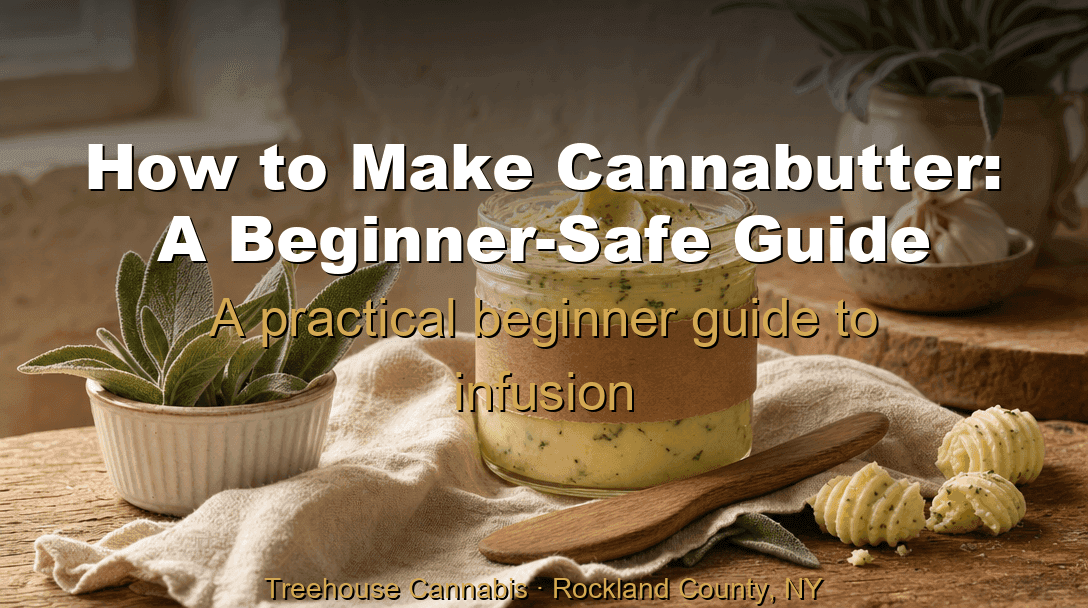
Learning how to make cannabutter at home comes down to two safe stages: decarboxylate the flower at 230°F for 40 minutes, then gently infuse it into butter over a double boiler for 2–3 hours. Done patiently at low heat, the finished butter carries roughly 30–60 mg of THC per tablespoon and can be swapped into any recipe.
This walkthrough is written for first-timers — the kind of person who has never owned an oven thermometer and who would rather not treat the kitchen like a chemistry lab. If that sounds like you, read the whole guide once before turning on a burner.
How to Choose Your First Cannabis Product: A Complete Guide for Beginners
What Is Cannabutter and How Does It Work?
Cannabutter is regular unsalted butter that has been infused with the active compounds in cannabis flower, primarily THC and CBD. THC and CBD are both fat-soluble, which means they bind readily to fatty substances like butter, ghee, coconut oil, or olive oil when gently heated together. The butter acts as a carrier solvent, holding onto the cannabinoids so they can later be delivered through food. Once strained and cooled, the finished butter looks, spreads, and bakes almost exactly like ordinary dairy butter, and it can be swapped into any recipe that calls for it.
What cannabutter is, at a glance:
- Unsalted butter infused with THC and CBD extracted from cannabis flower
- Made by gently heating ground decarboxylated flower in butter for 2–3 hours
- Looks, spreads, and bakes almost exactly like ordinary dairy butter
- A 1:1 swap for regular butter in any recipe that calls for it
The "how" of how to make cannabutter breaks down into two distinct stages. The first is decarboxylation, which is the controlled heating step that activates the cannabinoids in raw flower. The second is infusion, where the activated flower is simmered in butter for a couple of hours so the fat can pull the cannabinoids out of the plant material. Skipping or rushing either stage is what produces weak, harsh-tasting, or unpredictably strong batches, so it pays to understand both before measuring anything out.
Why Do You Need to Decarboxylate Cannabis First?
Raw cannabis flower does not actually contain much active THC. What it contains is THCA, the acidic precursor that converts into THC only when exposed to heat. The chemical conversion is called decarboxylation, and it is non-negotiable for any edible you plan to eat. Skip the heat step and you are essentially making herb-flavored butter that has very little psychoactive effect.
What decarboxylation does to a batch:
- Converts inactive THCA into active THC
- At 110°C (230°F), THCA approaches zero in roughly 30 minutes
- At 130°C (266°F), the same conversion takes only about 9 minutes
- Above roughly 160°C, THC begins degrading into the heavier cannabinoid CBN
- Skipping the step leaves you with herb-flavored butter that has little psychoactive effect
The science behind the conversion has been mapped out in a peer-reviewed study published in PMC, where researchers tracked THCA-to-THC conversion at several controlled oven temperatures [2]. Their key finding was that at 110°C (230°F), THCA approaches zero in roughly 30 minutes, while at 130°C (266°F) the same conversion takes only about 9 minutes. Above 145°C (293°F), the conversion is fast but the window for error narrows sharply. Health Canada's clinician reference confirms that complete THCA-to-THC decarboxylation has been observed across a wide range of 98°C to 200°C [4], giving home cooks plenty of safe targets to choose from.
How Long Does Weed Stay Fresh?
What's the Safest Temperature and Time for Decarbing at Home?
For a beginner, the practical answer is simple: 230°F (110°C) for 40 minutes. That target is widely recommended by Project CBD as a fully activating yet gentle decarb setting [3], and it sits squarely inside the safe zone established by the peer-reviewed kinetic study. The Treehouse Cannabis decarb guide translates that same study into a kitchen-ready chart [6], which makes it easy to see why the lower-and-longer option tends to produce a better-tasting batch than a hotter-and-faster one.
A quick comparison of the home-safe options:
| Temperature | Time | Result |
|---|---|---|
| 230°F (110°C) | 40 minutes | Default beginner target — full THCA conversion with minimal terpene loss |
| 250°F (121°C) | 20–30 minutes | Faster option that still preserves most of the flavor |
| 250°F+ approaching 300°F | — | Increasingly risky — THC begins degrading into CBN, which produces a heavier, sleepier effect |
| 300°F and above | — | Hard ceiling — cannabinoids burn off and terpenes turn acrid |
The single most useful piece of equipment for this stage is a cheap oven thermometer. Independent tests consistently show that residential ovens drift by 10–25°F from the number on the dial, which is the difference between a properly decarbed batch and one that has either under-converted or scorched.
Oven thermometer tips for a reliable decarb:
- Place the thermometer inside the oven while it preheats, then trust the reading over the dial.
- Spot-check the thermometer at 5-minute intervals once the oven has stabilized.
- Replace any thermometer that has been dropped or stored in a hot car, since the calibration drifts.
A Guide to Terpenes and Their Effects
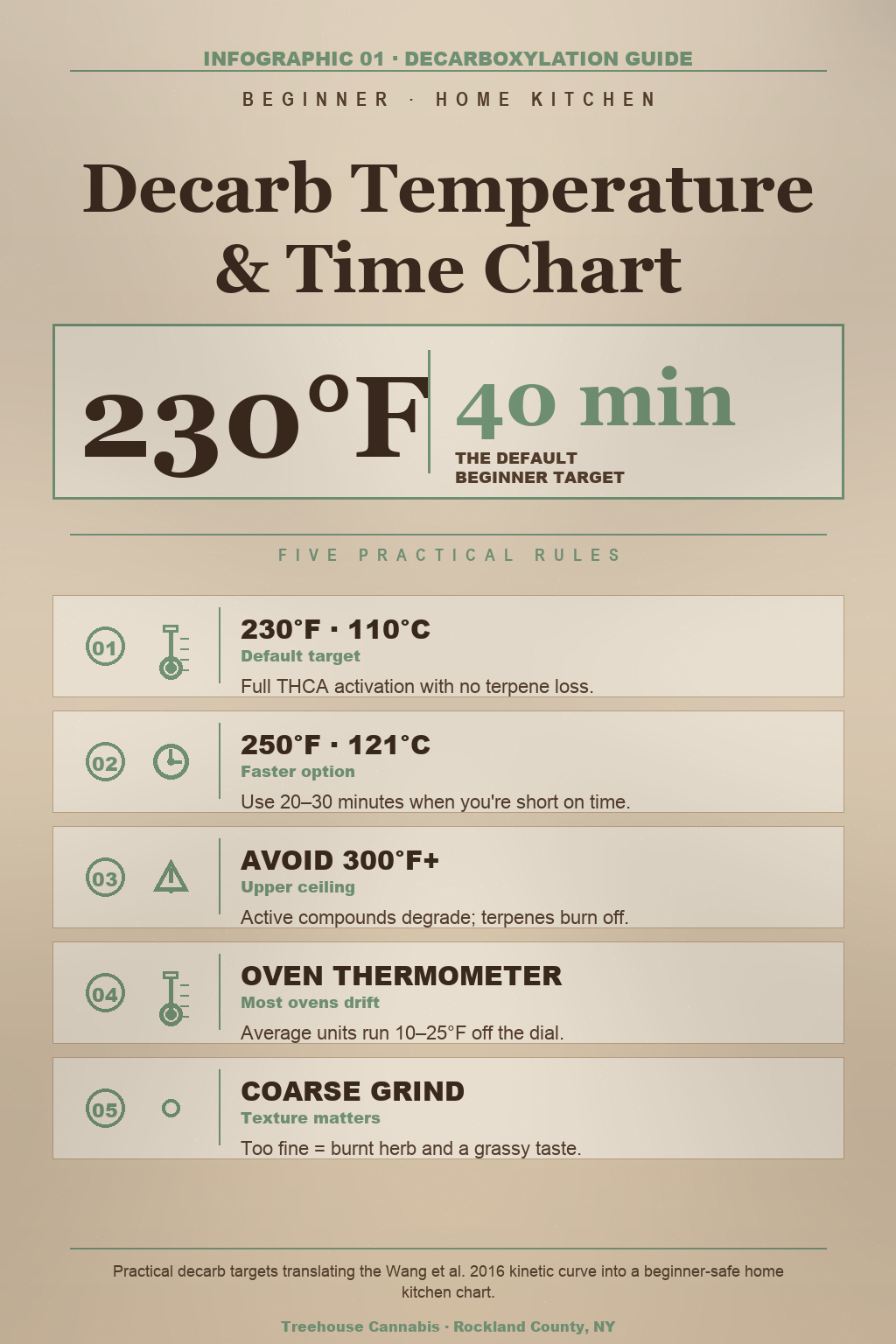
Grind the flower coarsely, somewhere between the texture of coarse sand and small peppercorns. A powder-fine grind burns at the edges and pulls bitter chlorophyll into the finished butter, while an overly chunky grind does not decarb evenly. Spread the ground flower in a single layer on a parchment-lined baking sheet, cover loosely with foil, and slide it into the preheated oven. The foil tent keeps terpenes from venting out, which preserves the aroma and flavor of the finished batch.
How Do You Make Cannabutter on the Stovetop (Step by Step)?
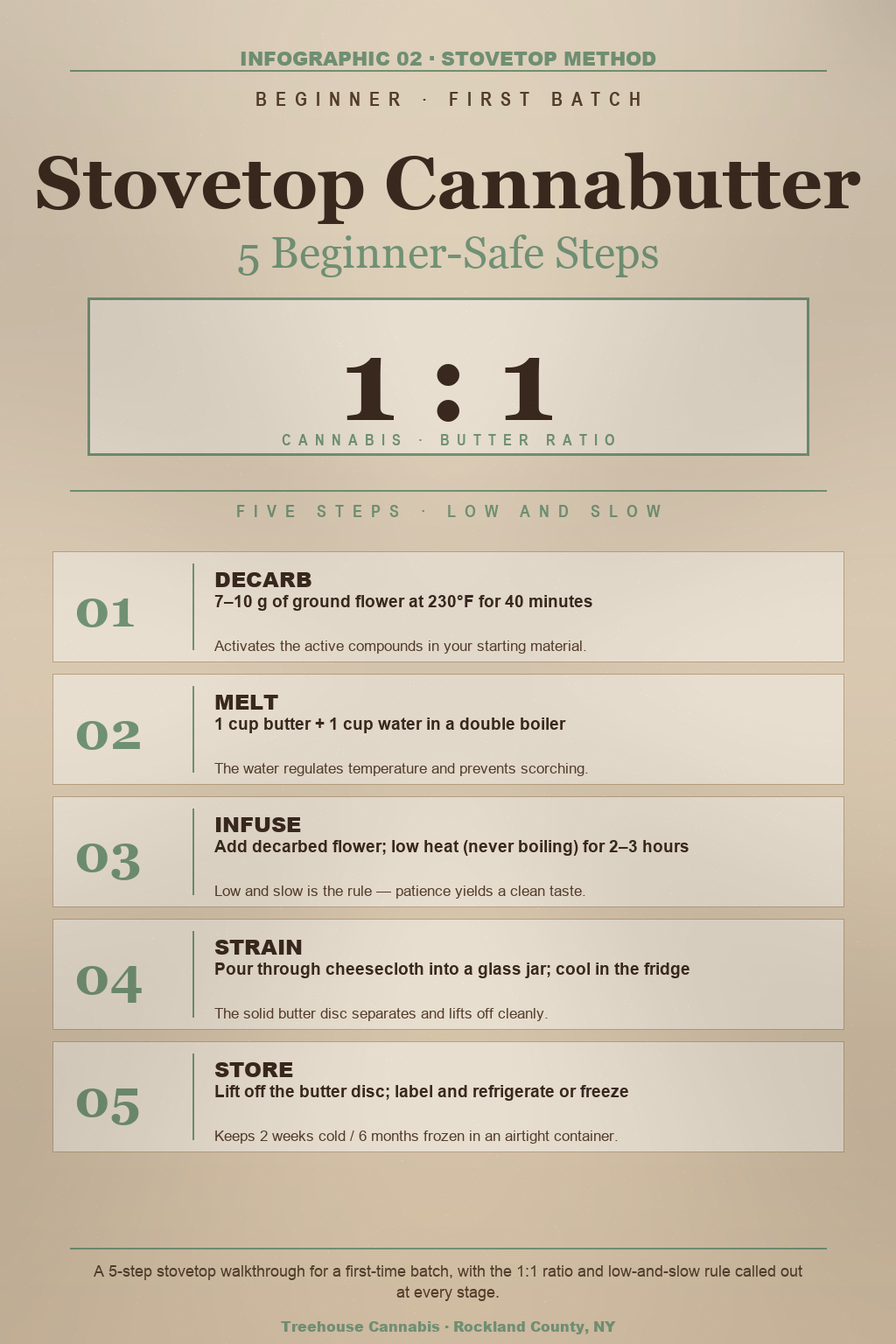
The stovetop double-boiler method is the most forgiving setup for a first-time cook because the water bath regulates the temperature and prevents the butter from scorching. You will need a medium saucepan, a heat-safe mixing bowl that nests over the saucepan without touching the water, a wooden spoon, a fine mesh strainer or several layers of cheesecloth, and a glass jar for the finished product. Most beginner recipes start with a 1:1 ratio: 1 cup of butter to 1 cup of water, infused with 7–10 grams of decarbed ground flower. Flower
A reliable beginner batch, broken into safe steps:
- Decarb 7–10 grams of ground flower at 230°F for 40 minutes and let it cool slightly.
- Add 1 inch of water to a saucepan and bring it to a bare simmer; nest a heat-safe bowl over the top.
- Add 1 cup of unsalted butter to the bowl and let it melt fully, then stir in the decarbed flower.
- Maintain the simmer for 2 to 3 hours, stirring every 20–30 minutes; never let the mixture boil.
- Strain the mixture through cheesecloth into a glass jar, press out the liquid, and refrigerate overnight.
The "never boiling" rule is the most important one. Boiling butter separates the milk solids, burns the cannabinoids, and produces a thin, harsh-tasting oil. A gentle, lazy-bubble simmer for 2–3 hours is enough to fully bind the cannabinoids to the fat without degrading them. After the overnight rest, the butter will have re-solidified into a pale green disc on top of the cooking water; lift the disc off, pat it dry, and discard the water underneath.
How Strong Is Homemade Cannabutter and How Much Should a Beginner Eat?
A standard 1:1 batch — 1 cup of butter infused with 7–10 grams of flower at roughly 15–20% THC — typically yields about 30–60 mg of THC per tablespoon of finished butter [1]. That number is an average, not a guarantee. The actual potency of any batch depends on the strength of the starting flower, how thoroughly the material was decarbed, how long the infusion ran, and how efficiently the butter bonded with the cannabinoids. Two batches made from the same starting material can easily differ by 20–30% in their final THC content.
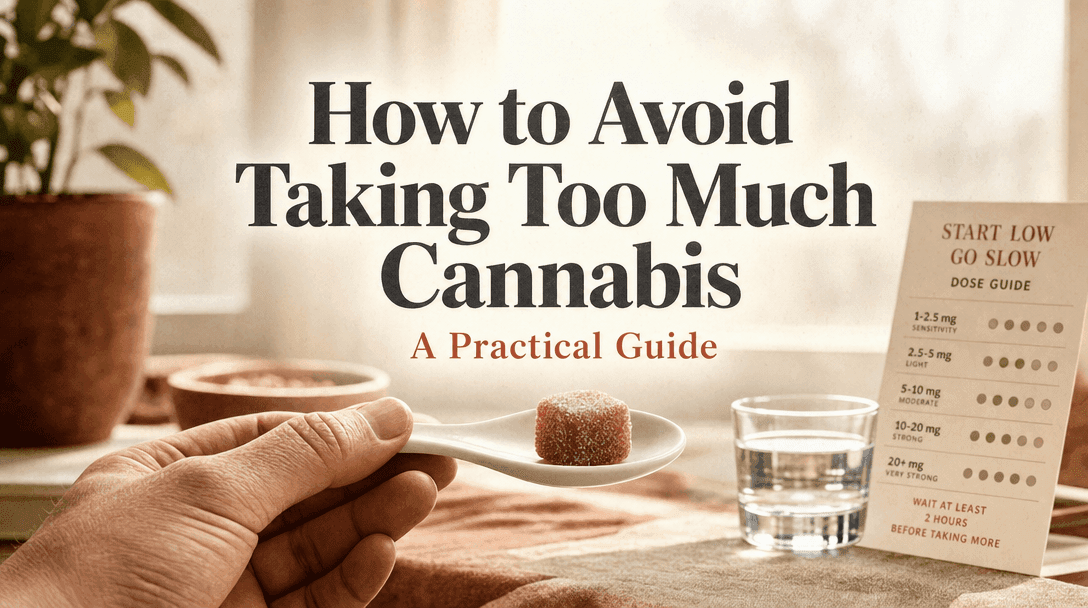
For beginners, the rule of thumb is to treat homemade edibles with extra respect. Consumer guidance from the New Jersey Cannabis Regulatory Commission recommends that new users start with a low dose and wait to feel the full effects before taking more [5]. The same guidance notes that edible onset typically runs 45 minutes to 2 hours, which is much slower than inhaled cannabis and is the single most common reason people over-consume on a first try. Edible effects generally last 4–8 hours, with the strongest window landing somewhere between 2 and 4 hours after eating.
A practical first-time plan:
- Start with a 2.5–5 mg THC serving, which translates to roughly 1 teaspoon or less of finished butter per portion.
- Eat on a light, balanced snack rather than an empty stomach to slow absorption and smooth the curve.
- Wait a full 2 hours before considering more; the peak often lands later than expected.
- Do not stack doses with inhaled cannabis; the two routes produce different effect profiles.
- Label every portion clearly so a guest never mistakes a homemade edible for a regular baked good.
If math and patience feel like too much friction, the simpler route is to skip homemade infusion entirely and start with a store-bought edible that has a labeled milligram dose. Pre-dosed gummies, mints, and chocolates make it easier to track exactly how much THC you have consumed, which is the safest path for any beginner.
How Should You Store Homemade Cannabutter Safely?
Cannabutter stores almost exactly like regular butter, but with two important differences: it must always be clearly labeled, and it must always be kept out of reach of anyone who does not know what is in it. Once strained and cooled, transfer the butter to a clean glass container, write the date and the approximate THC content per teaspoon on a piece of masking tape, and stick it on the lid. A refrigerator will keep the butter fresh for up to 2 weeks; a freezer will hold it for up to 6 months with no meaningful loss of potency. Storage Containers Accessories
Storage best practices for any home infusion:
- Use opaque or amber glass containers to block light, which slowly degrades cannabinoids.
- Keep the butter toward the back of the fridge where the temperature is most stable.
- Freeze finished portions in ice cube trays so each cube is a single serving you can thaw on demand.
- Store the jar separately from regular butter, ideally in a locked box or a high cabinet.
- Keep a written log of the date made, the starting material, and the rough potency per teaspoon.
For readers who would rather not worry about refrigeration cycles or the risk of confusing two butter sticks on a Sunday morning, Treehouse Cannabis carries airtight storage containers designed for infused ingredients, along with dosed edibles that remove the entire infusion step. Browse our Flower menu to see starting material for a future batch, or stop into our Nanuet store for one-on-one guidance on safe beginner dosing.
Frequently Asked Questions
What Is Cannabutter?
Cannabutter is unsalted butter infused with cannabinoids extracted from cannabis flower. THC and CBD are fat-soluble, so gently heating ground decarboxylated flower in butter binds the active compounds to the fat, producing an ingredient you can drop into any recipe that calls for regular butter.
Do You Have to Decarboxylate Cannabis Before Making Cannabutter?
Yes. Raw cannabis flower contains THCA, not active THC, so skipping the decarb step yields weak or inactive butter. The widely cited beginner target is 230–250°F (110–121°C) for 30–40 minutes, which fully converts THCA into THC without burning off terpenes.
What Is the Best Temperature and Time to Decarb Cannabis at Home?
For most home cooks, 230°F (110°C) for 40 minutes is the reliable default. 250°F (121°C) for 20–30 minutes works equally well if you want to save time. Avoid going above 300°F because temperatures at that level begin degrading THC into CBN and stripping the volatile aromatic compounds.
What Is the Easiest Method for First-Time Cannabutter Makers?
The stovetop double-boiler method is the most forgiving for a first batch. Melt 1 cup of butter with 1 cup of water, add 7–10 grams of ground decarbed flower, hold the mixture at low heat for 2–3 hours, and strain through cheesecloth. The water regulates temperature and prevents the butter from scorching.
How Strong Is Homemade Cannabutter?
A standard 1:1 ratio, meaning 1 cup butter to 7–10 grams of flower at roughly 15–20% THC, typically yields about 30–60 mg of THC per tablespoon of finished butter. Potency varies with the strength of your starting flower and how efficiently you infused it, so always dose by milligrams rather than by taste.
How Much Cannabutter Should a Beginner Eat?
Treat any homemade edible as a 5–10 mg THC serving at most, and wait a full 2 hours before taking more. Beginners and anyone returning after a long break should start with 2.5–5 mg to gauge individual response, since edible onset is slower and the effects last longer than inhaled cannabis.
How Long Does It Take for Cannabutter Edibles to Kick In?
Edibles made with cannabutter typically take 45 minutes to 2 hours to peak, and the effect window often runs 4–8 hours. Eating on a full stomach and avoiding redosing before the window closes are the two most reliable ways to keep the experience comfortable.
How Should Homemade Cannabutter Be Stored?
Cool the strained butter quickly, transfer it to a labeled airtight container, and refrigerate for up to 2 weeks or freeze for up to 6 months. Mark it clearly so it is never mistaken for regular butter, and keep it locked away from children, pets, and guests.
Sources
- Leafly — Step-by-step stovetop and slow-cooker cannabutter methods, including a 1:1 canna
- PubMed Central (Wang et al., 2016) — Defines the canonical THCA-to-THC conversion curve: at 110°C conversion approach
- Project CBD — Recommends 230°F (110°C) for ~40 minutes for full THCA activation, the commonly
- Health Canada — Authoritative regulatory source confirming that complete decarboxylation of THCA
- New Jersey Cannabis Regulatory Commission — State guidance that beginners should start with a low THC dose and wait to feel
- Treehouse Cannabis — Translates the Wang et al. peer-reviewed decarb curve into a practical home-kitc
About Treehouse Cannabis
Treehouse Cannabis is an adult-use dispensary serving Rockland County, NY, from our Nanuet store. We carry a curated flower menu, dosed edibles for beginners who would rather not measure milligrams themselves, and the storage accessories that keep a home kitchen organized. Stop in or browse online for one-on-one guidance on safe beginner dosing and starting material.
Cannabis is for adults 21 and older. Keep all cannabis products, including homemade cannabutter and any food made with it, locked away from children, pets, and unsuspecting guests. This article is intended for educational purposes for adult-use customers in New York and does not constitute medical, legal, or professional advice. Effects vary by individual; start low, go slow, and never drive or operate machinery while under the influence of cannabis.

Shop our products

Shop All

Flower

Pre-rolls
Vaporizers

Edibles
Drinks

Concentrates
Tinctures

Topicals

CBD

Pet CBD

Accessories