
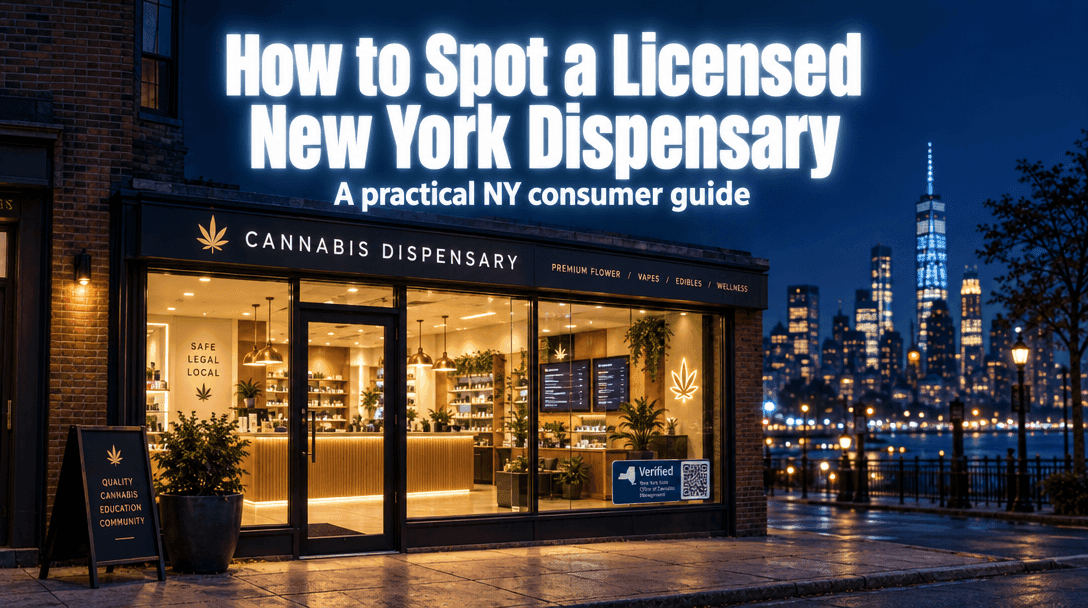
How to Spot a Licensed New York Dispensary
A licensed New York dispensary in 2026 is one of roughly 729 storefronts on the Office of Cannabis Management's official list, identified by three visible cues: the OCM Dispensary Verification Tool posted near the entrance, the New York Universal Symbol on every product package, and an ID check at the door before any sale. The legal framework behind those cues traces back to the Marihuana Regulation and Taxation Act (MRTA), signed March 31, 2021, which created the Cannabis Law and the OCM to regulate the new adult-use market.
For shoppers, the practical question is not whether dispensaries exist - it is whether the storefront in front of you is actually licensed, and OCM has built a public verification system so the answer takes seconds, not guesswork. The rest of this guide walks through that system, the packaging and storefront cues that back it up, and the real consequences of buying from an unlicensed shop instead.
What Does a Licensed New York Dispensary Look Like in 2026?
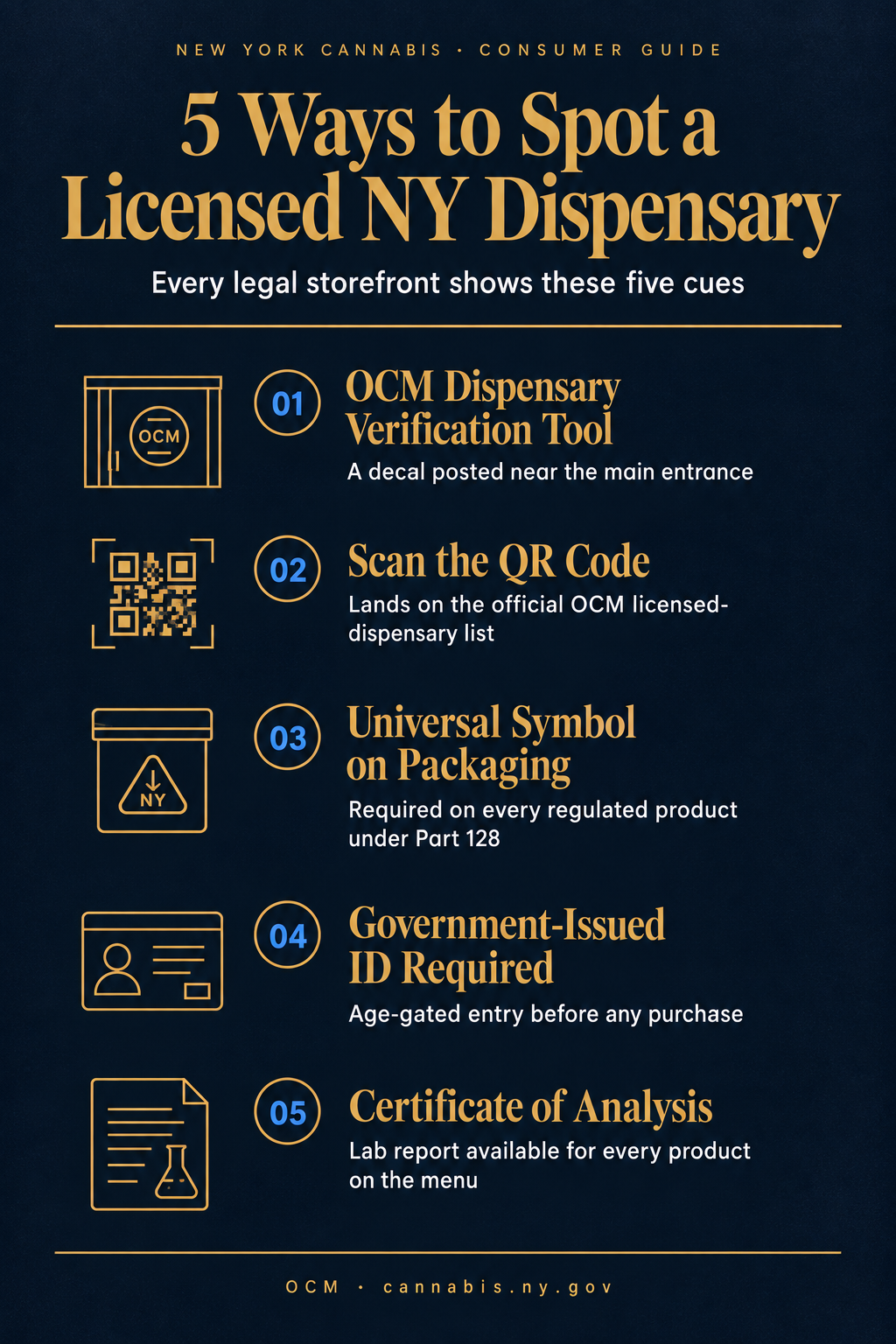
A licensed New York dispensary in 2026 looks like a regulated retail storefront, not a corner smoke shop. The difference comes down to three visible signals: an OCM-issued Dispensary Verification Tool posted near the main entrance, products that carry the New York Universal Symbol on the outermost packaging, and a hard age-gate at the door where staff check a government-issued ID before any purchase is even possible.
That regulated look did not exist before March 31, 2021, when the MRTA created the legal framework for adult-use sales and the OCM to oversee them [7]. The broader history of how the U.S. got here - from prohibition through state-by-state legalization to the MRTA - is laid out in The History and Evolution of Cannabis Laws in the U.S., and the practical day-to-day rules New Yorkers need to know (possession limits, where you can consume, and how to legally possess cannabis at home) are covered in NY Cannabis Possession & Use Rules.
For consumers, the regulated storefront model matters because every product on its shelf has been lab-tested for potency and contaminants, every label is checked against OCM's packaging rules, and the operator can lose its license if any of that slips. An unlicensed storefront can offer none of those guarantees, and the cost of skipping those checks is paid by the buyer, not the seller.
The three things that visually separate a licensed storefront from an unlicensed one:
- An OCM-issued Dispensary Verification Tool decal posted near the main entrance
- Universal Symbol packaging on every product, with a scannable CoA link on the label
- A hard age-gate at the door where staff check a government-issued ID before any purchase
How Do You Use the OCM Dispensary Verification Tool?
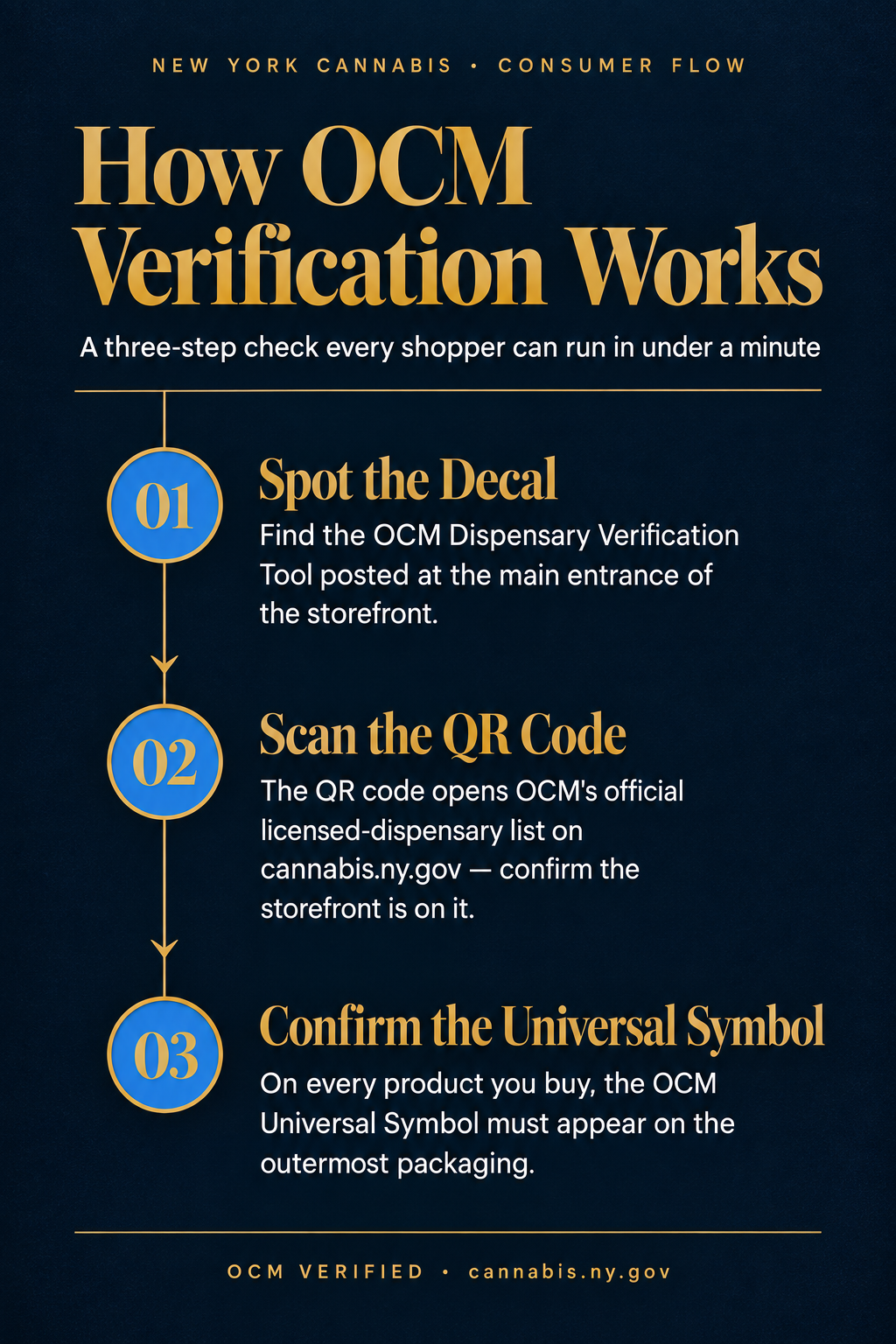
The OCM Dispensary Verification Tool is a window decal or storefront posting every licensed adult-use dispensary in New York must display near its main entrance. Scanning its QR code takes you directly to the OCM's official list of licensed dispensaries, where the storefront's license status is published in real time.
The three-step consumer check OCM recommends is straightforward:
- Spot the Dispensary Verification Tool decal posted at the entrance.
- Scan the QR code with your phone camera.
- Confirm the storefront name and address match the entry on cannabis.ny.gov.
If the storefront is on the OCM list, it is operating under one of the four adult-use license classes authorized to sell to consumers [1] [2]. If it is not, treat the products inside as unregulated regardless of what the menu says. The same rule applies at pop-ups, farmers' market booths, and events - if there is no scannable Verification Tool, there is no OCM license backing the sale.
For delivery customers, the same verification tool is also issued with every legal order, and the OCM list flags any Temporary Delivery Only licensee separately from full retail dispensaries [3]. The tool is a way to confirm a service is authorized, not a stamp that exempts it from oversight. As more adults explore regulated cannabis - including older consumers using it for sleep and wellness, as covered in How Seniors Are Using Cannabis in New York - the verification flow is the simplest way to make sure the product showing up at the door came from a regulated source.
What Is the Universal Symbol and Why Does It Matter?
The Universal Symbol is a New York-specific mark that OCM Part 128 requires on the outermost packaging of every regulated adult-use cannabis product sold in the state. Its job is to signal, at a glance, that the product inside has passed required lab testing and is being sold through the legal supply chain.
What to look for on the outermost packaging:
- The Universal Symbol printed directly on the package, not stickered on afterward
- A matching QR code or web link to that product's Certificate of Analysis (CoA)
- Intact, original brand labeling with matching batch and lot numbers
- OCM-issued warning labels and a "Keep Out of Reach of Children" panel
You will see the Universal Symbol on flower jars, edible wrappers, vape cartridges, and pre-roll tubes, and it has to appear on the outermost layer the consumer opens. If a product on a dispensary shelf is missing the symbol, or if the symbol has been cut, taped over, or printed on a sticker pasted onto otherwise plain packaging, that is a red flag - even at a storefront with a Verification Tool on the door. The symbol is the consumer's fastest check on packaging because it is mandatory, standardized, and printed at the packaging facility, not the dispensary.
The same packaging rule also requires a QR code or web link to the product's Certificate of Analysis, the third-party lab report that lists the actual THC and CBD content and confirms the product passed contaminant testing for pesticides, heavy metals, and microbial impurities [4] [2]. How New York's dispensary system got from a gray-market storefront era to a regulated packaging standard is mapped in The Rise of New York Cannabis Dispensaries in: A Historical Perspective.
The Universal Symbol is the consumer's single fastest check on packaging. The CoA is the deeper check for anyone who wants to know exactly what is in the product and whether the label matches the lab work. Both should be available on every regulated product you buy in New York.
What Other Storefront Cues Confirm a Dispensary Is Legitimate?
Beyond the Verification Tool and the Universal Symbol, several other storefront cues tell you a dispensary is operating under a legitimate OCM license:
- Government-issued ID is checked at the door, and again at the register, before any product is sold.
- Products are kept in original, sealed, branded packaging with intact labels and intact Universal Symbols.
- Staff can produce a Certificate of Analysis for any item on the menu within a minute.
- Receipts include the dispensary's OCM license number and the lot number printed on the product label.
- Pricing is consistent with New York's adult-use excise-tax structure, not the deep-discount pattern common at unlicensed shops.
Only four license classes can legally sell adult-use cannabis to consumers in New York: the Adult-Use Retail Dispensary, the Microbusiness (with retail authorization), the Registered Organization with Dispensing status, and a CSE Permit holder [5]. A storefront running under any other license - a CBD-only license, a hemp license, or no OCM license at all - is not authorized to sell adult-use cannabis, even if it carries cannabis-looking branding.
For anyone shopping a menu that includes accessories - glass, papers, and concentrate tools like the Ari Hot Knife (Misc. Color) - those accessories can be sold at both licensed and unlicensed shops, but a licensed storefront will always carry regulated flower and pre-rolls alongside the accessories, and it will show the Verification Tool at the door. That pairing is the most reliable cue that you are standing in a regulated store, not a smoke shop with a CBD license.
What Happens If You Buy From an Unlicensed New York Store?
Buying from an unlicensed New York store means the product has not been potency-tested or contaminant-tested, the labels may be wrong, and the operator has no license OCM can pull if something goes wrong. Unlicensed vapes in particular have been the source of multiple OCM enforcement actions because untested carts can contain pesticides, vitamin E acetate, or synthetic cannabinoids that never appear on a label.
The consumer-side risks stack up quickly:
- THC content on the label may be off by a factor of two or three in either direction.
- Contaminant testing for pesticides, heavy metals, and mold is not required and usually not performed.
- There is no regulatory body to file a complaint with if a product makes you sick.
- Recalls do not reach unlicensed storefronts because there is no chain of custody to trace.
The enforcement response on the operator side is significant. OCM Enforcement can issue Cease-and-Desist Orders, physically padlock unlicensed storefronts, and pursue civil penalties; the agency has run more than 2,000 inspections statewide, served roughly 500 sealing orders, and seized over $125 million in illicit cannabis to date [6]. Governor Hochul's FY2025 enforcement package raised the maximum civil penalty OCM can assess against an unlicensed storefront to $20,000 per day, and authorized padlock orders for repeat offenders [8].
For consumers, the practical risk is on the product side, not the legal side - adult-use possession is legal in New York, so buying from an unlicensed shop will not get you arrested, but it does mean the THC content on the label may be off by a factor of two or three, and there is no regulatory body you can file a complaint with if the product makes you sick. Shop owners with the right licensing - including New York-rooted brands, which you can sometimes recognize by apparel like New York Wants Weed T-Shirt - are operating in plain sight on the OCM list, and that visibility is exactly what makes their products safer.
How Do You Verify a New York Cannabis Delivery Service?
A licensed New York cannabis delivery service is one run by an OCM-authorized Adult-Use Retail Dispensary or by a separate operator holding a Temporary Delivery Only license, and both show up on the same OCM dispensary list you can search by city or ZIP. The same Verification Tool that decorates a retail storefront is also issued to consumers with every legal delivery order, so the verification process is built into the order itself.
To verify a delivery service before you place an order:
- Confirm the service is listed on cannabis.ny.gov/dispensary-location-verification, and check whether the listing is flagged Temporary Delivery Only.
- Ask the service which license class they operate under - the four legal options are the same four that apply to retail: Adult-Use Retail Dispensary, Microbusiness with retail authorization, Registered Organization with Dispensing, or a CSE Permit holder.
- Expect a government-issued ID check at the door, the same as a retail purchase.
- Expect the driver to hand over the product in sealed, branded packaging with the Universal Symbol visible on the outermost layer.
If a delivery service cannot answer the license-class question, or if it asks you to pay in cash only, meet in a parking lot, or skip the ID check, treat it as unlicensed and do not order [1] [5]. For shoppers building out their accessory kit along with their orders, regulated shops that deliver also stock the basics - pipes, papers, and concentrate tools, including the dab tools collection at Dab Tools Accessories - so a single legal delivery can cover both your regulated flower and your accessories without a separate run to a smoke shop.
Sources
- [1] New York State Office of Cannabis Management — Dispensary Location Verification
- [2] New York State Office of Cannabis Management — Consumers: How can a cannabis purchaser tell if they are buying regulated products?
- [3] New York State Office of Cannabis Management — Adult-Use Cannabis in New York
- [4] New York State Office of Cannabis Management — Part 128: Packaging & Labeling Guidance
- [5] New York State Office of Cannabis Management — Adult-Use Licensing
- [6] New York State Office of Cannabis Management — New York State Cannabis Enforcement
- [7] New York State Office of Cannabis Management — Cannabis Law Overview
- [8] Office of Governor Kathy Hochul — Enforcement Actions Against Unlicensed Cannabis Businesses in Ithaca
About Treehouse Cannabis
Treehouse Cannabis is an adult-use dispensary serving Rockland County, Orange County, and Westchester County from our Rockland County, NY location. We focus on regulated, lab-tested products, transparent dosing information, and cannabis education for adult consumers throughout the Hudson Valley. Browse our current menu, request a delivery, or stop by the store to see the OCM Dispensary Verification Tool posted at the entrance.
Cannabis is for adults 21 and older. Keep all cannabis products out of reach of children. This content is for informational purposes only and is not intended to be a substitute for professional medical advice, diagnosis, or treatment. Always consult a qualified healthcare provider before using cannabis, especially if you are pregnant, nursing, taking medications, or have a medical condition. Possession and use of cannabis are subject to New York State law; please review the latest OCM regulations for current possession limits, consumption rules, and approved consumption areas.
Shop our products

Shop All

Deals

Flower

Pre-rolls
Vaporizers

Edibles
Drinks

Concentrates
Tinctures

Topicals

CBD

Pet CBD

Accessories