How to Spot Old or Poorly Stored Cannabis Products
How to Spot Old or Poorly Stored Cannabis Products
Old cannabis products give themselves away in clusters, not single clues. Faded color, dull trichomes, crumbly texture, and a flat hay-like smell arrive together, because heat, light, and oxygen attack all of them at once. One soft sign is normal in an opened jar; three together mean the product is past its prime.
That is the whole test in miniature. Visible fuzz is the exception to everything above: it means spoilage rather than age, and it never belongs on a shelf. The rest of this guide explains what each check actually measures, what the laboratory numbers say about how fast flower degrades, how to tell a dry bud from a spoiled one, and what a customer in New York's regulated market can read off a package in about thirty seconds.
What Are the Signs of Old Cannabis?
The signs of old cannabis are faded color, dull matte trichomes, buds that crumble instead of holding their shape, and an aroma that has gone quiet or hay-like. They show up together because the same three forces - heat, light, and oxygen - drive every one of them on the same timeline.
Color is pigment breaking down. Bright green flower fading toward olive, tan, or brown is chlorophyll and other pigments degrading, not a strain trait and not a lighting trick. A flower that was olive on the day it was harvested exists, but a flower that has turned olive in the jar is telling you how long it sat there.
Trichomes are the visible face of the chemistry. Those frosty crystals are resin heads, and when they oxidize and collapse they read dull and matte instead of sparkling. That oxidation is the same process that converts THC into CBN, which is covered in more detail further down.
Texture is moisture. A bud that springs back when you squeeze it still holds enough water to keep its structure. A bud that crumbles into dust has dropped below the point where it holds together at all.
Smell is the volatile fraction leaving. Terpenes evaporate at room temperature, so a jar that has been opened repeatedly loses its sharp strain-specific note before it loses much of anything else - the same relationship that container research has measured directly [6].
Here is the honest threshold, in order of how much each sign matters:
- Color: bright green fading to olive, tan, or brown is pigment breaking down, not a strain trait
- Trichomes: frosty and sparkling means intact resin heads; dull and matte means those heads have oxidized
- Texture: a bud that holds its shape when squeezed is hydrated; a bud that crumbles has lost moisture
- Smell: a sharp strain-specific aroma going flat or hay-like means the volatile terpenes have evaporated
- Threshold: one soft sign is normal in any opened jar, three together means the product is past its prime
- Exception: any visible fuzz, grey-white patches, or musty odor is spoilage, not age - discard it
The same five checks, read three ways:
| Check | Fresh | Faded | Discard |
|---|---|---|---|
| Color | Bright green | Olive or tan | Brown or grey |
| Trichomes | Frosty, sparkling | Dull, matte | Webbed patches |
| Texture | Spongy, holds shape | Crumbles, bone dry | Damp or slimy |
| Smell | Sharp, terpy | Hay, flat | Musty, basement |
| Surface | Clean | Clean | Fuzz or spots |
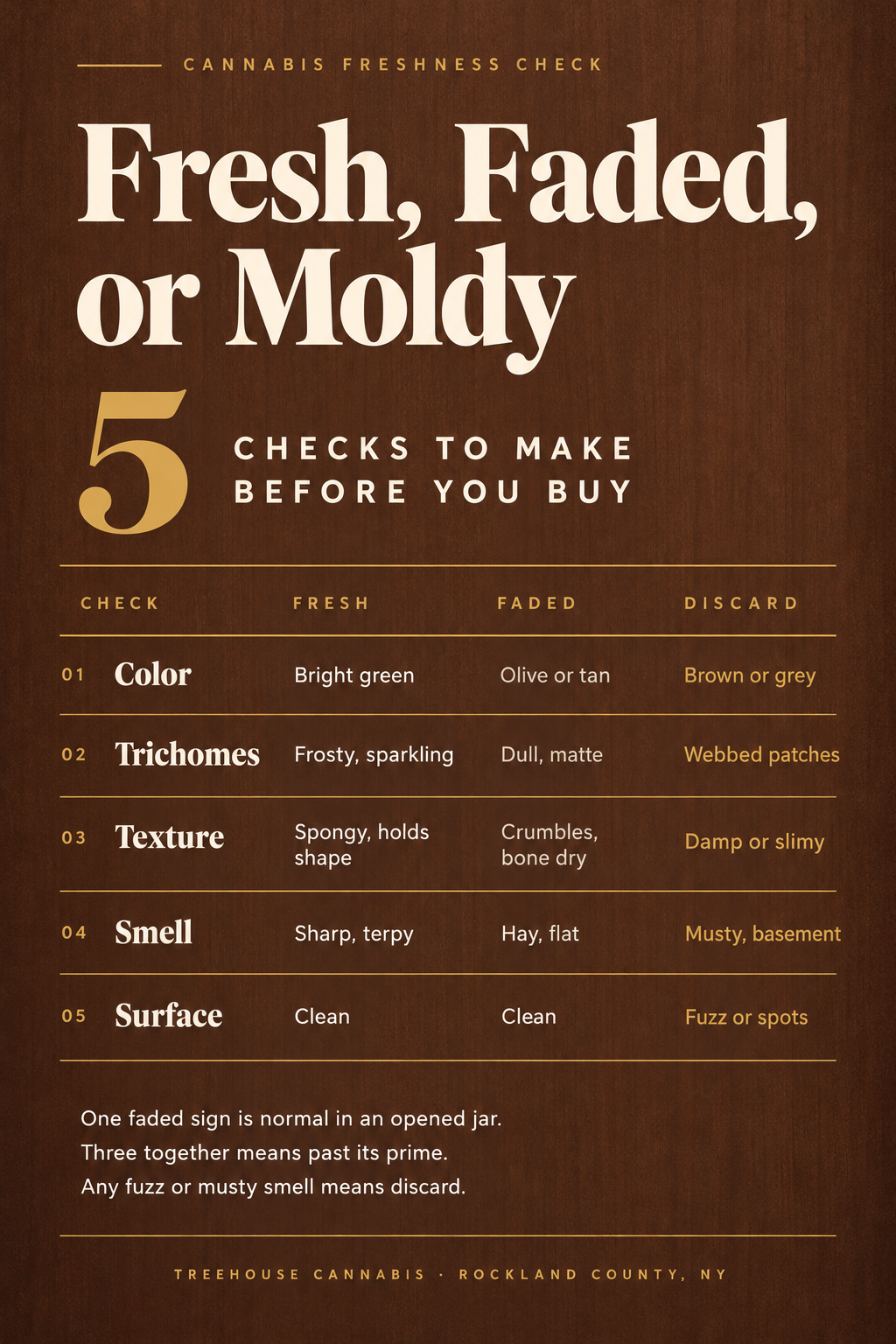
None of these checks is proof on its own, which is the point. A dry bud in a jar that was opened twenty times is old. A dry bud with webbing between the calyxes is something else entirely, and the difference matters more than any of the aesthetic signals [7]. If you want the timeline behind the texture test, How Long Does Weed Stay Fresh? breaks down what happens to flower month by month.
The fastest check at a counter is not visual at all. New York requires regulated retail packaging to carry the expiration date of the unopened product and a lot number, so the package answers the age question before you open anything [1].
What Does Old Cannabis Smell Like?
Old cannabis smells flat, grassy, or hay-like. The volatile terpenes that carry a strain's sharp aroma evaporate first, and what is left is the smell of the plant material itself rather than the profile that was tested.
There are two smells a customer will actually encounter, and they mean opposite things. Flat, hay, or weak-tea is an age and handling smell - nothing is growing in the jar, the aromatic compounds are simply gone. Musty, damp, basement, or dirty-sock is a moisture smell, and it points at fungal growth rather than age [7].
Terpenes are volatile organic compounds, and the container decides how much of that profile survives the trip from harvest to shelf. Comparing three storage containers for dried cannabis inflorescences, researchers found that flower held in a sealed glass bottle kept its original volatile organic compound profile better than flower in an open-to-air dry tray or a closed high-density polyethylene box [6].
That finding matters more than it first appears. It means the smell test is partly a report on the packaging, not only on the flower - two identical batches can read very differently depending on what they were stored in. How to Tell If Cannabis Flower Is Fresh walks through the same checks in the order a budtender would run them.
Aroma also leaves before potency does. Volatile compounds escape at room temperature, while cannabinoid loss is a slower chemical conversion, so a jar can still work while smelling like almost nothing. Smell is a useful signal, and an incomplete one.
What the aroma does tell you reliably:
- Flat, grassy, or hay-like: terpenes have evaporated, and the smell of plant material is what is left
- Weak rather than wrong: a quiet jar can still be potent, because aroma leaves faster than cannabinoids convert
- Musty, damp, or basement-like: moisture plus fungal growth, which is spoilage rather than age
- Container matters: sealed glass retained the original volatile profile better than an open tray or a plastic box
- Water activity is the underlying variable - mold cannot develop in cannabis that is dry enough
- If the smell is ammonia-like or sour, treat the product as spoiled and do not use it
That last point is worth repeating in plain terms. Quiet means old. Sour, damp, or ammonia-like means spoiled, and spoiled is a different category of problem.
If the flower is going to sit wrapped for a while before someone opens it, Cannabis Holiday Gifts 2026: The Complete Buyer's Guide covers how to choose a package that will still smell right when it is unwrapped.
Why Does Old Cannabis Make You Sleepy?
Old cannabis reads as weaker and heavier because THC oxidizes into cannabinol, or CBN, a far less intoxicating cannabinoid associated with a flatter, heavier feel. Aged flower is not stronger flower. It is depleted flower with a different cannabinoid ratio.
THC converts to CBN by oxidation, and a four-year controlled storage study found the reaction follows first-order kinetics. That means the pace depends on how much THC is left rather than on a fixed schedule, so the change is fast when the flower is fresh and slow when it is already mostly converted [4].
The size of the shift is large. In one analysis of 150 cannabis resin samples held in dark, dry rooms at 20 to 25 degrees Celsius for up to eight years, THC fell from 35.16 percent in fresh material to 0.44 percent by year eight. CBN peaked at 6.94 percent at two years and then declined [5].
That peak is the part most people get wrong. CBN itself degrades further, so a very old sample is not a CBN product - it is a sample with almost nothing left in it. The window where CBN is meaningfully elevated is a couple of years, not a decade.
Heat is the accelerator. CBN formed roughly three times faster at 30 degrees Celsius than at 4 degrees Celsius in a 360-day study of cannabis trimmings [3]. Only storage at minus 20 degrees Celsius prevented significant breakdown over four years, which means a room-temperature shelf loses measurable potency no matter how carefully everyone handled the product [4].
The mechanics, in order:
- The conversion: THC oxidizes into cannabinol, and the reaction follows first-order kinetics, so its pace tracks how much THC remains
- The size of the shift: THC fell from 35.16 percent in fresh material to 0.44 percent by year eight in one controlled analysis
- The CBN curve: CBN peaked at 6.94 percent at two years and then declined, so very old material is depleted rather than enriched
- Heat accelerates it: CBN formed roughly three times faster at 30 degrees Celsius than at 4 degrees Celsius
- Cold slows it but does not stop it: only minus 20 degrees Celsius prevented significant breakdown over four years
- What it means for you: aged flower feels flatter and heavier, not stronger, and it is not a sleep product
That last line is the one worth being blunt about. This is chemistry, not a health benefit. Aged flower is not a substitute for a product formulated and tested for a specific purpose, and a jar that went sleepy because it sat on a shelf is not a designed outcome.
Readers who came to cannabis later in life - or who are advising someone who did - may find How Seniors Are Using Cannabis in New York useful context on how that crowd approaches the plant.
How Long Does Cannabis Stay Fresh?
Well-stored flower holds peak quality for roughly six months to a year and declines slowly after that, with most of the early loss concentrated in the first month. Past a year, the change is real but gradual, which is why an old jar is usually disappointing rather than dramatically different.
The measured checkpoints come from different studies with different starting material, so treat them as separate observations rather than one continuous curve. From a 360-day storage study of cannabis trimmings, total potential THC fell 11.83 percent on average by day 30 and 34.6 percent by day 360 [3].
From the analysis of 150 resin samples stored in dark, dry rooms at 20 to 25 degrees Celsius, THC loss reached 16.6 percent after one year and 41.4 percent after four years. The same literature uses the THC-to-CBN ratio as an indicator of how long a sample has been stored, which is effectively a chemical clock [5].
From the four-year controlled study reviewed by Project CBD, only minus 20 degrees Celsius prevented significant breakdown, and ordinary refrigeration at 4 degrees Celsius was not enough [4].
The practical shape of that data:
- The window: roughly six months to a year at peak quality, then a slow decline
- Day 30: 11.83 percent of total potential THC already gone in the 360-day trimmings study
- Day 360: 34.6 percent lost over the same year of storage
- Year one to year four: 16.6 percent loss at one year and 41.4 percent at four years in resin stored at room temperature
- The curve flattens: most early loss happens in the first month, so age does not scale linearly
- What shortens it at home: heat, light, air, and repeated opening all accelerate the same reactions
The asymmetry is the useful takeaway. The first month does a lot of the damage, then the curve flattens into a slow decline - a two-year-old jar is not twice as bad as a one-year-old jar. Heat, light, air, and repeated opening are what push those same reactions faster in a real home [3].
Practically, that argues for buying amounts you will finish. Treat the printed expiration date as the ceiling rather than the goal, and expect a jar opened a dozen times to age faster than one opened twice. When you are restocking, the Flower category turns over fastest of anything in a busy store, which is one more reason to check dates there.
What Does Mold on Cannabis Look Like?
Mold on cannabis looks like a flat powdery or fuzzy film, grey-white patches, or fine webbing between buds. It appears in patches rather than coating the flower evenly, and unlike trichomes it does not sparkle.
Gray mold, caused by Botrytis cinerea, produces grey-white masses of mycelium and spores on affected tissue, along with brown water-soaked lesions that turn necrotic. University extension guidance names 65 to 75 degrees Fahrenheit combined with moist or humid conditions as the range most conducive to its growth and dispersal - which is exactly the environment a poorly stored jar creates [7].
The underlying variable is water activity, defined as the relative humidity immediately adjacent to the product. Mold spores cannot develop once cannabis is dry enough, and testing identified 59 to 63 percent relative humidity as the range where dried cannabis properties stay stable [9]. A jar that is too damp is the actual problem. A jar that is too dry is a different and lesser problem.
The distinction between mold and trichomes is the check most people fumble:
- What it looks like: flat powdery or fuzzy film, grey-white patches, or webbing between buds, in patches rather than evenly
- How to tell it from trichomes: trichomes glisten and sparkle on the surface, mold is dull, clumpy, and sits in the crevices
- The conditions that cause it: Botrytis cinerea favors 65 to 75 degrees Fahrenheit combined with moist or humid air
- The prevention number: mold spores cannot develop once cannabis is dry enough, and 59 to 63 percent relative humidity is the stable range
- Why it is a discard: cannabis is commonly contaminated with fungi, heat does not reliably destroy spores, and trimming around a patch is not a fix
- Who should be most careful: guidance advises people on chemotherapy or substantial immunosuppression not to smoke cannabis at all
Read side by side, the difference between the two is hard to miss:
| Feature | Trichomes | Mold |
|---|---|---|
| Appearance | Glistening and crystalline | Flat, powdery, or fuzzy |
| Distribution | Even across the surface | In patches, in crevices, or as webbing |
| Reaction to light | Sparkles and reflects | Dull, absorbs light |
| Smell | Strain-specific and sharp | Musty, damp, basement-like |
| Verdict | Normal plant anatomy | Discard the product |
That last point comes from the published literature rather than from any product label. A peer-reviewed case report and review of chronic pulmonary aspergillosis documents the condition in two long-term marijuana smokers, notes that both tobacco and marijuana are commonly contaminated with fungi, and advises that people on chemotherapy or substantial immunosuppression should not smoke marijuana [8].
So the rule is simple and does not bend. Visibly moldy cannabis is a discard, not a salvage job. Heat does not reliably destroy fungal spores, trimming around a patch does not make the rest safe, and there is no home test that turns a fuzzy bud into a usable one.
A pre-roll has the same exposure in a smaller package with more cut surface, which is why the Pre_rolls page is worth a look before you commit to a multi-pack.
How Do You Check Cannabis Freshness Before You Buy?
In New York's regulated market you check three things printed on the package: the expiration date, the lot number, and the storage instructions. State rules require all three, and the expiration date is the fastest honest signal available at the counter.
Part 128 packaging and labeling guidance requires retail cannabis packaging to be sealed to protect the product from oxygen exposure, contaminants, and degradation. It also requires the retail package or marketing layer to carry the expiration date of the unopened product, a lot number, and the proper storage conditions [1].
What the expiration date actually certifies is narrower than most people assume, and more useful. State consumer guidance notes that cannabis can change when exposed to air or other contaminants, so a product's Certificate of Analysis will not stay accurate forever, and it directs consumers to use the expiration date to judge whether the CoA still applies [2].
Read that again, because it is a sharper claim than "this is still good." The date tells you when the lab result stopped describing the contents in the package. A batch tested at 24 percent THC in March is not a promise about the same jar in December.
The lot number is what makes the claim checkable. It ties your package to a specific batch and a specific test, which is how a potency figure on a label becomes something you can trace rather than something you accept.
The storage line is a manufacturer instruction about temperature, light, and moisture, and it is worth following for a reason people miss: the expiration date was calculated against those conditions. Store the product somewhere else and the date no longer describes your situation [2].
What you can reasonably do:
- Expiration date: required on the retail package, and it marks when the product's lab result stopped describing the contents
- Lot number: ties the package to a specific batch and test, which makes the label claim checkable
- Storage instructions: printed on the package, and the expiration date was calculated against those conditions
- Sealed packaging: the rule exists to protect the product from oxygen, contaminants, and degradation before it reaches you
- Ask at the counter: request the date on the package, and choose the fresher lot when two are on the shelf
- Keep the original package: child-resistant and labeled beats decanted into an unlabeled jar
Two habits carry most of the value. Ask to see the date before the package goes in the bag, and when two lots of the same product are on the shelf, take the fresher one. Then keep the flower in the original child-resistant package instead of decanting it into an unlabeled jar where the date and lot number disappear.
Not everything on a dispensary shelf ages, of course. The New York Wants Weed T-Shirt does not care how long it has been in the case.
How Should You Store Cannabis to Keep It Fresh?
Airtight glass in the dark at a steady cool temperature, with humidity held around 59 to 63 percent, is the setup the published evidence supports. The refrigerator is the wrong answer for flower you open daily.
Container comes first, because it decides how much of the aroma you paid for survives. Comparing three storage containers for dried inflorescences, sealed glass retained the flower's original volatile organic compound profile better than an open-to-air dry tray or a closed high-density polyethylene box [6].
Light is the cheap fix most people skip. Across storage temperatures, amber jars retained 11.6 percent more delta-9 THC on average than clear jars [3]. That is a free improvement for anyone currently storing flower in a clear jar on a windowsill or a counter.
Temperature is the multiplier. CBN formed about three times faster at 30 degrees Celsius than at 4 degrees Celsius [3], and only minus 20 degrees Celsius prevented significant breakdown over four years [4]. A warm shelf is a slow loss. A hot car is a fast one.
Moisture is the line between faded and spoiled. Water activity is the relative humidity immediately adjacent to the product, mold spores cannot develop once cannabis is dry enough, and 59 to 63 percent relative humidity is the range where dried cannabis properties stay stable [9].
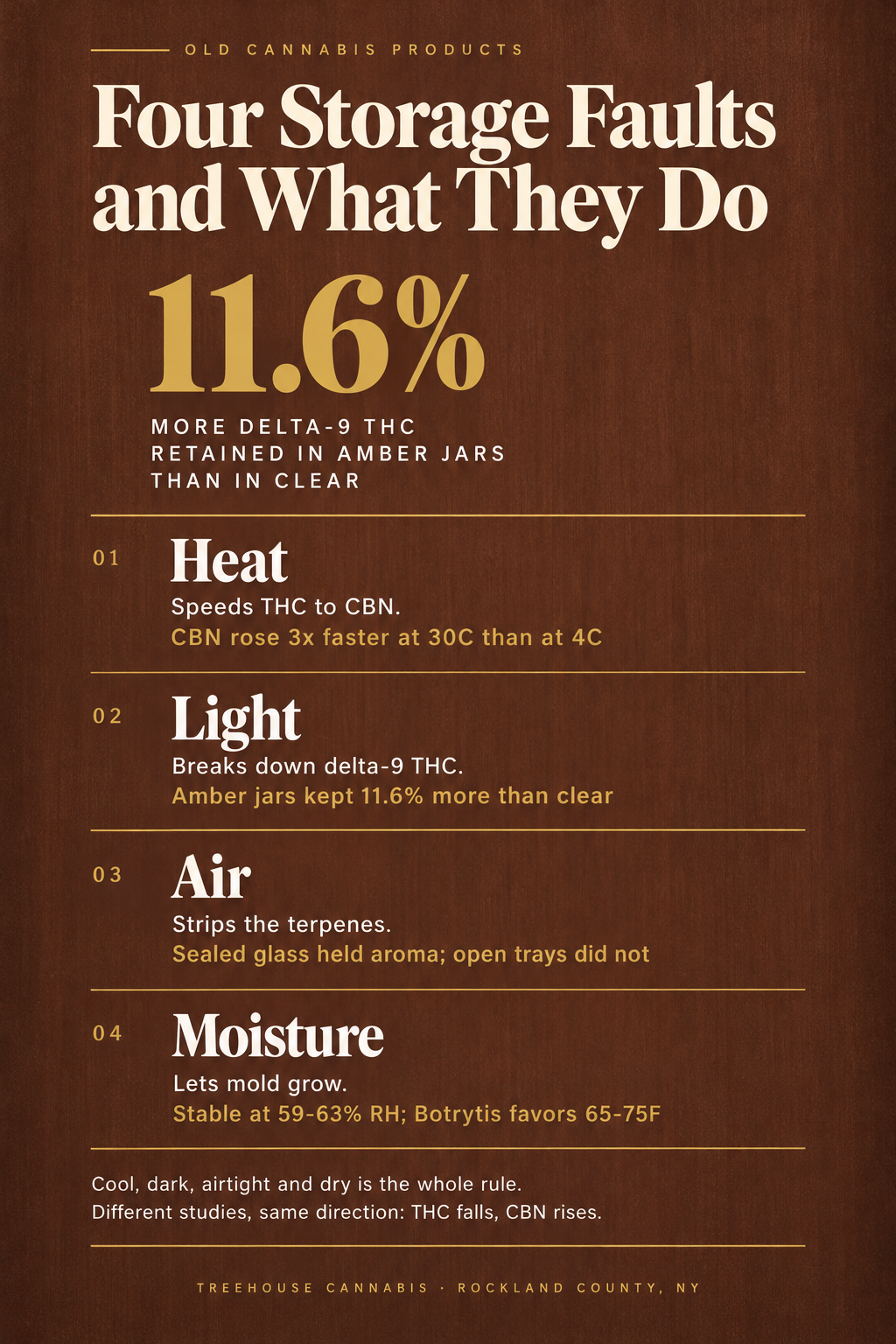
The order of operations:
- Container: sealed glass kept the original aroma profile better than an open dry tray or a closed plastic box
- Light: amber jars retained 11.6 percent more delta-9 THC on average than clear jars
- Heat: CBN formed about three times faster at 30 degrees Celsius than at 4 degrees Celsius
- Humidity: 59 to 63 percent relative humidity is the range where dried cannabis stays stable, and mold cannot develop below it
- Skip the fridge for daily flower: 4 degrees Celsius was not enough to stop breakdown, and every opening causes a humidity swing
- Follow the package: keep it in the original child-resistant container and use the storage instructions printed on it
The fridge deserves its own paragraph because it sounds like good advice. Refrigeration at 4 degrees Celsius was not enough to prevent breakdown in the four-year study [4], and every time you open a cold jar you pull it into warm humid air, which is a worse condition than a stable cupboard. Freezing has the same condensation problem at home - the studies used controlled conditions, not a kitchen freezer.
One instruction overrides all of this preference. Follow the storage line printed on the package, in the original child-resistant container, because that is the condition the expiration date was written against [2]. For the equipment side of the routine, the Trays Accessories section covers the rest.
What Are the Five Cannabis Freshness Checks Worth Making?
Five checks, thirty seconds. Color, trichomes, texture, smell, and the date printed on the package. One faded sign is normal in a jar that has been opened; three together means the product is past its prime; any fuzz, webbing, or musty smell means it is a discard.
- Color: bright green is fresh, olive or tan is faded, brown or grey is past it
- Trichomes: frosty and sparkling is intact resin, dull and matte is oxidized
- Texture: spongy and springy is hydrated, crumbling and bone dry is old
- Smell: sharp and terpy is fresh, hay or flat is faded, musty or sour is spoiled
- Date: the expiration date on the package is the fastest check available at a counter
- Surface: fuzz, grey-white patches, or webbing is spoilage, and no amount of trimming fixes it
Everything else in this guide explains why those five checks line up. Heat speeds the THC-to-CBN conversion, light breaks down delta-9 THC, air strips the terpenes, and moisture lets mold in - four faults, one direction.
Store flower cool, dark, airtight, and dry, buy amounts you will actually finish, and read the date before the package goes in the bag. Treehouse Cannabis in Rockland County, NY labels every product with its lot and expiration date, keeps flower in sealed, light-blocking packaging, and will pull a package so you can read the date before it goes in the bag. Browse the shelf or order online for pickup and delivery across Rockland, Orange, and Westchester Counties.
Frequently Asked Questions
How can you tell if cannabis is old?
Old cannabis usually shows several signs at once: color fading from green to olive, tan, or brown; trichomes that look dull and matte instead of frosty; buds that crumble instead of holding shape; and an aroma that has gone quiet or hay-like. One soft sign is normal. Three together means the product is past its prime.
What does old cannabis smell like?
Terpenes are volatile, so aged flower loses its sharp strain-specific smell first and takes on a flat, grassy, or hay-like note. That hay smell comes from residual plant material once the aromatic compounds have evaporated. A musty, damp, or basement-like smell is different and worse: it points to moisture and fungal growth, not just age.
Can you smoke old weed?
Usually yes, if it is only dry and faded. Expect a harsher, thinner smoke and a weaker effect, because THC has partly converted to CBN. Do not smoke cannabis with visible fuzz, grey or white patches, or a musty odor. Heat does not reliably destroy fungal spores, so moldy flower is a discard.
Why does old weed make some people sleepy?
As cannabis ages, THC oxidizes into cannabinol, or CBN. CBN is far less intoxicating and is associated with a heavier, more sedating feel, so aged flower often reads as weaker and sleepier than the same batch did when fresh. That shift is gradual and happens faster with heat, light, and air exposure.
How long does cannabis stay fresh?
Well stored flower holds up for roughly six months to a year at peak quality and declines slowly after that. Laboratory data shows total potential THC dropping about 12 percent by day 30 and about 35 percent by day 360, with most of the early loss concentrated in the first month.
What is the best way to store cannabis to keep it fresh?
Airtight glass in the dark, at a steady cool temperature, with humidity held around 59 to 63 percent. Glass outperformed open trays and plastic boxes for retaining aroma in published comparisons, and amber or opaque containers beat clear ones for THC retention. Skip the refrigerator for daily flower: repeated openings cause humidity swings.
What does mold on cannabis look like?
Mold looks like a flat powdery or fuzzy film, grey-white patches, or webbing between buds, and it tends to appear in patches rather than coating the flower evenly. Trichomes glisten and sparkle; mold is dull and clumpy. Any visible fuzz plus a musty smell means the product should be thrown out.
Should you check the expiration date before buying cannabis?
Yes. New York requires the expiration date of the unopened product, a lot number, and proper storage conditions on regulated retail packaging, and state guidance says the expiration date is how you judge whether the Certificate of Analysis still applies. That date is the single fastest freshness check available at the counter.
Sources
- New York State Office of Cannabis Management (OCM) — New York's Part 128 packaging and labeling rules require that retail cannabis pa
- New York State Office of Cannabis Management (OCM) — This OCM consumer fact sheet states that cannabis can change when it is exposed
- Anresco Laboratories — In this 360-day laboratory study of cannabis trimmings stored at 4, 22, and 30 d
- Project CBD — Project CBD's review of a four-year Italian study of hashish and marijuana store
- Scientific Reports (Nature) / National Library of Medicine — This analysis of 150 cannabis resin samples stored in dark, dry rooms at 20 to 2
- Analytical and Bioanalytical Chemistry (Springer) / National Library of Medicine — Comparing three storage containers for dried cannabis inflorescences, this study
- NC State Extension, North Carolina State University — This university extension publication describes gray mold, caused by Botrytis ci
- Mediterranean Journal of Hematology and Infectious Diseases / National Library of Medicine — This peer-reviewed case report and literature review documents chronic pulmonary
- Cannabis Industry Journal — This trade report explains water activity as the relative humidity immediately a
About Treehouse Cannabis
Treehouse Cannabis is a licensed adult-use dispensary in Rockland County, New York, serving customers across Rockland, Orange and Westchester Counties. This article is intended for adults 21 and older in New York State and explains how to tell fresh cannabis from faded or spoiled cannabis; it is not medical advice.
Cannabis is for adults 21 and older. Keep all cannabis products out of reach of children and pets, and never drive under the influence. This article is educational and is not medical advice. Product availability varies by location and is subject to New York State regulations.

Shop our products

Shop All

Deals

Flower

Pre-rolls
Vaporizers

Edibles
Drinks

Concentrates
Tinctures

Topicals

CBD

Pet CBD

Accessories