Bubble Hash Explained: Ice Water Extraction Without the Hype
Bubble Hash Explained: Ice Water Extraction Without the Hype
Bubble hash is cannabis resin separated with ice, water, and mesh instead of a solvent. The trichome heads freeze, snap off the plant, ride the water through a stack of screens, and get sorted by size. Nothing dissolves at any point, and the equipment is a bucket, a bag set, and ice.
The method is genuinely old and genuinely simple, and a fair amount of what gets sold as craft hash is ordinary resin in better packaging. What follows is the process, the numbers on the bags, and the signals that mean something at a counter.
What Is Bubble Hash, Exactly?
Bubble hash is solventless cannabis concentrate: resin-bearing trichome heads knocked off the plant in ice water, then sorted by size through a stack of mesh bags. Water carries the resin, screens separate it by diameter, and there is no solvent step to purge.
The mechanics start with the plant. Cannabis flowers carry microscopic, mushroom-shaped glandular trichomes, and those heads are where the plant's cannabinoids are produced [1]. Scanning electron microscopy of high-THC genotypes measured glandular heads at roughly 40 to 110 micrometers across [4]. That measurement is why a stack of bags can sort resin at all: the heads are objects of a known size, and the bags are holes of a known size.
A review of cannabis processing describes solventless production as filtering trichomes through a series of screens, then letting the material settle before collection and drying, and it names the result water hash or bubble hash [2]. Leafly's glossary describes the same sequence from the plant's end: the resin glands freeze and break away from the flower, pass through screens, and the plant material stays behind [6].
The name does not come from the wash water fizzing. Bubble hash is named for how the resin behaves under heat, bubbling and liquefying as trapped moisture escapes [6].
Potency claims deserve a hedge. Federal data puts non-solvent cannabis concentrates at roughly 39 to 60 percent THC, against 54 to 69 percent for solvent-based concentrates [1]. A lot of retail bubble hash sits below the top of that range, because leaf and immature heads travel along with the good resin.
- What it is: trichome heads separated by ice, water, and mesh, with no solvent at any step
- Why it works: glandular trichome heads measure roughly 40 to 110 micrometers, so mesh sized in microns can catch them [4]
- What stays behind: leaf, stem, and chlorophyll, which is the difference between a blonde grade and a green one
- Why it is called bubble hash: the resin bubbles and melts under heat, not the wash water [6]
- Potency, hedged: 39 to 60 percent THC across non-solvent concentrates, against 54 to 69 percent for solvent-based [1]
- Where the method came from: a water-based method published in a 1988 High Times advertisement and Mila Jansen's 1998 Ice-O-Lator bag system [8]
One published account traces modern ice water hash to an oral version passed to Nevil Schoenmakers in the early 1980s, then a water-based method published by Sam the Skunkman in a 1988 High Times advertisement, then Jansen's 1998 Ice-O-Lator bag system, after which multi-bag kits set the pattern for today's stacked wash bags [8].
Because the resin is already separated, it can also go into food once decarboxylated, the same as any other concentrate. If that is the direction you are headed, How to Make Cannabis Gummies at Home covers the edibles side.
Why Does Ice Water Hash Use Different Micron Bag Sizes?
A micron is one thousandth of a millimeter, and the number printed on a bag is the size of its mesh openings. Trichome heads vary in diameter, so a stack of bags with different mesh sizes sorts them into separate fractions. The numbers describe holes, not quality tiers.
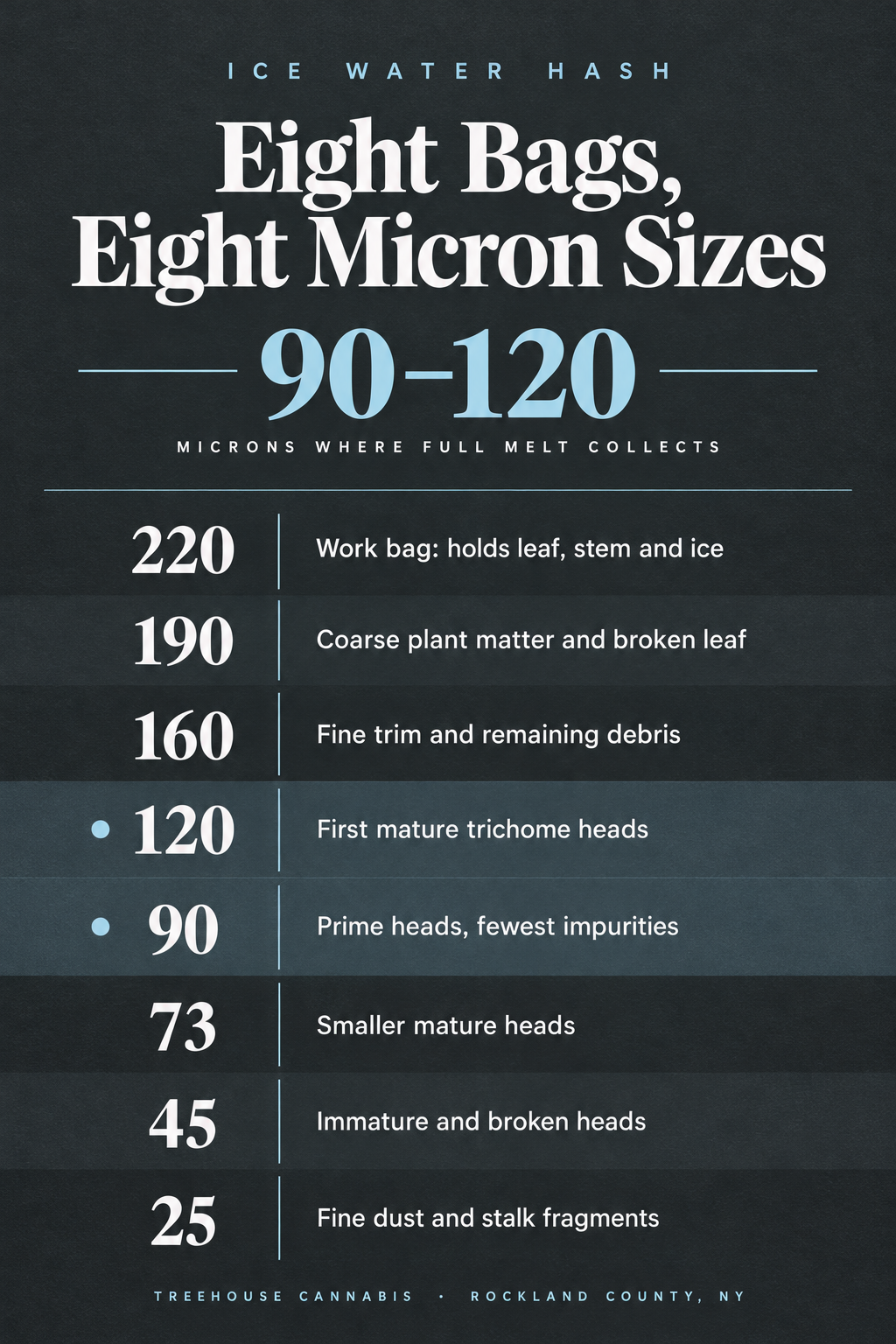
A standard eight-bag set runs 220, 190, 160, 120, 90, 73, 45, and 25 microns from coarsest to finest [7]. Each band has one job:
- 220 microns is the work bag, holding the flower, ice, and water while resin and water drain through
- 190 and 160 microns catch coarse leaf, broken stem, and debris
- 120, 90, and 73 microns are the collection bags, and the 90 to 120 window typically holds the most mature heads with the fewest impurities [7]
- 45 and 25 microns catch small, broken, and immature heads plus stalk fragments and fine dust
The sizes line up with the microscopy almost too neatly. Heads measured at 40 to 110 micrometers fall inside the 73 to 120 band, which is why the middle bags fill first with the cleanest resin. The same work found a constricted zone at the top of the trichome stalk that leaves many heads detached during post-harvest handling and drying [4], and those loose heads are what collects in the fine bags.
Micron is a size, not a grade. A 90-micron bag from one maker is not the same mesh as a 90-micron bag from another, kits run anywhere from four bags to eight, and the printed figure is a nominal opening rather than a certified specification. Two people can wash identical material through different kits and get fractions that do not line up.
What to expect from one batch through one stack: visibly different fractions, with the middle bags holding the material worth paying for and the outer bags holding volume. The 25 bag is not junk, it is just mostly fragments.
Two things worth knowing before you commit to a kit. Material that falls into the finest bags is cooking grade, and infused honey is a reasonable destination for trim and low grades - How to Make Cannabis-Infused Honey walks through that method. And if you are still working out which concentrate format suits how you consume, Flower, Vapes, Edibles, or Concentrates: Which Format Fits You? compares flower, vapes, edibles, and concentrates on the differences that matter.
How Is Ice Water Hash Made, Step by Step?
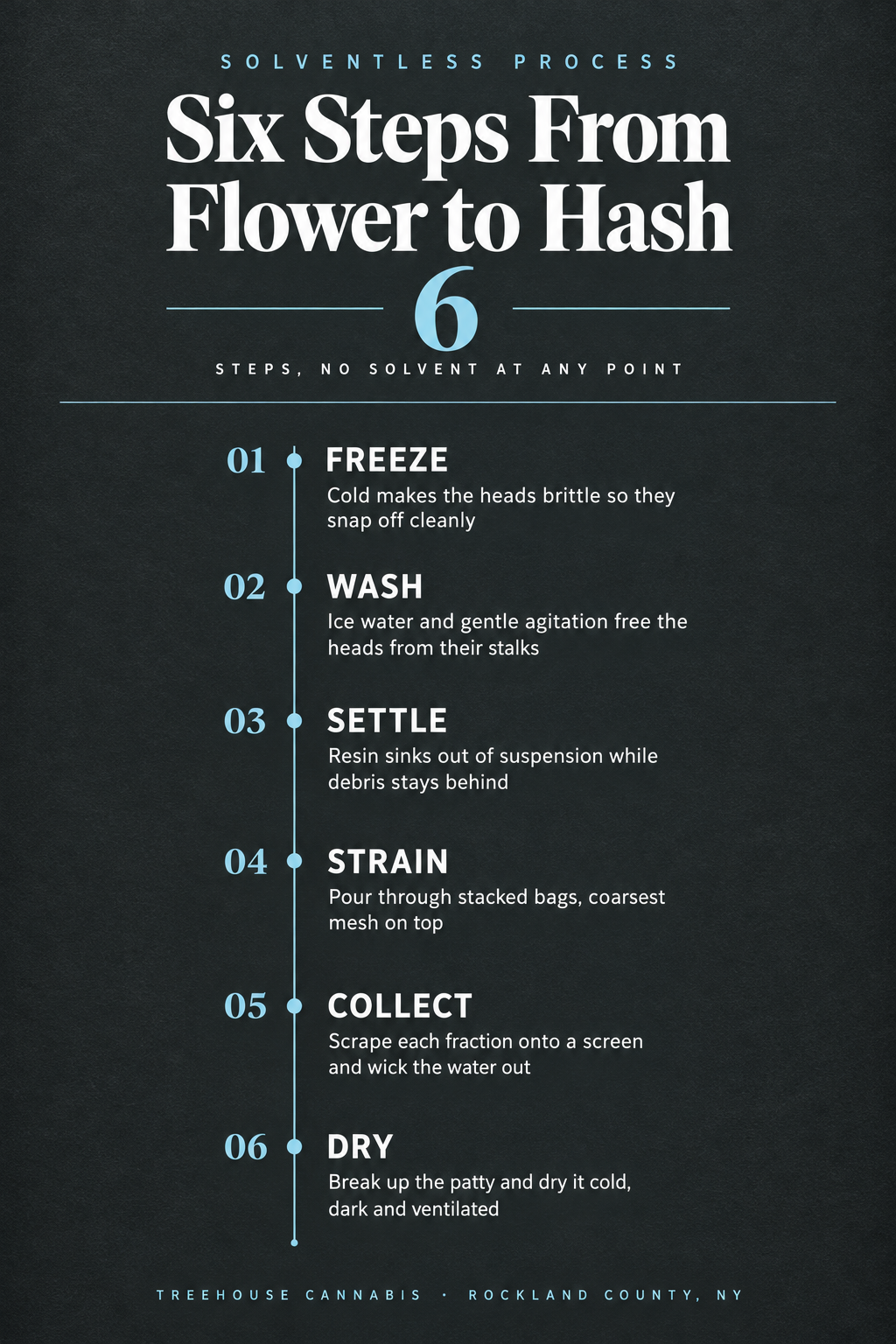
Freeze the cannabis, combine it with ice and water, agitate gently so trichome heads snap off without shredding leaf, then pour the slurry through stacked micron bags and collect, wick, and dry the resin cold and dark. Six steps, no solvent at any point.
The physical basis for the whole method is that constricted zone at the top of the trichome stalk. Heads detach readily during handling and drying [4], and cold makes them brittle so they snap off instead of smearing into the leaf. That is why step one is freeze and why every step after it stays cold.
- Freeze the material. Fresh-frozen flower and dried trim both work, but they wash differently, and cold keeps heads brittle rather than tacky.
- Wash with ice and water and agitate gently, by hand or in a washer built for it. A harsh wash shreds leaf and turns the batch green, and green resin is plant material you cannot wash back out.
- Let the wash settle before pouring, so resin drops out of suspension while fine debris stays suspended longer.
- Pour through the stack with the coarsest bag on top, then rinse down the bag walls so resin does not strand on the mesh.
- Collect each fraction onto a pressing screen and wick the water out with a towel rather than squeezing the patty.
- Break the patty into small pieces and dry it cold, dark, and ventilated for days, not hours.
The settle step is the one most home guides skip, and the peer-reviewed version keeps it. Trichomes are filtered through screens and then allowed to settle before collection and drying [2]. Skipping the pause means pouring debris straight into your collection bags.
Drying is where the method has a real weakness. A review of cold mechanical trichome isolation notes that water hash carries the drawback of water exposure [3]. The wash itself is fast. What follows - wicking, breaking up the patty, and days of cold ventilated drying - decides whether the resin that came off the plant is still good in a month.
On yield, expect a fraction of the input weight back, and expect that fraction to depend more on the starting material than on technique. Frosty, mature flower returns more than leaf-heavy trim from the same wash. No honest guide can promise a percentage, because the input varies more than the process does.
For contrast, solvent-based production works on a different principle entirely, and Live Resin vs Distillate Carts compares two of those formats if you want to understand what the water method avoids.
What Is Full Melt Hash, and Do the Stars Mean Anything?
Full melt is bubble hash that liquefies almost completely when heated, leaving little or no charred residue behind. The one-to-six star labels attached to it are informal shorthand for that behavior, not a regulated grade.
Where the good fractions land is consistent across equipment guides: full melt is most often collected in the 90 to 120 micron bags [7], the same window that holds the most mature heads with the fewest impurities.
What melt actually measures is cleanliness. Resin with low plant content liquefies and bubbles. Hash carrying leaf, chlorophyll, and stalk fragments chars and leaves ash behind. That is a purity measurement, not a potency one. A five-star sample is not automatically stronger than a three-star one, and the star count says nothing about how much THC is in the jar.
Moisture fakes the result, which is the part most people miss. A wet sample spits and bubbles no matter how clean the resin is, so the test only means something on hash that has actually dried. Judge a freshly collected patty by its melt and you are grading water.
On the label's status, be blunt with yourself. There is no official standard, no certifying body, and no agreed threshold between four stars and five, which means the same jar can reasonably be called different things by different sellers [7]. The scale is shared vocabulary among people who already know what they are looking at, and marketing shorthand everywhere else.
- Definition: hash that melts to liquid under heat and leaves little or no charred residue
- Where it comes from: most often collected in the 90 to 120 micron bags [7]
- What melt measures: clean resin and low plant content, not cannabinoid percentage
- Why moisture ruins the test: a wet sample bubbles and spits regardless of how clean the resin is
- What the stars mean in practice: informal shorthand for melt behavior, with no official standard behind it
- How to check yourself: a small sample on a low-temperature nail that melts clear tells you more than a package label
Ask for a melt demo, or judge a small sample at low temperature and watch whether it goes clear or leaves residue. That single observation beats any number printed on a package. To see how the grades are actually labeled on a shelf, the Hash Concentrates page is the place to start.
How Does Bubble Hash Compare to Kief, Rosin, and Live Resin?
Bubble hash, kief, and rosin are all solventless, but they separate resin differently - water and mesh, dry screening, and heat plus pressure - while live resin uses a solvent and tests in a higher band. Same plant, four routes to the resin.
| Product | How the resin is separated | Typical THC range | Texture |
|---|---|---|---|
| Bubble hash | Ice water and micron bags, no solvent | Roughly 39 to 60 percent across non-solvent concentrates [1] | Sandy to greasy, melts under heat |
| Kief | Dry-sifted through screens, no water and no solvent | Frequently lower than washed hash, because it is unrefined | Dry and powdery |
| Rosin | Heat and pressure, no solvent | Varies with the input material | Sap-like to shatter-hard, depending on temperature |
| Live resin | Hydrocarbon solvent on fresh-frozen material | 54 to 69 percent, with some products reported above 80 percent [1] | Saucy and terpene-rich |
Read those potency figures as ranges across product classes, because that is what they are [1]. They come from federal reporting on concentrate categories, not from a lab report on any jar in a store.
The commercial relationship between two of these is the part worth understanding. Bubble hash is frequently the input to rosin, which means wash quality becomes press quality downstream [2]. Clean, well-dried hash presses into clean rosin. Hash carrying leaf and trapped moisture presses into dark, sizzling rosin, and no amount of pressure fixes that after the fact [3].
Texture is the fastest tell at a counter, because you can see it through most packaging:
- Kief is dry and powdery, and it behaves like dust
- Bubble hash is sandy or greasy depending on grade and temperature
- Rosin is sticky and sap-like, or hard and glassy if it was pressed hot
- Live resin is saucy and moves in the jar
None of these is better than the others. They serve different purposes and budgets, and the right one depends on whether you want to sprinkle, press, or vaporize. For the pressed side of the family, the Rosin Concentrates page shows what is on the shelf.
What Separates Good Bubble Hash From Marketing Hype?
The honest signals are starting material, color, texture, melt behavior, and how dry the resin is. Not the star count, not the bag count, and not the word artisanal on the label.
Starting material decides most of the outcome. Fresh-frozen whole flower washes differently than dried trim, and no technique rescues poor input. If you are shopping flower with washing in mind, Thai Sunrise Flower - 70g shows the format that matters - whole flower, weighed, with the cultivar named rather than a trim pile.
The trichome density myth deserves its own paragraph, because it drives a lot of purchasing. A review of trichome quantification found that higher trichome density alone does not consistently predict cannabinoid content, because biosynthetic enzyme activity, genotype, and resin storage capacity are equally or more influential [5]. Visual frost is a real signal about trichome presence, and a weak signal about what those trichomes contain.
Color tells you about leaf. Pale blonde to tan usually means the separation was clean. Green means chlorophyll got shredded in during the wash. Dark brown or grey suggests oxidation, over-agitation, or age.
Texture should be sandy or greasy, never damp. Sticky-wet hash is a drying failure, and trapped water is the real spoilage risk here, because the ice water method's known drawback is water exposure [3].
- Starting material first: fresh-frozen whole flower and dried trim behave differently, and technique cannot fix poor input
- Trichome density is not potency: genotype, enzyme activity, and resin storage capacity matter as much or more [5]
- Color describes leaf content: blonde or tan means clean separation, green means shredded chlorophyll, brown or grey suggests oxidation or age
- Texture should be sandy or greasy, not damp - sticky-wet hash is a drying failure
- Star ratings and micron ranges are not grades and carry no standard behind them
- Potency numbers without a test attached are marketing, not measurement
At a counter, four questions do most of the work: what went into the wash, which micron fraction is in the jar, when was it dried, and is there a test attached to this batch. A seller who can answer those is telling you something. A seller who answers with a star count is telling you something too.
How Should You Store Bubble Hash So It Lasts?
Keep it cold, dark, and airtight, and treat residual moisture as the main threat. Trapped water supports mold in a product that never went through a solvent purge, which makes storage part of the process rather than an afterthought.
- Cold, dark, and airtight is the whole rule - glass over plastic, sealed over folded
- Refrigerator for regular use, freezer for long-term keeping
- Let the jar come to room temperature before opening, so condensation does not form on cold resin
- Handle from a small amount rather than the whole jar, and keep warm fingers off the patty
- Hash headed for rosin gets pressed rather than stored, and damp hash presses badly
The condensation point is the one people get wrong. A cold jar opened in a warm room pulls moisture straight onto the resin, which is the exact failure cold storage was meant to prevent. Take the jar out, leave it closed, wait, then open.
Light and heat are the second and third problems, since resin oxidizes and terpenes volatilize. That applies across concentrate formats, including the Live Resin Disposable Vaporizers you might keep in the same drawer.
That is also how storage connects back to the wash. Water exposure is the documented drawback of ice water extraction [3], so drying and storage are not cleanup steps at the end. They are the reason a good wash is still good a month later, and the reason a careless one is not.
Bubble hash is a process, not a promise - ice, water, mesh, and patience, with nothing dissolved along the way. Treehouse Cannabis in Rockland County, NY lists concentrates and flower with the strain, brand, and grade attached, and our staff will tell you honestly which jars are worth the money today. You can browse current Donut Trip | Tier 2 Live Rosin Concentrate | 4g and Thai Sunrise Flower - 70g listings before you come in, or order online for pickup and delivery across Rockland, Orange, and Westchester Counties.
Frequently Asked Questions
What is bubble hash?
Bubble hash is a solventless cannabis concentrate made by agitating cannabis in ice water so the resin-bearing trichome heads break off, then pouring the slurry through a stack of mesh bags that sort those heads by size. Nothing is dissolved. Water carries the resin, screens separate it by diameter, and the collected material is dried before use.
Why is it called bubble hash?
The name comes from how the hash behaves under heat, not from bubbles in the wash water. Clean bubble hash bubbles and liquefies when it is heated, and hash makers named the product for that reaction. The bubbling is trapped resin and residual moisture escaping as the material melts, which is also why a wet sample spits.
How is bubble hash made step by step?
Freeze the cannabis, then combine it with ice and water in a wash vessel. Agitate gently so trichome heads snap off without shredding leaf. Pour the slurry through stacked micron bags, largest on top, and rinse the bag walls. Collect resin from each bag, wick away water, break it into small pieces, and dry it cold and dark.
What do the micron numbers on bubble bags mean?
A micron is one thousandth of a millimeter, and the number on a bag is the size of its mesh openings. Trichome heads vary in diameter, so a bag stack sorts them. Coarse bags catch leaf and debris, middle bags catch mature heads, and the finest bags catch small, broken, or immature material. Micron is a size, not a grade.
What is full melt bubble hash?
Full melt is bubble hash that liquefies almost completely when heated, leaving little or no charred residue behind. Hash makers describe it on an informal one-to-six star scale, where five and six stars melt cleanly and one and two stars leave plant material behind. The label describes melt behavior, not THC percentage, and it has no official standard.
Is bubble hash stronger than regular flower?
Usually stronger by weight, yes. Federal data puts non-solvent cannabis concentrates at roughly 39 to 60 percent THC, against the teens to low twenties typical of dried flower. The range is wide because grade and starting material decide the outcome, so a cooking-grade wash and a six-star full melt are not comparable products even though both are bubble hash.
Is bubble hash the same as kief or rosin?
No, though all three are solventless. Kief is dry-sifted trichomes separated with screens and no water. Rosin is resin squeezed out with heat and pressure. Bubble hash sits between those processes: water and mesh isolate whole trichome heads, and that hash is then frequently pressed into rosin. Different methods produce different textures and grades.
How should you store bubble hash?
Keep it cold, dark, and airtight. Hash is sensitive to heat, light, and oxygen, and residual moisture is the bigger risk because trapped water supports mold. A sealed glass jar in the refrigerator works for regular use and the freezer for long-term keeping, but let the jar come to room temperature before opening it to avoid condensation.
Sources
- National Institute on Drug Abuse (NIDA), National Institutes of Health — This federal fact sheet states that solvent-based cannabis concentrates average
- Journal of Cannabis Research (BMC) / National Library of Medicine — This peer-reviewed narrative review of cannabis drying and extraction describes
- Molecules (MDPI) / National Library of Medicine — In this study of a cold mechanical trichome-isolation method on organically grow
- Journal of Cannabis Research (BMC) / National Library of Medicine — Scanning electron microscopy of two high-THC genotypes found glandular trichome
- Plants (MDPI) / National Library of Medicine — This review identifies stalked capitate trichomes as generally the principal sou
- Leafly — Leafly's glossary defines bubble hash as hash made with ice water in which canna
- Lowtemp Industries — This extraction-equipment guide explains that a standard eight-bag ice water ext
- Triminator — This history traces modern ice water hash to an oral account passed to Nevil Sch
About Treehouse Cannabis
Treehouse Cannabis is a licensed adult-use dispensary in Rockland County, New York, serving customers across Rockland, Orange and Westchester Counties. This article is intended for adults 21 and older in New York State and explains how ice water hash is separated, graded, judged and stored; it is not medical advice.
Cannabis is for adults 21 and older. Keep all cannabis products out of reach of children and pets, and never drive under the influence. This article is educational and is not medical advice. Product availability varies by location and is subject to New York State regulations.



Shop our products

Shop All

Deals

Flower

Pre-rolls
Vaporizers

Edibles
Drinks

Concentrates
Tinctures

Topicals

CBD

Pet CBD

Accessories