
Black Diesel Strain: Genetics and Terpene Profile
Black Diesel Strain: Genetics and Terpene Profile
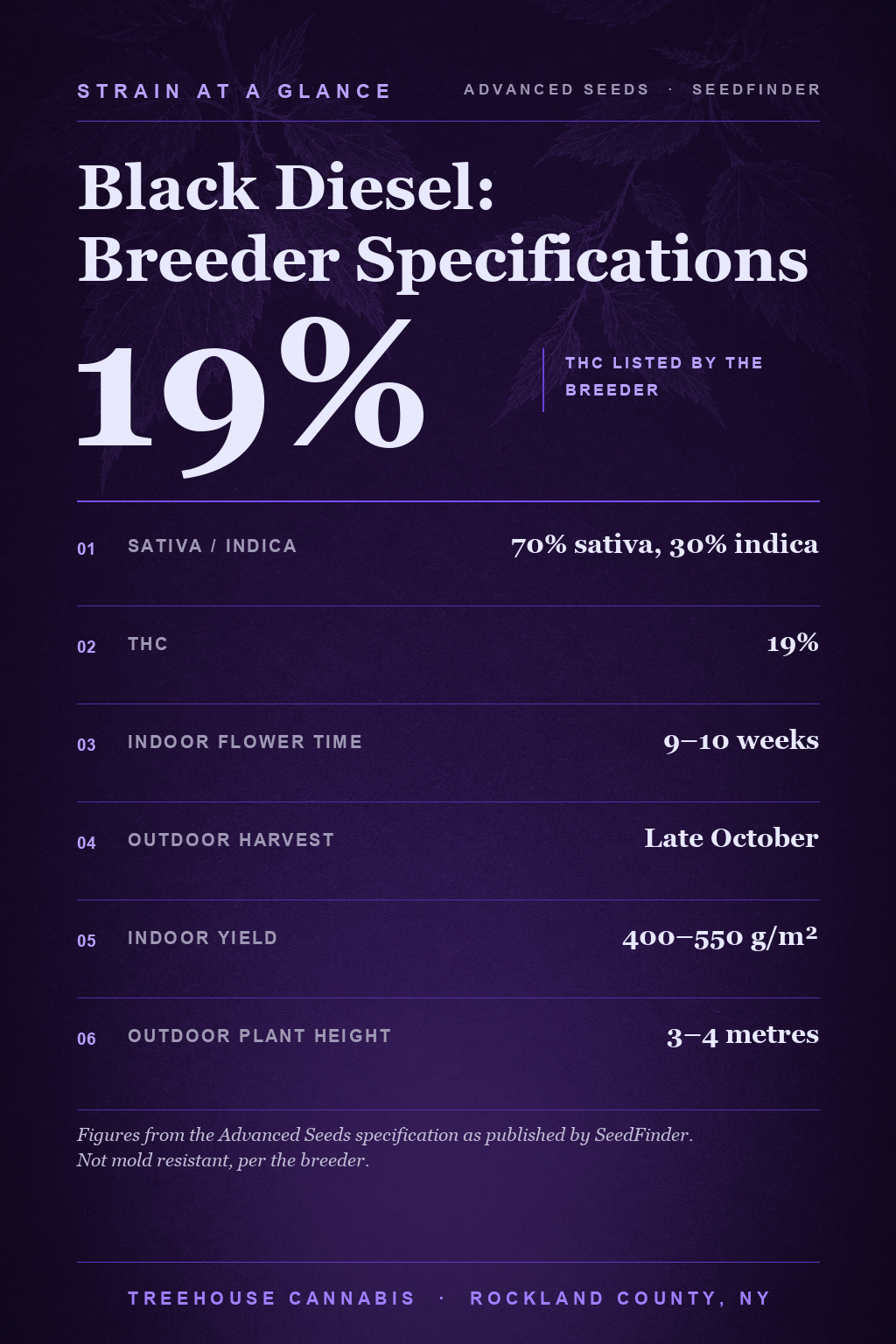
The Black Diesel strain is a sativa-dominant cultivar from Advanced Seeds, selected out of New York City Diesel and rated at roughly 70% sativa, 30% indica, 19% THC and a nine to ten week indoor flower. Its reported terpenes are myrcene and delta-3-carene, and the gassy grapefruit nose comes from limonene plus volatile sulfur compounds rather than from terpenes alone.
What Is the Black Diesel Strain?
Black Diesel is a sativa-dominant cultivar released by Advanced Seeds and selected out of New York City Diesel. The breeder rates it at roughly 70% sativa and 30% indica, with about 19% THC and a nine to ten week indoor flower time [3]. Those are breeder figures, not a certificate of analysis for any batch sitting on a shelf.
The plant is easy to recognize when it is grown well. Flowers finish large and dense, dark purple with green hues showing through, orange pistils, and heavy trichome coverage [6]. The nose is where it earns the name: ripe grapefruit and sour fruit on top, diesel and pepper underneath [4].
The headline figures, as the breeder lists them:
- Sativa and indica: 70% sativa, 30% indica, selected out of New York City Diesel
- Potency: 19% THC by the breeder's figure, 18-20% across independent strain databases
- Timing: nine to ten weeks indoors, late-October harvest outdoors in the Northern Hemisphere
- Structure: dense, dark purple buds with green hues, orange pistils and heavy trichome coverage
- Aroma shorthand: ripe grapefruit and sour fruit up front, diesel and pepper underneath
- Known weakness: the breeder states plainly that the plant is not mold resistant
That last point matters more than it looks. A cultivar that is not mold resistant demands careful drying and storage, and it is worth asking whether a batch in front of you was handled that way. If you want to see how these diesel lines sit against their relatives, Sour Diesel Strain Family: History, Genetics, and Terpenes covers the wider family.
The rest of this article does four things: it untangles the parentage dispute around Black Diesel, lays out the terpene set that published profiles report, explains the chemistry behind the fuel note, and shows how growing conditions and storage change all of the above.
What Black Diesel Genetics Come From New York City Diesel?
The honest answer is that the published record disagrees, and knowing that is more useful than a tidy family tree. The breeder describes Black Diesel as a selection of New York City Diesel rather than a documented two-parent cross [3]. Several strain databases say something different: New York City Diesel crossed with Black Domina, at the same 70/30 sativa ratio [5], [6].
| Lineage claim | Black Diesel parentage | What it would explain |
|---|---|---|
| Breeder specification | A selected New York City Diesel line | The diesel aroma, the 70/30 sativa ratio, the grapefruit character |
| Strain databases | New York City Diesel x Black Domina | The dark purple colouring and the denser flower structure |
Both claims agree on the parts that matter at a counter: sativa-dominant genetics, a grapefruit-forward nose, roughly 19% THC. They disagree on whether Black Diesel is a backcross-style selection or an outcross to a second parent, and those produce materially different plants.
New York City Diesel itself is better documented. Soma Seeds describes it as grown from seedstock brought back from New York, prized for a ripe red grapefruit aroma, on a 12-13 week flower [1]. Leafly records it as a cross of Mexican and Afghani landraces with grapefruit, diesel and chemical flavors, top terpenes of myrcene, caryophyllene and pinene, and five Cannabis Cup wins in the early 2000s [2].
- Breeder account: Black Diesel is a selected New York City Diesel line, not a documented two-parent cross
- Database account: New York City Diesel crossed with Black Domina, which would explain the purple colouring
- What everyone agrees on: the sativa-dominant ratio, the grapefruit-forward aroma, roughly 19% THC
- What the parent brings: Mexican and Afghani landrace ancestry per Leafly, and five Cannabis Cup wins
- Why it matters: a single selected line and a two-parent outcross grow and smell differently
The practical conclusion is simple enough. Treat "Black Diesel" as a name for a family of related lines, not one fixed genome, and read the label on the jar in front of you. If the vocabulary of terpenes is new to you, Understanding Terpenes in Cannabis walks through it from the ground up, and The Cannabis Terpene Wheel: A Visual Guide to Every Common Terpene maps the whole set visually.
Which Terpenes Define the Black Diesel Terpene Profile?
Published Black Diesel terpene panels are thin and they disagree with one another, so treat any profile as a reported set rather than a certified panel from a single batch. What follows is assembled from a strain profile and from consumer aroma data, not from a laboratory report on the jar in your hand.
Leafwell lists myrcene and delta-3-carene as the leads and describes the aroma as skunky, peppery, grapefruit, citrus, herbal and spicy [7]. Across 82 consumer ratings on Leafly, pepper, diesel and earthy sit at the top of the flavor list [4], which points to beta-caryophyllene and myrcene doing real work. Limonene is the reasonable read on the citrus side, given the grapefruit-forward New York City Diesel parent [2].
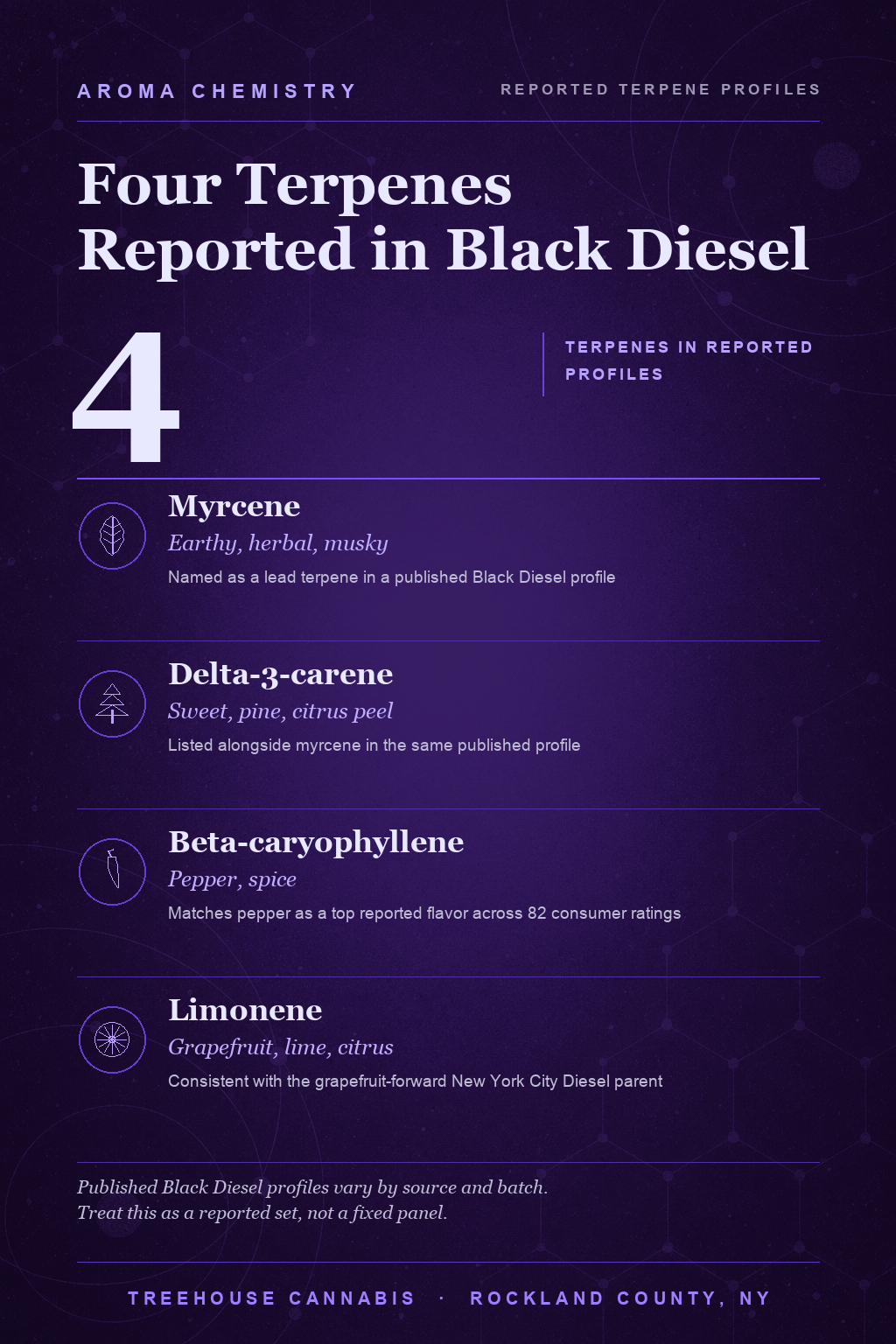
The four terpenes that show up in those reports:
- Myrcene: earthy, herbal, musky, named as a lead terpene in the published Black Diesel profile
- Delta-3-carene: sweet, pine and citrus peel, listed alongside myrcene in the same profile
- Beta-caryophyllene: pepper and spice, matching pepper as a top reported flavor across 82 consumer ratings
- Limonene: grapefruit, lime and citrus, consistent with the grapefruit-forward parent
The biology is worth one paragraph. Cannabis assembles monoterpenes through the MEP pathway and sesquiterpenes through the MEV pathway inside glandular trichomes, the same resin glands that hold cannabinoids and that rupture when flower is ground [9]. Terpene synthase expression differs between cultivars, with 33 synthase genes identified across six cultivars studied, which is why a terpene profile is genetically variable rather than fixed by a strain name [8].
Two pharmacology notes, offered as research rather than as outcomes a customer will feel. Beta-caryophyllene binds CB2 receptors selectively, which is why it is discussed on its own terms rather than folded into THC effects [11]. Limonene is the principal monoterpene of citrus peel, and reviews of its antioxidant, anti-inflammatory and neuroprotective findings note that most of the evidence is preclinical rather than human [12].
Myrcene deserves its own caveat. Its anxiolytic, analgesic and anti-inflammatory activity has been shown in animal studies, human studies are lacking, and the widely repeated claim that myrcene helps compounds cross the blood-brain barrier is thinly supported [13].
That is a long way from saying a terpene does a specific thing for you. What a terpene profile actually tells you is what the flower smells like, how it was grown, and how it has been kept since harvest. For a broader tour of the usual suspects, Cannabis Terpene Chart: Every Common Terpene by Aroma sorts the common terpenes by aroma.
Why Does Black Diesel Smell Gassy Instead of Fruity?
Because the fruit note and the fuel note come from different chemistry, and the nose perceives them independently. That is how Black Diesel ends up smelling like a gas station and tasting like grapefruit in the same pull.
The fruit side traces to limonene and to the ripe red grapefruit character of New York City Diesel [2], [7]. The fuel side is not a terpene story at all. Research across 13 cultivars identified a family of prenylated volatile sulfur compounds, chiefly 3-methyl-2-butene-1-thiol, as the main driver of the skunky, fuel-like scent [10].
What is happening in the jar breaks down like this:
- The fruit note: limonene plus the ripe red grapefruit character inherited from New York City Diesel
- The fuel note: prenylated volatile sulfur compounds, chiefly 3-methyl-2-butene-1-thiol, found across 13 cultivars
- Why both exist at once: separate chemical families, perceived independently by the nose
- Why it fades: sulfur compounds register at extremely low concentration and degrade readily
- What the name means: "diesel" describes an aroma family, not a shared pedigree
The concentration point explains a lot of retail experience. These sulfur compounds register at vanishingly low levels, so a small amount goes a long way inside a sealed jar, and they are chemically fragile. That is part of why a loud jar can go quiet over a few weeks, and why the first nose out of a freshly opened bag is not the same as the tenth. It is also why the word "diesel" appears on so many unrelated labels: it is an aroma promise, not a family tree.
How Do Growing Conditions and Storage Change Black Diesel Terpenes?
Short answer: the terpene profile is a snapshot, not a fixed trait. Accumulation responds to the grow, and terpenes keep degrading after harvest no matter how careful the handler is.
On the grow side, cannabinoid and terpene accumulation responds to light and other environmental conditions during cultivation, which is why the same cultivar can test differently from one grow or batch to the next [15]. Terpene synthase expression also varies between cultivars and individual plants [8].
The storage side has been measured directly. Researchers stored inflorescences and extracts for a year at 25, 4, -30 and -80 C and found terpenoid concentrations fell under every condition tested. Grinding and holding below -20 C were the least favorable, while whole, unground flower at 4 C performed best of the options tested [14]. That is one controlled experiment in a laboratory, not a guarantee about the drawer in your kitchen.
What that adds up to for a shopper:
- Grow-side variation: light and environment shift cannabinoid and terpene accumulation between batches
- Genetic variation: terpene synthase expression differs between cultivars and individual plants
- Storage result: terpenoid concentrations fell at 25, 4, -30 and -80 C across a full year
- Least favorable conditions tested: grinding, and holding below -20 C
- Best tested condition: whole, unground flower at 4 C
- What to do with it: buy whole flower, keep it sealed and cool, grind at use, and check the package date
So buy flower that still smells like something, prefer whole flower over pre-ground for aroma retention, keep it sealed and away from heat, and grind at the moment of use rather than in advance. Our Flower menu is the easiest place to compare those formats, and larger whole-flower packs such as Thai Sunrise Flower - 70g are the format the storage research favors.
One caution specific to this cultivar. Black Diesel is flagged as not mold resistant by the breeder and by strain listings [3], [4], [5], so "sealed and cool" should not be read as "sealed and damp." The harvest or package date on a dispensary label predicts aroma better than the strain name does.
How Does Black Diesel Compare With Other Diesel Cannabis Strains?
The only diesel line in this article with verified figures to compare against is Black Diesel's own parent, New York City Diesel. No source here tests Sour Diesel or any other diesel cultivar, so a wider table would be guesswork dressed up as data.
| Trait | Black Diesel | New York City Diesel |
|---|---|---|
| Parentage | Selected New York City Diesel line per the breeder; databases list NYC Diesel x Black Domina | Mexican and Afghani landraces per Leafly; seedstock brought back from New York per Soma Seeds |
| Sativa and indica | 70% sativa, 30% indica | Sativa-dominant |
| Indoor flower time | Nine to ten weeks | 12-13 weeks |
| Aroma | Ripe grapefruit, diesel, pepper | Grapefruit, diesel, chemical |
| Awards | Multiple Cannabis Cup wins | Five Cannabis Cup wins in the early 2000s |
| Mold resistance | Flagged as not mold resistant | Not specified in the sources used here |
Black Diesel figures come from the breeder specification and from strain listings [3], [4]; New York City Diesel figures come from its breeder and from Leafly [1], [2].
What the table is good for: a shorter flower window and denser, darker flowers on the Black Diesel side, and the longer original award record on the parent side. Neither column makes one better than the other. They are different plants with different grow demands.
- Parentage: a selected New York City Diesel line, with a database counterclaim of NYC Diesel x Black Domina
- Flower time: nine to ten weeks indoors against 12-13 for the parent
- Awards: multiple Cannabis Cup wins on both sides of this family
- Aroma: both grapefruit-forward, with Black Diesel adding pepper and earth
- Structure: dense dark purple flowers against the parent's narrower sativa expression
- Mold resistance: Black Diesel is flagged as poorly resistant
- How to shop it: ask for the terpene panel, check the package date, judge the flower in front of you
The diesel family is broad enough that two jars labeled diesel may share nothing but a name. If you would rather shop the format than the label, the Whole Flower Flower page lists whole-flower options, and our current Thai Sunrise Flower - 70g and Gumball Diamond Infused | Pre-Rolls | 5 pack listings carry strain names, potency and testing so you can read the jar instead of the marketing.
Black Diesel is a name for a family of related lines, not a fixed genome, so the jar in your hand matters more than the word on the label. Treehouse Cannabis in Rockland County, NY lists flower and pre-rolls with strain names, potency and testing attached, and our team will walk you through what is on the menu today, serving Rockland, Orange and Westchester Counties.
Frequently Asked Questions
What is the Black Diesel strain?
Black Diesel is a sativa-dominant cultivar released by Advanced Seeds and selected out of New York City Diesel. The breeder rates it about 70% sativa and 30% indica, with large dense flowers, a ripe grapefruit aroma and roughly 19% THC on a nine to ten week indoor flower time.
What are the parents of Black Diesel?
The breeder lists Black Diesel as a selection of New York City Diesel rather than a two-parent cross. Several strain databases disagree, listing it as New York City Diesel crossed with Black Domina. New York City Diesel itself is documented as a Mexican and Afghani landrace cross from Soma Seeds.
Is Black Diesel indica or sativa?
Advanced Seeds rates Black Diesel at 70% sativa and 30% indica, and it is usually listed as a sativa. Consumers most often report creative, uplifted and focused effects, with some describing a heavier body settle later on. Effects vary with tolerance, and with how the flower was grown and stored.
What terpenes does Black Diesel have?
Published profiles are thin and inconsistent, which is worth knowing before you shop. One strain listing gives myrcene and delta-3-carene as the leads, while consumer flavor reports center on pepper, diesel and earthy notes pointing to caryophyllene plus myrcene, with limonene a reasonable read on the grapefruit side.
Why does Black Diesel smell like diesel if it tastes fruity?
The fuel note and the fruit note come from different chemistry. Ripe grapefruit and citrus aromas trace to limonene and to New York City Diesel, while research across 13 cultivars shows the skunky, gassy edge comes largely from volatile sulfur compounds such as 3-methyl-2-butene-1-thiol rather than from terpenes alone.
How much THC does Black Diesel have?
The breeder lists Black Diesel at 19% THC. Independent strain listings place it roughly between 18% and 20%, with individual samples testing higher or lower. Potency varies by grower, harvest timing and laboratory, so treat any single figure as typical rather than guaranteed for the jar in front of you.
How long does Black Diesel take to flower?
Advanced Seeds lists nine to ten weeks indoors and a late-October harvest outdoors in the Northern Hemisphere. Plants are reported as very tall, reaching three to four metres outside, with indoor yields of roughly 400 to 550 grams per square metre. The breeder also notes the plant is not mold resistant.
Does the Black Diesel terpene profile stay the same between batches?
No. Terpene production is genetically variable, responds to light and environment during the grow, and keeps degrading after harvest. A year-long storage study found terpenoid concentrations fell under every condition tested, with whole unground flower at 4 C performing best, so two jars of the same cultivar can smell noticeably different.
Sources
- Soma Seeds — The breeder describes NYC Diesel as grown from seedstock brought back from New Y
- Leafly — Documents NYC Diesel as a cross of Mexican and Afghani landraces with top flavor
- SeedFinder — Carries the breeder's own specification for Black Diesel: 70% sativa and 30% ind
- Leafly — Records Black Diesel as a sativa with dense purple flowers, sour and fruity unde
- AllBud — Publishes a second lineage that conflicts with the breeder, listing Black Diesel
- Weedstraindb — Independently repeats the NYC Diesel x Black Domina lineage and the 70/30 sativa
- Leafwell — Lists Black Diesel's terpene profile as myrcene and delta-3-carene, puts THC at
- National Institutes of Health (PubMed Central) — Reports 33 cannabis terpene synthase genes across six cultivars and shows that t
- PLOS ONE — Shows that cannabis builds monoterpenes through the MEP pathway and sesquiterpen
- ACS Omega (PubMed Central) — Identifies a previously unknown family of prenylated volatile sulfur compounds i
- National Institutes of Health (PubMed Central) — Describes beta-caryophyllene as a dietary cannabinoid that binds CB2 receptors s
- International Journal of Molecular Sciences (PubMed Central) — Reviews d-limonene as the principal monoterpene of citrus peel, summarizing anti
- Frontiers in Nutrition — Reviews beta-myrcene's anxiolytic, analgesic and anti-inflammatory activity in a
- Frontiers in Plant Science — Stored cannabis inflorescences and extracts for a year at 25, 4, -30 and -80 C a
- Frontiers in Plant Science — Shows that cannabinoid and terpene accumulation in cannabis responds to light an
About Treehouse Cannabis
Treehouse Cannabis is a licensed adult-use dispensary in Rockland County, New York, serving customers across Rockland, Orange and Westchester Counties. This article is intended for adults 21 and older in New York State and covers the genetics, reported terpenes and storage of one cannabis cultivar; it is not medical advice.
Cannabis is for adults 21 and older. Treehouse Cannabis is an adult-use dispensary; this article is educational and informational only and is not medical advice. Cannabis affects people differently, and potency, aroma and effect vary by cultivar, batch, dose and storage. Please consume responsibly, keep all cannabis products out of reach of children and pets, and do not drive or operate machinery while impaired. Anyone with a health condition, anyone taking medication, and anyone who is pregnant or breastfeeding should speak with a licensed healthcare provider before using cannabis.



Shop our products

Shop All

Deals

Flower

Pre-rolls

Vaporizers

Edibles

Drinks

Concentrates

Tinctures

Topicals

CBD

Pet CBD

Accessories