
How to Start Low and Go Slow With Cannabis
How to Start Low and Go Slow With Cannabis
"Start low and go slow" is the harm-reduction rule most often repeated by state regulators, university health offices, and clinical guidance for new and returning adult-use cannabis customers[1]. It means picking the smallest reasonable THC dose for the format you have chosen, taking it once, and waiting until you feel the full effect before deciding whether to take more. The same milligram number can feel very different depending on whether it was inhaled or eaten, which is why a single "one-size" dose does not work for every format.
What Does "Start Low and Go Slow" Actually Mean With Cannabis?
The phrase "start low and go slow" is shorthand for three habits that every beginner can practice on day one[1]. State regulators use the wording because a THC experience that feels gentle at 2.5 milligrams can feel overwhelming at 10 milligrams, even for the same person on the same day[7].
Those three habits are:
- Choose the smallest reasonable serving for the product in front of you (the format, not the package).
- Take only that single serving — one hit, one low-dose gummy, one measured drop of tincture.
- Wait until the full effect has arrived before deciding whether to take anything else.
Going slow also means giving the body room to settle between sessions. Project CBD recommends that people with little or no cannabis experience start with a low amount shortly before bedtime for two days, then increase in small steps rather than jumping tiers[4]. Treating the first week like a learning period — not a performance — is what makes the rule stick.
For a helpful primer on the plant itself, our A Guide to Terpenes and Their Effects explains how aromatic compounds shape the flavor and feel of different cultivars. To understand why THC and CBD produce such different effects, the How THC and CBD Work guide breaks down the receptors and metabolism behind every dose.
How Many Milligrams of THC Should a Beginner Start With?
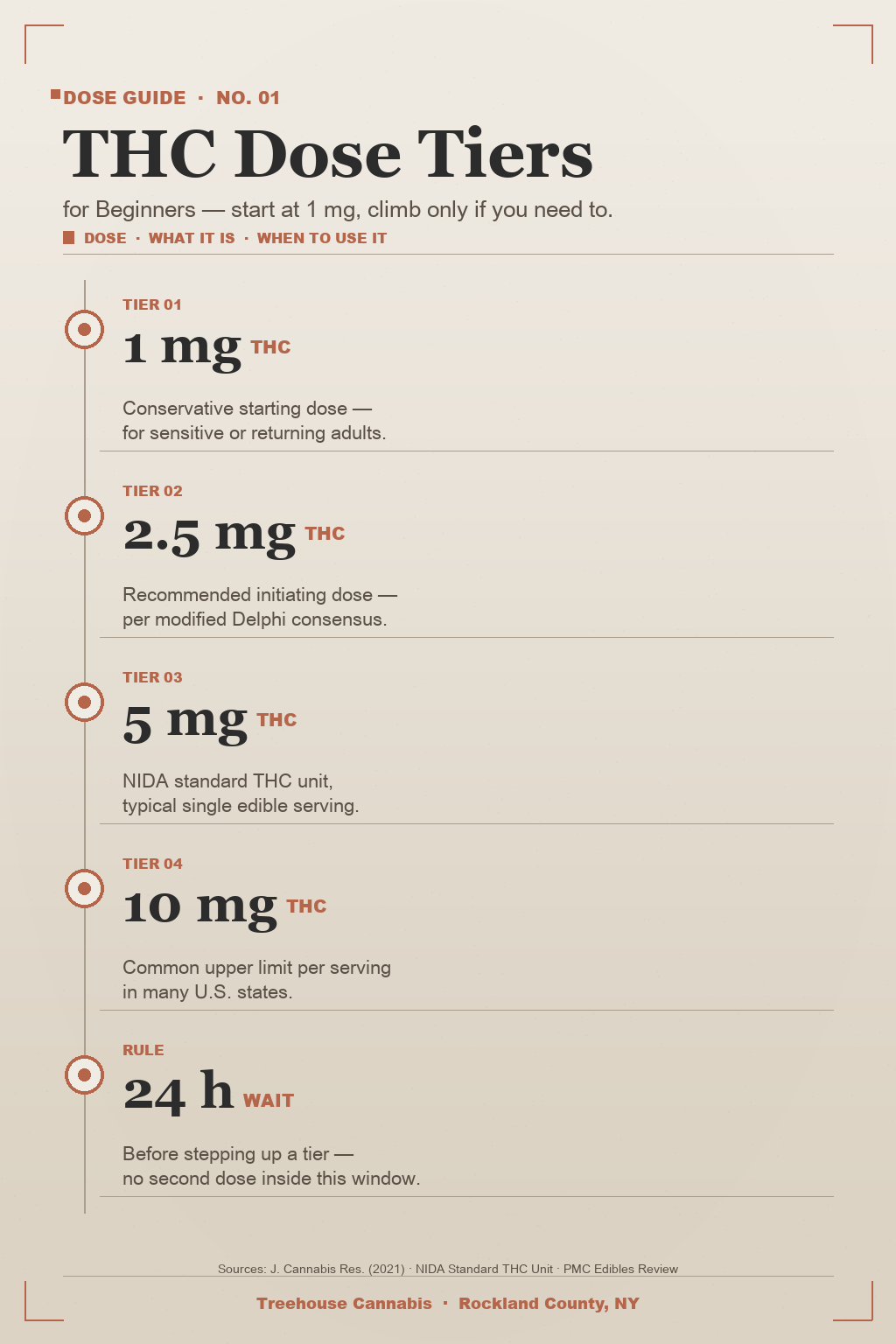
Most harm-reduction guidance converges on a small set of dose tiers that work for both inhaled and edible formats[2]. The National Institute on Drug Abuse now defines a standard THC unit as 5 mg of THC, which makes it easier to compare research results the way alcohol research uses a standard drink[5].
A simple ladder for new adult-use customers looks like this:
- 1 mg THC — conservative starting dose for sensitive, new, or returning adults
- 2.5 mg THC — the recommended initiating single dose from the Delphi consensus
- 5 mg THC — the NIDA standard unit, and a typical single edible serving
- 10 mg THC — the common per-serving upper limit cited by NIH reviewers[3]
The right tier for any individual depends on tolerance, body chemistry, and what was already consumed that day. Picking the lowest tier that matches the goal — a calmer evening, a lighter mood, a little creative spark — and stepping up only after a few sessions is the safer path. If a low-dose edible feels too subtle, the next step is 2.5 mg, not 10 mg.
The full Microdosing Cannabis: The Complete Guide to Low-Dose Wellness post goes deeper on choosing serving sizes that match personal goals, and from our online menu are a low-commitment way to find the right tier for the routine you want to build.
How Long Should You Wait Before Taking More Cannabis?
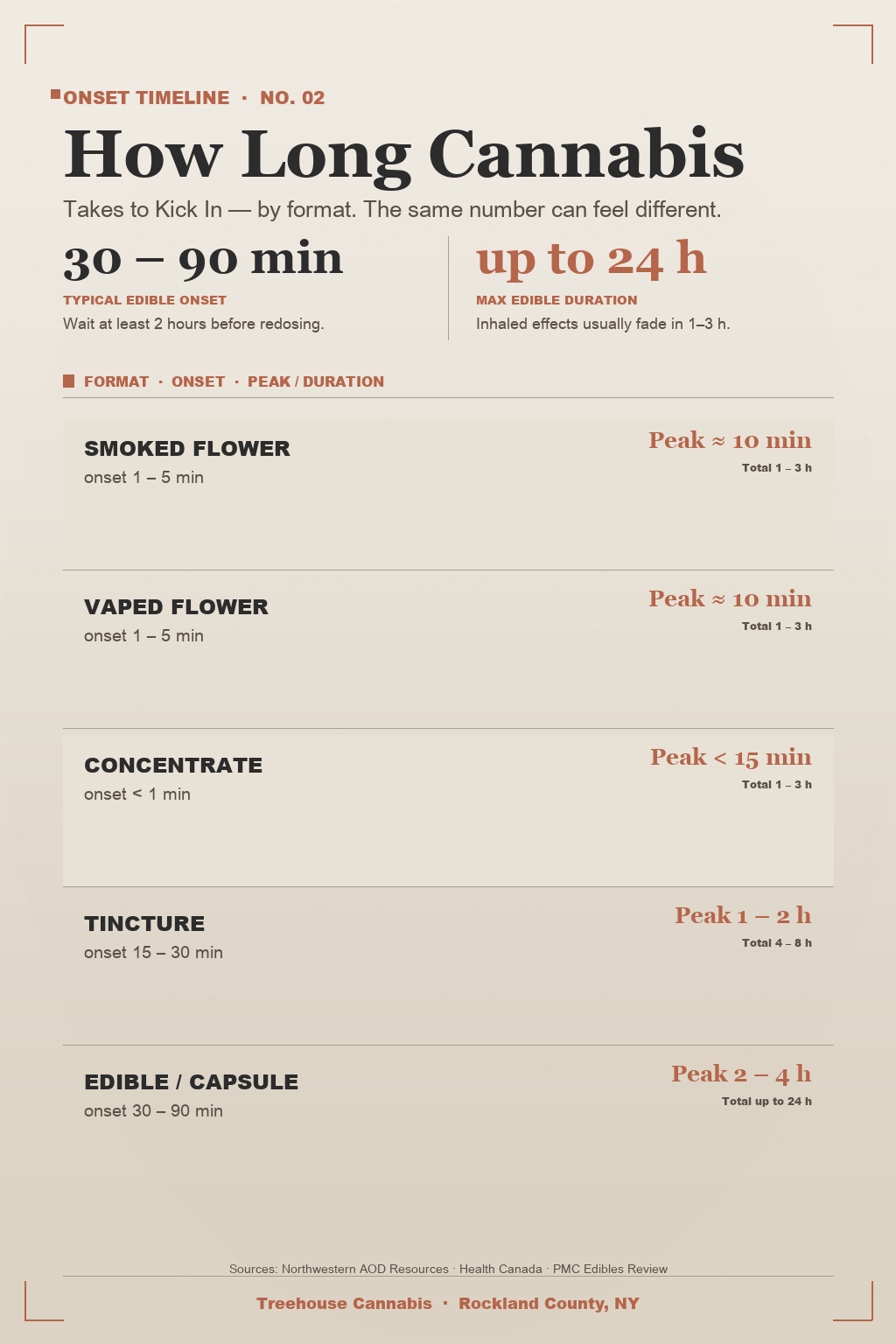
Timing is the part beginners most often get wrong, because the wait time depends almost entirely on the format[6]. The same wait rule does not work for inhaled and edible formats, because the body absorbs each one very differently.
A practical onset cheat sheet for adults:
- Smoked or vaped flower — effects arrive in 1 to 5 minutes and usually peak around 10 minutes
- Dab or concentrate vapor — onset within minutes, peak around 15 minutes
- Tincture under the tongue — onset 15 to 30 minutes
- Edible or capsule — onset 30 to 90 minutes, and the window can stretch past two hours[6]
A simple rule that fits both ends of that spectrum: wait at least 10 minutes before considering a second hit of flower, and wait at least two full hours before considering a second dose of an edible. The inhaled dose is easy to feel almost immediately, so doubling up too quickly is the most common way beginners end up more intoxicated than they intended.
Anyone returning to cannabis for the first time after a long break will also benefit from a one-day buffer between sessions. Our Cannabis Use For Beginners post covers the routine-building side of that buffer, and are an approachable format for pacing single hits at a time.
Why Do Edibles Feel Stronger Than Smoking or Vaping the Same THC Number?
The reason a 5 mg edible can feel very different from a 5 mg inhaled dose comes down to what the liver does to THC before it reaches the brain[6]. Inhaled THC skips that step, which is why the same milligram number lands more gently on the lungs than on the stomach.
Here is what changes when THC is swallowed instead of inhaled:
- Liver conversion: the liver turns delta-9-THC into 11-hydroxy-THC, which crosses the blood-brain barrier more easily.
- Longer, often more intense effect: that metabolite produces a stronger and longer experience than inhaled THC.
- Delayed peak: an edible does not peak for one to three hours, and the effects can linger for many hours longer than an inhaled session.
- Serving-size trap: NIH reviewers have flagged inconsistent serving sizes on edible packaging as a real consumer risk, which is why checking the per-serving milligram count on the label matters more than the per-package total[3].
For new customers, the practical translation is simple: an edible starting dose is roughly one-quarter to one-half of the equivalent inhaled dose, and the wait time is much longer. Browsing Edibles on the Treehouse menu by serving size — not by package total — is the safest way to pick a first edible.
What Are the Signs You Took Too Much, and What Should You Do?
A "too much" reaction to THC is uncomfortable but not life-threatening for adults, and it always passes[6]. Knowing the list ahead of time makes it easier to recognize what is happening in the moment and avoid the spiral of taking more to "fix" the feeling.
Common signs include:
- Anxiety or paranoia
- A racing heart
- Dizziness or confusion
- Nausea
- Impaired coordination
A calm recovery checklist that works for any format:
- Stop dosing. No more hits, no more edibles, no more tincture for the rest of the session.
- Hydrate with water or a non-alcoholic, non-caffeinated drink.
- Move to a safe, quiet space — a couch with a blanket and a familiar show works well.
- Breathe slowly. Anxiety spikes usually peak and fade within 30 to 60 minutes.
- Wait it out. Inhaled effects usually fade within 1 to 3 hours; edible effects can last longer[6].
If symptoms feel severe or do not improve, contacting a health professional or the Poison Control hotline is the right next step. For first-time customers who want to keep a session on the rails, starting with a single low-dose item — like a 2.5 mg gummy from our menu — is the easiest way to avoid the recovery checklist entirely. A small starter like from a single strain also lets new customers learn their response without committing to a larger quantity.
How Can You Build a Routine That Sticks With Cannabis?
The "start low and go slow" rule is less about a single number and more about building a routine around format, dose, and timing. Pick a low-dose product, take one serving, wait for the full effect, journal how it felt, and only step up after a few calm sessions. The point is not to find the strongest dose — it is to find the smallest one that does what the customer actually wants.
A simple four-step starter routine:
- Pick one format — flower, edible, vape, or tincture — and stick with it for the first few sessions.
- Pick the lowest tier that matches your goal (1 mg to 2.5 mg THC for most new adults).
- Wait for the full effect before redosing — minutes for inhaled, two hours for edibles.
- Journal the result in a quick note about dose, format, how long you waited, and how it felt.
Treehouse Cannabis carries low-dose gummies, sampler pre-roll packs, and single-strain vape carts built for customers easing into adult-use cannabis — a classic entry point like NY Diesel | Flower | 28g lets new customers learn their response one small session at a time. Stop by our dispensary in Rockland County, NY or shop the online menu to find a beginner-friendly product that matches the dose you want to start with.
This article is intended for adults 21 and older in New York State. Cannabis is for adults 21 and older — keep all cannabis products securely stored and out of reach of children, pets, and anyone under the legal age. Do not drive or operate heavy machinery after consuming cannabis, and avoid mixing cannabis with alcohol or other substances. If you are pregnant, nursing, or taking other medications, speak with a health professional before use. Effects vary by individual, dose, and format, and the guidance above is educational — not medical advice.
Sources
- New Jersey Cannabis Regulatory Commission — Official state guidance telling new and returning adults to start with a low THC
- Journal of Cannabis Research (NIH/PMC) — Modified Delphi consensus that 2.5 mg THC is an appropriate initiating dose, wit
- PubMed Central / NIH — Peer-reviewed review noting that only a small amount of an edible is needed to r
- Project CBD — Nonprofit clinical guidance recommending that patients with little or no cannabi
- National Institute on Drug Abuse (NIDA/NIH) — Federal notice defining a standard THC unit as 5 milligrams of THC, so researche
- Northwestern University – Alcohol and Other Drug Resources — University harm-reduction page advising one hit from a joint or bowl, or one ser
- Health Canada — Health Canada's summary document for clinicians describing recommended starting

Shop our products

Shop All

Flower
Pre-rolls
Vaporizers

Edibles
Drinks

Concentrates
Tinctures

Topicals

CBD

Pet CBD

Accessories