New York Cannabis Taxes Explained for Shoppers
New York Cannabis Taxes Explained for Shoppers
The New York cannabis tax you pay at the register is 13%. That single number covers everything the state charges you on an adult-use purchase: 9% to New York State and 4% to the local government where the sale happens. Adult-use cannabis products are also exempt from ordinary sales tax, so nothing stacks on top of that 13%. What follows is where each piece comes from, what your receipt should show, and where the money actually goes in Rockland, Orange, and Westchester Counties.
What Is the New York Cannabis Tax?
New York charges one retail excise on adult-use cannabis, and it totals 13% of the menu price. The Department of Taxation and Finance splits that into 9% state and 4% local, effective for sales on and after June 1, 2024 [1]. The Office of Cannabis Management describes the same structure in shopper terms and confirms the local share stays with the government where the sale occurred [3].
The part that surprises people most is the exemption. Adult-use cannabis products are exempt from New York's ordinary sales tax, which means the 13% excise occupies that space rather than sitting beside it. You are not paying sales tax plus an excise. You are paying one excise that replaces the sales tax entirely.
There is a second tax in the system, but it is not yours. A 9% wholesale excise is paid when a distributor sells or transfers adult-use product to a retailer, and by the time a price reaches a menu it is already inside that number [5]. Shoppers hear "9% and 13%" and assume 22%, but only the 13% is charged at checkout.
- 13% total retail excise: 9% New York State plus 4% for the local government where the sale happens
- 0% ordinary state and local sales tax on adult-use cannabis products
- 9% wholesale excise paid by distributors upstream, already reflected in the shelf price
- Only the 13% is charged to you at the register, on top of the menu price
Medical cannabis sits outside this structure completely. Registered organizations pay a 3.15% excise on gross receipts, and state rules bar them from adding it as a separate line on a receipt, so medical customers never see a cannabis tax line at checkout [9].
If you are still working out what you are allowed to buy and carry in the first place, How Much Cannabis Can You Legally Possess in New York? covers the possession limits that apply before any of this math starts.
How Much Is the NY Weed Tax You Pay at the Register?
The NY weed tax is a flat 13% of the menu price, which makes the arithmetic a single step. Multiply the sticker by 0.13 for the tax, then add it back, or skip a step and multiply by 1.13 for the out-the-door total. There is no bracket, no potency multiplier, and no county-by-county variation in the rate itself.
The figures below use median New York dispensary menu prices for November 2026 before tax [11]. They are illustrative arithmetic on published medians, not quoted prices from any specific shop, and they are rounded to the cent the way a register would print them.
- $44.00 eighth: $5.72 tax, $49.72 out the door
- $60.00 gram of concentrate: $7.80 tax, $67.80 out the door
- $28.00 100 mg edible pack: $3.64 tax, $31.64 out the door
- $19.47 single pre-roll: $2.53 tax, $22.00 out the door
- $177.44 ounce: $23.07 tax, $200.51 out the door
- Shortcut: multiply the menu price by 1.13
Notice how consistent the spread is. A $44 eighth and a $177 ounce pay the same percentage, so the tax never decides which product is the better value. It scales with whatever you already chose.
One practical wrinkle: many New York menus display the tax-included total right next to the base price, because state regulation requires it [6]. If a shelf tag shows $49.72 beside a $44.00 sticker, that is not a pricing error. That is the out-the-door number, disclosed before you reach the counter.
For shoppers comparing an eighth against a pack of gummies, Pillow Talk 2:1 | 10 Pack | Gummies | THC: 100mg, CBN: 50mg sits in the same 13% band as flower, so the comparison is about potency and servings rather than tax treatment. A single pre-roll follows the identical rule, which is why Gumball Diamond Infused | Pre-Rolls | 5 pack carry the same 13% as everything else in the case.
If you want the broader legal picture that shapes what is on the menu at all, New York Cannabis Laws in 2026: What's Legal, What's Restricted, What Changed walks through the 2026 rules in plain terms. Older shoppers comparing formats often find How Seniors Are Using Cannabis in New York useful for matching product type to the effect they actually want.
Why Is Cannabis Exempt From New York Sales Tax?
Do you pay sales tax on weed in New York? No. The Department of Taxation and Finance answers that question directly: adult-use cannabis products are exempt from sales tax [1]. The 13% excise takes the place of the state and local sales tax you would pay on ordinary goods, so the two are never combined on one cannabis line.
The contrast is easiest to see with a real local rate. Rockland County's combined ordinary sales tax rate is 8.375% in 2026, made up of 4% state, 4% county, and a 0.375% transit district component [10]. That rate applies to taxable goods bought in the county, and it does not apply to the cannabis itself.
- Official answer: adult-use cannabis products are exempt from sales tax
- The 13% excise replaces the sales tax rather than stacking on it
- Rockland County's ordinary combined rate is 8.375% on taxable goods, and cannabis does not pay it
- Accessories are not cannabis products, so they carry the regular sales tax
- Two totals on one receipt can follow two different tax rules
That last point catches people. The exemption covers cannabis products, not the merchandise sold beside them. A lighter, a pack of papers, or a grinder is ordinary tangible personal property, so it carries the standard state and local sales tax. A receipt with an eighth and a lighter can legitimately show a cannabis excise on one line and a sales tax charge on another, and neither is a mistake.
The exemption is not temporary and not conditional on how the product is consumed. It applies to the retail sale of adult-use cannabis products generally, which is why the 13% is the whole story at the register [3].
Where you consume it is a separate legal question from how it is taxed. Where Can You Legally Use Cannabis in New York? covers the places New York permits and prohibits use, which matters just as much as the receipt total.
What Is the 9% Wholesale Cannabis Tax in New York?
The 9% wholesale cannabis excise is charged on sales or transfers of adult-use cannabis products from a distributor to a retailer, effective June 1, 2024 [1]. It is a business-to-business tax. The distributor collects it, the retailer absorbs it into cost, and the shelf price you see already reflects it.
This is why it never appears as a line on your receipt. The Office of Cannabis Management's own receipt walkthrough labels the wholesale excise as not charged to the shopper, distinguishing it from the 9% state and 4% local retail excises that are [4]. Nothing is being hidden. The tax simply attaches to a transaction you are not part of.
- 9% excise on distributor sales or transfers to a retailer
- Not charged to the shopper as a receipt line because it is paid upstream
- Already reflected in shelf prices by the time you see a menu
- Vertically integrated microbusinesses and registered organizations pay it on 75% of the final retail price
- You cannot itemize it out of a price, so compare out-the-door totals
The 75% rule handles a structural gap. When a microbusiness or registered organization grows, processes, and sells directly to a consumer, there is no arm's-length distributor-to-retailer transaction to tax. In that case the wholesale excise is imposed on 75% of the final retail price instead [12]. The point is consistency: the same activity gets taxed whether or not a middle transaction exists.
For shoppers, the practical takeaway is narrow but real. You cannot separate the embedded wholesale portion from a sticker price, and no regulation requires a shop to break it out. That means the only meaningful comparison between two products or two shops is the out-the-door total, which already contains everything.
Flower sold in smaller, lower-cost formats is where this embedded cost is easiest to feel, since the wholesale portion rides on a smaller base. Small Buds Flower is a reasonable place to start if you are shopping on total spend rather than per-gram price.
What Replaced the New York Cannabis Tax on THC Potency?
New York repealed its THC potency tax on June 1, 2024 and replaced it with the flat 9% wholesale excise described above. Before that date, wholesale cannabis was taxed by cannabinoid content rather than by price, which meant two products at the same shelf price could carry very different tax burdens [2].
The repealed rates were specific: $0.005 per milligram of total THC for cannabis flower, $0.008 per milligram for concentrated cannabis, and $0.03 per milligram for cannabis edible products [2]. A high-potency concentrate therefore generated a far larger wholesale levy than a low-potency edible of identical retail value.
- Old system: wholesale tax scaled with THC content, not price
- Repealed rates: $0.005 per mg for flower, $0.008 for concentrates, $0.03 for edibles
- Replaced June 1, 2024 by a flat 9% wholesale excise to simplify collection
- The 13% retail excise did not change
- Neither the old potency tax nor the new wholesale excise appears on your receipt
The swap is easiest to read side by side, because almost nothing a shopper experiences actually moved.
| Tax element | Before June 1, 2024 | On and after June 1, 2024 |
|---|---|---|
| Wholesale tax basis | THC content, measured in milligrams | Flat percentage of the sale or transfer price |
| Wholesale rates | $0.005 per mg flower, $0.008 per mg concentrate, $0.03 per mg edible | 9% of the distributor-to-retailer price |
| Retail excise | 9% New York State plus 4% local | 9% New York State plus 4% local, unchanged |
| Charged at your register | No | No |
Every row that touches a receipt reads the same in both columns.
The Fiscal Year 2025 Enacted State Budget made the swap, and the stated reason was administrative: a potency-based tax required testing and milligram accounting at every transfer, while a percentage excise is simpler to collect from licensees [5]. The Division of the Budget briefing book frames it the same way, as a revenue-neutral simplification rather than a rate cut [12].
Here is the shopper-facing consequence, stated carefully. The potency tax was never a register line, so its repeal did not remove a visible charge from any receipt. What changed is upstream: products with very high THC content no longer carry a heavier wholesale levy than lower-potency products selling at the same price. Whether and how much that reached shelf prices varied by product and operator, and no state source puts a dollar figure on it.
The 13% retail excise you pay did not move. It was 9% state plus 4% local before June 1, 2024 and it is 9% state plus 4% local now [5].
Where Does the New York Cannabis Tax Money Go?
Start with the 4% local share, because that is the portion that stays near the sale. The Office of Cannabis Management describes the local 4% as 25% retained by the county and 75% distributed to the cities, towns, or villages inside that county, divided in proportion to cannabis sales [3]. A purchase in Rockland, Orange, or Westchester County therefore funds those local governments rather than the state general fund.
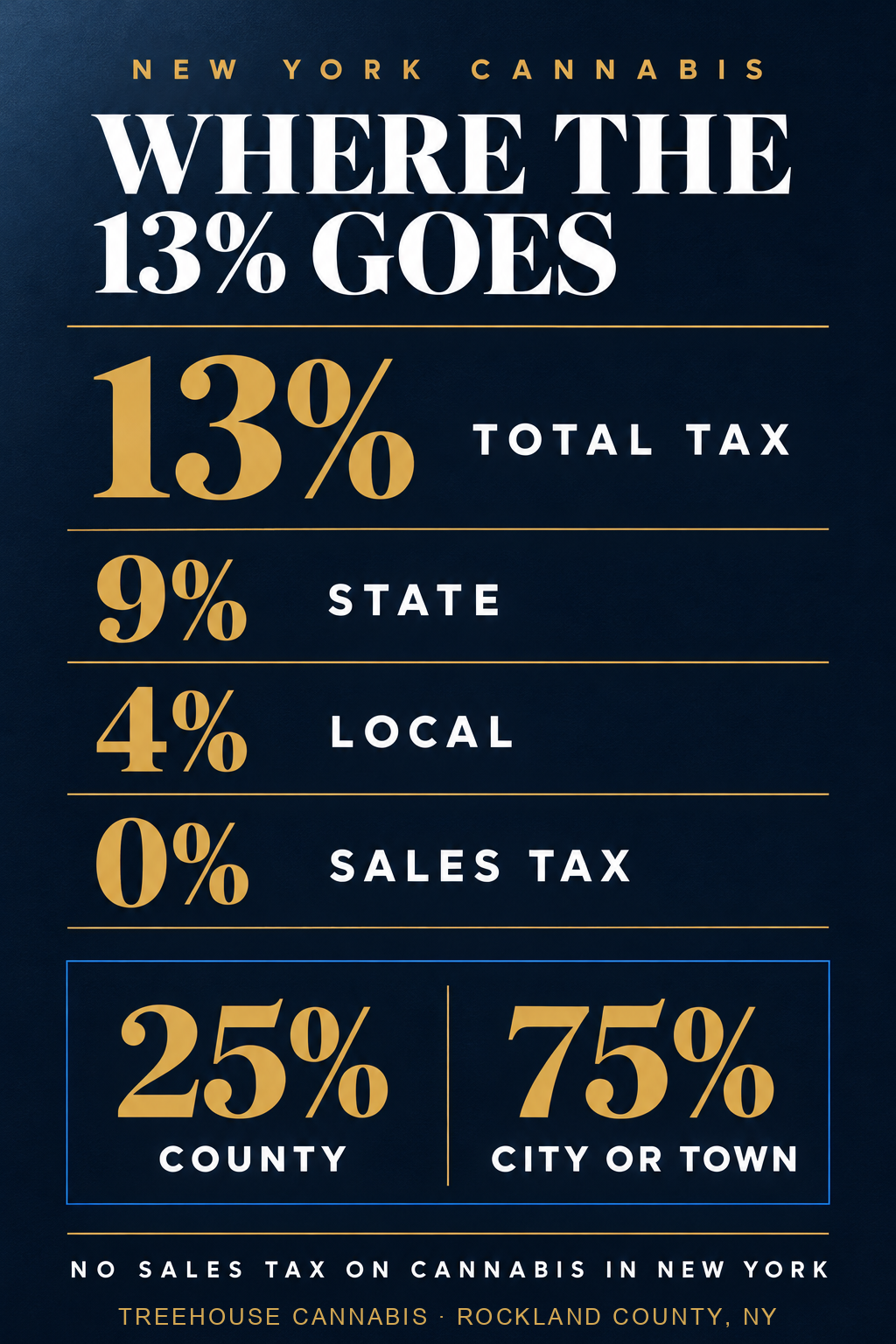
A county comptroller's report describes the same 4% from the municipal side, as 3% to the municipality where the sale occurred and 1% to the county [8]. The two descriptions reconcile: 3% plus 1% is the local 4%, and how it is booked depends on whether you are looking at it from the municipality's ledger or the county's.
- 4% local share: 25% county, 75% cities, towns, or villages where the sale happened
- Same 4% described by a county comptroller as 3% municipality plus 1% county
- Cannabis Revenue Fund: 40% education, 40% Community Grants Reinvestment Fund, 20% Drug Treatment and Public Education Fund
- Dutchess County received $1,565,037 across September 2023 to November 2025, including a $391,259 county share
- Buying locally keeps the local share in the county where the sale happens
The state side flows into the Cannabis Revenue Fund, split 40% to education, 40% to the Community Grants Reinvestment Fund, and 20% to the Drug Treatment and Public Education Fund [3]. Those are statutory allocations, not discretionary grants, which is why the split stays fixed as revenue grows.
For a sense of scale at the county level, Dutchess County reported receiving $1,565,037 in cannabis tax revenue for sales from September 1, 2023 through November 30, 2025, of which $391,259 was the county's own 25% share [8]. That is one county's number, not a projection for Rockland, Orange, or Westchester, and it is a useful reminder that the local share is a real revenue line rather than a rounding error.
None of this changes what you pay. The local share is carved out of the 13% you were already charged, not added to it. If you are choosing between flower formats and want the most product for a fixed budget, Whole Flower Flower lists whole flower options where the per-gram math tends to work in your favor at higher volumes.
How Do You Read a New York Dispensary Receipt?
State regulation sets the standard. Under 9 NYCRR 123.10, a retail dispensary that displays a price must also display the total cost including all taxes the consumer would pay, separately but in a similar font size or manner. Receipts must delineate the tax paid for each tax imposed under Article 20-C [6]. In plain terms: the tax-included number has to be visible, and the receipt has to itemize.
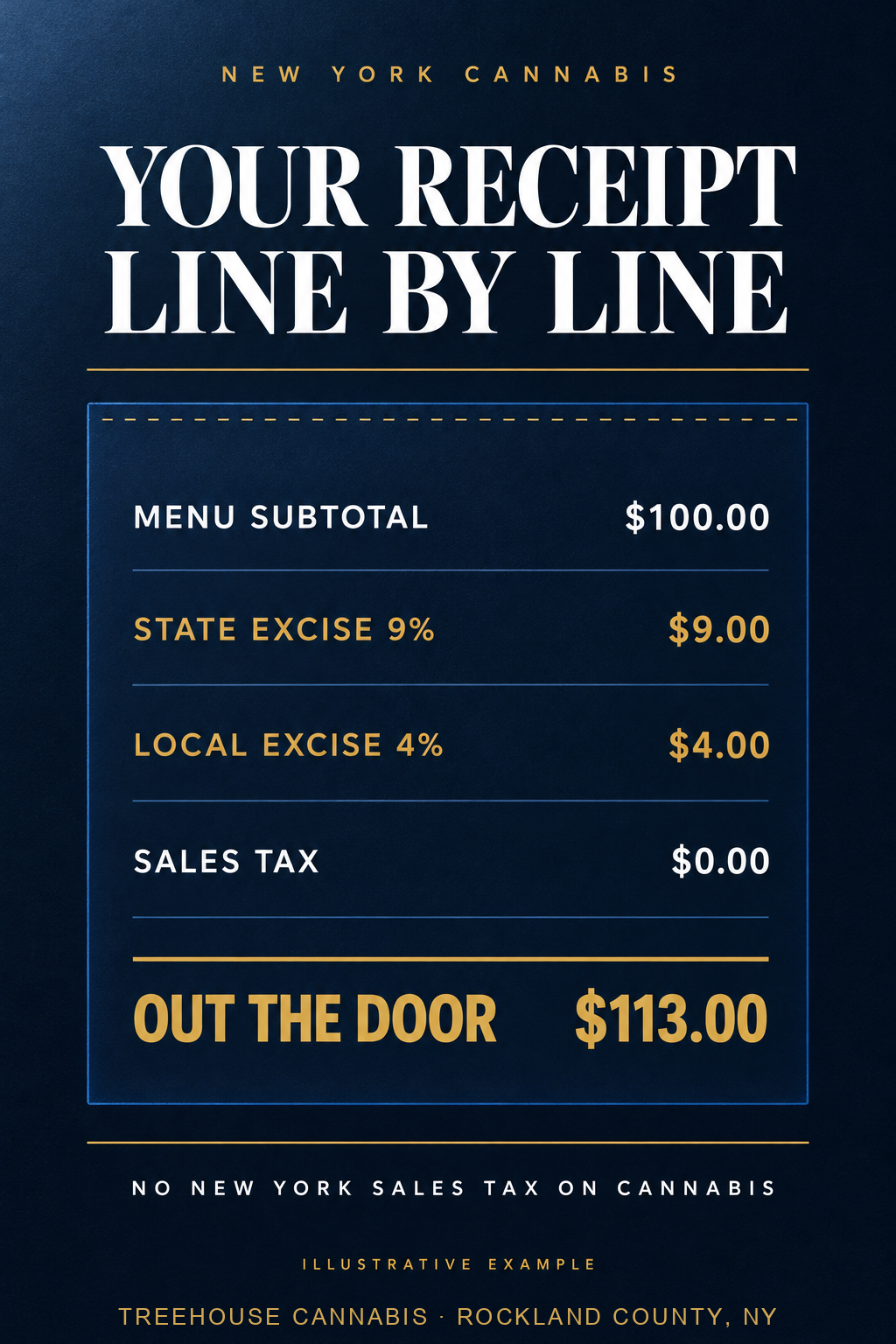
The Office of Cannabis Management's sample receipt shows what that looks like in practice: a subtotal, a 9% state excise line, a 4% local excise line labeled as staying in the village, town, city, or county of sale, and a total [4]. There is no New York sales tax line on the cannabis itself.
- Regulation requires the tax-included total to be displayed with the price, in a similar font size or manner
- Receipts must separately delineate each cannabis tax imposed under Article 20-C
- Expect a subtotal, a 9% state excise line, a 4% local excise line, and a total
- Expect no New York sales tax line on the cannabis itself
- Accessories on the same ticket follow the ordinary sales tax rate
- Check that the register total matches the displayed out-the-door price
A short check you can run at the counter:
- Confirm the subtotal matches the menu prices before tax.
- Confirm the state excise line equals 9% of that subtotal.
- Confirm the local excise line equals 4% of that subtotal.
- Confirm there is no separate state or local sales tax line on cannabis products.
- Confirm any accessories are taxed at the ordinary rate, which is 8.375% combined in Rockland County [10].
- Confirm the final total matches the tax-included price that was displayed.
Point 5 is the one most likely to produce a question, and it is also the one most likely to be correct as printed. A lighter taxed at 8.375% next to an eighth taxed at 13% is two different tax rules applied to two different categories of goods on one ticket, exactly as the law intends.
The regulation requires disclosure, not a specific layout. Point-of-sale systems vary in labeling and line order, so a shop may call the state line "NY Excise 9%" and the local line "Rockland Local 4%" while another uses different words. What has to be consistent is the substance: both taxes shown, no sales tax on the cannabis, and a total that matches the displayed price.
Pre-rolls are a good line to test this on, since a single-item purchase makes the arithmetic easy to verify by eye. Infused Buds Flower covers infused options if you are looking at pre-rolls that carry added concentrate.
Why Does Cannabis Pricing in New York Run Higher Than the Tax?
Because the 13% is a constant, price differences between products come from the sticker price, not from the tax rate. Two shops charging 13% on a $44 eighth both collect $5.72. If one shop's eighth costs $38 and another's costs $52, the gap is entirely in the base price, and the tax simply rides along proportionally.
As context for what a New York menu looks like before tax, November 2026 medians ran $44.00 for a 3.5 gram eighth, $19.47 for a single pre-roll, $28.00 for a 100 mg edible pack, $60.00 for a gram of concentrate, and $177.44 for an ounce [11]. Those are medians across licensed menus, not a single shop's pricing.
- Median New York menu prices in November 2026: $44.00 for an eighth, $19.47 for a single pre-roll, $28.00 for a 100 mg edible pack
- Statewide adult-use retail sales passed $4.1 billion since December 2022
- $1.41 billion in sales through the third quarter of 2026
- 744 licensed adult-use retailers open out of 1,039 licensed
- The tax rate is constant at 13%, so out-the-door comparison is the fair comparison
The market behind those prices has matured quickly. New York has recorded more than $4.1 billion in adult-use retail sales since December 2022, including $1.41 billion through the third quarter of 2026, with 744 licensed adult-use retailers open out of 1,039 licensed [7]. More licensed competitors generally means more price competition at the sticker, which is where the variation lives.
Licensed operators also carry costs that unlicensed sellers do not: mandatory testing, child-resistant packaging, licensing fees, seed-to-sale tracking, and compliance staffing. Those costs sit in the sticker price, not in the 13%. That is why blaming the tax for sticker shock misreads the receipt. The tax is the most predictable number on it [1].
So compare the way the math actually works. Add 13% to each candidate total and compare the out-the-door numbers, because the percentage will not break a tie. If the difference matters to your budget, buy the format where the per-gram or per-milligram cost is lowest rather than the one with the smallest sticker, which is where Martian Mints Flower - 70g pricing rewards a little arithmetic.
Branded apparel and accessories sit outside the cannabis exemption entirely, so they carry ordinary sales tax instead of the 13% excise. New York Wants Weed T-Shirt is an example of a non-cannabis item that follows that different rule.
Treehouse Cannabis in Rockland County lists out-the-door pricing on the menu, so the 13% is already in the number you see. Check the current menu before you shop and compare totals, not stickers.
Frequently Asked Questions
How much is the cannabis tax in New York?
New York adds a 13% retail excise tax to every adult-use cannabis purchase. Of that, 9% goes to the state and 4% goes to the local government where the sale happens. Adult-use cannabis is exempt from ordinary sales tax, so 13% is the only tax added at the register. [1] [3]
Do you pay sales tax on weed in New York?
No. The New York State Department of Taxation and Finance states that adult-use cannabis products are exempt from sales tax. The 13% cannabis excise tax stands in place of the state and local sales tax you would pay on other goods, so the two are never stacked on the same purchase. [1]
Is New York weed taxed twice?
Two taxes exist, but only one is charged to you at checkout. A 9% wholesale excise is paid upstream when cannabis moves to a retailer and is already built into shelf prices. The 13% retail excise is added to your subtotal at the register. [1] [4]
Did New York get rid of the THC potency tax?
Yes. Before June 1, 2024, New York taxed wholesale cannabis by THC content at $0.005 per milligram for flower, $0.008 for concentrates, and $0.03 for edibles. The Fiscal Year 2025 budget repealed that potency tax and replaced it with a flat 9% wholesale excise to simplify collection. [2] [5]
Why does my New York dispensary show the price with tax included?
State regulation requires it. Under 9 NYCRR 123.10, a dispensary that displays a price must also display the total cost including every tax, separately but in a similar font size or manner. The menu and the shelf tag should both show your out-the-door number. [6]
Where does the 4% local cannabis tax go?
It stays local. The county keeps 25% and distributes 75% to the cities, towns, or villages inside it, in proportion to cannabis sales. A purchase in Rockland, Orange, or Westchester County therefore funds those local governments rather than the state general fund. [3]
Are lighters, papers, and pipes taxed differently from cannabis?
Yes. The cannabis excise and the sales tax exemption apply to adult-use cannabis products, not to accessories. Lighters, papers, and pipes are ordinary taxable goods, so they carry the regular state and local sales tax, which is 8.375% combined in Rockland County. [1] [10]
Is medical cannabis taxed the same way in New York?
No. Medical cannabis sits outside the 13% adult-use retail excise. Registered organizations pay a 3.15% excise on gross receipts, and state rules bar them from adding it as a separate line item on a patient's receipt, so patients do not see a cannabis tax line at checkout. [9]
Sources
- New York State Department of Taxation and Finance — Establishes the current statewide rates effective for sales on and after June 1,
- New York State Department of Taxation and Finance — Documents the repealed THC potency tax that applied to wholesale sales before Ju
- New York State Office of Cannabis Management — Describes the three adult-use taxes in shoppers' terms (9% wholesale, 9% state r
- New York State Office of Cannabis Management — Walks through an actual licensed dispensary receipt line by line, labeling the 9
- New York State Cannabis Control Board / Office of Cannabis Management — States that the Fiscal Year 2025 Enacted State Budget repealed the wholesale THC
- New York Codes, Rules and Regulations, Title 9 Section 123.10 (Cornell LII) — Requires a retail dispensary to display, separately but in a similar font size o
- Office of Governor Kathy Hochul — Reports more than $4.1 billion in adult-use retail sales since December 2022, $1
- Dutchess County Comptroller (New York) — Confirms that adult-use cannabis products are exempt from regular sales tax in N
- New York State Department of Taxation and Finance — Sets the medical cannabis excise at 3.15% of gross receipts for sales on and aft
- Avalara — Puts Rockland County's combined ordinary sales tax rate at 8.375% for 2026 (4% N
- JointCommerce Cannabis Price Index — Reports median New York dispensary menu prices for November 2026 before tax: $44
- New York State Division of the Budget — Explains the policy reasoning behind the 2024 change: repealing the wholesale TH
About Treehouse Cannabis
Treehouse Cannabis serves customers across Rockland, Orange, and Westchester Counties, and lists out-the-door pricing on the menu so the 13% is already in the number you see. Bring a valid photo ID, ask a budtender to walk you through the tax lines on a receipt, and compare totals rather than stickers before you check out.
Cannabis is for adults 21 and older. Keep all cannabis products out of reach of children and pets, and do not drive or operate machinery after use. This article is educational and is not medical or legal advice. Cannabis affects people differently, and legal limits on possession and use still apply.

Shop our products

Shop All
Deals

Flower

Pre-rolls
Vaporizers

Edibles
Drinks

Concentrates
Tinctures

Topicals

CBD

Pet CBD

Accessories