What Does “Total THC” Mean on a Cannabis Label?
What Does “Total THC” Mean on a Cannabis Label?
On a cannabis label, total THC meaning is simple: the estimated intoxicating THC a product can deliver once heat is applied. It adds THC that is already active to the THCA that converts during smoking, vaping, or baking, using total THC = THC + (THCA x 0.877). The figure is calculated from a lab test, not measured from your package.
What Does Total THC Mean on a Cannabis Label?
Total THC is a forward-looking number. Raw cannabis stores most of its THC as THCA, an acidic form that does not produce intoxication on its own. Heat removes a chemical group from THCA and leaves behind THC, which is the molecule most customers associate with the cannabis experience. Total THC estimates that end result before you ever light up, vape, or bake.
The formula is short and it is the same one regulators use. Total THC equals the THC already present plus the THCA multiplied by 0.877, and that 0.877 factor accounts for the mass lost during conversion. New York's Part 128 labeling rule requires the principal packaging display panel to state total THC in milligrams per single serving and in milligrams per package, plus total THC as a percentage of weight or volume for inhalable products [1]. State regulators write the arithmetic the same way, as total THC = (THCA x 0.877) + THC, because the factor is built into how potency is reported rather than added afterward [7].
A few things that number is and is not:
- Total THC combines already-active THC with the THCA that becomes THC when heated
- The formula is total THC = THC + (THCA x 0.877), applied the same way by state and federal regulators
- New York requires total THC in milligrams per serving and per package, and as a percentage for inhalables
- The figure comes from a laboratory potency test, not from a measurement of the specific package you are holding
- A label may print total THC alongside a separate delta-9 THC figure for the product as tested
That last point trips people up. Delta-9 THC is what the lab measured directly in the sample. Total THC is what the same sample could deliver after decarboxylation. On a flower label heavy in THCA, the total figure can run several points above the delta-9 figure, and both are accurate descriptions of different things.
If you have ever tried to work backward from a package to a homemade batch, the same math applies in your kitchen. The process is spelled out in this guide to How to Calculate THC in Homemade Edibles.
How Do You Calculate Total THC From a Cannabis Label?
Find the potency panel first. Most regulated packages print THCA and THC as separate percentages, and edibles usually print them as milligrams. You want the THCA number, because that is the one that needs converting.
Three steps cover the whole calculation.
- Find the THCA percentage or milligram figure on the potency panel
- Multiply that THCA figure by 0.877
- Add the printed THC figure to the result
Take a flower label listing 23.2% THCA and 1.0% THC. Multiply 23.2 by 0.877 and you get about 20.35. Add the 1.0 and the total THC lands at roughly 21.35%, not 24.2%.
Potency panels print THC and THCA separately next to the total, and the total reflects the theoretical maximum after conversion rather than a simple sum of the two figures [8].
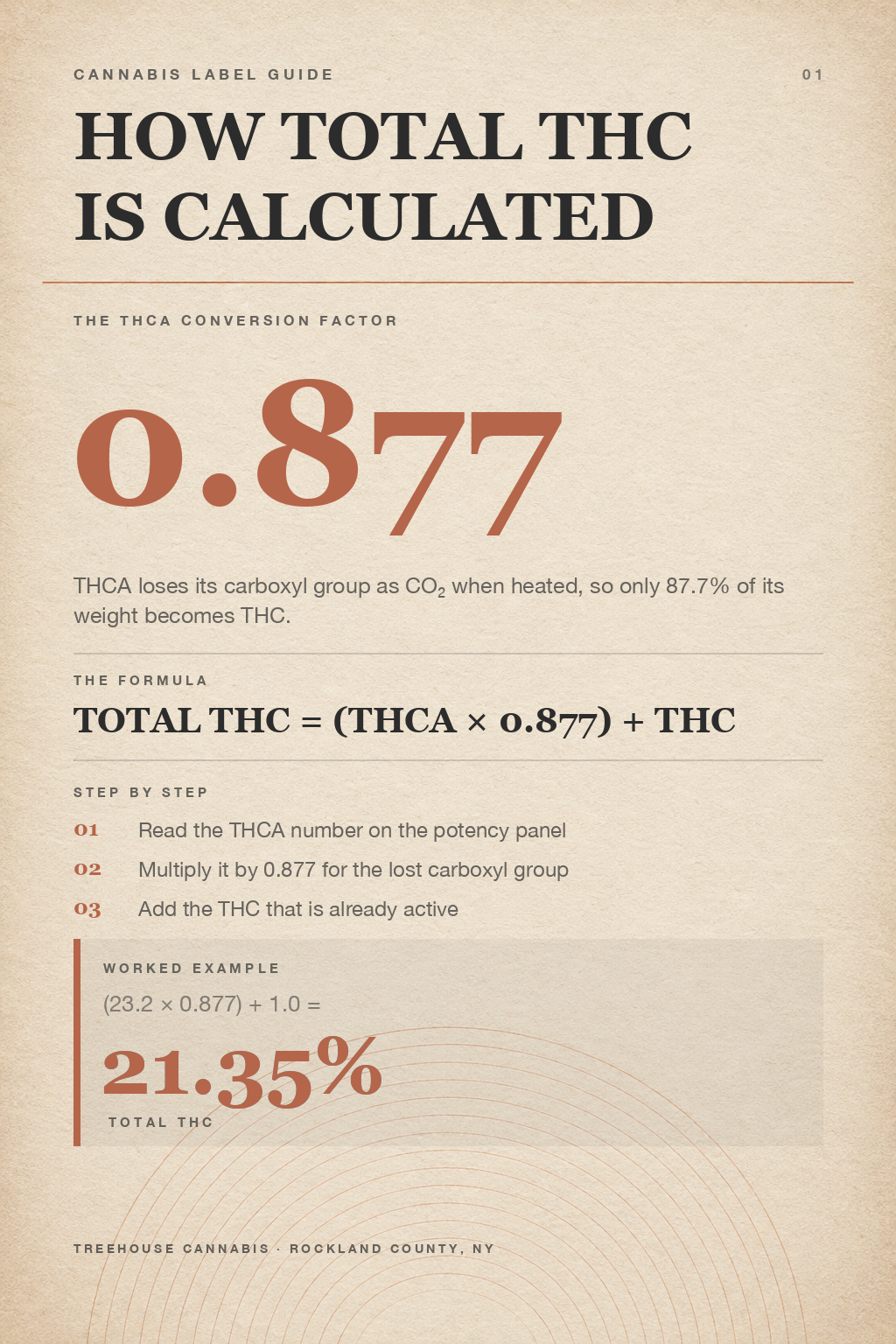
Here is why the order matters. The two printed numbers are never added together directly, so a package reading 1% THC and 23% THCA is not a 24% product. The difference is small at low THCA and large at high THCA, which is exactly where premium flower tends to sit.
| Reading | Math | Result |
|---|---|---|
| Straight sum (wrong) | 23.2 + 1.0 | 24.2% |
| Correct conversion | (23.2 x 0.877) + 1.0 | about 21.35% |
The same three steps work in milligrams. If a single serving lists 5 mg THC and 5 mg THCA, multiply 5 by 0.877 for about 4.4, then add the 5 for roughly 9.4 mg total THC per serving. A label that lists only milligrams per package instead of per serving means you have one more division to do before that math means anything.
For a wider look at what those percentages convert to in practice, this explainer on What Is THC? How the Main Cannabis Cannabinoid Works covers how the molecule behaves once it reaches the body. If you want to translate a converted number into an amount you actually consume, this guide to Cannabis Dosing: How to Find Your Right Amount by Consumption Method walks through finding your right amount by consumption method.
Why Does THCA Conversion Use a 0.877 Multiplier?
THCA is THC with an extra carboxyl group attached, and that extra group is the whole reason the number is not 1.0. When plant material is heated, the carboxyl group breaks away as carbon dioxide gas. The molecule that remains is THC, but it weighs less than the THCA it came from, because part of the mass left as gas.
The 0.877 figure is not a house convention invented by labs. It is the ratio of THC's molecular weight, 314.47, to THCA's molecular weight, 358.47. Divide the first by the second and you get 0.877, which means about 87.7% of THCA's starting weight becomes THC and the rest is lost as CO2.
What the multiplier actually represents:
- THCA is the acidic, non-intoxicating form of THC found in raw and cured cannabis
- Heating removes a carboxyl group that leaves the material as carbon dioxide
- Only about 87.7% of THCA's weight survives that step as THC
- The 0.877 figure is THC's molecular weight divided by THCA's, 314.47 over 358.47
- Federal hemp rules and New York cannabis rules both apply the same factor [3]
This is the same reaction whether the heat source is a lighter, a vaporizer, or an oven. The temperature and duration change how complete the conversion is, not the underlying chemistry. That is also why the multiplier describes a best case, a point worth returning to below.
How to Compare Cannabis Prices by Milligram of THC is a useful next read if you want to see how that converted number translates into price per milligram across different package sizes.
How Do Edibles and Flower Print Total THC Differently?
Inhalable products and edible products use different units because customers consume them differently. Flower, pre-rolls, and vape cartridges print total THC as a percentage of weight or volume, which lets a shopper compare one batch against another on a shelf. Orally ingested products print milligrams per single serving and milligrams per package, because a serving is the unit a customer actually consumes.
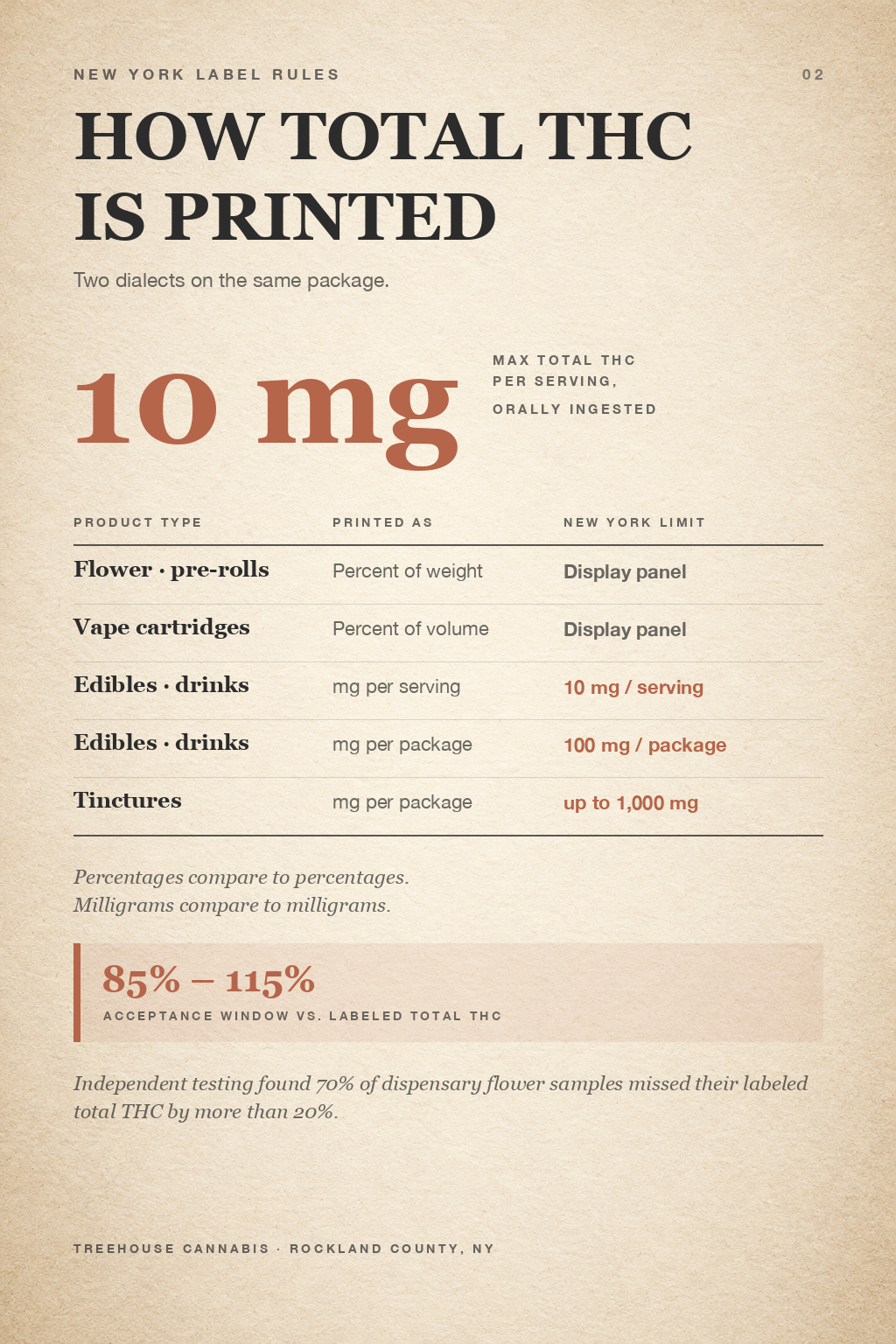
New York enforces that split with specific caps. Orally ingested products may contain no more than 10 mg total THC per serving and 100 mg total THC per package, and tinctures are allowed up to 1,000 mg per package [2]. Those are regulatory ceilings, not suggested amounts.
The practical differences:
- Flower, pre-rolls, and vape cartridges list total THC as a percentage of weight or volume
- Edibles, capsules, and drinks list milligrams per serving and milligrams per package
- New York caps orally ingested products at 10 mg total THC per serving and 100 mg per package
- Tinctures may go up to 1,000 mg total THC per package under state rules
- Divide the package total by the serving count before you compare two edible labels
The two formats side by side:
| Product type | Total THC printed as | New York limit |
|---|---|---|
| Flower and pre-rolls | Percentage of weight | Stated on the display panel |
| Vape cartridges | Percentage of volume | Stated on the display panel |
| Edibles and drinks | Milligrams per serving | 10 mg per serving |
| Edibles and drinks | Milligrams per package | 100 mg per package |
| Tinctures | Milligrams per package | Up to 1,000 mg per package |
A 20% flower label and a 10 mg edible label describe different things and cannot be compared as if they were the same unit. The percentage tells you concentration in plant material. The milligram figure tells you the amount in one serving of a finished product.
You can see the difference on real packaging in our Flower menu, where total THC and the THCA that feeds into it are printed per batch. A jar of Pineapple Express | Small Buds | 28g is a good example of a label where the THCA figure carries most of the total. Edible labels work the other way, since serving count sits next to the package total rather than being folded into a percentage.
If you are shopping flower, Pineapple Express | Small Buds | 28g is a reasonable place to start comparing potency panels side by side. For edible shoppers, Pillow Talk 2:1 | 10 Pack | Gummies | THC: 100mg, CBN: 50mg shows how serving counts and package totals are printed on finished products. Vape shoppers can check Honeycrisp • T-pro Disposable Vape • 2G for total THC listed by volume rather than weight.
Why Is Total THC a Ceiling Rather Than an Exact Dose?
Total THC assumes every bit of THCA converts to THC, and published research shows that assumption does not hold in practice. Decarboxylation is never perfectly complete, and some THC is lost or degraded along the way. Peer-reviewed work on acidic cannabinoid conversion cites an earlier heating experiment in which conversion peaked at only about 65% at 225 degrees Celsius [5].
Heat is not the only variable. THC degrades into CBN over time with exposure to light, heat, and oxygen, so a package that sat in a warm stockroom is not the same product the lab tested. THCA also converts slowly on its own during storage, which shifts the ratio between the two printed numbers without changing the package.
Regulators write the uncertainty into the rule. New York accepts a labeled total THC figure that falls between 85% and 115% of the tested concentration [2]. That window is an explicit acknowledgment that potency is a range, not a fixed point.
Independent testing backs up the range framing. A study of 107 dispensary flower samples found that only 32 landed within plus or minus 20% of the labeled delta-9 THC content, with label claims ranging from 12.04% to 58.20% while measured values ran 12.95% to 36.55% [6]. That is an industry-wide finding about how potency claims are generated, not an accusation aimed at any one retailer or brand.
What that means for a customer:
- Total THC assumes complete conversion, which published research shows does not happen
- One cited heating experiment reached only about 65% conversion at 225 degrees Celsius
- Heat, light, and oxygen can degrade THC into CBN during storage
- New York accepts labeled total THC within 85% to 115% of the tested concentration
- In one independent study, only 32 of 107 dispensary flower samples fell within 20% of the labeled delta-9 THC
The takeaway is to compare labels and verify batches, not to distrust every number you read. A potency panel is the most reliable starting point available to a customer, and it is still an estimate.
How Should You Read Total THC When You Shop?
Read the label the way you would read any other specification: match units before you compare. Percentages only make sense against other inhalables. Milligrams per serving only make sense against other edibles. Cross-format comparisons produce a number that looks meaningful and is not.
Then check what the printed figure actually measures. A menu that lists only delta-9 THC will understate any item heavy in THCA, which covers most flower and many concentrates. Ask whether the number is delta-9 or total before you draw a conclusion about potency. Our Edibles menu prints the serving count beside the package total for exactly this reason.
A short checklist for the counter:
- Compare percentages against percentages, and milligrams per serving against milligrams per serving
- Confirm whether the menu figure is delta-9 THC or total THC
- Ask for the batch potency panel instead of relying on a strain-wide average
- Treat average potency shifts as context: 3.96% in 1995 versus 16.14% in 2022
- Weigh method of consumption, tolerance, and other cannabinoids instead of chasing the highest number
Potency has moved a lot in a generation. Federal monitoring found average delta-9 THC in seized cannabis climbing from 3.96% in 1995 to 16.14% in 2022 [4]. A number that felt strong twenty years ago reads as ordinary today, so old assumptions about what a percentage means deserve a second look.
Finally, remember what total THC does not tell you. It says nothing about how the product is consumed, which other cannabinoids and terpenes are present, or how your own tolerance shapes the experience. Two products with identical total THC can land very differently for those reasons.
The most useful habit is to compare like with like, ask for the batch panel, and treat the number as one input rather than a verdict. Our team walks customers through potency panels every day, and reading the label correctly usually settles the question faster than any strain description.
Frequently Asked Questions
What does total THC mean on a cannabis label?
Total THC is the label's estimate of how much intoxicating THC a product can deliver once heat is applied. It combines THC that is already active with the THCA that converts during smoking, vaping, or baking, using the formula total THC = THC + (THCA x 0.877). New York requires that number in milligrams per serving and per package. [1] [7]
How do you calculate total THC from a label?
Multiply the THCA percentage by 0.877, then add the THC percentage. A flower label listing 23.2% THCA and 1.0% THC works out to (23.2 x 0.877) + 1.0, which is about 21.3% total THC. For edibles, run the same math in milligrams per serving instead of percentages. [7] [8]
Why is THCA multiplied by 0.877?
THCA carries an extra carboxyl group that leaves as carbon dioxide when the plant material is heated. Because that mass is lost, only about 87.7% of THCA's weight becomes THC. The figure is the ratio of THC's molecular weight, 314.47, to THCA's, 358.47, and both federal and New York rules use it. [3] [5]
Is total THC the same as the THC you actually feel?
Not exactly. Total THC is a theoretical ceiling that assumes every bit of THCA converts, and published decarboxylation research shows conversion is never perfectly complete. High heat can also degrade some THC into CBN. Treat total THC as the upper bound of what the product can deliver, not a promise of a specific experience. [5] [2]
What is a typical total THC percentage for flower?
Most regulated flower lands in the high teens to the mid twenties, and potency has climbed sharply over the decades. Federal monitoring found average THC of 3.96% in 1995 versus 16.14% in 2022. Independent testing has also found labeled flower claims far above what the same samples actually measured. [4] [6]
Do edibles list total THC differently than flower?
Yes. Inhalable products print total THC as a percentage of weight or volume, while edibles, capsules, and drinks print milligrams per serving and milligrams per package. New York caps a single serving at 10 mg total THC and a package at 100 mg, with tinctures allowed up to 1,000 mg per package. [1] [2]
Can total THC change after a package is sealed?
It can drift. THCA slowly converts to THC over time, and THC degrades into CBN with exposure to heat, light, and oxygen. That is one reason regulators allow a potency range instead of an exact match, and why New York sets an 85% to 115% acceptance window around the labeled total THC. [2] [5]
Why do two products with the same total THC feel different?
Total THC says nothing about how the product is consumed, what else is in it, or how your body handles it. Inhaled THC reaches the bloodstream in minutes while edible THC is processed through the liver and can take hours. Terpenes, other cannabinoids, tolerance, and dose all shift the experience too. [1] [5]
Sources
- Cornell Legal Information Institute — New York's Part 128 labeling rule requires the principal packaging display panel
- Cornell Legal Information Institute — New York caps orally ingested cannabis products at 10 mg total THC per serving a
- U.S. Department of Agriculture, Agricultural Marketing Service (eCFR) — Federal hemp rules define Total THC as the potential delta-9 THC content derived
- National Institute on Drug Abuse (NIDA) — Average delta-9 THC in seized cannabis samples rose from 3.96% in 1995 to 16.14%
- Cannabis and Cannabinoid Research (National Library of Medicine) — Peer-reviewed decarboxylation research shows THCA-to-THC conversion is never per
- Journal of Cannabis Research (National Library of Medicine) — Of 107 dispensary flower samples tested, only 32 fell within plus or minus 20% o
- Connecticut Department of Consumer Protection — State cannabis regulators explain the total THC formula in plain terms as Total
- Leafly — A typical potency panel lists separate THC and THCA percentages alongside total
About Treehouse Cannabis
Bring the label with you or ask a budtender to walk you through the potency panel at Treehouse Cannabis, serving customers across Rockland, Orange, and Westchester Counties. Comparing total THC, serving size, and the rest of the cannabinoid profile is the fastest way to pick a product that fits what you actually want.
Cannabis is for adults 21 and older. A valid photo ID is required at every licensed New York dispensary, and at delivery hand-off. Do not drive after consuming cannabis. Nothing in this article is medical advice.


Shop our products

Shop All

Deals
Flower

Pre-rolls
Vaporizers

Edibles
Drinks

Concentrates
Tinctures

Topicals
CBD

Pet CBD

Accessories