Beta-Caryophyllene: The Peppery Terpene That Binds CB2
Beta-Caryophyllene: The Peppery Terpene That Binds CB2
What the peppery sesquiterpene actually does at the CB2 receptor, how much of it sits in cannabis flower, and how to read a terpene label before you buy.
Beta-caryophyllene is the peppery sesquiterpene in cannabis that binds CB2, the cannabinoid receptor concentrated on immune cells, rather than CB1, the receptor behind the high from THC. That selectivity is why beta caryophyllene cannabis research looks so different from THC research: no intoxication, no psychotropic effect, and an evidence base built mostly on inflammation and pain models in animals. It is also the only terpene in routine cannabis testing that is documented to activate a cannabinoid receptor directly [13].
What Is Beta-Caryophyllene?
Beta-caryophyllene is a bicyclic sesquiterpene with the formula C15H24, the molecule behind the peppery bite of black pepper and a recurring note in cloves, oregano, basil and hops. Inside cannabis it is one of the major aroma compounds in flower, usually trailing beta-myrcene in measured abundance.
The chemistry explains the behavior. A sesquiterpene is built from three isoprene units, which makes it heavier and less volatile than the monoterpenes such as myrcene and limonene that create the first impression of fresh flower. That is why a peppery note tends to sit underneath citrus or pine top notes rather than lead them.
- Chemical identity: a bicyclic sesquiterpene, formula C15H24, heavier and less volatile than the monoterpenes [3]
- Sensory signature: peppery, woody, faintly spicy, closer to cracked black pepper and cloves than to citrus or pine
- Outside cannabis: black pepper, cloves, cinnamon, oregano, basil, hops and copaiba [13]
- Inside cannabis: one of the major terpenes in flower, typically behind myrcene in abundance
The food-plant list is not trivia. Beta-caryophyllene is the highest-content compound in black pepper essential oil, which is why the molecule reads as seasoning before it reads as anything botanical [10]. Anyone who has eaten a peppery meal has already met it.
What separates beta-caryophyllene from myrcene or limonene is not the smell. It is receptor behavior. Chemically it is a terpene, not a cannabinoid, but it attaches to a cannabinoid receptor directly, and that is unusual enough to carry the rest of this article. For a wider survey of where the compound turns up across the plant kingdom, Beta-Caryophyllene: Exploring the Peppery, Herbaceous Terpene Found Across the Plant Kingdom is the deeper read.
Why Is Beta-Caryophyllene Called a Dietary Cannabinoid?
Beta-caryophyllene is called a dietary cannabinoid because it binds the CB2 cannabinoid receptor as a functional agonist, and because the same molecule arrives through ordinary food. Researchers coined the phrase in a 2008 paper in the Proceedings of the National Academy of Sciences that measured the interaction directly [1].
- The 2008 finding: selective CB2 binding with an affinity constant of 155 nM, published in PNAS [1]
- The control that mattered: mice engineered without the CB2 receptor lost the response entirely [1]
- Why the label fits: the molecule reaches people through black pepper, cloves and other common foods
- Selectivity in plain terms: CB2 binding without CB1 engagement, and therefore no psychotropic effect [5]
- Secondary targets: PPAR alpha and PPAR gamma activity described in a 2024 review [5]
The 155 nM figure gets quoted constantly without explanation. An affinity constant describes how tightly a molecule attaches to a receptor in a laboratory assay, and a lower number means tighter binding. It is a measurement of molecular behavior, not a statement about potency in a product, and it should never be read as a dose.
The knockout mice are the part that mattered most. When the compound was given to animals engineered without a working CB2 receptor, the effect disappeared, which is the standard way to show a receptor is doing the work rather than coincidence [1]. A behavioral change in a normal mouse could come from a dozen downstream causes. A behavioral change that vanishes when one gene is removed points at that gene's receptor.
Two later findings broadened the picture without changing the core claim. A 2024 review describes beta-caryophyllene as a fully selective CB2 agonist with no psychotropic effect, and notes that it also acts on PPAR alpha and PPAR gamma, two nuclear receptors involved in metabolic signaling [5]. The same review points out that CB2 sits on microglia and immune cells and is upregulated during tissue damage, which is why so much CB2 research sits in inflammation rather than intoxication.
That last detail is why the dietary label is often stretched further than the evidence allows. Binding a cannabinoid receptor does not confirm that terpenes and cannabinoids combine to amplify each other. What Is the Entourage Effect—and Is It Backed by Science? covers what the entourage hypothesis actually claims and where the science currently stands on it.
For orientation on the rest of the aromatic family, The Cannabis Terpene Wheel: A Visual Guide to Every Common Terpene maps every common terpene in cannabis in one place, and A Guide to Terpenes and Their Effects walks through what each of them is generally associated with.
How Does CB2 Binding Differ From THC at CB1?
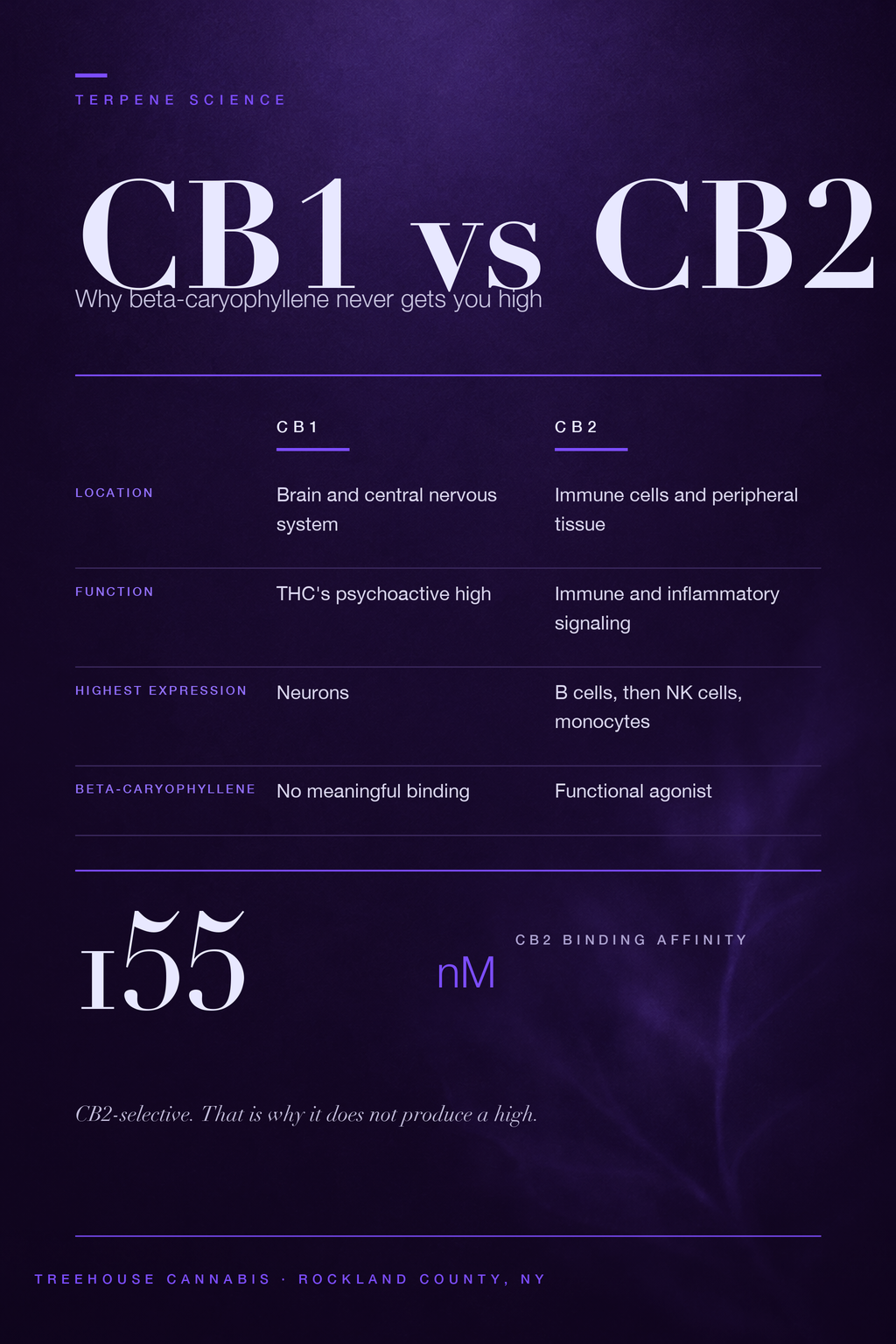
CB1 in the brain drives the high from THC, while CB2 on immune cells is where beta-caryophyllene acts, and that tissue split is why the terpene is not psychoactive. CB1 is concentrated in the brain and central nervous system. CB2 is expressed far more heavily on immune cells, where it handles immune and inflammatory signaling [9].
| Receptor | Where it is concentrated | What it drives |
|---|---|---|
| CB1 | Brain and central nervous system | The psychoactive effect of THC |
| CB2 | Immune cells and peripheral tissue | Immune and inflammatory signaling |
- CB1: concentrated in the brain, the receptor behind THC's psychoactive effect [9]
- CB2: dense on immune cells, with expression ranked B cells, natural killer cells, monocytes, neutrophils, CD8 T-cells and CD4 T-cells [9]
- The practical consequence: CB2 selectivity means beta-caryophyllene does not produce a high [5]
- Why immune distribution matters: CB2 is upregulated during tissue damage, which is why CB2 research centers on inflammation [5]
The expression ranking is worth pausing on, because it is the opposite of what most people assume about cannabis receptors. CB2 is not a brain receptor waiting for a plant molecule. It is an immune receptor that happens to accept one, and its numbers climb on B cells, natural killer cells, monocytes, neutrophils and both major T-cell populations [9].
That distribution has a practical consequence for anyone reading a terpene panel. A cultivar high in beta-caryophyllene is not a stronger or more intoxicating product than one low in it. The compound is not engaging the receptor that produces intoxication, so it cannot add to that effect in any straightforward way. A 2019 cell study went further and found that beta-caryophyllene did not activate CB1 or CB2 on its own in that assay at all, which is covered in more detail below.
The same logic applies to how terpenes are studied one at a time. What Is Limonene? A Citrus-Scented Guide to One of Cannabis’s Most Recognizable Terpenes takes that approach with limonene, and the method is the same: isolate one compound, measure what it does at a receptor, then compare the number with what a person would actually encounter.
What Does Beta-Caryophyllene Smell and Taste Like?
Beta-caryophyllene reads as cracked black pepper first, with cedar and clove behind it and a dry spiciness rather than sweetness. In flower it usually arrives as a bass note under a brighter top end, which is why peppery cultivars often get described as gassy or diesel-adjacent rather than spicy.
The sensory comparison is easy to run at home. Crush a black peppercorn next to a citrus peel: the pepper heat and the citrus sharpness are different compounds doing different jobs. Beta-caryophyllene carries the pepper side, and it does the same work in a hop cone, where it contributes part of the earthy bite [13].
- The nose: cracked black pepper, cedar, clove, a dry spiciness rather than sweetness
- The palate parallel: hops bitterness and black pepper heat both trace back to this compound family
- Oxidation: beta-caryophyllene degrades into caryophyllene oxide, and heat accelerates the conversion [10]
- What that means in the jar: peppery, fresh-smelling flower versus flat, oxidized aroma after poor storage
The oxidation pathway is the part that matters for judging freshness. In a 2021 extraction study on black pepper, caryophyllene oxide levels climbed steadily as temperature rose, while the parent compound declined [10]. The same reaction happens slowly in a warm jar or a hot car, and it is one reason old flower smells dull or faintly like cardboard instead of pepper.
Smell is a reasonable freshness check and a poor predictor of anything else. Aroma tells you which volatile compounds survived storage; it does not tell you cannabinoid content, and it certainly does not predict an effect. The certificate of analysis is the document that answers the chemical questions.
Format changes how much of that aroma reaches you. Whole flower keeps the volatile profile intact longest, a pre-roll exposes ground material to air once it is rolled, and a terpene-forward vaporizer delivers the lighter compounds at a controlled temperature. If aroma is the goal, Flower is the section of the menu where the flower-forward options live.
Honeycrisp • T-pro Disposable Vape • 2G
How Much Beta-Caryophyllene Is Actually in Cannabis Flower?
Measured beta-caryophyllene runs roughly 3.89 to 4.69 milligrams per gram of dried cannabis plant material, according to a validated GC-MS method that quantified 18 terpenes in cannabis essential oil [3]. That is a real number from a real assay, not a marketing figure, and it is a useful anchor for reading terpene panels.
- Measured range: 3.89 to 4.69 mg/g of dried plant material in a validated GC-MS study [3]
- Context: beta-myrcene measured higher at 5.85 to 8.62 mg/g in the same cultivars [3]
- Oxidation product: caryophyllene oxide measured 0.21 and 0.17 mg/g in the two cultivars [3]
- Survey scale: dominant terpene above 20 percent of the total in 39 of 108 chemotypes [4]
- Ceiling case: 65.86 percent of all terpenes and terpenoids in a single chemotype [4]
- Why labels differ: genetics, grow conditions, harvest timing and cure all shift the numbers
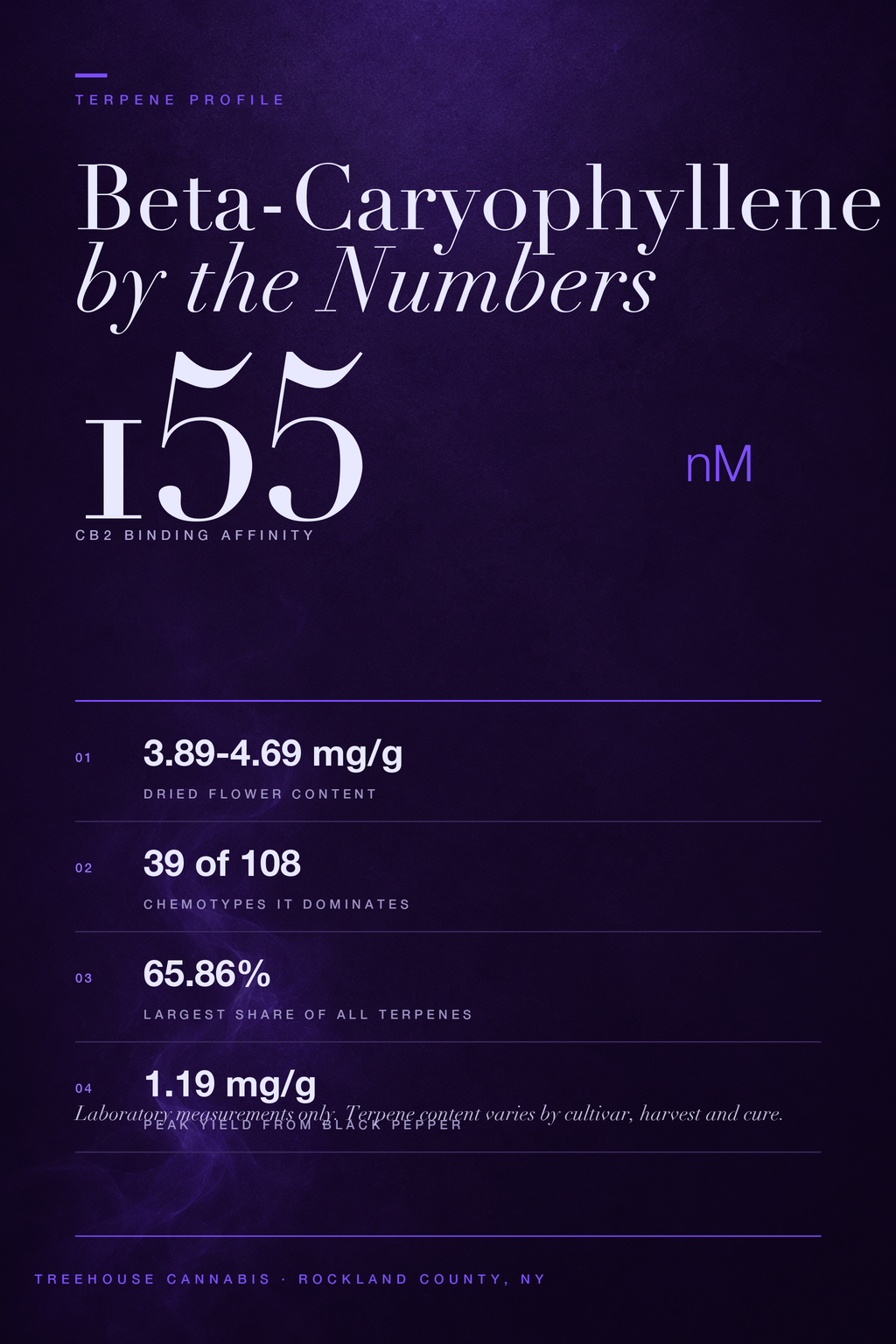
The 108-chemotype survey puts those numbers in context. Across cannabis and hemp samples analyzed by gas chromatography-mass spectrometry, beta-caryophyllene was the dominant terpene, above 20 percent of the total, in 39 of them, which was more than any other single compound [4]. In one chemotype it reached 65.86 percent of all terpenes and terpenoids measured. A compound that can be a rounding error in one cultivar and two thirds of the profile in another is not something a strain name can promise.
The myrcene comparison is the honest counterweight. In the same validated method, beta-myrcene came in higher, at 5.85 to 8.62 mg/g [3]. Beta-caryophyllene is a major terpene in cannabis, but it is usually not the most abundant one, and any article implying otherwise is overselling it.
Milligrams per gram describe what is in the plant. They are not a dose, they do not convert into an intake figure, and they say nothing about how much of the compound reaches you when the flower is heated. Treat the number as a composition measurement, the same way you would read a percentage on a nutrition label, not as a serving size.
Batch variation is the reason two jars of the same cultivar can test differently. Growing conditions, harvest timing, drying and cure all move the volatile profile, and a panel from last year's harvest describes last year's plant. Smaller buds from a given harvest carry the same terpene profile as the large ones, which makes Small Buds Flower a practical way to try a cultivar before committing to a larger format.
What Has Research Actually Shown About Beta-Caryophyllene?
Most of the positive findings come from animal and cell models, and the human record is thin. That is not a reason to dismiss the compound, but it is a reason to read every headline about beta caryophyllene effects with the study design in view.
In mice, oral beta-caryophyllene at 5 mg/kg strongly reduced carrageenan-induced inflammation in normal animals but not in animals lacking the CB2 receptor [1]. The same receptor dependency showed up in pain work: a 2014 study found oral beta-caryophyllene reduced late-phase inflammatory pain in a formalin test, eased heat and pressure sensitivity in a neuropathic pain model without producing tolerance, and outperformed a synthetic CB2 agonist in the same setup [2]. Dose mattered. At 1 mg/kg the compound did nothing in that pain model, so the effect was not a low-dose artifact.
- Animal inflammation data: 5 mg/kg reduced swelling in normal mice but not in CB2 knockout mice [1]
- Animal pain data: late-phase inflammatory and neuropathic pain reduced without tolerance; 1 mg/kg was ineffective [2]
- Human trial data: 100 mg daily for eight weeks lowered food addiction scores in 52 participants, with no effect on appetite or body composition [11]
- Human pharmacokinetics: peak plasma levels roughly tripled with a self-emulsifying formulation and arrived twice as fast [6]
- The counter-evidence: a 2019 cell study found no direct CB1 or CB2 activation from six common terpenes including beta-caryophyllene [8]
- Why the picture stays open: most positive findings are animal models, and receptor-level results conflict across assay types
The human data has two parts, and neither is a clinical result. A randomized, double-blind, placebo-controlled trial gave 52 women with obesity and diagnosed food addiction either 100 mg of beta-caryophyllene daily or a placebo for eight weeks. Yale Food Addiction Scale scores dropped significantly in the treatment group, while appetite, body composition and mental health measures showed no significant change [11]. A single trial in a specific population is a signal worth following, not a conclusion.
The pharmacokinetic work answers a different question: how much of an oral dose actually reaches the bloodstream. In 24 healthy subjects given a single 100 mg dose, a self-emulsifying formulation produced a peak plasma concentration of 204.6 ng/mL against 58.22 ng/mL for the same dose as neat oil, and reached that peak in 1.43 hours instead of 3.07 [6]. Formulation changed absorption by roughly a factor of three and a half, which is the kind of detail that separates a real dosing study from a supplement label.
Then there is the evidence that complicates the story, and it deserves equal billing. A 2019 cell study tested six common cannabis terpenoids, beta-caryophyllene among them, against human CB1 and CB2 receptors. None of them activated either receptor on their own, and none changed the signaling produced by THC or by a full agonist [8]. That directly undercuts the simplest version of the receptor story, and it is why researchers describe the field as unresolved rather than settled.
Two more results widen the uncertainty. In zebrafish tested at 0.02, 0.2, 2.0 and 4 percent exposure, only the highest concentration produced sedation, with no meaningful change in anxiety-like behavior or boldness at the lower levels [7]. And in rat self-administration models, a CB2 antagonist only partially blocked the compound's effects, while the response at higher doses appeared to run through non-CB2 routes [12]. Both findings point the same direction: the CB2 mechanism is real but incomplete, and dose changes which pathway is doing the work.
That is the honest summary. Beta-caryophyllene binds CB2 in binding assays, produces CB2-dependent effects in some animal models, and fails to activate the receptor in at least one cell assay. All of it is preclinical except a small trial and a pharmacokinetic study, and none of it supports a treatment claim.
Which Strains Are Highest in Caryophyllene and How Do You Shop for It?
Caryophyllene-forward cultivars that come up repeatedly include Girl Scout Cookies, Bubba Kush, Sour Diesel, Chemdog, Candyland, Death Star, Original Glue, Gelato, The White and Master Kush [13]. Treat that list as a set of leads rather than a specification, because a name does not control a terpene panel.
- Cultivar list: Girl Scout Cookies, Bubba Kush, Sour Diesel, Chemdog, Candyland, Death Star, Original Glue, Gelato, The White and Master Kush
- Why the name is only a hint: terpene content moves with genetics, grow conditions, harvest timing and cure [4]
- What to read instead: the certificate of analysis, checking beta-caryophyllene as a percentage or in mg/g
- Format matters: whole flower and pre-rolls preserve aroma compounds better than heavily processed formats
- Storage: keep flower sealed, cool and dark so beta-caryophyllene does not oxidize into caryophyllene oxide [10]
Two jars labeled with the same cultivar name can carry genuinely different terpene profiles, because the plant is a crop and the panel describes one harvest [4]. The practical move is to ask what the batch tested rather than what the strain is called, and to check whether beta-caryophyllene appears on the panel by percentage or in milligrams per gram. A dispensary that can hand you a current certificate of analysis is telling you more than any strain description will.
Format and storage decide how much of that profile survives to the moment you open the jar. Whole flower in a sealed, light-proof container holds the peppery note longest. Ground material in a pre-roll starts degrading from the moment it is packed. A vaporizer at a moderate temperature releases the lighter compounds first and leaves the heavier sesquiterpenes for later in the session, which is why the same flower can taste different in a joint and in a vape.
If you want a starting point that is easy to compare against a peppery reference, Girl Scout Cookies | Pre-Ground Infused Flower | 7g is a flower option on the current menu that fits the cookies family.
Gumball Diamond Infused | Pre-Rolls | 5 pack
Frequently Asked Questions
What is beta-caryophyllene?
Beta-caryophyllene is a bicyclic sesquiterpene, the aromatic compound behind the peppery bite of black pepper, cloves and hops. The same molecule is abundant in cannabis, where it acts as a major aroma compound alongside myrcene and limonene. Chemically it is a terpene, but its receptor profile is unusual for that class and gives it a distinct role in the plant. [13] [10]
Why is beta-caryophyllene called a cannabinoid?
Because it binds the CB2 cannabinoid receptor and acts as a functional agonist, a finding published in the Proceedings of the National Academy of Sciences in 2008. The authors coined the term dietary cannabinoid, since the same molecule also occurs in common food plants. That receptor activity separates it from every other major terpene found in cannabis. [1] [5]
Does beta-caryophyllene get you high?
No. Its binding is selective for CB2, which is found mainly on immune cells and peripheral tissues, rather than CB1, the receptor responsible for the high produced by THC. A 2019 laboratory study tested six common terpenes, beta-caryophyllene among them, and found none of them activated CB1 or CB2 on their own or altered THC signaling at receptor level. [9] [8] [5]
What does caryophyllene smell and taste like in cannabis?
Peppery, woody and slightly spicy, closer to cloves and black pepper than to fruit or pine. Chemically it is C15H24, a bicyclic sesquiterpene that also gives hops their earthy character. Cultivars marketed around that flavor profile tend to read as gassy or diesel-adjacent on the nose, which is caryophyllene doing much of the aromatic work. [13] [10]
How much beta-caryophyllene is actually in cannabis flower?
A validated GC-MS method measured beta-caryophyllene at 3.89 to 4.69 milligrams per gram of dried cannabis plant, with beta-myrcene higher at 5.85 to 8.62 milligrams per gram. A separate survey of 108 chemotypes found beta-caryophyllene was the dominant terpene above 20 percent of the total in 39 of them, more than any other compound. [3] [4]
What is the CB2 receptor and where is it found?
CB2 sits alongside CB1 as one of the two main cannabinoid receptors. CB1 is concentrated in the brain and drives the psychoactive effects of THC. CB2 is found in far greater numbers on immune cells, with expression highest in B cells, then natural killer cells, monocytes and neutrophils. That distribution is why CB2 research centers on inflammation and immune signaling. [9]
What has the research actually shown about pain and inflammation?
Mostly preclinical work in animals. A 2014 study found oral beta-caryophyllene reduced the late phase of inflammatory pain in a mouse formalin test, with the effect blocked when the CB2 receptor was removed. Chronic dosing also eased heat and pressure sensitivity in a neuropathic pain model without producing tolerance. Human trials remain limited. [2] [1]
Which cannabis strains are highest in caryophyllene?
Commonly cited caryophyllene-forward cultivars include Girl Scout Cookies, Bubba Kush, Sour Diesel, Chemdog, Candyland, Death Star, Original Glue, Gelato, The White and Master Kush. The name is a rough guide only, since terpene content shifts with growing conditions, harvest timing and curing, so a certificate of analysis is the better reference. [13] [4]
Sources
- Proceedings of the National Academy of Sciences (PNAS) / PubMed Central — The landmark paper showing (E)-beta-caryophyllene selectively binds the CB2 cann
- European Neuropsychopharmacology (Elsevier) — Orally administered beta-caryophyllene reduced late-phase inflammatory pain in a
- Phytochemical Analysis (Wiley) / PubMed Central — A validated GC-MS method quantifying 18 terpenes in cannabis essential oil measu
- Medical Cannabis and Cannabinoids (Karger) / PubMed Central — Gas chromatography-mass spectrometry across 108 cannabis and hemp chemotypes fou
- International Journal of Molecular Sciences (MDPI) / PubMed Central — A 2024 review describing beta-caryophyllene as a fully selective CB2 receptor ag
- Molecules (MDPI) / PubMed Central — The first human pharmacokinetic study of beta-caryophyllene, in 24 healthy subje
- Scientific Reports (Nature) / PubMed Central — Testing beta-caryophyllene at 0.02, 0.2, 2.0 and 4 percent exposure in zebrafish
- Cannabis and Cannabinoid Research (Mary Ann Liebert) / PubMed Central — A cell study of six common cannabis terpenoids including beta-caryophyllene foun
- International Journal of Molecular Sciences (MDPI) / PubMed Central — Establishes the tissue distribution contrast that underpins beta-caryophyllene's
- Food Science and Biotechnology (Springer) / PubMed Central — Beta-caryophyllene has the highest content of any compound in black pepper essen
- Appetite (Elsevier) — One of the few human randomized controlled trials of beta-caryophyllene, giving
- Frontiers in Pharmacology / PubMed Central — In rat self-administration models, a CB2 receptor antagonist partially blocked t
- Leafly — A consumer-facing reference confirming that caryophyllene is the only known cann
About Treehouse Cannabis
Every Treehouse Cannabis product page and in-store terpene panel lists what is actually in the batch, so you can check beta-caryophyllene levels before you commit. Stop by the Rockland County shop or browse the menu online, and ask the team to walk you through the certificate of analysis for any cultivar you are considering.
Cannabis is for adults 21 and older. Keep all cannabis products away from children and pets. This article is educational and is not medical advice. Do not drive or operate machinery while impaired.


Shop our products

Shop All

Deals

Flower

Pre-rolls
Vaporizers

Edibles

Drinks

Concentrates
Tinctures

Topicals

CBD

Pet CBD

Accessories