New York Cannabis Laws in 2026: What's Legal, What's Restricted, What Changed
New York Cannabis Laws in 2026: What's Legal, What's Restricted, What Changed
New York cannabis laws in 2026 allow adults 21 and older to legally possess, use, and cultivate cannabis under the Marihuana Regulation and Taxation Act (MRTA), signed March 31, 2021. The 2026 framework tightens retail proximity rules, expands showcase-event licensing, and adds CAURD license-conversion deadlines without rolling back consumer rights.
This guide walks through what is legal, what is restricted, and what has actually changed for New York cannabis consumers and retailers in 2026, with citations to the OCM, NORML, and the other primary sources behind every number. Readers looking to decode the symbols, dosing, and labeling on a dispensary shelf can start with our breakdown of Decoding NY Cannabis Labels, and for the longer arc of how New York got from prohibition to 660-plus dispensaries, see The Rise of New York Cannabis Dispensaries in: A Historical Perspective.
What Is the Current Legal Status of Cannabis in New York?
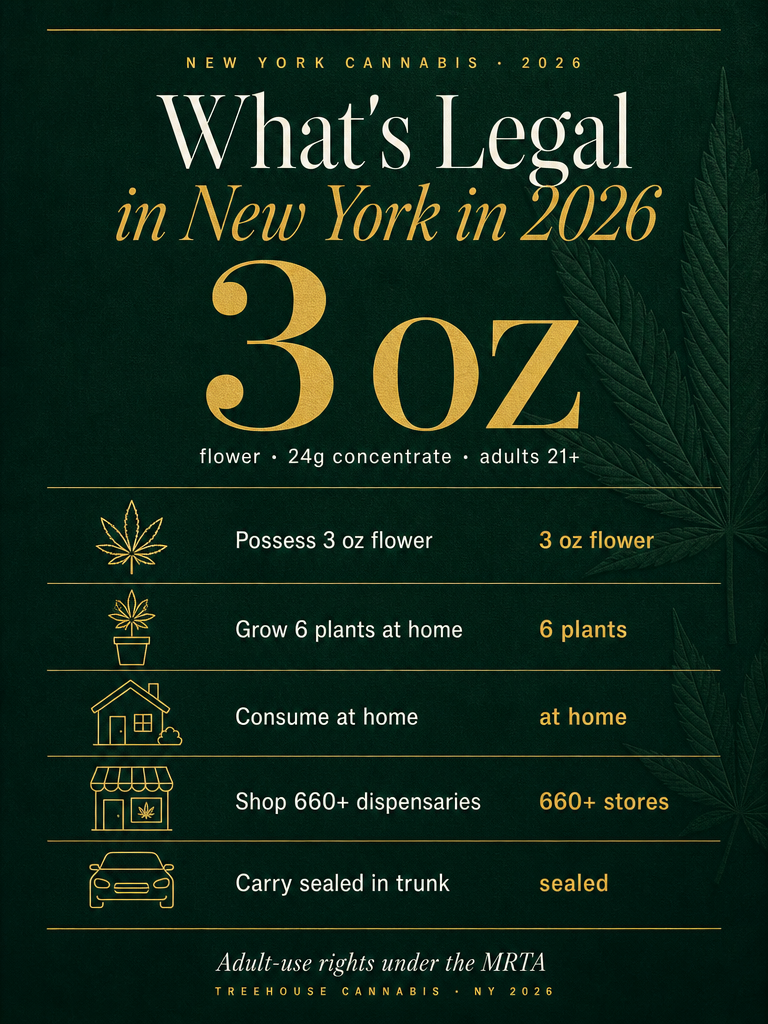
Cannabis is legal for adults 21 and older in New York for personal possession, personal use, and home cultivation, and a regulated retail market is operating statewide. The legal foundation is the MRTA, signed March 31, 2021, which also created the Office of Cannabis Management and the Cannabis Control Board to license and oversee cultivators, processors, distributors, and retailers [8]. As of mid-2026, the OCM has issued more than 1,400 licenses across cultivation, processing, distribution, and retail tiers, and 660-plus adult-use dispensaries are operating across the state.
- Adults 21+ may possess up to 3 ounces of flower and 24 grams of concentrated cannabis outside the home [1].
- Adults 21+ may grow up to 6 plants per household, with no more than 3 mature at a time [1].
- Adults 21+ may consume in a private residence or in most places where tobacco smoking is permitted [1].
- Adults 21+ may buy from any of 660+ licensed dispensaries statewide, and gifting schemes tied to other sales remain illegal [1].
- Driving is permitted only with cannabis sealed in the original packaging and stored in the trunk or a locked compartment, and impairment-based DUI enforcement is unchanged [1].
The MRTA also mandates automatic expungement of certain prior low-level cannabis convictions and sets a 50% social-equity goal for new licenses [7]. That goal is the reason the first wave of retail licenses went to Conditional Adult-Use Retail Dispensary (CAURD) applicants rather than incumbent operators, and the reason the 2026 retail landscape still skews toward justice-impacted owners.
How Much Cannabis Can You Legally Possess in New York?
Adults 21 and older may legally possess up to 3 ounces of cannabis flower and up to 24 grams of concentrated cannabis outside the home in 2026. These limits were set by the MRTA in 2021 and remain unchanged under the Cannabis Law administered by the Office of Cannabis Management [1]. Inside the home, the practical storage limit is whatever is intended for personal use; the OCM does not impose a separate in-home ounce cap.
The 3-ounce / 24-gram split covers two distinct product types:
- Flower includes dried cannabis buds and pre-rolls. Three ounces is roughly 85 grams, enough for casual adult use but tight enough that bulk buyers should plan accordingly.
- Concentrates cover vapes, oils, dabs, edibles, and other infused products measured by weight of the finished item. A single 1-gram vape cartridge and a 100-milligram edible both count toward the 24-gram ceiling.
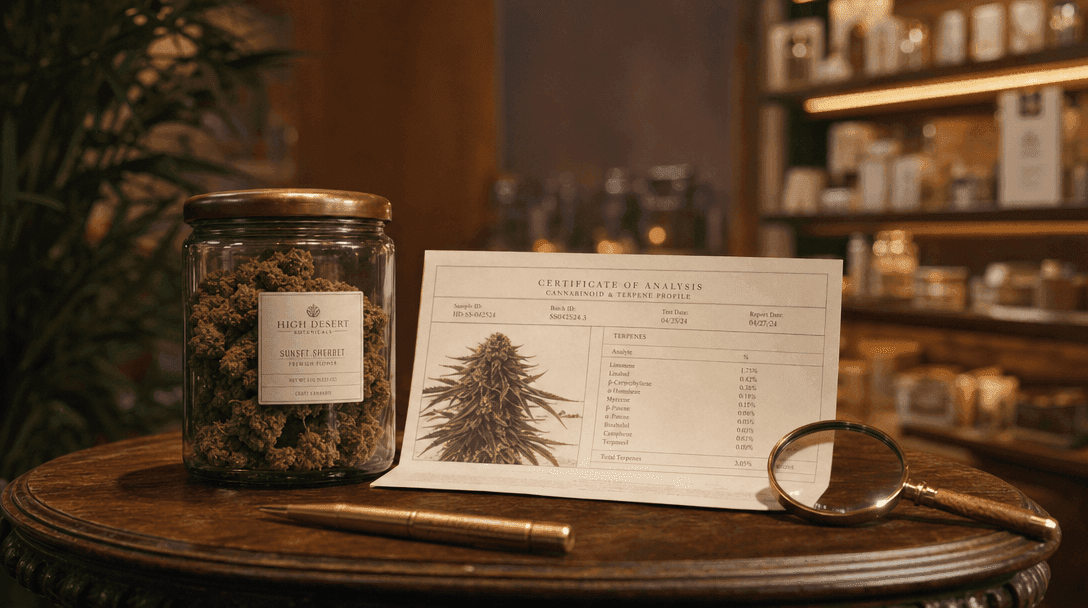
For shoppers browsing licensed dispensaries in New York, the flower category page shows what compliant, lab-tested product looks like on a 2026 shelf, with potency labels and required state warnings already attached.
Possession above the legal limit triggers escalating penalties under New York law. The tiers, as catalogued by NORML, are:
- 3 to 16 ounces: a violation punishable by a fine up to $150 [5].
- 16 ounces to 5 pounds: a misdemeanor with up to 1 year in jail and a $1,000 fine [5].
- 5 to 10 pounds: a felony with up to 4 years imprisonment and a $5,000 fine [5].
- More than 10 pounds: a felony carrying up to 7 years and a $10,000 fine [5].
The practical takeaway: a personal-use stash well under 3 ounces stays in the legal clear. Anything that looks like wholesale weight invites felony exposure.
Can You Grow Cannabis at Home in New York?
Yes. Adults 21 and older may cultivate up to 6 cannabis plants per household in New York, with no more than 3 mature (flowering) plants at any one time [1]. The plant cap is per household, not per resident, so two adults in the same apartment still share a 6-plant ceiling. Home cultivation was one of the cornerstones of the original MRTA and has not been restricted since.
The OCM's home-cultivation guidance is short but specific about guardrails:
- Plants must be kept in a secure, enclosed area, out of public view and out of reach of children [1].
- Home-grown cannabis cannot be sold, and gifting it for value follows the same penalty path as unlicensed retail [1].
- Home-grown cannabis cannot be transported across state lines, even to another legal state, because cannabis remains federally illegal [1].
The federal-status point matters in practice. A plant count dispute that would be a civil violation under New York law can still attract federal attention if the product leaves state borders. For adults who prefer to skip the cultivation question entirely, licensed retail is the cleaner path, and casual apparel like the [New York Wants Weed T-Shirt](New York Wants Weed T-Shirt) makes it easy to show where you stand without ever touching a trim bin.
Where Can You Legally Consume Cannabis in New York?
Adults 21 and older may consume cannabis in a private residence or in most places where tobacco smoking is permitted. The OCM's consumer-facing rules map consumption onto existing tobacco-smoking norms rather than carving out a separate cannabis geography [1].
What is allowed:
- Private residences, including rental units where the lease permits smoking.
- Outdoor areas where tobacco smoking is permitted, such as certain designated sections of public spaces.
- Licensed cannabis dispensaries, where on-premises consumption rules vary by license type and locality [1].
What is restricted or banned:
- Motor vehicles. Cannabis must stay sealed, in the trunk or a locked compartment, and no one in the car may open the packaging [1].
- Private businesses, including restaurant patios and bar outdoor seating, even where tobacco vaping is otherwise tolerated.
- New York State Parks and most other public outdoor spaces under the October 13, 2022 smoking ban, with a $50 maximum local-option civil penalty for violations [1].
- Federal property, including national parks, national forests, and federal buildings within New York State.
- Schools and school grounds, whether or not class is in session.
For concentrate consumers, products like the [Laundry List Live Rosin Stylus Dablicator | 1G](Laundry List | Live Rosin Stylus Dablicator | 1G) are designed for at-home use, and the OCM guidance is the same: keep it indoors, keep it sealed in transit, and do not open it in the car.
What Are the New York Cannabis Retail Rules in 2026?
Adult-use cannabis retail in New York runs through a tiered licensing system administered by the Office of Cannabis Management, with provisional equity-prioritized licenses still converting to final licenses and a fresh proximity law shaping where new stores can open. As of mid-2026, more than 660 licensed adult-use dispensaries are operating statewide [8], up from 261 at the end of 2024.
The current retail framework rests on a few moving parts:
- CAURD provisional licenses, the initial equity-prioritized retail licenses issued in 2022 and 2023, have been extended through December 31, 2026 for conversion to final adult-use retail licenses [4].
- The MRTA's 50% social-equity licensing goal applies across cultivation, processing, distribution, and retail tiers, with funding support of roughly $200 million to qualifying applicants [6].
- The February 11, 2026 S9155/A10140 proximity law codifies a 500-foot setback from same-street schools and a 200-foot setback from same-street houses of worship for any new dispensary location, while grandfathering dispensaries licensed before that date at their existing sites [2].
- The 2025 Second Circuit ruling in Variscite NY Four, LLC v. NY Cannabis Control Board struck down in-state residency priority for cannabis licenses on Dormant Commerce Clause grounds, opening the door to out-of-state operators once final licensing rounds resume [6].
For consumers trying to read the market, our primer on [navigating the cannabis market in New York](Navigating the Cannabis Market in New York) breaks down what to look for on a 2026 dispensary shelf, from terpene labels to required state warnings.
The proximity law is the single most consequential 2026 retail change because it locks in the location footprint of the existing CAURD tier while constraining where new general-license dispensaries can site. A dispensary that opened in 2024 at a corner that would now fall inside a school buffer is protected by the grandfather clause; a new applicant opening in 2026 has to measure carefully.
How Is Cannabis Taxed in New York?
New York uses a hybrid tax on adult-use cannabis: a potency-based distributor excise tax layered with a state retail excise tax and a local retail excise tax at point of sale. The structure was set by the MRTA in 2021 and remains unchanged in 2026 [7].
The three taxes that show up on a receipt or in a wholesale invoice:
- Distributor potency excise: 0.5 cents per milligram of THC for flower, 0.8 cents per milligram for concentrates, and 3 cents per milligram for edibles, paid by the distributor and typically baked into wholesale pricing [7].
- State retail excise: 9% on the retail price, charged at the register [7].
- Local retail excise: 4% on the retail price, also charged at the register, with the locality setting the rate up to the cap [7].
How potency-based tax rates compare across product categories:
| Product type | Distributor potency excise (per mg THC) | Charged at |
|---|---|---|
| Flower | 0.5 cents | Distributor (baked into wholesale) |
| Concentrates | 0.8 cents | Distributor (baked into wholesale) |
| Edibles | 3 cents | Distributor (baked into wholesale) |
Concentrate products take a higher potency tax per milligram than flower, which is one reason a high-THC cart carries a noticeably heavier tax load than the same dollar value of flower. For shoppers comparing concentrate categories, the concentrates catalog page makes the per-milligram math easier to see in practice.
State cannabis revenue is split, after administrative costs, by formula:
- 40% to education [7].
- 40% to the Community Grants Reinvestment Fund, which funds community reinvestment in areas disproportionately impacted by prior cannabis enforcement [7].
- 20% to drug treatment and public education [7].
The combined retail tax load at checkout is 13% on top of wholesale, before any local sales tax. For a $50 flower purchase, that means roughly $6.50 in state and local cannabis excise alone, separate from standard sales tax.
What Changed in New York Cannabis Law in 2026?
Four regulatory actions defined the 2026 New York cannabis landscape, each with a direct effect on consumers, retailers, or both. The full picture comes from the OCM's official rulemaking history [3].
- February 11, 2026: Governor Hochul signed S9155/A10140, clarifying how school and house-of-worship proximity distances are measured for cannabis retailers. Existing dispensaries were grandfathered at their current sites; new locations must observe the 500-foot school and 200-foot house-of-worship setbacks measured on the same street [2].
- March 25, 2026: OCM proposed amendments to Part 113 of the Medical Cannabis regulations, expanding patient access and refining provider rules. The proposed amendments were open for public comment through the spring [3].
- April 22, 2026: OCM adopted Part 117, the Cannabis Showcase Events regulations, creating a formal licensing path for ticketed cannabis tasting and education events. Showcase events expand consumer access beyond the dispensary counter and give operators a new way to introduce new products [3].
- December 31, 2026: The CAURD provisional license conversion deadline. CAURD operators who do not convert to final adult-use retail licenses by this date will not be able to continue operating under the CAURD framework, which will reshape the equity-licensed retail tier in 2027 [4].
The net effect for adult-use consumers is a tighter, more legible market: existing dispensaries protected, new ones constrained, and showcase events opening a fresh channel for product discovery. For more on the consumer side of the new product mix, our roundup of [cannabis-infused drinks in New York](Exploring the Best Cannabis-Infused Drinks in New York) tracks one of the categories showcase events are already surfacing.
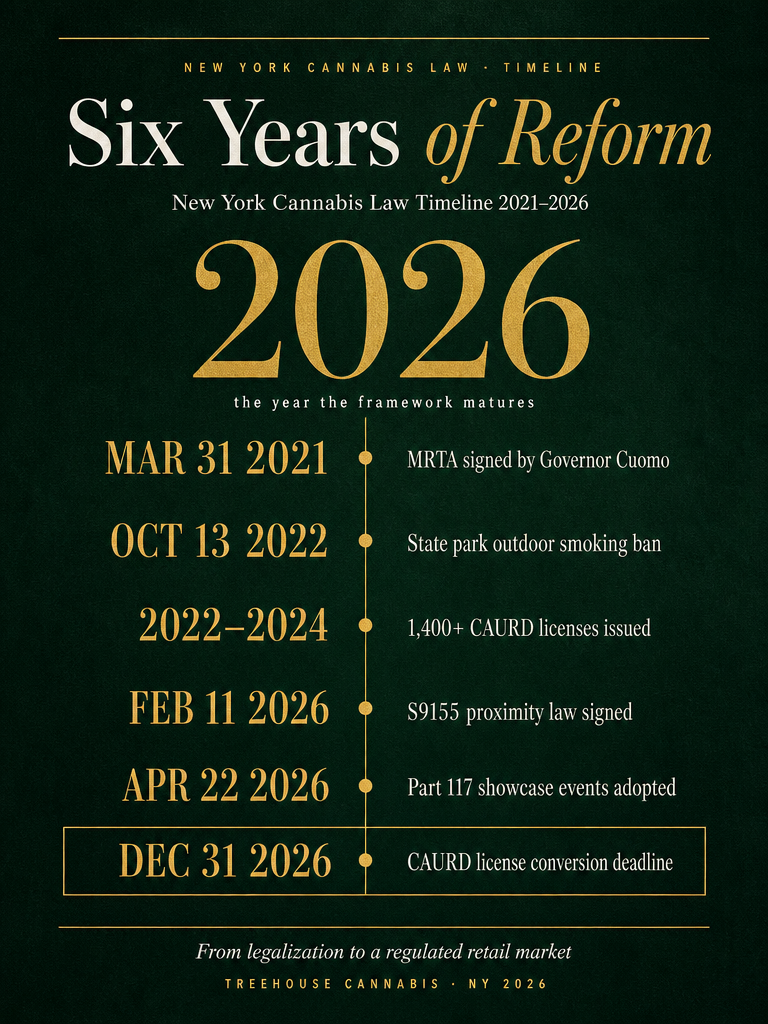
The April 2026 Part 117 adoption is the most consumer-visible change of the year because it legalizes a category of events that previously existed in a regulatory gray zone. Ticketed, licensed showcase events give New York adults a way to sample and learn about regulated products in a controlled setting, with consumption limits and security requirements built into the license.
What Should New York Cannabis Consumers Know Before Buying?
The 2026 retail market is the cleanest it has been since legalization, but a few habits keep every purchase inside the law:
- Buy only from licensed dispensaries. Gifting schemes tied to other sales are illegal under the OCM's enforcement posture and have been a consistent enforcement target [1].
- Keep cannabis in the original sealed packaging when transporting. Open product in a car is an open-container violation even if the driver is not impaired [1].
- Never cross state lines with cannabis, even between two legal states. Federal law applies at the border and on federal land, and the OCM's consumer guidance reflects that boundary directly [1].
- Treat cannabis DUIs as seriously as alcohol DUIs. Impairment-based enforcement has continued throughout legalization and is unaffected by the 3-ounce possession limit [1].
- Watch for licensed showcase events. Part 117, adopted April 22, 2026, created a regulated path for cannabis tasting and education events separate from dispensary retail [3].
For adult-use customers in Rockland, Orange, and Westchester Counties looking for compliant, lab-tested flower, pre-rolls, vapes, and edibles, Treehouse Cannabis carries product from New York-licensed cultivators on every shelf. Every item in stock is tested, labeled, and tracked under the current OCM framework, so the legal paperwork is already done before the bag goes out the door.
Frequently Asked Questions
How much cannabis can I legally possess in New York in 2026?
Adults 21 and older may legally possess up to 3 ounces of cannabis flower and up to 24 grams of concentrated cannabis (edibles, oils, and vapes) outside the home. These limits were set by the MRTA in 2021 and remain unchanged in 2026, administered by the New York Office of Cannabis Management.
Can I grow cannabis at home in New York?
Yes. Adults 21 and older may cultivate up to 6 cannabis plants per household, with no more than 3 mature plants at any one time. Plants must be kept in a secure enclosed area, out of public view, out of reach of children, and home-grown cannabis cannot be sold or transported across state lines.
What is the MRTA and what does it do?
The Marihuana Regulation and Taxation Act, signed March 31, 2021, legalized adult-use cannabis in New York and created the Office of Cannabis Management and Cannabis Control Board to regulate the new adult-use, medical, and cannabinoid hemp programs. It also mandated automatic expungement of prior low-level convictions and set a 50% social-equity licensing goal.
Where can I legally consume cannabis in New York?
Adults 21 and older may consume cannabis in a private residence or in most places where tobacco smoking is allowed. It is illegal to consume in a motor vehicle, in a private business, in any New York State Park or other public outdoor space under the October 2022 ban, or on federal property including national parks.
What changed for cannabis dispensaries in February 2026?
Governor Hochul signed S9155/A10140 on February 11, 2026, clarifying how school and house-of-worship proximity distances are measured for cannabis retailers. The law codifies a 500-foot setback from same-street schools and a 200-foot setback from same-street houses of worship, while grandfathering any dispensary licensed before that date at its existing location.
How is cannabis taxed in New York?
New York uses a hybrid tax on adult-use cannabis: a potency-based distributor excise tax of 0.5 cents per mg THC for flower, 0.8 cents for concentrates, and 3 cents for edibles, plus a 9% state retail excise tax and a 4% local retail excise tax at point of sale. State revenue is split 40% to education, 40% to the Community Grants Reinvestment Fund, and 20% to drug treatment and public education.
What are the penalties for possessing more than 3 ounces of cannabis in New York?
Possessing 3 to 16 ounces is a violation punishable by a fine up to $150. Possessing 16 ounces to 5 pounds is a misdemeanor with up to 1 year in jail and a $1,000 fine. Possessing 5 to 10 pounds is a felony with up to 4 years imprisonment and a $5,000 fine, and more than 10 pounds is a felony carrying up to 7 years and a $10,000 fine.
How many licensed cannabis dispensaries are operating in New York in 2026?
As of mid-2026, more than 660 licensed adult-use dispensaries were operating statewide, up from 261 at the end of 2024. The Office of Cannabis Management has issued over 1,400 licenses across cultivation, processing, distribution, and retail tiers since the launch of the regulated adult-use market.
Sources
- New York State Office of Cannabis Management — Defines the legal possession limits (3 oz flower / 24 g concentrate), where adul
- New York State Office of Cannabis Management — Documents the February 11, 2026 S9155/A10140 amendment that grandfathered dispen
- New York State Office of Cannabis Management — Provides the official timeline of MRTA-implementing regulations, including the A
- New York State Office of Cannabis Management — Explains the CAURD program as the initial equity-prioritized retail licensing me
- NORML — Catalogs the penalty tiers for possession, sale, and cultivation above the legal
- Cornell Law School Legal Information Institute — Explains CAURD's justice-impacted eligibility criteria, the $200M funding mechan
- Marijuana Policy Project — Summarizes the original MRTA provisions legalizing possession of 3 oz / 24 g, th
- Wikipedia — Provides legislative history (S854-A/A1248-A, signed March 31, 2021 by Governor
About Treehouse Cannabis
Treehouse Cannabis serves adult-use customers across Rockland, Orange, and Westchester Counties with lab-tested flower, pre-rolls, vapes, and edibles from New York-licensed cultivators. Every product on our shelves is compliant with current NY cannabis laws, tracked under the OCM framework, and labeled with the potency and warning information required by state regulation.
This content is intended for adults 21 and older in New York State. Cannabis is for adults of legal age only; keep out of reach of children and pets. Do not drive or operate machinery after consuming cannabis. Consult a qualified healthcare professional before using cannabis if you are pregnant, nursing, or taking medication. The information in this article is educational and does not constitute legal advice.

Shop our products

Shop All
Flower

Pre-rolls
Vaporizers

Edibles
Drinks

Concentrates
Tinctures

Topicals
CBD

Pet CBD

Accessories