
The History of Cannabis in New York
The History of Cannabis in New York
New York cannabis history spans more than a century, from the 1914 Boylan Bill restriction through the 1927 state ban, the 1937 Marihuana Tax Act, and the 1973 Rockefeller Drug Laws. The arc ended with the 2021 MRTA, which made New York the 15th state to legalize adult-use cannabis [2].
When Was Cannabis First Restricted in New York?
New York first restricted cannabis in 1914, when an amendment to the Boylan Bill placed Cannabis indica on the city's list of controlled drugs and required a prescription to obtain it. The state pushed much further in 1927, when it removed all medical purposes and completely prohibited cannabis at the state level [1].
Those two acts opened what would become roughly a century of prohibition, and their framing mattered. Early American law treated cannabis as a pharmaceutical substance to be dispensed by pharmacies, not a target of crime enforcement. The shift to outright restriction in 1927 recast the plant as a dangerous controlled substance rather than a medicine [1].
- 1914: New York City restricted Cannabis indica, requiring a prescription.
- 1927: The state removed all medical purposes and fully prohibited cannabis.
- Together, the two acts launched nearly a century of prohibition-driven policy.
Every legal event that followed — the 1937 federal tax act, the Rockefeller Drug Laws, and even the eventual 2021 legalization — built on the foundation those early restrictions created.
How Did the 1937 Marihuana Tax Act Affect New York?
The federal Marihuana Tax Act, signed on August 2, 1937, and effective October 1, 1937, shifted cannabis policy from a state matter to a nationwide concern [3]. Although it was a tax law on paper, its effect was to criminalize the plant across the country and to reinforce the restrictions New York had already put in place.
Harry Anslinger's Federal Bureau of Narcotics drove the act, framing cannabis as a threat to justify the new federal controls [3]. Anslinger found powerful allies in William Randolph Hearst, whose newspapers amplified the scare campaigns, and the Du Pont family, which benefited from the competition between a synthetic fiber (nylon) and hemp. The convergence of those interests produced one of the most consequential pieces of cannabis law in American history.
- The act was signed August 2, 1937, and took effect October 1, 1937.
- Importers and distributors had to affix an official Marihuana Tax Act stamp to any legal shipment.
- The stamp requirement effectively priced most legitimate trade out of existence [8].
There was one notable wartime exception. During World War II, the federal government encouraged farmers to grow industrial hemp for rope and fiber, temporarily removing hemp from the tax act's reach before reapplying it after the war [3]. The exception proved that hemp could be cultivated legally when it served a national need — and that the tax was about control, not about the plant itself.
What Was the LaGuardia Report and Why Did It Matter?
The LaGuardia Report was a 1944 scientific study by the New York Academy of Medicine, commissioned by Mayor Fiorello LaGuardia, that directly contradicted the federal government's claims about cannabis [4]. It stands as one of the earliest, evidence-based challenges to cannabis prohibition.
The study examined cannabis use in New York City and concluded that marijuana did not cause violence, did not create addiction in the way federal officials claimed, and did not lead users into harder drugs [4]. Those findings cut against the very basis of the 1937 tax act and the moral panic that had produced it.
- The report was commissioned by Mayor Fiorello LaGuardia and published in 1944.
- It found no evidence that marijuana caused violent behavior.
- It also rejected claims that marijuana led to addiction or to harder drug use.
Harry Anslinger attacked the report as unscientific and used his position to shut down further New York-led research [4]. Yet the science behind the LaGuardia Committee's findings held up, and the report remains a touchstone for anyone who studies the gap between what cannabis policy claimed and what evidence actually showed.
What Were the Rockefeller Drug Laws?
The Rockefeller Drug Laws were 1973 New York sentencing statutes, championed by Governor Nelson Rockefeller, that imposed mandatory minimum prison terms including 15 years to life for selling two ounces or more of cannabis [5]. They were among the harshest drug laws in the nation and reshaped the state's criminal justice system for decades.
The laws were a dramatic escalation. Rather than expanding discretion for judges, they removed it, forcing stiff sentences for nonviolent cannabis offenses regardless of circumstances. The result was a sharp rise in incarceration and a disproportionate impact on communities of color, who bore the weight of the mandatory minimums far more heavily than other groups [5].
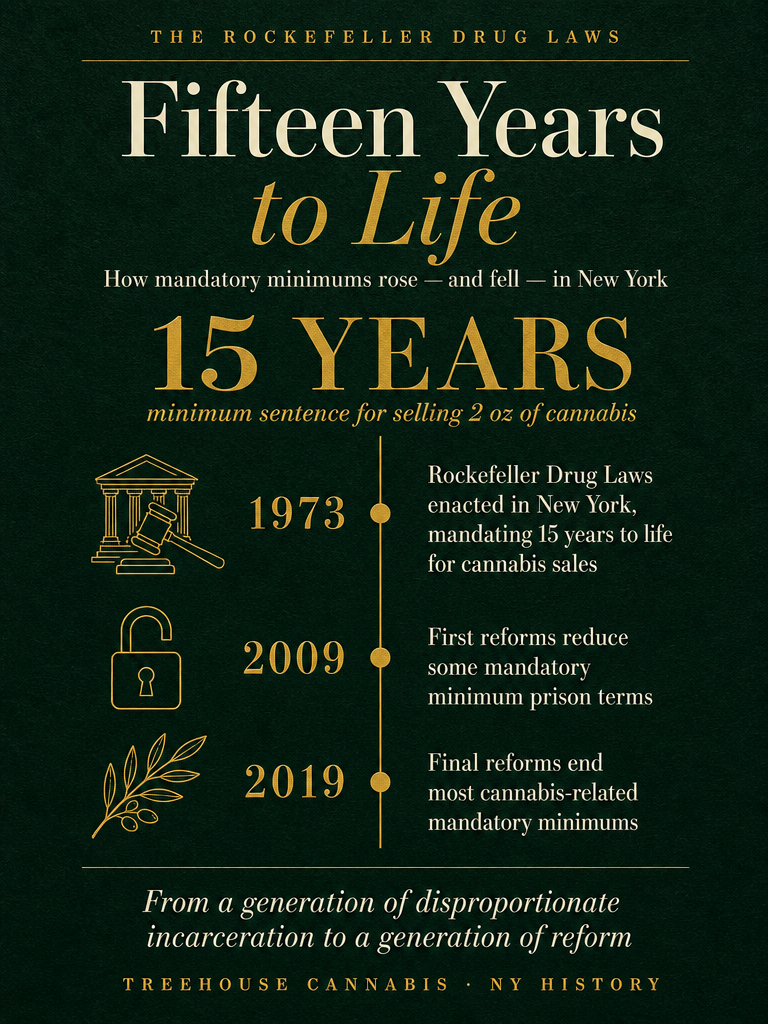
- 1973: Rockefeller Drug Laws imposed 15-years-to-life minimums for selling two ounces or more.
- 2009: The first reforms reduced some mandatory minimums.
- 2019: Final reforms ended most cannabis-related mandatory minimums.
The dismantling was gradual. Between 2009 and 2019, New York chipped away at the harshest provisions, reducing sentences and removing mandatory minimums for many cannabis offenses [5]. By the time adult-use legalization arrived in 2021, the framework that the Rockefeller Drug Laws built had been largely dismantled — a direct acknowledgment of the harm they had caused.
When Did New York Legalize Medical Marijuana?
New York legalized medical cannabis on July 5, 2014, when Governor Andrew Cuomo signed the Compassionate Care Act (A.6357-E and S.7923) into law [7]. The program was deliberately conservative at launch, restricting what participating customers could access and who could certify them.
Initially, the law limited registered customers to non-smokable forms of cannabis and required certification from practitioners registered with the program [7]. That meant oils, tinctures, capsules, and vaporizers rather than flower, and it created a slow, cautious rollout that frustrated advocates who had hoped for broader access.
- The Compassionate Care Act was signed on July 5, 2014.
- The original program restricted customers to non-smokable forms.
- Certified practitioners were required to register with the program.
The program finally launched in January 2016 with five registered organizations, each allowed to operate up to four dispensaries [2]. It grew steadily from there, reaching 151,284 registered customers and 3,455 certified practitioners by December 2021 [2]. The medical program proved that regulated cannabis could operate in New York safely — and it laid the operational groundwork for the full adult-use market that followed.
How Did the MRTA Legalize Adult-Use Cannabis in New York?
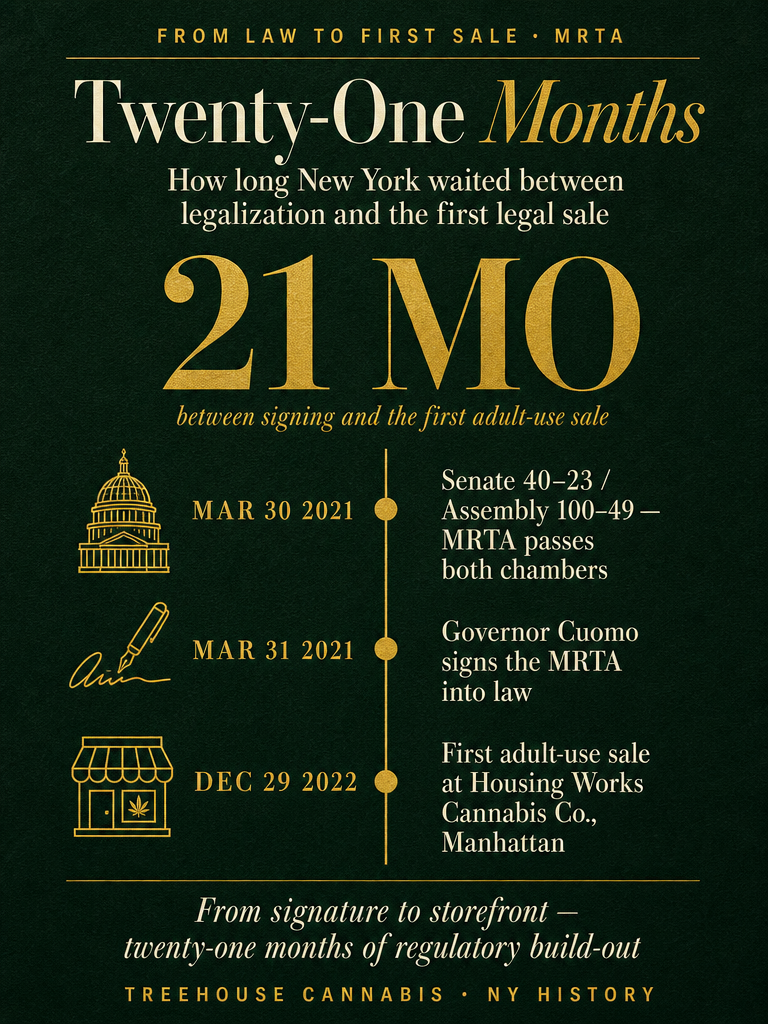
The Marihuana Regulation and Taxation Act (MRTA) passed the New York Senate 40-23 and the Assembly 100-49 on March 30, 2021, and Governor Andrew Cuomo signed it the next day, on March 31, 2021 [6]. That signing made New York the 15th state in the country to legalize adult-use cannabis [2].
The act did more than end prohibition. It created the Office of Cannabis Management and the Cannabis Control Board to oversee licensing and regulation [6]. It set out a framework for cultivation, processing, distribution, and retail, and it directed a share of the market to communities most affected by the Rockefeller-era enforcement.
- The MRTA passed the Senate 40-23 and the Assembly 100-49 on March 30, 2021.
- Governor Cuomo signed it on March 31, 2021.
- The act created the Office of Cannabis Management and the Cannabis Control Board.
For adults 21 and older, the MRTA legalized possession of up to three ounces of cannabis and 24 grams of concentrate [2]. Legalization, though, was only the legal milestone — actually buying cannabis in a licensed shop was another matter entirely, and the state's journey from signing to retail took more than 21 months.
For anyone who grew up in the era of prohibition, the recent shift in how people actually experience cannabis can take some getting used to — dosing and timing still matter. If you're curious about the practical side of modern consumption, our piece on why some edibles seem to take hours before they hit is worth a read You’re Not Lazy—Your Edible Just Peaked at the Wrong Time.
When Did the First Legal Adult-Use Sale Happen in New York?
The first legal adult-use cannabis sale in New York took place on December 29, 2022, at Housing Works Cannabis Co. in Manhattan [6]. The sale was a landmark: after more than a century of prohibition and 21 months of waiting after the MRTA was signed, a customer could finally walk into a licensed New York shop and buy cannabis legally.
That first sale was symbolic and practical at once. It marked the moment New York's legal adult-use market actually began operating on the ground, moving from legislation to a real retail experience that customers could touch and hold [1]. It also set the stage for the slower, deliberate rollout that followed across the state — a market that had to build licensed supply, processing, and retail capacity essentially from nothing.
- The first sale happened at Housing Works Cannabis Co. in Manhattan.
- The date was December 29, 2022, more than 21 months after the MRTA was signed.
- The sale marked the practical start of New York's legal adult-use market.
For customers in the Hudson Valley, the milestone mattered close to home. Today, licensed dispensaries throughout the region — including in Rockland, Orange, and Westchester Counties — are now part of that market, offering flower, vapes, edibles, and pre-rolls from New York producers to adult customers aged 21 and older.
Sources
- Wikipedia — Outlines the full arc of New York cannabis law from the 1914 Boylan Bill restric
- New York State Department of Health — Confirms that medical cannabis was implemented in 2016 under the Compassionate C
- Wikipedia — Documents the federal Marihuana Tax Act signed August 2, 1937 and effective Octo
- Wikipedia — Documents the 1944 New York Academy of Medicine study commissioned by Mayor Fior
- Wikipedia — Details the 1973 New York drug sentencing laws championed by Governor Nelson Roc
- Wikipedia — Records that the MRTA was passed by the New York Senate 40-23 and Assembly 100-4
- Marijuana Policy Project — Confirms that New York's medical cannabis law, the Compassionate Care Act (A.635
- U.S. Customs and Border Protection — Provides a federal law-enforcement history perspective on the 1937 Marihuana Tax
About Treehouse Cannabis
Treehouse Cannabis is a New York State licensed adult-use dispensary serving customers across Rockland, Orange, and Westchester Counties in the Hudson Valley. Our team guides adult customers through the state's legal cannabis market with practical, evidence-based information — from picking the right flower to understanding dosing and product timing. Browse our full menu online or stop into any of our locations to talk with a budtender about what works for you.
This content is intended for adults 21 and over. The information here is educational and does not constitute medical, legal, or professional advice. Always consult a qualified professional if you have questions about cannabis use and your health. Cannabis products may not be suitable for everyone; effects vary by individual.



Shop our products

Shop All

Deals

Flower

Pre-rolls
Vaporizers

Edibles
Drinks

Concentrates
Tinctures

Topicals

CBD

Pet CBD

Accessories