Cannabis and Jazz: How the Music and the Plant Grew Together
Cannabis and Jazz: How the Music and the Plant Grew Together
Cannabis and jazz share a documented cultural history, especially in Louis Armstrong's writings and the world surrounding early jazz recordings. Their connection is a story of musicians, language, and social attitudes, not evidence that cannabis invented jazz or explains the artistry of its creators.
Jazz's roots belong to African American musical creativity and the cultural exchanges of New Orleans. Blues, ragtime, brass bands, and African and Caribbean traditions helped shape a music heard at community gatherings as well as nightlife venues. [2]
Armstrong's autobiographical manuscripts add a personal voice to that musical history: he discussed cannabis, used the term "gage," and criticized criminal penalties. A different kind of record dates his instrumental "Muggles" to December 7, 1928, in Chicago. [1] [3]
Together, these sources offer a way into the subject without making the plant the explanation for the music. Here, "grew together" describes cultural overlap, not a proven causal relationship. The interesting details are in the differences between a musician remembering his life, a catalog documenting a session, and a statute recording a change in federal law.
How did cannabis and jazz become linked in cultural memory?
The connection appears in musicians' personal accounts and the historical world around their music. Armstrong's writings provide direct evidence of his cannabis experience, while musical histories and recording catalogs establish the setting without showing that cannabis created jazz. [1] [2] [3]
A famous musician's words can make an association memorable. Armstrong left accounts that allow readers to hear his perspective rather than rely entirely on later stories about him. But a vivid personal account is still personal: it cannot stand in for every band, audience, or neighborhood.
This history becomes clearer when its evidence is separated into distinct kinds:
- Personal manuscripts show what a musician recalled and believed.
- Musical histories explain communities, traditions, and movement between cities.
- Recording catalogs establish session dates, credits, and instrumentation.
- Preserved scores document musical material in a different form from recordings.
- Legal documents establish what lawmakers put into statutory text.
That approach leaves room for cultural connection without flattening a diverse musical world into a single lifestyle. It also makes the story more specific: who said something, what survives, and which details can actually be dated?
For a separate regional perspective, The History of Cannabis in New York explores the broader New York cannabis story beyond this focus on early jazz.
What shaped New Orleans jazz and its move to Chicago?
New Orleans jazz grew through African American musical innovation and exchanges among musical traditions. Touring, migration, riverboat work, and recordings helped carry it to Chicago, New York, and wider audiences. [2]
The National Park Service's history places music throughout community life, including parades, dances, picnics, weddings, and funerals. Reducing the story to a nightclub district misses the everyday settings where musicians played and listeners encountered their work. [2]
Several strands belong in that musical picture:
- Blues and ragtime contributed to the developing musical language.
- Brass-band traditions connected performance with public gatherings.
- African and Caribbean influences formed part of New Orleans' cultural exchange.
- Neighborhood events gave musicians varied settings in which to perform.
- Touring and relocation brought musicians into new working relationships and markets.
Armstrong's move to Chicago in 1922, at King Oliver's invitation, is one documented milestone. It places him within the movement of musicians and music beyond New Orleans; recordings then helped carry his influence further. [2]
That journey is a musical history, not evidence of a cannabis supply route. Knowing where a musician worked does not establish where a plant arrived, who supplied it, or how widely it circulated.
For a wider cultural lens beyond these early musical movements, read Cannabis and Music Culture: From Jazz Clubs to Modern Festivals.
What did Louis Armstrong write about cannabis and gage?
Armstrong wrote openly about his own cannabis experience, calling it "gage" and recalling encountering it in Chicago. Manuscript passages reproduced by the Louis Armstrong House Museum also document his objections to criminal penalties. [1]
His voice matters because it gives this history an identifiable speaker. Rather than a later writer assigning cannabis a role in his life, the museum presents passages in which Armstrong describes that relationship himself.
The useful distinctions are straightforward:
- "Gage" is the term Armstrong used in the reproduced passages.
- Chicago is the setting he recalled when describing his introduction to it.
- His account establishes his experience and perspective, not scene-wide prevalence.
- His objections to punishment document a personal position on criminalization.
His writing is also a reminder that historical testimony needs context. What a musician believed about cannabis is not automatically a current health fact, and affection for it does not establish improved technique, imagination, or performance.
Armstrong can be taken seriously as a witness to his own life without asking his recollections to answer scientific questions they were not designed to test. That distinction preserves his voice while keeping the article focused on culture rather than consumption advice.
For the broader national backdrop beyond Armstrong's account, USA Cannabis History: From Colonial Cash Crop to Controlled Substance follows a separate historical thread.
What do the Muggles recording and manuscript actually document?
The "Muggles" recording documents a Chicago instrumental session on December 7, 1928, with composer credits for Louis Armstrong and Earl Hines. A separate Library of Congress manuscript is cataloged circa 1930; it is not another date for that recording. [3] [4]
The University of California, Santa Barbara's Discography of American Historical Recordings identifies an instrumental jazz/dance sextet. Its instrumentation provides a concrete listening entry point: trumpet, trombone, clarinet, piano, banjo, and drums. [3]
Listen for the instruments as musical voices rather than treating the performance as an illustration of cannabis effects. The catalog tells readers what was recorded and who was credited; it does not tell them what anyone consumed during the session.
The core archival details are:
- Recording date: December 7, 1928.
- Recording location: Chicago.
- Composer credits: Louis Armstrong and Earl Hines.
- Ensemble description: an instrumental jazz/dance sextet.
- Separate manuscript: a copyright deposit cataloged circa 1930.
The Library of Congress describes an abbreviated musical document containing a melody line and block chords. Such a manuscript preserves something different from the sound of a performance: it should not be mistaken for a complete transcription of everything heard on the record. [4]
| Archival item | Date | What it establishes | What it does not establish |
|---|---|---|---|
| UCSB recording record | December 7, 1928 | Chicago session metadata, composer credits, and instrumentation | Cannabis effects on the performance or the title's slang meaning |
| Library of Congress manuscript deposit | Circa 1930 catalog date | Preservation of an abbreviated musical manuscript | A replacement date for the recording or a complete performance score |
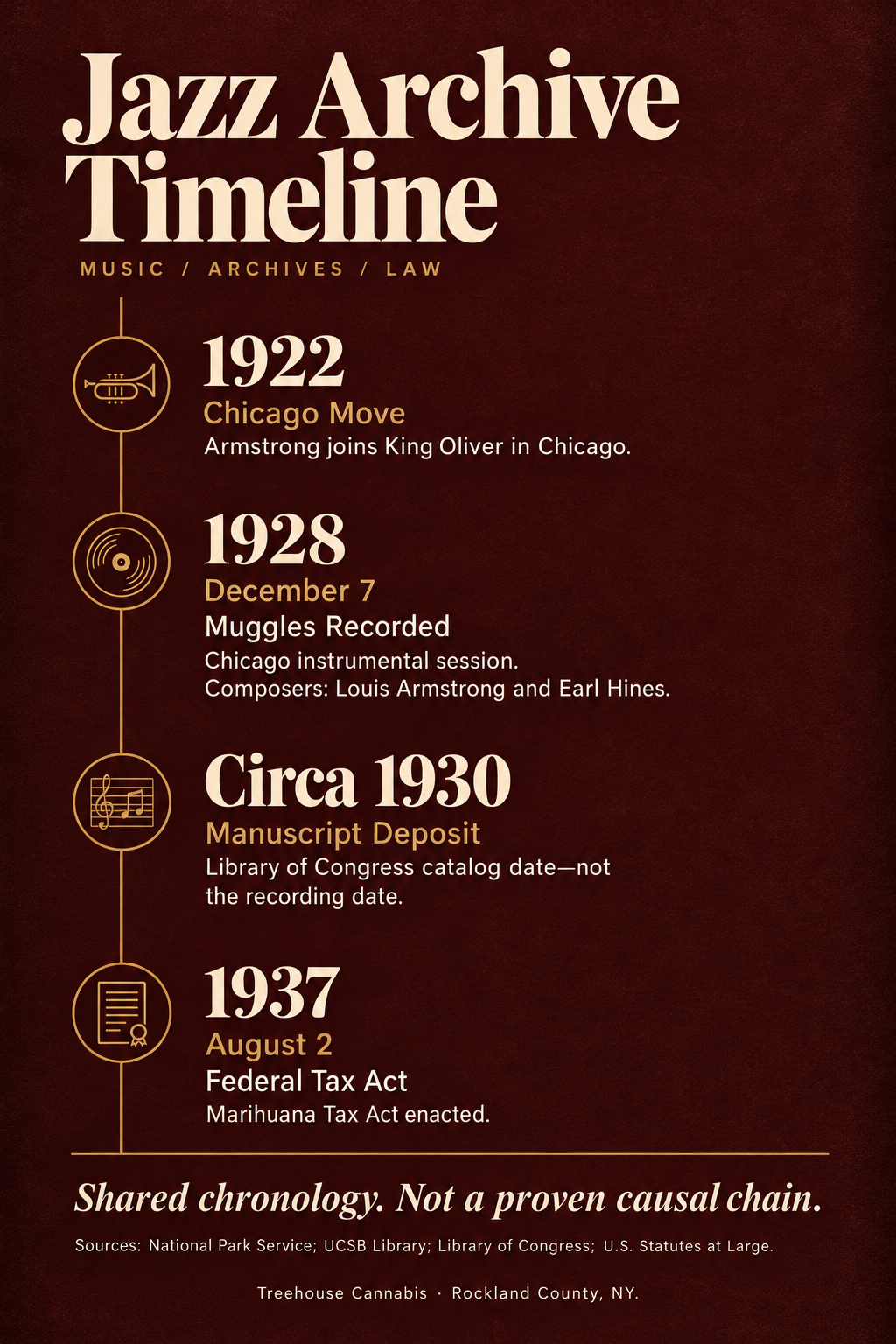
The timeline below places the artifacts alongside other milestones: Armstrong's 1922 move to Chicago, the December 7, 1928 recording, the circa 1930 manuscript catalog date, and the August 2, 1937 Marihuana Tax Act. These events share a chronology; their order does not prove that one caused another. [2] [3] [4] [5]
Neither catalog establishes the cannabis meaning of the title, and neither supports calling "Muggles" the first cannabis record. Those claims require evidence beyond the records used here.
Separately from the archives, adults browsing Treehouse's present-day menu can visit Pre Ground Flower; it is a contemporary shopping category, not evidence about this recording.
Where does the 1937 Marihuana Tax Act fit in cannabis and jazz history?
The Marihuana Tax Act belongs after these musical milestones in the timeline. Enacted August 2, 1937, it described a federal framework involving occupational and transfer taxes, registry, and recording requirements concerning marihuana. [5]
The act's original opening page is a primary legal source. Its wording helps establish the framework lawmakers set out, rather than relying on a later summary that compresses the law into a slogan.
Keep these points distinct:
- August 2, 1937 is the act's enactment date.
- Its stated framework concerns taxes and administrative requirements involving marihuana.
- The opening page is not the complete statute or its entire penalty regime.
- It does not establish a ban on a musical genre.
- It does not establish universal cannabis legality before 1937.
A statute also answers a different question from a musician's manuscript. Armstrong's account offers his perspective on punishment; the statute records legislative text. Neither source, by itself, supplies a complete account of enforcement motives or every musician's experience.
That boundary matters when connecting cannabis and jazz history. A cultural association does not establish that a federal law was written solely to suppress the music, and the opening page cannot prove why particular people were targeted.
Present-day browsing is a separate subject: Treehouse's Ratio Tinctures category describes a current menu grouping, not a category to project back onto this statute.
How can readers separate cannabis and jazz history from folklore?
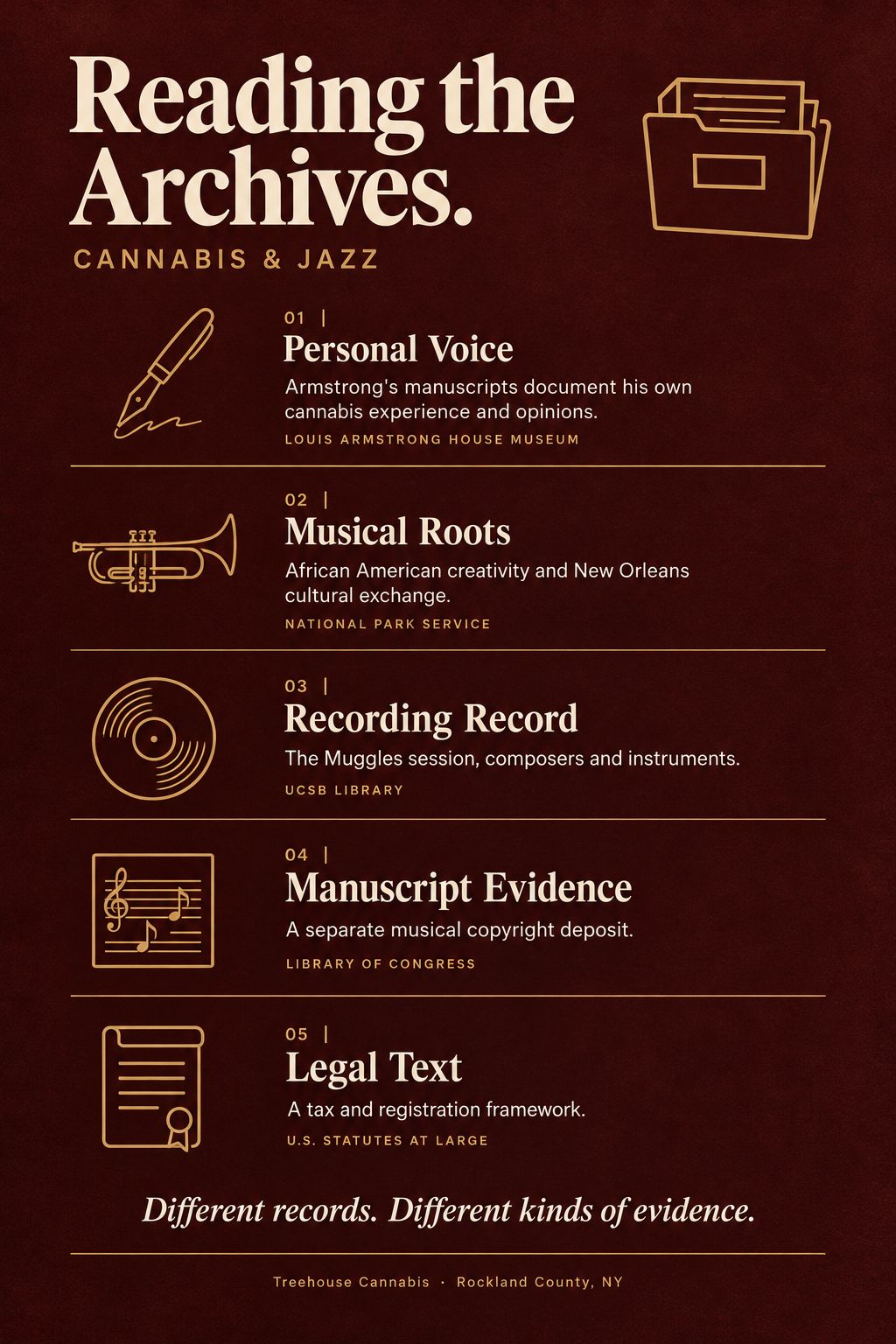
Match each claim to the kind of evidence that can support it. A personal manuscript can establish a recollection, a recording catalog can establish session details, and legal text can establish statutory language; none supplies every part of the story.
The five sources used here work together because they do different jobs. The museum preserves Armstrong's voice, the National Park Service supplies musical context, UCSB documents a recording, the Library of Congress identifies a manuscript, and the statute supplies legal text. [1] [2] [3] [4] [5]
When reading another account of cannabis and jazz, ask:
- Is there a named source behind the specific claim?
- Does the date refer to a performance, recording, manuscript, or law?
- Is one person's experience being presented as everyone's experience?
- Is a title's alleged slang meaning actually documented?
- Does a legal source establish wording, or is the writer inferring motives?
- Is historical testimony being turned into a claim about musical ability?
Leaving an unsupported anecdote out does not drain the subject of interest. Armstrong's writing, the movement of New Orleans musicians, and the surviving "Muggles" artifacts already give readers people, places, language, and music to explore.
The music deserves the center of that exploration. Cannabis can be part of a musician's documented life without becoming a shortcut explanation for the work.
For adults exploring the modern menu separately, Whole Flower Flower offers another browsing category; its labels should not be read as descriptions of historical cannabis.
What are common questions about cannabis and jazz?
The main questions concern Armstrong's testimony, the dated musical artifacts, and the limits of what those sources establish. The short answers return to three distinctions:
- Musical origins are not the same as cultural associations.
- Personal accounts are not population-wide evidence.
- Archival dates are meaningful only when the item being dated is clear.
What is the historical connection between cannabis and jazz?
Cannabis and jazz intersect in musicians' personal writings, including Armstrong's, and in the cultural history surrounding their recordings. That connection does not erase jazz's African American musical roots. These archives document individual experience and historical overlap, not proof that cannabis created jazz or that every musician used it. [1] [2]
Did Louis Armstrong use cannabis?
Yes. The Louis Armstrong House Museum reproduces manuscript passages in which Armstrong discusses cannabis, calls it "gage," and recalls encountering it in Chicago. He also criticizes criminal penalties. His words establish his personal experience and opinions, not medical benefits or a causal improvement in musical performance. [1]
When did Louis Armstrong record Muggles?
UCSB's recording catalog dates "Muggles" to December 7, 1928, in Chicago and credits Armstrong and Earl Hines as composers. It identifies an instrumental sextet. The Library of Congress separately preserves a manuscript deposit cataloged circa 1930, which should not be substituted for the recording date. [3] [4]
How did jazz spread from New Orleans to Chicago and New York?
Musicians carried New Orleans jazz through touring, riverboat work, and moves to other cities, while recordings brought the music to wider audiences. Armstrong's 1922 move to Chicago at King Oliver's invitation is one documented milestone. That musical movement does not, by itself, establish a route of cannabis distribution. [2]
Did the 1937 Marihuana Tax Act specifically ban jazz?
No. The act's opening page describes taxes, registry, and recording requirements involving marihuana, not a ban on jazz. It establishes a statutory framework, not a complete explanation of enforcement motives. Claims about officials targeting particular musicians require separate evidence beyond this opening page of the law. [5]
Does this history prove cannabis makes someone a better jazz musician?
No. Armstrong's manuscripts document his perspective, while recording catalogs document musical work. Neither establishes that cannabis improves creativity, improvisation, or skill. Cultural history can acknowledge what cannabis meant to an individual without treating that testimony as scientific proof or recommending consumption as a way to make or appreciate music. [1] [3]
Sources
- Louis Armstrong House Museum — The museum reproduces Armstrong's autobiographical manuscript passages describin
- National Park Service, New Orleans Jazz National Historical Park — Jazz developed through African American musical creativity and wider cultural ex
- University of California, Santa Barbara Library, Discography of American Historical Recordings — The discographic record dates Muggles to December 7, 1928, in Chicago, credits L
- Library of Congress, Music Division — The Library of Congress preserves an unpublished Muggles manuscript copyright de
- U.S. Government Publishing Office, United States Statutes at Large — The original statute's opening page documents the August 2, 1937 Marihuana Tax A
About Treehouse Cannabis
Treehouse Cannabis in Rockland County, NY shares educational articles about cannabis history and culture. Explore more of that reading to follow the people, documents, and social settings behind familiar associations.
Adults 21 and older can browse the contemporary menu separately from this historical discussion:
- Consult current listings for present-day product information rather than historical comparisons.
- The B.A.M • Flower • 70g listing is one such menu page, not a recommendation for listening, performing, or improving musical ability.
This article is for educational purposes only and is not medical or legal advice. Cannabis is for adults 21 and older.
Keep all cannabis products away from children and pets. Do not drive or operate machinery under the influence. Follow applicable laws and consume responsibly.



Shop our products

Shop All

Deals
Flower
Pre-rolls
Vaporizers
Edibles
Drinks

Concentrates
Tinctures

Topicals
CBD

Pet CBD
Accessories