What Is Kief and How Is It Used?
What Is Kief and How Is It Used?
What is kief? Kief is loose, powdery resin-gland material separated from cannabis flowers, often with small plant fragments mixed in. It commonly collects beneath a grinder screen and is used with flower, in infused products, or for pressed hash; it is not pure THC or automatically dab-ready. [1] [2]
The connection between these uses is the trichome: a small gland on the cannabis plant that contains cannabinoids and aromatic terpenes. Separating those glands changes the balance of resin and other plant tissue, but it does not produce a standardized product with a predictable potency. [4]
Understanding kief starts with identifying the material, not choosing a device. Loose grinder powder, pressed hash, and rosin describe different things, even when they share a botanical starting point. The distinctions below explain where kief comes from, how it appears in cannabis products, and what storage and product labels can tell an adult customer.
What is kief and where does it come from?
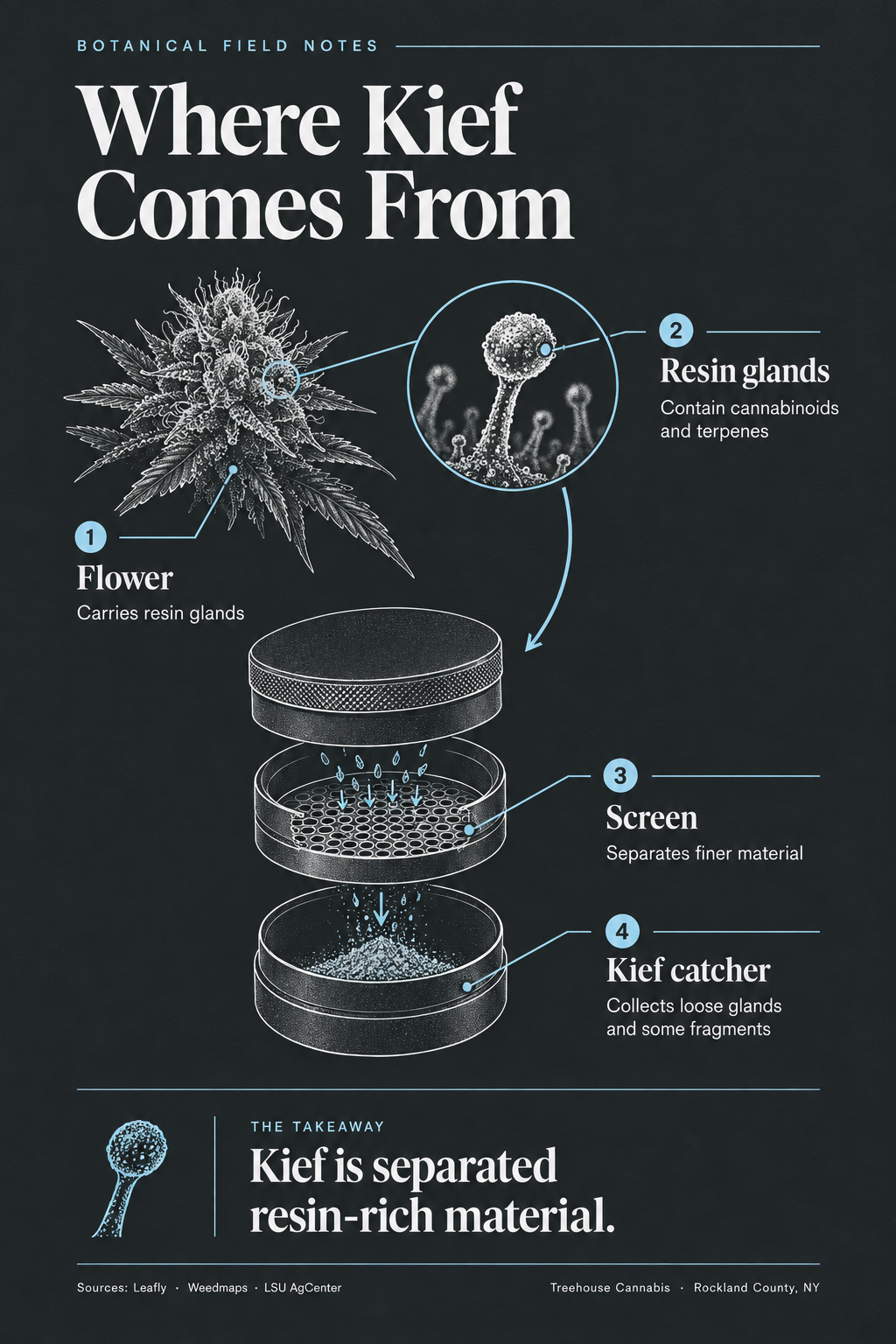
Kief comes from glandular trichomes that detach from cannabis flowers. These resin glands contain cannabinoids and terpenes; once separated, they form a loose collection that may also include small pieces of plant tissue. [2] [4]
On an intact flower, the glands are part of the bud's surface. Grinding and other handling can separate some of that material, which is why a fine powder may appear beneath a grinder screen. That powder is different from the larger pieces of ground flower above it. [1]
The basic anatomy is straightforward:
- Flower carries resin glands alongside other plant tissue.
- Glandular trichomes contain cannabinoids and aromatic terpenes.
- Detached glands contribute to the material called kief.
- Small plant fragments can remain mixed into the collection.
- Color alone does not establish potency, purity, or safety.
Kief is sometimes called "pollen," but that nickname is not a botanical definition. Cannabis pollen and detached resin glands are different materials; a chamber marketed as a pollen catcher is commonly intended to collect kief. [2]
Nor is kief another name for pure THC. Its composition depends on the source flower and what separated with the glands, so the powder's appearance cannot establish a cannabinoid percentage. [1] [4]
How does a grinder collect kief?
A screened grinder collects kief by allowing fine detached material to pass into a lower chamber while larger flower pieces remain above the screen. Not every grinder includes this separate collection area, often called a kief catcher. [1] [3]
The screen performs mechanical separation rather than chemical extraction. Material reaches the collection chamber because it is small enough to pass through, not because the grinder has isolated a single cannabinoid or removed every plant fragment.
A grinder's layout helps explain what is collecting:
- The grinding compartment breaks flower into smaller pieces.
- A screened section separates some finer material from larger pieces.
- The lower catcher holds the powder that passes through.
- A grinder without a screen and separate chamber does not make this same separation.
- Flower characteristics, equipment, and handling affect the collection.
Sifting boxes use a related principle: dry material passes across a screen that separates finer resin-rich material from larger plant pieces. Neither a screened grinder nor a sifting box guarantees a particular yield or purity. [3]
The useful distinction is between the flower chamber and the catcher beneath it. Finding fine powder in the lower chamber explains its origin, but it does not make that powder a tested concentrate with known specifications.
How is kief used with cannabis products?
Kief is commonly combined with flower, included in infused joints, used as a coating on some infused products, or processed into pressed hash. These are different product formats, not evidence that every batch of loose kief is interchangeable. [1] [3]
Common uses fall into several categories:
- Flower combinations that include separated resin-rich material.
- Infused pre-rolls containing kief alongside other ingredients.
- Exterior coatings on certain infused products.
- Pressed hash made by compacting resin material.
- Further processing into other cannabis products.
An infused pre-roll can contain more than flower and kief. For a closer look at how those ingredients differ, see Infused Pre-Rolls Explained: Flower, Kief, Oil, and Potency; the specific product label remains the reference for what a particular pre-roll contains.
Edible preparation is a separate processing context. Loose raw kief is not equivalent to a standardized ready-to-eat edible, and its name does not establish a measured serving or a predictable finished result. [1] [3]
The related guide How to Make Cannabis-Infused Coconut Oil covers an infusion topic rather than defining loose kief. The important distinction here is between a resin-rich starting material and a finished product with its own preparation and labeling.
For broader terminology before comparing formats, Cannabis Use For Beginners provides additional background. Knowing whether an item is flower, an infused product, or a concentrate is more useful than assuming everything containing kief works the same way.
How does kief compare with flower, hash, and dry sift?
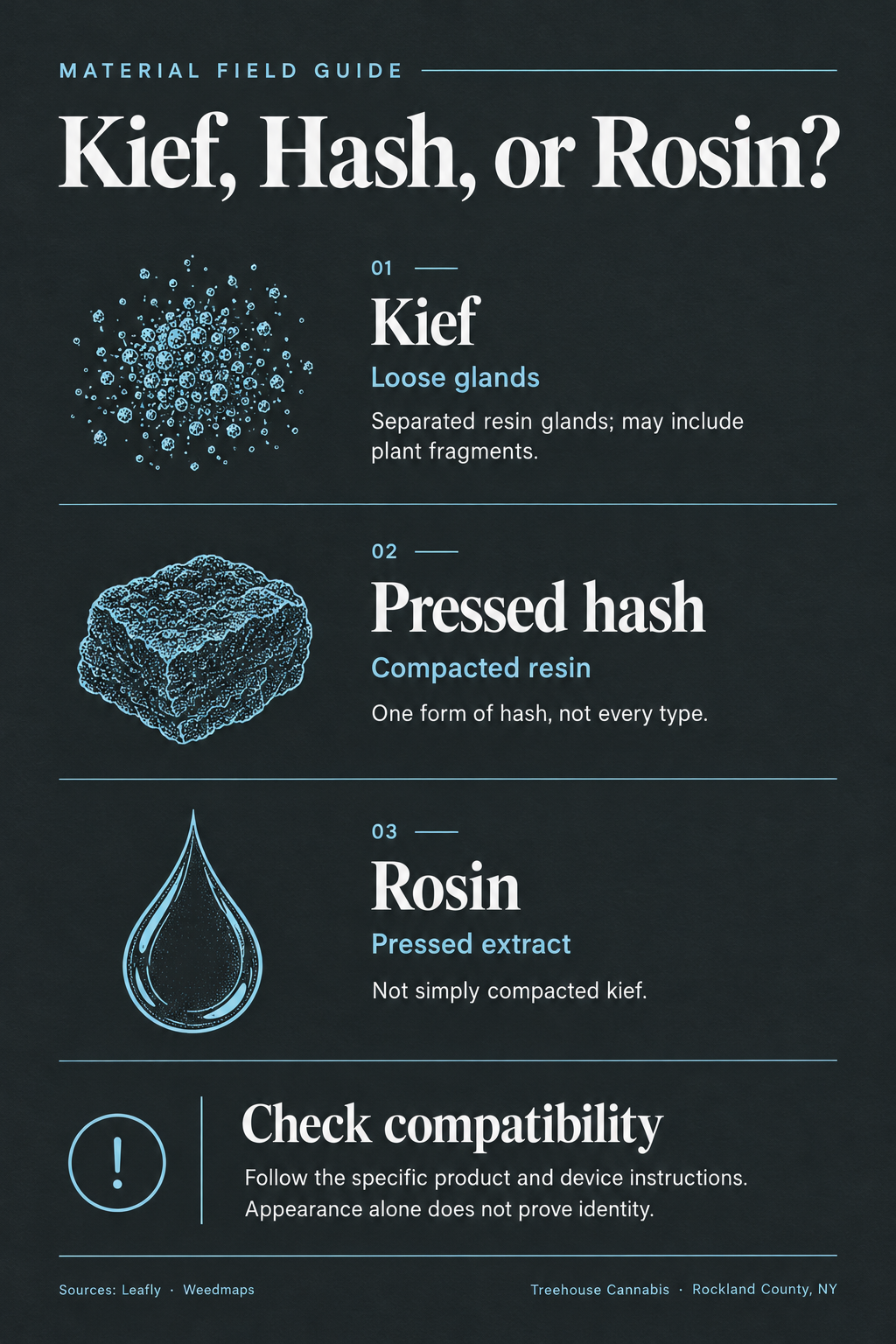
Flower retains the bud's broader structure, while kief consists of loose separated resin-rich material. Dry sift describes dry-screened material and can overlap with kief; pressed hash is compacted resin, while rosin is a distinct pressed extract. [1] [2] [3]
| Material | What the term describes | Important distinction |
|---|---|---|
| Flower | Cannabis buds containing resin glands and other plant tissue | The glands remain part of a larger botanical structure |
| Kief | Loose detached resin glands with variable plant fragments | Not pure THC or automatically dab-ready |
| Dry sift | Resin-rich material collected through dry screening | Can overlap with kief; the name does not establish purity |
| Pressed hash | Compacted resin material | One form within the broader hash category |
| Rosin | An extract produced using a press | Different from simply compacting kief into hash |
Kief and dry sift are not always opposing categories. One term describes the loose material and the other emphasizes a collection method, so their meanings can overlap. "Dry sift" alone does not prove how thoroughly the material was separated. [3]
Similarly, pressed hash can be made from kief, but hash is a broader category. It would be inaccurate to describe every hash product as compressed powder from a household grinder. Rosin is also not simply another name for that compacted powder. [1] [2]
Keep these distinctions in mind:
- Flower includes resin glands and the surrounding bud structure.
- Kief separates some resin-rich material from that structure.
- Dry sift refers to dry screening and may describe kief-like material.
- Pressed hash changes loose resin material into a compacted form.
- Rosin is an extract, not merely a different shape of loose kief.
Kief generally has a greater concentration of cannabinoids than the flower it came from because it gathers resin glands rather than the entire bud. That does not establish a universal potency multiplier: starting material and the amount of plant tissue mixed in both vary. [1] [4]
Treehouse's Flower category is a place to explore the whole-flower side of this comparison, not a guarantee that a particular kief product is available. For regulated products, consult the label and available Certificate of Analysis rather than estimating potency from color or texture. [5]
Can ordinary kief be used in a dab rig?
Ordinary grinder kief should not be treated as interchangeable with a dab-ready concentrate. Residual plant particles can burn and leave residue rather than melting cleanly, and the word "kief" does not establish compatibility with a rig or concentrate vaporizer. [1]
The distinction concerns the material, not just the equipment. Owning a concentrate rig does not turn whatever is in a grinder catcher into a product suited to that device.
Before making a compatibility assumption, distinguish these points:
- Ordinary grinder collections can retain plant particles.
- A powdery appearance does not prove clean melting.
- The name "kief" does not establish device compatibility.
- A labeled concentrate is a different product category.
- Specific product directions and equipment instructions matter.
An accessory listing such as 9.5" Concentrate Rig with Banger | White describes equipment, not an endorsement of ordinary grinder kief for that equipment. Check the intended material and instructions for both the product and the device rather than using the accessory's name as a compatibility test.
This caution does not classify every dry-sift or hash product the same way. It means the exact product matters: broad category names cannot replace product-specific information.
How should kief be stored?
Keep kief in a clean, dry, airtight container away from sunlight and heat. Quality preservation and access safety are separate concerns: cannabis also belongs in locked storage away from children and pets. [3] [5]
A useful storage checklist is:
- Choose a clean, dry, airtight container.
- Keep it away from direct sunlight and heat.
- Avoid introducing moisture.
- Limit unnecessary handling of the contents.
- Store cannabis locked away from children and pets.
There is no single freshness deadline that applies to every collection of kief. Starting material and storage conditions differ, so a fixed shelf-life promise would be misleading. Appearance alone is also not a substitute for product-specific information.
When considering an accessory such as the Treehouse Smell-Proof Travel Case, distinguish odor control from secure storage. A smell-proof description does not by itself establish that a case is child-resistant, lockable, or suitable as an airtight primary container.
Follow the storage directions on regulated products and keep their identifying information available. New York's consumer guidance directs adults toward regulated products and Certificates of Analysis, which provide information a loose, untested grinder collection cannot supply. [5]
What else should adults know about kief?
The most useful questions about kief concern its identity, collection, concentration, and compatibility. These short answers summarize the distinctions without assigning a universal potency, recipe, or storage lifetime.
- Identify the material before assuming how it can be used.
- Separate product terminology from tested specifications.
- Keep storage quality and secure access on the same checklist.
What is kief?
Kief is loose, powdery material made from resin glands that separate from cannabis flowers. Those glands contain cannabinoids and aromatic terpenes. Kief often collects below a grinder screen and may include plant fragments, so it is neither pure THC nor simply finely ground flower. [2] [4]
How is kief used?
Common uses include combining it with flower, including it in infused joints, coating certain infused products, and processing it into pressed hash. These categories involve different finished products. Loose grinder kief is not interchangeable with every concentrate or equivalent to a standardized ready-to-eat edible. [1] [3]
Is kief stronger than regular flower?
Kief generally contains a greater concentration of cannabinoids than its source flower because it collects resin glands rather than the entire bud. Actual potency varies with the starting material and remaining plant fragments. A regulated product's label and laboratory results are more informative than appearance. [1] [5]
What is the difference between kief, hash, and dry sift?
Kief describes loose separated resin glands, while dry sift describes dry-screened material and can overlap with kief. Pressed hash is compacted resin that can be made from kief. Hash is a broader category, however, so not every hash product begins as ordinary grinder powder. [1] [3]
How does a grinder collect kief?
A screened grinder allows finer detached material to pass into a lower chamber while larger flower pieces remain above the screen. That lower chamber is often called a kief catcher. Not every grinder has one, and flower, equipment, and handling affect what collects rather than producing a guaranteed yield. [3]
Can you dab ordinary grinder kief?
Ordinary grinder kief is not the same as a concentrate intended for dabbing. Remaining plant particles can burn and leave residue instead of melting cleanly. The exact product and equipment instructions matter; the word "kief" alone does not establish suitability for a dab rig or concentrate vaporizer. [1]
How should kief be stored?
Use a clean, dry, airtight container away from heat and sunlight, and avoid introducing moisture. Cannabis also belongs in locked storage away from children and pets. There is no single freshness deadline for every batch, and a smell-proof accessory does not automatically establish secure or airtight storage. [3] [5]
Sources
- Leafly — Kief is separated cannabis trichomes collected through grinder screens or siftin
- Leafly — Kief is a loose, powdery collection of detached resin glands containing cannabin
- Weedmaps — Kief can be collected in a screened grinder or sifting box, used with flower or
- Louisiana State University Agricultural Center — Cannabis glandular trichomes are sites of cannabinoid synthesis and storage and
- New York State Office of Cannabis Management — New York consumer guidance is intended for adults 21 and over, directs purchaser
About Treehouse Cannabis
Treehouse Cannabis serves adult-use customers in Rockland County, NY. Adults 21 and older can explore the current menu and ask the team about product labels and differences between flower, kief, and other concentrates.
- Confirm specific products on the live menu; availability varies.
- Review the exact product's label and available laboratory information.
- Ask about category differences without assuming device compatibility.
Cannabis is for adults 21 and older. This article is for educational purposes only and is not medical advice. Keep all cannabis products locked away from children and pets. Do not drive or operate machinery while impaired.



Shop our products

Shop All

Deals

Flower

Pre-rolls
Vaporizers

Edibles

Drinks

Concentrates

Tinctures

Topicals

CBD

Pet CBD

Accessories