
What Is THCA? The Cannabinoid in Raw Cannabis
What Is THCA? The Cannabinoid in Raw Cannabis
What is THCA? It is the acidic precursor to THC that cannabis plants actually produce in their glandular trichomes. In raw, unheated flower, roughly 90% of total THC content exists as THCA [1]; the molecule's extra carboxyl group keeps it from binding the brain's CB1 receptors, so on its own THCA is non-psychoactive [7].
What Is THCA and Where Does It Come From?
THCA is the molecule the cannabis plant actually produces. THC only appears later, after heat or time strips that extra carboxyl group away. In fresh, undried cannabis biomass, about 95% of the THC, CBD, and CBC content exists as the acidic parent forms (THCA, CBDA, CBCA) [2].
The plants do not synthesize THC directly — they make THCA from cannabigerolic acid (CBGA) through a dedicated enzyme, and THCA accumulates in the mushroom-shaped glandular trichomes that coat the flowers and sugar leaves [5].
Key facts about where THCA comes from:
- Cannabis plants synthesize THCA from CBGA, not directly from THC.
- THCA accumulates in the mushroom-shaped glandular trichomes that coat flowers and sugar leaves.
- In fresh cannabis, roughly 90% of total THC content exists as THCA [1].
- Heat, time, or alkaline conditions convert THCA into THC through decarboxylation.
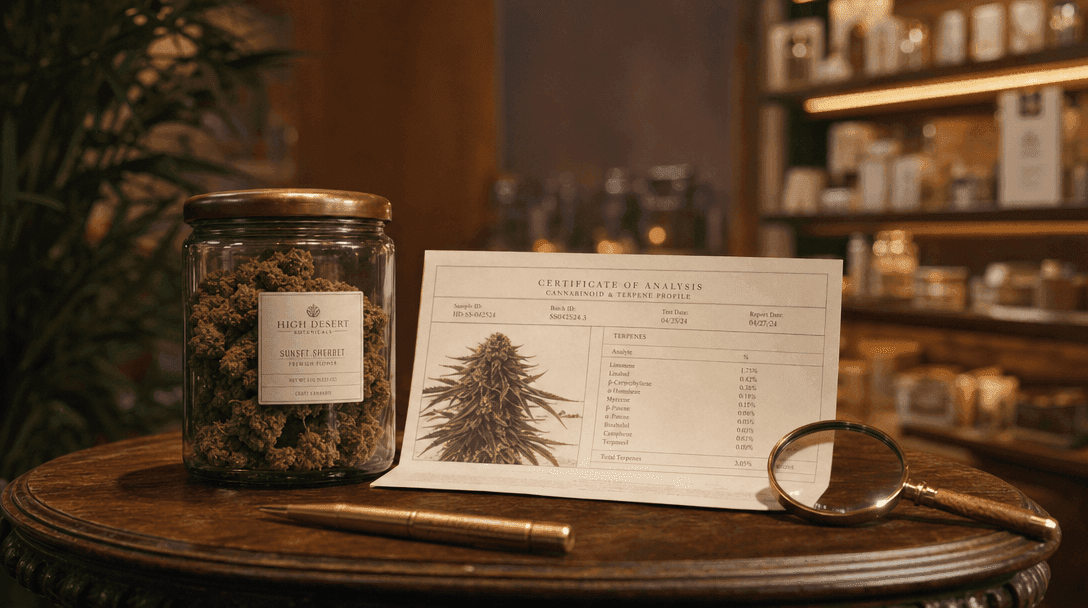
Because THCA dominates the cannabinoid profile of fresh flower, lab-tested labels almost always show a "total THC" number that is calculated from a higher THCA percentage rather than measured THC. A jar that tests at 24% THCA, for example, has the chemical potential for roughly 24% THC once heated. The same plant, eaten raw, would carry essentially none of that psychoactive load.
A practical deep dive on how this plays out across real products — including potency math, freshness, and how dispensaries read THCA numbers — is in Treehouse's THCA vs THC: What's Actually in Your Weed? (2026 Guide).
Does THCA Get You High?
No — not in its raw form. THCA does not produce intoxicating effects in humans because it does not effectively activate the CB1 receptors in the brain [3]. The bulky carboxyl group physically keeps the molecule from fitting into the receptor's binding pocket the way THC does. In HHS's own 2025 federal description, delta-9 tetrahydrocannabinolic acid is characterized as a non-psychoactive cannabinoid that is nonetheless integral to the production of legal hemp [7].
The contrast between raw and heated THCA is straightforward:
- Raw THCA does not activate CB1 receptors in the brain, so it is non-intoxicating.
- Heat converts THCA into THC, which is what produces the high consumers feel.
- Smoking, vaping, dabbing, and baking all trigger decarboxylation.
- Raw cannabis juice and unheated tinctures keep THCA in its non-intoxicating form [5].
The picture changes the moment heat enters. Smoking, vaping, dabbing, or baking all trigger decarboxylation — the same molecule loses its carboxyl group and turns into THC, which is what produces the high consumers feel. Project CBD has long noted that raw cannabis juice or unheated tinctures retain THCA's non-intoxicating character, while the same material heated becomes standard THC [5].
For a fuller breakdown of how THC, CBD, and the endocannabinoid system actually interact at the receptor level, see Treehouse's How THC and CBD Work.
THCA vs THC: What's the Actual Difference?
THCA and THC are nearly identical molecules. The only structural difference is one extra carboxyl group (COOH) on THCA, and that single group is what flips the molecule from inactive to psychoactive on the CB1 receptor. Remove the carboxyl group with heat and THCA becomes THC; the conversion is stoichiometric, meaning one molecule of THCA yields one molecule of THC plus one molecule of carbon dioxide [4].
Key points:
- THCA and THC differ by one carboxyl group (COOH) — that's the only structural change.
- That extra group keeps THCA from binding CB1 receptors, so raw THCA is non-intoxicating.
- Heat removes the carboxyl group as CO₂, converting one THCA molecule into one THC molecule.
- Fresh flower is roughly 90% THCA by cannabinoid content; THC appears only after decarboxylation.
- HHS (2025) describes THCA as non-psychoactive; THC remains a scheduled controlled substance [7].
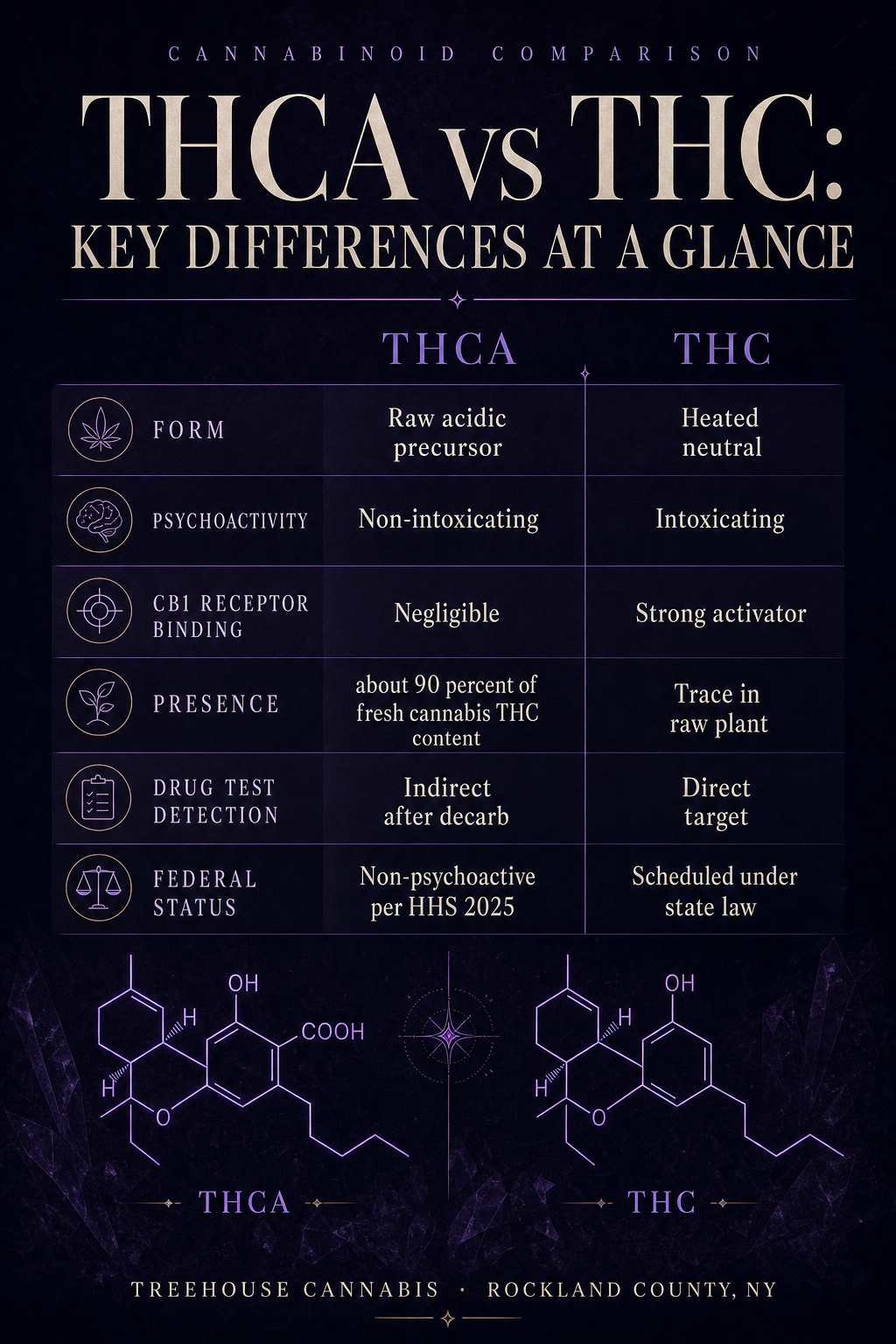
A side-by-side comparison makes the practical contrast clearer:
| Property | THCA | THC |
|---|---|---|
| Form in plant | Acidic precursor (raw) | Neutral (only after heat) |
| Psychoactivity | Non-intoxicating | Intoxicating |
| CB1 receptor binding | Negligible | Strong activator |
| Share of fresh-cannabis THC content | ~90% of total | Trace in raw plant |
| Typical drug-test target | Indirect (only after decarb) | Direct metabolite target |
| Federal description (HHS, 2025) | Non-psychoactive cannabinoid [7] | Scheduled controlled substance |
A useful consumer-side consequence of this chemistry: storage time matters. THCA slowly decarboxylates during curing and long storage, so older flower can test higher in THC and lower in THCA than the same strain when fresh. Treehouse's How Long Does Weed Stay Fresh? walks through the practical side of that drift, including humidity, jar choice, and what changes consumers can actually expect to notice.
How Does Decarboxylation Turn THCA Into THC?
Decarboxylation is the heat-driven reaction that strips THCA's carboxyl group and releases it as carbon dioxide gas, leaving behind THC. The reaction is faster and more complete than the equivalent conversion of CBDA or CBGA, which is why properly decarbed flower is reliably psychoactive while the same math is murkier for raw CBD-rich material [4].
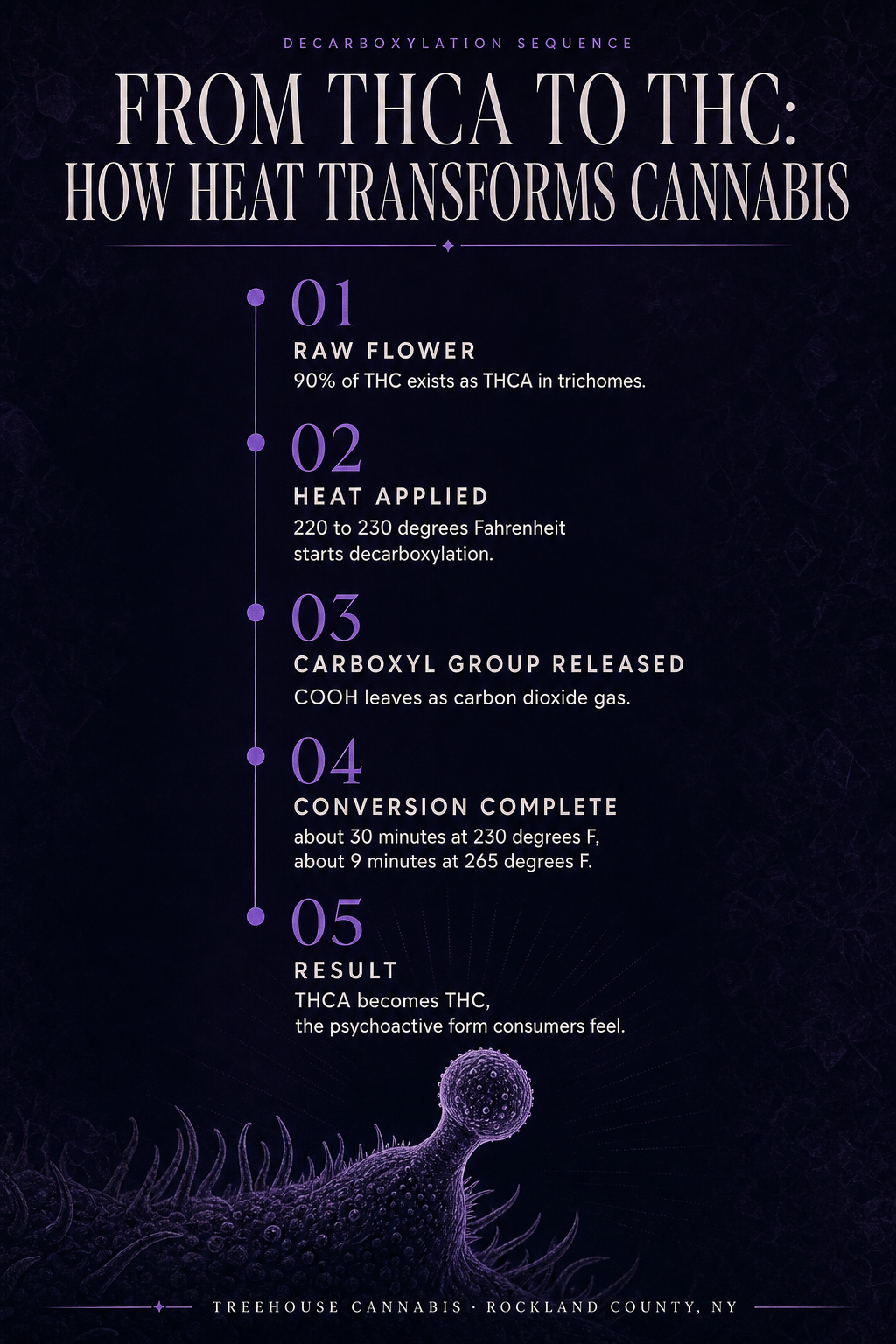
The key variables are temperature and time, and they trade off against each other:
- Around 220–230°F (about 110°C), the reaction is gentle and takes roughly 30 minutes to run to completion [4].
- Push the oven to 265°F (about 130°C) and the same conversion finishes in roughly 9 minutes [4].
- Smoking and vaping apply temperatures well above 400°F almost instantly, which is why inhaled cannabis is psychoactive right away.
- Real-world smoking recovers only about 30–70% of the THCA as THC, because some of the material burns off before the reaction completes [1].
For edibles, the material must be decarboxylated before it goes into butter or oil. Leafly's standard recommendation is to bake ground cannabis at around 220°F for 30–40 minutes on a parchment-lined sheet, then infuse [6]. Going much hotter, or much longer, drives off terpenes and can degrade cannabinoids into CBN and other byproducts — which is why the "low and slow" rule of thumb exists.
Treehouse's customers interested in trying decarbed flower can browse the Edibles category for products that have already gone through this step, or pick up a raw flower like NY Diesel | Flower | 28g and decarb at home with the times above.
What Are the Potential Benefits and Effects of THCA?
The honest answer is: the research is early, the findings are preclinical, and human clinical evidence is still limited. THCA has been studied mostly in cell cultures and animal models, where it has shown anti-inflammatory, anticonvulsant, neuroprotective, and anti-nausea activity without THC's intoxicating effects [3]. That profile has drawn interest from physicians who work with cannabis-naive or cannabis-sensitive customers, particularly in epilepsy and pain contexts [5].
A few important caveats belong alongside any list of potential effects:
- Most of the published data is preclinical — cell models and animal studies, not large human trials.
- Effective doses in early clinical anecdotes are reported at the low end (milligrams, not the grams often associated with THC dosing), but standardized dosing guidance does not yet exist [5].
- THCA products that have been heated behave like standard THC products, both in effects and on drug tests — there is no THCA-specific "lite" high.
- Anyone using cannabis for a specific health goal should talk with a clinician familiar with their full medical picture. This article is informational, not medical advice.
The practical takeaway for adult-use customers is that raw, unheated cannabis — fresh-frozen flower, cold-pressed juice, raw tinctures — does carry THCA alongside other cannabinoids and terpenes, and that profile has its own character. It is not the same thing as consuming the heated, decarboxylated form.
Is THCA Legal and Will It Show Up on a Drug Test?
The legal question and the drug-test question are usually treated as one, but they actually run on different rules.
On the legal side, THCA itself is a naturally occurring plant compound. In its 2025 update to the Mandatory Guidelines for Federal Workplace Drug Testing Programs, HHS described delta-9 tetrahydrocannabinolic acid as a non-psychoactive cannabinoid that is an important precursor integral to the growth and production of legal hemp [7]. Federal hemp law, however, is written around delta-9 THC content (0.3% or less by dry weight), and some testing frameworks calculate "total THC" by adding THCA into that limit. That can put high-THCA flower above the federal threshold on paper even when measured delta-9 THC is essentially zero. New York State has its own cannabis framework; customers should always check current state and local rules before assuming any cannabis product is permitted where they are.
On the drug-test side, standard panels look for THC-COOH — now formally called delta-9 THCC by HHS — which is the metabolite produced after the body processes THC [7]. The test does not target plant THCA directly. The catch is that any THCA-rich product that gets heated (smoked, vaped, baked) produces THC and then THC-COOH, which is what the test catches. Trace THCA can also appear in samples after smoking because of the small amount of unconverted material that survives combustion [1]. So while pure, unheated THCA consumed raw is unlikely to register, anything heated into THC will.
Practical summary for adult-use customers:
- THCA itself is federally classified by HHS as a non-psychoactive cannabinoid (2025).
- Federal hemp law still measures delta-9 THC at 0.3% or less by dry weight.
- Some testing frameworks add THCA into the "total THC" calculation, so high-THCA flower can read above-threshold on paper.
- Standard drug tests look for THC-COOH (now called delta-9 THCC), not plant THCA directly.
- Any heated THCA product produces THC-COOH and registers the same as regular THC on a drug test.
- State and local rules vary — always check current law where you live.
Frequently Asked Questions
What is THCA?
THCA (tetrahydrocannabinolic acid) is the acidic precursor to THC found in raw, unheated cannabis. The plant makes it in glandular trichomes from CBGA, and in fresh flower roughly 90% of total THC content is actually THCA. Because it carries an extra carboxyl group, THCA doesn't bind well to CB1 receptors and is not psychoactive.
Does THCA get you high?
No, not in its raw form. THCA does not produce psychoactive effects in humans because it doesn't effectively activate the CB1 receptors in the brain. The moment you apply heat — smoking, vaping, or baking — THCA converts to THC through decarboxylation, and that's what delivers the high.
What is the difference between THCA and THC?
THCA and THC are nearly identical molecules — THCA just has an extra carboxyl group (COOH). That extra group makes THCA too bulky to fit CB1 receptors, so it isn't intoxicating. Heat removes the carboxyl group as carbon dioxide, converting THCA into THC. That reaction, called decarboxylation, is the only chemical difference that matters to consumers.
How does THCA become THC?
Heat triggers decarboxylation, the reaction that strips THCA's carboxyl group and leaves THC. Smoking and vaping do this almost instantly. For edibles, Leafly recommends baking cannabis around 220°F for 30–40 minutes to activate it before infusing butter or oil. Lower heat takes longer; very high heat can destroy cannabinoids and terpenes.
What are the potential benefits of THCA?
Research is still early, but preclinical studies suggest THCA may have anti-inflammatory, neuroprotective, and anti-nausea properties — without THC's intoxicating effects. Project CBD reports doctors using very low daily doses for epilepsy and pain patients. No established medical applications exist yet, and human clinical evidence remains limited.
Is THCA legal?
THCA itself is a naturally occurring plant compound, and HHS describes it as a non-psychoactive cannabinoid important to legal hemp production. Federal hemp law measures delta-9 THC (0.3% or less), and some testing frameworks count THCA toward that limit. State rules vary, so always check local law.
Does THCA show up on a drug test?
Standard drug tests look for THC-COOH, the metabolite produced after THC is consumed — not THCA itself. HHS renamed that metabolite delta-9 THCC specifically to distinguish it from plant THCA. Still, any THCA product that's heated into THC can generate that metabolite, and trace THCA can appear in samples after smoking cannabis.
Sources
- National Center for Biotechnology Information (NIH/PMC) — Cannabis and Cannabinoid Research — THCA-A is the non-psychoactive acidic precursor of THC, accounting for up to 90%
- National Center for Biotechnology Information (NIH/PMC) — Journal of Cannabis Research — In fresh cannabis biomass, 95% of THC, CBD, and CBC exist as their acidic parent
- National Center for Biotechnology Information (NIH/PMC) — THCA is a non-psychoactive, CB1-inactive acidic cannabinoid with preclinical ant
- National Center for Biotechnology Information (NIH/PMC) — Cannabis and Cannabinoid Research — THCA-A decarboxylates to THC stoichiometrically and faster than CBDA or CBGA; co
- Project CBD — Cannabis plants synthesize THCA (not THC) from CBGA; THCA is not psychoactive an
- Leafly — THCA in raw cannabis will not get you high; heat removes its carboxyl ring to fo
- U.S. Department of Health and Human Services (Federal Register) — HHS formally describes delta-9 tetrahydrocannabinolic acid as a non-psychoactive
About Treehouse Cannabis
Treehouse Cannabis curates lab-tested flower, pre-rolls, vapes, and concentrates for adult-use customers in Rockland County, NY and the surrounding area. Every product is labeled with its cannabinoid breakdown, and budtenders can walk customers through THCA percentages, terpene profiles, and how each format changes the experience.
Cannabis is for adults 21 and older. Keep all cannabis products out of the reach of children and pets. This content is intended for adult-use customers in New York State and is for informational purposes only — it is not medical advice. Always consume responsibly and in accordance with local laws and regulations.
Shop our products

Shop All
Flower

Pre-rolls
Vaporizers

Edibles
Drinks

Concentrates
Tinctures

Topicals
CBD

Pet CBD
Accessories