
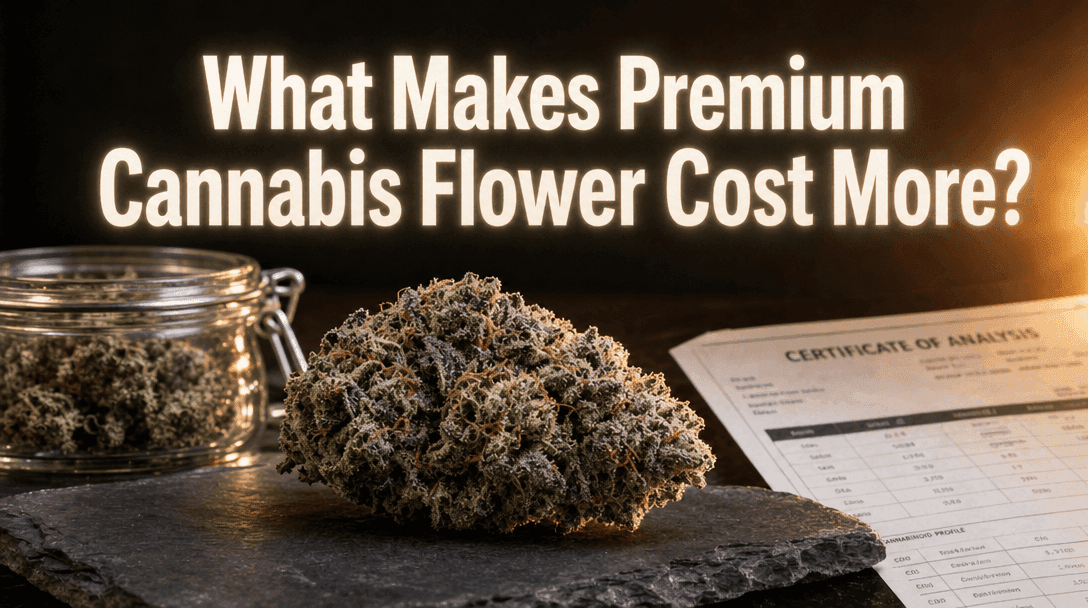
What Makes Premium Cannabis Flower Cost More?
What Makes Premium Cannabis Flower Cost More?
Premium cannabis flower costs more because indoor cultivation, hand-trimming, slow-curing, and full-panel Certificate of Analysis testing add documented production inputs that budget flower skips -- not because of a strain name or a headline THC percentage. In regulated markets like New York, that documented-inputs difference shows up as a measurable cost per gram on the shelf.
What Does "Premium" Cannabis Flower Actually Mean on a Dispensary Shelf?
"Premium" is shorthand for a specific bundle of production choices that show up on a top-shelf menu. Indoor-grown, hand-trimmed, slow-cured flower sold with a Certificate of Analysis covering cannabinoids, terpenes, pesticides, microbials, and heavy metals is the working definition used across adult-use markets [9]. Customers who shop with that definition in mind quickly learn to separate the premium tier from "top-shelf" branding that has no testing or cultivation transparency behind it.
The premium tier is not defined by THC alone. A premium claim should be backed by a batch-matched COA, a documented indoor or light-deprivation cultivation method, and a cure time measured in weeks rather than days. Premium Flower
For shoppers new to legal cannabis in New York, the menu can read like a wall of strain names rather than a wall of quality claims. The premium section is where the labels and the lab reports are most likely to match. How Seniors Are Using Cannabis in New York
A useful starting question for any buyer is: does the lot number on the package match the lot number on the COA? If the answer is yes, the premium claim is grounded. If the answer is no, the price tag is doing the talking the COA is not. Valentine’s Day Cannabis Gifts: Thoughtful Ideas for Every Cannabis Lover
The bundle customers are actually paying for in the premium tier looks like this:
- Indoor cultivation with documented climate control inputs
- Hand-trimmed flower, not machine-trimmed
- Slow-cure for four to eight weeks at controlled humidity
- Full-panel Certificate of Analysis with batch matching
- Disclosed cultivation method on the menu or label
How Does Cultivation Method Drive the Price of Premium Flower?
Cultivation method is the single largest cost line in any premium flower breakdown. Indoor facilities run lighting, HVAC, dehumidification, and CO2 supplementation around the clock, which drives commercial indoor production costs roughly 1.5 to 2x higher per pound than outdoor [1]. Leafly's home-grow analysis pegs indoor cultivation at about $1.95 to $3.90 per gram before labor, versus $0.60 to $1.19 per gram for outdoor [2]. That input-cost gap is the structural reason indoor flower carries a consistent premium in legal markets.
Washington grower Bryan Gabriel has framed it simply: indoor setups give cultivators total control over temperature, airflow, light spectrum, and CO2 -- and that control is what the premium tier pays for [9]. Greenhouse and sun-grown operations trade that control for cheaper inputs and larger runs, which is why those tiers typically price below indoor on a dispensary menu.
The cost stack behind indoor cultivation looks roughly like this:
- High-efficiency lighting (LED or HPS) running 12 to 18 hours per day
- HVAC and dehumidification targeting 70 to 78 degrees F and 45 to 55% RH during flower
- CO2 supplementation at 1,000 to 1,500 ppm during lights-on
- Substrate, nutrients, and integrated pest management consumables
- Direct labor across the full vegetative and flower cycle
Pheno-hunting and genetics sit on top of that stack. Premium flower starts with selected cuts that have been screened for aroma, structure, and resin production across multiple grows, not with a generic seed. For customers mapping their first legal purchase, walking the cost stack helps explain why the indoor line item always reads higher on the menu. How to Choose Your First Cannabis Product: A Complete Guide for Beginners
Why Does Hand-Trimming and Slow-Curing Cost More -- and Is It Worth It?
Hand-trimming and slow-curing are the second-largest contributors to premium pricing, and they are also the steps most likely to be skipped on budget flower. Machine trimmers process pounds per hour but shear trichome heads off the bud and damage the resin layer that carries cannabinoids and terpenes. Hand-trimming is slower, costs more in labor, and preserves the trichome integrity that controls aroma, flavor, and potency on the shelf.
The cure step is where premium flower separates itself most clearly from rushed product. A four to eight-week cure at 58 to 62% RH lets chlorophyll break down, residual moisture equalize, and monoterpenes redistribute evenly through the bud. Skipping or shortening the cure saves weeks of inventory carrying cost but costs the cultivator the smoothness and aroma that customers pay a premium to experience.
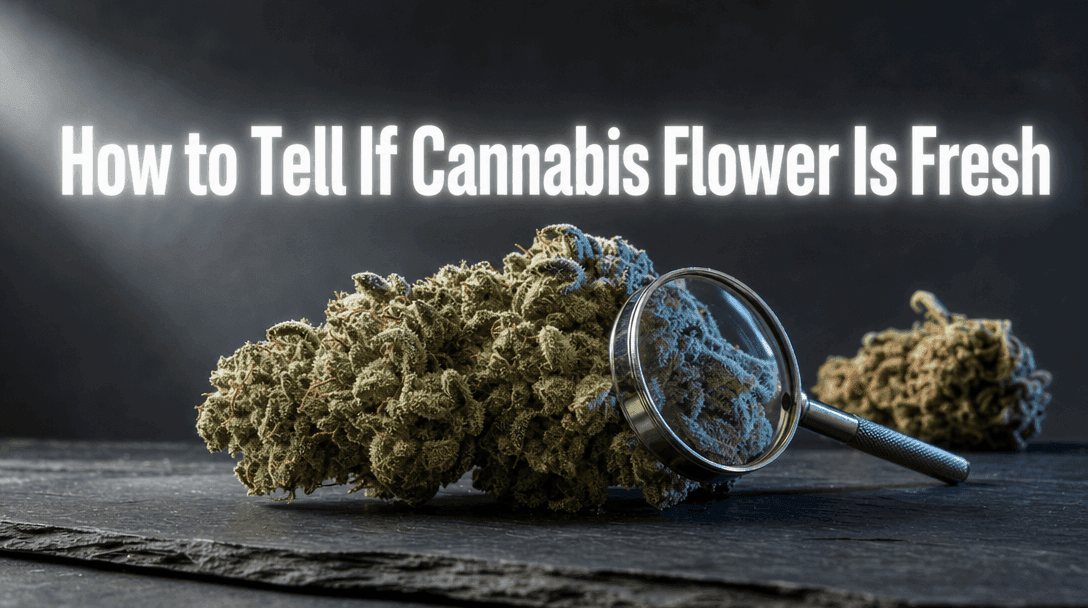
Hand-trim, slow-cure, then store in airtight glass -- the freshness window is meaningfully longer when every step is done right. How Long Does Weed Stay Fresh?
What that costs in practice looks roughly like this:
- Direct trim labor (often several hours per pound, more for tight hand-trim standards)
- Climate-controlled cure rooms running 58 to 62% RH for 4 to 8 weeks
- Inventory carrying cost (capital tied up in unsold flower during cure)
- Glass jars, humidity packs, and storage handling for the cured product
For customers, the smoking experience is the only test that matters. A well-cured jar opens with a clean, layered aroma; the smoke is smooth; the ash burns light gray. A rushed jar smells grassy, burns hot, and turns the bowl black -- the visible signs of a cure that was skipped.
Why Doesn't a Higher THC Percentage Justify Paying More for Premium Flower?
Higher THC percentages on a label do not reliably justify a premium price, and the research now backs that up. A 2023 PLOS ONE study HPLC-tested 23 flower samples from 10 Colorado dispensaries and found observed THC averaged about 15% against labels claiming 19.6 to 23.3%, with roughly 70% of samples more than 15% below the labeled potency [6]. A 2025 Scientific Reports audit of 277 products from 52 dispensaries confirmed the pattern, finding only 56.7% of flower met the state's +/-15% label-accuracy threshold -- while concentrates passed at 96% [7].
A 2025 medRxiv preprint independently tested 74 Colorado products and confirmed that flower labels significantly overstated THC (p<0.001) and exceeded the state's 15% legal variance, while concentrates and edibles fell within tolerance [8]. Three independent research teams, same direction of finding.
What that means for premium-shopping:
- A 28% THC label does not reliably mean 28% in the jar
- Observed flower THC across multiple studies clusters lower than labeled
- Concentrates are far more label-accurate than flower, by a wide margin
- Premium claims should ride on COA results, not the headline number
Three independent label-accuracy audits side-by-side:
| Study | Sample | Flower pass rate (+/-15%) | Concentrate pass rate (+/-15%) |
|---|---|---|---|
| Schwabe et al., 2023 (PLOS ONE) | 23 flower samples, 10 dispensaries | ~30% (70% more than 15% below label) | Not tested |
| Giordano et al., 2025 (Scientific Reports) | 277 products, 52 dispensaries | 56.7% | 96% |
| Limbacher et al., 2025 (medRxiv) | 74 products, Colorado | Significantly overstated THC (p<0.001); exceeded 15% legal variance | Within tolerance |
The premium tier for flower earns its price through documented inputs -- cultivation method, cure time, full-panel testing -- not through the printed THC percentage. Customers who shop by COA rather than by THC label tend to find that premium flower often delivers comparable or lower headline numbers but a noticeably fuller terpene profile and a smoother experience.
What Hidden Costs Hide Inside Premium Flower Pricing?
The price tag customers see at the counter is the sum of a long line-item stack, most of which never appears on the label. Federal effective tax rates on U.S. cannabis operators run 30 to 70% [5], and state and local excise taxes stack on top of that. A 2026 Health Economics study of 1,525 consumers found 89% of sales lost to a tax-driven price hike migrated to the illicit market -- meaning high taxes inflate retail prices without strengthening the legal market [5].
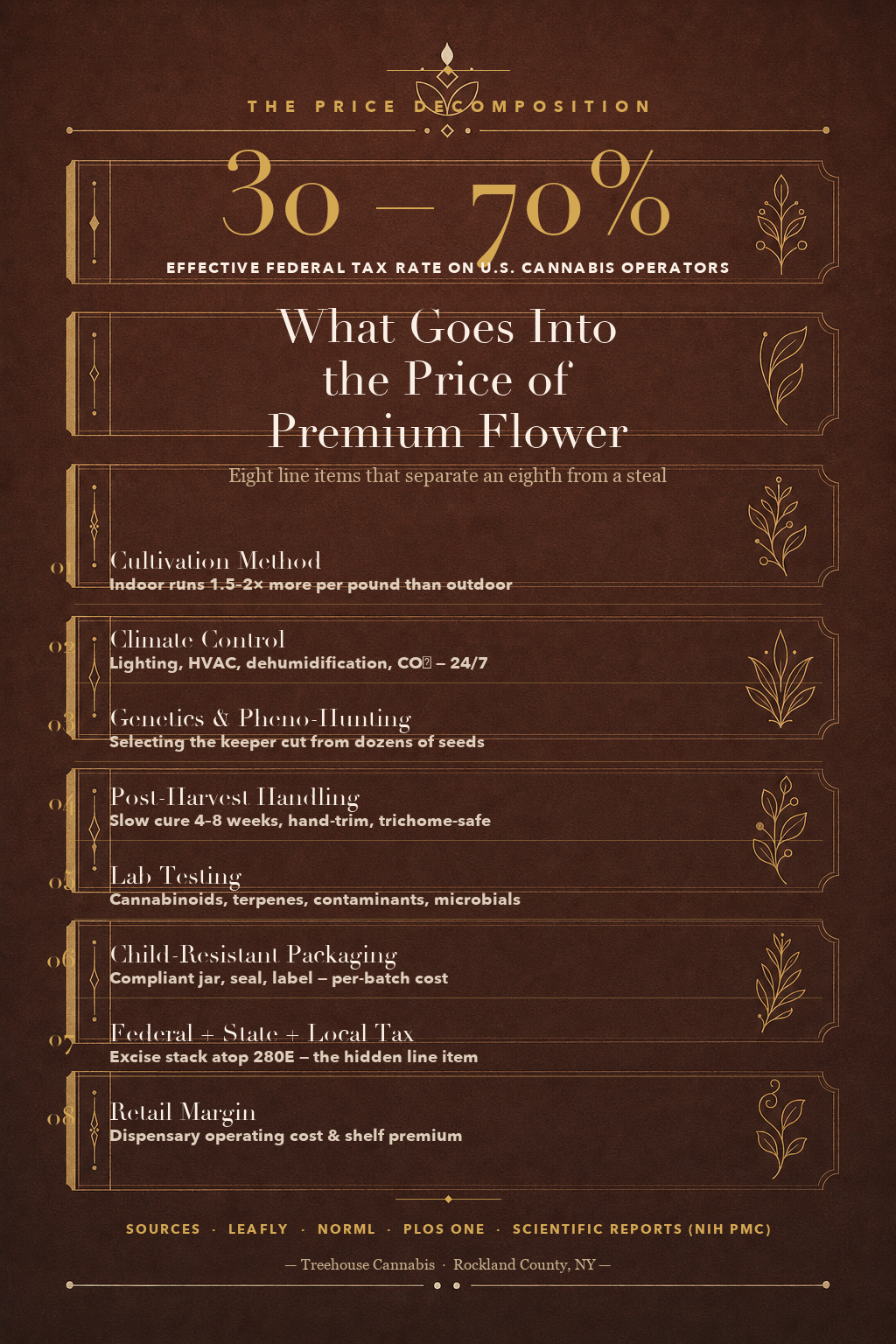
Beyond taxes, several other fixed costs get baked into every eighth:
- Mandatory cannabinoid and contaminant testing per batch
- Microbial and (in some states) terpene panel testing
- Child-resistant compliant packaging and labeling
- State-level seed-to-sale tracking (METRC compliance)
- Retail margin on top of wholesale cost
Mandatory testing is a fixed cost that does not scale down with batch size. Small craft batches absorb several dollars per gram of testing overhead, while large commercial runs spread the same panel across many more pounds. That structural difference is one reason a single-batch craft eighth can cost noticeably more than a contract-grown budget eighth at comparable potency.
The wholesale side has been compressing as the market matures. NORML reports state-legal cannabis sales exceeded $29 billion in 2025 despite wholesale-price compression from oversupply [3]. Falling wholesale prices do not always translate to lower retail prices -- they tend to compress cultivator margins first, and the cultivators running premium indoor operations absorb the most pressure.
NORML-cited research also suggests consumers tolerate retail prices up to roughly $14 per gram before they begin switching back to the unregulated market [4]. That ceiling sits well below where some premium indoor flower prices in New York have landed. For shoppers comparing tiers, the Flower category page Flower is the right place to see how the line items add up across price points.
How Should Customers Read a Certificate of Analysis to Verify a Premium Claim?
A premium claim earns its price when a buyer can verify it against a real Certificate of Analysis. The COA is the document that ties the jar in a customer's hand to a specific batch, a specific lab, and a specific set of test results -- and reading it well is the single highest-leverage skill in premium flower shopping.
The pieces of a premium COA a customer should look for:
- Batch or lot number matching the package exactly
- Lab name and ISO/IEC 17025 accreditation status
- Full cannabinoid panel: THCA, delta-9 THC, CBDA, CBG, CBN
- Terpene panel with specific percentages (not just "terps")
- Pesticide, heavy metal, and microbial screens with pass/fail
- Test date within the last 12 months
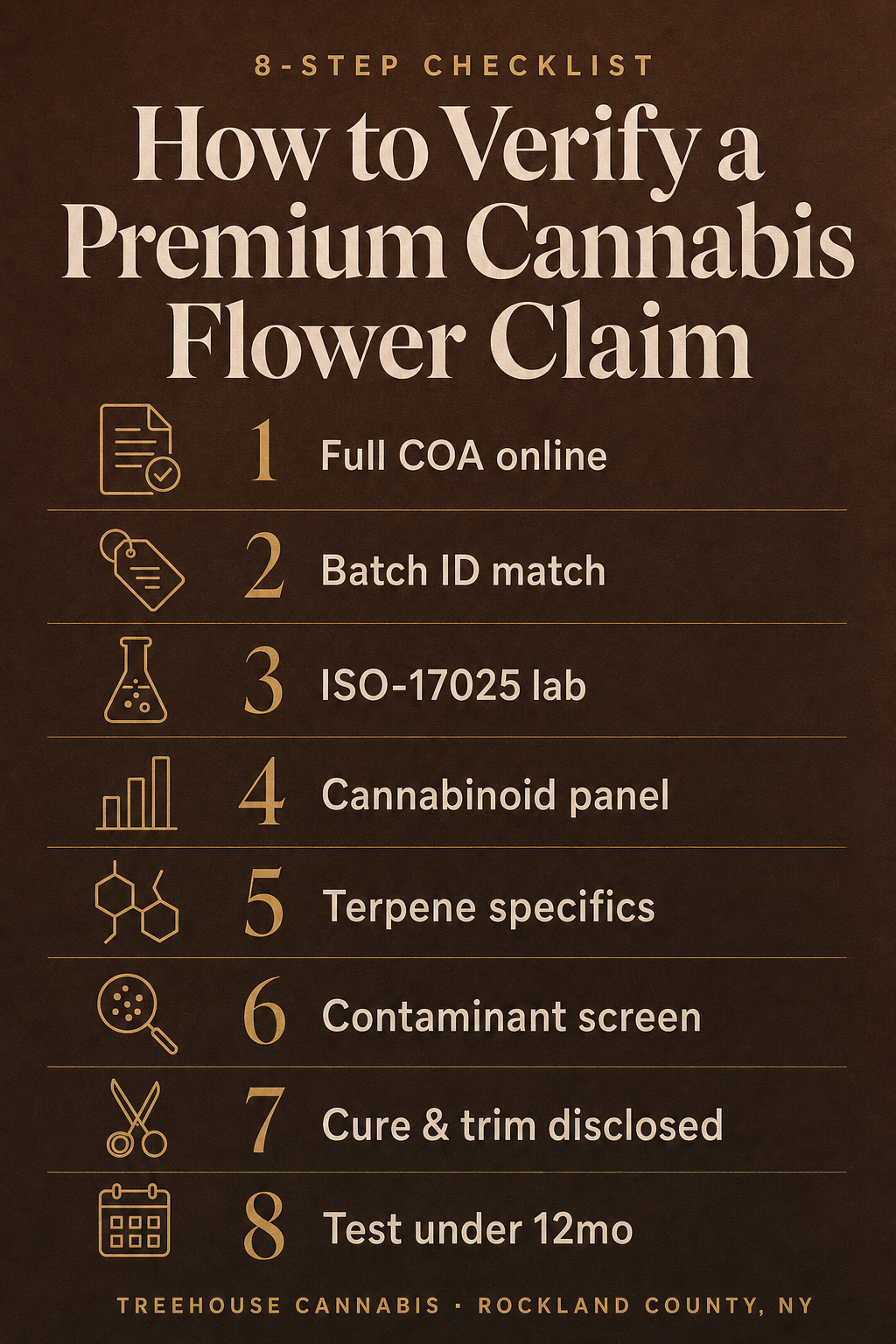
The difference between a label-driven premium claim and a COA-driven premium claim comes down to traceability. A label-driven claim says "28% THC, top shelf" and stops there. A COA-driven claim points to a specific lab report, names the cannabinoids and terpenes by percentage, and confirms the lot number on the jar matches the report. The latter is what justifies the price.
Treehouse Cannabis customers in Rockland, Orange, and Westchester Counties can request and review COAs for any premium flower product on the menu -- every batch on the shelf is tied to verifiable testing rather than a label promise. As a practical example, a premium indoor eighth like MAC Stomper - Premium - 3.5g ships with full-panel testing documentation rather than a printed THC headline, which is the working pattern across the premium tier. Midnight Orgy - Premium - 3.5g
The right shopping framework is simple: read the COA before you read the price tag. Once the COA is on the table, the price tag starts to mean something concrete -- and the difference between a $35 eighth and a $60 eighth becomes a difference between documented inputs and a marketing claim.
Sources
- Leafly — Leafly estimates home grow at ~$0.45/g outdoor and $1.34–$5.80/g indoor vs. $5–$
- Leafly — Leafly's per-gram build-up shows indoor home cultivation at $1.95–$3.90/g and ou
- NORML — NORML reports that falling wholesale prices — driven by oversupply — are compres
- NORML — NORML cites research that consumers are comfortable paying up to ~$14/gram for l
- NORML — NORML summarizes a Health Economics study showing tax-driven price increases pus
- PLOS ONE — Schwabe et al. HPLC-tested 23 flower samples from 10 Colorado dispensaries and f
- Scientific Reports (via NIH PMC) — Giordano et al. tested 277 products from 52 Colorado dispensaries: only 56.7% of
- NIH PMC (medRxiv preprint) — Limbacher et al. independently tested 74 Colorado products and confirmed flower
- Leafly — Leafly's cultivation-method explainer, quoting Washington grower Bryan Gabriel,
About Treehouse Cannabis
Treehouse Cannabis is an adult-use dispensary serving customers 21 and older in Rockland County, Orange County, and Westchester County, NY. The store carries indoor-grown, hand-trimmed, slow-cured flower and pre-rolls across a range of price tiers, with every product tied to a verifiable Certificate of Analysis. Browse the menu at treehousecannabis.com or stop in to review COAs in person.
Cannabis is for adults 21 and older. Keep all cannabis products out of reach of children and pets. Do not drive or operate machinery while under the influence of cannabis. The content in this article is intended for educational and informational purposes only and does not constitute medical, legal, or professional advice. Please consume responsibly and in accordance with New York State law.

Shop our products

Shop All

Flower

Pre-rolls
Vaporizers

Edibles

Drinks

Concentrates

Tinctures

Topicals

CBD

Pet CBD

Accessories