
Why some people spiral and others sail — and what you can do about it
Why Does Weed Make Some People Paranoid? The Science Behind the Anxious High
Why does weed make some people paranoid, while others smoke the same amount and feel perfectly relaxed? It's one of the most common cannabis experiences — and one of the least explained.
The answer isn't "it depends on the strain." It comes down to your endocannabinoid system, your brain chemistry, and a handful of factors that determine whether THC tips you into anxiety or calm.
Here's what the science says.
Why Paranoia Happens: The CB1 Receptor Mechanism
When you inhale THC, it binds to CB1 receptors — proteins embedded throughout your brain and nervous system. These receptors are part of your endocannabinoid system (ECS), which regulates mood, memory, fear response, and appetite.
The amygdala is where paranoia starts. This almond-shaped brain region sits in your limbic system and governs your fear and anxiety responses. When THC overstimulates amygdala CB1 receptors, your brain receives an overload of threat signals. Fear processing goes into overdrive. You become hyper-aware of your surroundings, socially self-conscious, and prone to intrusive thoughts.
This explains why people describe feeling like "everyone is looking at me" or "something bad is about to happen" — their brain's threat detection system has been artificially amplified.
The prefrontal cortex is the counterweight. Research from animal studies suggests cannabis produces relaxation when it activates the front region of the brain, where reward-processing opioid receptors are dense. When THC primarily hits the back region instead, adverse reactions — including paranoia and anxiety — become more likely.
This front-versus-back brain sensitivity varies between individuals, which is why identical doses produce opposite reactions in different people.
Why THC Dose Matters So Much
A landmark 2017 study published in Journal of Clinical Psychopharmacology tested 42 healthy adults across different THC doses. At 7.5mg, participants reported reduced negative feelings during a stress task. At 12.5mg, the effect flipped — the same participants experienced increased anxiety and paranoia.
The difference wasn't the person. It was the dose.
Higher THC concentrations flood your CB1 receptors faster than your brain's inhibitory systems can compensate. The result: an overstimulated amygdala, disrupted prefrontal regulation, and the classic "too high" spiral.
This is why experienced users often prefer lower-THC products with higher CBD content. CBD doesn't bind directly to CB1 receptors the way THC does. Instead, it appears to modulate THC's effects — buffering anxiety and dampening the paranoid response without producing its own psychoactive high.
What Triggers Paranoia? The Six Key Factors
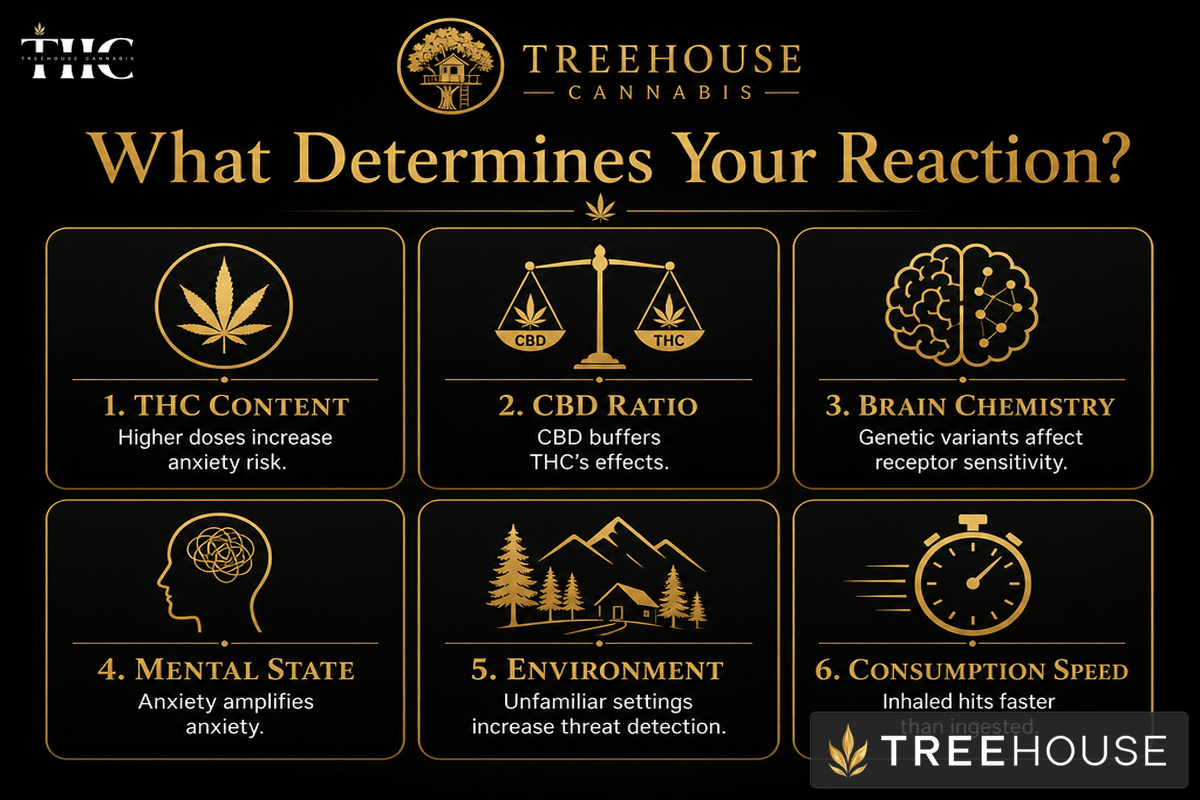
No single factor predicts cannabis-induced paranoia. Instead, it's a combination of variables stacking together:
1. Your brain chemistry and genetics People with certain genetic variants in the COMT and AKT1 genes show different susceptibility to cannabis-induced paranoia. The CNR1 gene — which codes for the CB1 receptor itself — also shows methylation patterns linked to altered receptor density. If your endocannabinoid system is naturally more sensitive or less densely populated, you're more prone to anxious reactions.
2. Mental state going in Cannabis amplifies whatever emotional state you bring with it. If you're already anxious, stressed, or in a negative headspace, THC tends to amplify those feelings rather than override them. This is why "set and setting" — your mindset and environment — matters so much.
3. Environment and social context Smoking alone in an unfamiliar place produces different effects than smoking in a comfortable, familiar setting with trusted people. Paranoia often emerges when your brain can't reconcile unfamiliar sensory input with a sense of safety.
4. Consumption method Inhaled THC hits your CB1 receptors within seconds. The peak arrives fast, and so does the potential for overstimulation. Edibles produce a slower onset, which some people find gives their brain more time to adjust — though the total effect can last much longer and be harder to manage.
5. Experience level and tolerance Regular users develop CB1 receptor downregulation — their brains adapt to constant cannabinoid exposure by reducing receptor density. This tolerance lowers the anxiety risk. First-time and occasional users haven't developed this adaptation, making them more susceptible to intense effects.
The Paranoia Scale: What Happens at Each Stage
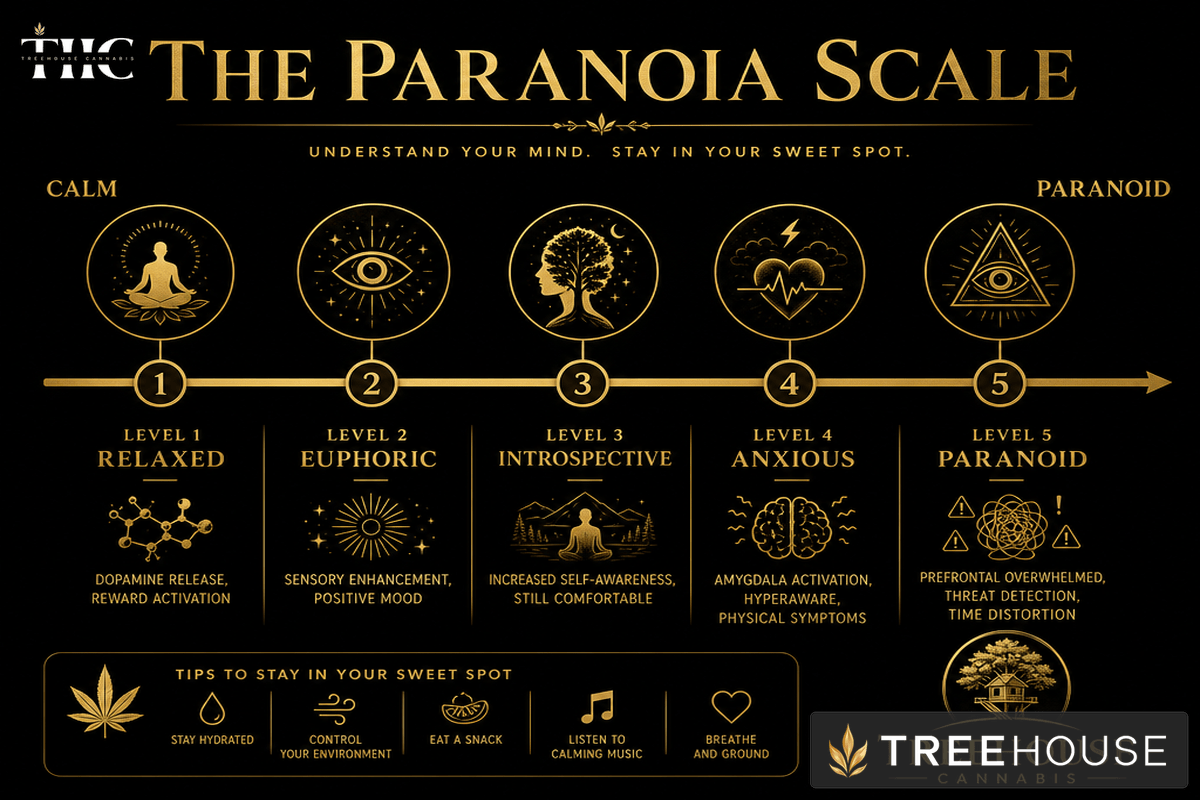
As CB1 activation increases, your experience moves through recognizable stages:
Level 1 — Relaxed (light use) Dopamine releases in the reward pathway. The front prefrontal cortex is activated. You feel calm, social, at ease.
Level 2 — Euphoric (moderate use) CB1 activation spreads. Sensory perception sharpens. Music sounds better, food tastes more intense. Mood stays positive as long as the dose stays within your threshold.
Level 3 — Introspective (approaching threshold) CB1 activation begins affecting the amygdala. Self-awareness increases. You might start noticing your own thought patterns more intensely. Still comfortable, but more internally focused.
Level 4 — Anxious (over threshold) Amygdala activity surges. Threat detection increases. You become hyperaware of social cues, start second-guessing interactions, feeling judged. Physical symptoms emerge: racing heart, dry mouth, perspiration.
Level 5 — Paranoid (significantly over threshold) Prefrontal regulation is overwhelmed. Fear response dominates. You may feel like people are watching you, talking about you, or that you're in danger — even in familiar, safe environments. Temporal distortion (time slowing) is common at this stage.
Level 6 — Panic (extreme overstimulation) Full amygdala activation. Complete loss of rational assessment. Terrifying thoughts, derealization, feeling that the experience will never end. This is a medical situation in rare cases, requiring reassurance and grounding techniques.
How to Manage or Prevent Cannabis Paranoia
If you've experienced cannabis-induced paranoia, these evidence-based approaches can help:
Start low and go slow. This is the single most effective strategy. Take one puff, wait ten minutes, assess. You can always consume more; you can't undo what's already in your system.
Choose CBD-rich products. A 1:1 THC to CBD ratio significantly reduces anxiety risk compared to THC-dominant products. CBD modulates the CB1 overstimulation that triggers paranoid reactions.
Stay in a familiar, comfortable environment. Your setting shapes your cannabis experience. Calm, safe, familiar spaces reduce the threat-detection triggers that produce paranoia.
Grounding techniques work. Focus on concrete sensory input: hold an ice cube, smell black pepper, name five things you can see. These interrupt the anxiety spiral by redirecting your prefrontal cortex.
Breathe deliberately. Slow, deep breathing activates the parasympathetic nervous system, directly counteracting the "fight or flight" response that drives paranoid thinking.
Wait it out. Cannabis effects peak within 30–90 minutes and fully dissipate within 2–4 hours. Paranoia is time-limited — reminding yourself of this helps prevent the additional anxiety that comes from fearing the experience won't end.
What About Tolerance Breaks?
Research on tolerance breaks shows that CB1 receptor density recovers during periods of abstinence. After just 48 hours without cannabis, receptor upregulation begins. After two to four weeks, many users find their sensitivity returns — meaning lower doses produce the same effects they once needed larger amounts to achieve.
This recovery process also means that after a tolerance break, your paranoid threshold may be lower than before. Start again with doses 30–50% below what you were using pre-break.
The Bottom Line
Cannabis-induced paranoia isn't a character flaw or a sign that something is wrong with you. It's a predictable pharmacological response rooted in how THC interacts with your brain's fear-processing systems.
The factors are knowable and largely manageable. Your genetics, dose, consumption method, mental state, and environment all contribute. Understanding these mechanisms lets you make informed choices — and when paranoia does strike, knowing why makes it far less frightening.
About Treehouse Cannabis
Treehouse Cannabis is a licensed adult-use dispensary serving the Rockland County and greater New York area. Whether you're looking for a relaxing evening or exploring what cannabis has to offer, our knowledgeable team is here to help you find the right product for your experience.
Visit us at treehousecannabis.com or stop by our Nyack location to speak with our team in person.
Disclaimer: This article is for informational purposes only and does not constitute medical advice. Cannabis affects individuals differently. Please consume responsibly and in accordance with New York State regulations.
Sources
- Healthline — Cannabis Paranoia: Why It Happens and How to Handle It
- PMC — Cannabis, a cause for anxiety? A critical appraisal of the anxiogenic and anxiolytic properties
- PMC — THC, CBD, and Anxiety: A review of recent findings on the anxiolytic and anxiogenic effects of plant-derived cannabinoids
- Frontiers in Neuroscience — The CB1 receptor: linking impulsivity and substance use disorder
- PMC — Do AKT1, COMT and FAAH influence reports of acute cannabis intoxication experiences


Shop our products

Shop All

Flower

Pre-rolls
Vaporizers

Edibles

Drinks

Concentrates

Tinctures

Topicals

CBD

Pet CBD

Accessories