Cannabis and Sex: What Research Says About Intimacy and THC
Cannabis and Sex: What Research Says About Intimacy and THC
What surveys and clinical cohorts actually show about THC, desire, orgasm, dose, consent, and the practical details people ask about.
Cannabis and sex research is survey-based rather than trial-based. The largest dataset, 51,119 U.S. adults, found that weekly and daily users reported about 36% higher sexual frequency than never-users. That is an association between two reported behaviors, not proof that cannabis improves sex.
The distinction shapes everything below. People who use cannabis differ from people who do not in ways a survey cannot capture, and the studies quoted most often recruit from dispensaries, which means they are talking to people who already like the product.
What follows separates what the research actually measured from what it is often assumed to prove. There are real, useful findings here about desire, orgasm, timing, consent and barrier safety. There is also no clinical trial, no long-term data, and no way to predict how any one person will respond.
What Does the Research Say About Cannabis and Sex?
The honest answer is that cannabis and sex research is survey-based. The evidence base is cross-sectional surveys, clinic cohorts, population telephone interviews and one small randomized crossover experiment that measured endocannabinoids rather than sexual satisfaction. No trial has tested cannabis as a treatment for anything sexual.
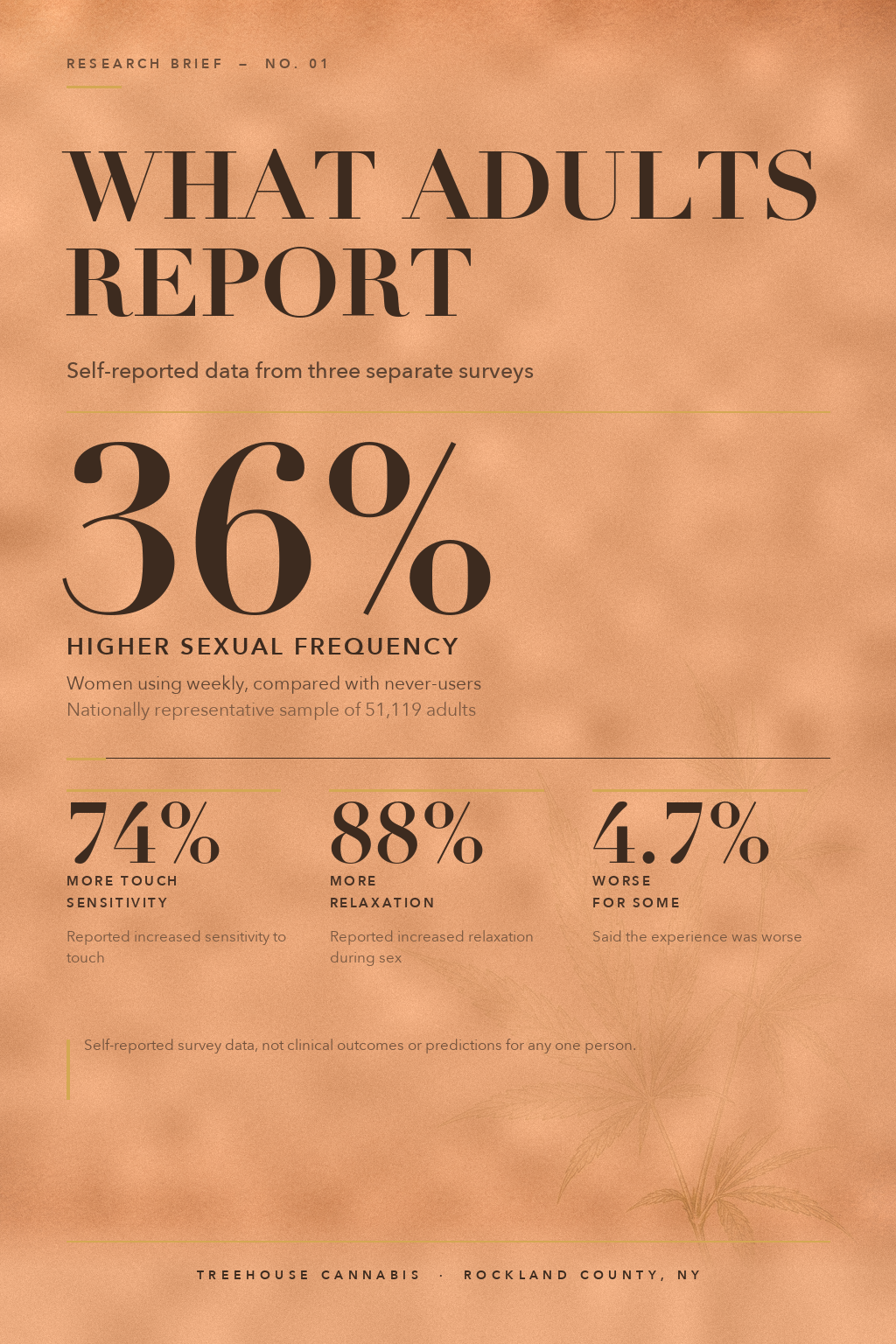
The largest dataset is the National Survey of Family Growth analysis of 51,119 U.S. adults aged 25 to 45. Women who used cannabis weekly reported 36% higher sexual frequency than never-users, an incidence rate ratio of 1.36 (95% CI 1.15 to 1.60). Men who used daily reported the same 36% higher frequency, with an incidence rate ratio of 1.36 (95% CI 1.21 to 1.53) [1].
The finding ran toward more sex rather than impaired function in every demographic group the authors examined.
What that means in plain terms:
- The evidence base is surveys, cohorts and one small randomized crossover experiment, not a clinical trial of cannabis for sexual function.
- 51,119 U.S. adults aged 25 to 45 were analyzed in the National Survey of Family Growth study.
- Women who used cannabis weekly reported 36% higher sexual frequency than never-users, an incidence rate ratio of 1.36.
- Men who used daily reported 36% higher frequency at the same incidence rate ratio of 1.36.
- The direction was more sex rather than impaired function across every demographic group examined.
A separate survey of 216 people who had combined cannabis with sex found a more mixed picture. 38.7% said sex was simply better, 24.5% said it was sometimes better, 16.0% said better in some ways and worse in others, and 4.7% said it was worse [9]. That 4.7% belongs in the story rather than buried under the favorable numbers.
Three limits apply to all of it. A cross-sectional survey cannot tell you which came first, whether cannabis changed the sex or the sex changed the cannabis use. Cannabis users differ from non-users in relationship status, age, health and openness in ways the survey does not measure. And dispensary-recruited samples select for people who already use and are interested in the product.
The 2024 review of the literature frames the relationship as bidirectional and dose-dependent, which is a careful way of saying the effect appears to run in both directions and that the amount matters more than the substance itself [6]. That survey-first pattern is not unique to this topic. Most cannabis health questions are still answered the same way, as Cannabis and Gastritis: What the Research Says lays out in detail.
Does Weed Increase Libido?
In surveys, most people who use cannabis say it raises their desire, but the pattern reverses at higher amounts. The defensible answer is that lower amounts are linked to heightened desire and larger amounts are not.
The headline number is self-report. Among 216 people with experience combining cannabis and sex, 58.9% reported increased desire [9]. That is what people said happened, not a measured change in anything.
The 2024 review adds the shape of the curve. It describes a bidirectional pattern in which lower doses are linked to heightened desire and enjoyment while higher doses may decrease both desire and performance, and it notes the effects differ between men and women rather than following one pattern [6].
The counterweight matters as much as the finding:
- 58.9% of 216 people with experience combining cannabis and sex reported increased desire.
- The 2024 review links lower doses to heightened desire and enjoyment.
- The same review links higher doses to potentially decreased desire and performance.
- Effects differ between men and women rather than following a single pattern.
- Daily male users in a survey of 8,656 Australians had 3.94 times higher odds of difficulty reaching orgasm.
- Daily male use was also associated with reaching orgasm too quickly, at 2.68, and too slowly, at 2.05.
Those odds ratios come from a telephone survey of 8,656 Australians, where daily male users were more likely to report difficulty reaching orgasm (adjusted odds ratio 3.94, 95% CI 1.71 to 9.07), reaching orgasm too quickly (2.68) and reaching orgasm too slowly (2.05) [10]. Heavy daily use is the pattern carrying the negative signals, which is the opposite of what a bigger amount would promise.
Most writing on weed and libido fails because it collapses three things into one. Desire is wanting. Arousal is the body's response. Pleasure is how the experience felt.
A questionnaire asking whether sex was better with cannabis does not separate them, and a yes can mean any of the three. The 811-person survey detail makes this concrete: 62.5% said cannabis enhanced pleasure during masturbation, which is a pleasure finding rather than a desire finding [8].
Context is worth keeping in view, because desire does not operate in isolation. The sleep side gets a full treatment in Cannabis and Sleep Quality: What Actually Works (and What Doesn't). Hormonal shifts, including the transition years, get their own look in The Menopause-Cannabis Connection: How Women Are Finding Natural Relief, and the anxiety angle is covered in Cannabis and Anxiety: Finding Relief Without the Panic.
What Makes Cannabis and Sex Feel Different?
Cannabis changes how sex feels through three routes: overlap with the body's own endocannabinoid receptors, direct evidence that this system is part of sexual response itself, and perception and setting. Only one of them is a measured biological mechanism.
The first is receptor overlap. The body makes its own cannabinoid-like signaling molecules, anandamide and 2-AG, and THC binds the same cannabinoid receptors that system uses. The federal research summary describes THC as the intoxicating compound in cannabis that produces changes in mood, thoughts and perception of reality [13].
The second is direct evidence that this system is part of the sexual response itself. In a single-blinded randomized crossover study, orgasm significantly raised plasma levels of 2-AG while anandamide was unchanged [11]. Separate work found circulating endocannabinoid concentrations associated with sexual arousal in women [12]. That is the strongest biological reason THC could plausibly shift sexual experience, and it shows the system is involved in normal sexual response rather than that cannabis improves anything.
The third route is perception and setting, which is where most of the survey data sits:
- The body makes its own cannabinoid-like molecules, anandamide and 2-AG, and THC binds the same receptors they use.
- Federal research describes THC as the intoxicating compound that changes mood, thoughts and perception.
- In a single-blinded randomized crossover study, orgasm significantly raised plasma 2-AG while anandamide was unchanged.
- Circulating endocannabinoid concentrations have been associated with sexual arousal in women.
- 74.3% of 216 respondents reported increased sensitivity to touch with cannabis.
- 65.7% reported more intense orgasms and 69.8% reported better relaxation.
- 87.7% of 811 surveyed adults reported increased relaxation during sex.
Among 216 people, 74.3% reported increased sensitivity to touch, 65.7% more intense orgasms and 69.8% better relaxation [9]. In the 811-person survey, 87.7% reported increased relaxation during sex and 71.9% said cannabis enhanced their sense of taste [8].
Treat that third route as an explanation rather than a measured mechanism. Surveys record what people believe happened. Relaxation and reduced self-consciousness change how the same physical sensation gets interpreted, which is a real effect without being a pharmacological one.
The same perception shift is part of why the compound gets studied for other mental states, including the creativity question in Does Cannabis Really Boost Creativity? What the Science Says. It is also a reason to read Can Cannabis Affect Memory? What Current Research Shows before assuming a clear head is guaranteed. The underlying biology gets a broader treatment in The Science of Cannabis: What the Research Actually Says.
Can Cannabis Help Women Reach Orgasm?
Three surveys found women who used cannabis before sex reported better orgasm outcomes, and every one of them is self-report from women who chose to answer a survey.
Start with what was measured. In 373 women surveyed at an academic obstetrics and gynecology practice, 34.0% said they used cannabis before sexual activity, and after adjustment those women had 2.13 times higher odds of reporting satisfactory orgasms (95% CI 1.05 to 4.35). Lubrication and pain differences in that study were not statistically significant [2]. The confidence interval is wide, so 2.13 is a direction rather than a precise effect.
Then the dispensary sample. Among 452 women, higher use frequency tracked with higher Female Sexual Function Index scores, 29.0 at the highest frequency versus 26.7 at the lowest (P = .003). Each additional use per week added 0.61 points to the total score, and each step up in use intensity lowered the odds of screening positive for female sexual dysfunction by 21% (odds ratio 0.79, 95% CI 0.68 to 0.92). Method of consumption and chemovar showed no consistent effect [3].
The third study narrowed to women who already had trouble. Of 410 women who use cannabis, 202 reported difficulty reaching orgasm with a partner, and within that group 72.8% said cannabis before partnered sex increased orgasm frequency, 71% said it made orgasm easier and 67% said it improved orgasm satisfaction, all at P below .001 [7].
The points that limit all three:
- 34.0% of 373 women surveyed at an academic ob-gyn practice reported using cannabis before sexual activity.
- Those women had 2.13 times higher odds of reporting satisfactory orgasms after adjustment.
- Lubrication and pain differences in that study were not statistically significant.
- In 452 women surveyed at dispensaries, mean index scores were 29.0 at the highest use frequency versus 26.7 at the lowest.
- Each additional use per week added 0.61 points to the total index score.
- Each step up in use intensity lowered the odds of screening positive for sexual dysfunction by 21%.
- Among 202 women who reported orgasm difficulty with a partner, 72.8% said cannabis increased orgasm frequency and 71% said it made orgasm easier.
- Method of consumption and chemovar showed no consistent effect on any of these outcomes.
None of this settles the causal question. Dispensary and clinic samples are self-selected, the answers are retrospective, and a woman who expects cannabis to help may report that it did. Expectation cannot be separated from effect in this design, and that limitation is the whole difference between a survey result and a clinical one.
Orgasm difficulty is also common and has clinical treatments. That is a different conversation from a product conversation, and it belongs with a clinician rather than a menu.
Does Cannabis Affect Erections and Testosterone?
At typical use the male data is mostly reassuring. At heavy daily use the signal turns negative, and the disagreement between studies is mostly about who each one recruited.
The largest cohort is also the most clinically grounded. Between 2008 and 2017, 7,809 men attended an academic andrology clinic, and 993 of them, or 12.7%, used cannabis. Those users had slightly higher mean Sexual Health Inventory for Men scores, 21.9 versus 21.2, and reported more sexual events per month, 8.8 versus 7.8. Cannabis use was not associated with either the score or serum testosterone on multivariate analysis, and the authors concluded there were no clinically significant deleterious effects on male sexual parameters [5].
A dispensary survey of 325 men complicates the picture in the other direction. More frequent use was statistically associated with higher International Index of Erectile Function scores, but the authors judged the clinical significance likely low and flagged selection bias. Method of consumption and cannabinoid composition showed no association [4].
Then the counterweight. Daily male users in the 8,656-person Australian survey had 3.94 times higher odds of difficulty reaching orgasm [10].
Reading the three together:
- A 10-year cohort followed 7,809 men attending an academic andrology clinic, and 993 of them, or 12.7%, used cannabis.
- Cannabis users had slightly higher Sexual Health Inventory for Men scores, 21.9 versus 21.2.
- They reported more sexual events per month, 8.8 versus 7.8.
- Cannabis use was not associated with the sexual health score or with serum testosterone on multivariate analysis.
- In a 325-man dispensary survey, more frequent use was associated with higher erectile function scores, but the authors judged clinical significance likely low.
- Method of consumption and cannabinoid composition showed no association in that survey.
- Daily male users in an 8,656-person population survey had 3.94 times higher odds of difficulty reaching orgasm.
- The studies disagree partly because of who each one recruits, which is a selection question rather than a biology question.
Who gets recruited decides a lot of the answer. An andrology clinic sees men referred for a sexual complaint but measures them the same way regardless of use. A dispensary survey recruits people who are satisfied with a product. A population telephone survey catches heavier users who never see a clinician at all.
On testosterone specifically, the claim readers search for most: in the 7,809-man cohort, cannabis use was not associated with serum testosterone. That is one cohort's finding and it is the only testosterone result in the sources here. It is not proof that cannabis has no hormonal effect.
How Much Cannabis Is Too Much Before Sex?
There is no number in the literature, but there is a consistent pattern: smaller amounts track with heightened desire and enjoyment, larger amounts track with reduced desire and performance, and 4.7% of 216 experienced users said cannabis made sex worse outright [9].
Route matters as much as amount, because the timing is completely different.
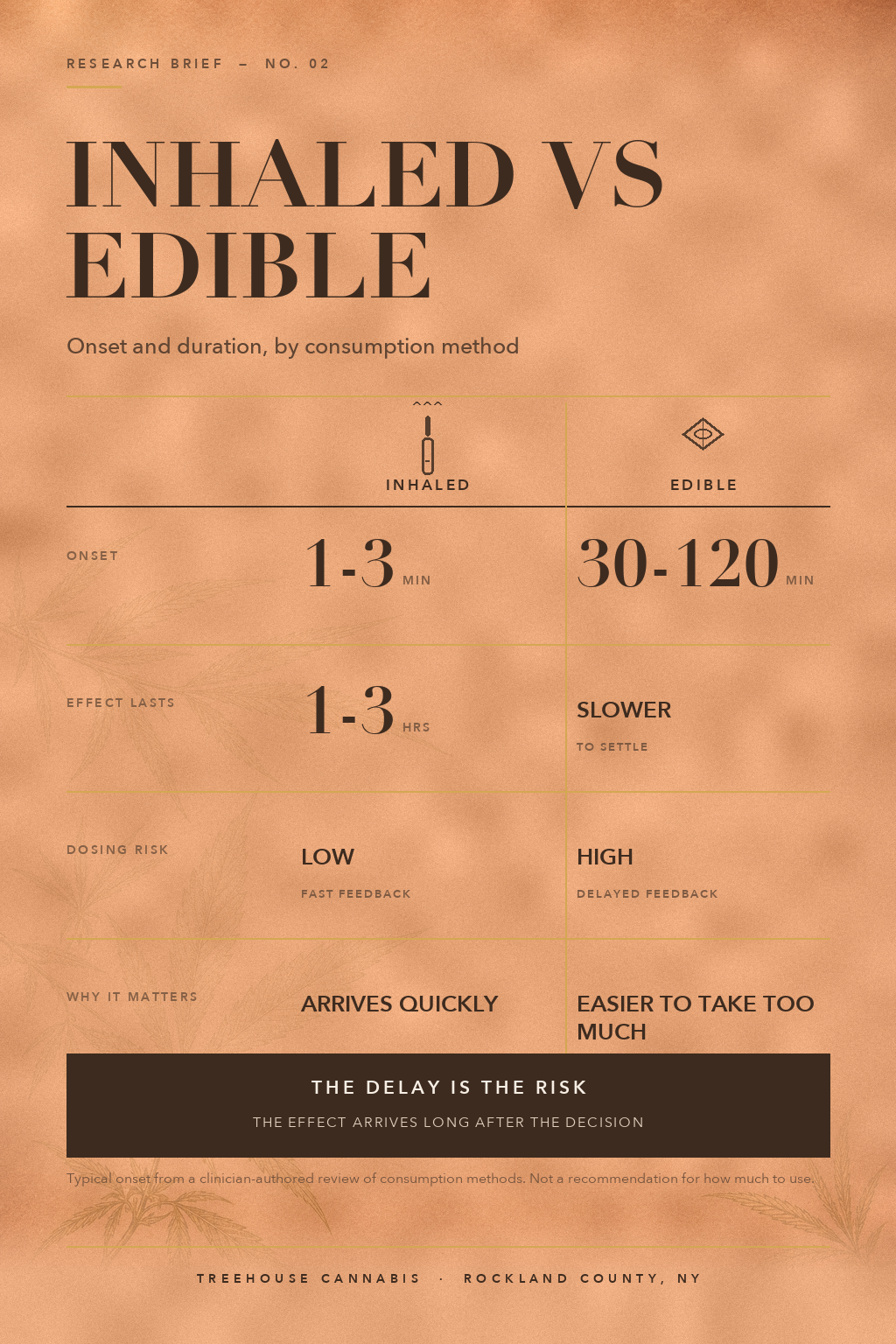
| Inhaled | Edible | |
|---|---|---|
| Onset | 1 to 3 minutes | 30 to 120 minutes |
| Effect lasts | 1 to 3 hours | Slower to settle |
| Dosing risk | Low, with fast feedback | High, with delayed feedback |
| Why it matters | The effect arrives quickly | Easier to take too much |
Inhaled cannabis takes effect in roughly 1 to 3 minutes and lasts about 1 to 3 hours, while edibles take 30 to 120 minutes to take effect and carry a higher risk of dosing errors [16].
What that timing difference comes down to:
- Smaller amounts track with heightened desire and enjoyment across the research literature.
- Larger amounts track with reduced desire and performance.
- 4.7% of 216 experienced users said cannabis made sex worse.
- Inhaled cannabis takes effect in roughly 1 to 3 minutes and lasts about 1 to 3 hours.
- Edibles take 30 to 120 minutes to take effect and carry a higher risk of dosing errors.
- Product variety and THC content have increased substantially, so the same physical amount of two products is not the same amount of THC.
- There is no universal threshold in the literature, and tolerance, setting and expectation all shift the response.
That delay is the practical problem for intimacy. With an edible the effect arrives long after the decision, so the temptation is to take a second amount before the first has landed. That is exactly how people end up further from the experience they planned than they wanted to be, and it is why the edible column is the one worth reading twice.
Potency compounds it. The variety of cannabis products and their THC content have increased substantially in recent years [13], which means the same physical amount of two products is not the same amount of THC. A familiar-looking portion is a poor guide, and format is not a shortcut either, since a vape and a low-dose edible sit at opposite ends of the timing curve.
A packaged flower product with a stated THC percentage, like NY Diesel | Flower | 28g, at least gives you a labeled number to work from instead of a guess. For the contrast in onset, Honeycrisp • T-pro Disposable Vape • 2G covers the fast end of the menu and Peach x Oishii Live Resin Gummies | 10 pk covers the delayed end.
The limits are real. There is no universal threshold in the literature. Response varies with tolerance, body, setting and expectation. A person's own history with a particular product is more informative than any general number, and experience with a different product tells you less than people assume.
Does Being High Affect Consent?
Yes, it can. The distinction that governs everything else is intoxication versus incapacitation, because those are different categories with different consequences for consent.
Someone who is intoxicated may still be able to consent. Someone who is incapacitated cannot. Evaluating incapacitation means judging the person's decision-making ability, their awareness of consequences and their level of consciousness, and the standard is the perspective of a sober, reasonable person rather than the perspective of the person who wants something to happen [14].
Cannabis matters here specifically because of what THC does. The federal research summary describes changes in mood, thoughts and perception of reality [13]. That is a description of a substance that alters judgment, not one that leaves it intact, and it is why the consent question is real rather than theoretical.
In practice:
- Intoxication and incapacitation are different categories, and the difference is what governs consent.
- Someone who is intoxicated may still be able to consent.
- Someone who is incapacitated cannot consent.
- Incapacitation is judged on decision-making ability, awareness of consequences and level of consciousness.
- The standard is the perspective of a sober, reasonable person, not the perspective of the person who wants something.
- THC changes mood, thoughts and perception of reality, which is why the judgment question is real.
- Consent is ongoing, so a check-in during is normal rather than awkward.
- Confusion, disorientation or a partner not tracking the situation is a stop, not a negotiation.
Consent is ongoing rather than a single question at the start. A check-in during is normal and not awkward. If a partner is confused, disoriented or not tracking the situation, that is a stop rather than a negotiation, and no amount of prior enthusiasm changes it.
Both partners' states matter, which means the person who is less impaired carries more of the responsibility for that judgment. Mixing cannabis with alcohol stacks impairment in a way that makes the sober-reasonable-person standard harder to apply, not easier. Being high yourself is never a reason to skip the check.
This is ethics and general guidance rather than legal advice. Consent standards vary by jurisdiction and by situation, and the specifics belong with someone qualified to answer them.
Is Cannabis Lube Safe With Condoms?
Usually not with latex, and this is the one place in the article where a wrong assumption has a concrete consequence.
Most cannabis lubricants are oil-based. Oil breaks down latex condoms, dental dams and gloves and reduces their effectiveness, which defeats the entire reason for using them [15].
The working rule is short:
- Most cannabis lubricants are oil-based.
- Oil breaks down latex condoms, dental dams and gloves and reduces their effectiveness.
- Water-based lubricants are safe with latex.
- Silicone-based lubricants are safe with latex and are the better choice for anal sex and for use in or around water.
- Check whether a product's base is oil, water or silicone before relying on a barrier.
- If a product does not state its base, do not assume it is compatible.
- THC balms and topicals sold for muscle and joint relief are not lubricants and belong to a different product category.
- The research base on cannabis-infused lubricants specifically is thin, so treat claims about them with caution.
Water-based and silicone-based lubricants are safe with latex, and silicone-based lubricants are the better choice for anal sex and for use in or around water [15].
Label reading is the practical step. Check whether the base is oil, water or silicone before relying on a barrier. If a product does not say, do not assume it is compatible, because a product marketed for sensation or flavor tells you nothing about its base.
There is also a category confusion worth naming. THC balms and topicals sold for muscle and joint relief are a different product category with a different formulation. They are not lubricants and should not be repurposed as one.
Be clear about what is not known. Cannabis-infused lubricants are their own small category, the research base on them specifically is thin, and no verified source here supports claims that they enhance sensation or increase arousal.
Close on the barrier point: a compatible lubricant protects the barrier rather than replacing it, and no lubricant should be treated as making a condom fail-proof.
What Should You Know Before Combining Cannabis and Sex?
The research supports reported gains in relaxation and pleasure, and it does not support a treatment claim. Persistent pain or new sexual difficulty belongs with a clinician, not a product.
What the research supports:
- Users consistently report more relaxation and more pleasure, with 87.7% reporting increased relaxation and 65.7% more intense orgasms.
- The endocannabinoid system is measurably involved in sexual response, with 2-AG rising at orgasm.
- The effect appears dose-dependent rather than uniform, with smaller amounts and larger amounts pointing in different directions.
What it does not support:
- There is no randomized trial of cannabis for sexual function.
- There is no long-term data on repeated use in this context.
- There is no evidence that cannabis treats any sexual disorder.
- There is no way to predict an individual response from a group average.
The guardrails are short enough to remember:
- Choose less than a usual session rather than more.
- Account for whether the product is inhaled or edible, because the timing is completely different.
- Keep any barrier method paired with a latex-compatible lubricant.
- Treat consent as an ongoing conversation rather than a single answer.
- Skip it entirely if a partner is uncomfortable or impaired.
One clinical line, stated without alarm. In the largest survey the authors found no statistically significant reduction in pain during sex, which is not the same as saying cannabis makes pain worse [2]. Persistent pain, new erectile difficulty or a loss of interest that bothers someone deserves a conversation with a clinician rather than another product, and cannabis is not a substitute for diagnosis or treatment.
Treehouse Cannabis serves customers across Rockland, Orange and Westchester Counties, and the team can walk through formats, listed potency and what is actually in stock if you want to compare a low-dose edible against a vape or a tincture. THC1000 Releaf Tincture | 30mL | 1000mg is one option for anyone who prefers a measured, low-volume format.
Whatever you choose, the research is clearest on two points: smaller amounts are where the reported benefits show up, and a barrier method always needs a latex-compatible lubricant.
Frequently Asked Questions
Does cannabis actually improve sex, or is it just a placebo?
Surveys consistently show people report better sex, and some findings hold up after adjustment. Women who used cannabis before sex had 2.13 times higher odds of reporting satisfactory orgasms, and higher use frequency tracked with higher Female Sexual Function Index scores. These are observational studies, so no one has shown that cannabis causes better sex. [2] [3]
Does weed increase libido?
Most users say yes in surveys, with 58.9% of one sample reporting increased desire. A 2024 review found the pattern depends on dose: lower doses were linked to heightened desire and enjoyment, while higher doses reduced both, and effects differ between men and women. Daily heavy use has also been associated with orgasm difficulty in men. [6] [9] [10]
Why does cannabis make sex feel better?
Three plausible routes. THC binds the same receptors as the body's endocannabinoids, and plasma levels of 2-AG rise at orgasm. Most users also report more relaxation and more sensitivity to touch. Being relaxed changes how the same physical sensation is interpreted, which is an explanation the research discusses rather than a measured mechanism. [11] [12] [9]
Can cannabis help women reach orgasm?
Several surveys point that way. Among 202 women who reported orgasm difficulty with a partner, 72.8% said cannabis before partnered sex increased orgasm frequency and 71% said it made orgasm easier. In another study, women who used cannabis before sex had 2.13 times higher odds of satisfactory orgasms. All of this is self-reported, and expectation cannot be ruled out. [7] [2]
Can cannabis cause erectile dysfunction?
At typical use the evidence is mostly reassuring. A 10-year cohort of 7,809 men found cannabis users had slightly higher sexual health scores and no association with serum testosterone. A population survey complicates that picture, finding daily users had 3.94 times higher odds of difficulty reaching orgasm, so dose and frequency appear to matter. [5] [10]
How much cannabis should you use before sex?
There is no threshold in the research, but the pattern is consistent: smaller amounts track with heightened desire and enjoyment while larger amounts track with reduced desire and performance. Route matters just as much, because inhaled effects arrive in 1 to 3 minutes while edibles take 30 to 120 minutes, with a higher risk of dosing errors. [6] [16]
Does being high affect consent?
It can. Intoxication and incapacitation are different categories: someone who is intoxicated may still be able to consent, while someone who is incapacitated cannot. Incapacitation is judged on decision-making ability, awareness of consequences and level of consciousness from the perspective of a sober, reasonable person. Confusion or disorientation is a stop, not a negotiation. [14]
Is cannabis lube safe to use with condoms?
Usually not with latex. Most cannabis lubricants are oil-based, and oil breaks down latex condoms, dams and gloves and reduces their effectiveness. If you are relying on a barrier, use a water-based or silicone-based lubricant instead. Silicone-based lubricant is the better choice for anal sex and for use in or around water. [15]
Sources
- The Journal of Sexual Medicine / National Library of Medicine — In a nationally representative sample of 51,119 U.S. adults aged 25 to 45 from t
- Sexual Medicine / National Institutes of Health (Saint Louis University School of Medicine) — Among 373 women surveyed at an academic obstetrics and gynecology practice, 34.0
- Sexual Medicine / National Library of Medicine — In 452 women surveyed at dispensary locations, higher cannabis use frequency was
- Sexual Medicine / National Institutes of Health — In 325 men surveyed at a dispensary, more frequent cannabis use was statisticall
- Canadian Urological Association Journal / National Library of Medicine — In a cohort of 7,809 men attending an academic andrology clinic from 2008 to 201
- Psychopharmacology / National Institutes of Health — This review of the cannabis and sexuality literature finds a bidirectional, dose
- Sexual Medicine / National Institutes of Health — Of 410 valid survey responses from women who use cannabis, 202 (52%) reported di
- Journal of Cannabis Research / National Institutes of Health — In a survey of 811 adults who use cannabis (mean age 32.1, 64.9% female), 87.7%
- The Journal of Sexual Medicine / National Library of Medicine — Among 216 people with experience combining cannabis and sex, 38.7% said sex was
- The Journal of Sexual Medicine / National Library of Medicine — In a telephone survey of 8,656 Australians, daily cannabis users were more likel
- The Journal of Sexual Medicine / National Library of Medicine — In two studies including a single-blinded randomized crossover design, orgasm si
- The Journal of Sexual Medicine / National Institutes of Health — Measuring circulating endocannabinoids in women found associations between endoc
- National Institute on Drug Abuse (NIDA), National Institutes of Health — NIDA's federal research summary states that THC is the intoxicating compound in
- Brown University BWell Health Promotion — Brown University's health promotion guidance distinguishes intoxication from inc
- Cornell Health, Cornell University — Cornell Health's patient guide explains that oil-based lubricants break down lat
- Society of Cannabis Clinicians — This clinician-authored review of consumption methods notes that inhaled cannabi
About Treehouse Cannabis
Treehouse Cannabis is a licensed adult-use dispensary in Rockland County, New York, serving customers 21 and older across Rockland, Orange and Westchester Counties. Our budtender team walks customers through product formats, listed potency and what is actually in stock before they buy, and anyone dealing with persistent pain, new sexual difficulty or a loss of interest should talk with a clinician rather than treat a product as a substitute for diagnosis.
Cannabis is for adults 21 and older. Keep all cannabis products away from children and pets. This article is educational and is not medical advice. Do not drive or operate machinery while impaired.
Shop our products

Shop All

Deals

Flower

Pre-rolls
Vaporizers

Edibles
Drinks

Concentrates
Tinctures

Topicals

CBD

Pet CBD

Accessories