
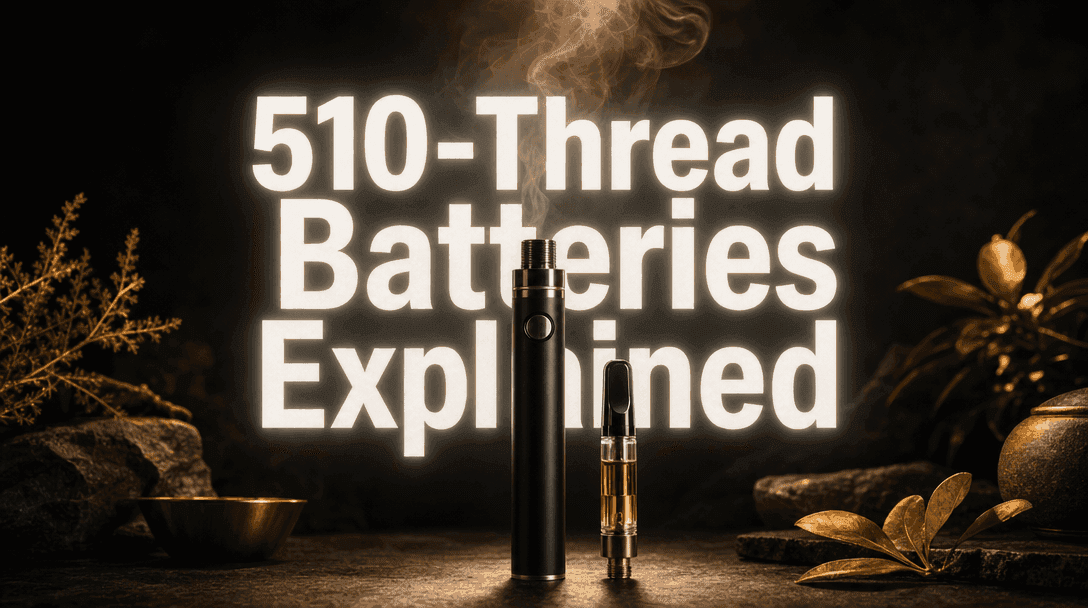
510-Thread Batteries Explained: Voltage, Charging, and Safety
510-Thread Batteries Explained: Voltage, Charging, and Safety
A 510 thread battery is the small rechargeable power unit that screws onto a cannabis vape cartridge, and it is the closest thing the cannabis industry has to a universal connection — roughly 85% of carts use it today. The "510" label describes a 5mm diameter thread with 10 threads per inch, and the voltage you set controls flavor, vapor production, and safety.
What Is a 510-Thread Battery and Why Is It Universal?
A 510 thread battery is the small rechargeable power unit that screws onto a cannabis vape cartridge. The "510" name describes the physical connection: a 5mm diameter thread with 10 threads per inch [4]. That screw pattern is the standard joint between a vape cartridge and the battery that powers it.
The format was introduced by Joyetech in 2010 for nicotine e-cigarettes and quickly spread through the vaping world [2]. As cannabis concentrates moved into cartridge form in the mid-2010s, cartridge makers adopted 510 threading rather than reinventing a cannabis-specific connection. The result: a single shared standard that lets almost any cart screw onto almost any battery.
Older thread types — 601, 808, and eGo — still exist in legacy devices, but 510 won because it offered a better balance of size, electrical conductivity, and manufacturing tolerance [4]. Today the standard is so widespread that browsing a selection of compatible batteries and accessories from a modern dispensary menu is essentially a 510-only experience Batteries Accessories.
Key reasons the 510 standard won the cannabis cartridge market:
- Universal mechanical fit: Every modern cannabis cart screws onto every modern 510 battery, regardless of brand.
- Refined electrical tolerances: The 510 contact geometry carries voltage reliably across hundreds of attachment cycles.
- Compact form factor: 510 threading allowed pen-style and box-mod batteries to stay slim without sacrificing connection strength.
- Manufacturer alignment: Cart makers and battery makers converged on 510 instead of fragmenting the market with proprietary connections.
For more on how the same universal-format thinking applies to cannabis dosing — where one standard dose does not fit every consumer — see our piece on edible timing and individual response You’re Not Lazy—Your Edible Just Peaked at the Wrong Time.
How Does 510 Battery Voltage Affect Vape Cartridge Performance?
Voltage is the single biggest variable you control on a 510 battery. It determines how much electrical energy flows into your cartridge's coil, which in turn sets the temperature of the heating element and the density of the vapor it produces.
Most 510 batteries run on a single lithium-ion cell with a nominal voltage of 3.7V — fully charged at 4.2V and considered depleted at 3.0V [5]. Variable-voltage batteries let you step the output across roughly 2.0V to 4.2V, while fixed-voltage models stay locked at one output, typically 3.3V or 3.7V [7].
What changes when you push voltage up or down:
- Lower voltage (2.0V–2.7V): Thinner, cooler vapor; more visible flavor from delicate terpenes; milder effect per pull.
- Mid voltage (2.8V–3.4V): The most common "daily" range — balanced flavor, satisfying vapor, and reasonable battery life.
- Higher voltage (3.5V–4.2V): Thicker clouds, faster extraction, but the coil runs hot enough to scorch terpenes and can taste burnt after a few pulls.
True compatibility between a battery and a cartridge depends on three things: the voltage output, the cartridge's coil resistance (measured in ohms), and the viscosity of the oil inside [3]. A thin distillate at 1.0 ohm vaporizes easily at 3.0V; a thick winterized rosin at 1.0 ohm needs more voltage to fully extract.
For a deeper look at how extraction and grind consistency influence vapor quality in a different format, our post on over-grinding and terpene loss covers similar chemistry Does Over-Grinding Weed Ruin the High?.
Which Voltage Should You Use for Distillate, Live Resin, and Rosin Carts?
There is no single "best" voltage for a 510 battery — the right setting depends entirely on what's inside the cart. Oil viscosity, terpene content, and coil design all change the answer.
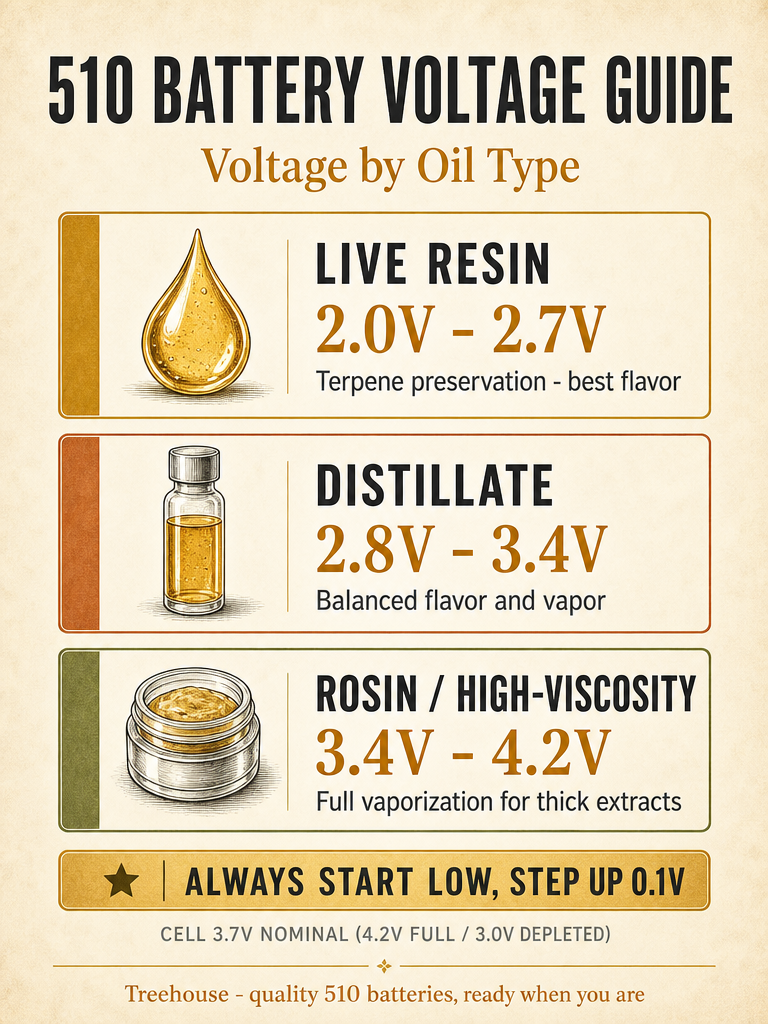
The general rule: match voltage to viscosity, then start low and step up in 0.1V increments until vapor and flavor feel right [6].
| Oil Type | Recommended Voltage | Why |
|---|---|---|
| Live resin | 2.0V–2.7V | Lower heat preserves the delicate terpene profile that gives live resin its flavor |
| Distillate | 2.8V–3.4V | Thin, refined oil vaporizes cleanly at mid-range; balance of flavor and cloud |
| Rosin / high-viscosity | 3.4V–4.2V | Thicker oil needs more heat to fully extract; pushes past the 3.7V cell nominal |
Quick voltage-matching checklist:
- Check the oil type on the cart label before attaching.
- Set the battery to the lowest preset or dial position.
- Take one short pull and note the flavor and vapor density.
- Step up 0.1V at a time and repeat until vapor feels right.
- Stop immediately if the taste turns burnt or harsh — that is terpene scorch, not better extraction.
A practical starting method: attach your cart, set the battery to its lowest voltage, take one short pull, then step up 0.1V and try again. Stop when the vapor tastes right and the cart produces visible cloud without any burnt or harsh note. Going above that point rarely improves the experience — it just burns terpenes and shortens coil life.
To explore high-viscosity extracts that benefit from the higher end of this range, our rosin concentrates collection lists current rosin options Rosin Concentrates, and our guide to the difference between resin, live resin, and rosin explains how each is made What is The Difference Between Resin, Live Resin, and Rosin?.
What Is the Difference Between Fixed-Voltage and Variable-Voltage 510 Batteries?
The two main categories of 510 batteries differ in how much control they give you over output.
Fixed-voltage batteries ship with a single output, typically 3.3V or 3.7V, that matches the most common use case [7]. They are simpler — no buttons to learn beyond the fire button, no menus, no settings to remember. They tend to be cheaper and smaller, which makes them popular for first-time buyers and travelers.
Variable-voltage batteries add a control scheme (usually two or three clicks of the fire button, or a separate voltage button) that cycles through 3–4 preset levels, commonly 2.8V / 3.4V / 3.7V / 4.0V, or a continuous dial from 2.0V to 4.2V [5]. They cost more and add complexity, but they let you dial in a setting for thin distillate one day and thick rosin the next.
Quick comparison — fixed-voltage versus variable-voltage 510 batteries:
- Output: Fixed = one preset (3.3V or 3.7V); Variable = 2.0V–4.2V across multiple steps.
- Control: Fixed = none; Variable = click cycles or a dial.
- Price: Fixed = lower; Variable = higher.
- Best for: Fixed = one oil type; Variable = mixed carts or terpene-focused sessions.
| Feature | Fixed-Voltage 510 Battery | Variable-Voltage 510 Battery |
|---|---|---|
| Output range | One preset, typically 3.3V or 3.7V | 2.0V–4.2V across 3–4 presets or a continuous dial |
| User control | None — fire button only | Click cycles or voltage dial to step through settings |
| Best for | Single oil type matched to the preset | Multiple oil types (distillate, live resin, rosin) in rotation |
| Price tier | Lower; popular for first-time buyers | Higher; preferred by experienced users |
| Form factor | Slimmer pen-style bodies | Mid-size pens or box mods |
Which is right depends on what you actually vape:
- Mostly one type of cart? A fixed-voltage battery matched to that oil's ideal range keeps things simple.
- Multiple oil types or viscosities? A variable-voltage battery is worth the extra cost.
- Want flavor preservation above all? Pick variable with a low-end setting around 2.0V–2.6V for live resin sessions.
For a deeper look at how these three oil types differ in extraction method and resulting viscosity, our explainer on resin, live resin, and rosin covers the chemistry.
How Do You Charge a 510 Battery Safely?
Charging is where most 510 battery safety advice actually lives. Lithium-ion cells store enough energy to start a fire if they are mistreated, and the FDA's published guidance on vape battery fires is built around everyday habits rather than exotic failure modes [1].
Charge time and ports. Most 510 batteries charge in 30 to 90 minutes via micro-USB or USB-C, depending on cell capacity [5]. A slim 280mAh pen-style battery tops off in well under an hour; a 650–900mAh mod-style box takes closer to 90 minutes. The LED typically turns green or shuts off when the cell reaches a full 4.2V charge.
Capacity tiers:
- 280–350mAh: Ultra-slim pen-style batteries; one or two sessions per charge.
- 400–650mAh: Mid-size batteries; the most common tier for daily cart users.
- 900mAh+: Box mod batteries; longest life but larger form factor.
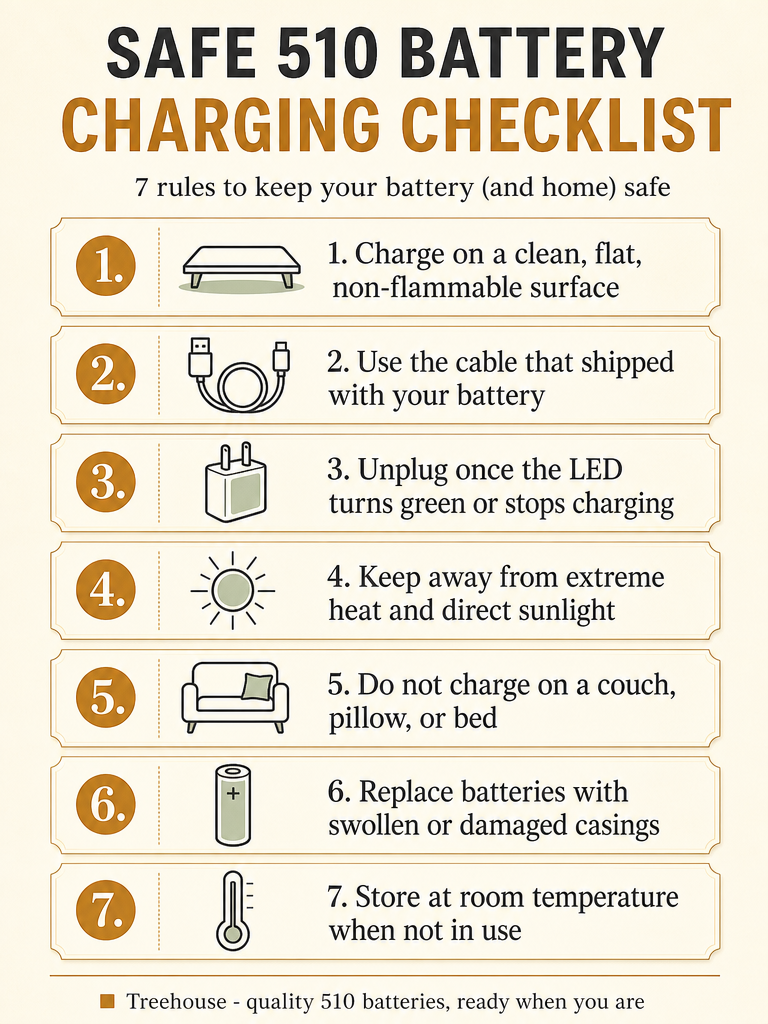
Safe charging checklist:
- Surface: Charge on a clean, flat, hard surface you can see — not under a pillow or on a couch cushion [1].
- Cable: Use the cable that shipped with the battery or a known-good equivalent.
- Heat: Keep the battery away from direct sunlight, radiators, and hot cars while plugged in.
- Visibility: Never leave a charging battery unattended overnight on a flammable surface.
- Indicators: Unplug once the LED turns green or the charge light shuts off.
Overnight charging. Modern batteries with a protection circuit board cut charging current at 4.2V, so overnight charging is generally safe with a quality unit [5]. The risk shows up when a battery lacks overcharge protection, sits on a flammable surface, or is exposed to heat while plugged in. Charge on a clean, flat, hard surface you can see — not under a pillow or on a couch cushion [1].
Cable discipline. Use the cable that shipped with the battery or a known-good equivalent. Cheap, high-resistance cables can undercharge the cell; damaged cables with exposed wiring can short.
For a broader look at how safety testing and lab verification apply across cannabis products — including vaporizer hardware and cartridges — our guide to cannabis Certificates of Analysis walks through what those documents cover Understanding Cannabis COAs: Your Guide to Lab Testing and Safety.
What Protections Should a Quality 510 Battery Have?
A quality 510 battery contains more than just a lithium-ion cell. Inside the housing sits a small protection circuit board (PCB) that watches the cell and intervenes before something goes wrong. The four critical functions are well documented in industry safety specifications [5].
- Overcharge protection: Stops current flow once the cell reaches 4.2V. Without this, the cell can swell, vent, or catch fire.
- Over-discharge protection: Cuts output when the cell drops below about 3.0V. Running a lithium-ion cell below this threshold permanently damages capacity.
- Short circuit protection: Detects a dead short between the 510 threads and shuts down output before the cell overheats. This is what triggers when your cart blinks three times at attachment.
- Overcurrent protection: Limits how much current the cell can deliver at one time, protecting both the battery and the cartridge coil.
Operation basics. Most 510 batteries follow the same beginner conventions: five clicks of the fire button to power on, two clicks for preheat (a low-voltage warm-up cycle for thick oil), five clicks to power off [8]. The five-click lock prevents the battery from firing in a pocket or bag.
Warning signs a battery lacks protection:
- No LED indicator at all, or an LED that never changes color or pattern.
- The battery stays warm long after the cable is unplugged.
- Visible swelling in the cell casing, or a chemical smell.
- No listed certifications (look for basic FCC or CE marks) on the packaging.
Batteries with verified protection circuits are not dramatically more expensive than bare-bones units, and the difference shows up the first time something goes wrong — a shorted cart, a child leaving the battery on all night, or a charge cable that fails mid-cycle.
What Are the Key Takeaways for Getting the Most From Your 510 Battery?
A 510 battery is one of the simplest pieces of cannabis hardware, but the standard it represents — 5mm diameter, 10 threads per inch, 2.0V–4.2V operating range, 3.7V lithium-ion cell — is the result of a decade of refinement across both the nicotine vaping and cannabis industries.
Get the voltage right for your oil type, charge on a clean hard surface, and buy from manufacturers that include the four core protection circuits. Those three habits cover roughly 90% of what determines whether your 510 setup is a good daily experience or a problem:
- Match voltage to oil viscosity — live resin and rosin stay flavorful at 2.0V–2.7V, distillate at 2.8V–3.4V, and thick extracts want 3.4V–4.2V.
- Charge away from flammables — always use a clean, flat, non-flammable surface and unplug once the LED turns green.
- Buy protected hardware — look for overcharge, over-discharge, short-circuit, and overcurrent protection.
- Start low and step up — raise voltage in 0.1V increments until the balance of flavor and vapor is right.
Browse the Treehouse Cannabis battery and accessories selection for current 510-compatible hardware, or stop into any of our Rockland, Orange, or Westchester County locations to talk through which battery pairs best with the cartridge you already own.
Sources
- U.S. Food and Drug Administration (FDA) — Authoritative federal safety guidance for vape batteries, including the specific
- iKrusher (vape hardware manufacturer) — Defines the 510-thread standard, traces its origins to Joyetech's 2010 introduct
- iKrusher (vape hardware manufacturer) — Explains that 510 compatibility depends on voltage output, coil resistance, and
- Discount Vape Pen — Defines the 510 name as 5mm diameter with 10 threads per inch and explains the m
- Discount Vape Pen — Documents the lithium-ion cell nominal voltage of 3.7V (4.2V full to 3.0V deplet
- Discount Vape Pen — Provides oil-type-specific voltage recommendations: live resin 2.0V–2.6V, distil
- Elemental Wellness Center (San Jose dispensary) — Breaks down fixed-voltage versus variable-voltage 510 battery types and matches
- G Pen (Grenco Science) — Walks through beginner operation of a 510 battery — the 5-click power-on convent
About Treehouse Cannabis
Treehouse Cannabis is a New York State licensed adult-use dispensary serving customers across Rockland, Orange, and Westchester Counties. Our team helps adult customers navigate the cannabis category with practical, evidence-based guidance — from choosing the right 510-thread battery to understanding which voltage suits a particular extract. Browse our full menu online or visit any of our locations to talk with a budtender about hardware, dosing, and product selection.
This content is intended for adults 21 and older. The information here is educational and does not constitute medical, legal, or professional advice. Always follow the manufacturer's instructions for your specific device, and consult a qualified professional if you have questions about cannabis use and your health. Cannabis products may not be suitable for everyone; effects vary by individual.



Shop our products

Shop All

Flower

Pre-rolls
Vaporizers

Edibles

Drinks

Concentrates
Tinctures

Topicals

CBD

Pet CBD

Accessories