
Indica vs Sativa: Why the Labels Are Mostly Meaningless
Indica vs Sativa: Why the Labels Are Mostly Meaningless
Indica vs sativa labels describe how a cannabis plant grows, not how it will make you feel. Large-scale chemistry, modern genetics, and the industry's own classification reforms converge on the same answer: the popular "indica = couch-lock, sativa = energy" framing is folklore, not science.
What does indica vs sativa actually mean?
In strict botany, "indica" and "sativa" describe how a cannabis plant grows, not how it makes a person feel. Indica-type plants are short, bushy, and broad-leafed, adapted to cooler climates and shorter growing seasons. Sativa-type plants are tall, narrow-leafed, and adapted to warm, equatorial climates with long seasons. That morphological split is real, observable, and reproducible from seed.
| Plant trait | Indica-type | Sativa-type |
|---|---|---|
| Height | Short, bushy | Tall, narrow |
| Leaf shape | Broad, wide leaflets | Thin, narrow leaflets |
| Native climate | Cool, short seasons | Warm, equatorial, long seasons |
| Flower density | Dense | Airy |
| Common folk effect | Sedating ("in da couch") | Uplifting, energetic |
The practical distinction is narrow:
- Use plant shape to describe morphology and cultivation traits.
- Do not use plant shape to predict aroma, potency, or personal effects.
- Use the lab profile instead when comparing products for purchase.
The familiar effect-based shorthand — indica for "in da couch," sativa for uplifting, energetic, creative — does not follow from the morphology. In practice, every modern analysis of commercial flower finds the two labels predict almost nothing about chemical content, aroma, or reported effects [10].
Browse the live Flower to compare jars by total THC, dominant terpenes, and grower notes instead of by category. To see how the same critique applies to specific products, look at Blackberry Kush | Flower | 28g and New Yorker | Flower • 3.5g — one labeled indica, one labeled sativa, with effect profiles driven by the lab sticker, not the category on the jar.
Looking for value? Treehouse Cannabis Specials lists current flower deals where the lab-tested numbers are right on the product page. For the aroma side of effects, The Science of Cannabis Terpenes: Beyond THC goes deep on terpenes. For the older Treehouse take on the traditional framing, Indica Vs Sativa walks through where the indica vs sativa distinction came from.
Where did the indica/sativa labels come from?
The terms entered Western science in the late 1700s. Carl Linnaeus named Cannabis sativa in 1753; Jean-Baptiste Lamarck proposed a separate species, Cannabis indica, in 1785, based on plants he observed in India that were shorter, denser, and more narcotic than Linnaeus's European hemp. By the twentieth century, "sativa" and "indica" had become loose vernacular buckets for growers and traders, applied inconsistently across regions and breeding programs [1].
Key milestones in the labels' history:
- 1753 — Linnaeus names Cannabis sativa from European hemp specimens.
- 1785 — Lamarck proposes Cannabis indica for shorter Indian plants.
- Mid-20th century — Growers begin using "indica/sativa" as informal effect shorthand.
- 2018 — McPartland consolidates everything into one species, C. sativa L., with two subspecies [1].
Modern systematic work consolidates everything under one species, Cannabis sativa L., with two recognized subspecies: subsp. sativa and subsp. indica [1]. That formal taxonomy does not line up with how the words are used on a dispensary shelf today.
The labels survived because they were convenient, not because they were correct. For the retail-side perspective on how the labels evolved into the modern hybrid category, see The Real Deal About Cannabis: Breaking Down Indicas, Sativas, and Everything in Between.
Does indica really make you sleepy and sativa really make you energetic?
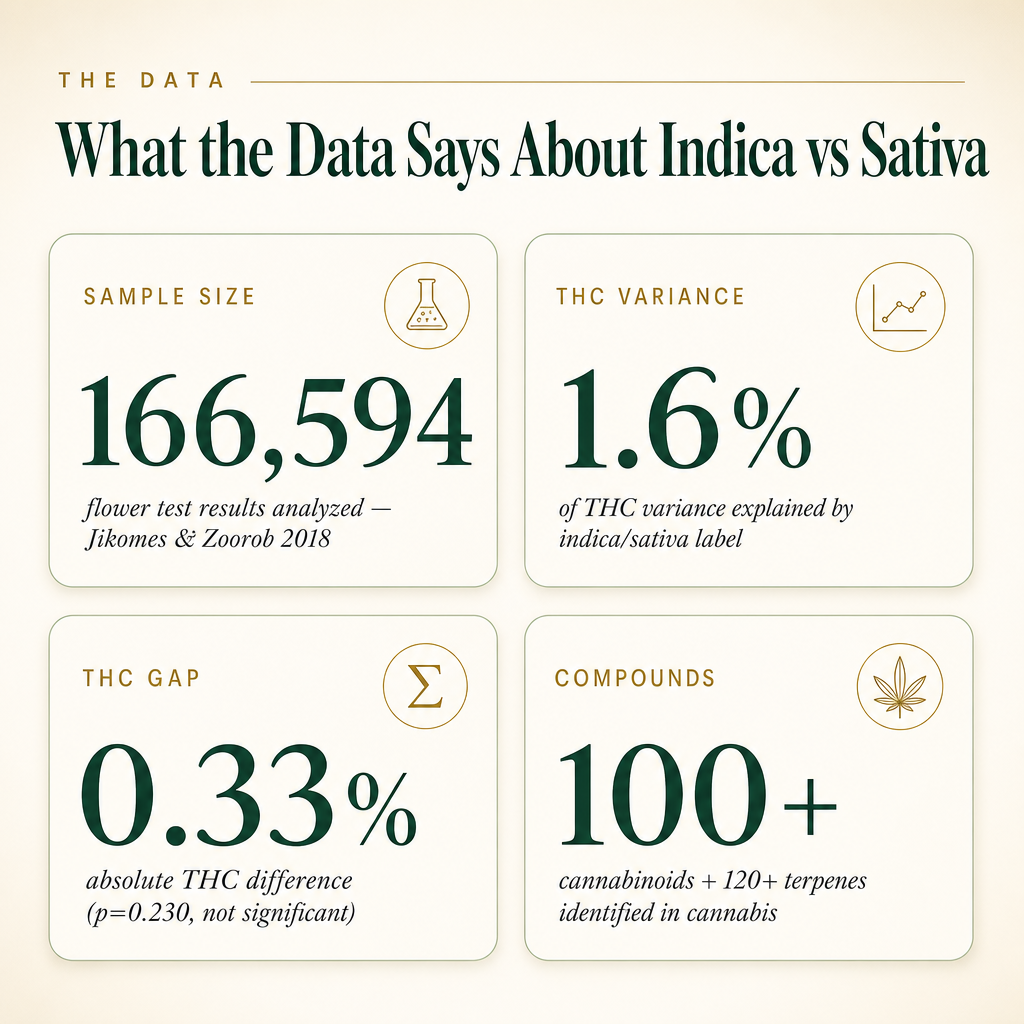
This is the most common belief in cannabis retail, and the data does not support it. The largest published analysis on the question pulled 166,594 Washington-state commercial flower test results and asked how well the indica/sativa/hybrid label predicted total THC content. The answer: the label explained about 1.6% of the variance, and the absolute THC difference between indica- and sativa-labeled flower was 0.33%, a gap that was not statistically distinguishable from sampling noise [7].
Headline numbers from the Jikomes & Zoorob 2018 study:
- n = 166,594 Washington-state commercial flower tests analyzed.
- r² ≈ 1.6% of THC variance explained by the indica/sativa/hybrid label.
- 0.33% absolute THC gap between indica- and sativa-labeled flower (p = 0.230, not statistically significant).
- THC varied more between testing labs and product categories than between labels.
Translation: if you grab two jars at random, one labeled "indica" and one labeled "sativa," knowing those labels tells you almost nothing about THC content. The same study found that THC varied much more between labs and product categories than between the indica and sativa labels.
The folklore survives in part because individual experiences feel real. People consistently feel sedated by some strains and energized by others. But that variation is better explained by terpenes, by your own tolerance and mindset, and by which cannabinoids are present in what ratios — none of which are captured by an indica/sativa sticker [4]. For the related question of whether higher THC percentages actually deliver stronger effects, Is High THC Percentage Really Better? Debunking the Potency Myth covers why chasing the highest THC number is also a weak predictor.
What do genetics say about indica vs sativa?
If the plant-level botanical split is real, you would expect genetic testing to cleanly separate "indica" plants from "sativa" plants. It doesn't. A 2015 Dalhousie / Bedrocan International study, published in Nature Plants, looked at the genetics of hundreds of named strains and found that sativa-labeled plants were no more genetically similar to other sativa-labeled plants than they were to indica-labeled plants [3].
| Genetic test result | What it should look like if the labels were real | What it actually looks like |
|---|---|---|
| Sativa-labeled plants cluster together | Yes | No — they cluster randomly with indica-labeled plants |
| AK 47 wins both Sativa Cup and Indica Cup | Impossible | Happened, four years apart, no rename |
| "OG Kush" is one cultivar across growers | Yes | No — same name, unrelated genetics |
What the genetics actually show:
- Sativa-labeled plants cluster with indica-labeled plants in genetic tests, not with each other.
- "AK 47" won a Cannabis Cup Sativa Cup and an Indica Cup four years apart with no rename and no genetic rework [2].
- Strain names like "OG Kush" can refer to genetically unrelated cultivars across different grow operations.
The same study highlighted a vivid example: the strain known as AK 47 won a Sativa Cup at one Cannabis Cup and an Indica Cup four years later, with no rename and no genetic rework in between [2]. If the labels were biological categories, this could not happen.
There is now broad scientific consensus that the current commercial use of "indica" and "sativa" labels is misleading and does not provide reliable information about a plant's genetic or chemical makeup [3]. The genetic data is the cleanest single piece of evidence that the labels describe marketing categories, not biological ones [2].
If indica and sativa don't determine effects, what do cannabis terpenes and chemotypes do instead?
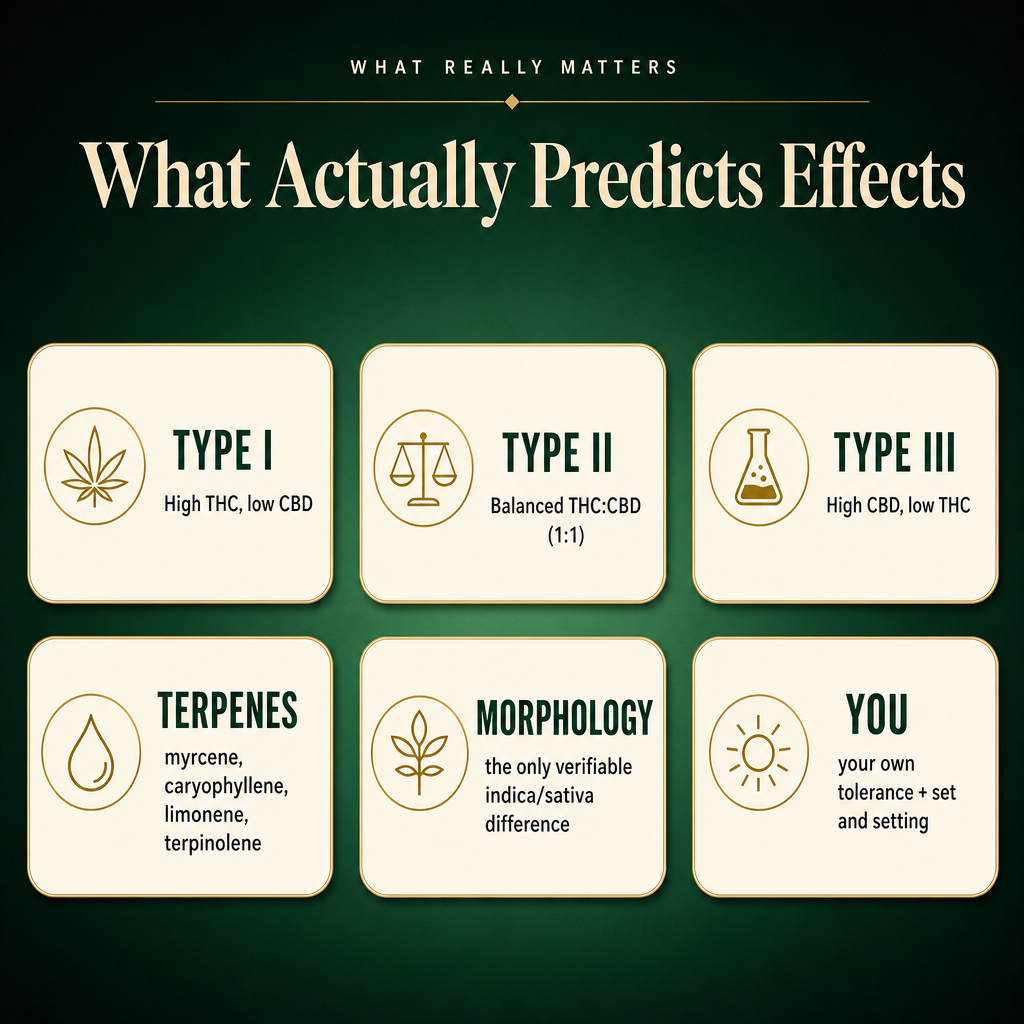
Two things: the cannabinoid ratio and the terpene profile. Most modern classification systems collapse the indica/sativa/hybrid trichotomy into a chemovar (chemical variety) model built on THC:CBD ratios:
| Chemotype | THC | CBD | Market share in legal U.S. flower |
|---|---|---|---|
| Type I | High | Low | Overwhelming majority |
| Type II | Balanced (often ~1:1) | Balanced (often ~1:1) | Small but growing |
| Type III | Low | High | Niche, hemp-adjacent |
For a more useful product comparison, check:
- Cannabinoid ratio: whether the flower is Type I, II, or III.
- Dominant terpenes: especially the top three listed on the lab report.
- Personal variables: dose, tolerance, mindset, and setting.
This Type I/II/III framework is the system cannabis educators now use in place of the indica/sativa/hybrid trichotomy [9] [10].
Within a chemotype, the dominant terpene profile does much of the heavy lifting on aroma and subjective effect. The two most common terpenes in C. sativa are β-caryophyllene (peppery, sometimes described as "relaxing") and β-myrcene (earthy, associated in folklore with sedation), and they tend to dominate regardless of label [8]. On average, indica-labeled flower is slightly higher in myrcene, and sativa-labeled flower is slightly higher in terpinolene and 3-carene, but these are trends, not rules [4].
The biggest single predictor of how a specific flower will feel is its full chemical fingerprint — total THC, total CBD, the minor cannabinoids (CBG, CBN, THCV), and the top three terpenes — read off the certificate of analysis on the jar. That fingerprint is what Leafly, Healthline, and most modern cannabis educators now use to describe what a product will do [9] [10]. If you want to predict effects well, ditch the sticker and read the lab sheet.
For a deeper look at how terpenes shape the experience, see Flower.
Are cannabis labels regulated at all?
Labeling rules vary from state to state. New York's adult-use framework, built under the Cannabis Law enacted in 2021, requires accurate THC and CBD percentages on every legal product and prohibits unverified medical claims, but does not require that an "indica" or "sativa" label match any chemical test [11]. A jar can be labeled "sativa" or "indica" based on grower or retailer preference without those words carrying any binding claim about effects.
What New York's cannabis labels do — and don't — require:
- Required: accurate THC and CBD percentages on every legal product.
- Required: prohibition of unverified medical claims on packaging.
- Not required: that "indica" or "sativa" descriptors match any chemical test.
- Not required: that an "indica"/"sativa" label correspond to a defined chemotype.
That gap is exactly why the industry's classification language is moving. Major strain databases have already replaced the indica/sativa/hybrid trichotomy with chemovar and terpene-based categories. New York and other legal states require the lab numbers; the shops layer on the labels by convention, not by regulation [9] [10].
Frequently asked questions
What is the real difference between indica and sativa?
Plant morphology, not chemistry or effects. Indica plants are short and broad-leafed (adapted to cold climates); sativa plants are tall and thin-leafed (adapted to warm climates). The popular effect-based distinction is not supported by genetic or chemical testing [1] [10].
Does indica really make you sleepy and sativa really make you energetic?
This is consumer folklore, not science. A 2018 analysis of 166,594 Washington-state flower tests found indica/sativa labels explained only 1.6% of THC variability, and the indica-versus-sativa THC difference was not statistically meaningful. The strain known as AK 47 won both a Sativa Cup and an Indica Cup four years apart [7] [2].
If indica and sativa don't determine effects, what does?
Cannabinoid ratio (THC:CBD) and dominant terpene profile. Indica-labeled flower trends slightly higher in myrcene, sativa-labeled flower trends slightly higher in terpinolene and 3-carene, but those are trends, not rules [4].
Are there really only three cannabis chemotypes?
Type I (high THC, low CBD), Type II (balanced 1:1), and Type III (high CBD, low THC). Most commercial flower in legal markets is Type I regardless of whether it is labeled indica, sativa, or hybrid [9].
What are terpenes and how do they shape the cannabis experience?
Aromatic compounds — including myrcene, caryophyllene, limonene, and terpinolene — that interact with cannabinoids to produce an "entourage effect." More than 120 terpenes have been identified in cannabis, and they vary widely across chemovars [6].
Why are strain names like 'OG Kush' so inconsistent between dispensaries?
Genetic testing has shown two samples labeled "OG Kush" can be more genetically similar to other strains than to each other. The same strain name often refers to genetically unrelated cultivars in different grow operations [2].
Should I still use indica vs sativa when shopping at a dispensary?
It works as a rough starting point — most "indica" strains skew toward sedating terpenes, and most "sativa" strains skew toward uplifting ones — but check the lab-tested cannabinoid and terpene percentages on the actual jar to predict effects more accurately [9].
Are cannabis labels regulated at all?
Labeling standards vary by state. New York requires adult-use products to be labeled with THC and CBD percentages and prohibits unverified medical claims, but does not require indica/sativa labels to match any chemical test [11].
Sources
- Cannabis and Cannabinoid Research (Mary Ann Liebert) — Cannabis is a single species (Cannabis sativa L.) with two recognized subspecies
- Dalhousie University (Dal News, republishing The Conversation) — Dalhousie/Bedrocan Nature Plants study of hundreds of strains found indica-label
- Bedrocan International — Sativa-labeled plants are no more genetically similar to each other than to indi
- Frontiers in Psychiatry / PMC — Analytical studies show cannabis labeled indica has similar concentrations of ma
- Therapeutic Advances in Psychopharmacology (SAGE) / PMC — Cannabis contains over 400 chemical entities with more than 60 cannabinoid compo
- Molecules (MDPI) / PMC — Terpenes are the primary aromatic constituents of cannabis and interact with can
- Scientific Reports (Nature) / PMC — Analysis of 166,594 Washington-state cannabis flower test results found the indi
- Molecules (MDPI) / PMC — beta-Caryophyllene and beta-myrcene are the most common and often dominant terpe
- Leafly — Leafly's own strain database now uses the cannabinoid and terpene model (chemova
- Healthline — Cannabis strains are broadly categorized into Type I (high THC/low CBD), Type II
- New York State Office of Cannabis Management — Cannabis is legal in New York State for adults 21 and older for adult-use posses
About Treehouse Cannabis
Treehouse Cannabis is an adult-use dispensary in Middletown, New York, serving customers 21 and older across Orange County, Rockland County, and the Hudson Valley. Our budtenders help you shop by chemovar and lab-tested terpene profile — not by sticker. Browse our live flower menu or stop in to see the lab results on every jar.
Cannabis is for adults 21 and older. Keep out of reach of children and pets. Do not drive or operate machinery while using cannabis. If you are pregnant, breastfeeding, or taking medication, consult a licensed clinician before use. Effects may vary by individual; start low and go slow.
Shop our products

Shop All

Flower

Pre-rolls
Vaporizers

Edibles
Drinks

Concentrates
Tinctures

Topicals

CBD

Pet CBD
Accessories