
Budget Cannabis vs Premium Cannabis: What Are You Paying For?
Budget Cannabis vs Premium Cannabis: What Are You Paying For?
Budget vs premium cannabis comes down to what you can see, smell, and verify on the label — not the percentage on the jar. The same flower can run anywhere from about $20 to past $60 an eighth, depending on how it was grown, cured, tested, and taxed. Here's what actually drives that price spread.
What Does Budget vs Premium Cannabis Actually Mean on a Dispensary Shelf?
On an adult-use dispensary shelf in the Hudson Valley and across New York, the same flower category can show up at three price points in the same week. Budget eighths often land in the high teens to low $20s, mid-shelf jars typically run $30–$45, and small-batch premium jars can climb past $60 before tax[8]. The spread isn't an illusion: New York's average item price sat at $28.81 in July 2026, well above California at $17.85 and Michigan at $8.65[8].
For a practical framing, the tiers look like this:
- Budget flower is the workhorse — outdoor or greenhouse-grown, faster-cured, machine-trimmed, designed to hit a price point.
- Mid-shelf flower adds indoor cultivation, longer cures, and more hand-trim, but stops short of pheno-hunted small batches.
- Premium flower is the small-batch craft version — indoor-grown, slow-cured, hand-trimmed, with a documented terpene panel.
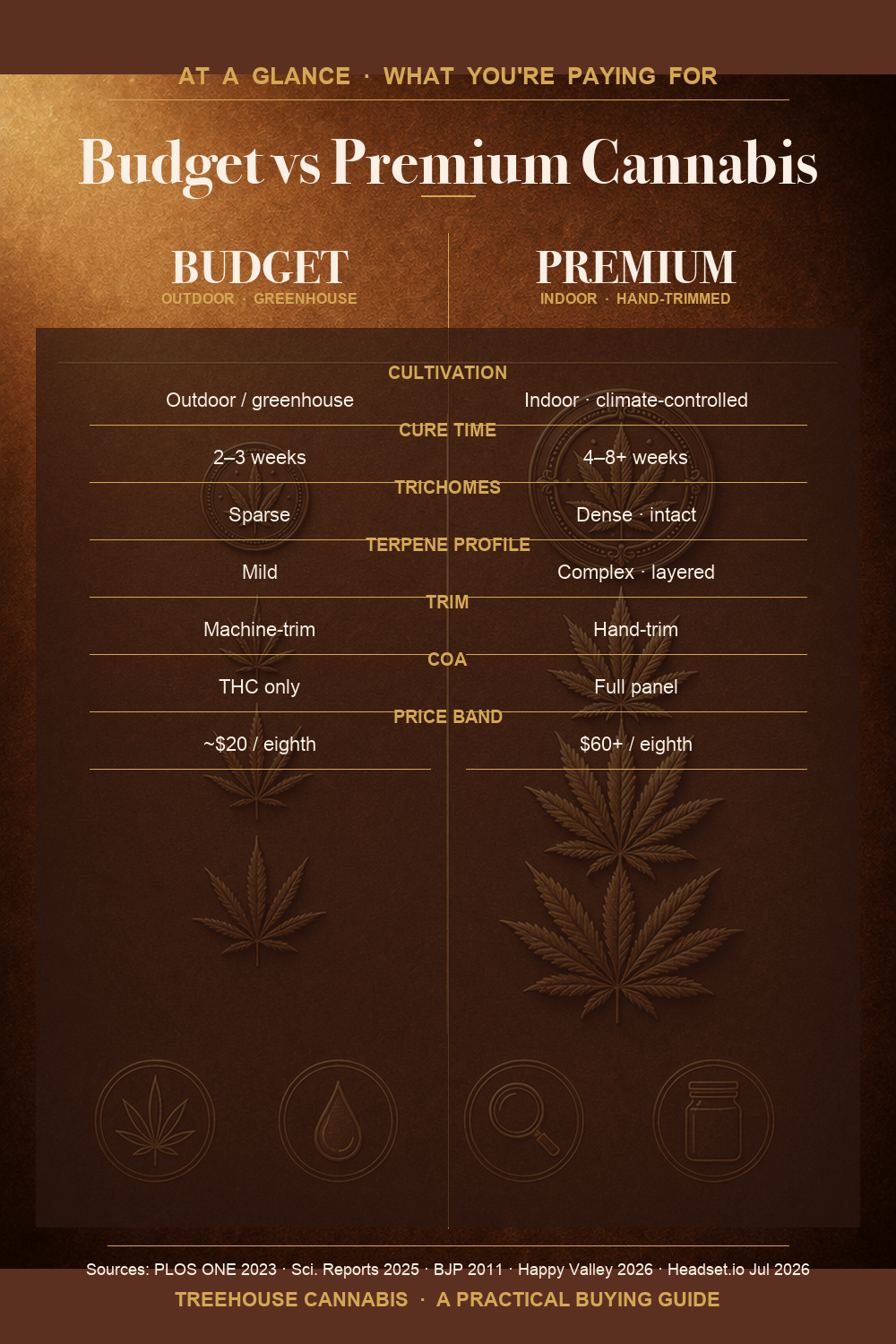
A quick side-by-side of the two tiers most customers compare side by side:
| Feature | Budget Flower | Premium Flower |
|---|---|---|
| Typical cultivation | Outdoor or greenhouse, sun-grown or supplemented | Indoor, fully controlled environment |
| Cure time | 2–3 weeks (accelerated) | 4–8+ weeks (slow) |
| Trim method | Machine-trim, faster | Hand-trim, trichome-preserving |
| Trichome density | Lighter, more variable batch to batch | Dense, intact coverage |
| Terpene profile | Milder, simpler aroma | Richer, more complex aroma |
| COA depth | THC + CBD (legal minimum) | Full panel: cannabinoids, terpenes, contaminants |
| Typical price band (eighth) | ~$20 | $60+ |
Premium Flower sits at the top of that range, where flavor, aroma, and trichome condition are the headline features rather than just the THC number. Both tiers are legal adult-use cannabis; the difference is the depth of work that goes into each jar and the transparency on the label.
The tier a customer picks shapes the experience, but timing and method of consumption still matter — even the best flower can feel off if the consumption moment is wrong, as covered in You’re Not Lazy—Your Edible Just Peaked at the Wrong Time.
What Drives the Price Difference: Cultivation, Genetics, and Post-Harvest Handling?
The biggest chunk of the price gap comes before the jar is even sealed: how the plant was grown, what was done to it after harvest, and what it cost the cultivator to get it tested and packaged. Indoor-grown cannabis typically runs 1.5x to 2x more per pound than outdoor, which is why indoor flower almost always carries a premium on the shelf[5].
Cultivation method sets the floor for cost and quality:
- Indoor — full control of light spectrum, humidity, and VPD; highest operating cost; densest, most consistent trichome coverage.
- Greenhouse — partial environmental control using sunlight supplementation; lower cost than indoor; quality varies widely by operator.
- Outdoor — sun-grown, weather-dependent; lowest cost; trichomes and terpene expression can be excellent but batch consistency is harder.
Post-harvest work is where premium earns its label. A slow cure runs 4–8+ weeks in climate-controlled containers, while budget product often moves through a 2–3 week accelerated cure to hit market faster[7]. Hand-trim preserves the trichome head; machine-trim is faster but knocks trichomes off and can leave bud looking rougher[6]. Both choices show up in the aroma when the jar opens.
Genetics are the third cost driver. Pheno-hunting — growing dozens of seeds from the same parent strain and selecting the single best expression — is labor-intensive, and the resulting cut is often limited-run[6]. Limited supply plus strong demand is a textbook pricing pattern. For a closer look at how strains get selected and what makes a connoisseur's pick, see The Top Cannabis Strains: A Connoisseur's Guide to Premium Selection.
Why THC Percentage Is Not the Quality Marker Most People Think It Is?
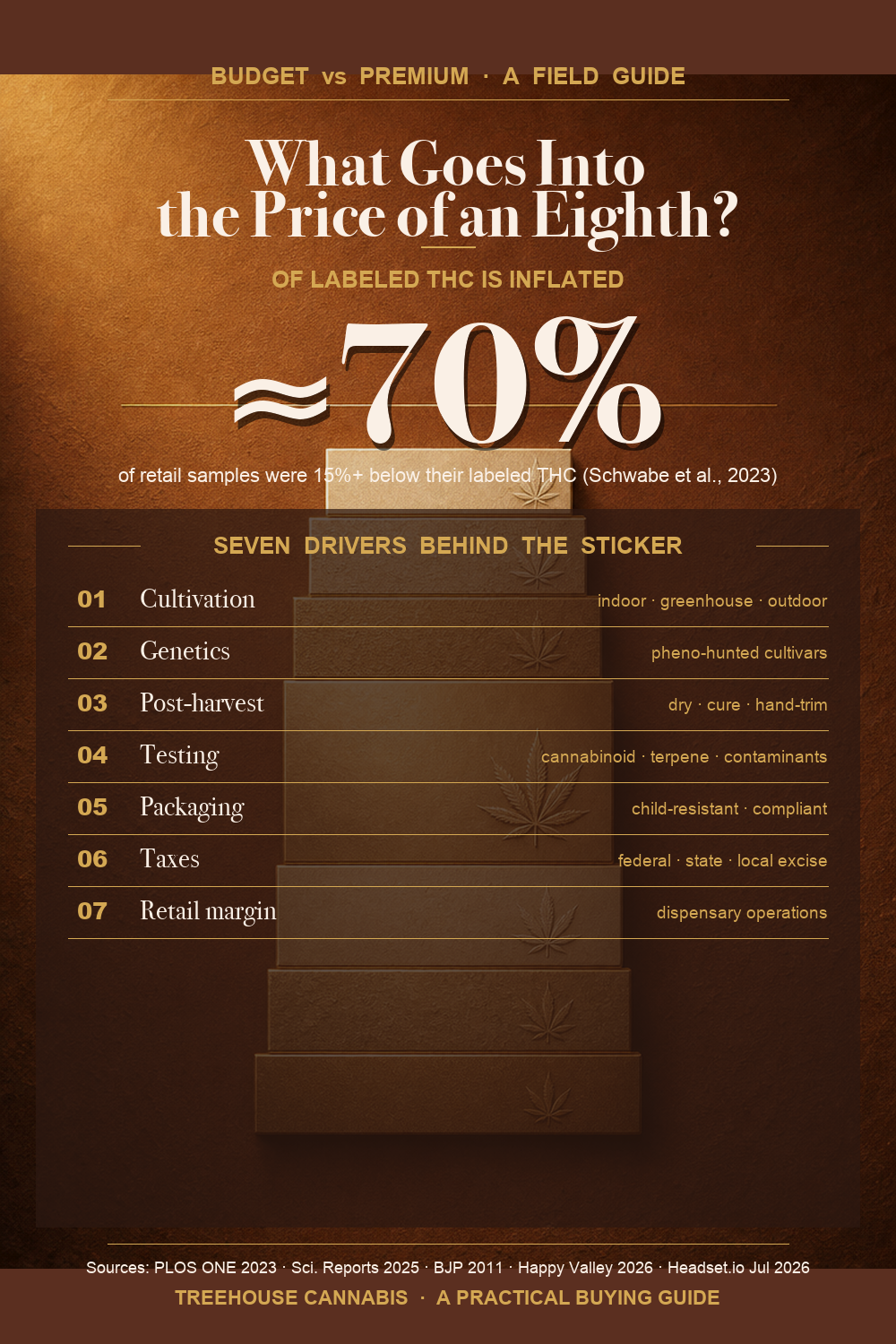
THC percentage on the label is the most expensive number to trust on the dispensary shelf. Peer-reviewed testing has repeatedly shown that labeled potency is overstated relative to what independent labs measure.
- A 2023 PLOS ONE study HPLC-tested 23 flower samples from 10 Colorado dispensaries and found observed average THC was about 15%, against labeled averages ranging from roughly 19.6% to 23.3% — roughly 70% of samples came in more than 15% below the labeled value[1].
- A 2025 Scientific Reports study of 277 products across 52 Colorado dispensaries found only 56.7% of flower products met a ±15% label-accuracy threshold[2].
- The pattern held in concentrates too, where observed THC was significantly lower than labeled THC across the same product set[2].
The implication is uncomfortable but practical: a higher-priced jar with a 28% THC label isn't reliably delivering more THC than a 22% mid-shelf jar. The label is one signal among several, and it's the one most likely to be inflated[6].
For a working catalog of what's actually on dispensary shelves, Flower is the easiest place to compare THC claims across current flower SKUs and see how much the numbers move within a single menu.
What Do Terpenes and Trichomes Actually Do, and Why Should Customers Care?
Terpenes are the aromatic compounds that give each strain its distinctive smell — citrus, pine, fuel, berry, pepper — and they sit in the same trichome heads that produce cannabinoids. Trichomes are the tiny mushroom-shaped glands coating quality flower; intact trichome coverage is one of the few visual cues that survives casual inspection[6].
The case for paying attention to terpenes rests on a peer-reviewed framework called the entourage effect:
- A 2011 British Journal of Pharmacology review laid out the working hypothesis: terpenoids like limonene, myrcene, alpha-pinene, linalool, and beta-caryophyllene interact with cannabinoids and may shape the subjective experience of a given flower[3].
- A 2020 Current Neuropharmacology review extended the framework, reviewing evidence that terpenes paired with cannabinoids produce synergistic effects on mood and anxiety pathways[4].
For adult-use customers, the practical takeaway is straightforward: a preserved terpene profile is the differentiator premium flower is actually selling. Two jars with the same labeled THC can feel noticeably different if one has a richer, more complex aroma profile than the other.
The five terpenes worth knowing:
- Limonene — citrus; commonly associated with bright, uplifting profiles.
- Myrcene — earthy, musky; common in cultivars described as relaxing.
- Alpha-pinene — pine; linked to alertness and clarity.
- Linalool — floral, lavender; common in calming profiles.
- Beta-caryophyllene — peppery, herbaceous; the only terpene known to also interact directly with cannabinoid receptors[3]. For a deeper look at how this one behaves, see Beta-Caryophyllene: Exploring the Peppery, Herbaceous Terpene Found Across the Plant Kingdom.
What Hidden Costs Make Up the Price Tag (Taxes, Testing, and Packaging)?
Even before retail markup, the back-end cost stack on a legal cannabis product is unusually heavy compared to most consumer goods. Federal effective tax rates on US cannabis companies range from roughly 30% to 70%, depending on entity structure and state[5].
State and local taxes layer on top:
- Massachusetts adult-use combines a 6.25% sales tax with a 10.75% state excise and up to a 3% local option[5].
- New York's adult-use structure adds its own cannabis-specific excise on top of sales tax, which is one of the reasons the same product costs more in Buffalo than it does in Michigan[8].
Testing is a fixed cost that doesn't scale down for budget product. Every batch sold at retail has gone through mandatory cannabinoid, contaminant, and microbial screening, and a useful Certificate of Analysis covers pesticide panels and heavy metals too — not just total THC[6]. The labs charge per test, not per tier, so testing costs the same per gram whether the customer is buying a $20 eighth or a $60 eighth.
Packaging is the other silent driver. Child-resistant compliant jars, exit bags, batch-tagged labels, and tamper-evident seals all cost more than the generic glass and plastic used in most consumer products. None of these line items are optional, and they all land in the shelf price.
For a practical walkthrough of what a full-panel COA should include and how to read one without a chemistry degree, see Understanding Cannabis COAs: Your Guide to Lab Testing and Safety.
When Does Budget Cannabis Make Sense, and When Is Premium Worth It?
Neither tier is "correct" — the right pick depends on what the customer is doing with it.
Budget flower is the right call when:
- Volume matters more than nuance — a busy week, a long social session, or shared consumption where individual flavor notes get lost in the room.
- The flower is going into an infusion or cooking, where the original terpene profile is going to be altered by heat anyway.
- The customer is still dialing in preferences and learning what strains and aromas they actually like.
Premium flower is the right call when:
- Flavor and aroma are the point — a quiet evening where the experience itself is the whole activity.
- The customer wants a specific cultivar with documented lineage and a full-panel COA.
- Consistency matters — pheno-hunted small batches tend to hit the same profile jar after jar, while budget product can vary more between batches[7].
Small Buds Flower sits in the middle of the spread — it's flower, just smaller bud size, often at a noticeable price reduction per gram without sacrificing the underlying cultivar. For customers who care about value but want indoor or craft-grown genetics, it's the practical compromise.
The simplest decision rule: ask whether the customer would notice the difference in aroma and effect between two jars side by side. If yes, premium is paying for something real. If no, the budget tier is doing the job and the savings go further[7].
How Should Customers Read a Certificate of Analysis So the Price Means Something?
A COA is the lab report for each batch, and a useful one goes well past total THC. The legal minimum on most labels is total THC and CBD; that's the floor, not the ceiling.
A COA worth trusting includes:
- Cannabinoid breakdown — THCA, CBDA, CBG, CBN, with specific percentages rather than a single combined total.
- Terpene panel — the top five or six terpenes with their percentages, so the customer can see whether limonene, myrcene, or caryophyllene dominates.
- Pesticide screening — pass/fail on the state's required pesticide list.
- Microbial testing — yeast, mold, and bacteria counts.
- Heavy metals — lead, arsenic, cadmium, mercury.
- Batch and harvest date — links the report to the specific jar in front of the customer.
If the COA only shows total THC and total CBD, that's the regulatory minimum, not a quality signal[6]. Premium flower that publishes a full-panel COA is doing two things at once: confirming the product is clean, and giving the customer the information needed to compare terpene profiles across batches.
For customers reading COAs for the first time, a useful habit is to compare the terpene total across two jars at the same labeled THC — the jar with the higher, more diverse terpene total is the one with the more preserved aromatic profile, which is what premium flower is actually selling.
Frequently Asked Questions
Is premium cannabis actually better than budget cannabis? Premium flower typically delivers denser trichomes, richer terpene profiles, slower cures, and hand-trim, which usually means a more flavorful and consistent experience[6][7]. Budget options can still be effective, especially for higher-volume customers or cooking, but they generally offer less complexity in aroma and flavor.
Why is some weed so much more expensive? Higher prices reflect cultivation method (indoor-grown cannabis costs 1.5x to 2x more per pound than outdoor), genetics, hand-trim and slow-cure labor, deeper testing, premium packaging, and layered taxes — federal effective rates of 30–70% plus state and local[5][7]. Brand positioning also plays a role in mature markets.
Does higher THC mean better quality? No. Peer-reviewed testing has repeatedly shown that labeled THC on retail flower is often inflated[1][2]. A 2023 PLOS ONE study found observed THC averaged roughly 15% versus labeled averages of 19–23%, and a 2025 Scientific Reports study found only about 57% of flower products met ±15% label-accuracy thresholds[1][2]. THC percentage is one of the least reliable quality markers[6].
What is the entourage effect in cannabis? The entourage effect is the proposed synergy between cannabinoids (like THC and CBD) and terpenes (like myrcene, limonene, pinene, and beta-caryophyllene). A 2011 review in the British Journal of Pharmacology laid out the framework[3], and a 2020 review in Current Neuropharmacology extended it[4]. This is the scientific basis for the industry's argument that preserved terpene profiles justify premium pricing.
How much should a gram or eighth of cannabis cost? It varies widely by state. In New York in mid-2026, the average item price sat around $29, with eighths averaging roughly $33[8]. California eighths run cheaper, while Michigan sits at the low end near $9 per item. Local taxes and supply dynamics drive most of the spread between markets.
Is indoor-grown cannabis worth more than outdoor? Indoor cultivation costs 1.5x to 2x more per pound than outdoor[5], but it gives growers tighter control over light spectrum, humidity, VPD, and feeding schedules. The result is typically more consistent flower with denser trichomes[6]. Whether the extra cost is worth it depends on whether the customer values flavor, aroma, and consistency over price per gram.
How do you tell good weed from bad weed by looking at it? Reliable visual cues include dense, well-formed buds with intact trichome coverage, precise hand-trim that preserves trichomes, vibrant coloration, and minimal stem and seed content[6]. Avoid relying on color alone — purple does not mean potent — or THC percentage on the label. Aroma and a full-panel Certificate of Analysis are more reliable indicators.
What should a Certificate of Analysis (COA) include? A useful COA goes beyond THC and CBD percentages. Look for a full cannabinoid breakdown (THCA, CBDA, CBG, CBN), a terpene panel with specific percentages, pesticide screening, microbial testing, and heavy metal testing[6]. A COA that only shows total THC is the legal minimum, not a quality signal.
Sources
- PLOS ONE — HPLC testing of 23 samples from 10 Colorado dispensaries found observed average
- Scientific Reports (Nature) — Across 277 products from 52 Colorado dispensaries, only 56.7% of flower products
- British Journal of Pharmacology — Cannabis terpenoids (limonene, myrcene, alpha-pinene, linalool, beta-caryophylle
- Current Neuropharmacology — Reviews evidence that terpenes combined with cannabinoids produce synergistic ('
- Happy Valley — Identifies four primary pricing drivers for cannabis flower: certification (clea
- Hashtag Cannabis (Seattle) — Premium pricing reflects pheno-hunted genetics, controlled-environment cultivati
- DDM Cannabis — Premium flower typically undergoes 4-8+ week cures versus 2-3 week accelerated c
- Headset.io — New York's average item price was $28.81 in July 2026, the highest among major U
About Treehouse Cannabis
Treehouse Cannabis is an adult-use dispensary serving the Hudson Valley — Rockland, Orange, and Westchester counties, with menus curated for adults 21 and older. The budtenders walk customers through COAs, aroma profiles, and cultivation method so the price tag on the jar reflects what's actually inside. Stop by to compare budget and premium flower side by side.
This content is for adults 21 and older in New York State. Treehouse Cannabis is an adult-use dispensary; this article is for educational and informational purposes only and is not medical advice. All cannabis products discussed here are adult-use only and are not intended to diagnose, treat, cure, or prevent any condition. If you have questions about your health, medications, or potential interactions, talk to a qualified professional, and always follow the dosing guidance printed on the product label. Effects vary by individual; consume responsibly, keep all cannabis products out of reach of children and pets, and do not drive or operate machinery while impaired.

Shop our products

Shop All

Flower

Pre-rolls
Vaporizers

Edibles

Drinks

Concentrates

Tinctures

Topicals

CBD

Pet CBD

Accessories