
Cannabis and Anxiety: Finding Relief Without the Panic
Cannabis and Anxiety: Finding Relief Without the Panic
Cannabis and anxiety have a complicated, dose-dependent relationship: the same plant can both calm and panic a nervous system depending on THC dose, the THC-to-CBD ratio, and your personal chemistry. Low to moderate THC often feels calming, while high-THC products can spike anxiety and paranoia — a U-shaped curve documented by Drexel University's Center for Cannabis Research.
What Does Cannabis Actually Do to Anxiety?
Cannabis and anxiety have a complicated relationship because the plant contains more than one active compound, and they pull the stress response in opposite directions. THC is the part that gets you high, and at low to moderate doses it can feel calming; CBD is non-intoxicating and tends to feel steadying across a wider dose range [1].
The catch is that THC's effect on anxiety follows a U-shaped curve, not a straight line. A small amount can dial the stress response down, while a larger amount of the same product can push it sharply up. A Drexel University fact sheet summarizes the pattern: THC reduces anxiety at lower doses and increases it at higher doses [2].
For shoppers, the practical takeaway is that the difference between "this calms me" and "this sends me into panic" usually comes down to three variables: how much THC, what the THC-to-CBD ratio is, and which terpenes dominate the strain.
A few quick variables decide which side of the curve you land on:
- THC dose — lower amounts typically calm, higher amounts can spike anxiety
- THC-to-CBD ratio — more CBD in the mix tends to soften THC's anxiogenic edge
- Dominant terpenes — limonene, linalool, and beta-caryophyllene are linked to calming effects
- Your personal tolerance and sensitivity — the same dose reads very differently across consumers
If you have ever had an edible hit you an hour later than you expected and ruined an evening, you already know the basics of dose and onset — we covered the timing side of that experience in You’re Not Lazy—Your Edible Just Peaked at the Wrong Time. And if you want a concrete balanced-ratio option to compare against pure THC flower, a live rosin product like Insane Pound Cake Rosin VS Iced Sangria Live Resin | Box | 1g is a useful reference point for what "lower-THC, terpene-forward" looks like in practice.
Why Does THC Sometimes Cause Paranoia or Panic?
THC causes paranoia and panic because it binds to CB1 receptors in the amygdala and prefrontal cortex, the same brain regions that process fear and threat. At a low dose, that binding can soften the stress response. At a higher dose, the same receptors become overstimulated, and the result feels like an actual danger signal: racing heart, intrusive thoughts, and a sense that something is wrong [3].
Several modern shifts have made this dose-response curve more dangerous by default. Average THC content in legal-market flower has climbed from roughly 12 percent in the early 2010s to 20–30 percent today, and concentrates routinely test above 70 percent. That means a "normal" bowl now contains far more THC than the joint your older relative smoked in college, and the room for error has shrunk accordingly.
A few non-product factors push the same dose in either direction:
- Tolerance — frequent consumers usually tolerate higher THC without panic, while occasional users do not
- Set — stress level, mood, and prior bad experiences all change the response
- Setting — a familiar, safe environment makes a bad reaction less likely
- Food intake — THC absorbed on an empty stomach hits harder
Regular or heavy use is not without its own risks. A long-running line of research has associated frequent cannabis use with anxiety symptoms and an elevated risk of an anxiety disorder diagnosis, particularly in younger users [6]. That does not mean cannabis causes anxiety for everyone, but it does mean the relationship is bidirectional: anxiety drives use, and heavy use can deepen anxiety.
If you have noticed that the same dose feels stronger than it used to, the tolerance explanation in Can You Build THC Tolerance? is worth a read before you assume the strain changed.
What Is the Best CBD-to-THC Ratio for Anxiety?
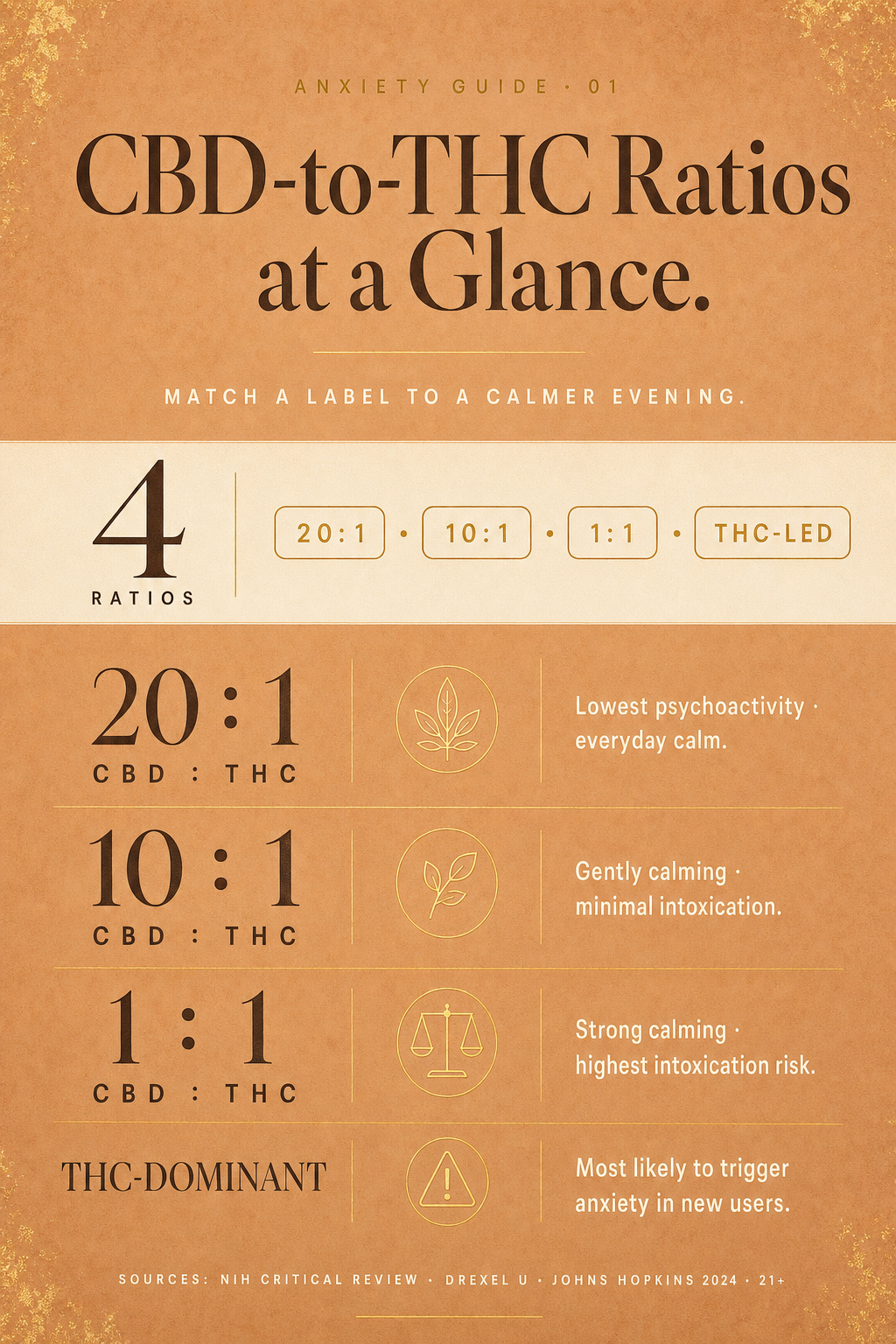
The best CBD-to-THC ratio for anxiety is one that keeps THC low enough to avoid triggering a panic response while still giving the calming benefit of cannabinoids. A 2025 systematic review of clinical studies on medicinal cannabis and anxiety concluded that CBD-dominant and balanced preparations showed the most consistent promise for anxiety outcomes, while THC-dominant products carried the highest risk of provoking the very symptom users were trying to treat [8].
| Ratio | Psychoactivity | Best for | Anxiety risk |
|---|---|---|---|
| 20:1 CBD:THC | Barely any | Everyday entry for anxiety-prone consumers | Lowest |
| 10:1 CBD:THC | Mild | Users who want a touch more cannabinoid effect | Low |
| 2:1:1 THC/CBD/CBG | Noticeable | Experienced consumers with some tolerance | Moderate |
| 1:1 CBD:THC | Strong | Calming paired with clear intoxication | Higher |
| THC-dominant | High | Lowest-priority option when calming is the goal | Highest |
A simple framework for shopping:
- 20:1 CBD:THC — barely any psychoactivity, a sensible everyday entry for anxiety-prone consumers
- 10:1 CBD:THC — mildly calming with minimal high, a step up for users who want a touch more cannabinoid effect
- 1:1 CBD:THC — strong calming paired with noticeable intoxication, best for experienced consumers with some tolerance
- THC-dominant — the highest-risk option for someone whose main goal is calming the nervous system
CBD-dominant and balanced ratios are the lowest-risk starting points because CBD appears to buffer some of THC's anxiogenic effects. Balanced-ratio products like Kiwi Strawberry Balanced 2:1:1 THC/CBD/CBG Rosin Gummies | 10 pack | 100mg are an easy way to get into the 2:1:1 range without having to mix your own. If you prefer a sublingual route for more precise dose control, looking at is a reasonable next step.
Which Cannabis Terpenes Help With Anxiety?
Three cannabis terpenes have the strongest evidence for helping with anxiety, and one of them now has a small human study behind it. Terpenes are the aromatic compounds that give cannabis its smell, and they do far more than provide flavor — several interact with the same neurotransmitter systems that regulate mood and calm.
- Limonene — A 2024 Johns Hopkins double-blind study of 20 adults found that vaporized d-limonene significantly reduced THC-induced anxiety and paranoia, a rare human result in this space [4]. Look for it in citrus-scented strains.
- Linalool — Preclinical studies have shown linalool producing anxiolytic effects comparable to diazepam, working through the GABA-A pathway [5]. It is the same terpene that gives lavender its calming reputation.
- Beta-caryophyllene — Activates CB2 receptors and has shown anxiolytic and anti-inflammatory effects in animal models.
- Myrcene — Sedating and earthy, but at high levels it can feel couch-locked and over-sedating for some users.
The terpenes that matter most for anxiety — limonene, linalool, beta-caryophyllene — appear across strain categories. That is the practical problem with the indica versus sativa label: lab analyses consistently show that indica-labeled and sativa-labeled flower contain similar average THC and CBD content, with the meaningful chemical difference living in the terpene profile [7].
In other words, "indica" is not a reliable synonym for "calming," and "sativa" is not a reliable synonym for "anxiety-producing." For a closer look at what the labels actually mean chemically, Indica Vs Sativa walks through the lab data. If you want the longer terpene science, The Science of Cannabis Terpenes: Beyond THC goes deep on the compounds beyond THC.
How Does Consumption Method Change the Anxiety Risk?
Consumption method changes the anxiety risk because each route of administration has a different onset time, duration, and dose-control profile. Choosing the right method can matter as much as choosing the right strain, especially for someone who has had a bad reaction in the past.
| Method | Onset | Duration | Dose control | Anxiety risk |
|---|---|---|---|---|
| Inhalation (flower, vape) | 10–30 min | 2–3 hours | High (one puff at a time) | Lowest — easy to titrate, easy to recover |
| Sublingual tincture | 15–45 min | 4–6 hours | High (dropper) | Low — precise dosing |
| Edibles | 90 min–3 hours | 6–10 hours | Low (committed dose) | Highest — delayed onset drives over-consumption |
| Topicals | Local, no high | Variable | N/A | Effectively none — no psychoactivity |
A few practical takeaways for anxiety-prone consumers:
- Start with inhalation or sublingual — fastest feedback, easiest to back off
- Save edibles for experienced consumers who can wait through the full onset
- Treat topicals as a separate category — calming format, no intoxicating effect at all
- Keep a low-dose, fast-acting option on hand as a "rescue" for bad nights
Edibles are the method most often involved in anxiety emergencies, and the reason is timing. A consumer who does not feel anything after 45 minutes takes another dose, the first dose finally peaks two hours in, and the second dose is also working by then. The result is the classic over-consumption panic attack.
For consumers who want the long duration of an edible but with a faster feedback signal, inhalation formats like paired with low-dose options are often a better starting point. Pre-rolled options from Topicals give a short, controllable session, and topicals are worth knowing about for consumers who want the cannabis plant without the high.
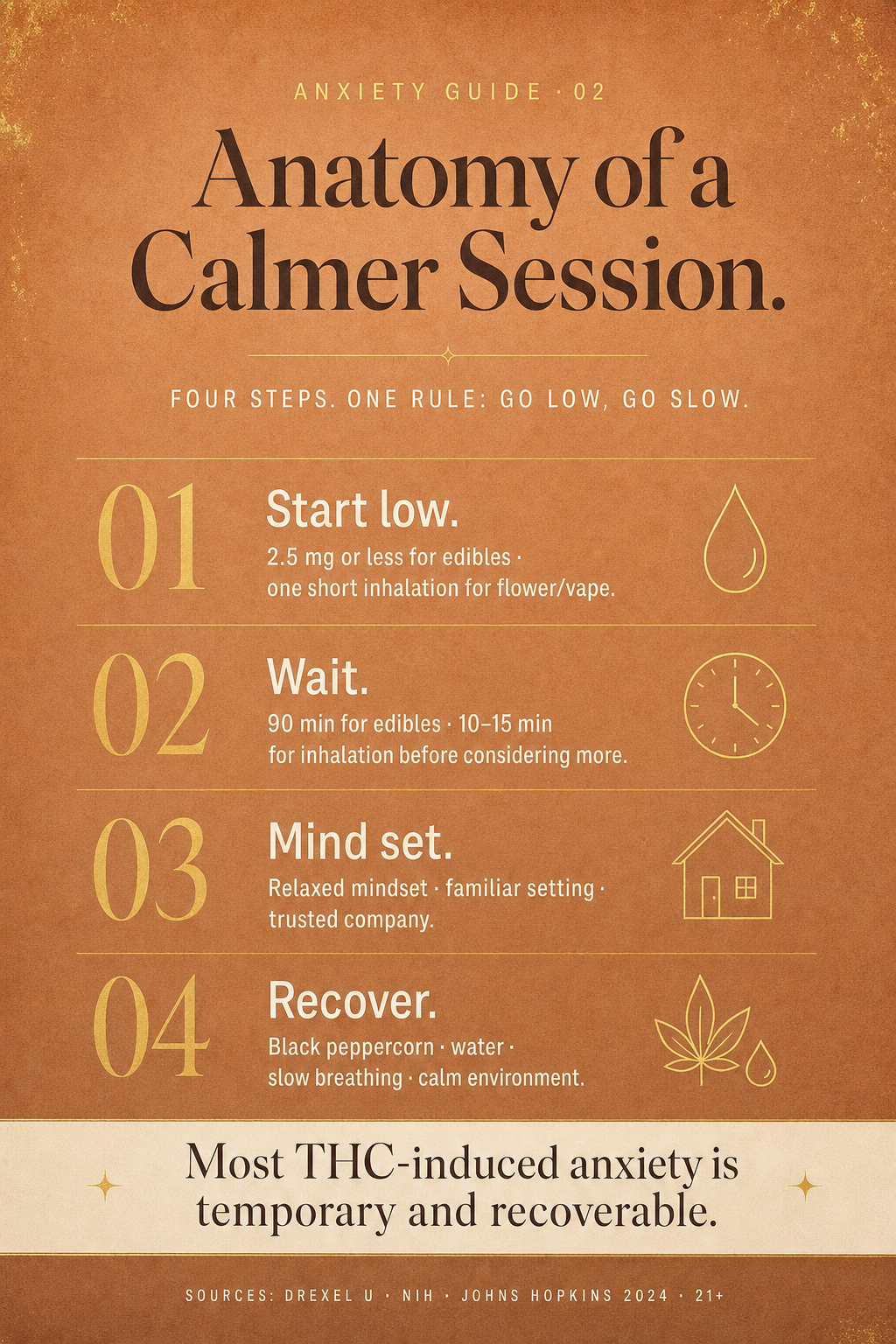
The general rule for anxiety-prone consumers is to start at the smallest reasonable dose — 2.5 mg or less for edibles, one short inhalation for flower or vaporizers — and wait through the full onset window before considering more.
What Set and Setting Practices Lower the Risk of a Bad Experience?
Set and setting lower the risk of a bad cannabis experience because they shape the psychological context in which the dose lands.
"Set" is your mindset going in: your stress level, your expectations, and your prior experiences with cannabis. "Setting" is your physical environment and the people around you. A relaxed set plus a familiar, safe setting with someone you trust is the lowest-risk combination for an anxiety-prone consumer.
A short checklist for a low-risk session:
- Pick a calm window — no obligations for the next few hours
- Choose a familiar space — your couch, not a crowded party
- Have a sober or trusted friend nearby if you are new or anxious
- Hydrate and have snacks ready before you start
- Keep a glass of water, some black peppercorns, and a calm playlist within reach
For a longer session where you want duration without the slow edible onset, balanced-ratio gummies like Stress Free Relief | 20 Pack | Gummies | THC: 100mg, CBD: 400mg can be useful because the CBD softens the THC peak. Pairing those with for a short pre-roll to "test the waters" before committing to a gummy is a common approach among anxiety-prone consumers, and inhaling flower from a low-THC batch sourced from is one of the easier ways to keep titration tight.
If a bad reaction does happen, the standard remedies — black peppercorn sniffing, slow breathing, hydration, and a calm environment — are widely circulated. The evidence for most of these is anecdotal rather than clinical, but they are also harmless and tend to work because they pull attention away from the racing thoughts and toward a slow sensory signal.
What Are the Most Common Cannabis and Anxiety Questions?
Quick answers:
- Low THC can calm; high THC can spike anxiety — CBD is steadying across a wider dose range.
- At high doses, THC overstimulates CB1 receptors in the amygdala, producing racing heart and panic.
- CBD-dominant or balanced ratios (20:1 or 10:1 CBD:THC) are the lowest-risk starting point.
- Limonene, linalool, and beta-caryophyllene have the most promising anxiety-calming evidence.
- Start at 2.5 mg THC or less and wait 90 minutes — microdosing keeps the calming without the spike.
Can cannabis actually help with anxiety, or does it make it worse? Both effects are real, and the difference mostly comes down to dose, ratio, and the person. Low to moderate doses of THC can feel calming, while high doses commonly trigger anxiety, racing thoughts, and paranoia. CBD tends to feel calming across a wider dose range without producing intoxication. People sensitive to THC or new to cannabis are most likely to land on the wrong side of that line.
Why does THC sometimes cause paranoia or panic? THC binds to CB1 receptors in the amygdala and prefrontal cortex, the same regions that process fear and threat. At low doses this can dial the stress response down, but at higher doses the same receptors become overstimulated, producing the racing heart, intrusive thoughts, and sense of danger that feel like a panic attack.
What is the best cannabis ratio for anxiety, CBD or THC? Research consistently points to CBD-dominant or balanced products as the lowest-risk starting point for anxiety-prone consumers. Ratios like 20:1 or 10:1 CBD to THC deliver the calming potential of cannabinoids while keeping the intoxicating, paranoia-inducing effect of THC low. Pure THC-dominant flower is the highest-risk option for someone whose main goal is calming the nervous system.
What are the best terpenes for anxiety in cannabis? Limonene, linalool, and beta-caryophyllene have the most promising pre-clinical evidence for anxiolytic effects. Linalool in particular has shown diazepam-comparable calming in mouse models through the GABA-A pathway. A 2024 Johns Hopkins human study also found that vaporized d-limonene significantly reduced THC-induced anxiety and paranoia. Myrcene can be sedating but in high amounts may feel couch-locked and over-sedating for some people.
How much THC is too much THC for someone with anxiety? Most clinical guidance recommends starting at 2.5 mg or less of THC and waiting at least 90 minutes before considering more, especially with edibles where onset is delayed. THC-anxiety effects are dose-dependent and personal; even experienced users can find that a familiar strain at a higher dose tips into panic. Microdosing at 1 to 2.5 mg is a common strategy for anxiety-prone consumers who want the calming without the spike.
What is set and setting, and why does it matter for anxiety? Set is your mindset going into the experience, including your stress level, expectations, and prior experiences with cannabis. Setting is your physical environment and the people around you. Both shape whether a session feels calming or activating. A relaxed set plus a familiar, safe setting with a trusted friend is the lowest-risk combination for someone prone to anxiety.
How long does a cannabis-induced anxiety episode last? Duration depends on the consumption method. Inhaled THC peaks within 10 to 30 minutes and largely clears in two to three hours, while edible THC can peak at 90 minutes to three hours and linger six to ten hours. The feelings are uncomfortable but temporary. Black peppercorn sniffing, hydration, slow breathing, and a calm environment are commonly cited remedies, though evidence for them is mostly anecdotal.
Is indica or sativa better for anxiety? Lab analyses show indica and sativa flower contain similar THC and CBD levels on average; the meaningful chemical difference is the terpene profile. Indica-labeled flower tends to be higher in myrcene and other sedating terpenes, while sativa-labeled flower tends to be higher in terpinolene and pinene. For anxiety, what actually matters is the THC-to-CBD ratio and the dominant terpenes, not the strain category label.
Cannabis is for adults 21 and older. Keep all cannabis products out of reach of children and pets. This article is for educational purposes only and is not medical advice. Consult a qualified healthcare professional before using cannabis, especially if you are pregnant, nursing, taking medications, or have a medical condition. Effects vary by person; start low and go slow.
Sources
- National Center for Biotechnology Information (NCBI / NIH) — A peer-reviewed critical review summarizing that cannabis produces both anxiolyt
- Drexel University Center for Cannabis Research and Education — THC reduces anxiety at lower doses and increases anxiety at higher doses in a U-
- National Center for Biotechnology Information (NCBI / NIH) — Preclinical literature confirms dose-dependent THC effects on anxiety: anxiolyti
- Johns Hopkins Medicine — A double-blind human study of 20 adults found that vaporized d-limonene (a canna
- National Center for Biotechnology Information (NCBI / NIH) — Preclinical studies show linalool produces anxiolytic effects comparable to diaz
- National Center for Biotechnology Information (NCBI / NIH) — Regular cannabis use is associated with anxiety symptoms and increased risk of a
- National Center for Biotechnology Information (NCBI / NIH) — Lab analyses show indica and sativa labeled cannabis contain similar concentrati
- Elsevier (ScienceDirect) - Psychiatry Research — A systematic review of clinical studies finds medicinal cannabis demonstrates po
About Treehouse Cannabis
Treehouse Cannabis is an adult-use dispensary serving Rockland, Orange, and Westchester Counties in New York. The team curates low-dose, balanced-ratio, and CBD-forward products for adult consumers shopping for a calmer experience. Browse the menu online or stop by the storefront to talk through ratio and format with a budtender. Cannabis is for adults 21 and older — please consume responsibly.
Shop our products

Shop All

Flower

Pre-rolls
Vaporizers

Edibles
Drinks

Concentrates
Tinctures

Topicals

CBD

Pet CBD

Accessories