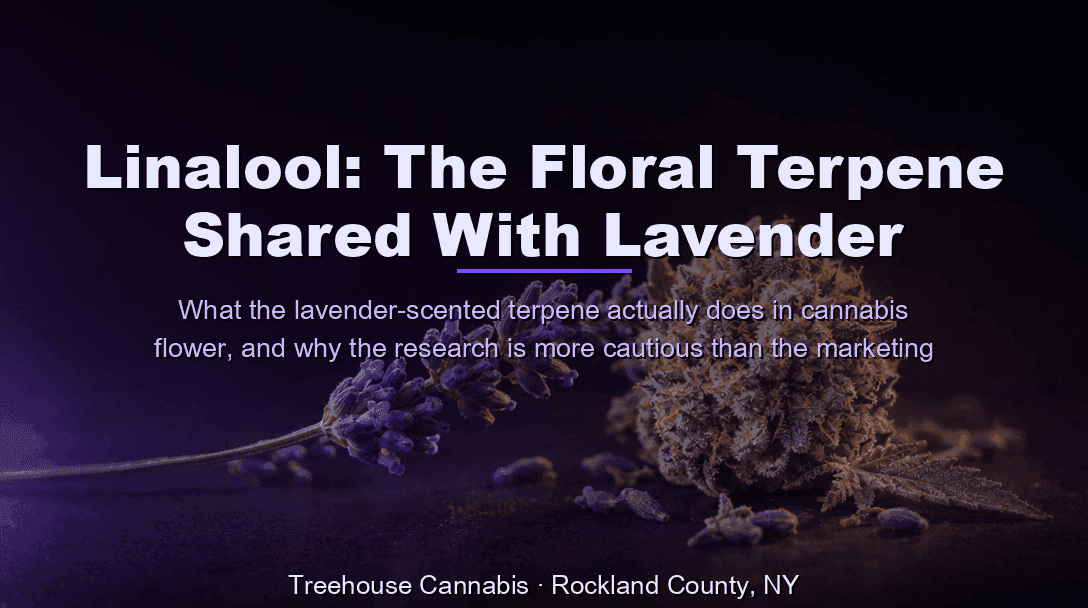
Linalool: The Floral Terpene Shared With Lavender
Linalool: The Floral Terpene Shared With Lavender
What the lavender-scented terpene actually does in cannabis flower, how much of it you are really getting, and why the research is more cautious than the marketing.
Linalool is a monoterpene alcohol that gives lavender its scent and appears in more than 200 plant species, cannabis included. The linalool cannabis connection is about aroma, not intoxication: it shapes how flower smells, rarely leads the terpene profile, and its calming reputation rests on animal and laboratory work rather than proven human outcomes.
What Is Linalool and Why Does It Matter in Cannabis?
Linalool is a monoterpene alcohol produced by more than 200 plant species, and in cannabis it shapes aroma and flavor rather than producing intoxication.
It is one of the volatile compounds that decides how a cultivar smells, and by extension how the experience of smoking or vaporizing it reads.
The chemical distinction matters more than it sounds. Terpenes and cannabinoids are separate families of molecules, and the effects most people associate with cannabis come from the cannabinoid side of the ledger. Linalool has no intoxicating mechanism of its own, and no amount of it will substitute for THC in a flower sample.
- Linalool is a terpene, not a cannabinoid, so it cannot produce a high on its own [9]
- It occurs in more than 200 plant species, with lavender and basil the best-known sources
- The average person already consumes roughly two grams a year through ordinary food [9]
- It does not accumulate in the body, so dietary exposure stays steady rather than building up [9]
- In cannabis it is almost always a supporting note rather than the dominant terpene [9]
That dietary context is worth having, but it is not a safety guarantee for concentrated products. A gram of flower carries a small amount of linalool; a bottle of essential oil carries a great deal more, and the two should not be reasoned about as if they were the same exposure. Reviews of linalool describe a low toxicity profile alongside antimicrobial, anti-inflammatory and antioxidant activity in laboratory work, which is a long way from a claim about what inhaling flower will do for you [7].
Where linalool fits in the wider picture is as one voice in a chorus. The 2024 review of entourage research notes that terpenes and cannabinoids may interact, while also noting that no reliable evidence yet proves the interaction enhances anything [6]. Linalool is a reasonable place to start understanding that idea, because it is common, well studied in isolation, and rarely dominant enough to confuse the picture.
For the botanical and cultural history of the compound, including how it moved from perfumery into cannabis breeding, Understanding Linalool: A Botanical and Cultural Look at One of Cannabis’s Most Recognized Terpenes covers that ground in more detail.
What Does the Linalool Terpene Smell and Taste Like?
Linalool smells floral and lavender-forward, with a light citrus peel edge and a warm spice note underneath.
In cannabis it usually reads as a soft floral layer sitting behind stronger myrcene or limonene rather than as a standalone lavender punch.
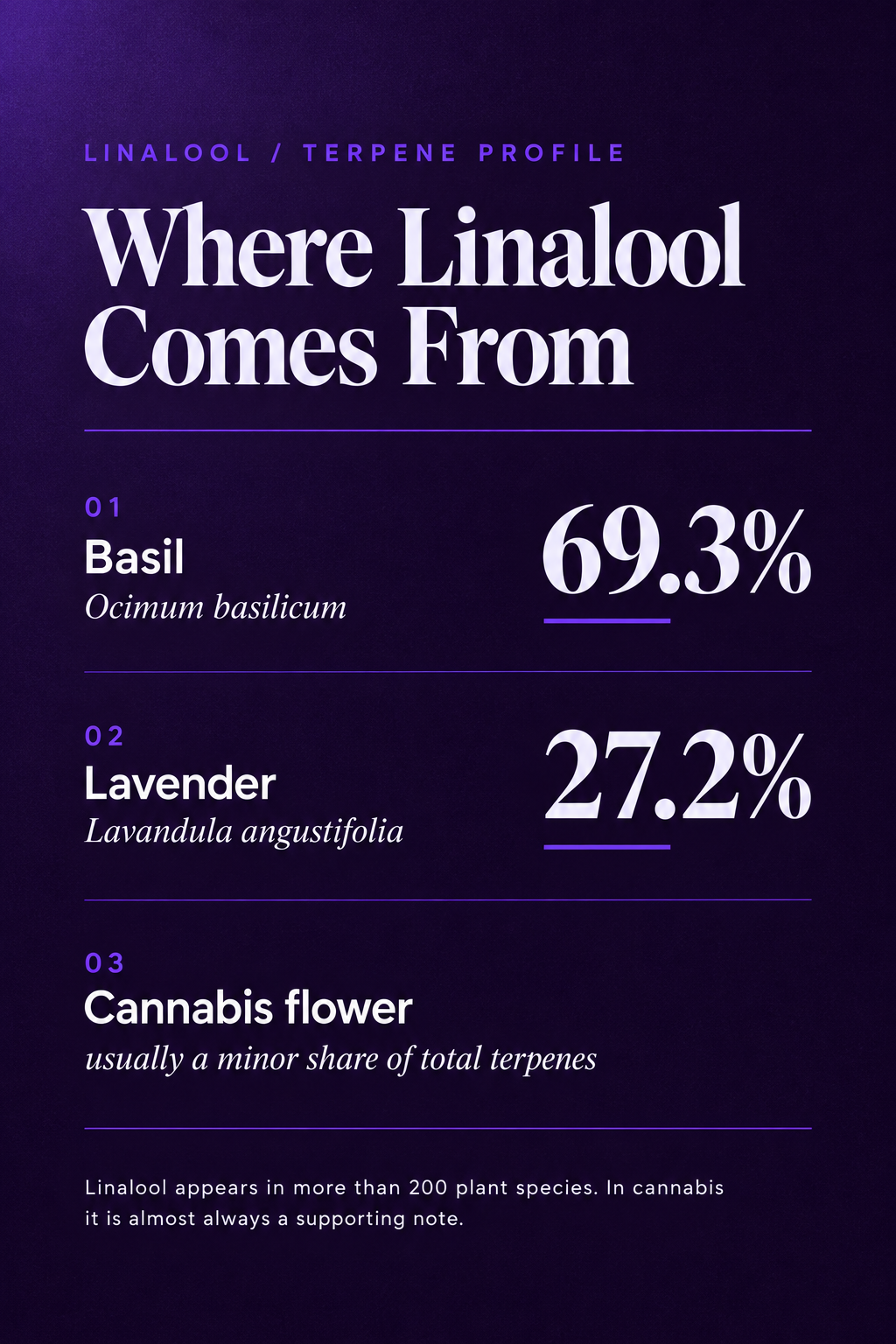
The concentration numbers explain the character. Linalool makes up roughly 27.2 percent of lavender essential oil and about 69.3 percent of basil essential oil, so the same molecule produces two very different sensory impressions depending on what surrounds it [7]. In lavender it is the signature; in basil it hides inside a green, peppery profile.
| Impression | What it reads like | Where else you meet it |
|---|---|---|
| Primary | floral, lavender, faintly sweet | lavender oil, dried lavender sachets |
| Secondary | light citrus peel | bergamot, coriander leaf |
| Warm edge | soft spice | basil, some mints |
Cannabis rarely delivers the full lavender experience, because the flower's dominant terpene sets the frame. A cultivar running high myrcene will read earthy and herbal with a floral shadow; one running high limonene will read citrus-first with the floral note arriving late. Smelling a jar is a better test than reading a percentage, since the human nose integrates the whole panel at once.
Other familiar sources make the smell easier to place: coriander seed, mint, bergamot and rose all carry linalool at meaningful levels [7]. If you have ever crushed a fresh basil leaf and noticed something perfume-like under the green, that is the same compound at work.
- Primary impression: floral, lavender and slightly sweet
- Secondary notes: light citrus peel with a warm spice edge
- Lavender essential oil runs about 27 percent linalool, basil about 69 percent [7]
- In cannabis the note usually sits behind myrcene or limonene rather than leading the profile
- Coriander, mint, bergamot and rose carry the same compound at lower levels [7]
Two Treehouse guides help place this in context. The Cannabis Terpene Wheel: A Visual Guide to Every Common Terpene maps linalool against the other common terpenes so the floral notes have a reference point, and A Guide to Terpenes and Their Effects covers what each of those terpenes is generally associated with.
How Much Linalool Is Actually in Cannabis Flower?
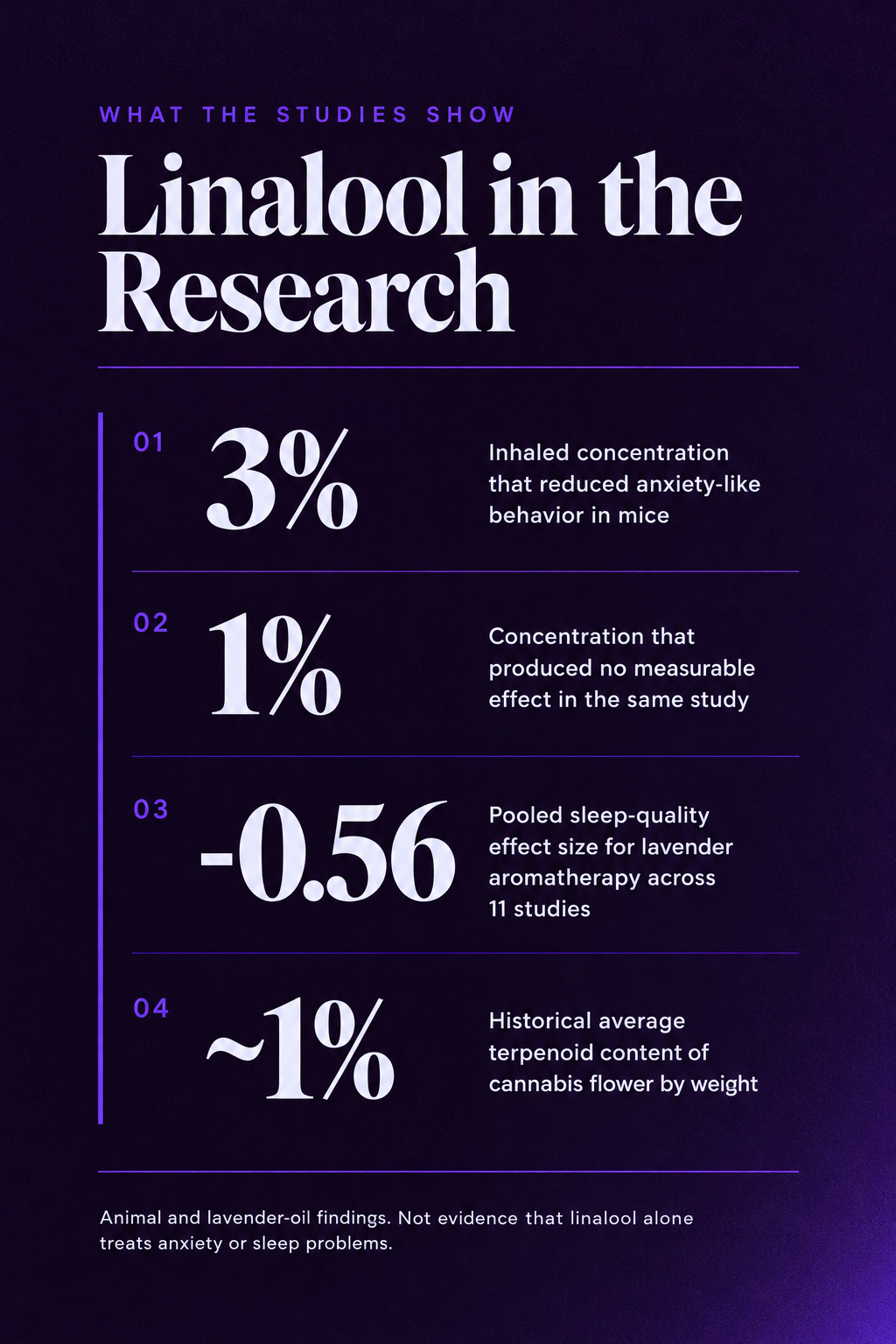
Cannabis flower historically averaged about one percent terpenoids by weight, and linalool is usually a small fraction of that total.
Selective breeding has pushed some total terpene loads above 3.5 percent, but a larger total does not tell you which terpene is elevated, and in most cultivars linalool still rarely ranks among the top three.
The historical average comes from the same 2024 review that examined the entourage hypothesis, which notes that flower terpenoid content has risen substantially as breeders selected for aroma [6]. A sample at 3.5 percent total could be almost entirely myrcene and caryophyllene with linalool as a rounding error.
- Historical average terpenoid content: about one percent of flower weight [6]
- Selective breeding has pushed total terpene loads above 3.5 percent in some lines [6]
- Linalool rarely ranks in a cultivar's top three terpenes [9]
- Batch-to-batch variance comes from genetics, harvest timing, drying and cure
- The certificate of analysis is the only reliable source for a specific batch
This is where marketing language and lab data part company.
| What the label says | What it actually tells you |
|---|---|
| "Linalool-rich" | A claim about character, not a measured percentage |
| "Lavender strain" | A naming convention, not a terpene panel |
| "High terpenes" | A total figure that says nothing about which ones |
| "3.5% terpenes" | A real total, still silent on the linalool share |
| Certificate of analysis | Per-batch percentages for each tested terpene |
Two grams from the same cultivar grown by two different farms can produce noticeably different panels, because harvest timing and cure both move the volatile profile. That is the practical reason to ask for the certificate of analysis rather than relying on a strain name you liked last year.
Delivery format matters too. A dry herb vaporizer set to a moderate temperature releases the lighter monoterpenes, linalool included, before the heavier ones, which is part of why the same flower can taste different in a joint and in a vape. If you are comparing formats rather than cultivars, a vaporizer makes the aromatic panel easier to notice.
Laughing Gas | House Of Sacci | Disposable Vape | 2g
Understanding Terpenes in Cannabis goes deeper on how terpene percentages are measured and what the numbers on a panel actually represent.
What Are the Reported Linalool Effects?
In mice and laboratory preparations, linalool altered anxiety-like behavior and interacted with GABA-A, NMDA and serotonin targets.
Almost all of that work used concentrations above what a person inhales from flower, so it describes mechanisms rather than lived experience.
Start with the animal work, because it is the most concrete. Inhaled linalool at three percent reduced anxiety-like behavior in mice, increased social interaction and decreased aggression, while one percent produced no measurable effect in the same setup [5]. Memory impairment appeared only at the higher concentration, which suggests the effective window is narrow rather than "more is better."
- Inhaled linalool at 3 percent reduced anxiety-like behavior in mice; 1 percent did not [5]
- The same study saw increased social interaction and reduced aggression [5]
- Linalool positively modulates GABA-A receptors in laboratory preparations [3]
- Its oxygenated metabolites retain far less activity, so the parent molecule carries most of the effect [3]
- Lavender oil and linalool bind the glutamate NMDA receptor and the serotonin transporter [4]
- These are animal and in vitro findings, not proof of how people experience flower
| Exposure level | What the research reports | What it cannot tell you |
|---|---|---|
| 3 percent inhaled, mice | reduced anxiety-like behavior, more social interaction, less aggression [5] | whether a person inhaling flower gets the same response |
| 1 percent inhaled, mice | no measurable behavioral change, no memory effect [5] | that a lower exposure is inert in people |
| In vitro receptor assays | GABA-A modulation; NMDA and serotonin transporter binding [3] | anything about felt experience or realistic dose |
| High-concentration CB1 assays | cannabinoid-like behavior in mice, low-efficacy CB1 activity [2] | whether inhaled doses do anything similar |
The receptor work fills in the mechanism. Linalool positively modulates inhibitory GABA-A receptors in vitro, and its oxygenated metabolites show only reduced activity, which points to the intact molecule as the active agent rather than its breakdown products [3]. Separately, lavender essential oil and linalool bound the glutamate NMDA receptor and the serotonin transporter but showed no affinity for the GABA-A benzodiazepine site, which argues for a glutamate and serotonin route rather than the benzodiazepine one [4].
There is also a cannabinoid-adjacent finding worth naming carefully. A 2021 study found that linalool and four other cannabis terpenes produced cannabinoid-like behaviors in mice and activated CB1 receptors in vitro at high concentrations, with linalool showing low efficacy and a mixed CB1 and adenosine mechanism [2]. That is a laboratory result at concentrations nobody inhales from a joint, and the authors treat it as a starting point rather than a demonstration.
The practical takeaway is a species caveat. Mice are not people, vaporized concentrations in a chamber are not the same as a puff from a pipe, and in vitro receptor binding is not a felt effect. If you want to compare what is actually in the jar before drawing your own conclusions, the current Flower menu lists cultivars with their batch information.
Does Linalool Help With Anxiety and Sleep?
The human evidence is mostly about lavender oil rather than isolated linalool, and the effects are modest.
Nothing in the literature shows that linalool alone treats anxiety or insomnia, and no responsible reading of it supports using cannabis as a substitute for care.
The strongest human data point is a 2026 meta-analysis of eleven studies, which found lavender essential oil aromatherapy improved adult sleep quality with a pooled effect size of -0.56 (95% CI -0.96 to -0.17) [8]. That is a small-to-moderate effect by conventional standards, and the authors note inconsistent dosing and small samples across the trials they pooled.
- Most human trials use lavender essential oil, not isolated linalool [8]
- A 2026 meta-analysis of eleven studies found a pooled sleep effect size of -0.56 [8]
- Those trials varied widely in dose and method, and samples were small [8]
- A 2024 vaporized-linalool study in mice found sex-dependent anxiety responses [1]
- Linalool plus CBD produced a measurable interaction in female mice at doses that did nothing alone [1]
- Linalool is one of lavender's two main components, so lavender results cannot be credited to it alone
| Evidence type | What was actually tested | What it supports |
|---|---|---|
| Human meta-analysis, 11 studies | lavender essential oil aromatherapy and adult sleep quality [8] | a small-to-moderate effect for the oil, not for isolated linalool |
| Human trials generally | lavender oil or lavender preparations [8] | nothing specific to linalool, because the oil also contains linalyl acetate |
| Animal vapor study, 2024 | vaporized linalool at 5 percent in mice [1] | sex-dependent anxiety responses in mice, not human outcomes |
| Animal interaction study | sub-effective linalool plus CBD in female mice [1] | a hypothesis about interaction, not a dosing strategy |
That last point is the one most linalool marketing skips. Lavender oil contains both linalool and linalyl acetate, and a study of the oil cannot isolate the contribution of either. Crediting the sleep result to linalool specifically requires a trial of isolated linalool, which the human literature does not currently provide at any scale.
The animal work adds nuance rather than certainty. A 2024 study using vaporized linalool at five percent, described by the authors as the upper end of naturally occurring cannabis terpene levels, found sex-dependent anxiety responses, and combining sub-effective linalool doses with CBD produced an effect in female mice that neither produced alone [1]. Findings like that are worth following, but they are hypotheses about interaction, not evidence about people.
If anxiety or sleep problems are persistent, the honest recommendation is a clinician, not a dispensary. Cannabis can be part of an adult's routine, but it is not a treatment, and it can worsen anxiety for some people. Cannabis and Anxiety: Finding Relief Without the Panic covers that side of the conversation, including why panic reactions happen and what makes them more likely.
Does Linalool Contribute to the Entourage Effect?
Possibly, but the evidence does not yet support the confident version of the claim.
A 2024 systematic review found that terpenes and cannabinoids may interact while concluding that no reliable evidence proves synergistic or additive enhancement.
The entourage hypothesis proposes that the whole plant produces an experience that isolated cannabinoids cannot, with terpenes shaping the character of the high. It is an appealing idea and it is repeated as settled fact in a great deal of cannabis writing, which is exactly why the 2024 review is worth reading in full [6].
- The entourage effect proposes terpenes and cannabinoids interact to shape the experience
- A 2024 review found the hypothesis plausible but not reliably demonstrated [6]
- In vitro work shows linalool activating CB1 receptors at high concentrations [2]
- That same work describes linalool as low efficacy with a mixed CB1 and adenosine mechanism [2]
- Realistic inhaled doses are far below the concentrations used in those experiments
| Finding | Where it comes from | What it establishes |
|---|---|---|
| Terpenes and cannabinoids may interact; synergy unproven | 2024 systematic review [6] | the hypothesis is plausible, not demonstrated |
| Linalool activates CB1 at high concentrations with low efficacy | 2021 in vitro receptor work [2] | a mechanism at doses nobody inhales |
| Adding linalool moved a cannabinoid agonist EC50 from 254 nM to 679 nM | same 2021 study [2] | a measurable interaction in a dish, not in a person |
The CB1 finding is the one most often cited in support, and it deserves a closer look. In the 2021 study, linalool acted as a low-efficacy cannabinoid receptor agonist, and the authors describe a mixed CB1 and adenosine mechanism rather than a clean receptor effect [2]. Co-administration work in that paper shifted the potency of a synthetic cannabinoid agonist in vitro, from an EC50 of 254 nM alone to 679 nM with linalool present, which is a measurable interaction in a dish and not a claim about potency in a person.
Other research has found no meaningful modulation of THC by terpenes at realistic doses, which is the opposite conclusion from the same general body of work. Holding both findings at once is uncomfortable, and it is the accurate position. Terpene content plausibly shapes aroma, and aroma plausibly shapes expectation, and expectation plausibly shapes experience; none of those links has been nailed down experimentally in humans.
Which Cannabis Strains Are Highest in Linalool?
Cultivars most often cited for linalool character include Lavender, LA Confidential, Do-Si-Dos, Zkittlez, Granddaddy Purple and Amnesia Haze.
None of those names is chemical data, and the same cultivar can test very differently depending on who grew it.
| Cultivar | Typical aromatic read | Why it comes up |
|---|---|---|
| Lavender | floral, herbal, softly sweet | the classic linalool-forward reference |
| LA Confidential | pine, floral, earthy | often described as floral-leaning OG territory |
| Do-Si-Dos | sweet, floral, earthy | cookies-family lines frequently carry floral notes |
| Zkittlez | fruity, candy, floral | sweet profile with a floral backing |
| Granddaddy Purple | grape, berry, floral | berry aromas commonly paired with linalool |
| Amnesia Haze | citrus, incense, floral | linalool alongside terpinolene and citrus |
Read that table as a set of leads, not a specification. Strain names are marketing labels rather than standardized chemical categories, and two jars labeled Do-Si-Dos from different producers can carry completely different terpene panels [9]. Reviews of cannabis terpene data make the same point from the testing side: the numbers move with genetics, harvest timing, drying and cure, and only a per-batch panel captures the specific flower in front of you [6].
- Lavender and LA Confidential are the classic linalool-forward references
- Do-Si-Dos, Zkittlez and Granddaddy Purple often carry floral notes alongside other terpenes
- Amnesia Haze pairs linalool with terpinolene and citrus
- Strain names are marketing labels, not chemical data
- Ask for the batch certificate of analysis or smell the flower before buying
In practice, shopping for linalool means shopping for aroma rather than for a name. Ask what the batch panel says, then smell the jar: a floral top note that lingers after the citrus and pine fade is the sensory signature people are usually chasing. Smaller buds from the same harvest carry the same terpene profile as the large ones, which makes Small Buds Flower a reasonable way to test a cultivar before committing to a larger format.
If you want a single starting point, B.A.M • Flower • 70g is a current flower option worth smelling against a known floral reference.
Frequently Asked Questions
Does linalool get you high on its own?
No. Linalool is a terpene, not a cannabinoid, so it does not produce intoxication by itself. Any high from cannabis flower comes from THC and other cannabinoids. Linalool contributes the lavender-forward aroma and is studied for how it may shape the overall experience alongside those cannabinoids. [9]
What does linalool smell and taste like?
Floral and lavender-forward, with a light citrus and spice edge. It is the defining aroma compound in lavender oil and also appears in basil, coriander, mint and bergamot. In cannabis it usually reads as a soft floral layer behind stronger myrcene or limonene notes rather than a standalone lavender punch. [7]
How much linalool is actually in cannabis flower?
Usually a supporting terpene, not the leading one. Research notes cannabis flower terpenoid content historically averaged about one percent of weight, with selective breeding pushing totals above three and a half percent. Within that panel linalool typically sits below the dominant terpene, and only a few cultivars carry it near the top. [6]
Is linalool safe to consume?
Dietary exposure is constant and unremarkable, with the average person taking in roughly two grams a year through ordinary foods, and linalool does not accumulate in the body. Concentrated essential oils applied to skin can irritate sensitive people. Amounts present in cannabis flower are far smaller than aromatherapy or topical use. [7]
Does linalool help with anxiety?
The preclinical evidence is consistent but not conclusive. Inhaled linalool at three percent reduced anxiety-like behavior in mice, and a 2024 vapor study found sex-dependent responses, with female mice responding to repeated exposure. Human trials mostly test lavender oil rather than isolated linalool, so treat calming claims as promising but unproven. [5]
Can linalool help you sleep?
Human evidence centers on lavender oil, not isolated linalool. A 2026 meta-analysis of eleven studies found lavender aromatherapy improved adult sleep quality with a small-to-moderate pooled effect. Linalool is one of lavender's two main components, so the benefit cannot be credited to linalool alone, and trial methods varied widely. [8]
What is the entourage effect, and does linalool contribute to it?
The entourage effect is the idea that terpenes and cannabinoids work better together than alone. Reviews find the hypothesis plausible but unproven, with mixed laboratory results. Some studies show linalool activates CB1 receptors directly at high concentrations; others find no modulation of THC at realistic doses. [6]
Which cannabis strains are highest in linalool?
Cultivars commonly cited include Lavender, LA Confidential, Do-Si-Dos, Zkittlez, Granddaddy Purple and Amnesia Haze. Because linalool rarely dominates a profile, read the certificate of analysis instead of trusting the strain name. The same cultivar can vary considerably by grower, harvest timing and cure. [9]
Sources
- NeuroSci (MDPI) / PubMed Central — Vaporized linalool at 5% concentration (described as the upper end of naturally
- Scientific Reports (Nature) / PubMed Central — Linalool and four other cannabis terpenes produced cannabinoid-like behaviors in
- Frontiers in Chemistry / PubMed Central — Linalool positively modulates inhibitory GABA-A receptors in vitro, and its oxyg
- Frontiers in Pharmacology / PubMed Central — Lavender essential oil and linalool bound the glutamate NMDA receptor and the se
- Phytomedicine / PubMed (NIH) — Inhaled linalool at 3% (but not 1%) reduced anxiety-like behavior, increased soc
- Pharmaceuticals (MDPI) / PubMed Central — A systematic review of cannabis entourage research found terpenes and cannabinoi
- Molecules (MDPI) / PubMed Central — Reviews linalool's antimicrobial, anti-inflammatory, antioxidant and neuroprotec
- Holistic Nursing Practice / PubMed (NIH) — Meta-analysis of eleven studies found lavender essential oil aromatherapy improv
- Leafly — Consumer-facing reference establishing that linalool occurs in over 200 plant sp
About Treehouse Cannabis
Curious what a floral terpene actually smells like in the jar? Treehouse Cannabis in Rockland County keeps batch terpene information on hand, so you can check the certificate of analysis before you buy instead of guessing from a strain name. Ask the team to walk you through the current flower menu and smell a few cultivars side by side.
Cannabis is for adults 21 and older. Keep all cannabis products away from children and pets. This article is educational and is not medical advice. Do not drive or operate machinery while impaired.


Shop our products

Shop All

Deals

Flower

Pre-rolls
Vaporizers

Edibles

Drinks

Concentrates
Tinctures

Topicals

CBD

Pet CBD

Accessories