
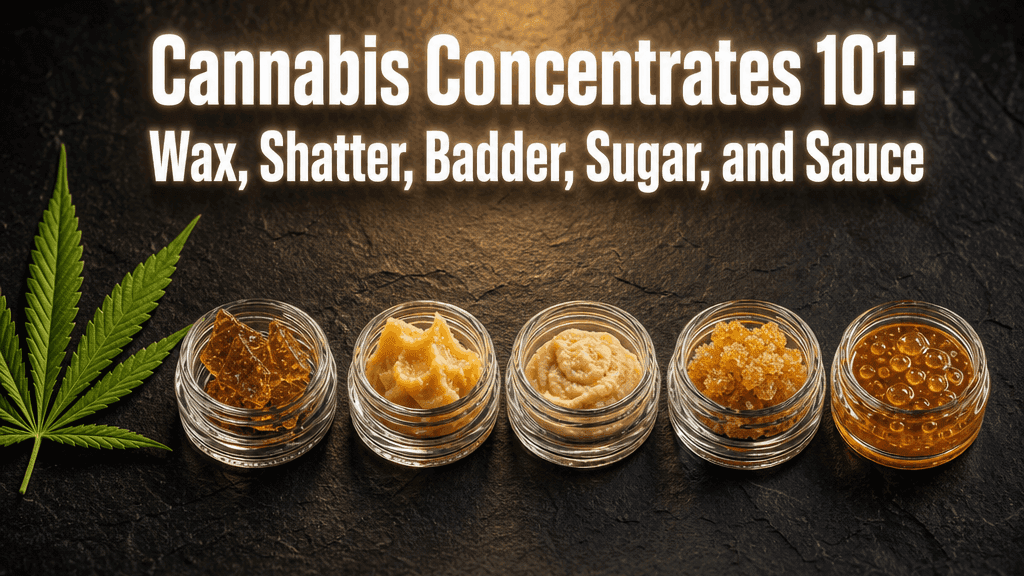
Cannabis Concentrates 101: Wax, Shatter, Badder, Sugar, and Sauce
Cannabis Concentrates 101: Wax, Shatter, Badder, Sugar, and Sauce
What Are Cannabis Concentrates and Why Are They So Potent?
Cannabis concentrates are condensed extracts of the plant's trichomes, the resin glands where cannabinoids and terpenes are produced [1]. Most carry 50% to 90% or more THC, well above the 15% to 25% typical of premium flower [2]. Stripping trichomes from plant matter delivers a more concentrated dose of active compounds per inhalation, which is why concentrates exist.
Concentrates split into two main families:
- Solvent-based extracts use chemicals such as butane, propane, ethanol, or supercritical CO2 to dissolve cannabinoids and terpenes from plant material, then purge the solvent to recover the active compounds [3]. The five textures covered in this guide (wax, shatter, badder, sugar, and sauce) all sit inside this family.
- Solventless concentrates skip chemicals entirely and use only mechanical separation (ice-water baths, heat, and pressure) to collect trichomes. Kief, bubble hash, and rosin are the most common examples.
Customers new to stronger formats should treat concentrates with the same dose-patience used for any delayed-onset product. For a parallel example on how a different format can catch you off guard on timing, the Treehouse Cannabis blog post You’re Not Lazy—Your Edible Just Peaked at the Wrong Time walks through why an edible can peak hours later than expected. The full lineup of regulated, lab-tested extracts is on the Concentrates page at Treehouse Cannabis.
What Is Shatter and How Is It Made?
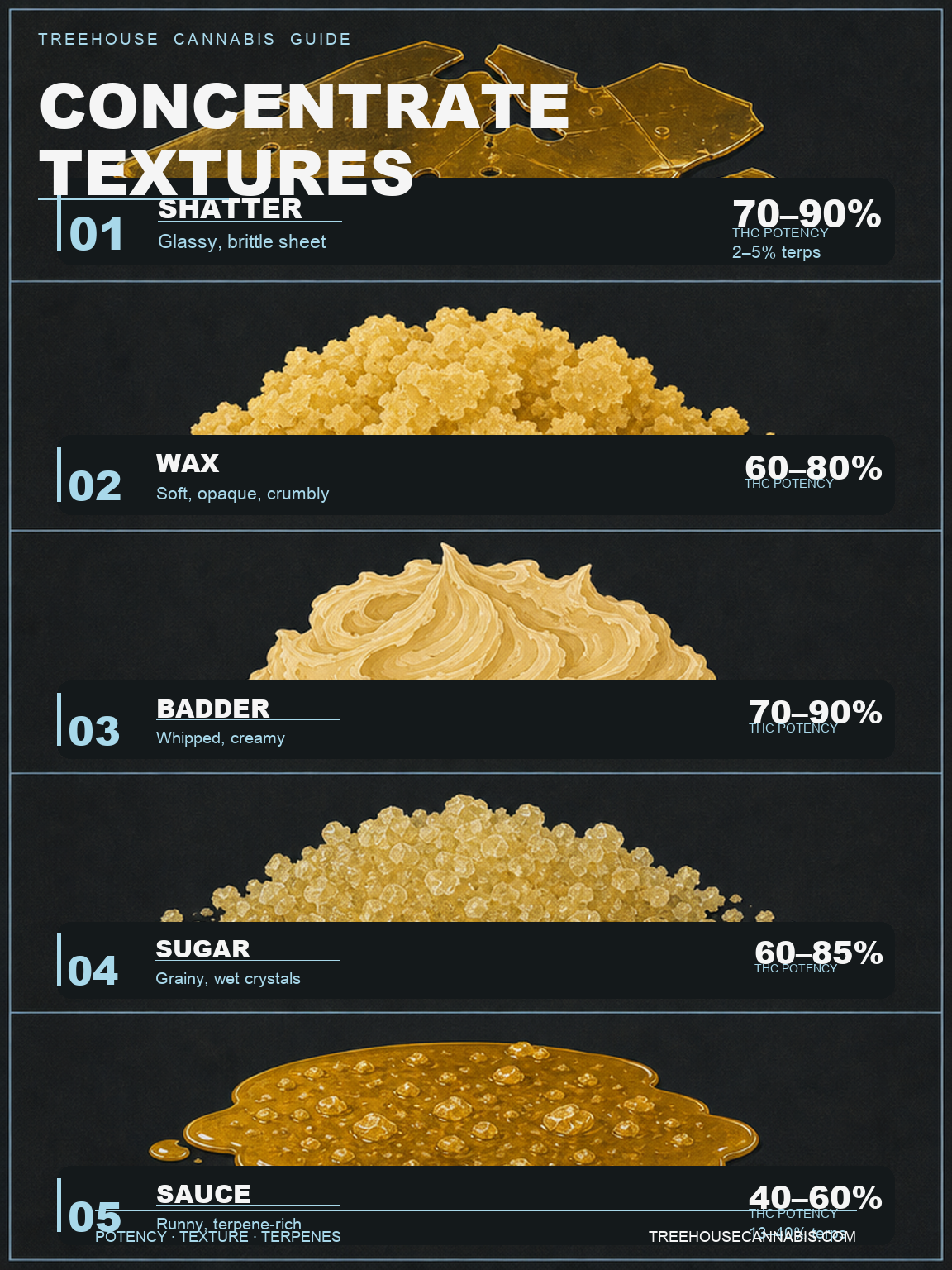
Shatter is the glassy, brittle sheet form of butane hash oil (BHO). It gets its translucent amber look from a controlled hydrocarbon extraction followed by a vacuum purge, where the oil is left undisturbed while residual solvent evaporates [5]. Whipping, stirring, or jarring the oil mid-purge disrupts the smooth sheet, which is why each texture on dispensary shelves is a deliberate processing choice rather than a different starting material.
Shatter characteristics at a glance:
- Texture: Glassy, brittle sheet that snaps cleanly along a fault line
- Typical THC: 70% to 90% [1]
- Typical terpenes: 2% to 5%
- Solvent: Most often butane, because its low boiling point preserves delicate terpenes and limits heat damage [5]
- Use: Vaporizes cleanly on a dab rig or compatible vaporizer
Typical shatter tests at 70% to 90% THC with 2% to 5% retained terpenes, putting it on the higher-potency end of the solvent-based family [1]. Butane is the most common solvent for shatter and other BHO textures because its low boiling point helps preserve delicate terpenes and limits heat damage during extraction [5]. The finished product is a thin, brittle sheet that snaps cleanly along a fault line and dissolves into vapor when heated on a dab rig or in a compatible vaporizer.
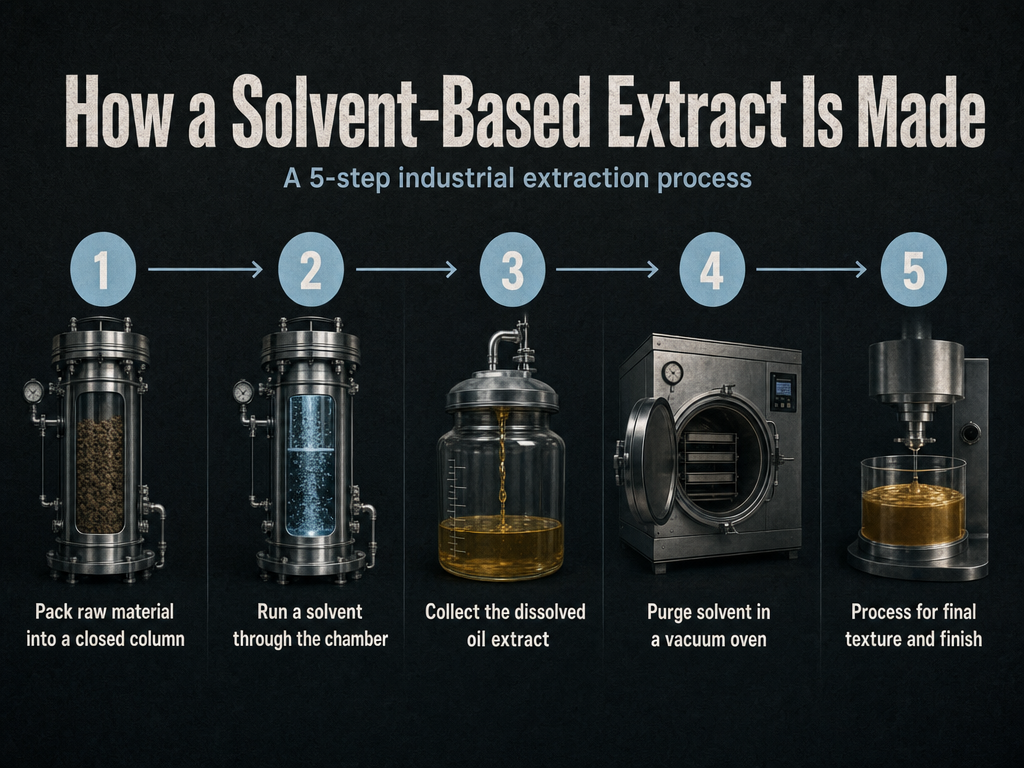
How shatter is made, step by step:
- Pack the column: Ground cannabis is packed into a closed-loop extraction column
- Run the solvent: Butane or propane is passed through the material under pressure to dissolve cannabinoids and terpenes
- Recover the oil: The dissolved oil is collected and filtered to remove plant particulates
- Vacuum purge: Residual solvent is removed in a vacuum oven, usually at low heat for 24 to 72 hours
- Leave undisturbed: The oil is left still while it finishes purging, which is what produces the glass-like sheet rather than a whipped texture
The aroma profile of shatter depends heavily on the cultivar processed and how fresh the starting material was. For a deeper read on the myrcene-dominant strains that often anchor those profiles, the Treehouse Cannabis blog post Understanding Myrcene: The Aromatic Terpene Found Across Nature and Cannabis breaks down myrcene's role across cannabis and other aromatic plants.
What Is Wax and How Does It Differ From Shatter?
Wax is the same hydrocarbon extract as shatter, but it is whipped or agitated during the vacuum purge. That agitation traps air and breaks up the smooth sheet, leaving an opaque, crumbly, candle-wax look [1]. Wax typically tests at 60% to 80% THC, slightly lower than shatter on average because the increased surface area lets off more terpenes during purging.
Wax characteristics at a glance:
- Texture: Soft, opaque, crumbly (candle-wax to honeycomb)
- Typical THC: 60% to 80%
- Why it's beginner-friendly: Easy to scoop, handles low temperatures well, and gives visible feedback when fully vaporized
- Storage: Holds a soft, pliable consistency in a silicone jar without cracking apart
For new concentrate customers, wax is often the friendliest entry point. It is easy to scoop with a dab tool, handles low temperatures well, and gives visible feedback when it has fully vaporized on a banger. The texture is forgiving, the dose is easy to control, and the per-gram price point is usually friendlier than premium sauce or live resin. Because wax holds a soft, pliable consistency at typical room temperature, it stores well in a silicone jar without cracking apart the way shatter can.
Wax vs. shatter at a glance:
| Property | Wax | Shatter |
|---|---|---|
| Texture | Soft, opaque, crumbly | Glassy, brittle sheet |
| THC range | 60% to 80% | 70% to 90% |
| Production | Oil whipped during vacuum purge | Oil left undisturbed during purge |
| Storage | Holds shape in a silicone jar | Can crack if jared or chilled |
| Best for | Beginner-friendly entry | High-potency, low-terp-loss dabs |
The Oil Concentrates page on the Treehouse Cannabis menu covers the oil-textured solvent-based extracts, including waxes, budders, and pull-and-snap variants that fall between shatter and full badder on the texture spectrum.
What Is Badder (Budder) and What Is Sugar?
Badder (also called budder) is the whipped, creamy form of a hydrocarbon extract. After the initial purge, the oil is agitated or hand-whipped under controlled heat, which whips air into the concentrate for a soft, frosting-like consistency [1]. Badder typically tests at 70% to 90% THC, comparable to shatter, but with a more pronounced terpene aroma because of the way whipping exposes surface area.
Sugar is the same extract at a different stage of the same process. Instead of whipping the oil smooth, processors jar it and let it rest in a cool environment. Cannabinoids begin to crystallize out of the terpene-rich oil, producing a wet, grainy texture that looks like damp sugar crystals [1]. Sugar concentrates typically test at 60% to 85% THC and can be either live-cured (made from fresh-frozen starting material) or made from cured flower.
How badder and sugar are made, step by step:
- Start with hydrocarbon oil: Use the same butane or propane extraction as shatter, then collect and filter the dissolved oil
- Whip for badder: While the oil is still warm, hand-whip or agitate it under controlled heat until it reaches a frosting-like consistency
- Jar and rest for sugar: Skip the whipping step; jar the warm oil and place it in a cool environment to rest
- Wait for crystallization: Over days to weeks, THCA crystals form inside the jar and the terpene-rich oil settles around them
- Skim or mix: Badder is scooped smooth; sugar is often mixed at packaging so the wet crystals stay suspended in oil
Badder vs. sugar at a glance:
| Property | Badder (Budder) | Sugar |
|---|---|---|
| Texture | Whipped, creamy, spreadable | Grainy, wet, crystalline |
| THC range | 70% to 90% | 60% to 85% |
| Production | Oil whipped under controlled heat | Oil jarred and rested in a cool environment |
| Aroma | Pronounced, whipping-exposed terpenes | Varies by live-cured vs cured flower |
| Best for | Customers wanting soft, scoopable texture | Customers wanting intense flavor in a wetter, more crystalline form |
The badder-versus-sugar distinction matters because both come off the same production line at different points. A jar labeled badder is smooth and scoopable, while a jar labeled sugar has visible crystals suspended in oil. Customers who want a soft, whipped texture pick badder; customers who want intense flavor in a slightly wetter, more crystalline form pick sugar.
The Badder Concentrates page on the Treehouse Cannabis site filters the catalog down to badder-specific jars so customers who know they want that whipped texture can find what they are looking for without scrolling through unrelated extracts.
What Is Terp Sauce and Why Is It So Flavorful?
Terp sauce is a high-terpene, full-spectrum solvent-based extract made by letting a fresh-frozen hydrocarbon extract rest in a cool jar. Over that rest, THCA crystals sink to the bottom while a thick, syrupy terpene layer rises to the top [1]. The result is a two-phase product with visible crystalline structures suspended in a flavorful, runny oil.
Sauce characteristics at a glance:
- Terpene content: 13% to 40% — the highest of any solvent-based concentrate
- THC range: 40% to 60% (lower than shatter or badder because terpenes take the place of THCA)
- Appearance: Two-phase product with crystalline structures suspended in a syrupy oil
- Starting material: Most often fresh-frozen (live) rather than dried and cured flower, to preserve volatile terpenes [6]
Sauce is the most terpene-heavy solvent-based concentrate on the market, typically carrying 13% to 40% terpenes and 40% to 60% THC [1]. The trade-off is real: more terpenes means less room for THCA, so sauce often runs lower on potency per gram than shatter or badder. What customers get in return is a dramatically fuller flavor and aroma profile, which is why sauce is often the first pick for flavor-first dabbers.
Most live sauce starts with fresh-frozen plant material rather than dried and cured flower. Freezing the plant immediately after harvest preserves the volatile terpene profile that would otherwise evaporate during the drying and curing stages [6]. That is the same fresh-frozen starting point used to make live resin, and it is the reason live sauce tends to taste closer to the living plant than cured-material extracts do. For customers wondering what the THCA in those sinking crystals actually converts to once heated, the Treehouse Cannabis blog post THCA vs THC: What's Actually in Your Weed? (2026 Guide) walks through the THCA-to-THC conversion in detail.
How Do You Dab Safely and What Should You Look For on the Label?
To dab safely, start with low temperature, a small dose, and a current Certificate of Analysis. Most dabbers work between 315F and 600F, with 315F to 450F for flavor and above 570F for full extraction.
Beginner dabbing checklist:
- Temperature: Start around 400F on an e-rig or digital rig to keep the dose manageable
- Dose size: A dab the size of a grain of rice is a reasonable starting point
- Wait time: Wait at least ten minutes between dabs so the first one lands before adding more
- Source: Buy only from a licensed dispensary that publishes a Certificate of Analysis for the batch
A dab the size of a grain of rice is a reasonable starting point. Because most concentrates test between 60% and 90% THC, a small scoop carries far more THC than a typical joint hit, and the difference between a pleasant dose and an overconsumed one is often just a few extra milligrams [4]. Waiting at least ten minutes between dabs lets the first one land before adding more.
Always buy concentrates from a licensed dispensary that publishes a Certificate of Analysis (COA) for each batch. A proper COA covers four things:
- Potency — the actual THC and CBD percentage
- Residual solvents — a check that the purge step worked
- Pesticides — a check that the starting material was clean
- Heavy metals — a check that the plant was grown in safe soil
If a dispensary cannot show a current COA for the batch on the shelf, that is a reason to shop elsewhere. Customers who want a gentler introduction to concentrates, or who prefer the slower onset of inhaled flower, can also browse regulated flower like Gas Lit • Flower • 70g on the Treehouse Cannabis menu.
For customers sensitive to terpene-driven effects, the Treehouse Cannabis blog post Bisabolol 101: The Gentle Terpene You Should Know walks through bisabolol, one of the gentler terpenes common in modern cannabis cultivars.
Frequently Asked Questions
What are cannabis concentrates? Cannabis concentrates are condensed extracts of the plant's trichomes, the resin glands where cannabinoids and terpenes are produced. Most concentrates carry 50% to 90% or more THC, well above the 15% to 25% THC typical of premium flower.
What is the difference between wax, shatter, badder, sugar, and sauce? They are all solvent-based cannabis extracts made from the same starting oil, but post-processing decides the texture. Shatter is glassy and brittle, wax is soft and opaque, badder or budder is whipped and creamy, sugar is grainy and wet-looking, and sauce is a runny, terpene-rich syrup often containing visible THCA crystals.
Are cannabis concentrates stronger than flower? Yes. Concentrates are far more potent per gram than flower, which is why new customers should start with a rice-grain-sized dab at low temperature rather than a full scoop. Standard flower usually tests around 15% to 25% THC while most concentrates sit between 60% and 90% THC.
How are wax and shatter made? Most wax and shatter are made by running a hydrocarbon solvent such as butane or propane through cannabis flower or hash, then purging the solvent in a vacuum oven. Whipping the oil during purging makes wax or badder, while leaving the oil undisturbed with controlled heat produces shatter's glass-like sheet.
What is terp sauce? Terp sauce is a high-terpene, full-spectrum extract made by letting a fresh-frozen hydrocarbon extract rest in a cool environment so THCA crystals sink to the bottom and a thick, aromatic terpene layer rises to the top. It is the most terpene-heavy solvent-based concentrate on the market, typically carrying 13% to 40% terpenes.
What temperature should you dab at? Most concentrate enthusiasts dab between 315F and 600F, with low-temp dabs in the 315F to 450F range favored for flavor and terpene preservation, and high-temp dabs above 570F used for full extraction. Beginners should start low, around 400F, to avoid harsh vapor and wasted concentrate.
What is the difference between solvent-based and solventless concentrates? Solvent-based concentrates use chemicals such as butane, propane, ethanol, or CO2 to strip cannabinoids and terpenes from plant material, while solventless concentrates use only mechanical separation (ice-water baths, heat, and pressure) to collect trichomes. The solventless family includes kief, bubble hash, and rosin, and is often marketed as a chemical-free craft option.
Are cannabis concentrates safe? Concentrates from licensed dispensaries that publish third-party lab results are generally safe for adult customers. Their high THC content increases the chance of overconsumption, so it is best to buy only from regulated retailers that share Certificates of Analysis for potency, residual solvents, pesticides, and heavy metals.
Sources
- ACS Laboratory — Defines cannabis concentrates as condensed extracts of trichomes and lists typic
- Wikipedia — Defines cannabis concentrate as a THC and/or CBD concentrated mass typically ran
- The Greener Institute — Distinguishes solvent-based extracts from solventless concentrates and describes
- Cureus (via PubMed Central / NCBI) — Peer-reviewed editorial noting that cannabis concentrates can vary widely in THC
- Molecules (via PubMed Central / NCBI) — Reviews butane hash oil (BHO) extraction in detail, including the dissolution of
- ACS Laboratory — Explains the fresh-frozen vs dried starting-material distinction that creates th
About Treehouse Cannabis
Treehouse Cannabis is a licensed adult-use dispensary serving Rockland, Orange, and Westchester Counties in New York. Every product on the menu, from flower and pre-rolls to vapes and concentrates, is third-party lab tested and clearly labeled with potency and terpene information.
Browse the full lineup of solvent-based and solventless concentrates at Treehouse Cannabis, where every product is third-party lab tested and clearly labeled by texture and potency.
Cannabis is for adults 21 and older. Keep all cannabis products, including concentrates, out of reach of children and pets. This article is intended for adults of legal age in their jurisdiction. Cannabis concentrates are for adult-use only and should be kept out of reach of children and pets. Effects vary by individual; start with a small amount and wait before consuming more. Consult a qualified professional if you have questions about cannabis and your health.

Shop our products

Shop All

Deals

Flower

Pre-rolls
Vaporizers

Edibles
Drinks

Concentrates
Tinctures

Topicals

CBD

Pet CBD
Accessories