
Myrcene: The Earthy Terpene Behind the 'Couch Lock' Claim
Myrcene: The Earthy Terpene Behind the 'Couch Lock' Claim
What the research actually shows about myrcene sedation, how much of it is really in your flower, and why the mango trick keeps circulating.
Myrcene is a monoterpene and one of the three most abundant terpenes in commercial cannabis flower, and its couch lock reputation comes from rodents injected with isolated myrcene at 50 to 200 mg/kg. Flower rarely carries more than 0.5% myrcene, so a gram holds single-digit milligrams. No controlled human trial has linked myrcene at cannabis doses to couch lock.
What is myrcene, and where did the couch lock claim come from?
Myrcene is the earthy, musky monoterpene that carries much of cannabis's aroma, and its couch lock reputation traces to rodents injected with 50 to 200 mg/kg of isolated myrcene rather than to anything measured in smoked flower.
It reads as earthy, musky, and resinous, with a soft sweet edge near mango [8].
The aroma, the natural sources, and how labs identify it are covered in Understanding Myrcene: The Aromatic Terpene Found Across Nature and Cannabis, so this article does not repeat them. Instead it follows one claim, that myrcene pins you to the couch, back to its source:
- The couch lock reputation comes from rodents given injected isolated myrcene at 50 to 200 mg/kg
- The widely repeated 0.5% threshold is described in reviews but never established by a primary study
- Myrcene also occurs in hops, lemongrass, thyme, bay leaf, verbena, and ripe mango [8]
The 0.5% figure circulates as if it were a measured cutoff. The 2021 peer-reviewed review notes that cannabis material above roughly 0.5% myrcene is described in the literature as sedating, and calls this the couch-lock effect [2]. Read that carefully: it reports a convention, not a demonstration, and no primary study establishes 0.5% as where sedation begins.
A compound can be sedating at a high injected dose and still sit at trivial amounts in smoked flower, and that distinction is what most myrcene writing skips.
For the wider map, The Cannabis Terpene Wheel: A Visual Guide to Every Common Terpene places myrcene beside the other common terpenes, and What Is Pinene? The Pine-Scented Terpene That May Sharpen Focus covers the terpene usually described as its opposite in character.
How much myrcene is actually in cannabis flower?
Individual terpenes in commercial flower rarely exceed 0.5% by weight and total terpene content averages about 2%, so a gram carries single-digit milligrams of myrcene rather than hundreds.
The best available measurement is the largest chemotaxonomic analysis of commercial cannabis flower published to date: 89,923 samples from testing labs in six US states, where myrcene, beta-caryophyllene, and limonene ran highest on average [1].
The arithmetic is simple enough to do on paper:
- One gram of flower at 0.5% myrcene works out to about 5 mg
- One gram at 0.2% myrcene works out to about 2 mg
- Rodent studies injected isolated myrcene at 50 to 200 mg/kg
- A 200 mg/kg dose in a 25 gram mouse is about 5 mg of pure myrcene in one injection
| What is measured | Amount | Where it comes from |
|---|---|---|
| Ceiling for a single terpene | rarely more than 0.5% by weight | 89,923 sample dataset |
| Average total terpenes | about 2% by weight | same dataset |
| Myrcene in one gram at 0.5% | about 5 mg | arithmetic |
| Myrcene in one gram at 0.2% | about 2 mg | arithmetic |
| Sedation studies in mice | 100 and 200 mg/kg injected | rodent studies |
| Same dose in a 25 gram mouse | about 2.5 to 5 mg per injection | arithmetic |
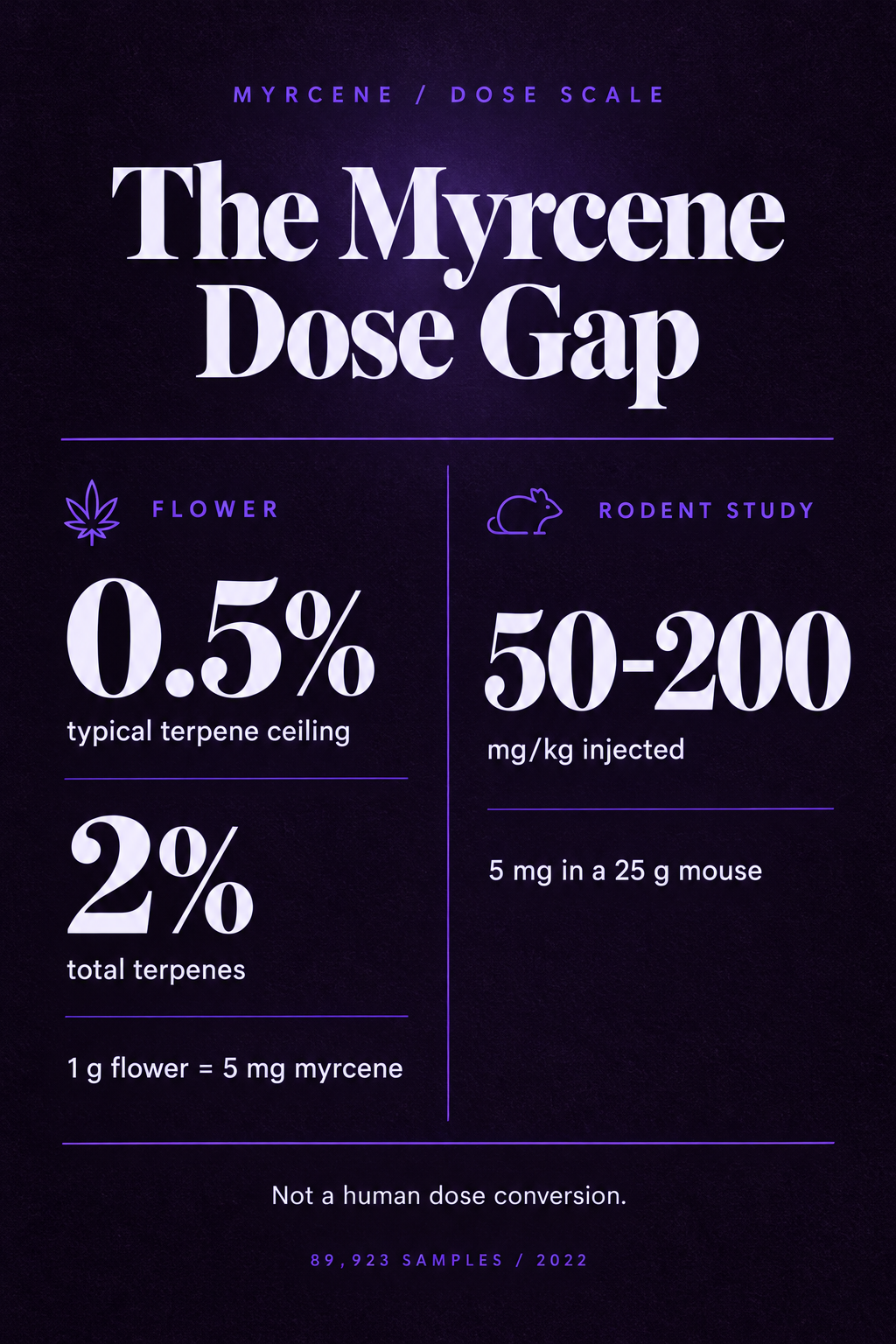
Those figures describe what sits in the material before combustion destroys part of it, so a label's milligram count is a ceiling rather than a delivered amount. Now put that beside the animal work.
Mice received myrcene at 100 and 200 mg/kg by intraperitoneal injection [7], 50 and 200 mg/kg in the insomnia model [3], and 1 to 200 mg/kg in the neuropathic pain study [6]. The compound was isolated and injected into an animal weighing tens of grams, so a 200 mg/kg dose in a 25 gram mouse is roughly 5 mg of pure myrcene at once.
The caveat matters. That is arithmetic, not a species dose conversion, and milligram-per-kilogram scaling is not a validated way to predict human effects.
The narrower conclusion: the concentrations sit orders of magnitude apart, which is why a rodent result cannot be pasted onto a joint. For how terpene percentages get measured, see The Science of Cannabis Terpenes: Beyond THC.
What do the animal studies on myrcene sedation actually show?
They show real sedative-type effects, including longer barbiturate sleep, impaired balance, and shorter sleep latency, but all from injected or vaporized myrcene at doses far above flower, and none from a controlled human trial.
The 2002 rodent paper most often cited for sedation gave mice 100 and 200 mg/kg intraperitoneally and found muscle relaxation, reduced crossings, rearing and grooming, and roughly 2.6 times longer barbiturate-induced sleep at the high dose. It also reports a slightly anxiogenic rather than anxiolytic profile [7].
The signals across the literature point the same direction:
- A 48% decrease in rota-rod balance time at 200 mg/kg, meaning impaired coordination [2]
- About 2.6 times longer barbiturate-induced sleep at 200 mg/kg [7]
- Shorter sleep latency and longer sleep in an insomnia mouse model at 50 and 200 mg/kg [3]
- Anxiolytic effects from vaporized terpene at 5%, varying by sex and exposure pattern [4]
- Reduced neuropathic pain with no direct CB1 action, and an aversive place-preference response [6]
| Study | Model and route | Main finding | Why it does not prove couch lock |
|---|---|---|---|
| Rodent study, 2002 | Mice, 100 and 200 mg/kg injected | Muscle relaxation, 2.6 times longer barbiturate sleep | Injected isolated myrcene far above flower content |
| Insomnia model, 2024 | Mice, 50 and 200 mg/kg | More quiet time, shorter sleep latency, GABA up | Animal model of induced insomnia, injected |
| Vapor study, 2024 | Mice, vapor at 5% terpene | Anxiolytic effects varying by sex and exposure | Authors state cannabis-relevant evidence is sparse |
| Pain study, 2025 | Mice, 1 to 200 mg/kg | Pain relief, no direct CB1 action, aversive | Pain endpoint, not sedation, no human comparison |
The insomnia model points at a mechanism rather than a receptor: raised GABA and serotonin with upregulated GABA-A and 5-HT1A expression [3]. The vapor study, the closest anyone has come to modeling inhalation, used 5% terpene and found anxiolytic effects varying by sex and exposure pattern, with the authors noting that evidence at cannabis-relevant doses is sparse [4].
The pain study cuts against a simple sedation story: myrcene reduced neuropathic pain with no direct CB1 action and was aversive in a place-preference test [6].
Draw the line honestly. These are consistent signals of a pharmacological effect in animals, but none establishes a human couch-lock threshold, and the mechanism is not cannabinoid receptor activation. For how terpenes are studied, start with Understanding Terpenes in Cannabis.
Does myrcene make THC stronger or help it cross the blood-brain barrier?
There is no solid evidence for either claim. Cell studies found myrcene neither activates CB1 or CB2 receptors nor changes how THC signals through them, and reviews call the barrier mechanism poorly supported.
In assays at human CB1 and CB2, the THC response measured 59% of control when THC was applied alone versus 55% when common terpenes including beta-myrcene were added [5]. That is noise, not potentiation, and if anything it points the wrong way.
- Myrcene did not activate CB1 or CB2 receptors in cell assays [5]
- No direct CB1 action was found even where myrcene reduced pain in mice [6]
- The blood-brain-barrier claim has limited robust support in the reviews [2]
| Claim | What would have to be true | What the studies found |
|---|---|---|
| Myrcene boosts THC | A change in THC signaling at CB1 | 59% of control alone versus 55% with terpenes |
| Myrcene opens the blood-brain barrier | A demonstrated permeability effect in vivo | Reviews call the mechanism poorly supported |
| Myrcene acts on cannabinoid receptors | Direct CB1 or CB2 activity | No activation and no direct CB1 action |
People genuinely do feel different after different cultivars, so the experience behind the belief is real even when the explanation is wrong. Total THC and CBD content, the other terpenes, route, amount consumed, and expectation all vary more between products than a myrcene percentage does. Absence of evidence is not proof that terpenes do nothing, only that this claim has not been demonstrated.
Does eating mango before smoking really add myrcene and get you higher?
No controlled human study has tested it. Mango does contain myrcene, but amounts vary by variety and ripeness, oral absorption is poorly characterized, and the ritual has no measured basis.
The logic runs: mango contains myrcene, myrcene is in cannabis, so eating one adds to the other.
- No controlled human study has tested mango before cannabis
- Myrcene content in fruit varies by variety and ripeness
- Oral absorption of myrcene and its timing are poorly characterized
- The sedation studies used injected or vaporized myrcene, not eaten fruit
- Expectation is a documented influence on how a session feels
Myrcene is a long-used food flavoring and fragrance ingredient [2], which says nothing about whether fruit-sized amounts reach the brain inside a useful window. The studies behind the rumor injected or vaporized isolated myrcene [7], a different delivery problem from digesting fruit [4].
Digestion is variable, so a mango is not a controlled delivery method, and expectation shapes subjective drug response reliably. If you enjoy mango, eat the mango.
How do you shop for myrcene-forward flower without falling for the hype?
Shop by the batch certificate of analysis, treat strain names as marketing shorthand, and judge a product by your own response rather than one terpene number.
A legal-market flower label and its COA carry a terpene panel with percentages for that batch, and those move between harvests. References commonly name OG Kush, Blue Dream, Grape Ape, and Tangie as myrcene-forward cultivars [8], but names are not standardized, so the document beats the name.
A practical method:
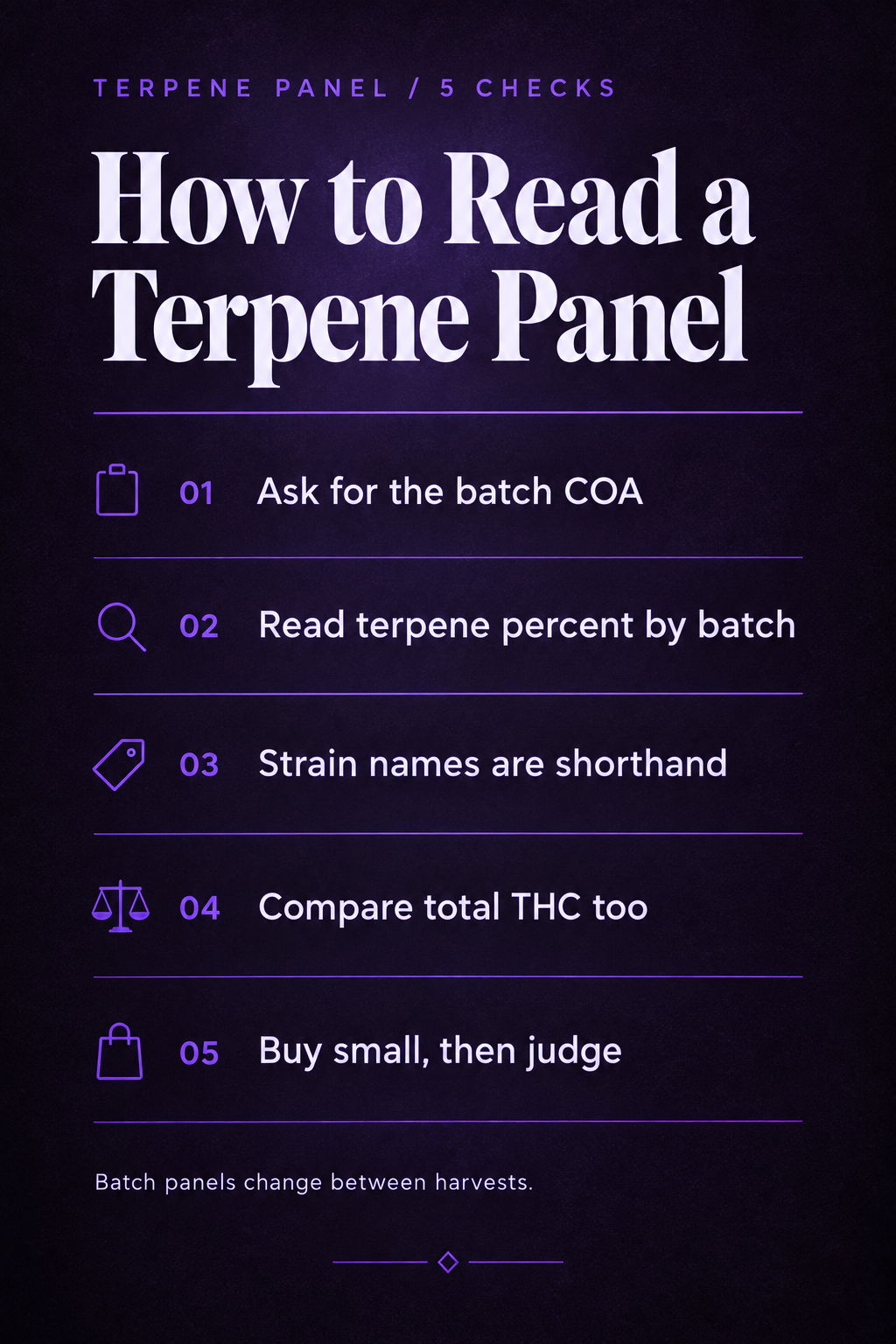
- Ask for the certificate of analysis for the batch you are buying
- Read the terpene panel in percentages, expecting it to vary between harvests
- Treat strain names as shorthand, not a specification
- Weigh total THC and any CBD or CBN content alongside it
- Buy a small format first and note how that batch felt
Labels do not share a denominator. A flower listing such as the batch panels you will see browsing Flower reports terpenes as a percentage of weight, multi-unit packs such as The Fruit Plate Hash Walker | 6pk Hash Infused Pre-rolls | 3g report total weight across units, and the tea listing at Blood Orange Herbal Tea | 10mg THC / 10mg CBD | 16oz is built on milligrams per serving, comparable to other beverages but not to flower.
For jarred flower, B.A.M • Flower • 70g examples let you practice reading that kind of batch panel. For cartridge formats, ZPK | Disposable Vape | 2g listings show concentration and hardware, which is what you need to compare one cartridge against another. And if relaxation is the goal, read the whole profile, since cannabinoid content and amount consumed drive the experience more than a myrcene line.
What else do adults ask about myrcene and couch lock?
Short version: myrcene has real animal data behind it and a best-known human claim that nobody has tested in people.
- The couch lock claim rests on rodent injections at 50 to 200 mg/kg
- Flower rarely exceeds 0.5% myrcene, so a gram holds single-digit milligrams
- Cell studies found no receptor-level mechanism for boosting THC
Does myrcene actually cause couch lock?
Not on the evidence available. The sedation story comes from rodents given 100 to 200 mg/kg of isolated myrcene by injection, far above what smoked flower delivers, and no controlled human trial has shown that myrcene at cannabis doses causes couch lock.
What does myrcene smell like and where else is it found?
Earthy, musky, and resinous, with a soft sweet, fruity edge that reads as mango or balsam. It is the dominant aroma compound in hops and also occurs in lemongrass, thyme, bay leaf, verbena, and ripe mango.
How much myrcene is actually in cannabis flower?
Very little by weight. Across 89,923 commercial flower samples from six states, individual terpenes were rarely above 0.5% and total terpenes averaged about 2%. A one-gram joint typically carries a few milligrams, not hundreds.
Does myrcene make THC stronger or help it cross the blood-brain barrier?
That claim gets repeated in reviews but rests on thin ground. The 2021 myrcene review itself calls the barrier mechanism poorly supported, and cell studies found myrcene neither activates CB1 nor changes how THC signals through it.
Does eating a mango before smoking get you higher?
No controlled human study has tested it, and the proposed mechanism has failed in cell work. Mango does contain myrcene, but amounts vary by variety and ripeness. If the ritual seems to work, expectation is the likeliest explanation.
Is myrcene sedating on its own?
In animals at high doses, yes. Mice given myrcene showed muscle relaxation and longer barbiturate-induced sleep, and an insomnia-model study found sedative-hypnotic effects through GABA and serotonin pathways. Human data on isolated myrcene is essentially absent, so treat sedation as a possible contributor, not a promise.
Which cannabis strains are high in myrcene?
References commonly name OG Kush, Blue Dream, Grape Ape, and Tangie as myrcene-forward cultivars. Strain names are not standardized and lab panels vary batch to batch, so the certificate of analysis tells you more than the name on the jar.
Sources
- PLoS ONE / National Institutes of Health — In the largest chemotaxonomic analysis of commercial cannabis flower to date (n
- Frontiers in Nutrition / National Institutes of Health — This peer-reviewed review lists myrcene's reported analgesic, sedative, antioxid
- Pharmaceuticals (Basel) / National Institutes of Health — In an insomnia mouse model, beta-myrcene at 50 and 200 mg/kg increased quiet tim
- NeuroSci / National Institutes of Health — Using vapor exposure modeled on human inhalation at 5% terpene (the upper end of
- Cannabis and Cannabinoid Research / National Institutes of Health — In cell assays, six common cannabis terpenoids including beta-myrcene neither ac
- Pain / National Institutes of Health — Myrcene injected at 1 to 200 mg/kg reduced neuropathic pain behavior in male and
- Phytomedicine / National Library of Medicine — This is the rodent study most often cited for myrcene sedation: mice given myrce
- Leafly — Consumer-facing reference describing myrcene as one of the most common cannabis
About Treehouse Cannabis
Treehouse Cannabis publishes adult-use education for customers in Rockland County, New York. Myrcene is worth understanding, but it is not a switch that decides whether a product relaxes you, and nothing here is medical advice. If you are choosing a product for sleep or anxiety, ask the staff for the batch panel and talk to a healthcare professional about anything that is a health concern.
Cannabis is for adults 21 and older. Keep all cannabis products away from children and pets. This article is educational and is not medical advice. Do not drive or operate machinery while impaired.



Shop our products

Shop All

Deals

Flower

Pre-rolls
Vaporizers

Edibles

Drinks

Concentrates
Tinctures

Topicals

CBD

Pet CBD

Accessories