

Cannabis and Social Life: How Sharing Weed Shapes Friendships
Cannabis and Social Life: How Sharing Weed Shapes Friendships
Cannabis social life centers on the same ritual it always has: a joint passed around a circle of friends. Adults 21 and older overwhelmingly share cannabis with people they already know, and the puff-puff-pass rule keeps the rotation fair. The format changes — prerolls, vapes, low-dose edibles — but the social instinct behind sharing weed stays the same.
This is a look at what researchers, etiquette writers, and adults 21 and older actually say about sharing weed. It covers why the friend group is the strongest signal of whether and how someone uses cannabis, the rules that keep a shared session fair, and what harm reduction looks like when a mouthpiece rotates around the circle.
Why do adults share cannabis with friends in the first place?
Friends are the single strongest correlate of an adult's own cannabis use. The Elsevier Handbook of Cannabis and Related Pathologies summarizes decades of social-science research and finds that friends' cannabis-use patterns predict an individual's pattern more reliably than personal preference, family history, or even local laws [1]. The same friend who invites you over for dinner is, statistically, the friend most likely to invite you to share a joint.
That overlap is not an accident. Sharing a piece of cannabis fuses the pharmacological effect — the relaxation, the ease of conversation — with a social one. The ritual is the point. A 2024 UCLA survey of 925 non-medical inhaled cannabis users documented a measurable shift in sharing patterns during the COVID-19 pandemic: the share of users who abstained from sharing rose from roughly 12.4% before the pandemic to about 24.9% during it, even though most regular users kept sharing in private circles when they could [2]. The practice is responsive to cultural context, but it does not need a public venue to survive.
Why friend groups carry the practice:
- Friends' use patterns are the strongest correlate of an individual's use, ahead of family, personal preference, or local law.
- The shared ritual fuses the pharmacological effect (relaxation, ease of conversation) with a social one (recognition, belonging).
- Sharing cannabis is overwhelmingly a private, friend-group activity — most adults are not looking for strangers.
- Even at the COVID-19 peak, the majority of regular users kept sharing in private circles; only the share who abstained roughly doubled.
Most adults who use cannabis socially already understand the trade. They are not looking for strangers. They are looking for a friend, a quiet evening, and a reason to slow down together. Sharing weed is overwhelmingly a private activity, even in places where public consumption is allowed, and that privacy is part of why the ritual feels close rather than performative. For adults who also want to stay active without losing the unwind, our look at how cannabis fits into a fitness routine breaks down where the two habits overlap Weed & Workouts: How Cannabis Fits Into an Active Lifestyle.
The other side of that private ritual is recovery. Heavy social use — late nights, shared joints, weekend rotations — can quickly outrun a person's sleep schedule, and a friend group that pulls together on a Friday often pulls the next Monday apart. If sharing has started to crowd out rest, the practical dose-and-timing patterns in Cannabis and Sleep Quality: What Actually Works (and What Doesn't) are a useful counterweight to keep in the same circle of habits Cannabis and Sleep Quality: What Actually Works (and What Doesn't).
What does 'puff, puff, pass' actually mean, and why is it the social norm?
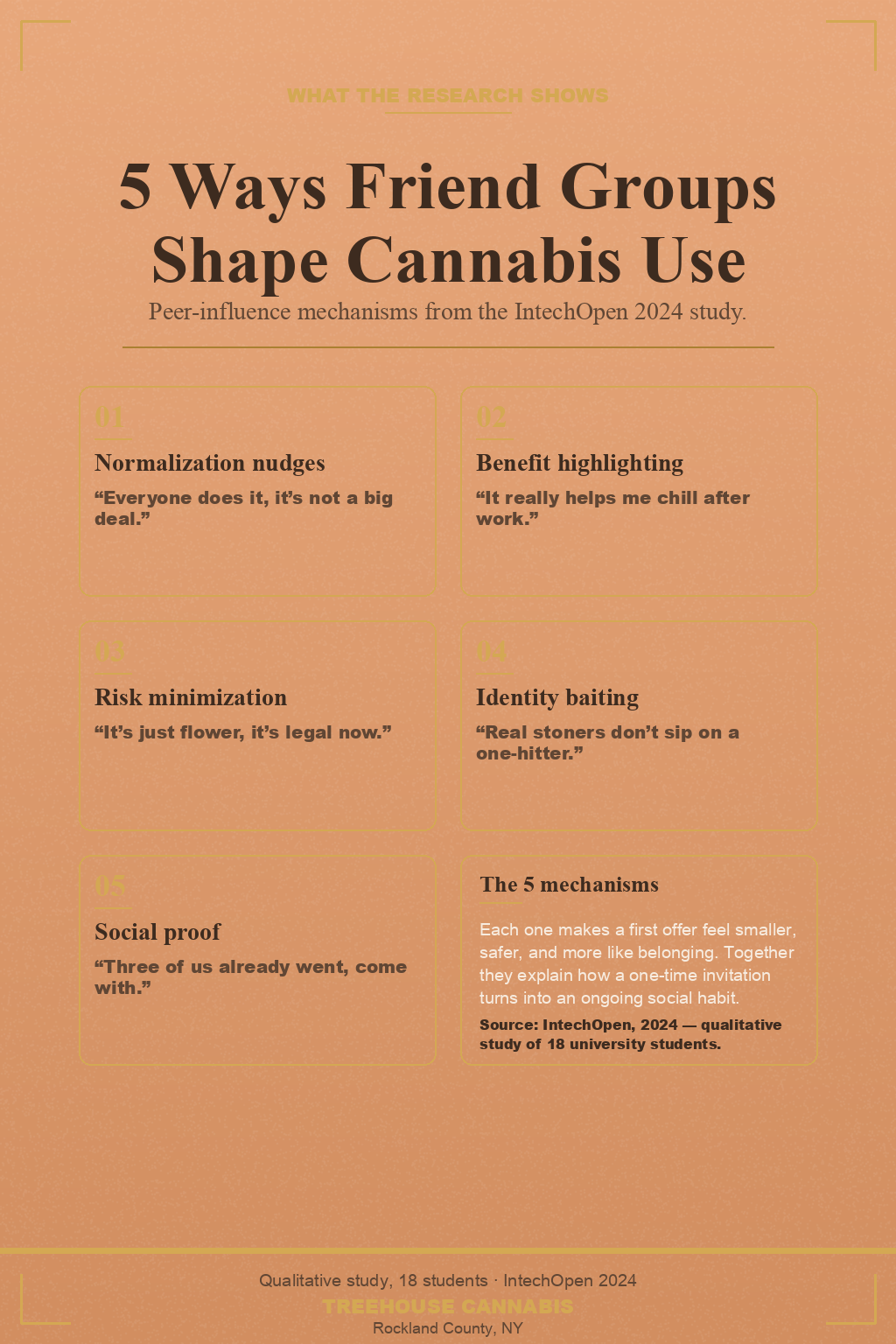
The phrase sounds like nursery rhyme, but the rule behind it is a fairness contract. Two puffs, then pass it on. The rule exists so no one monopolizes the joint and so the piece actually circulates around the room.
Without the rule, the same person — usually the most enthusiastic or the most talkative — keeps the cherry going while everyone else waits. The etiquette authority Lizzie Post, in Higher Etiquette, treats puff-puff-pass as a long-standing cannabis-specific norm that sits alongside passing the bong left-to-right around the circle [6]. Both rules do the same thing: they turn one person's private inhale into a shared turn.
The norm is older than legalization. It works because it is simple to teach a newcomer, obvious to enforce, and light enough to be enforced socially rather than verbally. A group that has agreed on the rule rarely needs to talk about it again. A group that has not agreed usually notices within five minutes. The Royal Queen Seeds explainer on sharing joints and bongs describes the ritual as one of the things that "makes the cannabis community so connected" — with the candid caveat that connection and germ exposure are not mutually exclusive [7].
In practice, a few small habits keep the ritual honest:
- Light evenly. A torch-lit tip wastes flower and crowds the next person's hit with ash.
- Stick to two puffs, regardless of how short the first one felt.
- Pass in one consistent direction so nobody has to guess whose turn is next.
- Hold the piece by the filter, not by the lit end, especially if it is a hand-rolled joint with no crutch.
- If the rotation slows because someone is deep in conversation, they wave the next person on — they do not hold the piece hostage.
Music tends to be the co-pilot of any session that lasts longer than a single rotation, and the same traditions that built the modern cannabis counter also built the way soundtracks travel around a living room. Our read on Cannabis and Music Culture: From Jazz Clubs to Modern Festivals traces the thread from smoky small rooms to outdoor stages, where a passed joint became less a rebellion than a shared pause Cannabis and Music Culture: From Jazz Clubs to Modern Festivals.
A fair circle also tends to be a louder, more talkative circle. Some strains amplify that effect more than others — the sativa-leaning, terpinolene-heavy cultivars tend to bring out conversation in a way that heavy indicas do not. Our guide to Why Some Strains Make You Chatty breaks down which terpene profiles tend to put a group in storytelling mode Why Some Strains Make You Chatty.
The hardest version of the rule to honor is when the host has put months of care into their own supply. A friend who has been Growing Cannabis at Home in New York knows exactly how much work went into that jar — and a guest who helps themselves without asking has already broken the contract Growing Cannabis at Home in New York: What You Need to Know. The etiquette norm in that case is to ask before opening a sealed jar, and to leave at least as much as the host would have smoked for the night.
How do friend groups turn a one-time offer into an ongoing habit?
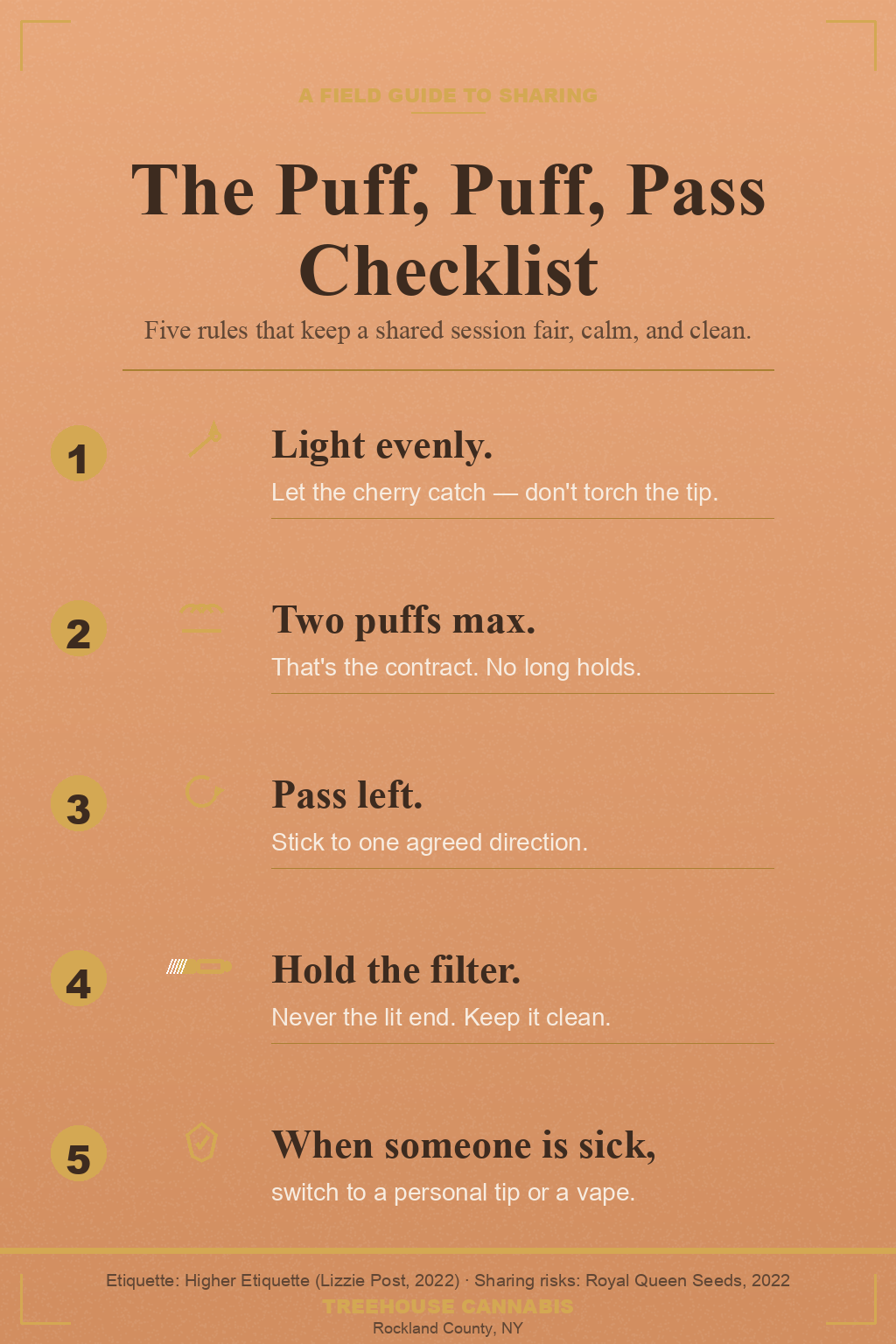
The mechanics of peer influence on cannabis use are not mysterious; researchers have simply named them. A 2024 qualitative study published through IntechOpen, based on interviews with 18 university students, identified five distinct peer-influence mechanisms that show up again and again in friend groups: normalization nudges ("everyone does it, it's not a big deal"), benefit highlighting ("it really helps me chill after work"), risk minimization ("it's just flower, it's legal now"), identity baiting ("real stoners don't sip on a one-hitter"), and social proof ("three of us already went, come with") [3]. None of these require a conspiracy. They are how people invite each other into shared rituals across every domain of adult life — book clubs, gym buddies, weekend hikers.
A 2024 systematic review in Frontiers in Psychiatry, drawing on eight longitudinal studies, found that friends' cannabis use is the strongest single predictor of an adolescent's own use, ahead of family attitudes and broader community norms [4]. The same dynamic, recalibrated for adults, describes how a one-time shared preroll on a Saturday becomes a Sunday rotation by the end of the month. The ritual is the engine: every time the joint comes around the circle, the next person has to decide whether to take a turn or wave it past, and that visible choice is what makes the habit feel like a group activity rather than a private decision.
The five recurring peer-influence mechanisms, named by researchers:
- Normalization nudges — "everyone does it, it's not a big deal."
- Benefit highlighting — "it really helps me chill after work."
- Risk minimization — "it's just flower, it's legal now."
- Identity baiting — "real stoners don't sip on a one-hitter."
- Social proof — "three of us already went, come with."
For adults 21 and older, the right frame is observation rather than alarm. Some friend groups naturally drift toward cannabis; others do not. The five mechanisms above describe how the drift happens, and recognizing them by name makes it easier to choose which invitations feel right and which feel like pressure. They are also why cannabis has found a stable social home in settings where a drink would have been the default a generation earlier. Soccer supporters in dozens of countries have built a cannabis culture around match day — the smoke-out before and after the game is the unofficial third half for many supporters' groups, and our piece on Cannabis and the Beautiful Game: How Soccer Fans Around the World Enjoy Cannabis Culture walks through how the ritual travels between leagues and continents Cannabis and the Beautiful Game: How Soccer Fans Around the World Enjoy Cannabis Culture.
Community rituals work the same way. Where a group has already chosen what its celebrations look like — what music, what food, what shared toasts — cannabis often finds a place in the rotation without anyone having to argue for it. That is how it became part of Pride Month festivities in cities across North America, and our piece on How Cannabis Became a Pride Month Tradition traces how the practice moved from underground fundraisers to public street festivals over the past decade How Cannabis Became a Pride Month Tradition.
Is sharing a joint or bong actually safe between friends?
Honest answer: it carries the same risks as sharing a drink, a microphone, or a vape — and most adults understand those intuitively. Shared mouthpieces do pass saliva, and saliva does pass the common cold, flu, mononucleosis, strep throat, and the broader category of respiratory infections that travel through close contact [7]. None of that is unique to cannabis. It is the cost of every social format where one device moves around a group.
What is useful is to separate what is genuinely a risk from what gets exaggerated. A shared joint is not going to give anyone an exotic infection that a sneezed-on doorknob would not. The everyday respiratory viruses are the realistic concern, and those are also the easiest to mitigate. Adults who want to keep the ritual without the swap can do a few things that do not kill the mood:
- Personal mouth tips. A small silicone or cardboard sleeve that fits over the joint filter is the cheapest insurance on the market. Each guest uses their own; the host washes them with dish soap between sessions.
- A clean mouthpiece. For a bong or a dry-herb vaporizer hose, an alcohol wipe on the glass between rotations solves ninety percent of the problem. It takes ten seconds and nobody notices.
- Switch formats when someone is sick. A guest who is fighting a cold can still participate with a personal edible, a 510-thread cartridge on their own battery, or a stack of infused seltzers. Nobody has to feel like the patient.
The deeper point is that etiquette is also hygiene. The same two-puff, pass-left rule that keeps the circle fair is also the rule that keeps the rotation moving and reduces the time any single mouthpiece spends near another person's mouth. Speed is its own safety measure. A circle that lingers on one person's turn invites exactly the kind of close, repeated contact that spreads ordinary illness.
For groups that want to remove the variable entirely, a dry-herb vaporizer with a fresh mouthpiece per guest, or a table full of low-dose gummies, lets the social energy stay intact while the shared hardware disappears. The mouthpieces are individual; the conversation is still shared.
Where can adults in New York actually consume cannabis socially today?
New York's MRTA, the law that legalized adult-use cannabis in the state, also created a licensed on-site consumption framework — what most people call a cannabis lounge. As of mid-2026, the state's Office of Cannabis Management has not yet opened the application window for those licenses [5]. No state-licensed cannabis lounge is currently operating in New York, which means the social side of cannabis is, for the moment, still mostly a private activity.
For adults 21 and older in Rockland, Orange, and Westchester Counties, that translates to a few practical patterns. Most social consumption happens at a private residence, with the host's permission. Pickup and delivery from a licensed dispensary is what supplies those at-home sessions. A round of flower or a multi-pack of prerolls covers the rotation; a handful of low-dose gummies covers the friends who don't inhale. Hosts who keep a clean routine — sealed jars labeled by strain, fresh mouthpieces on the counter, a tray for ash rather than a coaster — make their living room more comfortable for guests who don't use cannabis regularly.
Practical patterns for at-home social sessions:
- Most consumption happens at a private residence, with the host's permission.
- Pickup and delivery from a licensed dispensary supplies the session — flower, prerolls, edibles, 510-thread cartridges.
- Hosts who label sealed jars by strain and keep fresh mouthpieces on hand make guests more comfortable.
- Bring enough for the group and a snack, not for one — the polite move scales like bringing a bottle to dinner.
The polite move when a friend is hosting is to bring enough for the group and a snack, not for one. A small bag of gummies is an underrated offering; it gives the guests who don't smoke a way to participate in the evening at their own pace without the group slowing down for them. The same social logic that makes people bring a bottle to a dinner party applies here, scaled down: a single contribution that lifts the whole circle is more valuable than a private stash hoarded in a coat pocket.
For adults who used to meet friends at a bar and are curious how a different format works on a weeknight, the broader switch is real and well documented. Our look at Cannabis and Alcohol Alternatives: Why Some Adults Are Switching walks through why some adults have replaced Friday cocktails with a shared preroll and a record on, and what changes when the ritual swaps format Cannabis and Alcohol Alternatives: Why Some Adults Are Switching. The pull toward cannabis in those settings is not a moral claim against alcohol; it is a practical observation that the social reward of a slow, shared inhale outlasts the morning for a lot of adults. Catching up with friends one-on-one, with a clean routine, is a quiet, durable form of the same instinct — and a good way to keep the social side of cannabis inside the habits that work for the long run.
Frequently Asked Questions
Why do people share cannabis with friends?
Sharing cannabis with friends is both a social bonding ritual and a long-standing piece of cannabis etiquette. A 2023 UCLA study of 925 inhaled-cannabis users found that the majority continued sharing even during the COVID-19 pandemic, and peer-reviewed research describes puff-puff-pass as a ritual that reinforces group cohesion, trust, and a sense of inclusion among adults who use together.
Does cannabis actually bring people closer together?
Cannabis tends to be used in small, intimate friend groups, and friends who share use report higher friendship quality but also more conflict. A 2024 qualitative study found that passing a joint fuses the cannabis effect with social reward, producing "sticky" memories that strengthen the friendship.
What is the 'puff, puff, pass' rule?
Puff, puff, pass is the informal rule that each person takes two puffs of a shared joint before passing it on. It is built on fairness: no one should hold the piece long enough that it stops feeling shared. Lizzie Post's Higher Etiquette treats the rule as a long-standing norm of cannabis social life.
Is it safe to share a joint or bong with friends?
Sharing a joint, blunt, or bong means direct saliva contact, which can transmit cold, flu, and other respiratory infections the same way sharing a drink can. Harm-reduction advice is to use your own mouth tip, sanitize mouthpieces, or switch to edibles and dry-herb vaporizers when anyone in the group is feeling sick, while still respecting the social ritual.
Are there cannabis consumption lounges in New York?
Not yet for most adults. New York's MRTA created a licensed on-site consumption framework, but as of mid-2026 the Office of Cannabis Management has not opened applications for OSC licenses and no state-licensed cannabis lounge is operating in New York. Adults 21 and older who want to consume socially usually do so in a private residence with the host's permission.
How does peer influence shape first-time cannabis use?
A 2024 IntechOpen qualitative study identified five recurring peer-influence mechanisms behind first-time cannabis use: normalization nudges, benefit highlighting, risk minimization, identity baiting, and social proof. Combined with neuro-ritual bonding from the shared act of smoking, these mechanisms turn a one-time offer into a memorable group experience that often anchors ongoing social use.
Sources
- Elsevier / Handbook of Cannabis and Related Pathologies (Academic Press) — Comprehensive academic chapter showing that friends' cannabis-use patterns are o
- UCLA Center for Cannabis and Cannabinoids, Harm Reduction Journal (BMC) — UCLA survey of 925 non-medical inhaled cannabis users documents a measurable shi
- IntechOpen (peer-reviewed open access) — Qualitative study with 18 university students identifies five peer-influence mec
- Frontiers in Psychiatry / PubMed Central (NCBI) — Systematic review of eight longitudinal studies finds that cannabis use is most
- High Time Lounges (consumer-facing legal reference) — Explains that New York's MRTA created a licensed on-site consumption (OSC) frame
- Emily Post Institute (Lizzie Post, author) — Etiquette authority Lizzie Post codifies 'puff, puff, pass' as a long-standing c
- Royal Queen Seeds (consumer education blog) — Explains the social and health trade-offs of sharing joints and bongs, noting th
About Treehouse Cannabis
Treehouse Cannabis is a licensed adult-use dispensary serving customers 21 and older across Rockland County, NY, with pickup and delivery to surrounding areas. We carry flower, prerolls, edibles, vape cartridges, and concentrates from licensed producers — and we are happy to walk a customer through any format before they buy.
Stock the circle, not just yourself. When you are hosting, the move is to bring enough for everyone. Browse Treehouse Cannabis for the formats that travel well between friends, with same-day pickup and delivery across Rockland County.
Cannabis is for adults 21 and older. Keep all cannabis products securely stored and out of reach of children, pets, and anyone else who should not have access. Do not drive or operate machinery while impaired. If you are pregnant, nursing, or taking other medications, talk to a healthcare provider before using cannabis. The information in this article is educational and does not substitute for professional medical advice. New York adults 21 and older can purchase cannabis legally from licensed dispensaries like Treehouse Cannabis; consuming in public or on federal land remains prohibited under state and federal law.

Shop our products

Shop All

Deals

Flower

Pre-rolls

Vaporizers

Edibles
Drinks

Concentrates

Tinctures

Topicals

CBD

Pet CBD

Accessories