Can Cannabis Affect Memory? What Current Research Shows
Can Cannabis Affect Memory? What Current Research Shows
Yes, cannabis can affect memory, but mostly inside a narrow window. THC disrupts the hippocampus and orbitofrontal cortex while a person is high, so new information is harder to encode and recall. The cannabis and memory research agrees the acute effect is real; whether it lasts is a genuinely mixed question.
Most of that impairment is temporary and depends on dose. Whether any of it lasts is a separate question, and the answer differs sharply between someone who uses occasionally and someone who meets criteria for cannabis use disorder.
What Is the Connection Between Cannabis and Memory?
Yes, cannabis and memory are connected, but the connection is narrower than most headlines suggest. THC disrupts the hippocampus and orbitofrontal cortex while a person is intoxicated, which makes new information harder to hold onto. Most of that impairment is temporary and depends on dose.
THC attaches to cannabinoid receptors on neurons in regions that govern memory, thinking, attention, and time perception. The hippocampus is the structure that encodes new memories, and it carries a high density of the CB1 receptors THC binds [1]. That anatomical overlap explains why the effect is specific rather than global: a person can hold a conversation while struggling to remember what was said ten minutes earlier.
Three timeframes structure almost every claim in this article, and keeping them separate prevents most of the confusion around the topic:
- While high: acute impairment measured in hours, driven mainly by dose and potency.
- The days after: residual effects that shrink as THC clears and withdrawal settles.
- Long-term heavy use: deficits that persist in people who meet criteria for cannabis use disorder.
The National Academies review graded the evidence along those lines. It found moderate evidence that acute cannabis use impairs learning, memory, and attention, but only insufficient evidence for working memory impairment specifically, and limited evidence for impairment during sustained abstinence [2]. Those grades describe how confident researchers are, not how large the effect is.
It also helps to separate two questions that get merged online. "Does weed kill brain cells" asks about structural damage. "Does weed make it harder to remember things right now" asks about function during intoxication. The human evidence supports the second far more firmly than the first, and conflating them is how both the alarmist and the dismissive versions of this topic go wrong.
Memory is not the only function that shifts once the high fades. Sleep and dream recall change too, which Cannabis and Lucid Dreaming: What Happens When You Smoke Before Bed covers in more detail.
How Does THC Affect Short Term Memory While You Are High?
During intoxication, THC reliably impairs working memory, the mental scratchpad you use to hold a phone number or the start of a sentence long enough to act on it. The effect is dose-dependent, and the threshold is lower than most people assume.
In a placebo-controlled, double-blind crossover trial with a combined sample of 46, a single 15 mg dose of THC impaired visual working memory while 7.5 mg did not [5]. The same paper reviewed 57 prior digit-span conditions and found 73.68% failed to detect any THC effect. The authors attribute most of those null results to inadequate statistical power and short tasks rather than to the absence of an effect, which is a useful warning about how easily small studies produce reassuring headlines.
The 2026 study of 154 adults tested 45 minutes after medical-grade cannabis at 16.1% THC sharpened the picture. Visuospatial working memory was selectively impaired, while auditory-verbal and short-term memory stayed intact [6].
| Memory domain | Effect at peak intoxication |
|---|---|
| Visuospatial working memory | Impaired |
| Auditory-verbal memory | No significant change |
| Short-term memory | No significant change |
| Accuracy judging own performance | Reduced |
That table is the point of the section. The deficit is not a blanket fog, because some tasks degrade while others hold steady. A person can follow a conversation and still lose track of where an object was three seconds ago.
The same study reported a larger deficit in males (d = -0.87) than in females (d = -0.48), a group-by-sex interaction the authors present as a finding to replicate rather than a rule to apply to any individual [6].
The mechanism is coming into focus, though mostly in animals. In mice, THC disrupted short-term object-recognition memory through hippocampal protein kinase C and neurogranin signaling, and blocking that pathway prevented the short-term but not the long-term deficit [11]. That is mechanistic rodent evidence, not proof of the same sequence in people, but it points to a functional disruption in the short-term window rather than structural destruction.
A few practical points follow from this research:
- Working memory is the short-term store you use to hold information for a few seconds, and it is the domain most consistently affected.
- Dose sets the threshold: 15 mg produced measurable impairment in controlled testing where 7.5 mg did not.
- The impairment is selective, hitting visuospatial tasks harder than verbal ones in the largest recent study.
- Subjective impairment and measured impairment diverge, because THC also reduces accuracy about how well you are performing.
- Strain names predict little about any of this, as Indica vs Sativa: Why the Labels Are Mostly Meaningless explains, while stated THC content predicts more.
For the receptor-level explanation behind those differences, CBD vs THC: The Science Behind the Two Most-Discussed Cannabinoids walks through why the two most-discussed cannabinoids behave so differently in the body.
How Long Does Weed Brain Fog Last After You Stop?
Weed brain fog follows a fairly consistent pattern: hours for the acute effect, days for the residual, and one to two weeks for verbal learning and memory to return toward baseline. The most useful number comes from a 2018 meta-analysis of 69 cross-sectional studies covering 2,152 users and 6,575 comparison participants. The overall effect was small at d = -0.25, and in the 15 studies that required more than 72 hours of abstinence it fell to d = -0.08, which is not statistically significant [3].
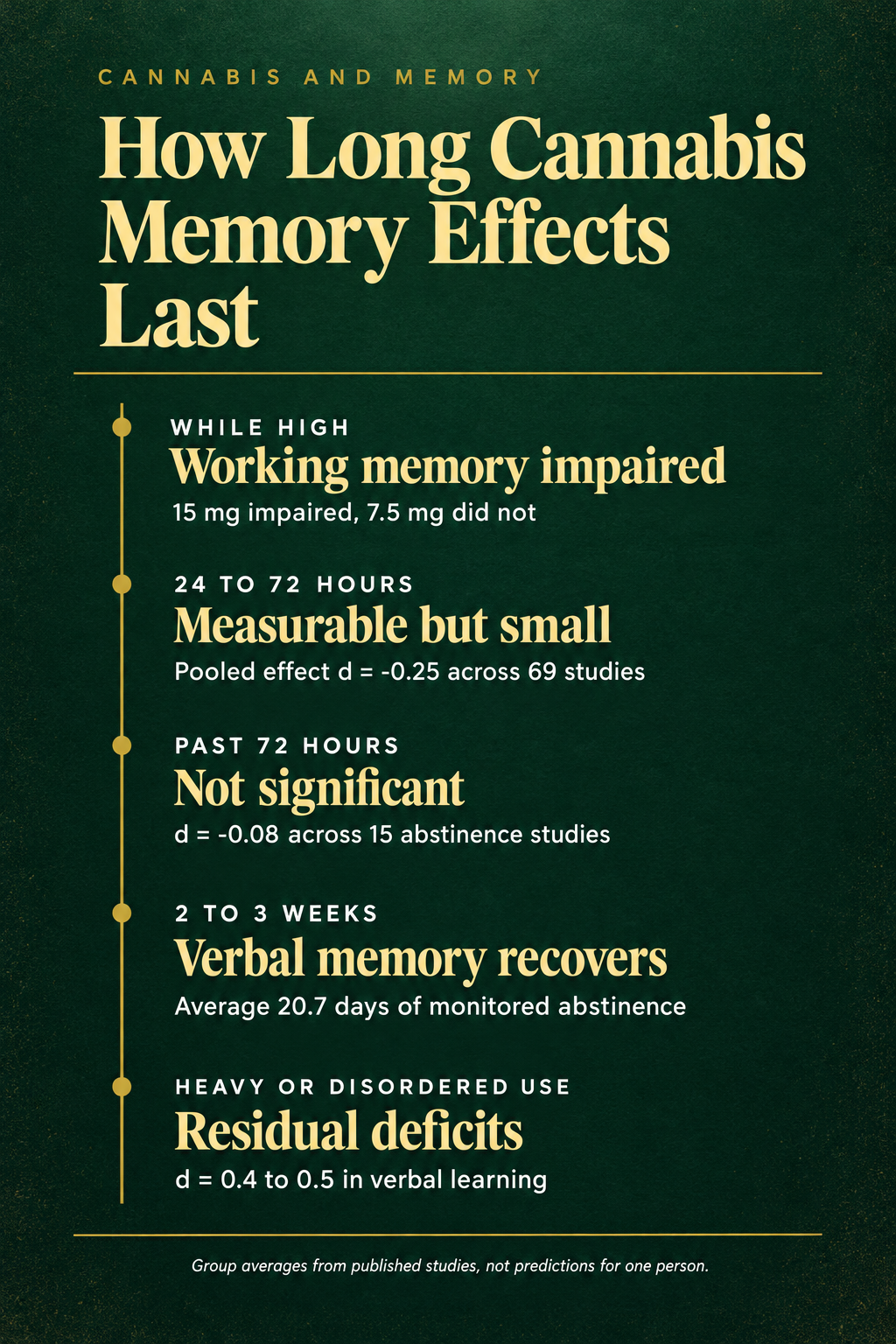
Read that carefully, because it cuts both ways. It suggests a large share of the measured deficit tracks recent use rather than permanent change. It does not prove that, because cross-sectional designs cannot establish causation and cannot rule out pre-existing differences between people who use heavily and people who do not.
The recovery evidence points the same direction. In a study where abstinence was verified by weekly urinalysis and continuous sweat patches, adolescent and young adult users recovered sustained attention across roughly three weeks, averaging 20.7 days by the third session [8]. Prior abstinence research summarized in that paper reported verbal learning and memory recovering within one to two weeks and psychomotor speed within about a month, with attention and inhibition taking longer.
What the timeline looks like in practice:
- Hours: acute impairment, tracking blood THC concentration.
- One to three days: residual effects that are measurable but small in pooled data.
- Past 72 hours: deficits fall below significance in meta-analytic estimates.
- One to two weeks: verbal learning and memory typically recover in monitored studies.
- Weeks to a month: attention and psychomotor speed are the slower domains to normalize.
Two caveats deserve equal billing. Participants in the monitored study had already been abstinent for about a week when they enrolled, so some recovery may have happened before the first test, a limit the authors acknowledge. Federal summaries also describe attention, memory, and learning problems lasting days or weeks after the acute effects wear off, depending on a person's history, which is a range rather than a schedule [1].
For how THC and CBD reach these systems in the first place, How THC and CBD Work is a useful primer on the pathway.
Is Cannabis-Related Memory Loss Permanent?
For most adults, the evidence does not support permanent damage. That is not the same as a clean bill of health, and the gap between those two statements is where this question actually lives.
The strongest counterweight comes from a 2025 meta-analysis of people diagnosed with cannabis use disorder. It found small-to-moderate impairments in 10 of 13 cognitive domains, with the largest deficits in verbal learning and memory, processing speed, and working memory at d = 0.4 to 0.5, while verbal fluency and attention were least affected [4]. The authors caution that residual impairment should not be underestimated prematurely.
Here is how the three layers compare:
| Timeframe | Finding | Evidence strength |
|---|---|---|
| Acute, while high | Working memory and verbal recall impaired | Moderate to strong |
| Residual, days after | Small deficits that shrink with abstinence | Moderate |
| Persistent, heavy or disordered use | Small-to-moderate deficits in verbal learning and working memory | Limited to moderate, correlational |
The National Academies graded impairment during sustained abstinence as limited evidence and left persistence versus recovery unresolved after 24 hours or 25 to 32 days without cannabis [2]. Limited is not the same as disproven. It means the available studies cannot yet separate a lasting drug effect from characteristics that were there before someone began using heavily.
What the evidence supports, stated plainly:
- Occasional or casual use looks largely reversible with abstinence.
- Heavy use that meets cannabis use disorder criteria leaves a measurable residual in verbal learning and working memory.
- The permanence question is open, not settled in either direction.
- Frequency and duration of use matter more than any single session.
- Most pooled evidence is cross-sectional, so causal claims about permanence outrun the data.
Nothing in that changes with product format, but format does change how much THC lands in a session. Options such as Small Buds Flower exist partly because smaller units are easier for a customer to meter without weighing anything.
Does Cannabis Affect Adolescent Memory Differently Than Adult Memory?
Yes, adolescence is treated as the higher-risk window, though the direct comparison evidence is thinner than the warnings suggest. The hippocampus and prefrontal cortex keep maturing through adolescence, which is the biological reason heavy use during that window draws scrutiny.
NIDA states that long-term learning and memory problems are a risk when heavy use begins in youth [1]. That is a federal summary of a body of work rather than one trial, and it does not specify an effect size.
The direct comparison is more equivocal. In the CannTeen study, chronic users performed worse than controls on verbal episodic memory by a small margin, with no significant differences in spatial working memory or response inhibition, and no evidence that 16 and 17 year olds were more vulnerable than adults aged 26 to 29 [7]. The authors are explicit that large longitudinal studies are still needed to confirm the findings.
| Question | Adolescents | Adults |
|---|---|---|
| Brain development | Hippocampus and prefrontal cortex still maturing | Maturation largely complete |
| Federal summary | Long-term learning and memory problems flagged when heavy use begins in youth | Not framed as a developmental risk |
| Direct comparison (CannTeen) | Small verbal episodic memory deficit versus controls | Same small-margin deficit pattern at ages 26 to 29 |
| Greater vulnerability confirmed | No, not in the one direct comparison | Reference group |
How to weigh the two:
- The developmental argument is biologically plausible and supported by federal summaries.
- The one direct adolescent-versus-adult comparison did not confirm greater adolescent vulnerability.
- That comparison is cross-sectional, so it cannot rule out differences that predate use.
- A reviewed youth trial found participants continuously abstinent for four weeks had significantly better memory than those still using [2], which shows the deficit is at least partly reversible.
- Prevalence of use in this age group makes it a public health question regardless of how the causality debate resolves.
Nothing about the packaging changes the developmental argument. Whole Flower Flower and a vape cartridge deliver THC to the same receptors, so the variables that matter are dose and frequency rather than format.
Does CBD Affect Memory the Same Way THC Does?
No. CBD alone has not shown memory impairment in healthy adults, even at high doses. Oral CBD up to 800 mg did not significantly impair learning or memory, and the study found no interaction between CBD and the presence of THC [10].
| Measure | THC | CBD |
|---|---|---|
| Receptor action | Binds CB1 receptors directly | Does not bind CB1 directly |
| Measured memory effect | Impairs working memory while high | No measurable impairment in healthy adults |
| Dose range studied | Effect appears around 15 mg in controlled testing | Tested up to 800 mg |
| Interaction with the other cannabinoid | Acute effects persist | No interaction detected with THC presence |
| Typical retail presence | Dominant in most flower and vape products | Often a minor component |
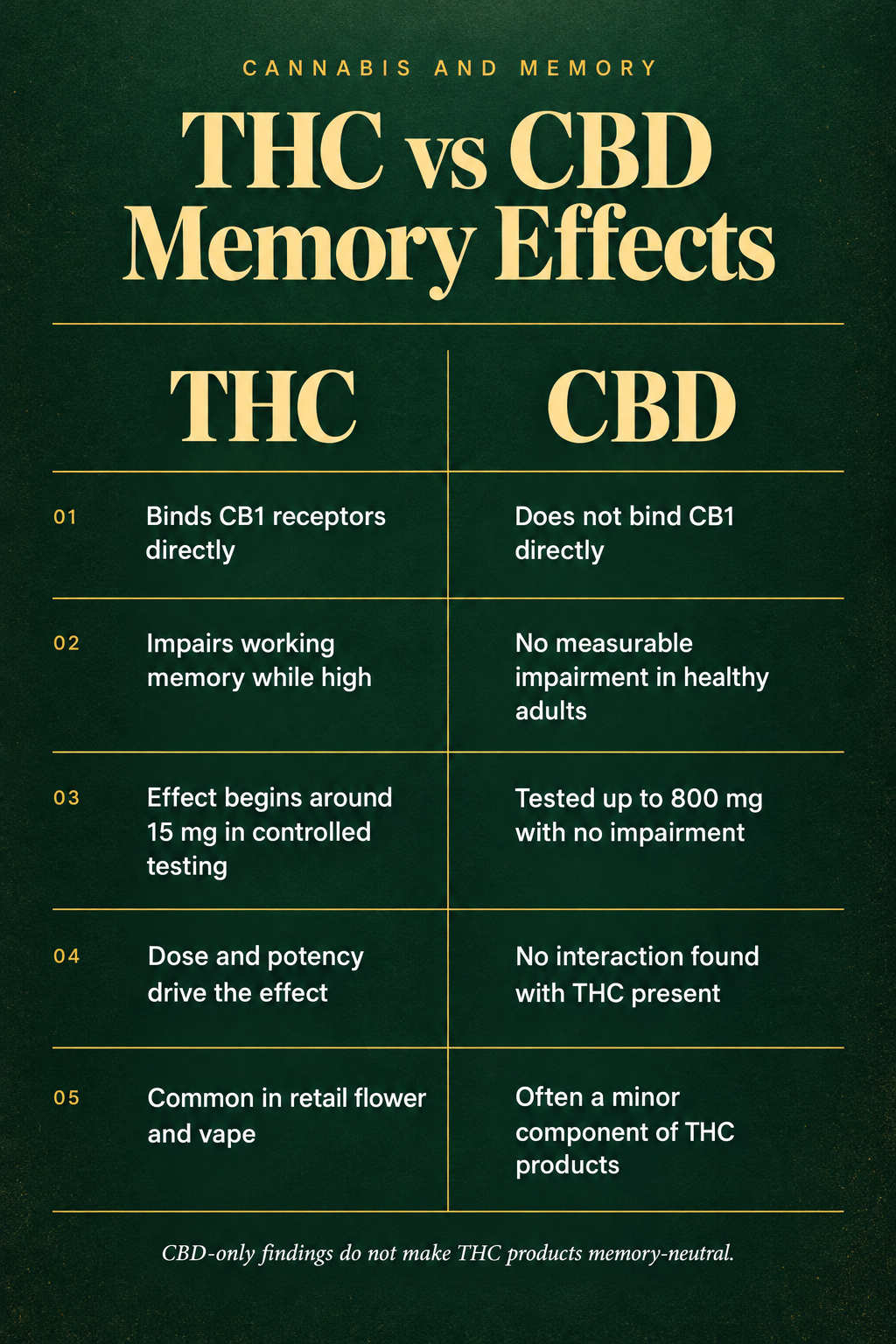
The obvious misread is that a CBD-heavy product is therefore memory-neutral. It is not, because that finding describes CBD alone, and most retail flower and vape products are THC-dominant. A product that pairs both cannabinoids, such as Half Baked Lemonade + Tea | 10mg THC / 10mg CBD | 16oz, still carries THC's acute effects at the dose it contains.
There is also a promising signal that should not be acted on yet. The CBD study noted a trend toward a possible memory-protective effect in adults over 50, with the authors stating the subgroup was tiny, on some measures as few as six participants, and underpowered [10]. A trend in an underpowered subgroup is a hypothesis for the next study, not a reason to buy anything.
What that means for reading a label:
- CBD-only products are a different exposure than THC-dominant ones, and research does not transfer between them.
- Equal THC and CBD content does not cancel the THC effect.
- Potency per serving is the number that matters, not the ratio on its own.
- The National Academies review did not grade CBD as protective for memory [2].
Menu listings such as Love Is All You Need | 10 Pack | Gummies | 100mg Thc | 400mg CBD state THC and CBD content per serving, which is the comparison worth making if potency is what you are tracking.
What Reduces the Memory Effects of Cannabis?
Dose and potency are the levers with the best support. If 7.5 mg did not impair visual working memory in controlled testing where 15 mg did, then consuming less THC should mean less measurable impairment [5]. That is a statement about group averages, not a promise about any individual session.
Tolerance is the most common assumption and the least reliable one. The 2026 study specifically recruited people who used cannabis at least five days a week for at least a year and still found visuospatial working memory impaired at peak intoxication [6]. Habitual exposure changed how impaired they felt more than whether they were impaired.
Feeling clear-headed is a poor instrument for measuring this. In the controlled trial, THC increased mind wandering and reduced metacognitive accuracy about task performance, meaning people were worse at judging how well they were doing while under the influence [5].
Sustained abstinence is the one lever with direct recovery data behind it, from the four-week improvement in the reviewed youth trial [2] to the monitored recovery timeline in young adults [8].
What actually helps, ranked by strength of evidence:
- Lower the dose: the clearest dose-response finding in the literature.
- Lower the potency: stated THC percentage is a better guide than the strain name.
- Choose products with consistent, clearly labeled serving sizes rather than estimating.
- Do not rely on tolerance as a shield, because regular users still test impaired.
- Treat sustained abstinence, not a night off, as the reset that shows up in studies.
Label transparency does the practical work here. Formats such as Pre Ground Flower and menu entries like B.A.M • Flower • 70g that print THC content per gram or per serving let a customer compare instead of guess, which is the difference between choosing a dose and accepting one.
What Else Do People Ask About Cannabis and Memory?
Nearly every remaining question about this topic lands in the same short list, so here are short answers to each.
- Whether any effect is permanent, and for whom.
- How long the fog lasts after stopping.
- Why THC specifically interferes with recall.
- Whether CBD behaves differently from THC.
- Whether older adults or long-time users face a different picture.
Can cannabis affect your memory?
Yes. THC disrupts the hippocampus while a person is high, and controlled studies reliably show impaired working memory and verbal recall during that window. The effect depends on dose and is usually temporary. A 2018 meta-analysis found only small deficits in regular users, and those shrank to non-significance after more than 72 hours without cannabis [1] [3].
How long does weed brain fog last?
Most people clear acute impairment within hours, but residual fuzziness can last days. Pooled data show deficits become statistically non-significant after more than 72 hours of abstinence. Monitored-abstinence studies report verbal learning and memory recovering within one to two weeks, with sustained attention taking closer to three weeks [3] [8].
Does THC cause short term memory loss?
During intoxication, yes. THC reduces activity in hippocampal circuits needed to encode new information, so recent events and newly learned material are hardest to hold. A placebo-controlled trial found 15 mg THC impaired visual working memory while 7.5 mg did not, and the 2026 study found visuospatial working memory impaired while verbal memory stayed intact [5] [6].
Is cannabis memory loss permanent?
For most adults the evidence does not support permanent damage, and deficits largely shrink with abstinence. However, meta-analyses of people with cannabis use disorder still find moderate residual deficits in verbal learning and working memory, and heavy use beginning in adolescence carries the clearest risk of longer-lasting effects [2] [4].
Does CBD affect memory?
CBD alone does not appear to impair memory. Oral CBD at doses up to 800 mg did not significantly impair learning or memory in healthy adults. CBD is not a shield, though, because products containing THC still carry THC's acute effects, and most retail flower and vape products are THC-dominant [10].
Why does cannabis make you forget things?
THC binds CB1 receptors that are dense in the hippocampus and prefrontal cortex, the regions that encode new memories and hold information in mind. Rodent work shows THC disrupts short-term recognition memory through hippocampal protein kinase C signaling, and human testing shows visuospatial working memory selectively impaired at peak intoxication [11] [6].
Does cannabis affect memory differently in older adults?
The picture is milder than expected. In a cohort of adults 50 and older, current frequent users had worse immediate memory than non-users, but delayed and working memory showed no differences, and occasional or past users performed comparably to people who never used [9].
Does tolerance stop the memory effects of cannabis?
Not reliably. People who use cannabis daily can feel less impaired while still showing measurable deficits. A 2026 study of people using cannabis at least five days a week for at least a year still found visuospatial working memory impaired at peak intoxication, and controlled testing found THC also reduced accuracy about one's own task performance [5] [6].
Sources
- National Institute on Drug Abuse (NIDA) — THC binds cannabinoid receptors in the hippocampus and orbitofrontal cortex, bra
- National Academies of Sciences, Engineering, and Medicine — The National Academies concluded there is moderate evidence that acute cannabis
- JAMA Psychiatry (Scott et al.) — Across 69 cross-sectional studies (2,152 cannabis users and 6,575 comparison par
- PubMed (Pilon et al.), Addiction — A meta-analysis of studies in people diagnosed with cannabis use disorder found
- Neuropsychopharmacology (Adam et al.) — In a placebo-controlled, double-blind crossover study with adequate statistical
- Frontiers in Behavioral Neuroscience — In 154 adults tested during peak intoxication on medical-grade cannabis (16.1 pe
- Psychopharmacology (CannTeen study) — Chronic cannabis users performed worse than controls on verbal episodic memory b
- Journal of the International Neuropsychological Society (Medina et al.) — In a toxicology-monitored abstinence study, adolescent and young adult cannabis
- Cannabis (journal), Solomon et al. — Among adults aged 50 and older, current frequent cannabis users had worse immedi
- Journal of Cannabis Research (Springer) — Oral CBD alone, including doses as high as 800 mg, did not significantly impair
- Neuropsychopharmacology (Busquets-Garcia et al.) — In mice, THC specifically disrupted short-term object-recognition memory through
About Treehouse Cannabis
Treehouse Cannabis serves adult-use customers in Rockland County from Nyack, with regular shoppers coming in from Orange and Westchester Counties. Every menu listing states potency and serving information, so you can compare THC and CBD content instead of guessing from a strain name.
Curious about what is actually in a product before you try it? Stop by the shop or browse the Treehouse Cannabis menu, and ask the team to walk you through the labels on anything you are considering.
Cannabis is for adults 21 and older. Keep all cannabis products out of reach of children and pets. This article is educational and is not medical advice. Effects vary by person, product, dose, and frequency of use. If you have questions about how cannabis interacts with a medication or a health condition, talk to a licensed healthcare provider.

Shop our products

Shop All

Deals

Flower

Pre-rolls
Vaporizers

Edibles

Drinks

Concentrates
Tinctures

Topicals

CBD

Pet CBD

Accessories