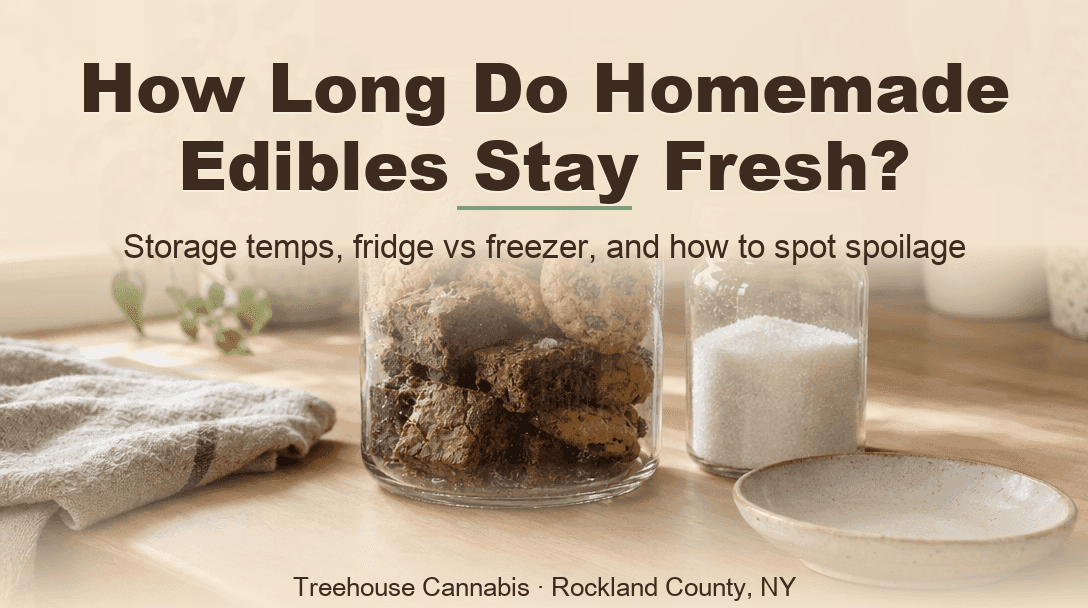
How Long Do Homemade Edibles Stay Fresh?
How Long Do Homemade Edibles Stay Fresh?
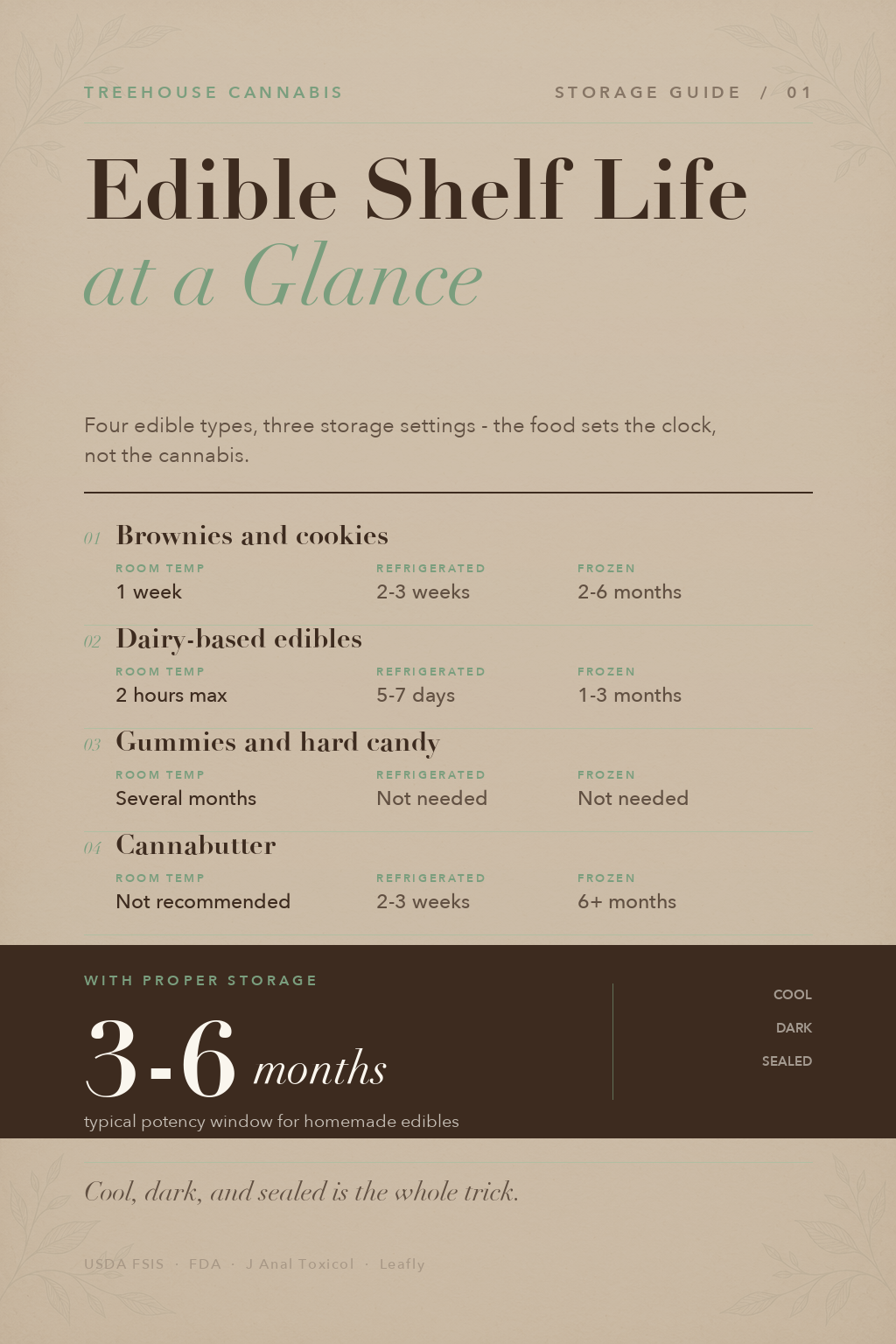
How long do homemade edibles last? Most stay fresh about one week at room temperature and two to three weeks refrigerated, because shelf life follows the base recipe rather than the cannabis. Low-moisture candies keep for months, and frozen baked goods hold quality for two to six months, though food safety runs on a shorter clock.
How Long Do Homemade Edibles Last?
Shelf life is set by the food, not the cannabis. Infusing a recipe with cannabis does not preserve it, so a brownie follows brownie rules and a cheesecake follows cheesecake rules. That single idea explains almost every number below.
Here is the practical range for a typical home batch:
- Baked goods such as brownies and cookies: about one week at room temperature, two to three weeks refrigerated.
- Dairy-based edibles such as cheesecake, pudding, or milk chocolate: five to seven days refrigerated, and no more than two hours at room temperature.
- Gummies and hard candies: measured in months when kept cool and sealed, because their low moisture content works against spoilage.
- Cannabutter: two to three weeks refrigerated, six months or more frozen.
- Infused baked goods in the freezer: two to six months for best quality.
Those windows describe quality, and quality is the shorter clock. Food safety runs on a separate timetable set by federal guidance. Perishable food should not sit above 40 F for more than two hours, and that shrinks to one hour when the room is above 90 F [1]. Refrigerators belong at or below 40 F and freezers at 0 F [2].
Cannabis is not a preservative, which is why the base recipe decides everything [8]. The uncomfortable part is that the two clocks rarely agree. A brownie can look and taste fine on day nine while sitting outside its safe refrigerated window, and it can taste stale on day three while being perfectly safe. When the clocks disagree, the safety clock wins.
One more number is worth keeping in view, because it is the most common source of confusion online. Leftovers that have been cooked and refrigerated are generally at their safest for three to four days [1]. That is stricter than the two-to-three-week figure people quote for refrigerated baked edibles, and the difference is not a contradiction. It reflects how much moisture, dairy, and egg are in the recipe. Knowing which rule your batch falls under is more useful than memorizing one number.
If you are still deciding how much of a batch to make, it helps to understand how long the experience itself runs, which How Long Does a Cannabis High Last by Consumption Method? explains by consumption method.
What Makes Some Edibles Spoil Faster Than Others?
Two variables decide most of it: water activity and acidity. Low-water-activity foods such as cookies, brownies, crackers, and hard candy are lower risk because spoilage organisms need moisture to grow. Low-acid, high-moisture products such as puddings, cheesecakes, custards, and milk-based chocolates need refrigeration and need it quickly [3].
Dairy and egg content matter for the same reason. They raise water activity and add a nutrient base that spoilage organisms use well, which is why a cream-cheese frosted cookie goes bad on a different schedule than a plain shortbread.
The infusion base carries its own risk, and this is the part most home cooks have never heard. A food safety review of cannabis-infused products in Colorado noted that oil, glycerol, or glycol-based infusions sitting in a low-oxygen, low-acid environment can support anaerobic pathogens, including C. botulinum, when the product is not prepared and stored properly [3]. In plain terms: infused oils and butters are not shelf-stable indefinitely just because they started as fat. They still have to be refrigerated and used inside their window.
Environmental factors do the rest of the damage:
- High ambient humidity softens baked goods and speeds mold growth.
- A batch left uncovered dries out on the surface and picks up contaminants from the air.
- Containers or utensils that were not clean going in shorten the batch's life before it even cools.
- Warm storage temperatures accelerate both spoilage and cannabinoid loss.
The food safety side of this is the same whether or not cannabis is involved. That is the practical takeaway: treat an infused batch exactly as you would treat the same recipe without it, and if you are new to the infusion step itself, How to Make Cannabutter: A Beginner-Safe Guide covers the basics of getting the fat clean and fully decarbed before it ever meets a recipe.
For the consumer-side version of these questions, Do Edibles Expire? Potency & Safety Guide walks through how commercial edibles are dated and what those printed windows actually mean.
Do Homemade Edibles Lose Potency Over Time?
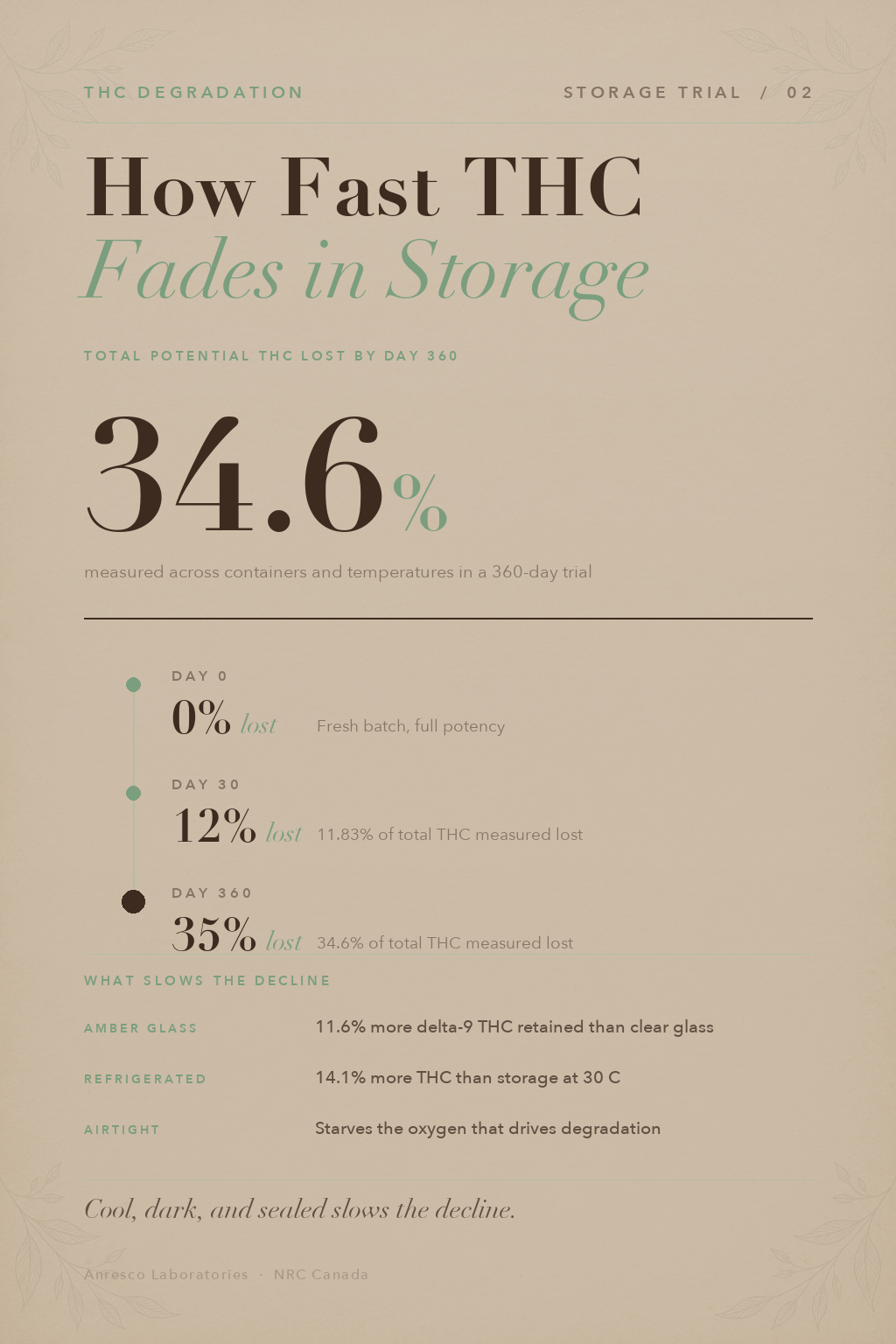
Yes, gradually, and the loss is measurable in a lab. In a 360-day storage trial on cannabis material, total potential THC fell 11.83 percent by day 30 and 34.6 percent by day 360 [5]. Roughly a third of the potency was gone inside a year.
Storage conditions move those numbers substantially. Refrigerated samples held 14.1 percent more THC than samples stored at 30 C, and amber glass retained 11.6 percent more delta-9 THC than clear glass on average [5].
| Storage condition | Approximate effect on THC retention |
|---|---|
| Sealed, amber glass, refrigerated | Highest retention in the trial |
| Sealed, amber glass, room temperature | Moderate loss over months |
| Clear glass, warm room | Fastest decline measured |
| Frozen, airtight | Slows degradation substantially |
The underlying pattern is predictable. Cannabinoid decay follows first-order kinetics, averaging about 2 percent per month at 20 C, and the 85 percent shelf life roughly doubles with every 5 C drop in storage temperature [6]. Cold storage is not a trick, it is arithmetic.
Four levers move the decline, and they compound:
- Temperature: colder storage slows the reaction, with roughly a doubling of shelf life per 5 C drop.
- Light: amber or opaque containers retained more delta-9 THC than clear glass.
- Oxygen: airtight packaging limits the oxidation that drives degradation.
- Time: the loss is gradual and roughly linear at a given temperature, not a sudden cliff.
There is a useful counterpoint, and it is the one that keeps baked goods from being hopeless. In a stability study on prepared brownie test material, baking did not degrade THC or CBD, and the baked brownies were stable at room temperature for at least three months [4]. That is a genuinely encouraging result, and it is also the number most often misread. The study measured cannabinoid stability, not whether the brownie still tasted fresh or stayed safe to eat. A brownie can hold its THC for months while being stale, dry, or past its food safety window.
One caveat applies to every figure in this section. These results come from cannabis material and prepared test material handled in a lab, not from a home kitchen with a hand-mixed batter and an unknown oven. Treat them as directional rather than as a guarantee about your batch. Potency also holds for a typical three to six months with proper storage, which lands in the same range from a different direction [7].
Degradation is not the same thing as elimination, either. How long a dose stays detectable in the body is a separate question from how long a batch stays potent, and How Long Does Weed Stay in Your System? covers that side of the timeline.
How Should You Store Homemade Edibles?
Store them cool, dark, dry, and airtight, in that order of impact. Oxygen speeds THC degradation, so an airtight seal matters more than an attractive jar [7]. Light matters too: amber or opaque glass beat clear glass by 11.6 percent in the storage trial, which is a concrete reason to move the batch off the windowsill [5].
A storage routine that covers all of it:
- Cool the batch completely before sealing it. Trapped steam turns into condensation, and condensation invites mold.
- Divide it into portions you will actually finish. Smaller portions thaw faster and get opened less often.
- Seal each portion in an airtight, opaque container or a well-pressed freezer bag with the air worked out.
- Refrigerate anything perishable within two hours of baking, or within one hour if the room is above 90 F [1].
- Freeze what you will not eat within about two weeks. Freezers belong at 0 F [2].
- Thaw frozen portions overnight in the refrigerator rather than on the counter.
Freezing is the most underused tool here. Properly frozen food stays safe indefinitely, and only its quality declines over time [2]. That means a six-month-old frozen brownie is not a safety gamble, though it may be a texture disappointment. Wrap portions airtight to prevent freezer burn and to keep the batch from absorbing the odors of everything else in the freezer.
Labeling is the step people skip and later regret:
- What is inside, including the flavor or strain if it matters to you.
- Dose per piece, recorded when the batch was made rather than estimated later.
- The date it was made.
- The date it should be finished by, based on the base recipe.
Cannabutter gets the same treatment: airtight, away from light, dated, and refrigerated. If you want a tested, dated alternative to a home batch, the Edibles category lists potency and serving information on every package, which removes the guesswork that home batches always carry.
Temperatures are worth checking rather than assuming. A refrigerator that reads 45 F is not doing the job, and a freezer that cycles above 0 F will cost you quality and shelf life [2].
Do Homemade Edibles Last as Long as Store-Bought Edibles?
No, and the reasons are structural rather than a knock on home cooking. Commercial producers control water activity to a specification, seal or nitrogen-flush the package, add preservatives where the recipe allows, and print a tested expiration date. A home batch uses ordinary kitchen ingredients, gets portioned by hand, and often ends up in a bag on the counter.
| Factor | Homemade | Commercial |
|---|---|---|
| Water activity | Varies batch to batch | Controlled and tested |
| Packaging | Bag, wrap, or household container | Sealed or nitrogen-flushed |
| Preservatives | None unless the recipe includes them | Used where the recipe allows |
| Dating | Whatever you wrote on the lid | Printed, tested expiration date |
| Potency figure | Estimate from your infusion | Lab-tested per batch |
| Typical refrigerated life | Days to a few weeks | Weeks to months |
| Typical frozen life | Two to six months for quality | Often longer, per label |
The potency row is the one that matters most in practice. A commercial label states a tested figure, so a 10 mg gummy is 10 mg within the lab's tolerance. A home estimate depends on how evenly the infusion was mixed and how consistently the batter was portioned, and those two variables can drift more than any storage loss discussed above.
None of that makes homemade edibles a bad idea. It makes them a batch you have to date and track. Three habits close most of the gap:
- Eat them inside the window their base recipe allows rather than the window you hope for.
- Freeze what you will not finish within about two weeks.
- Write the dose on the container while you still remember it.
A tested, dated package is doing that bookkeeping for you. A home batch is only as reliable as the note you wrote on the lid.
If you want a reference point for what a labeled package looks like, Love Is All You Need | 10 Pack | Gummies | 100mg Thc | 400mg CBD is a clear example: the package states the count, the potency per piece, and the CBD content, so nothing about the dose has to be inferred. Gummies in particular tend to hold up well in storage compared to baked goods, and the Gummies Edibles selection shows how those products are categorized.
How Can You Tell if Homemade Edibles Have Gone Bad?
Start with the signs you can actually see and smell:
- Mold in any color, including small spots or fuzzy patches.
- Off, sour, or fermented smells.
- Rancid notes from nuts or butter, which smell like old oil rather than like the ingredient.
- Darkened, greasy-looking, or translucent patches on the surface.
- Sweating, sticky spots, or visible condensation inside the container.
- A stale, flat, or bitter taste that was not there when the batch was fresh.
Mold deserves its own line because of a common misconception. Mold is a sign of spoilage even when the food has been refrigerated, so scraping the visible part off does not make the rest safe [2]. The mold you can see is the fruiting body, not the full extent of the growth.
| Sign | What it usually means |
|---|---|
| Mold, any color | Spoiled, discard the whole portion |
| Sour or fermented smell | Bacterial growth, discard |
| Rancid nut or butter note | Fat oxidation, discard |
| Sweating or sticky surface | Moisture migration, likely microbial growth |
| Stale or flat taste | Quality loss, edible but past its best |
| No change at all | Not proof of safety, check the date |
That last row is the hard part. Foodborne pathogens do not reliably change taste, smell, or appearance, so the date on the container is a better safety signal than the sniff test ever will be. This is why the labeling step in the storage routine is not fussiness.
Discard without tasting when any of these apply:
- The batch is past the safe window for its base recipe.
- It sat out longer than two hours, or one hour above 90 F [1].
- It was refrigerated after sitting out all day.
- You cannot tell when it was made.
- Mold is present anywhere in the container.
Freezing does not rescue a batch that was already unsafe when it went in, and reheating does not reliably fix one either. When in doubt, throw it out. A batch of brownies is cheaper than a bad night.
For storage containers that actually seal and block light, the Storage Containers Accessories selection is a reasonable place to start, and a labeled, dated, airtight container is the single cheapest upgrade to any home batch.
Whether you press your own cannabutter or prefer a tested, dated package, Treehouse Cannabis in Rockland County carries a full menu of lab-tested edibles with clear potency labeling, so you always know what is in the batch and how fresh it is.
What Else Do People Ask About Homemade Edibles?
Most of the remaining questions about homemade edibles come down to a short list, so here are direct answers to each.
- The refrigerated and frozen windows for each edible type.
- How fast THC actually degrades in storage.
- The warning signs that mean a batch is spoiled.
- Whether freezing rescues a batch, and how to thaw it.
- How homemade batches stack up against dated commercial packages.
How long do homemade edibles last?
It depends on the food, not the cannabis. Most homemade baked edibles such as brownies and cookies stay fresh about one week at room temperature and two to three weeks refrigerated. Low-moisture items such as hard candies and gummies last months, and frozen infused baked goods hold quality for two to six months.
Do homemade edibles lose potency over time?
Yes, gradually. Lab storage trials show total potential THC dropping 11.83 percent within the first 30 days and 34.6 percent after 360 days, with degradation speeding up in heat and light. Refrigeration and amber glass slow the loss, and frozen storage slows it further.
How can you tell if homemade edibles have gone bad?
Look for mold in any color, off or sour smells, rancid nut or butter notes, darkened or greasy patches, sweating surfaces, and a stale or flat taste. Mold can grow even in the refrigerator. Because foodborne pathogens do not reliably change taste or smell, discard anything kept past its safe window instead of testing it.
Can you freeze homemade edibles?
Yes. A freezer held at 0 F keeps food safe indefinitely, and only quality declines over time. Wrap portions airtight to prevent freezer burn and odor transfer, then thaw overnight in the refrigerator rather than on the counter. Freezing does not rescue a batch that was already unsafe.
How long does homemade cannabutter last?
Refrigerated cannabutter is typically good for two to three weeks, and frozen it holds quality for six months or longer. Store it airtight and away from light, and label it with the date. Infused fats are not shelf-stable indefinitely just because they started as butter.
Do homemade edibles last as long as store-bought edibles?
Usually not. Commercial producers control water activity, use sealed or nitrogen-flushed packaging, add preservatives where the recipe allows, and print a tested expiration date. A home batch uses ordinary kitchen ingredients and is portioned by hand, so it generally spoils faster and should be dated and eaten inside its base recipe window.
What is the best way to store homemade edibles?
Cool, dark, dry, and airtight. Use opaque or amber containers, refrigerate anything perishable within two hours of baking, freeze what you will not finish within about two weeks, and label every container with the contents, dose per piece, and the date it was made.
Sources
- USDA Food Safety and Inspection Service — Refrigerate leftovers at 40 F or below or freeze at 0 F as soon as possible, nev
- U.S. Food and Drug Administration — Keep refrigerators at or below 40 F and freezers at 0 F, follow the two-hour rul
- National Library of Medicine (PubMed Central) — Edible food safety risk tracks water activity and acidity -- low-water-activity
- Journal of Analytical Toxicology (National Library of Medicine) — Baking did not degrade THC or CBD in brownie test material, ten commercial brown
- Anresco Laboratories — In a 360-day storage trial, total potential THC fell 11.83% by day 30 and 34.6%
- National Research Council of Canada — Cannabinoid decay follows first-order kinetics, average THCA plus THC degradatio
- Leafly — Infusing food with cannabis does not change that food's shelf life, potency usua
- Emily Kyle Nutrition — Cannabis is not a preservative, so shelf life depends on the food itself: baked
About Treehouse Cannabis
Treehouse Cannabis serves adult-use customers in Rockland County, with regular shoppers coming in from Orange and Westchester Counties. Every menu listing states potency and serving information, so you can compare THC and CBD content instead of guessing from a product name.
Questions about how a batch was made, how it should be stored, or what the label means? Stop by the shop or browse the Treehouse Cannabis menu, and ask the team to walk you through anything you are considering.
Cannabis is for adults 21 and older. Keep all cannabis products out of reach of children and pets. This article is educational and is not medical advice. Effects vary by person, product, dose, and frequency of use. If you have questions about how cannabis interacts with a medication or a health condition, talk to a licensed healthcare provider.


Shop our products

Shop All

Deals

Flower

Pre-rolls
Vaporizers

Edibles
Drinks

Concentrates
Tinctures

Topicals

CBD

Pet CBD

Accessories