Cannabis Seeds: What Legal Shoppers Should Know
Cannabis Seeds: What Legal Shoppers Should Know
New York lets adults 21 and older buy cannabis seeds from licensed retailers and grow a small number of plants at home. Federal law is a separate question, and it does not turn on the word seed. It turns on the THC concentration of the plant the seed came from, and that test gets stricter at the end of 2026.
This guide covers both layers, then the parts that actually decide whether a purchase works out: which seed type to buy, what the label should tell you, how long seed keeps, and how to start plants without blowing past the plant limit.
Are Cannabis Seeds Legal in New York?
Yes, for adults 21 and older, through the licensed channel. New York's home cultivation rules let consumers buy seeds or immature plants from an adult-use retail dispensary, a microbusiness, or a registered organization with dispensing [4]. From there, the state's cap is three mature and three immature plants per person, with a ceiling of six mature and six immature at any private residence [3] [11] [5].
Federal law answers a different question. The Agriculture Improvement Act of 2018 authorized hemp production and removed hemp and hemp seed from the DEA's schedule of controlled substances [1]. What it did not do is make the word seed the deciding term. Hemp is defined by THC concentration, so the same seed can be hemp or marijuana depending on the plant it came from.
That distinction got sharper. P.L. 119-37 rewrote the definition around a 0.3% total THC standard that counts THCA, and it expressly excludes viable seed from a cannabis plant above that concentration from the definition of hemp. Those seeds fall back under the Controlled Substances Act as marijuana [2]. Most of the new definition takes effect December 11, 2026, after the delay in P.L. 119-103 [2].
The four points that matter to a shopper:
- New York authorizes seed and immature plant sales to adults 21 and older through licensed adult-use channels [4].
- The 2018 farm bill removed hemp and hemp seed from the controlled-substances schedule [1].
- From December 11, 2026, viable seed from a plant above 0.3% total THC is excluded from the federal hemp definition [2].
- Growing at home is legal in New York, but selling or bartering what you grow is not [3].
Two things that federal change does not do. It does not repeal New York's home cultivation law, and it does not make a licensed New York seed sale illegal. It changes how the federal government classifies the seed, which matters most when seed crosses state lines. Possession limits at home are a separate calculation from the plant count, and How Much Cannabis Can You Legally Possess in New York? lays out the numbers.
The honest summary: state law authorizes the purchase, federal law still hinges on the plant's chemistry, and the gap between the two narrows on December 11, 2026.
Where Can You Legally Buy Cannabis Seeds?
New York names three licensed channels. Adult-use retail dispensaries are the obvious one. Microbusinesses and registered organizations with dispensing are the other two, and all three may sell seeds and immature plants to customers 21 and older [4].
Stocking is voluntary, and it is inconsistent. A shop that carries flower, edibles, and vapes is not required to carry seed, so the practical move is a phone call before the drive. Ask whether they have seed in stock, what type it is, and whether they can hold a pack.
What the state does and does not require at the counter:
- Seeds are not required to pass safety testing the way cannabis flower is [4].
- Pesticides must still be disclosed on the label [4].
- A safety insert is provided at the point of sale [4].
- Only licensed adult-use retailers, microbusinesses, and registered organizations with dispensing are inside this channel [4].
The line worth drawing is at unlicensed seed banks and out-of-state mail order. Those sit outside the regulated channel entirely, and after December 11, 2026 viable seed from a high-THC plant is no longer hemp for federal purposes [2]. That makes cross-state shipping a different risk category than walking into a licensed shop.
The household math and the storage obligations that come with a home grow are spelled out in New York Home Grow Rules: Plants, Storage, and Household Limits. If you would rather shop from home, New York Cannabis Delivery Rules: What Shoppers Should Know explains how licensed delivery works in New York, though the state's seed guidance is written around the retail sale itself.
Most customers treat seed as the long game. The flower counter is where the visit still happens, and B.A.M • Flower • 70g is a reasonable place to start while a garden gets going. If you are new to what you are actually looking at once a plant finishes, What Is Cannabis Flower? A Beginner’s Guide covers the basics of flower.
What Is the Difference Between Regular, Feminized, and Autoflower Seeds?
Three labels, three different breeding outcomes, and only one of them is about light. Regular seed is untreated, so it produces roughly half male and half female plants [6]. Feminized seed comes from a female plant that was induced to produce male flowers and pollinate itself, typically with an ethylene inhibitor such as silver thiosulfate, which pushes the offspring overwhelmingly female [8]. Autoflower seed carries photoperiod insensitivity, so those plants flower on their own schedule instead of waiting for the shorter days of late summer [9].
| Type | How it is made | What you usually get | Male risk |
|---|---|---|---|
| Regular | Untreated, open pollination | About half male, half female | High, by design |
| Feminized | Female plant treated with an ethylene inhibitor such as silver thiosulfate, then self-pollinated | Overwhelmingly female | Low, not zero |
| Autoflower | Recessive photoperiod-insensitivity allele at the Autoflower1 locus | Overwhelmingly female, flowers on its own timeline | Low, not zero |
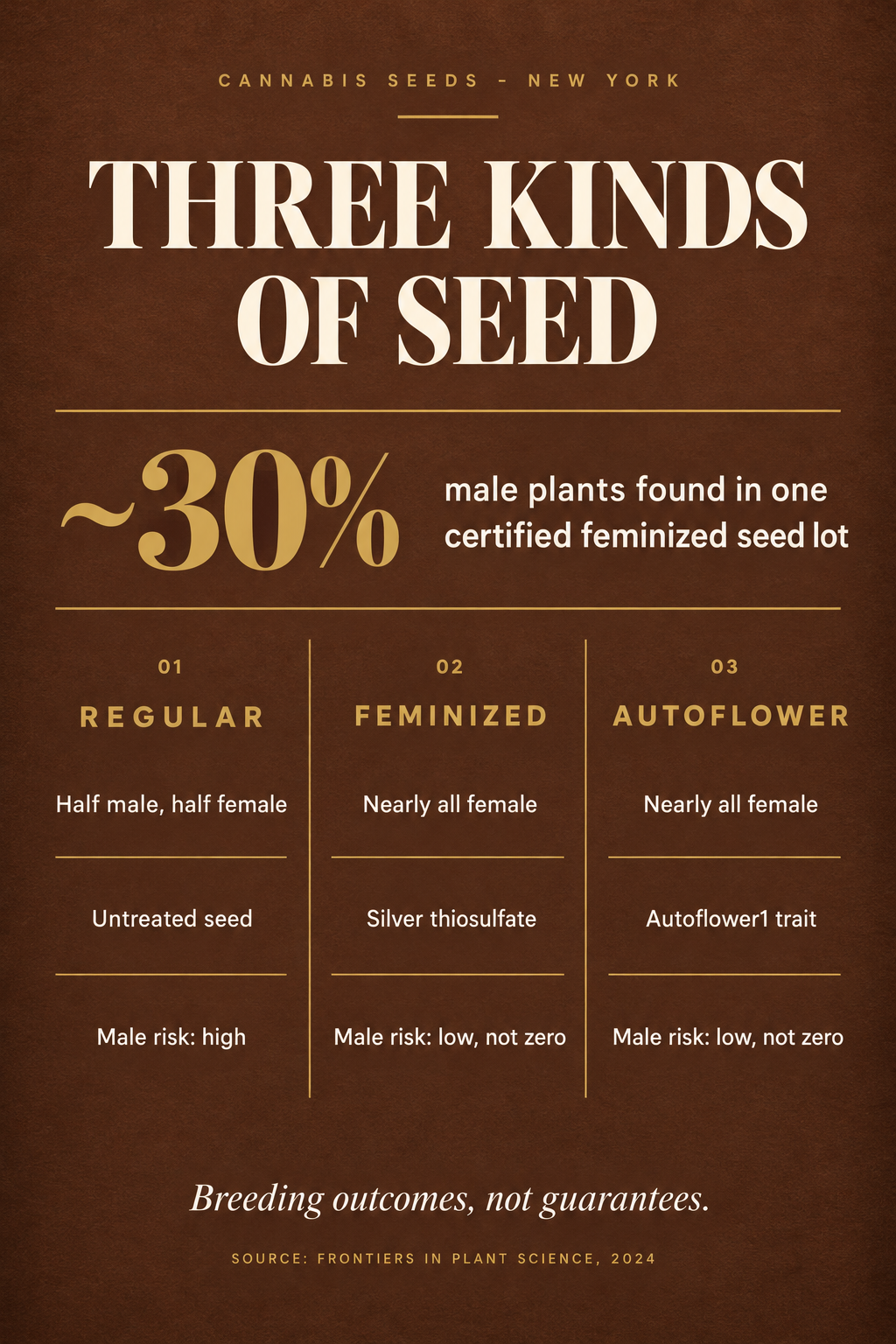
The part sellers tend to skip is that none of these is a guarantee. The feminizing method is well understood but not foolproof, and one documented commercial lot sold as certified feminized seed produced roughly 30% male plants. Those males cross-pollinated the crop and cut its THC [8]. That is not a hypothetical edge case; it is a documented failure of a labeled product.
Autoflower carries its own caveat. Photoperiod insensitivity behaves as a recessive allele at a single major locus called Autoflower1, which was introgressed from high-latitude cannabis populations, and some commercially marketed autoflower populations still segregate for the trait rather than breeding true [9]. In practice, not every seed in a pack behaves the same way, and a pack that is not fully stabilized can throw plants that keep waiting for a light change.
What to take from all of this:
- Regular seed is the cheapest way to get both sexes, and the male half is the cost of doing business [6].
- Feminized seed raises the odds substantially but does not remove the need to check for male flowers [8].
- Autoflower seed shortens the schedule, which helps a small indoor grow, but the trait can still segregate within a pack [9].
- Whichever you buy, plan for at least one plant that does not behave the way the label promised.
Light changes drive photoperiod plants, which is one reason outdoor growers time their season carefully. Where cannabis may legally be used is a separate set of rules, covered in Where Can You Legally Use Cannabis in New York?.
What Should You Check on a Seed Label Before You Buy?
Start with the panel the state requires. Pesticide disclosure belongs on a cannabis seed label, and a safety insert comes with the sale [4]. That is the only label content New York mandates for seed, so everything else is a seller's choice. The absence of a field is not proof of a problem, but it is worth asking about.
Beyond the required panel, these are the fields a grower actually needs:
- The cultivar name, plus whether the pack is regular, feminized, or autoflower [8].
- A lot or batch identifier, so a pack that underperforms is traceable to something.
- A packaged or harvest date, because how long the seed has already sat changes the storage math entirely [7].
- The seed count in the package, since price per seed is the number that compares across brands.
- How the shop has held the seed since delivery, which no label will tell you.
That last one is the question worth asking out loud. A shop with a warm back room can undo a perfect storage specification in a month, and the label will still read correctly [7]. Ask whether seed is kept cool and dry, and how long the current pack has been on the shelf.
Treat any claimed germination percentage as a seller's claim, not a tested guarantee. For feminized and autoflower lines, expect variation within a single pack even when the label is accurate [8] [9]. A pack is a population, not a promise.
Seed shopping in person is also a conversation, and some customers would rather keep the visit short. If that is you, the New York Wants Weed T-Shirt is a small piece of New York cannabis culture to take home while the real shopping gets done.
How Long Do Cannabis Seeds Last, and How Should You Store Them?
Years, if the seed is dry and cold. Weeks, if it is warm and damp. The research on hemp seed makes the gap unusually clear, and the same physiology applies to cannabis seed generally.
The measured results:
- Seed held at 4 to 10 degrees Celsius with 6% to 8% moisture germinated 81% to 90% after 24 months [7].
- Seed dried to about 6% moisture and kept at room temperature still reached 89% germination and 94% viability after two years [7].
- Seed at 14% moisture held at 25 degrees Celsius had a safe storage window of roughly 2.8 weeks [7].
- Older work cited in the same review kept original viability for 15 years at 5.7% to 8.3% moisture and minus 10 to 10 degrees Celsius [7].
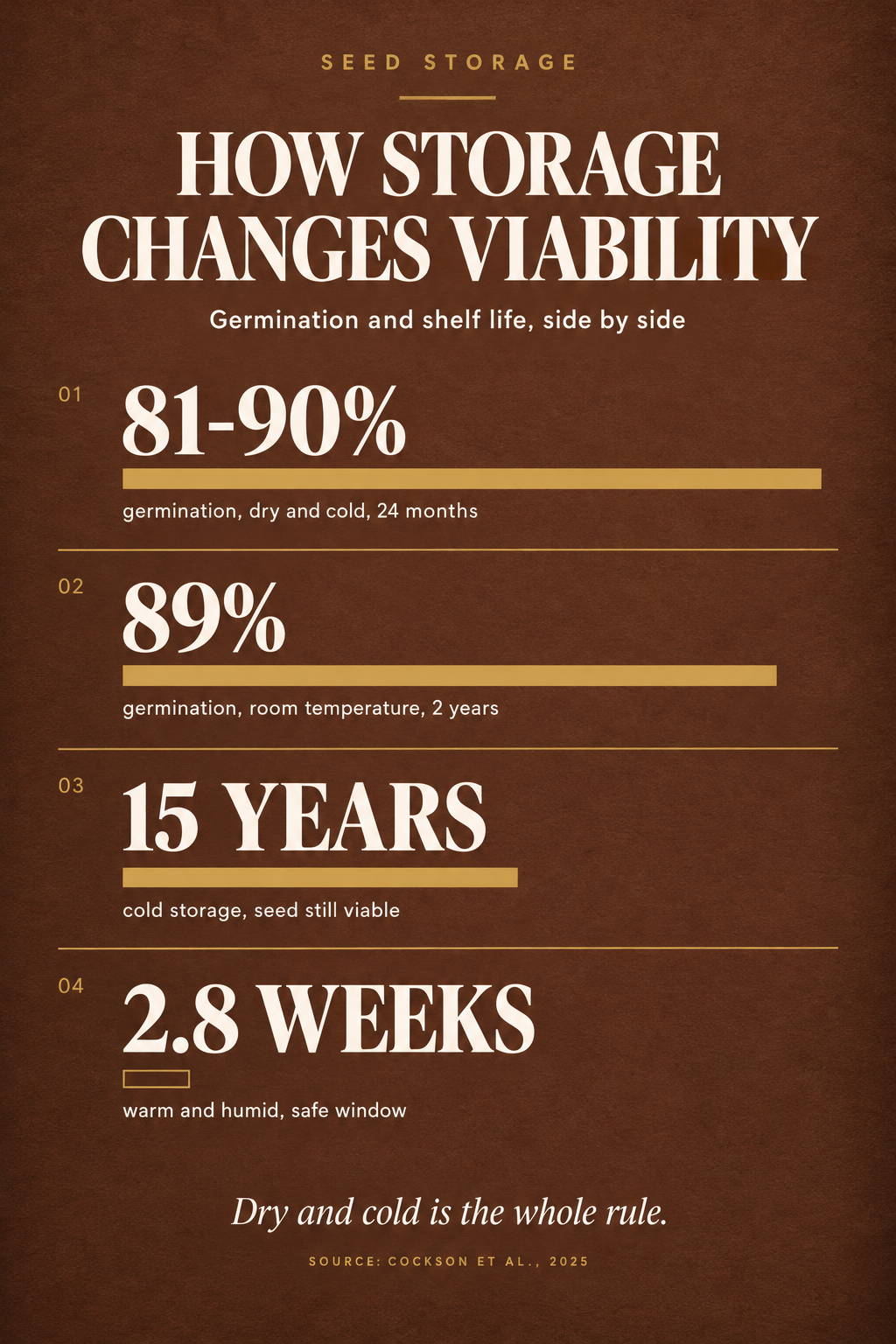
Read those four lines together and the rule falls out. Moisture is the variable that decides everything, and temperature is the multiplier. At 6% to 8% moisture, seed survives years at room temperature and far longer in a refrigerator. At 14% moisture, a warm shelf turns a viable pack into dead seed in under a month.
Those figures come from hemp seed trials, not from a high-THC cannabis study, so treat them as the best available proxy rather than a cannabis-specific guarantee [7]. The direction of the effect is not in doubt.
The practice, in order:
- Dry first. Seed that goes into a container damp is already losing time, and freezing damp seed damages tissue [7].
- Then cold and dark. A refrigerator holds temperature stable, and light exposure is easy to eliminate.
- Airtight with a desiccant pack keeps moisture from creeping back in.
- Label the container with the cultivar and the date it went in, so a two-year-old pack is identifiable later.
- Let a refrigerated container come to room temperature before opening it, or condensation lands directly on the seed.
For the container itself, Storage Containers Accessories is where the airtight options live. If you would rather not improvise with a kitchen jar, Black | Slim Pen 510 Vape Battery is one option off the accessory shelf.
How Can You Tell Male From Female Cannabis Plants?
You cannot tell before flowering, and that is the part most new growers get wrong. Cannabis is naturally dioecious, meaning separate male and female plants, and the two are visually indistinguishable through vegetative growth [6]. No leaf shape, node spacing, or early height difference reliably sexes a plant.
Sex becomes visible at the nodes once flowering begins. Female plants develop paired bracts with two stigmas, which is where the buds form. Males form clustered pollen sacs that open and release pollen [6].
Two facts should shape the plan:
- A genetically female plant can spontaneously produce viable male flowers under environmental stress, which is why a feminized pack can still surprise you [6].
- Pollen does not linger long but travels far: viability stays above 75% for only a few days and falls below 10% by day nine [6].
- There is no known separation distance that fully eliminates wind pollination [6].
- Only female plants count toward New York's plant limit [4].
- A plant grown from seed that turns out male may be replaced with an additional immature plant [4].
That last pair is the practical relief. A male is not a legal problem and not a lost plant count. It is a plant you remove and replace, which is exactly why germinating in waves beats starting a whole pack at once.
If you want a comparison point for what a finished female plant should look like, Flower is where the current harvest sits.
How Do You Germinate Cannabis Seeds Within New York's Plant Limits?
Germination is mostly a moisture problem, and the seed is built to make it harder. The outer pericarp is a physical barrier, and in low-germinating seed lots, removing it improved final germination by roughly 38% compared with intact seed [10]. The germination substrate and moisture level also strongly affected how many seedlings developed normally [10]. You are not going to scarify a retail pack, but the finding tells you where the leverage is: water management, not luck.
Most viable seed cracks and shows a root tip within three to ten days when kept warm, dark, and evenly moist. Waterlogged media is the common failure, because a submerged embryo cannot get oxygen. Damp but not soaked, and warm but not hot, is the whole target.
Then the limit math, which is where a legal home grow actually goes wrong:
- Three mature and three immature plants per person [11].
- Six mature and six immature plants per private residence, regardless of how many adults live there [11].
- Cultivation is limited to the grower's private residence [11].
- Up to five pounds of cannabis may be lawfully possessed at home [11].
- Plants must be secured from anyone under 21, and cannabis odor must not become a nuisance [3].
- Selling, trading, or bartering homegrown cannabis is prohibited [3].
The limit counts plants, not seeds. That single sentence prevents most of the trouble. A ten-pack germinated on one tray can put a two-adult household over the per-residence cap within two weeks, and immature plants count too [11]. Start a few, confirm they are female, and stagger the next round.
For shoppers in Rockland, Orange, or Westchester County, Treehouse Cannabis carries the flower, pre-rolls, and accessories that go with a legal home grow, and our team can point you to the licensed channels authorized to sell seed. Seed stocking varies by retailer, so confirm availability before you make the trip.
Frequently Asked Questions
These are the questions that come up most often before a first seed purchase.
Are cannabis seeds legal in New York?
Yes, for adults 21 and older. New York lets consumers buy seeds or immature plants from licensed adult-use dispensaries, microbusinesses, and registered organizations, then grow up to three mature and three immature plants per person, with a six and six cap per household. Selling or bartering homegrown cannabis is still illegal.
Where can I legally buy cannabis seeds?
In New York, licensed adult-use retail dispensaries, microbusinesses, and registered organizations with dispensing may sell seeds and immature plants to adults 21 and older. Call ahead, because not every shop stocks them. Unlicensed online seed banks and out-of-state mail order sit outside that regulated channel.
How long do cannabis seeds last?
Kept cool and dry, cannabis seed holds up well. Research on hemp seed found 81% to 90% germination after 24 months at 4 to 10 degrees Celsius with 6% to 8% moisture, and 89% germination after two years at room temperature when seed moisture stayed near 6%. Warm, humid storage shortens that window sharply.
How should I store cannabis seeds?
Keep them dark, dry, and cool. A sealed airtight container in a refrigerator, with a desiccant pack, holds moisture low and temperature stable. Avoid the freezer unless the seed is properly dried, since ice crystals damage tissue. Let refrigerated seeds reach room temperature before opening the container to prevent condensation.
What is the difference between feminized, regular, and autoflower seeds?
Regular seed produces roughly half male and half female plants. Feminized seed comes from a female plant induced to produce male flowers, so nearly all offspring are female. Autoflower seed carries a recessive photoperiod-insensitivity trait, so plants flower on a timeline instead of waiting for the shorter days of late summer.
Do cannabis seeds count toward my plant limit?
No. New York counts plants, not seeds, and only female plants count toward the limit. Plants are immature from germination through the vegetative stage and become mature once buds and flowers are visible. If a plant grown from seed turns out male, the rules let you start an additional immature plant to replace it.
How long does it take cannabis seeds to germinate?
Most viable cannabis seeds crack and show a root tip within three to ten days when kept warm, dark, and evenly moist. Cooler conditions slow the process. Seeds that have not germinated after about two weeks are usually non-viable, or they were kept too wet, which suffocates the embryo.
Can I buy cannabis seeds online?
It depends on where the seller is licensed and what they ship. New York's regulated channel is licensed retailers and registered organizations inside the state. Federally, hemp seed is legal, but viable seed from plants exceeding 0.3% total THC is excluded from the hemp definition under the 2026 federal change, so cross-state cannabis seed sales carry real legal risk.
Sources
- U.S. Department of Agriculture — The Agriculture Improvement Act of 2018 authorized hemp production and removed h
- Congressional Research Service (Library of Congress) — P.L. 119-37 rewrote the hemp definition around a 0.3% total THC standard that in
- New York State Office of Cannabis Management — New York adults 21 and older may cultivate up to six plants at home for personal
- New York State Office of Cannabis Management — Adult-use consumers 21 and older may purchase seeds or immature plants from an a
- New York State Office of Cannabis Management — Home cultivation became legal for New York adults 21 and older with a three matu
- Oregon State University Extension Service — Cannabis is naturally dioecious with separate male and female plants that are vi
- Agrosystems, Geosciences & Environment (Cockson et al., University of Kentucky) — Hemp seed stored at 4 to 10 degrees Celsius with 6% to 8% moisture germinated 81
- Frontiers in Plant Science (Timoteo Junior & Oswald) — Feminized cannabis seed is produced by applying an ethylene inhibitor such as si
- Frontiers in Plant Science (Toth et al., Cornell University) — Photoperiod insensitivity, the trait marketed as autoflower, behaves as a recess
- Crops (MDPI), University of Kentucky — The cannabis seed's outer pericarp is a physical barrier to germination: removin
- New York State Senate (Penal Law, Article 222) — New York statute caps personal cultivation at three mature and three immature ca
About Treehouse Cannabis
Treehouse Cannabis serves adult-use customers in Rockland County from Nyack, with regular shoppers coming in from Orange and Westchester Counties. Every menu listing states potency and product type, so you can compare what you are buying instead of guessing from a name.
Shopping for a home grow and not sure what goes with it? Stop by the shop or browse the Treehouse Cannabis menu, and ask the team to walk you through the labels on anything you are considering.
Cannabis is for adults 21 and older. Keep all cannabis products away from children and pets. This article is educational and is not medical advice. Do not drive or operate machinery while impaired.

Shop our products

Shop All

Deals

Flower
Pre-rolls
Vaporizers

Edibles
Drinks

Concentrates
Tinctures

Topicals

CBD

Pet CBD

Accessories