Cannabis and Reggae: A Cultural History Beyond the Stereotypes
Cannabis and Reggae: A Cultural History Beyond the Stereotypes
Cannabis and reggae are linked through Rastafari, not through the music alone. Ganja reached Jamaica with indentured laborers from India in the mid-19th century, Rastafari communities made it a sacrament in the 1940s while being prosecuted for it, and Jamaican musicians carried it from coded ska instrumentals to open roots reggae anthems. [2] [4]
The dates matter more than the mood. Cannabis arrived in the mid-19th century, Jamaica prohibited it in 1913, a mandatory minimum sentence for ganja offenses followed in 1941, and possession of small amounts was not decriminalized until 15 April 2015. [2] [1]
Two corrections belong at the top. Not every Rastafari smokes, and not every reggae artist is Rastafari. Jamaica also decriminalized two ounces or less in 2015; it did not legalize cannabis. [5] [1]
What follows is the sequence in the order it actually happened: the plant, the law, the faith, and then the recordings.
How Are Cannabis and Reggae Actually Connected?
The link runs through Rastafari practice, with the music acting as a carrier rather than the cause. Ganja was already embedded in Jamaican working-class life before Rastafari emerged, and the movement gave an existing plant a sacramental meaning. [2]
The popular version merges three separate things into one image.
- The plant arrived first, with Indian indentured labor, and spread through plantation and urban working-class life.
- Rastafari gave it sacramental meaning under persecution, in a movement that took shape in the 1930s.
- The music encoded it in instrumental titles, then named it outright, then exported it.
- The international market reduced all three to a logo.
Rastafari emerged in Jamaica roughly a century after the plant arrived, which is the detail most retellings skip. [2] Adherents and scholars describe ganja as a sacrament used in reasoning and groundation. That framing belongs to them, not to this article, and it is not a claim about medicine. [5]
The practice is specific rather than generic. In reasoning sessions participants smoke and work through moral and social questions, passing the herb clockwise around the circle, while groundation ceremonies combine singing, dancing, feasting, and smoking. Adherents cite biblical passages as authorization for the practice and describe smoking as their communion. [5] [2] Described from outside, that is a liturgy with rules, not a consumption habit.
The three strands also moved at different speeds. The plant traveled through labor and trade, slowly. The sacrament took shape inside a religious community that was being raided, prosecuted, and evicted. The recordings moved fastest, because a song can cross a border in a way that a plant cannot.
The causal claim has to stay narrow. Recordings carried the association between cannabis and reggae; the plant did not produce the music, unlock creativity, or improve anyone's playing. A wider version of that story, outside Jamaica, is traced in Cannabis and Music Culture: From Jazz Clubs to Modern Festivals.
Did Rastafari Bring Ganja to Jamaica?
No. East Indian indentured laborers brought both the plant and the word ganja to Jamaica in the mid-19th century, roughly a century before Rastafari emerged in the 1930s. [5]
The etymology is the giveaway. Ganja is a Hindi term derived from Sanskrit, which places the plant's Jamaican vocabulary in post-emancipation labor migration rather than in an African or Ethiopian origin story. [5]
Ganja entered working-class life as tea, as a rum-based preparation, and as smoke, first among plantation workers and then in towns. It was a commonplace of Jamaican life long before it became a controversy. [2]
- 1840s and 1850s: indentured labor from India arrives after emancipation.
- Ganja enters Jamaican working-class life as tea, tonic, and smoke.
- 1913: prohibition arrives, decades before the religion does.
- 1930s: Rastafari emerges and inherits the plant.
Sources disagree on the arrival year. Some point to the 1840s, others to 1854, which is why mid-19th century is the honest formulation rather than a single fixed date. [2] What is not in dispute is the direction of travel: Rastafari inherited an existing plant and smoking culture rather than importing one.
Two things make the myth easy to keep. The faith and the plant were both present in the same rural parishes by the 1930s, and the sacrament gave the plant a public meaning it had not carried before. [2] The sequence still runs arrival first, prohibition second, faith third.
Regional comparison helps here. New York's own cannabis sequence ran through a different set of labor and legal pressures, which The History of Cannabis in New York sets out, and the American version, from colonial cash crop to controlled substance, is covered in USA Cannabis History: From Colonial Cash Crop to Controlled Substance. The Jamaican pattern is distinct: arrival through indenture, prohibition before the faith, sacrament after the law.
Why Did Jamaica Outlaw the Plant Rastafari Called a Sacrament?
The prohibition came before the faith and was then enforced against it. Jamaica's Opium Act of 1913 and Dangerous Drug Act of 1924 predated Rastafari by roughly two decades. [2]
The escalation followed the movement. A 1941 mandatory minimum sentence for ganja offenses is read by scholars as a response to Rastafari's growing influence rather than to any documented change in consumption. [2]
Leonard Howell's Pinnacle commune shows the pattern in one place. Police had arrested Howell and 27 Rastas on cultivation charges by 1941, raided the community again in 1954, and saw it evicted by 1956. [2]
- 1913 Opium Act and 1924 Dangerous Drug Act predate Rastafari.
- 1941 mandatory minimum follows the movement's growth.
- Pinnacle raided in 1941, again in 1954, evicted by 1956.
- Coral Gardens, 11-13 April 1963.
- 4 April 2017: formal apology in Parliament.
Coral Gardens is the event the timeline turns on. From 11 to 13 April 1963, after a fatal confrontation near Montego Bay, police and military detained Rastafarians across the island, beat many of them, and forcibly cut locks. [7]
The counts vary between accounts, and that disagreement should be stated rather than smoothed over. Roughly 150 to 160 people were directly affected, and the Daily Gleaner of 14 April 1963 reported eight dead in the initial violence. [7]
The official narrative of 1963 and the Rastafari account differ on what triggered the operation and on how many people died. Named scholarship reads the period through the Youth Black Faith and the state's fear of an organized, self-governing Black community. That argument belongs to Chevannes and to the scholars who follow him, not to this article. [2]
On 4 April 2017 the government apologized in Parliament and offered compensation. [7] The American legal thread, which followed its own logic, is traced separately in The History and Evolution of Cannabis Laws in the U.S..
How Did Ganja Get Into Jamaican Music, From Ska to Roots Reggae?
Ganja entered Jamaican music through coded ska instrumentals, then open rocksteady vocals, then roots reggae anthems that traveled internationally. A ganja tune is a song dealing wholly or predominantly with cannabis consumption, cultivation, or distribution, and the form has been analyzed mainly in Jamaican roots reggae of the 1970s and 1980s. [6]
The recordings moved from coded to open over roughly two decades.
- Ska, 1964: coded instrumental titles legible only to insiders.
- Rocksteady: the first open ganja vocals.
- Roots reggae, 1970s: the ganja anthem goes international.
- Dancehall: the reference becomes routine.
- 2010s: Reggae Revival reverence versus dancehall reportage.
In 1964 Tommy McCook recorded "Good Collie Bud" and Don Drummond cut "Cool Smoke", instrumentals whose titles carried their meaning past anyone who was not listening for it. [4]
Hopeton Lewis's "Cool Collie" is probably the earliest rocksteady vocal to address ganja directly, a judgment the music press hedges rather than settles. King Stitt's "Herbsman Shuffle" was among the first talking records made in Jamaica. [4]
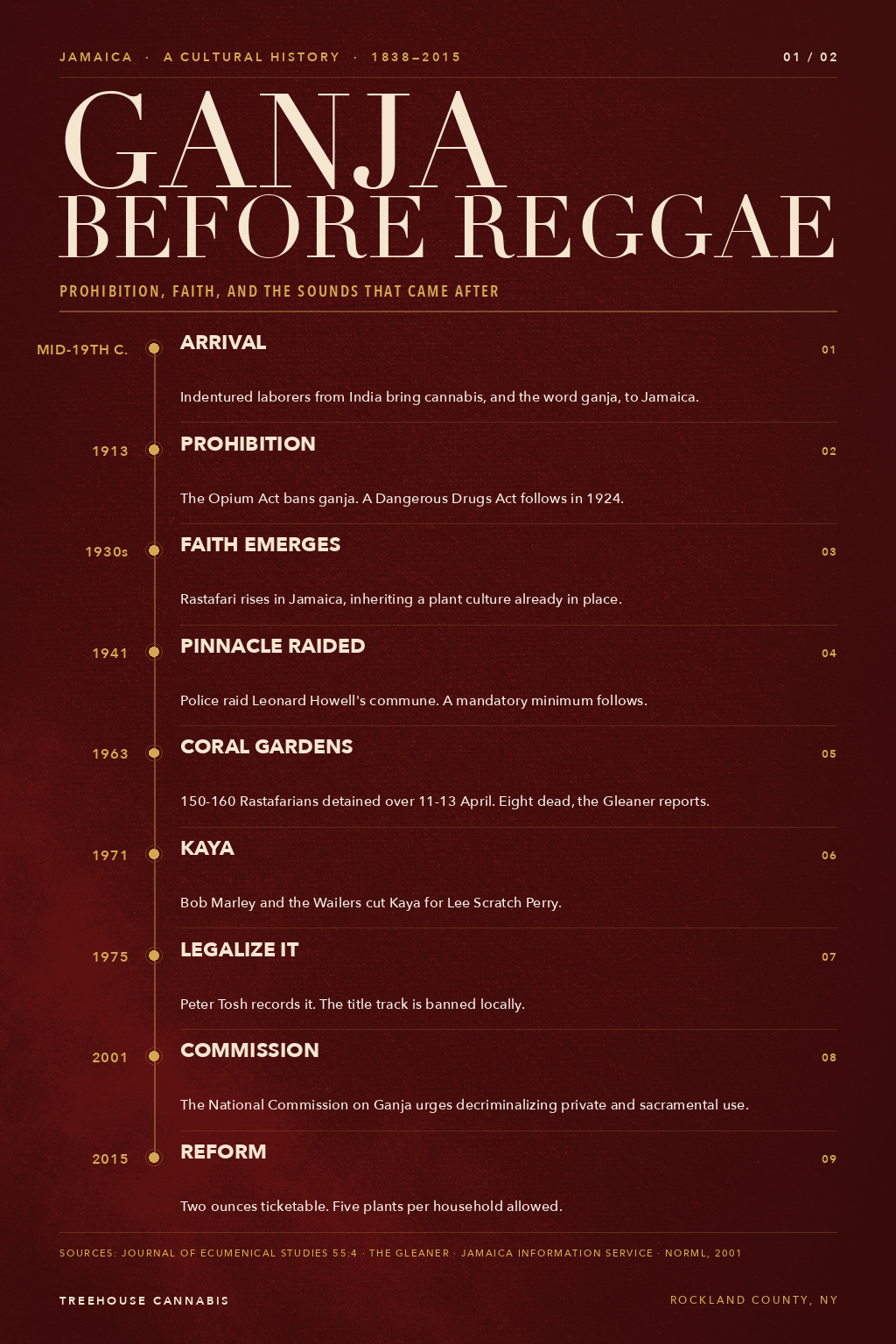
Bob Marley and the Wailers cut "Kaya" in 1971 for Lee Scratch Perry, and adapted Richie Havens's "Indian Ropeman" as "African Herbman". [4] Dancehall extended the thread: Wayne Smith's "Under Mi Sleng Teng" drew on Barrington Levy's "Under Mi Sensi", and by the 2010s the field had split between Reggae Revival reverence and dancehall's more graphic framing. [4]
The analytical point is structural rather than anecdotal. These songs carried arguments about criminalization, racism, and denied rights. They were not simply entertainment about a party. [6]
Ganja anthems also traveled with the music itself, through touring and record distribution, which is why the association hardened abroad faster than it did at home. [4]
The plant those records described is now sold under regulation in New York, and readers who want to browse legally can start with Small Buds Flower, which collects smaller-format flower.
Why Was Peter Tosh's Legalize It Banned in Jamaica?
The album's title track was banned locally when first released, with Jamaican radio and customs suppressing copies. It was written as a direct response to police targeting of Tosh for ganja use and as a political argument for legalization. [4]
The dating is worth fixing, because it circulates wrongly. The track was recorded in 1975 and released in 1976, in the same decade that produced "Kaya". [4]
- Written against police targeting of Tosh for ganja.
- Recorded 1975, released 1976.
- Banned locally on release, with radio and customs suppression.
- Adopted abroad as the movement's anthem.
- Jamaica decriminalized small amounts in 2015, not legalized.
The irony is structural. Suppression at home amplified the song abroad, where it became the defining cannabis-legalization anthem of reggae. [4] Legalization did not arrive for another four decades, and even then only partially.
The ban also shows how enforcement reached beyond people. Radio play was withheld and customs intercepted copies, so a record could be treated as contraband in the same period when simple possession still carried prison terms of three to five years under earlier statutes. [4] [8]
Tosh was making a political argument, not drafting a statute. The temptation to turn him into a policy expert should be resisted. [5]
Retail rules arrived on their own schedule, and New York's licensed market now sells ground flower alongside whole. Pre Ground Flower lists pre-ground options.
What Did Jamaica's 2015 Cannabis Law Actually Change?
The Dangerous Drugs (Amendment) Act, in force from 15 April 2015, decriminalized possession of two ounces or less and created narrow sacramental and medical pathways. It did not legalize cannabis. [1]
What changed:
- Two ounces or less became ticketable and non-arrestable, with no criminal record and a J$500 fixed penalty payable within 30 days.
- Households may cultivate up to five plants.
- A Cannabis Licensing Authority was created for medical, therapeutic, scientific, and hemp activity.
- Rastafari aged 18 or over may apply for authorization to cultivate sacramentally, and may smoke at locations registered as places of Rastafarian worship.
What did not change:
- Public smoking remains prohibited, including within five metres of a public place.
- Sacramental ganja may not be sold or exported.
- Possession above two ounces remains a criminal offense.
- Production and sale for general use remain regulated.
| What the 2015 amendment changed | What it left in place |
|---|---|
| Possession of 2 oz or less no longer arrestable; J$500 ticket, no record | Possession above 2 oz remains criminal, with a possible conviction |
| Up to five plants per household may be cultivated | Public smoking and smoking within five metres of a public place prohibited |
| Rastafari 18+ may apply to cultivate and smoke sacramentally at registered places of worship | Sacramental ganja may not be sold or exported |
| A Cannabis Licensing Authority regulates medical, therapeutic, scientific, and hemp activity | Production and sale for general use remain regulated, not legalized |
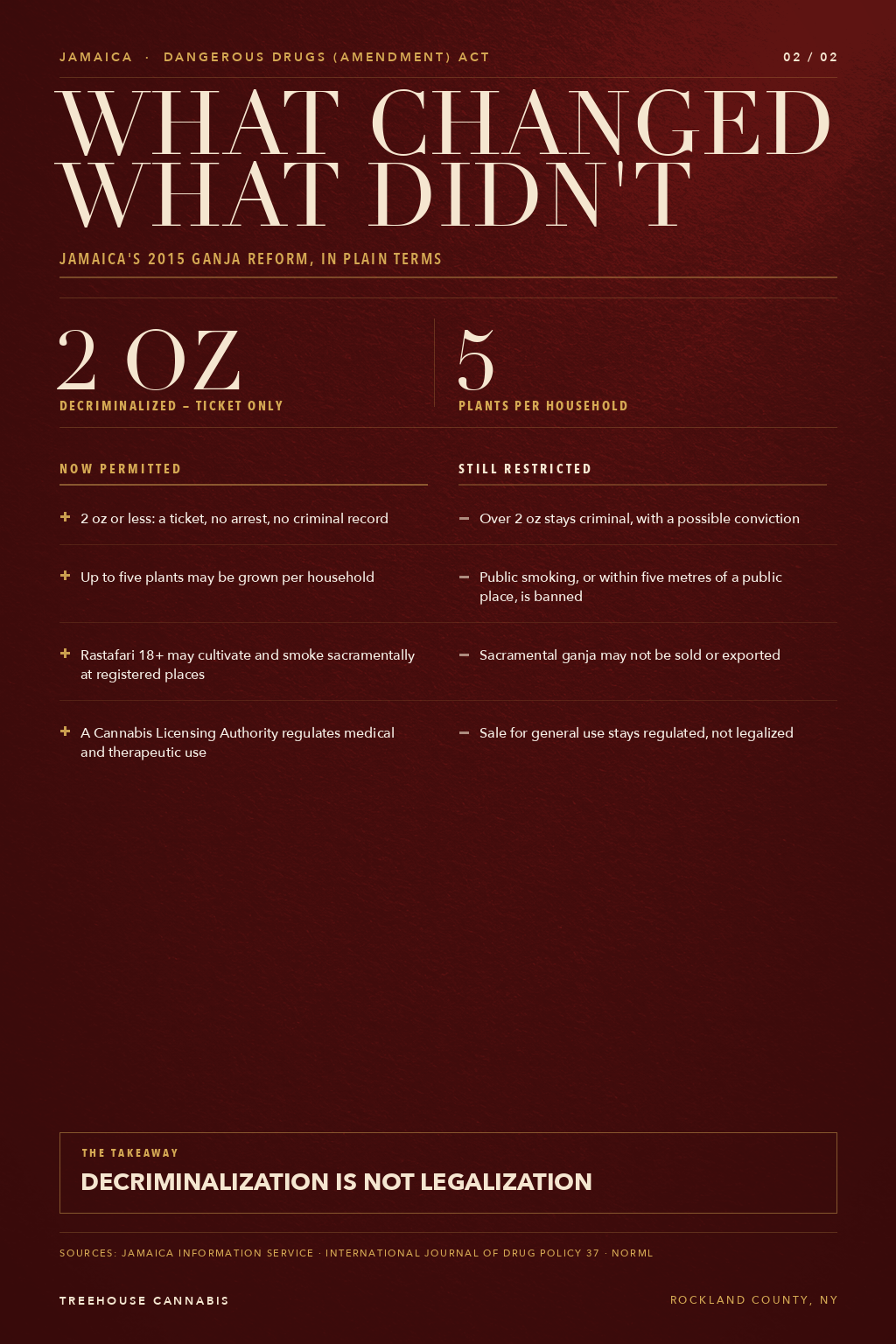
The peer-reviewed assessment is that this made Jamaica the first country in the Western hemisphere to allow cannabis use for sacramental purposes. [8] Many Rastafari read the licensing requirement as another encounter with Babylon, a reading that belongs to them and is not adjudicated here. [2]
New York sells the same plant under a different rulebook, and Whole Flower Flower covers whole-format flower for customers comparing formats.
Which Stereotypes Does This History Actually Correct?
Five corrections stand out: Rastafari did not bring ganja to Jamaica, not every Rastafari smokes, not every reggae artist is Rastafari, ganja did not create the music, and Jamaica did not legalize cannabis in 2015.
- Rastafari did not bring ganja to Jamaica; indentured labor did.
- Not every Rastafari smokes; practice varies by person and community.
- Not every reggae artist is Rastafari.
- The plant did not create the music.
- Decriminalization is not legalization.
The shorthand has a history of its own. Ganja anthems were a genuine export success, Bob Marley's international rise in the 1970s carried the association worldwide, and the imagery was easy to market. [4]
The 2001 National Commission on Ganja, chaired by Barry Chevannes, found that wider acceptance outside poor neighborhoods arrived only with Marley and other reggae bands in the 1960s and 1970s, and described ganja's standing as culturally entrenched. [3] That is a finding about reception, not about causation, and it should not be stretched into one.
The cost of the shorthand is compression. It flattens a music that also carried anti-colonial politics, spiritual longing, and dancehall's street reportage, and it turns a prosecuted religious practice into a tourist cliche.
Infused formats sit alongside flower on a legal menu. Infused Buds Flower covers flower that has been infused rather than simply trimmed, and one example from the current menu is B.A.M • Flower • 70g.
Reading the sources critically means noticing who is speaking. Statute and government releases describe what the law permits. Peer-reviewed policy work describes implementation and its gaps. Rastafari accounts describe what those rules felt like from inside a persecuted community. The three are not interchangeable, and a good history keeps them separate.
What Questions Do Readers Ask About Cannabis and Reggae?
The questions below come up most often, and short answers follow each one.
Did Rastafari bring cannabis to Jamaica?
No. Indentured laborers from India brought the plant and the word ganja in the mid-19th century, roughly a century before Rastafari emerged in the 1930s. [5]
What is the real connection between cannabis and reggae?
The link runs through Rastafari practice. Many Rastafari treat ganja as a sacrament used in reasoning and groundation, and musicians carried that practice into ska, rocksteady, roots reggae, and dancehall. [2] [4]
Do all Rastafari smoke cannabis?
No. Ganja is central to the practice of many Rastafari, but the movement has never been uniform and use varies by individual and community. [5]
Why was Peter Tosh's Legalize It banned in Jamaica?
The title track was banned locally when first released, and radio and customs suppressed copies. It was written against police targeting of Tosh for ganja use. [4]
What changed in Jamaica in 2015?
The Dangerous Drugs (Amendment) Act made possession of two ounces or less ticketable with no criminal record, allowed five plants per household, kept public smoking illegal, and created a sacramental pathway at registered places of worship. [1]
Is cannabis fully legal in Jamaica now?
No. Jamaica decriminalized small amounts and created licensing for medical and sacramental activity. It did not legalize production, sale, or export for general use. [8]
What was the Coral Gardens incident?
Over 11-13 April 1963, police and military detained Rastafarians across the island, beat many, and forcibly cut locks. Roughly 150 to 160 people were affected, and the government apologized in Parliament on 4 April 2017. [7]
Why do people assume reggae is all about weed?
Because ganja anthems were a real export success, Marley's 1970s rise carried the association worldwide, and the imagery was easy to sell. That shorthand flattens a much wider body of music. [6]
Quick answers:
- The plant arrived before the faith and before the genre.
- Prohibition arrived in 1913, before both.
- The music moved from coded instrumentals to open anthems.
- 2015 was decriminalization, not legalization.
Sources
- Jamaica Information Service (Government of Jamaica) — The Dangerous Drugs (Amendment) Act 2015, in force from 15 April 2015, made poss
- Journal of Ecumenical Studies (Randy R. Goldson), vol. 55 no. 4, pp. 569-594 — Peer-reviewed history arguing that Jamaican anti-cannabis law predated Rastafari
- NORML — In 2001 a government-appointed National Commission on Ganja chaired by Universit
- Red Bull Music Academy Daily (David Katz) — Traces the ganja record from covert ska-era instrumentals with coded titles, thr
- Leafly (Lisa Rough) — Explains that East Indian indentured labourers brought cannabis to Jamaica after
- BASSCOMESAVEME (Big Breeze, Jena) — Defines the 'ganja tune' as a song dealing completely or predominantly with cann
- The Gleaner (Paul H. Williams) — Recounts the Coral Gardens incident of 11-13 April 1963, when Jamaican police an
- International Journal of Drug Policy (S. Davenport and B. Pardo), vol. 37, pp. 60-69 — Peer-reviewed policy review finding that Jamaica's 2015 amendment decriminalised
About Treehouse Cannabis
Treehouse Cannabis is a licensed adult-use dispensary serving Rockland County and the surrounding Hudson Valley. Our team answers questions about New York's rules in store, and the menu is open to customers 21 and older with valid ID.
- A licensed adult-use dispensary, not a medical provider.
- A menu open to customers 21 and older with valid photo ID.
- Staff on hand in store for questions about New York's cannabis rules.
Cannabis history is often retold as a mood rather than a sequence of events. Reading it in order, with dates and sources attached, is more useful and more interesting. If you are browsing for yourself, our B.A.M • Flower • 70g and Tropicana Cookies Diamond Infused | Pre-Rolls | 5 pack selections are a sensible starting point, and staff can walk you through what is currently available.
Cannabis is for adults 21 and older. Keep all cannabis products out of reach of children and pets, and do not drive or operate machinery under the influence. This article is educational and is not medical advice.

Shop our products

Shop All

Deals
Flower

Pre-rolls
Vaporizers
Edibles
Drinks

Concentrates
Tinctures

Topicals

CBD

Pet CBD
Accessories