
CBG vs CBD: How the Cannabinoids Compare
CBG vs CBD: How the Cannabinoids Compare
What the science actually says about cannabigerol and cannabidiol — origin, receptors, effects, and when each one is worth trying.
What Is CBG and How Is It Different From CBD?
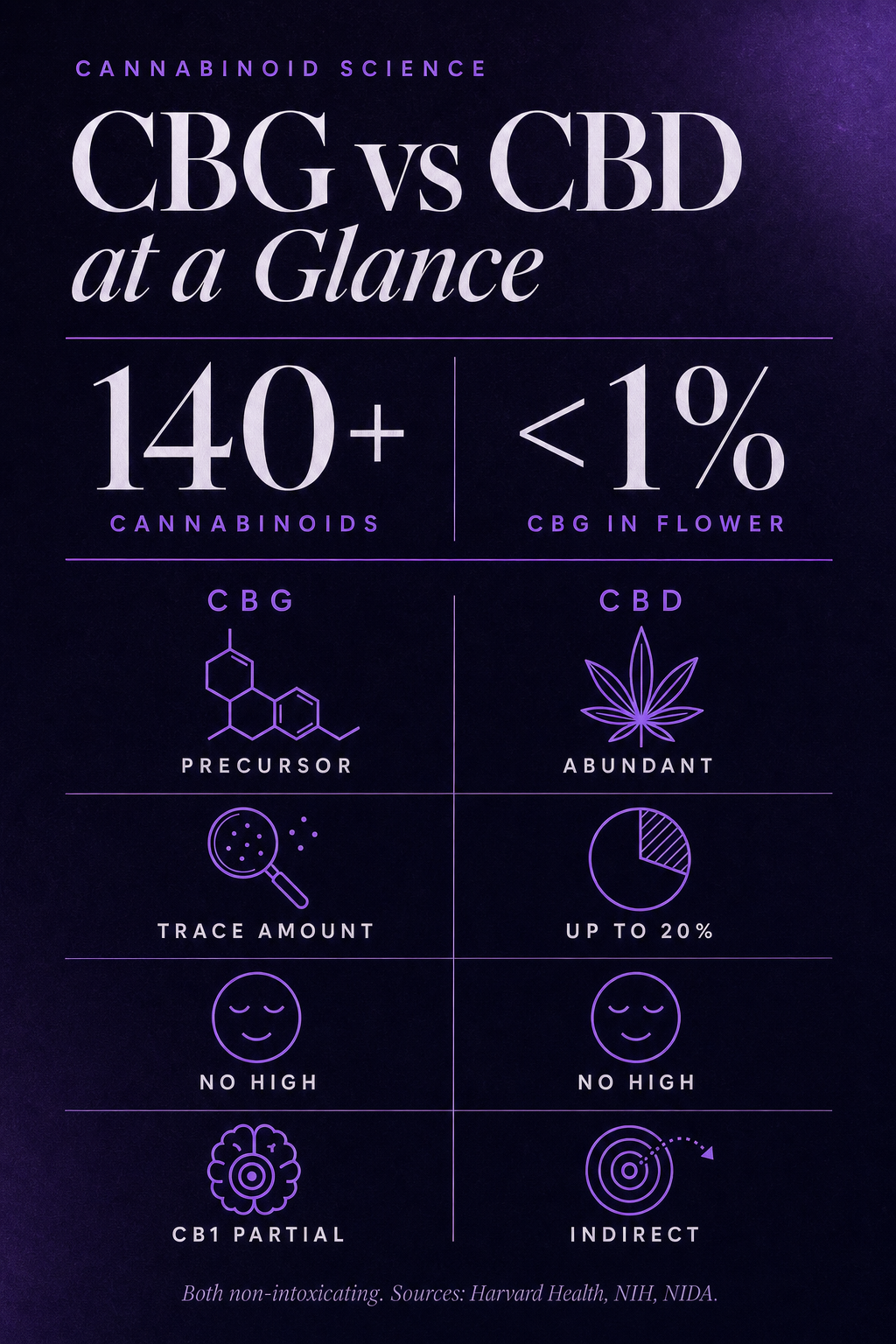
CBG vs CBD comes down to origin, receptor activity, and the depth of human evidence behind each. Both are non-intoxicating cannabinoids found in Cannabis sativa [1], but CBG is the biosynthetic precursor the plant uses to produce CBD, THC, and CBC as it matures [3], which is why mature flower usually contains only trace CBG while CBD runs far more abundant.
That origin story is the single most useful fact in any cbg vs cbd comparison. Because mature flower has already converted most of its CBGA into other cannabinoids, dried cannabis typically contains less than 1 percent CBG by dry weight, while a CBD-rich chemovar can run 20 percent or higher [8]. CBG is therefore classified as a minor cannabinoid, and CBG-forward products are usually more expensive to produce than CBD-forward ones.
A few shorthand distinctions help before going deeper:
- Both molecules are non-intoxicating on their own and will not produce a high without THC present.
- CBD is the dominant cannabinoid in most modern hemp chemovars and is sold in nearly every product category.
- CBG is a minor cannabinoid that usually requires early harvesting or specialized breeding to extract in meaningful quantities.
- The two engage the endocannabinoid system in fundamentally different ways, which is the focus of the next section.
How Do CBG and CBD Interact With the Endocannabinoid System?
The endocannabinoid system is the body's network of CB1 and CB2 receptors, the endocannabinoids that activate them, and the enzymes that break those endocannabinoids down. CBG and CBD engage this network in fundamentally different ways, and that is where most of the cbg vs cbd confusion comes from.
CBD is what pharmacologists call an indirect modulator. It does not bind strongly to either CB1 or CB2 receptors [2]. Instead, CBD influences enzymes such as FAAH that break down the endocannabinoid anandamide, and engages targets like the serotonin 5-HT1A receptor. The practical effect is that CBD changes the signaling environment rather than switching receptors on directly.
CBG behaves more like a classic cannabinoid ligand. It acts as a partial agonist at both CB1 and CB2, and it also engages alpha-2 adrenoceptors and several TRP channels [4]. Researchers describe CBG's pharmacology as sitting between THC and CBD at the cannabinoid receptors — close enough to interact with them, weak enough not to trigger the THC high [5].
For a deeper primer on how THC and CBD map onto the same receptor system, the Treehouse guide How THC and CBD Work walks through the receptor-level mechanics in plain language. The takeaway for customers is that CBD works by reshaping the signaling environment, while CBG works by tapping the receptor system more directly — just without the psychoactive punch THC delivers.
A quick map of the receptor targets each cannabinoid engages:
- CBG: Partial agonist at CB1 and CB2; also engages alpha-2 adrenoceptors and TRP channels (TRPV1, TRPV2, TRPA1).
- CBD: Weak or no binding at CB1 and CB2; modulates FAAH to slow anandamide breakdown; engages 5-HT1A serotonin receptors.
- Both: Bind too weakly at CB1 to trigger the THC high, so neither produces an intoxicating effect on its own.
- Result: CBD changes the signaling environment; CBG taps the receptor system more directly, just without the psychoactive punch.
What Are the Effects and Benefits of CBG vs CBD?
The cbg effects vs cbd effects conversation is really a story about two very different evidence bases. CBD has substantially more human data behind it, including randomized controlled trials for generalized anxiety, social anxiety, certain pediatric epilepsy syndromes, and a growing body of work on inflammation and sleep. CBG, by contrast, has a younger human literature but a more novel preclinical signal.
Preclinical work on CBG is genuinely interesting. Animal and immune-cell studies have shown notable anti-inflammatory activity through non-cannabinoid pathways, including TRP channels and PPAR-gamma signaling in immune and epithelial tissues [5]. Early controlled studies reported that cannabinol and cannabigerol both reduce intraocular pressure by roughly 1.5 to 3.0 mm Hg [7], which is why CBG still shows up in research on ocular hypertension and glaucoma management.
Human evidence is finally catching up. A 2025 seven-day randomized clinical trial evaluated CBG at a 100 mg daily oral dose and found the dose well tolerated, with a mild increase in self-reported appetite [6]. That is the first short-term human safety and tolerability dataset for oral CBG in adults, and it is a meaningful step beyond preclinical models.
Side-by-side, the evidence picture across the most common use cases looks like this:
| Use case | CBG | CBD |
|---|---|---|
| Best-documented human evidence | Short-term safety and tolerability (2025 seven-day trial); early intraocular pressure studies | Randomized controlled trials for anxiety, social anxiety, and certain pediatric epilepsy syndromes |
| Anxiety | Preclinical anti-anxiety activity through 5-HT1A pathways; not yet studied in large human trials | Multiple randomized controlled studies for generalized and social anxiety |
| Inflammation | Notable preclinical activity via TRP channels and PPAR-gamma signaling | Larger published human evidence base overall, including NSAID-comparison studies |
| Intraocular pressure | Early controlled human and animal studies showing roughly 1.5–3.0 mm Hg reductions | Less studied for this specific endpoint |
| Nausea | Enhanced CBD's anti-nausea effect in preclinical rat models | Used clinically for treatment-resistant nausea in some contexts |
| Typical flower concentration | Less than 1% by dry weight (minor cannabinoid) | Up to 20%+ in CBD-rich chemovars |
A balanced summary looks like this:
- Best human evidence: CBD wins on anxiety, certain epilepsy syndromes, and overall anti-inflammatory work.
- Most novel preclinical signal: CBG on COX and TRP channel pathways, intraocular pressure, and MRSA antibacterial activity.
- Where the data is thinnest: head-to-head CBG vs CBD comparisons in humans — those trials barely exist.
- Where both already show up: full-spectrum products that intentionally combine the two cannabinoids.
Can CBG or CBD Get You High on Their Own?
Neither CBG nor CBD produces an intoxicating high when isolated and used by themselves. Both bind too weakly at the CB1 receptor to trigger the psychotropic effect associated with THC [8], which is exactly why both are sold as non-intoxicating and why CBG-dominant hemp products are legal under the same federal framework as CBD.
The interesting wrinkle is what happens when THC enters the picture. If a product contains THC alongside CBG or CBD, the THC will still produce psychoactive effects, and neither cannabinoid reliably cancels that out. Full-spectrum CBD products may slightly modulate how intense the THC high feels through the entourage effect, but they do not eliminate it. That matters for adult-use customers deciding between an isolate CBD tincture and a balanced 1:1:1 THC:CBG:CBD gummy — the isolate will feel like nothing at all on the CB1 receptor, while the balanced edible will feel like a normal THC edible with a softer comedown rather than a fundamentally different high.
For readers curious about the cultural side of how cannabis intoxication has been portrayed over the decades, the Treehouse piece Cannabis in the Movies: How Film Changed the Story traces the on-screen story of the cannabis high from Reefer Madness through modern film. The biology and the mythology have not always agreed.
Key facts on whether CBG or CBD can get you high:
- Both bind too weakly at the CB1 receptor to trigger the psychotropic effect associated with THC.
- Both are sold legally as non-intoxicating cannabinoids under the same federal hemp framework.
- If a product contains THC alongside CBG or CBD, the THC will still produce psychoactive effects.
- Neither CBG nor CBD reliably cancels out the THC high, though full-spectrum CBD may soften the perceived intensity.
- An isolate CBG or isolate CBD product will feel like nothing at all on the CB1 receptor.
Do CBG and CBD Work Better Together Than Alone?
This is the entourage-effect hypothesis applied to minor cannabinoids, and the preclinical signal is genuinely interesting. Rat studies have shown CBG can enhance CBD's anti-nausea effects, and the two cannabinoids engage overlapping but distinct receptor sets — CBG leans into CB1/CB2 partial agonism while CBD leans into FAAH inhibition and 5-HT1A modulation [4]. That is the mechanistic case for combining them.
Human trials directly testing CBG plus CBD combinations are still early, so the practical answer for now is that the combination looks promising mechanistically but is not yet proven in controlled clinical trials. The product world has already moved ahead of the literature: balanced 1:1:1 THC:CBG:CBD gummies, 2:1:1 ratios, and daytime chews that combine all three cannabinoids are common on dispensary menus precisely because customers are asking for them.
For readers who want the broader context on how cannabinoids and the aromatic compounds in cannabis interact, the Treehouse primer A Guide to Terpenes and Their Effects covers the terpene side of the entourage equation, and the deep dive on What Is Terpinene in Cannabis? An Educational Overview shows how a single terpene like terpinene can shape the perceived character of a product. The honest summary is that the entourage effect is real enough to design products around, but rigorous human data on specific cannabinoid pairings is still catching up.
Why combining CBG and CBD is the leading theory:
- Preclinical rat studies show CBG can enhance CBD's anti-nausea effects.
- The two engage overlapping but distinct receptor targets, which is the mechanistic case for pairing them.
- Product formats like 1:1:1 THC:CBG:CBD gummies and 2:1:1 ratios are already on dispensary menus.
- Rigorous human trials on CBG plus CBD combinations are still early; the practical answer is mechanistically promising, not yet clinically proven.
How Do You Choose Between CBG and CBD Products?
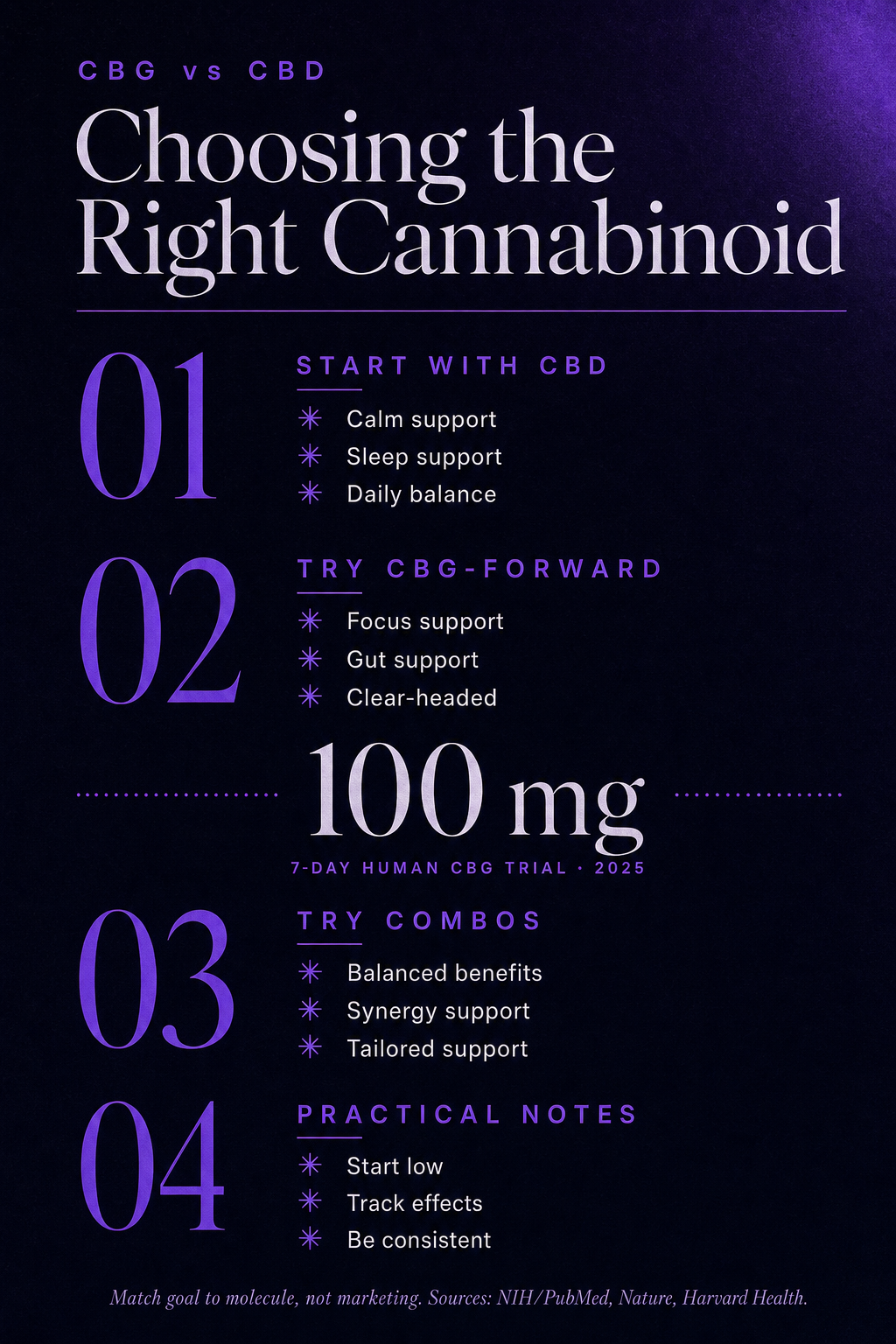
Start by matching the cannabinoid to the goal you actually have, not to the marketing copy. If anxiety or general stress support is the priority, CBD has the deeper human evidence record and is the more defensible first pick. If you have already tried CBD and want to explore a complementary mechanism, a daytime CBG-forward chew or a low-dose CBG:CBD gummy is a reasonable next step. If inflammation is the focus, both have preclinical data — CBD has more published human work overall, CBG has the more novel COX and TRP channel signal.
Practical availability shapes the choice as much as the science does. CBD is in nearly every product category — tinctures, capsules, topicals, flower, and vapes — so customers who want flexibility can find it almost anywhere. CBG is mostly concentrated in Wild berry x Shishkaberry Live Resin | Gummies | 10 Pack | 100mg like gummies, chews, mints, and chocolates, with a smaller selection of Mango Gelato x Strawberry Kush | Disposable Live Resin Vape | 1g such as disposables, and a more limited range of High Dose "UP" | Tincture | 1000MG. That means CBG products tend to land in edible form more often than in flower or vape form.
For customers ready to explore a combination product, the Wild Berry x Shishkaberry Live Resin gummy at Wild berry x Shishkaberry Live Resin | Gummies | 10 Pack | 100mg is a good example of the kind of edible that pulls multiple cannabinoids into one dose, and the broader Edibles category covers most of the edible formats where CBG shows up.
A practical decision rubric:
- Pick CBD first if you want the deepest human evidence record, the widest product selection, and clear daytime clarity without sedation.
- Pick CBG-forward blends if you have already explored CBD and want a complementary receptor mechanism, or if inflammation through a novel pathway interests you.
- Pick a combination product if you want both mechanisms in a single dose and your dispensary stocks balanced THC:CBG:CBD gummies or chews.
- Always check the certificate of analysis for the actual CBG and CBD content by milligram, not just the front-of-pack claims.
Frequently Asked Questions
What is the main difference between CBG and CBD?
Both are non-intoxicating cannabinoids in Cannabis sativa, but CBG is actually the biosynthetic precursor the plant uses to produce CBD and THC as it matures, which is why mature flower contains only trace amounts of CBG (often less than 1%) while CBD tends to be much more abundant, and why CBG products are usually more expensive to produce.
Does CBG get you high?
No. CBG binds too weakly at the CB1 receptor to produce an intoxicating high on its own, and it is sold as a non-intoxicating cannabinoid under the same federal framework as CBD. If a product contains THC, the THC will still produce psychoactive effects, and CBG will not cancel them out.
Is CBG or CBD better for anxiety?
CBD has substantially more human data behind it for anxiety, including randomized controlled studies in generalized social anxiety. CBG has shown preclinical anti-anxiety activity through 5-HT1A pathways but has not yet been studied for anxiety in large human trials, so most cannabis-aware clinicians treat CBD as the better-supported option for anxiety until CBG human research catches up.
Is CBG or CBD better for inflammation and pain?
Preclinical research points to CBG as having notable anti-inflammatory activity in animal colitis models and immune-cell assays, while CBD has more published anti-inflammatory work overall, including NSAID-comparison studies. Head-to-head mouse data suggests CBG and CBD work through complementary mechanisms, which is why many full-spectrum products combine them rather than treating them as competitors.
Do CBG and CBD work better together?
Preclinical rat studies show CBG can enhance CBD's anti-nausea effects, and the two cannabinoids engage overlapping but distinct receptor sets, which supports the theoretical case for combining them. Human trials directly testing CBG plus CBD combinations are still early, so the combination looks promising mechanistically but is not yet proven in controlled clinical trials.
How much CBG is in a typical cannabis plant?
Most mature Cannabis sativa flower contains less than 1% CBG by dry weight, which is why CBG is classified as a minor cannabinoid and why CBG-forward products tend to be more expensive than CBD-forward ones. Some breeders now produce chemovars bred specifically for higher CBG content, often by harvesting earlier in flower when CBGA has not yet converted into other cannabinoids.
Are CBG products safe to take every day?
A 2025 seven-day randomized human clinical trial evaluating CBG at 100 mg daily found the dose well tolerated with a mild increase in self-reported appetite, which is the first short-term human safety and tolerability data for oral CBG in adults. Longer-term human safety data does not yet exist at the same depth as CBD, so most clinicians treat CBG as probably well tolerated short term and less proven long term until longer studies are published.
Sources
- Harvard Health Publishing — Cannabis contains roughly 600 distinct molecules and over 140 cannabinoids; CBG
- PubMed Central (National Institutes of Health) — CBG does not directly bind to the CB1 receptors that drive THC's psychoactive ef
- PubMed Central (National Institutes of Health) — CBG is the terpenophenolic precursor cannabinoid from which both THC and CBD are
- PubMed (U.S. National Library of Medicine) — CBG is the biosynthetic precursor to THC, CBD, and CBC; it shows receptor activi
- PubMed Central (National Institutes of Health) — Most CBG pharmacology is attributed to partial agonism at CB1 and CB2 cannabinoi
- Nature (Scientific Reports) — A seven-day randomized human clinical trial evaluating CBG at a 100 mg daily dos
- PubMed Central (National Institutes of Health) — Early controlled studies in humans showed cannabinol and cannabigerol both reduc
- National Institute on Drug Abuse (NIDA / NIH) — Marijuana contains over 100 cannabinoids including THC, CBD, and CBG; THC produc
About Treehouse Cannabis
Treehouse Cannabis is a Rockland County, New York dispensary serving adult-use customers across Rockland, Orange, and Westchester Counties. We focus on clear, evidence-informed education so our customers can choose the products that actually fit their goals, whether that means a CBD-forward tincture, a CBG-rich edible, or a balanced combination edible that pulls multiple cannabinoids into one dose.
This article is intended for adults 21 and older. Cannabis is for adults 21 and older. Keep all cannabis products out of the reach of children and pets. Do not drive or operate machinery after consuming cannabis products. If you are pregnant, breastfeeding, or taking prescription medications, consult a licensed clinician before using cannabinoid products. The information in this article is educational and is not a substitute for medical advice from a qualified provider.
Shop our products

Shop All

Flower

Pre-rolls
Vaporizers

Edibles

Drinks

Concentrates
Tinctures

Topicals

CBD

Pet CBD

Accessories