How “Reefer Madness” Shaped American Cannabis Policy
How "Reefer Madness" Shaped American Cannabis Policy
The reefer madness history most people carry is backwards. The 1936 film did not cause marijuana prohibition. It was a low-budget exploitation picture that played scattered theaters, faded within a few years, and was rediscovered by accident decades later.
Federal prohibition came through the Marihuana Tax Act, approved August 2, 1937 and effective October 1, 1937, pushed by Treasury narcotics officials who barely mentioned the movie [1] [5]. The film gave the panic a face. It did not write the law.
Did "Reefer Madness" Actually Cause Marijuana Prohibition?
No, and the correction matters more than the trivia. Reefer Madness was a low-budget exploitation picture, not a government production, and it never entered the 1937 hearings that produced federal prohibition.
It was shot in 1936 as Tell Your Children with financing from a church group, then bought, re-cut and retitled by exploitation distributors for the roadshow circuit [1]. It was never shown to Congress. Federal prohibition arrived through a tax statute drafted by Treasury lawyers, not through a movie.
The sequence is the whole argument:
- The film was an independent exploitation picture, not a government production
- It was shot in 1936 and retitled repeatedly by distributors before anyone called it Reefer Madness
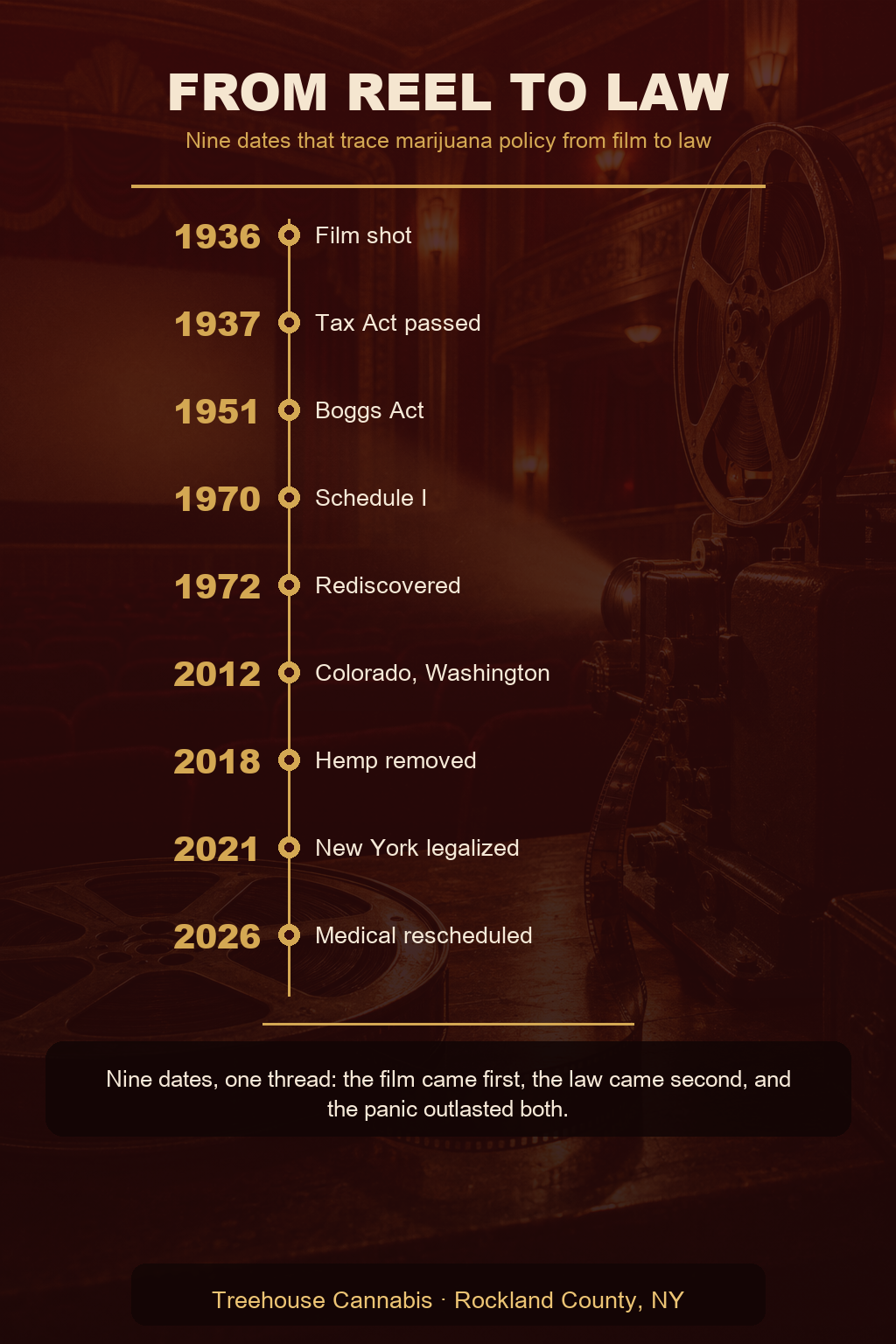
- Federal prohibition arrived via the Marihuana Tax Act, approved August 2, 1937 and effective October 1, 1937
- The film became the symbol of the panic only after it was rediscovered in 1972
- The phrase now names a pattern of exaggerated fear, not the movie itself
The myth and the record do not line up:
| The myth | The record |
|---|---|
| Government film | Church-funded independent picture |
| Always called Reefer Madness | Originally Tell Your Children |
| Caused the 1937 ban | Tax Act, driven by Treasury and nativist politics |
| Banned everywhere | New York and Pennsylvania censors only |
| Big-city hit | Small-town roadshow bookings |
That last point is the useful one. When someone calls a modern potency scare or a hemp-derived THC panic "reefer madness," they are not talking about a 1936 film. They are naming a recurring structure: a dramatic claim, a sympathetic audience, and a policy response that arrives faster than the evidence [3].
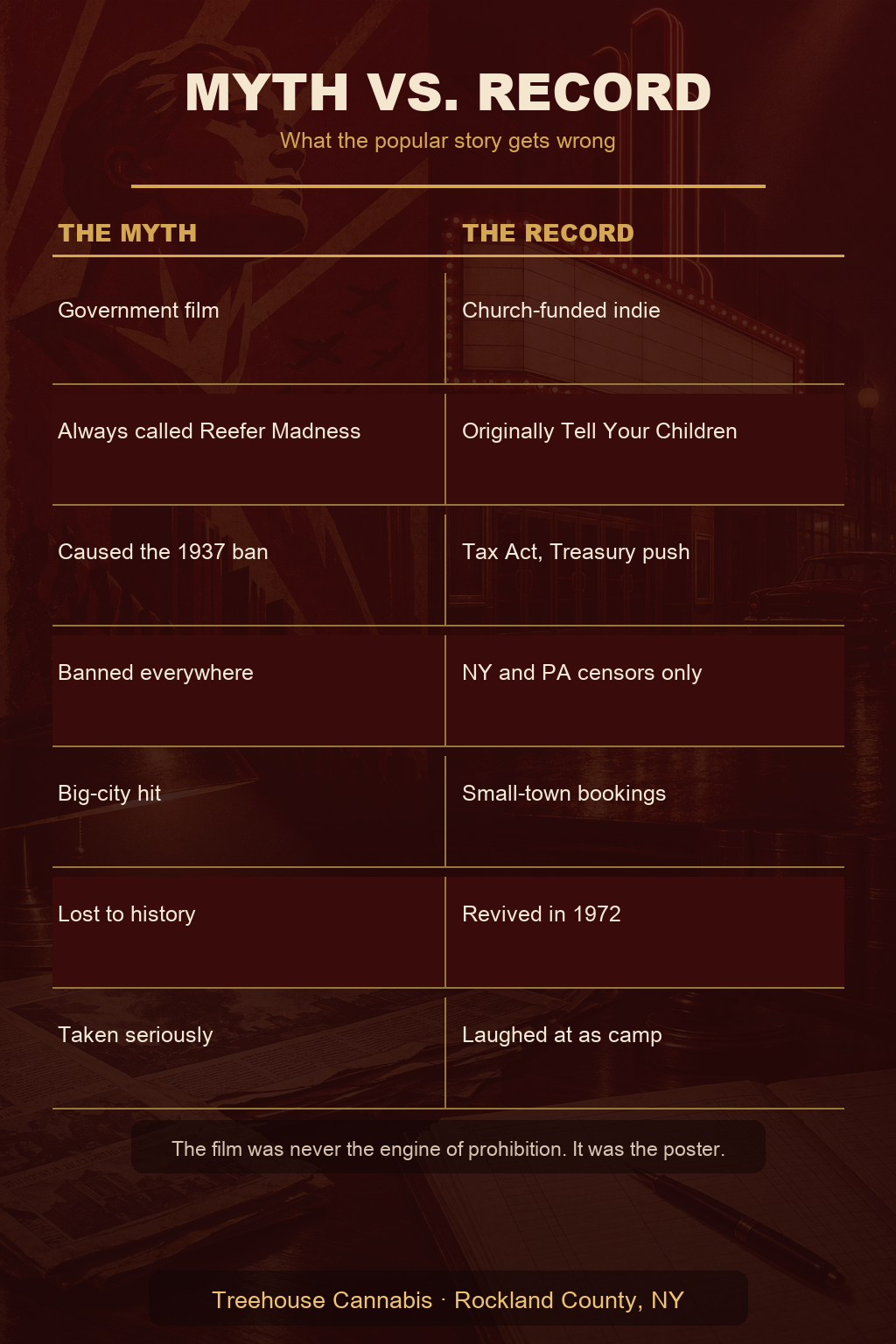
The film's own record is thin next to the myth around it. It was not a box-office hit, it was not banned nationwide, and there is no evidence it moved a single vote on the Tax Act. Some state censors did ban related titles, which is covered below, and that unevenness describes the era far better than the idea of a coordinated national campaign. The movie was a mirror reflecting a panic that already existed. It was not the source.
What Was Reefer Madness Originally Called?
It was produced as Tell Your Children. The filmmakers were making a morality tale for parents, financed by a church group, warning that a single marijuana cigarette could ruin a teenager's life [1]. That was the pitch. Nothing about the original production suggests a government agency, a public health bureau, or a national campaign.
What happened next is the part most retellings skip. Exploitation producer Dwain Esper bought the picture, re-cut it, and sent it out on the roadshow circuit, where a film could be booked town by town with its own ballyhoo and its own local controversy. Distributors ran it under several titles over the following years, including The Burning Question, Doped Youth, Dope Addict and Love Madness. The name Reefer Madness arrived with a later re-release, years after the shoot [1].
- Original title: Tell Your Children
- Financing: a church group, intended as a morality tale for parents
- Re-cut and re-released by exploitation producer Dwain Esper for the roadshow circuit
- Later titles included The Burning Question, Doped Youth, Dope Addict and Love Madness
- The name Reefer Madness arrived with a later re-release, years after the shoot
That production history explains something viewers notice immediately: the film feels incoherent. Characters change, scenes repeat, and the pacing lurches. It was re-edited into whatever framing a local distributor thought would sell tickets, so the negative accumulated the fingerprints of several different sales pitches [3]. There is no single authoritative cut to point at, which is a strange thing to say about the most famous anti-cannabis film ever made.
The broader arc the film sits inside, from colonial hemp cultivation to the 1937 tax, is covered in USA Cannabis History: From Colonial Cash Crop to Controlled Substance. If you want the state-level version of the same story, The History of Cannabis in New York traces how New York moved from prohibition to a licensed market.
Why Did Reefer Madness Play Small Towns Instead of Big Cities?
Because the panic was commercial and local, not a federal publicity operation. Newspaper coverage of the 1936 to 1938 anti-marijuana exploitation films shows bookings concentrated in smaller cities and towns, where theater owners and local officials treated the films' sensationalism as a useful public warning [2]. A roadshow picture needed a venue willing to advertise it as shocking. Small-town theaters and local authorities were willing.
The reception split sharply by market:
- Coverage of the 1936 to 1938 films shows bookings concentrated in smaller cities and towns
- Local theater owners and officials embraced the sensationalism as a public warning
- Big-city critics panned the films
- New York and Pennsylvania state censors banned related titles outright
- The result was an uneven, locally driven panic rather than one national propaganda campaign
That censorship detail is the one that surprises people. New York and Pennsylvania censors did not treat these films as helpful education. They banned related titles outright [2]. So the picture that later generations assumed was official government messaging was, in two of the largest states, suppressed by the government.
What actually spread the message was a patchwork: a booking here, a church screening there, a local newspaper amplifying the sensational bits. No federal office distributed prints. No agency coordinated the release. The films traveled the way any exploitation picture traveled in the 1930s, on ticket sales, and they stopped traveling when the tickets stopped selling.
The full legal history behind that patchwork, including the state laws that predated federal action, is laid out in Why Is Cannabis Illegal? A History of Marijuana Prohibition in America.
What Did the Marihuana Tax Act of 1937 Actually Do?
It created a de facto federal ban without ever using the word prohibition. Growing and using marijuana was legal under federal law before 1937 [5]. The Act did not outlaw the plant. It imposed an occupational excise tax, a transfer tax, and registry and recordkeeping duties on anyone who dealt in it, then made compliance practically impossible by rarely issuing the stamps the law required [6].
The mechanics are worth spelling out, because they are the reason the law worked:
- Before 1937, growing and using marijuana was legal under federal law
- The Act imposed an occupational excise tax, a transfer tax, and registry and recordkeeping duties
- Approved August 2, 1937; effective October 1, 1937
- Treasury rarely issued the required stamps, so the tax functioned as a de facto ban
- Anslinger called marijuana an intrastate problem in January 1937 and thought the transfer tax would fail
- Nativist testimony tying the drug to Mexican and African American users shaped the hearing record
A legal dealer had to register, pay the occupational tax, and obtain stamps for every transfer. The stamps existed on paper. In practice they were unavailable, which meant a lawful transaction was nearly impossible to complete and an unlawful one was easy to prosecute [5]. That is how a revenue measure becomes a ban: not by statute, but by administrative scarcity.
Here is the part that undercuts the propaganda narrative most cleanly. As late as January 1937, Commissioner Harry Anslinger publicly described marijuana distribution as an intrastate problem whose solution lay in uniform state narcotic laws, called the federal transfer-tax idea ridiculous when Treasury first floated it, and doubted the bill would pass [4]. The head of the Federal Bureau of Narcotics was not, in January, campaigning for a federal marijuana statute.
The hearing record itself was built on nativism rather than pharmacology. Anslinger tied the drug to Mexican and African American users and inserted into the record a letter asking what a small marijuana cigarette could do to "one of our degenerate Spanish-speaking residents," while members of Ways and Means showed little independent knowledge of the drug and congressional concern was minimal [7]. The law that outlasted the century was assembled quickly, on thin testimony, with the film nowhere in the room.
How Did the Boggs Act Turn Panic Into Prison Time?
By replacing paperwork with prison. The Boggs Act, approved November 1, 1951, imposed the first federal mandatory minimum sentences for narcotic and marijuana offenses, with escalating penalties for repeat offenders [8]. Until then, federal marijuana enforcement ran through tax compliance. After Boggs, it ran through sentencing, and the sentence did not depend on whether anyone was harmed.
Five years later Congress raised its own stakes. The Narcotic Control Act of 1956, approved July 18, 1956, amended the Internal Revenue Code and the Narcotic Drugs Import and Export Act to tighten federal control of "narcotic drugs and marihuana," lifting the penalties Boggs had set [9]. The word marihuana sits in the statute beside heroin, in a law about narcotics, which is how the two became one policy problem.
The practical effect on an ordinary person was severe:
- 1951 Boggs Act: first federal mandatory minimums for narcotic and marijuana offenses
- 1956 Narcotic Control Act: tighter control of narcotic drugs and marihuana, higher penalties
- First-offense possession: mandatory minimum of 2 to 10 years and a fine up to $20,000
- Repeat offenses escalated further under both laws
- 1970: Congress repealed most federal mandatory minimums and separated marijuana from other narcotics
A first-offense federal marijuana possession conviction carried a mandatory minimum of 2 to 10 years and a fine of up to $20,000 [10]. No probation, no diversion, no judicial discretion worth the name. The panic that began as a tax form had become a prison term.
Then the reversal, which gets far less attention than the escalation. Congress repealed most federal mandatory minimums in 1970, the same year NORML was founded and marijuana was separated from other narcotics in federal law [10]. That is the hinge the next section turns on: the same year the sentencing regime came apart, the film that supposedly explained it all came back.
How Did Reefer Madness Become a Cult Film and a Legalization Tool?
Because it was free. The film fell into the public domain, so prints were cheap and legal to screen, which meant anyone with a projector and a sense of humor could put it in front of an audience [1]. A movie made to frighten parents became a rental.
The turn happened fast. NORML founder Keith Stroup paid $297 for a print and used screenings in May 1972 as a fundraiser for that year's California legalization initiative [1]. The campaign lost. The screenings did not, and the crowds that came for the fundraiser left with a joke instead of a warning.
- The film fell into the public domain, so prints were cheap and legal to screen
- NORML founder Keith Stroup paid $297 for a print
- May 1972 screenings served as a fundraiser for that year's California legalization initiative
- New Line Cinema's Robert Shaye put it on the midnight-movie circuit
- Audiences recast it as comedy, and the phrase came to mean marijuana panic itself
New Line Cinema's Robert Shaye then moved it onto the midnight-movie circuit, where it played for years to crowds who came to laugh [1]. That is a strange fate for a 66-minute picture made for roughly $100,000 by people who believed they were saving teenagers. The meaning inverted completely: a film built to produce fear produced camp, and camp is a far more effective recruiting tool than a lecture [3].
The phrase escaped the film entirely after that. Reefer madness stopped meaning a title on a marquee and started meaning the pattern: the exaggeration, the moral panic, the law that follows. Every later generation that reaches for the phrase is quoting a movie it has probably never watched.
None of this made the film an origin story. The movie predates the legalization movement by four decades. The movement did not create it; the movement found it in the discard bin and put it to work.
Where Does Reefer Madness Logic Still Show Up in Policy?
In potency numbers, hemp-derived products, and youth-use statistics. The targets changed. The structure did not.
Where the 1930s panic attached the drug to jazz musicians and "reefer dens," the modern version attaches to concentrate percentages, delta-8 sold at gas stations, and any headline containing the phrase "in children."
The same reflex, aimed at different evidence:
| Then: the 1930s panic | Now: the 2020s panic |
|---|---|
| Jazz musicians and "reefer dens" | Concentrate percentages and hemp-derived THC |
| A church-funded roadshow film | Social posts and gas-station delta-8 |
| The Marihuana Tax Act of 1937 | Scheduling fights and state licensing rules |
| Federal sentencing as the answer | Product caps and lab testing as the answer |
The hardware followed the same path. The glass and tools that once signaled a raid are now stocked like any other retail accessory: Dab Tools Accessories sit behind a licensed counter a few feet from the register.
The molecule changed too. A measured five-milligram dose like Focus Coffee Shot | 5mg THC | 2oz is exactly what the panic's descendants would have called a menace. In a regulated shop it is a labeled serving with a number printed on it.
Federal law has moved, unevenly and recently. A DEA final rule published April 28, 2026 (91 FR 22714) and effective that day moved FDA-approved drug products containing marijuana, and marijuana subject to a state medical marijuana license, from Schedule I to Schedule III [12]. The rule explicitly does not authorize manufacture, distribution or use for non-medical purposes, so it is a narrower change than the headlines suggested.
- The panic's target moved: potency, hemp-derived THC and youth use replaced jazz-era stereotypes
- April 28, 2026 final rule (91 FR 22714): FDA-approved marijuana products and state-licensed medical marijuana moved to Schedule III
- That rule does not authorize non-medical manufacture, distribution or use
- Marijuana itself is still Schedule I; a separate rescheduling hearing was reinstated April 28, 2026 (91 FR 22777) with notices due May 28, 2026
- 64 percent of U.S. adults supported legalization in 2025, down from 68 to 70 percent between 2020 and 2024
- Support by party in 2025: 85 percent Democratic, 66 percent independent, 40 percent Republican
The plant itself has not been rescheduled. The separate rulemaking to move marijuana from Schedule I to Schedule III, proposed May 21, 2024 (89 FR 44597), drew heavy comment and hearing requests; DEA scheduled a hearing for December 2, 2024, withdrew that notice, and on April 28, 2026 (91 FR 22777) reinstated a formal evidentiary hearing, with written notices of participation due by May 28, 2026 [13]. Marijuana's own schedule placement remains unresolved while the paperwork grinds.
Public opinion moved faster than the statute and then wobbled. Gallup put support for legalization at 64 percent of U.S. adults in 2025, down from 68 to 70 percent between 2020 and 2024. Support stood at 85 percent among Democrats and 66 percent among independents but only 40 percent among Republicans, a 13-point one-year drop and the lowest Republican support in a decade [11]. That is what a live political fight looks like, not a settled question.
Hemp is the clearest example of the pattern repeating with a new substance. The Agriculture Improvement Act of 2018 removed hemp, defined as cannabis at or below 0.3 percent THC on a dry weight basis, from Schedule I entirely [16]. A decade later, hemp-derived intoxicants draw exactly the kind of emergency rhetoric the 1930s aimed at the plant itself. Same reflex, different molecule.
How Did New York Get From Prohibition to Licensed Retail?
Slowly, state by state, with the federal schedule unchanged the whole time. California went first on medical access: voters passed Proposition 215, the Compassionate Use Act, on November 5, 1996, shielding seriously ill patients and their caregivers from state liability with a physician's recommendation [14]. Proposition 64 in 2016 legalized non-medical adult use and licensed retail sale.
The 2012 votes proved a state could legalize, regulate and tax while marijuana stayed Schedule I federally. Colorado's Amendment 64 passed with about 55.3 percent and Washington's Initiative 502 with about 55.7 percent, making them the first two states to do it [17]. Neither needed federal permission, which is the part that mattered.
New York followed in 2021. Governor Cuomo signed the Marihuana Regulation and Taxation Act on March 31, 2021, raising the possession limit to three ounces, expanding expungement of prior marijuana convictions, and giving localities until December 31, 2021 to opt out of retail dispensaries or on-site consumption [15].
- November 5, 1996: California's Proposition 215 exempted patients and caregivers from state liability
- November 2012: Colorado's Amendment 64 passed with about 55.3 percent and Washington's Initiative 502 with about 55.7 percent
- December 20, 2018: the Farm Bill removed hemp at or below 0.3 percent THC from Schedule I
- March 31, 2021: New York's MRTA legalized adult use, set a three-ounce possession limit and expanded expungement
- Localities had until December 31, 2021 to opt out of dispensaries or on-site consumption
- October 6, 2022: federal pardons for simple possession under federal law and the D.C. Code
The federal threads ran alongside. On October 6, 2022, President Biden issued a full, complete and unconditional pardon for U.S. citizens and lawful permanent residents convicted of simple marijuana possession under federal law or the D.C. Code, restoring political and civil rights but explicitly not pardoning other marijuana offenses [18]. Pardons do not reschedule a drug. They do clean up some of the damage the sentencing era left behind.
Today the shelf in front of you is the end of that timeline. Rockland, Orange and Westchester County shops sell tested, labeled flower and pre-rolls under a state framework that did not exist a decade ago, and Small Buds Flower is sold by the eighth at a licensed counter instead of appearing in a case file. The panic that started with a roadshow picture and a tax stamp ended, at least locally, in a retail aisle with a receipt.
The laws that came out of the Reefer Madness era are still being unwound, and New York's licensed market is one of the places that shows it. Treehouse Cannabis serves Rockland County and the surrounding Orange and Westchester County communities, so you can see what regulated, tested cannabis actually looks like instead of what a 1936 roadshow said about it. On the menu now: NY Diesel | Flower | 28g and Super Jack Diamond Infused | Pre-Rolls | 5 pack, taxed, tested, and legal for adults.
That is the actual legacy. Not a film that wrote a law, but a panic that outlived its own evidence by roughly ninety years, and a slow, unglamorous administrative retreat from it.
Frequently Asked Questions
Did Reefer Madness actually cause marijuana prohibition?
No. It was a low-budget exploitation film that played scattered theaters and small towns. Federal prohibition came through the Marihuana Tax Act of 1937, driven by narcotics officials and nativist politics. The film became the era's symbol only after its 1972 rediscovery, decades later. [1] [5]
What was Reefer Madness originally called?
It was produced as Tell Your Children and financed by a church group as a morality tale for parents. Distributors re-cut and retitled it The Burning Question, Doped Youth, Dope Addict and Love Madness. The title Reefer Madness came from a later re-release. [1]
Was Reefer Madness a government film?
No. Independent producers made it with church financing, and exploitation producer Dwain Esper bought and re-cut it for the roadshow circuit. Audiences in the 1970s assumed it was official propaganda because of its lecture framing, but no federal agency produced or funded it. [1] [3]
What did the Marihuana Tax Act of 1937 do?
It imposed an occupational excise tax and a transfer tax on anyone dealing in marijuana, plus registry and reporting requirements. Because Treasury rarely issued the stamps needed to comply, the law worked as a de facto federal ban. It was approved August 2, 1937 and took effect October 1, 1937. [5] [6]
Why is marijuana still Schedule I under federal law?
Because the plant-level rescheduling rulemaking is unfinished. A 2026 rule moved FDA-approved marijuana products and state-licensed medical marijuana to Schedule III, but it did not reschedule the plant itself. DEA reinstated a formal evidentiary hearing on April 28, 2026, with written notices of participation due May 28, 2026. [12] [13]
How did Reefer Madness become a cult film?
The film fell into the public domain, so prints were cheap and legal to screen. In 1972 NORML founder Keith Stroup paid $297 for a print and used screenings as a fundraiser. New Line Cinema then put it on the midnight-movie circuit, where audiences laughed instead of recoiling. [1]
Does the phrase reefer madness still get used today?
Yes, usually as an accusation rather than a description. Advocates, journalists and regulators invoke it to describe modern panics over THC potency, hemp-derived products and youth use. It now names the pattern of exaggerated fear itself, not the 1936 film. [3] [16]
Is marijuana federally legal in 2026?
Not for non-medical use. A DEA final rule effective April 28, 2026 moved FDA-approved marijuana products and state-licensed medical marijuana to Schedule III, but recreational marijuana remains federally controlled. A separate rulemaking to reschedule the plant itself is still in evidentiary hearings. [12] [13]
Sources
- Turner Classic Movies — Reefer Madness was a low-budget exploitation film, not a government educational
- Points (Alcohol and Drugs History Society) — Newspaper coverage of the 1936-1938 anti-marijuana exploitation films shows they
- JSTOR Daily — Produced as an exploitation melodrama that drew on racial stereotypes, Reefer Ma
- Schaffer Library of Drug Policy (David F. Musto, Archives of General Psychiatry) — As late as January 1937 Commissioner Harry Anslinger publicly called marijuana d
- Congressional Research Service (via EveryCRSReport) — Growing and using marijuana was legal under federal law before 1937; during the
- U.S. Government Publishing Office — The Marihuana Tax Act was approved August 2, 1937 and took effect on the first d
- Drugtext (Warren Handel, DPF: The Pioneers of Reform) — Nativism shaped the 1937 hearings: Anslinger tied marijuana to Mexican and Afric
- U.S. Government Publishing Office — The Boggs Act, approved November 1, 1951, imposed the first federal mandatory mi
- U.S. Government Publishing Office — The Narcotic Control Act of 1956, approved July 18, 1956, amended the Internal R
- PBS Frontline — Under the Boggs and Narcotics Control Acts a first-offense marijuana possession
- Gallup — Sixty-four percent of U.S. adults say marijuana use should be legal, down from 6
- Federal Register (Drug Enforcement Administration) — A DEA final rule published April 28, 2026 (91 FR 22714) and effective that day m
- Federal Register (Drug Enforcement Administration) — The separate rulemaking to transfer marijuana itself from Schedule I to Schedule
- California Department of Justice, Office of the Attorney General — California voters passed Proposition 215, the Compassionate Use Act, on November
- New York State Association of Counties — Governor Cuomo signed the Marihuana Regulation and Taxation Act (A.1248A/S.854A)
- U.S. Department of Agriculture, Office of the General Counsel — The Agriculture Improvement Act of 2018 (Pub. L. 115-334), signed December 20, 2
- Connecticut General Assembly, Office of Legislative Research — In November 2012 Colorado voters approved Amendment 64 with about 55.3 percent a
- The White House (Biden Administration archives) — On October 6, 2022 President Biden issued a full, complete and unconditional par
About Treehouse Cannabis
Treehouse Cannabis is a licensed adult-use dispensary in Rockland County, New York, serving customers across Rockland, Orange and Westchester Counties. The menu lists tested flower, pre-rolls and edibles with potency printed per package, and the team can walk you through what New York's regulated framework actually requires of every product on the shelf.
Cannabis is for adults 21 and older. Keep all cannabis products out of reach of children and pets. This article is educational and is not medical or legal advice. Do not drive or operate machinery while impaired. Follow applicable state and local laws.


Shop our products

Shop All

Deals

Flower

Pre-rolls

Vaporizers

Edibles

Drinks

Concentrates

Tinctures

Topicals

CBD

Pet CBD

Accessories