Cannabis and Heart Rate: Why THC Can Make Your Heart Race
Cannabis and Heart Rate: Why THC Can Make Your Heart Race
What the research actually shows about THC, heart rate, tolerance, and the symptoms that deserve emergency care.
Cannabis raises heart rate because THC activates cannabinoid receptors in the heart and blood vessels, which pushes the autonomic nervous system toward sympathetic stimulation and pulls back the vagal slowing that normally governs your pulse. That cannabis heart rate effect is measurable within minutes of inhalation. In a 2024 laboratory study of healthy regular users, smoking THC-predominant cannabis raised heart rate by a mean of 17 beats per minute, while CBD-predominant cannabis produced no significant change[1]. Most of that effect settles over a few hours, and it is not the same thing as a heart attack, though the two can overlap and some symptoms deserve emergency care.
Why Does THC Make Your Heart Race?
THC activates cannabinoid receptors in the heart and blood vessels and shifts the autonomic nervous system toward sympathetic stimulation, away from the vagal slowing that normally keeps a resting pulse steady[3]. The result is a faster heartbeat within minutes of use rather than hours.
The mechanism research points at CB1 receptor activation as the main driver, not smoke irritation alone:
- THC acts on cannabinoid receptors in the heart and blood vessels, and the heart-rate effect appears within minutes
- A CB1-selective antagonist given to healthy volunteers before marijuana cut the mean peak heart-rate rise by 59 percent
- Propranolol also attenuated the tachycardia in the same line of mechanism research
- Those are mechanism findings about how the response works, not treatments to try and not a drug to combine with cannabis
- Oral THC at 7.5 mg and 15 mg raised heart rate dose-dependently and reduced high-frequency heart rate variability, the marker of parasympathetic control[4]
- High-frequency variability is an indirect index of autonomic balance, so it describes a shift in nervous system signaling rather than damage to the heart
- A wearable study in 31 adults living with cannabis use disorder found heart rate variability fell in both the time and frequency domains after smoking, alongside a rise in average heart rate[11]
What people describe as THC heart racing is a real shift in autonomic balance that shows up in the measurements. It is not only a feeling, and it is not the same thing as cardiac injury.
The metabolite layer explains why routes behave differently. Pharmacokinetic and pharmacodynamic modeling of data from healthy volunteers found that THC itself and its active metabolite 11-hydroxy-THC drive the heart-rate response and act synergistically, while the inactive metabolite THC-COOH does not contribute[6].
More THC reaching the bloodstream at once means more receptor activation at once, which is the same reason What Makes Premium Cannabis Flower Cost More? ties price to cannabinoid content rather than to branding.
How Much Does Cannabis Raise Your Heart Rate?
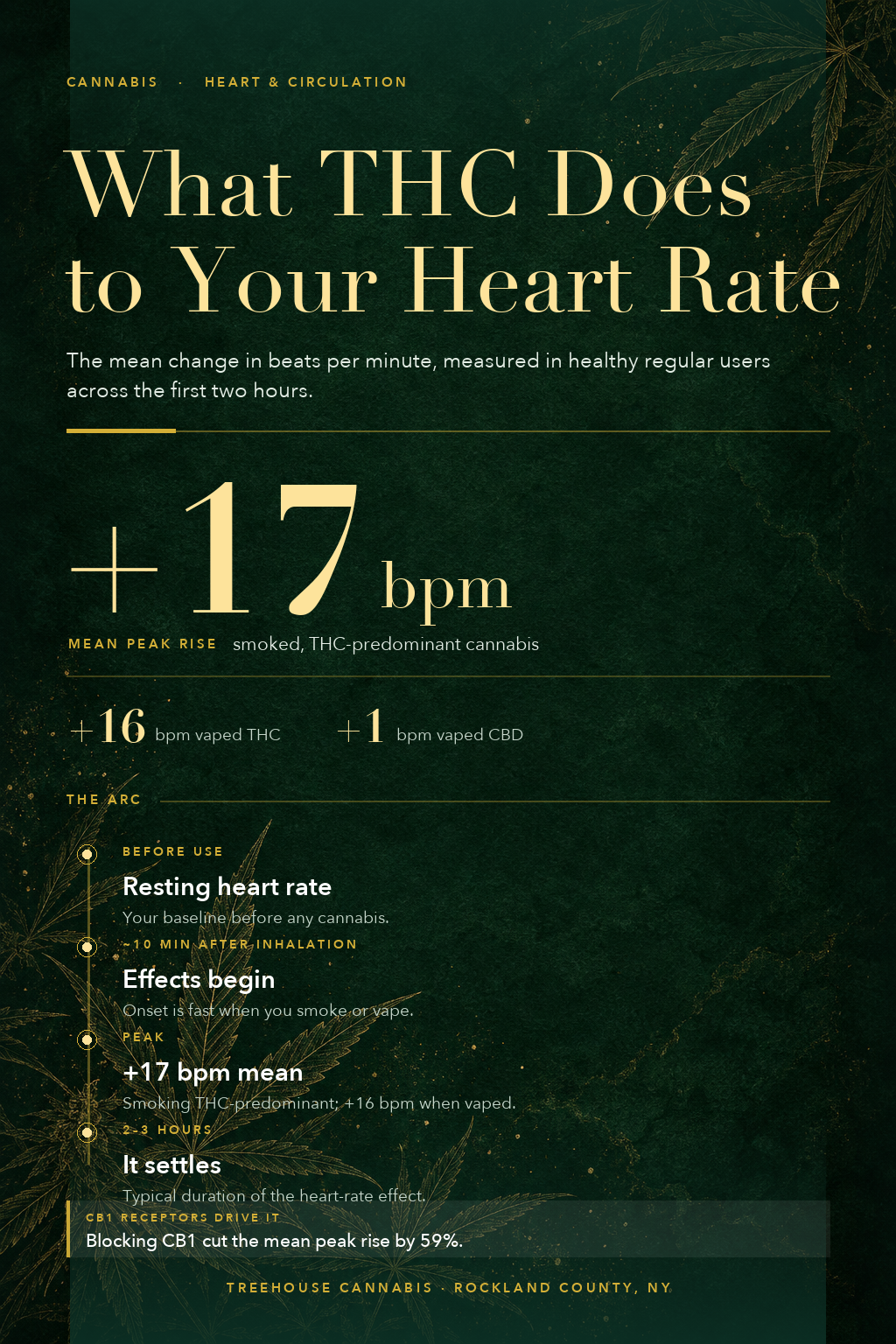
In controlled laboratory studies of healthy adults, THC-predominant cannabis raised heart rate by roughly 16 to 17 beats per minute on average. Those are group means from small studies, not a forecast for any one person.
- Smoking THC-predominant cannabis raised heart rate by a mean of 17 plus or minus 15 beats per minute in healthy regular users[1]
- Vaporizing THC-predominant cannabis raised it by a mean of 16 plus or minus 16, with both results significant at P below 0.0001
- Vaporizing CBD-predominant cannabis produced no significant change, at 1 plus or minus 4 beats per minute
- A systematic review of 14 experimental studies found tachycardia in every study it reviewed[2]
- Two randomized trials in that review found the increase was dose-dependent
- That review also flags that its experiments used THC doses far below current dispensary potency, which limits how far the numbers travel to a modern shop
- Older measurements cited in review literature range from a 20 to 100 percent increase, a figure that belongs to the review rather than to a single current measurement[3]
- A verified simulation model estimated that half of healthy adults would cross 100 beats per minute at 15 mg of inhaled THC or 60 mg of oral THC, assuming a 70 bpm baseline, and its authors caution that simulated risk figures should be read with caution[7]
MedlinePlus defines a heart rate above 100 beats per minute as tachycardia, which is the clinical word for what some people notice[12]. Individual responses still vary with dose, route, tolerance and baseline health, so the direction of these findings is more dependable than their size.
A strain name on a package is not a potency measurement, and Indica vs Sativa: Why the Labels Are Mostly Meaningless makes the case for why those labels say less than most people assume. The compound doing the work is THC itself, and What Is THC? How the Main Cannabis Cannabinoid Works explains how the main cannabinoid acts on the body. A labeled THC percentage on a product page such as NY Diesel | Flower | 28g is a more useful input than the strain name printed beside it.
How Long Does Heart Racing Last After Cannabis?
Heart-rate effects appear within about 10 minutes of inhalation and typically run 2 to 3 hours, according to older measurements cited in review literature[3].
- Effects appear within about 10 minutes of inhalation
- The effect typically lasts 2 to 3 hours in those older measurements
- Oral cannabis follows a slower curve, with a delayed onset instead of the quick inhaled spike[4]
- THC and its active metabolite 11-hydroxy-THC shape the response over time in pharmacokinetic modeling[6]
- Naturalistic studies often measure heart rate about two minutes after smoking, which captures the early peak and not the full curve[5]
- Among older adults using edibles, heart rate was tracked from before use to two hours after use[10]
- Cardiovascular tolerance can be lost within about 48 hours of stopping oral THC, so the same amount can feel stronger after a break
The measurements are narrower than the lived experience. A naturalistic study of 140 participants measured heart rate about two minutes after smoking, which is the peak rather than the whole curve, so most people noticing a racing heart are living through a longer window than any single study captured[5].
Route changes the shape of that curve. Oral THC produces a slower onset than inhalation, so the same question asked of an edible does not have the same answer as the same question asked of a joint or a vape[4]. In 234 adults aged 60 and older using edibles, researchers tracked heart rate from before use to two hours after use, a window that suits a slower onset but not a fast inhaled one[10].
Which cannabinoid is doing the shaping also changes how the curve behaves, and CBG vs CBD: How the Cannabinoids Compare compares the non-THC cannabinoids involved.
Does Smoking, Vaping, or Edibles Change the Heart-Rate Effect?
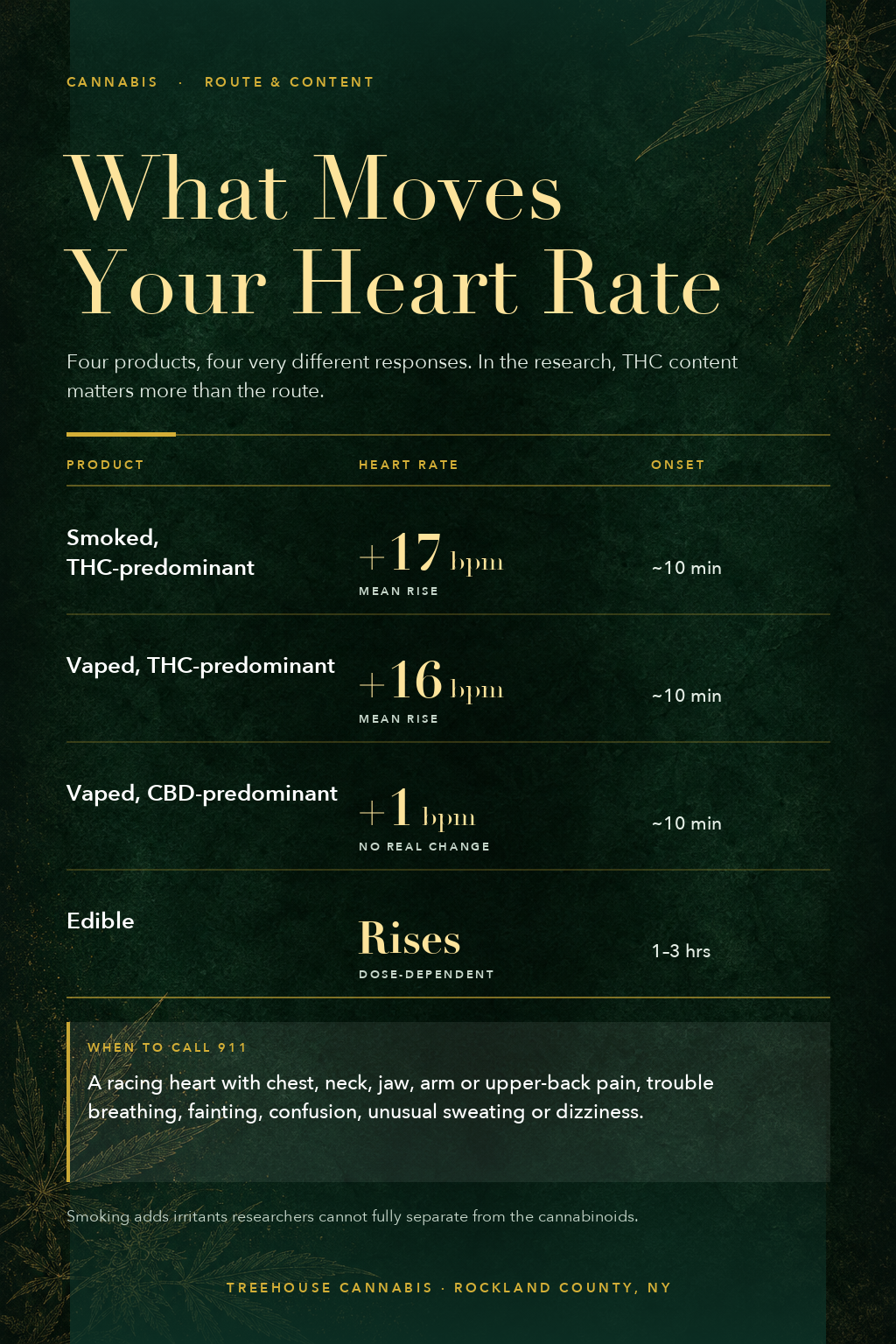
THC content matters more than delivery method. In the 2024 crossover study, smoking and vaporizing THC-predominant cannabis produced nearly identical heart-rate increases, while CBD-predominant cannabis produced none[1].
| Product type | Heart rate effect | Timing |
|---|---|---|
| Smoked, THC-predominant | +17 bpm mean | Onset within about 10 min |
| Vaped, THC-predominant | +16 bpm mean | Onset within about 10 min |
| Vaped, CBD-predominant | +1 bpm, no significant change | Onset within about 10 min |
| Edible | Dose-dependent rise in studies | Slower onset, hours |
- Smoking and vaporizing THC-predominant cannabis produced nearly identical heart-rate increases, at 17 and 16 beats per minute
- CBD-predominant cannabis produced no significant change in the same study
- Edibles are converted in the liver to 11-hydroxy-THC, which also drives the heart-rate response and works alongside THC
- The modeled amount needed for the same simulated effect was several times higher orally than by inhalation, which is a modeling result rather than a dosing comparison[7]
- Older adults using edibles showed a heart-rate rise two hours after use that tracked with blood THC levels, but only in the low and moderately active groups[10]
- That activity interaction is a first-of-its-kind observational finding that has not been replicated, so it remains preliminary
- CDC notes that most studies linking cannabis to heart attacks and strokes involve people who smoked it, so cannabinoid effects are hard to separate from smoke irritants[8]
Edibles behave differently because THC is converted in the liver to 11-hydroxy-THC, which the modeling study shows also drives the heart-rate response, and because oral administration has a slower onset than inhalation[6]. The difference is in the curve, not in whether the compound acts on the heart.
Format also decides what information sits in front of you when you weigh a purchase, and the Edibles category page lists potency per serving for those formats. A single product listing such as Peach x Oishii Live Resin Gummies | 10 pk puts the same numbers on one card. The comparison above covers measured heart rate only. Lung and cardiovascular questions about smoke are separate, less settled questions that this evidence does not answer.
Does CBD Make Your Heart Race?
In the one study that compared the two head to head, no. Vaporizing CBD-predominant cannabis produced no significant heart-rate change, at 1 plus or minus 4 beats per minute, while vaporizing THC-predominant cannabis through the same route produced a 16 beat per minute increase[1].
- Vaporizing CBD-predominant cannabis produced no significant heart-rate change, at 1 beat per minute
- In that same study, vaporizing THC-predominant cannabis raised heart rate by 16 beats per minute
- The contrast points to THC content rather than to the presence of a cannabinoid at all
- Higher-concentration extract products did not produce a significantly different heart rate than lower-concentration flower[5]
- That concentration comparison did not reach statistical significance, so it shows no detected difference rather than proof that concentration does not matter
- These measurements cover heart rate in the moment, not broader cardiovascular outcomes
That head-to-head comparison, side by side:
| Cannabinoid, vaped | Mean heart-rate change | Significant? |
|---|---|---|
| THC-predominant | +16 bpm | Yes, P below 0.0001 |
| CBD-predominant | +1 bpm | No significant change |
The cleanest way to read this is narrow. It is one 2024 study in healthy regular users, it measures a change in heart rate over the minutes after use, and it says nothing about whether CBD is heart-safe, heart-protective, or useful for a racing heart.
The design is what makes the contrast meaningful. Both arms used the same delivery method and the same session structure, so the route was held constant while the cannabinoid content changed. What moved was the heart-rate response.
The naturalistic evidence adds a second layer. In that study of 140 participants, higher-concentration extract products did not produce a significantly different heart rate than lower-concentration flower[5]. That comparison did not reach statistical significance, which means no difference was detected rather than that concentration is irrelevant.
The observational outcome data discussed later in this article is a separate body of evidence with its own limits, and the two should not be blended together.
Does Tolerance Change How Much Your Heart Races?
Not cleanly. The best naturalistic evidence found no reliable difference by how often people use cannabis, which means tolerance is not a safety margin.
- In 140 participants smoking their own cannabis, heart rate was significantly higher than in controls[5]
- The size of that increase did not differ significantly by how often participants used cannabis
- Higher-concentration extract products did not produce a significantly different heart rate than lower-concentration flower
- Neither comparison reached statistical significance, so they show no detected difference rather than proof that no difference exists
- The frequency comparison returned p = 0.18 and the concentration comparison p = 0.096, so the honest reading is that the study did not detect a difference
- A smaller response in frequent users is not the same as a safe response
- Review literature reports that cardiovascular tolerance can be lost within about 48 hours of stopping oral THC[3]
- The same review describes a biphasic response, where higher doses in animals produced a slower heart rate, which is animal research and does not describe human experience
That study used participants' own cannabis, including everyday formats such as Pre Ground Flower, so potency, strain and amount all varied at once and could not be held constant[5].
Concentration labels on a shelf product, such as the THC percentage listed for NY Diesel | Flower | 28g, are worth reading closely, but they did not predict the size of the heart-rate response in that study.
The wearable data points the same direction. In 31 adults living with cannabis use disorder, average heart rate rose after smoking while both time-domain and frequency-domain heart rate variability fell[11]. Autonomic balance shifted in the same direction in occasional users, in people with heavy daily use, and in the naturalistic sample.
What that means for a frequent user is not that the effect disappears. It means the evidence does not support reading a smaller measured response as a safe one.
What Does the Research Say About Cannabis and Heart Attacks and Strokes?
The longer-term evidence shows an association, not a cause, and it is worth keeping separate from the acute heart-rate effect described above.
- Daily cannabis use was associated with higher odds of heart attack, at an adjusted odds ratio of 1.25, in an analysis of 434,104 US adults[9]
- Stroke odds were also higher, at an adjusted odds ratio of 1.42
- Less frequent users still showed elevated, though lower, odds
- Similar patterns appeared among people who never smoked tobacco
- Cross-sectional data establishes association only, and both cannabis use and cardiovascular history were self-reported
- The survey covered 27 states and 2 territories rather than the whole country
- CDC says cannabis could increase the risk of stroke, heart disease and other vascular diseases, and that more research is needed to understand the full impact and whether it raises mortality risk[8]
- The cardiovascular review notes that case reports of infarction and arrhythmia cannot establish causation[3]
Most of that research looks at smoked cannabis, which is the format the Whole Flower Flower category represents. A temporary rise in heart rate after use is not a heart attack, and a heart attack is not what a temporary rise in heart rate means.
Both statements are true at once, and the observational data above says nothing about what any one person's heart rate did on any given evening.
The CDC frames the same evidence in terms of what is still unknown, stating that more research is needed to understand the full impact of cannabis on the cardiovascular system and whether it raises mortality risk[8]. That framing is worth holding onto, because the confident version of this topic is the one that gets people hurt.
Two gaps are worth naming plainly. The data covers 27 states and 2 territories rather than the whole country, and both cannabis use and cardiovascular history came from self-report, so recall error runs through both sides of the relationship. The cardiovascular review makes the matching point about the case-report literature, noting that reports of infarction and arrhythmia describe what happened without establishing that cannabis caused it[3].
When Does a Racing Heart Need Medical Attention?
Get emergency care for a racing heart when it arrives with chest pain or pressure, trouble breathing, fainting, confusion, unusual sweating or dizziness. Cleveland Clinic and MedlinePlus publish the same general guidance for palpitations, and Cleveland Clinic also advises calling for palpitations that are new or getting worse[13][12]. The full warning-sign list is below.
- Call 911 for chest, neck, jaw, arm or upper-back pain or pressure alongside a racing heart
- Call 911 for shortness of breath, unusual sweating, fainting, confusion or lightheadedness
- Cleveland Clinic also advises calling for palpitations that are new or getting worse
- MedlinePlus defines a heart rate above 100 beats per minute as tachycardia, so readers can tell whether the number they see counts
- Anyone with known heart disease, a heart rhythm problem, high blood pressure, or a family history of sudden cardiac death should talk to a clinician before using cannabis
- Mention cannabis use during routine check-ups the same way you would disclose smoking
- THC raises heart rate and myocardial oxygen demand, and the research does not establish safety for people with existing cardiovascular conditions[8]
That is published general guidance rather than medical advice for any individual reader, and it is not a diagnosis of what a given symptom means. Whether to start, stop, or change cannabis use for heart reasons is a decision for a licensed clinician.
Treehouse Cannabis carries THC-dominant flower, pre-rolls, vapes, edibles and tinctures for customers across Rockland, Orange and Westchester Counties, and the budtender team can walk you through product formats, potency listings and what is actually in stock before you buy. Anyone with a heart condition should talk with a clinician first and mention cannabis use at check-ups.
Frequently Asked Questions
Why does THC make your heart race?
THC activates cannabinoid receptors in the heart and blood vessels and shifts the autonomic nervous system toward sympathetic stimulation while reducing vagal slowing. A cardiovascular review found the effect appears within about 10 minutes of inhalation and lasts 2 to 3 hours, and that a CB1-selective antagonist cut the mean peak heart-rate rise by 59 percent. [3] [4]
How much does cannabis raise your heart rate?
In a 2024 study of healthy regular users, smoking THC-predominant cannabis raised heart rate by an average of 17 beats per minute and vaporizing it by about 16, while vaporizing CBD-predominant cannabis produced no significant change. Older measurements cited in review literature have ranged from 20 to 100 percent increases. Individual responses vary with dose, route, tolerance and baseline health. [1] [3]
Does the way you take cannabis change the heart-rate effect?
THC content matters more than delivery method. In the 2024 study, smoking and vaporizing THC-predominant cannabis produced similar increases, while CBD-predominant cannabis produced none. Edibles differ because THC is converted to 11-hydroxy-THC, which also drives the heart-rate response, and onset is slower, so the effect is harder to predict from an edible. [1] [6]
How long does the racing feeling last after cannabis?
Usually within the window when THC is active, roughly the first few hours for inhaled cannabis, though timing varies. One older measurement cited in review literature placed the effect within 10 minutes of inhalation, lasting 2 to 3 hours. One complication: the same review reports that cardiovascular tolerance can be lost within about 48 hours of stopping. [3]
Does tolerance reduce the heart-rate effect?
Not cleanly. In a naturalistic study of 140 participants, the heart-rate increase after smoking did not differ significantly by how often people used cannabis, and higher-concentration products did not produce a significantly different heart rate than lower-concentration ones. Other research describes partial tolerance to cardiac effects that fades quickly. A smaller response in frequent users is not a safe response. [5] [3]
Is a racing heart after cannabis ever a medical emergency?
Call 911 if the racing comes with chest, neck, jaw, arm or upper-back pain or pressure, shortness of breath, unusual sweating, dizziness, confusion or lightheadedness, or if you pass out. Those are the emergency warning signs listed by Cleveland Clinic, and MedlinePlus gives the same guidance for palpitations with chest pain, trouble breathing, sweating, dizziness or loss of consciousness. [12] [13]
Can cannabis cause heart attacks or strokes?
Large observational studies have found associations between heavier cannabis use and cardiovascular events, and CDC says cannabis could increase the risk of stroke and heart disease. In a 2024 analysis of 434,104 US adults, daily use was linked to higher odds of heart attack and stroke, with similar patterns among people who never smoked tobacco. These studies show association, not cause. [9] [8]
What should someone with a heart condition know before using cannabis?
Anyone with known heart disease, a heart rhythm problem, high blood pressure, or a family history of sudden cardiac death should talk to a clinician before using cannabis, and should mention it during routine check-ups the way they would disclose smoking. THC raises heart rate and myocardial oxygen demand, and the research does not establish safety for people with existing cardiovascular conditions. [8] [13]
Sources
- Journal of the American Heart Association (JAHA); NIH PubMed Central — In healthy regular cannabis users, smoking THC-predominant cannabis raised heart
- Journal of General Internal Medicine; Society of General Internal Medicine (NIH PubMed Central) — Across 14 experimental studies (7 randomized trials and 7 non-randomized), marij
- Journal of Clinical Medicine (MDPI); NIH PubMed Central — Smoking marijuana causes immediate tachycardia - one cited study measured a 20-1
- Psychophysiology; Society for Psychophysiological Research (NIH PubMed Central) — In a placebo-controlled laboratory study of occasional female cannabis users, or
- Cannabis and Cannabinoid Research; International Society for Cannabis Research (NIH PubMed Central) — In 140 participants who smoked their own cannabis in a naturalistic setting, hea
- European Journal of Drug Metabolism and Pharmacokinetics (NIH PubMed Central) — Pharmacokinetic/pharmacodynamic modeling of data from healthy volunteers found t
- Pharmaceutics (MDPI); NIH PubMed Central — Using a verified physiologically based pharmacokinetic-pharmacodynamic model tes
- Centers for Disease Control and Prevention, National Center for Injury Prevention and Control — CDC states that cannabis can make the heart beat faster and raise blood pressure
- Journal of the American Heart Association; NIH PubMed Central — In a cross-sectional analysis of 434,104 US adults from the 2016-2020 Behavioral
- European Journal of Applied Physiology (Springer Nature); NIH PubMed Central — In 234 adults aged 60 and older who used cannabis edibles, higher blood THC leve
- International Journal of Psychophysiology; International Organization of Psychophysiology (NIH PubMed Central) — Using wearable heart rate monitoring in 31 young adults living with cannabis use
- MedlinePlus, U.S. National Library of Medicine — MedlinePlus defines a heart rate above 100 beats per minute as tachycardia, and
- Cleveland Clinic, Heart, Vascular & Thoracic Institute — Cleveland Clinic advises calling 911 right away for palpitations accompanied by
About Treehouse Cannabis
Treehouse Cannabis is a licensed adult-use dispensary in Rockland County, New York, serving customers 21 and older across Rockland, Orange and Westchester Counties. Our budtender team walks customers through product formats, potency listings and what is actually in stock before they buy, and anyone with a heart condition should talk with a clinician first and mention cannabis use at check-ups.
Cannabis is for adults 21 and older. Keep all cannabis products away from children and pets. This article is educational and is not medical advice. Do not drive or operate machinery while impaired.
Shop our products

Shop All

Deals
Flower

Pre-rolls
Vaporizers

Edibles
Drinks

Concentrates
Tinctures

Topicals

CBD

Pet CBD

Accessories