Cannabis Tinctures: A Complete Guide to Sublingual Dosing
Cannabis Tinctures: A Complete Guide to Sublingual Dosing
How sublingual tinctures work, how to read the label, and how to build a dose you can repeat with confidence.
Cannabis tinctures are liquid extracts dosed by volume: read the milligrams per milliliter on the label, multiply by the milliliters you draw, and you know your dose. That arithmetic is what makes a tincture repeatable without smoking. Get those two numbers right and the same bottle behaves the same way twice.
That gap between expectation and result is where most tincture confusion lives. A label promises a sublingual product; your body may treat it as a swallowed one. A dropper looks like a measuring tool; it usually is not. This guide works through the pharmacology, the arithmetic, and the storage science, in that order, so the dose you take on Friday is the dose you can take again on Monday.
What Are Cannabis Tinctures?
A cannabis tincture is a liquid cannabis extract measured in drops or milliliters, not a smoked or inhaled product.
The traditional version is a hydroethanolic soak, cannabis steeped in high-proof alcohol and strained, though many products sold as tinctures today use a carrier oil or glycerin instead.
- A tincture is a liquid extract measured in drops or milliliters, not a smoked or inhaled product
- Three common bases and what they change: high-proof alcohol, carrier oil, and glycerin
- Hydroethanolic tinctures at 80-90% ethanol carried about ten times the cannabinoids of 40% ethanol tinctures
- Flowering tops produced about ten times the cannabinoids of leaves in the same preparation
- Labels state milligrams of THC or CBD per milliliter, which is the number every dose calculation starts from
The base matters more than most shoppers expect, because it decides how much of the plant actually ends up in the bottle. In a direct analysis of hydroethanolic cannabis tinctures, preparations made with 80 to 90 percent ethanol carried roughly ten times the cannabinoids of the same preparation at 40 percent ethanol [7]. Starting material behaved the same way: flowering tops produced about ten times the cannabinoids of leaves run through an identical process [7].
Alcohol carries the most cannabinoids and is the closest thing to the historical product. Oil is the most common base on modern menus, and it is largely swallowed rather than absorbed under the tongue, which shifts the whole timeline. Glycerin is thinner, sweeter and a weaker solvent, so it extracts less efficiently and tends to arrive as a milder product.
Potency is printed as milligrams per milliliter, which separates the two jobs a tincture asks of you: the dropper measures volume, and the label states cannabinoid content. A 30 mL bottle dosed at 10 mg per mL holds 300 mg of THC in total, and the arithmetic from there is simple division [11].
Tinctures are also not a niche format in New York. Invoice data from 11,590 registrants in the state's medical cannabis program found sublingual tincture was the second most common delivery method at 36.5 percent, behind vaporization cartridges at 41.2 percent, and 47.0 percent of registrants aged 65 and older chose tinctures [8]. The format's appeal is easy to understand once you have tried to measure a gummy.
How Does Sublingual Cannabis Absorption Work?
Sublingual cannabis absorption is meant to work by letting cannabinoids cross the thin tissue under the tongue and enter circulation directly, skipping the digestive route and most of the first pass through the liver.
That shortcut is why sublingual dosing gets described as a pharmacokinetic middle ground between inhaling and swallowing [2].
The typical numbers attached to that middle ground are an onset of about 15 to 45 minutes and a duration of 6 to 8 hours, against 5 to 10 minutes for inhaled cannabis and 1 to 3 hours for a swallowed product [2] [5]. Route, not dose alone, is what shapes the curve.
- The sublingual route is meant to absorb through tissue under the tongue instead of through the digestive tract
- Onset generally 15-45 minutes and duration 6-8 hours for sublingual products
- Inhaled cannabis starts in 5-10 minutes; swallowed cannabis takes 1-3 hours
- CBD oil drops and CBD capsules produced comparable blood levels in a randomized crossover trial of eight men
- A sublingual tablet designed for the route absorbed faster than comparator products in 12 volunteers
- Route of administration, not dose alone, is what controls the shape of the experience
Then comes the part most tincture marketing skips. Much of that onset data comes from nabiximols, a formulated oromucosal spray, and it varies widely between products [2]. The word on the box is a claim; the formulation is the evidence.
Two trials make the point in opposite directions. In a randomized crossover study of eight men, CBD oil taken as sublingual drops and the same oil swallowed in gelatin capsules produced comparable plasma profiles, which implies the drops were largely swallowed before any meaningful absorption under the tongue could occur [3]. In a crossover study of 12 healthy volunteers, a sublingual tablet built specifically for the route produced substantial cannabinoid exposure with faster absorption than the comparator products [4].
So the honest answer to "does sublingual work" is: it can, and whether it does depends on the product. An alcohol tincture held under the tongue for 30 to 45 seconds has a plausible path to mucosal absorption [11]. An oil drop that gets swallowed behaves like a low-dose edible, which is exactly what the eight-person trial measured.
If you want the broader map of how dose and route interact before you commit to a number, Cannabis Dosing: How to Find Your Right Amount by Consumption Method breaks down each consumption method, and Microdosing Cannabis: How to Do It Right covers what small, repeated doses look like in practice. The most common way people get this wrong is also the simplest, and 5 Mistakes with Cannabis Tinctures collects those errors in one place.
How Do You Read a Tincture Label for Accurate Tincture Dosage?
A tincture dose equals the concentration in milligrams per milliliter multiplied by the volume you draw, which is why the label comes first and the dropper comes second.
- Read milligrams per milliliter first, then multiply by the volume you draw
- A 10 mg per mL tincture delivers 5 mg in 0.5 mL and 2.5 mg in 0.25 mL
- A full dropper is not reliably one milliliter and is not a serving size
- An oral syringe marked in 0.1 mL steps turns dosing into a repeatable measurement
- New York labels state cannabinoid content per serving and per package, carry a QR code to the certificate of analysis, and show an expiration date
That arithmetic holds no matter what the bottle looks like, and it is the whole reason a tincture can be more precise than a gummy. A 10 mg per mL tincture delivers 5 mg in 0.5 mL and 2.5 mg in 0.25 mL, so the only variable left is how carefully you measure.
The dropper is where measurement breaks down. A "full dropper" is not reliably one milliliter, because dropper assemblies differ between bottles, and no manufacturer's dropper is a substitute for a marked measuring tool. An oral syringe marked in 0.1 mL increments costs a couple of dollars and removes the guesswork entirely, which is also the tool the standard titration protocols assume you are using [6]. If you are moving your dose up or down, How to Start Low and Go Slow With Cannabis lays out the reasoning behind the slow approach.
New York labeling rules do more of the work than most shoppers realize. Labels must state cannabinoid content in milligrams per serving and per package, carry a QR code linking to that product's certificate of analysis, and show an expiration date, because cannabinoid content changes as a product is exposed to air [10]. For scale, adult-use edible products in New York may contain up to 10 mg of THC per serving [9]. That cap is an edible rule, not a tincture rule, but it is a useful reference point when you are deciding whether 5 mg is a lot.
High Dose "UP" | Tincture | 1000MG
One practical note before the math: a certificate of analysis describes a batch, not a bottle in isolation. If the QR code points to a panel whose date predates your purchase by a year, treat the printed potency as an approximation and dose accordingly.
What Is a Safe Starting Tincture Dosage for Beginners?
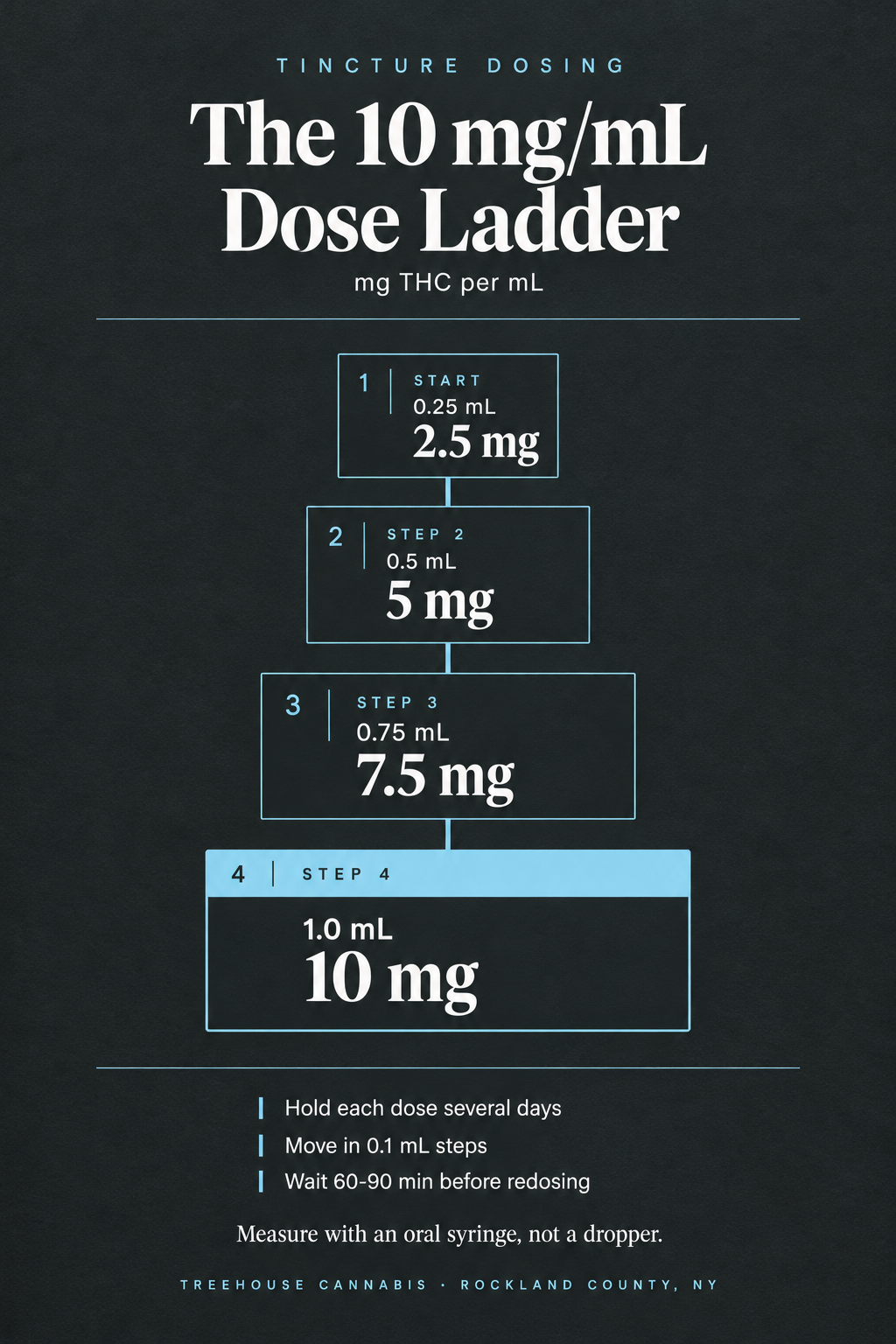
A cautious starting tincture dosage is about 2.5 mg of THC, which is 0.25 mL of a 10 mg per mL product, and some people reasonably start lower. There is no universal correct dose, only a dose you can measure, repeat, and adjust without guessing.
- Start around 2.5 mg THC, the equivalent of 0.25 mL of a 10 mg per mL tincture
- Hold that dose for several days before changing anything
- Increase in 0.1 mL steps with an oral syringe so each change is measurable
- Wait 60 to 90 minutes before deciding a dose did nothing
- Daily doses above 20-30 mg THC may increase adverse events and tolerance without improving benefit
- A single uncomfortable reaction is a reason to step down, not to push through
Slow titration is a method rather than a suggestion. Hold the dose for several days, log the onset, the duration and anything unwanted, then move in 0.1 mL increments so each change is something you can actually attribute to the change rather than to the day [6]. Two tenths of a milliliter at 10 mg per mL is 2 mg, which is a meaningful step for a new consumer and a rounding error for a daily one.
The waiting rule causes more bad evenings than any other single mistake. Sublingual onset runs 15 to 45 minutes, but a swallowed dose can take 1 to 3 hours to arrive, so 20 minutes is not enough evidence to conclude that your dose did nothing [2] [5]. Give it at least 60 to 90 minutes. The instinct to top up early is exactly how a modest dose becomes an overwhelming one.
There is also a ceiling worth knowing about. State guidance notes that daily doses above 20 to 30 mg of THC may increase adverse events and tolerance without improving benefit [5]. That is not a target and it is not a hard limit; it is a signpost saying that more is not where the gains are.
If a single dose produces an uncomfortable reaction, the correct response is to step down at the next session, not to push through the same dose hoping it settles. Sensitivity changes with sleep, food, alcohol, stress and the product itself, so a dose that worked last month is not a guarantee this week.
How Long Do Cannabis Tinctures Last?
Tincture effects generally last 6 to 8 hours when the dose stays under the tongue, which is closer to an edible than to a vape.
Inhaled cannabis runs roughly 2 to 4 hours, so a tincture taken at 6 p.m. can still be present at midnight [2].
- Expect roughly 6 to 8 hours from a sublingual dose
- Inhaled cannabis runs about 2 to 4 hours, so tinctures sit closer to an edible
- Swallowed doses show a 30 to 90 minute delay, a peak at 2 to 3 hours, and effects out to 4 to 12 hours
- Duration climbs with dose and with tolerance
- Clear your schedule for the full window rather than assuming it will wear off early
Two variables stretch that window. The first is whether the dose was swallowed, since oil-based drops largely are, and swallowed cannabis has been measured with a 30 to 90 minute delay to onset, a peak at 2 to 3 hours and effects running 4 to 12 hours [1]. The second is dose and tolerance: a higher dose at the same concentration lasts longer than a lower one, and regular use tends to shift your response in both directions over time.
This is why the same bottle can feel different on two different evenings. Held under the tongue, the curve starts early and ends around the 6 to 8 hour mark. Swallowed, the whole curve slides later and stretches. Neither outcome means the product is inconsistent; it means the route changed without the label changing.
Plan accordingly. If a tincture at 7 p.m. can still be active at 1 a.m., that is a decision you want to make before you take it rather than after. The rule about spacing doses is the practical version of this, and How Long Should You Wait Before Taking More Cannabis? walks through the timing question in detail.
How Do Sublingual Cannabis Tinctures Compare With Edibles, Vapes, and Smoking?
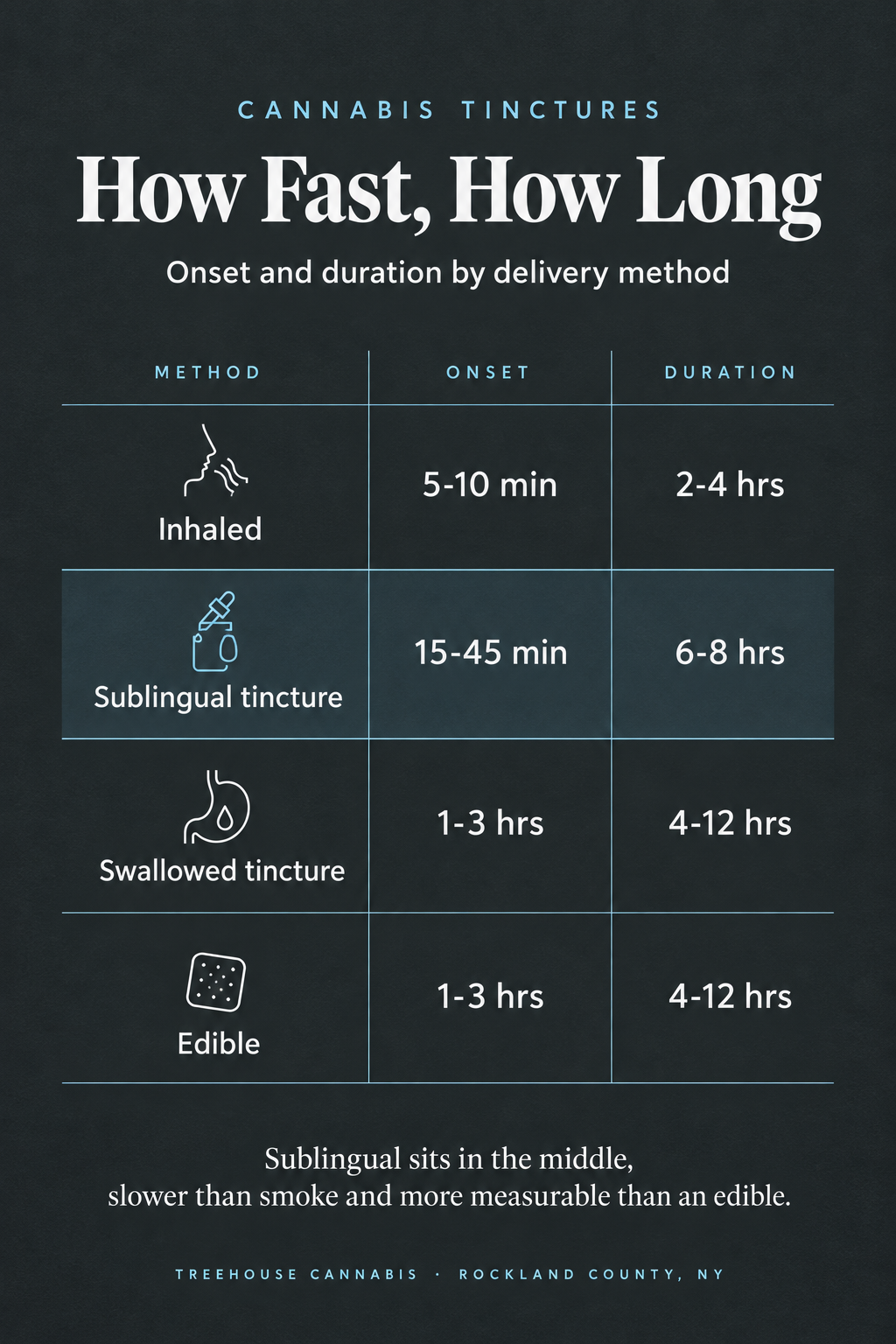
Tinctures sit between inhalation and edibles on both speed and controllability: slower to arrive than a vape, far easier to measure than a gummy, and longer lasting than either.
| Method | Onset | Typical duration | What it is like |
|---|---|---|---|
| Inhaled (smoke or vape) | 5-10 minutes | 2-4 hours | Fastest feedback, hardest to measure precisely |
| Sublingual tincture | 15-45 minutes | 6-8 hours | Measured by volume, moderate wait, long tail |
| Swallowed tincture | 1-3 hours | 4-12 hours | Behaves like an edible despite the bottle |
| Edible | 1-3 hours | 4-12 hours | Delayed onset, easiest to overdo by redosing |
- Inhaled: fastest onset at 5-10 minutes, shortest duration around 2-4 hours
- Sublingual tincture: 15-45 minute onset, 6-8 hour duration, measured by volume
- Swallowed tincture or edible: 1-3 hour onset and the longest tail, out to 4-12 hours
- A swallowed tincture behaves like an edible no matter what the bottle calls it
- Tinctures trade speed for measurability and duration
The trade-off is real in both directions. Inhalation is fast and short, which makes it easier to judge a dose in real time and easier to overshoot without noticing. Tinctures are slower to arrive, but the volume measurement is precise and the effect lasts long enough that you are not re-dosing every hour. Edibles are the least predictable of the four, not because the dose is unclear but because the delay is long enough that people add a second dose before the first one has reported back.
Being fair about the downsides: tinctures require label math, and an oil-based drop may absorb more like an edible than the word "sublingual" implies [3]. If precision matters more than speed, that is still a good trade. If you want the fast feedback of inhalation, a tincture will not give it to you.
The comparison also explains why format does not change the molecule. The same THC that arrives in 5 minutes through a vape arrives over hours through a tincture, and the terpene profile that shapes the aroma of flower is largely absent from a distilled tincture, which is why flavor expectations do not transfer between formats. A Guide to Terpenes and Their Effects covers what those aromatic compounds do and do not contribute.
If you want to see what the format looks like on a real menu, the Tinctures collection lists current options with potency printed per bottle. For readers who would rather skip the dropper entirely, a measured edible such as Pillow Talk 2:1 | 10 Pack | Gummies | THC: 100mg, CBN: 50mg offers a fixed per-piece dose, though the onset curve is the same slow one described above.
Pillow Talk 2:1 | 10 Pack | Gummies | THC: 100mg, CBN: 50mg
How Should You Store Cannabis Tinctures?
Store a cannabis tincture upright, tightly capped, in a cool dark place, in its original child-resistant packaging and out of reach of children and pets.
- Keep it upright and tightly capped in the original child-resistant bottle
- Store in a cool, dark place away from heat and direct light
- Total THC losses measured up to 15% after three months at room temperature
- Losses reached up to 45% after fifteen months stored refrigerated
- THCA-to-THC conversion is the main change as a tincture ages
- Check the expiration date and certificate of analysis rather than trusting an old bottle's label
Those are the basics. The reason they matter is that the product measurably changes while it sits there.
The stability data is blunt. In an analysis of hydroethanolic tinctures, total THC losses reached up to 15 percent after three months at room temperature, and up to 45 percent after fifteen months stored refrigerated, with THCA-to-THC conversion the main chemical change over time [7]. An old bottle is not the same product you bought, even when nothing about the label has changed.
That is the practical argument for the expiration date and the certificate of analysis. New York requires both on the label, and both exist because cannabinoid content shifts as a product is exposed to air [10]. A bottle two years past its date is not dangerous in the way spoiled food is dangerous, but its printed potency is fiction.
Do not transfer a tincture into an unlabeled container, and do not decant it into a dropper bottle from something else. A homemade or repackaged product carries no verified potency at all, and the child-resistant packaging is doing real work. New York guidance is explicit that products should be stored locked and out of reach of children and pets [9].
Cool and dark beats clever. A kitchen cabinet away from the stove is better than a windowsill, and a refrigerator is acceptable but not a magic preservation chamber, given that the 45 percent loss figure came from refrigerated storage rather than room-temperature storage. Buy a bottle you will finish, and check the panel before you trust the number.
Treehouse Cannabis stocks tinctures and other measured-dose products at its Rockland County location, and the team can walk you through the label math before you buy. Customers across Rockland, Orange, and Westchester Counties can check current tincture availability online before making the trip.
Frequently Asked Questions
What is a cannabis tincture?
A cannabis tincture is a liquid extract sold in a dropper bottle, traditionally made by soaking cannabis in alcohol, though many products sold as tinctures today use oil or glycerin instead. Potency is printed as milligrams of THC or CBD per milliliter, so the dropper measures volume while the label tells you the actual cannabinoid amount. [7] [11]
How long does a cannabis tincture take to kick in under the tongue?
Held under the tongue, effects usually begin in about 15 to 45 minutes. Swallowed doses behave like edibles and take one to three hours. Because absorption varies enormously between formulations, wait at least 60 to 90 minutes before deciding that a dose did nothing and taking more. [2] [5]
How much THC should a beginner take in a tincture?
A cautious first dose is about 2.5 mg of THC, which is a quarter milliliter of a 10 mg per mL tincture. Some people start lower. Keep that dose steady for several days before nudging upward, and treat any single strong reaction as a signal to cut back rather than push through. [5] [6]
How do I read a tincture label to measure a dose?
Find the concentration in milligrams per milliliter, then multiply by the volume you draw. A 10 mg per mL tincture delivers 5 mg in 0.5 mL and 2.5 mg in 0.25 mL. Do not assume a full dropper equals one milliliter or one serving, because dropper sizes vary between bottles. [10] [11]
Should I hold a tincture under my tongue or swallow it?
It depends on the base. Alcohol-based tinctures can cross the tissue under the tongue, so holding for 30 to 45 seconds is worthwhile. Oil-based drops are largely swallowed anyway, and research comparing CBD oil drops with capsules found comparable blood levels. Follow the directions for your specific product. [3] [11]
How long do tincture effects last?
Sublingual doses are generally described as lasting six to eight hours, longer than inhaled cannabis at roughly two to four hours and closer to an edible. Swallowed tincture behaves like an edible from the start. Duration climbs with dose and tolerance, so plan a longer window than you think you need. [1] [2]
Can I add a tincture to food or drinks?
Only when the label says the product is meant to be swallowed or mixed. Adding it to food shifts absorption to digestion, which means a slower one to three hour onset and a longer, more edible-like experience. Mixing into a drink also makes it harder to confirm how much you actually consumed. [2] [5]
How should I store a cannabis tincture?
Keep it in the original child-resistant bottle, upright, in a cool dark place away from heat and light. Cannabinoid content drifts over time even under good conditions, with one tincture study measuring total THC losses up to 15% after three months at room temperature. Check the expiration date and certificate of analysis. [7] [9]
Sources
- Clinical Pharmacokinetics (Grotenhermen) — Route of administration controls THC pharmacokinetics: inhaled THC peaks in plas
- Anesthesia & Analgesia (MacCallum et al.) — Places sublingual products such as tinctures as a pharmacokinetic middle ground
- Cannabis and Cannabinoid Research (Johnson et al.) — A randomized crossover trial in eight men found CBD oil taken as sublingual drop
- Cannabis and Cannabinoid Research (Tarlovski et al.) — In a randomized crossover study of 12 healthy volunteers, a novel sublingual tab
- Utah Department of Health and Human Services — Provides a route comparison table listing oral-mucosal sublingual tincture onset
- Canadian Pharmacists Association — Documents a practical slow-titration protocol that starts at a tiny measured vol
- Scientia Pharmaceutica (Wohlfart et al.) — Analyzed hydroethanolic cannabis tinctures and found 80-90% ethanol tinctures ca
- Cannabis and Cannabinoid Research (Kaufmann et al.) — Invoice data from 11,590 New York cannabis patients showed sublingual tincture w
- New York State Office of Cannabis Management — States that New York adult-use edible products may contain up to 10 milligrams o
- New York State Office of Cannabis Management — Explains that New York labels state cannabinoid content in milligrams per servin
- Leafly — A consumer reference that walks through a milligram-per-milliliter dosing chart
About Treehouse Cannabis
Treehouse Cannabis is a licensed adult-use dispensary in Rockland County, New York, serving customers across Rockland, Orange, and Westchester Counties. Every tincture on the menu lists its cannabinoid content in milligrams per milliliter, and the team can pull the certificate of analysis for any batch so you can check potency and expiration before you buy.
Cannabis is for adults 21 and older. Keep all cannabis products locked and out of reach of children and pets. This article is educational and is not medical advice. Cannabis affects people differently, so start with a small measured dose and do not drive or operate machinery while impaired.

Shop our products

Shop All

Deals

Flower
Pre-rolls
Vaporizers

Edibles
Drinks

Concentrates
Tinctures

Topicals

CBD

Pet CBD

Accessories