Delta-8 THC: What It Is and How It Differs From Delta-9
Delta-8 THC: What It Is and How It Differs From Delta-9
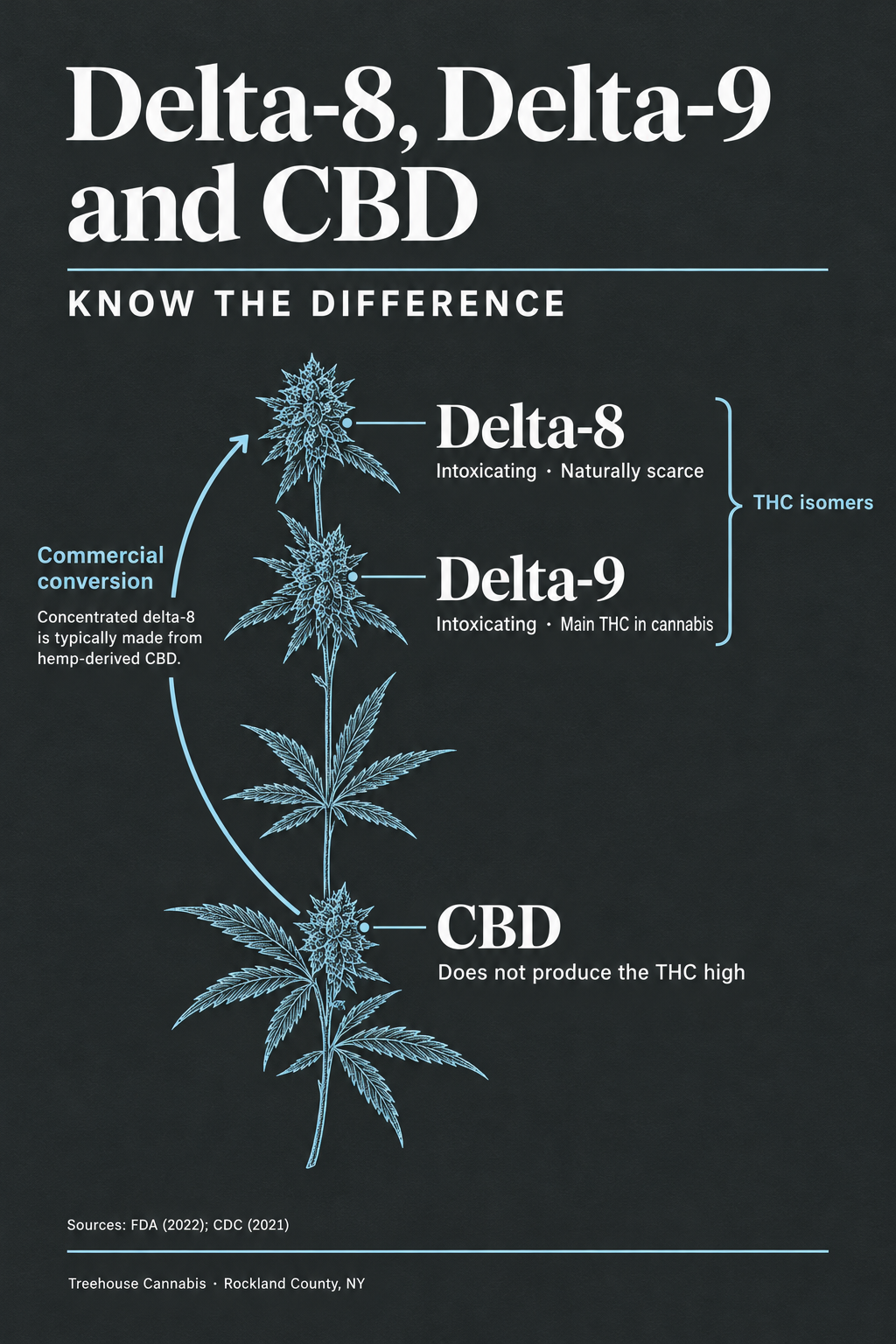
Delta 8 THC is an intoxicating cannabinoid found naturally in small quantities in cannabis; concentrated commercial products are typically made by converting hemp-derived CBD. Delta-9 THC, by contrast, is the principal THC isomer in cannabis. Both can cause a high and impairment; neither the word "hemp" nor a milder reputation changes that. [1] [2]
For New York shoppers, the distinction also involves the rules governing a product's sale. New York prohibits delta-8 THC products in its cannabinoid hemp program, while maintaining a separate regulated adult-use cannabis market. A package labeled "hemp-derived" does not establish that it is authorized for sale in the state. [3] [4]
The useful questions are straightforward: What cannabinoid is in the finished product? How was it produced? What does its label actually establish? Understanding those differences is more useful than treating delta-8 as simply a lighter version of ordinary THC.
What is delta 8 THC?
Delta 8 THC is a THC isomer: a closely related form of THC with a different molecular arrangement. It occurs naturally in cannabis in small quantities and can produce intoxicating effects. [1] [2]
The name identifies a cannabinoid, not a product category, quality standard, or guarantee about the experience. A delta-8 gummy and a delta-8 vape may contain the same named cannabinoid, but that name alone does not explain their full ingredients or manufacturing conditions.
Three facts help separate the compound from its marketing:
- Delta-8 is a form of THC, not another name for CBD.
- Cannabis naturally contains relatively small amounts of it.
- Concentrated commercial products typically use delta-8 made by converting hemp-derived CBD.
- Hemp origin does not make the finished product non-intoxicating. [1] [2]
This distinction matters whenever "hemp" appears prominently on a package. The starting plant and the finished product's effects are different questions. A hemp-derived ingredient can become an intoxicating cannabinoid through processing; the original source does not erase the finished compound's properties.
How does delta 8 vs delta 9 compare?
Delta-8 and delta-9 are related THC isomers, and both can cause intoxication. Delta-9 is the most prominently occurring THC isomer in cannabis; delta-8 occurs in smaller amounts and is commonly manufactured from CBD for concentrated products. [1] [2]
The comparison is broader than which one is described as stronger. Commercial sourcing, finished-product composition, and the regulatory program governing sales all matter.
| Feature | Delta-8 THC | Delta-9 THC |
|---|---|---|
| Occurrence in cannabis | Naturally present in small quantities | Principal THC isomer in cannabis |
| Common commercial sourcing | Concentrated products typically use converted hemp-derived CBD | Cannabis-derived THC is common in regulated adult-use products |
| Intoxication | Can cause a high and impairment | Can cause a high and impairment |
| Meaning of the name | Identifies a cannabinoid, not a safety certification | Identifies a cannabinoid, not automatic sales authorization |
| New York context | Delta-8 products are prohibited in the cannabinoid hemp program | A separate regulated adult-use market exists; not every delta-9 product is authorized |
The cannabinoid and sourcing distinctions come from FDA and CDC guidance; the New York distinctions come from OCM's consumer and licensee guidance. [1] [2] [3] [4]
Delta-8 is often described as less psychoactive than delta-9, but that does not create a dependable conversion between products. Historical estimates should not be turned into a universal potency percentage, equivalent serving, or prediction of someone's response.
Keep these takeaways separate:
- Both cannabinoids can impair judgment and driving ability.
- A reputation for milder effects is not evidence that a product is safe.
- The cannabinoid name does not establish manufacturing quality.
- State authorization depends on the applicable rules, not simply whether a label says delta-8 or delta-9. [1] [2] [4]
Is delta 8 natural, and how is it different from CBD?
Delta-8 occurs naturally in cannabis, but concentrated commercial products are typically made by chemically converting CBD. CBD is a different cannabinoid and does not produce the characteristic THC high; delta-8 can. [1] [2]
"Naturally occurring" and "commercially manufactured" can therefore both describe delta-8, depending on the context. Finding a compound in a plant does not establish that a concentrated retail product was extracted directly from that plant without conversion.
| Question | CBD | Delta-8 THC |
|---|---|---|
| Is it the same cannabinoid? | No; CBD is a different cannabinoid | No; delta-8 is a THC isomer |
| Does it produce the characteristic THC high? | No | It can |
| What is the commercial relationship? | Hemp-derived CBD can be the starting material | Often produced by converting CBD |
These distinctions explain why CBD origin does not mean CBD-like effects. After conversion, the finished cannabinoid is different from the starting material. [1] [2]
When reading sourcing language:
- Separate natural occurrence from how a particular product was manufactured.
- Identify the cannabinoids in the finished product, rather than relying on "made from hemp."
- Do not assume a CBD starting material means the product is non-intoxicating.
- Treat "natural" as a description to investigate, not a safety certification.
For the broader distinction between the two familiar cannabinoid categories, read CBD vs THC: The Science Behind the Two Most-Discussed Cannabinoids. It provides context for why CBD and THC should not be treated as interchangeable.
Does delta 8 get you high, and what affects delta 8 safety?
Yes. Delta-8 THC can cause a high and impairment. The FDA has not evaluated or approved delta-8 products for safe use, and a reputation for milder effects does not establish that they are safer than delta-9 products. [1] [2]
There are two distinct issues: the intoxicating effects of the cannabinoid and the composition of the finished product. Calling something "diet weed" addresses neither reliably.
The FDA warns that chemical conversion can introduce potentially harmful by-products or contaminants. That is a manufacturing concern, not a finding that every delta-8 sample contains the same contaminants or that every manufacturer uses the same process. [1]
Labeling also matters. If a package emphasizes hemp or CBD without clearly explaining its intoxicating ingredients, shoppers may misunderstand what they are buying. The CDC's archived 2021 advisory describes concerns about labeling and unexpected intoxication; its historical reports should not be treated as current prevalence figures. [2]
Practical considerations include:
- Do not drive or operate machinery while impaired.
- Keep products out of reach of children and pets, using child-resistant storage.
- Do not treat a milder-effect claim as a promise about individual response.
- Read the ingredient list and look for manufacturer and batch identification.
- Remember that a laboratory report neither guarantees safety nor establishes legal authorization. [1] [3]
For accessory context, Treehouse Smell-Proof Travel Case is a separate travel-case listing, not a delta-8 recommendation. A smell-proof description alone does not establish child resistance, prevent impairment, or make carrying a product lawful.
Where consumption is permitted is another separate question. For the adult-use setting, Where Can You Legally Use Cannabis in New York? explains the location rules; it should not be read as authorization for a prohibited hemp product.
Is delta 8 legal in New York's cannabinoid hemp program?
No. New York prohibits delta-8 THC products in its cannabinoid hemp program. OCM guidance also prohibits cannabinoid hemp products containing cannabinoids created through isomerization, explicitly including delta-8 THC. [3] [4]
OCM's revised October 2024 licensee guidance addresses cannabinoid hemp products distributed or offered for retail sale in New York. It states that these products may not contain synthetic, artificially derived, or isomerization-created cannabinoids, including delta-8 THC. The guidance explains the program's regulations; it is not itself a new statute. [4]
The restriction has historical roots: OCM's November 2021 announcement explicitly described the prohibition on delta-8 product sales under the cannabinoid hemp regulations. That announcement supplies background, while the consumer page and 2024 guidance provide the more relevant program explanation here. [5]
This is a sales-and-distribution discussion within a particular regulatory program. It is not a blanket statement about every possession scenario or every possible adult-use formulation. New York's regulated adult-use cannabis market is separate, and the presence of delta-9 on a label does not automatically authorize a product either.
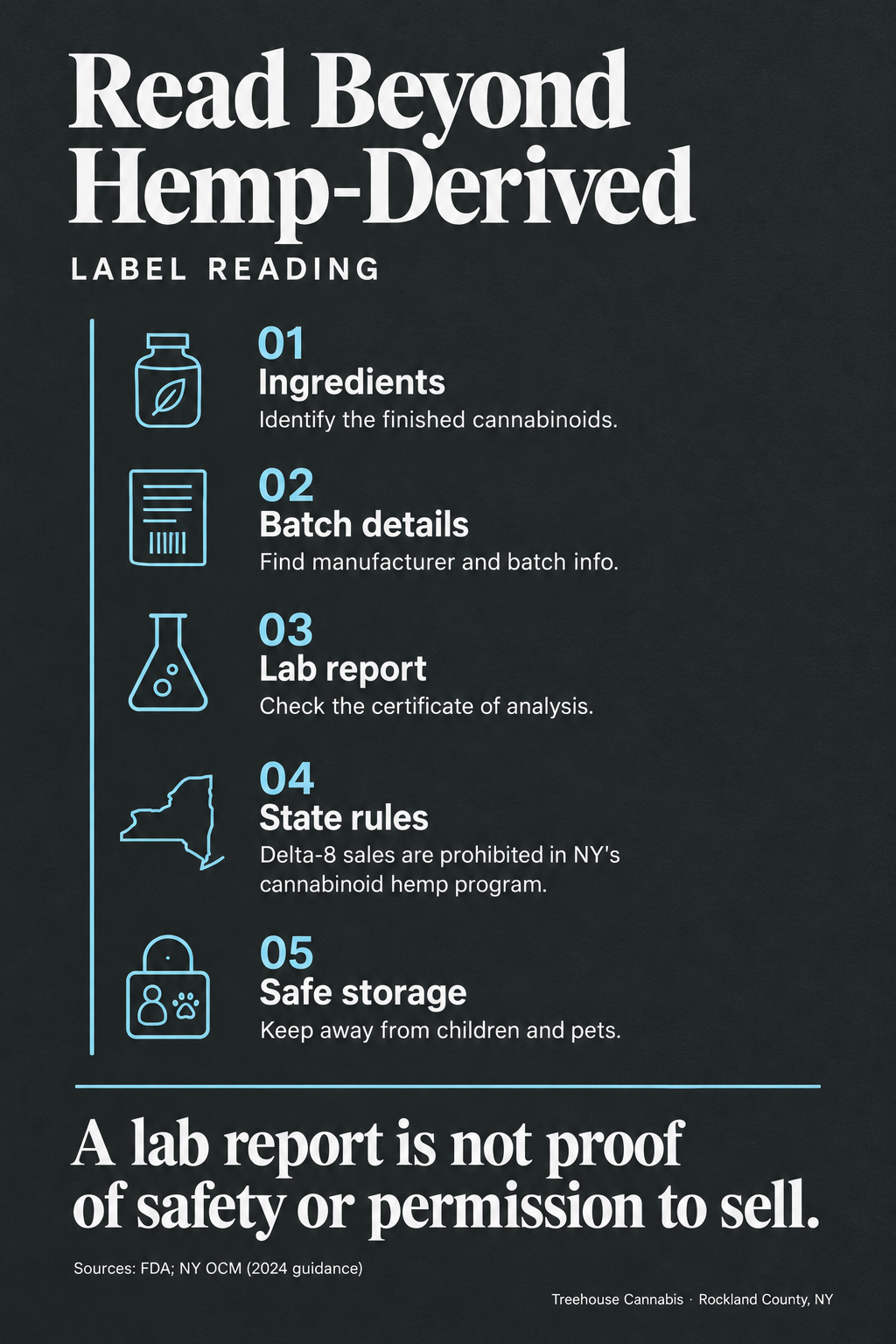
Read beyond "hemp-derived" with this checklist:
- Identify the New York regulatory program under which the seller claims to operate.
- Check the finished-product ingredients and cannabinoid names.
- Look for manufacturer identification and batch information.
- Review the certificate of analysis linked by the package's QR or bar code.
- Do not treat "Farm Bill compliant" marketing as New York sales authorization.
- Do not assume a laboratory report can make an otherwise prohibited product permissible. [3] [4]
For a broader explanation of the separate adult-use framework, see Is Weed Legal in New York? The Adult-Use Rules Explained. If the question concerns an adult-use delivery order, New York Cannabis Delivery Rules: What Shoppers Should Know covers that additional set of rules; delivery availability does not resolve a product's legal status.
Cannabis-themed merchandise is a different category again: New York Wants Weed T-Shirt is apparel, not a cannabinoid product or a delta-8 recommendation. Branding and cultural references should not be confused with authorization to sell intoxicating hemp products.
What are the common questions about delta 8?
The main questions about delta 8 concern intoxication, CBD conversion, and New York's hemp rules. The short answer is that delta-8 can impair, differs from CBD, and is prohibited in the state's cannabinoid hemp program. [1] [3]
Keep three points in view:
- Delta-8 is intoxicating even when it is hemp-derived.
- CBD and delta-8 are not interchangeable.
- New York's hemp rules are distinct from its adult-use cannabis rules.
What is delta 8 THC?
Delta-8 THC is an intoxicating cannabinoid found naturally in small amounts in cannabis. Concentrated commercial products are typically manufactured by converting hemp-derived CBD. It is related to delta-9 THC, but it is not the same compound and should not be confused with CBD, which does not produce the characteristic THC high. [1] [2]
How is delta 8 different from delta 9?
Delta-8 and delta-9 are related THC isomers, and both can produce intoxication. Delta-9 is the main THC isomer in cannabis, while delta-8 occurs in much smaller quantities. Commercial delta-8 commonly comes from converted CBD. Manufacturing, labeling, and regulation matter alongside any difference in psychoactive strength. [1] [2]
Does delta 8 get you high?
Yes. Delta-8 THC has psychoactive and intoxicating effects, according to the FDA and CDC. Descriptions such as "diet weed" or "hemp-derived" do not mean a product is non-intoxicating or safe to drive after using. Product composition and individual responses vary, so a milder reputation cannot reliably predict someone's experience. [1] [2]
Is delta 8 legal in New York?
New York prohibits delta-8 THC products in its cannabinoid hemp program. OCM guidance specifically prohibits products containing cannabinoids created through isomerization, including delta-8 THC. A hemp-derived or Farm Bill compliant label does not override state requirements. This restriction is distinct from New York's separate regulated adult-use cannabis market. [3] [4]
Is delta 8 the same as CBD?
No. CBD and delta-8 THC are different cannabinoids. CBD does not produce the characteristic THC high, while delta-8 is intoxicating. Manufacturers can chemically convert hemp-derived CBD into delta-8, but that starting material does not make the finished product equivalent to CBD or remove the possibility of impairment. [1] [2]
Is delta 8 natural or manufactured?
Both descriptions need context. Delta-8 occurs naturally in cannabis, but only in small quantities. Concentrated products are typically made by chemically converting hemp-derived CBD rather than simply extracting large amounts of naturally occurring delta-8. The FDA warns that this process can introduce potentially harmful by-products or contaminants. [1] [2]
Is delta 8 safer than delta 9?
A reputation for milder effects does not establish that delta-8 is safer than delta-9. Both can cause impairment, and the FDA has not evaluated or approved delta-8 products for safe use. Manufacturing contaminants, inaccurate labeling, and variable formulations create additional uncertainty, so delta-8 should not be presented as risk-free. [1] [2]
Sources
- U.S. Food and Drug Administration — Delta-8 THC is an intoxicating cannabinoid found naturally in small quantities;
- Centers for Disease Control and Prevention — Delta-9 is the most prominently occurring THC isomer in cannabis, while delta-8
- New York State Office of Cannabis Management — New York's consumer guidance identifies intoxicating hemp products, including pr
- New York State Office of Cannabis Management — New York's revised October 2024 guidance states that cannabinoid hemp products d
- New York State Office of Cannabis Management — The November 2021 announcement explicitly states that the cannabinoid hemp regul
About Treehouse Cannabis
Treehouse Cannabis publishes educational information for adults navigating New York's cannabis market. This article explains cannabinoid terminology and hemp-program restrictions; it does not recommend delta-8 products or represent that Treehouse sells them.
When exploring regulated adult-use cannabis, keep these questions separate:
- What cannabinoids does the finished product contain?
- What does the available label and batch information establish?
- Which New York rules apply to the product, sale, and intended setting?
This article is for educational purposes only and is not medical or legal advice. Cannabis is for adults 21 and older. Keep all cannabis products out of reach of children and pets. Do not drive or operate machinery while impaired.

Shop our products

Shop All

Deals
Flower

Pre-rolls
Vaporizers

Edibles
Drinks

Concentrates
Tinctures

Topicals
CBD

Pet CBD

Accessories