
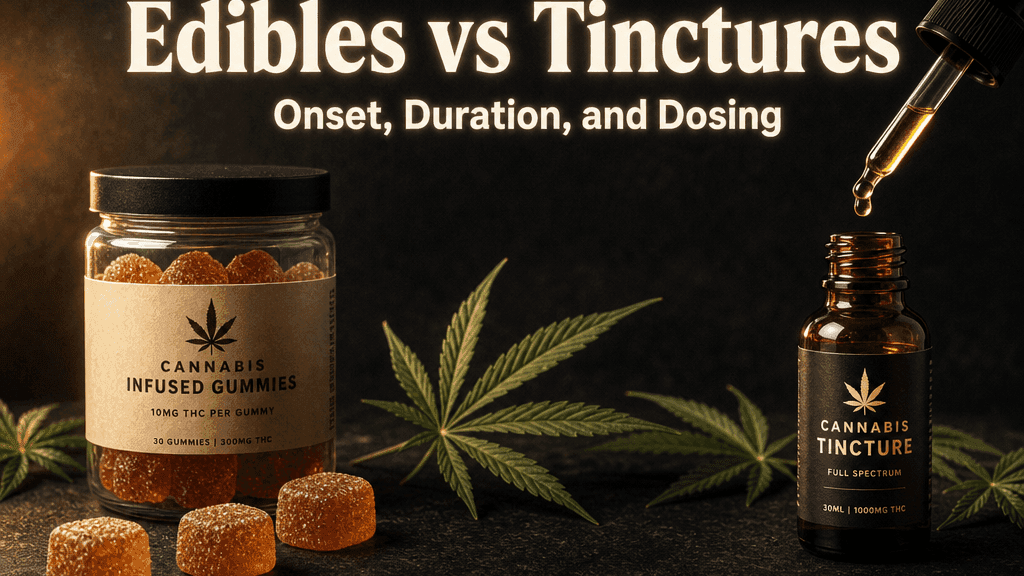
Edibles vs Tinctures: Onset, Duration, and Dosing
{ "@context": "https://schema.org", "@type": "FAQPage", "mainEntity": [ { "@type": "Question", "name": "How long does it take for edibles to kick in compared to tinctures?", "acceptedAnswer": { "@type": "Answer", "text": "Edibles typically take 30 to 120 minutes to begin producing effects because THC is absorbed through the digestive tract and metabolized by the liver. Tinctures held under the tongue usually begin working within 15 to 30 minutes because cannabinoids enter the bloodstream directly through the mouth's mucosal tissue, bypassing digestion and first-pass metabolism." } }, { "@type": "Question", "name": "How long do the effects of edibles last versus tinctures?", "acceptedAnswer": { "@type": "Answer", "text": "Edible effects commonly last 4 to 12 hours, with the strongest window at 2 to 4 hours after ingestion, due to the slow release of 11-hydroxy-THC from the liver. Sublingual tincture effects generally last 1 to 4 hours, making the two formats suited to very different timing needs." } }, { "@type": "Question", "name": "Why do edibles feel stronger than tinctures at the same dose?", "acceptedAnswer": { "@type": "Answer", "text": "When THC is swallowed, the liver converts a portion of it into 11-hydroxy-THC, a metabolite that crosses the blood-brain barrier readily and is pharmacologically active. Tinctures taken under the tongue absorb directly and skip most of that liver conversion, so the same milligrams typically feel milder." } }, { "@type": "Question", "name": "What is a safe starting dose for someone new to edibles or tinctures?", "acceptedAnswer": { "@type": "Answer", "text": "Published clinical consensus recommends starting with 2.5 to 5 mg of THC and waiting at least two hours before taking more. For tinctures, 2.5 to 5 mg held under the tongue is a comparable starting point, with at least one hour between doses so the effect can be evaluated before adjusting." } }, { "@type": "Question", "name": "Can you take a tincture and an edible at the same time?", "acceptedAnswer": { "@type": "Answer", "text": "You can, but the combined effect can be stronger and longer than either alone, and the onsets do not line up: the sublingual tincture kicks in within about 30 minutes while the edible peaks two to four hours later. Most harm-reduction guides recommend combining only with full awareness of the total THC milligram dose across both products." } }, { "@type": "Question", "name": "Is sublingual absorption more efficient than swallowing an edible?", "acceptedAnswer": { "@type": "Answer", "text": "Yes. Sublingual absorption bypasses first-pass metabolism and is closer to inhalation in speed, while oral ingestion has a published bioavailability of only about 4 to 12 percent. That lower bioavailability is part of why edible milligram doses appear much higher than tincture milligram doses on product labels." } }, { "@type": "Question", "name": "Which is better for fast-acting relief: edibles or tinctures?", "acceptedAnswer": { "@type": "Answer", "text": "Tinctures are generally the better choice for faster onset, typically within 15 to 30 minutes when held under the tongue. Edibles are better suited to situations where you want longer coverage and are willing to wait an hour or two for the effect to build, such as overnight sleep support." } }, { "@type": "Question", "name": "Do edibles or tinctures last longer in the body for drug testing?", "acceptedAnswer": { "@type": "Answer", "text": "Both routes are processed by the liver and can produce positive results on drug tests for days to weeks depending on frequency of use. The subjective effects last longer for edibles (4 to 12 hours) than tinctures (1 to 4 hours), but how long THC metabolites remain detectable is more about frequency and dose than the specific route of ingestion." } } ] }
Edibles vs Tinctures: Onset, Duration, and Dosing
How two cannabis formats deliver THC differently — and how to pick the one that fits your timing, tolerance, and routine.
Edibles vs tinctures come down to one question: do you want THC to reach your bloodstream slowly through digestion, or quickly through the tissue under your tongue? Edibles typically take 30 to 120 minutes to begin and last 4 to 12 hours, while sublingual tinctures begin within 15 to 30 minutes and last 1 to 4 hours.
How Do Edibles and Tinctures Actually Differ?
Key points:
- Edibles vs tinctures both deliver THC, but they take entirely different paths from mouth to bloodstream.
- Edibles — gummies, chocolates, baked goods, capsules — are swallowed and absorbed through the digestive tract, then sent through the liver before reaching th…
- Tinctures are liquid cannabis extracts held under the tongue, where cannabinoids cross the mucosal tissue directly into the bloodstream and largely skip the…
Edibles vs tinctures both deliver THC, but they take entirely different paths from mouth to bloodstream. Edibles — gummies, chocolates, baked goods, capsules — are swallowed and absorbed through the digestive tract, then sent through the liver before reaching the brain.
Tinctures are liquid cannabis extracts held under the tongue, where cannabinoids cross the mucosal tissue directly into the bloodstream and largely skip the digestive system. That single split — liver metabolism versus mucosal absorption — is the engine behind every other difference between the two formats.
| Format | Route | Key Difference |
|---|---|---|
| Edibles (gummies, capsules, baked goods) | Digestive tract + liver first-pass | Converted to 11-hydroxy-THC, longer and heavier effect |
| Tinctures (sublingual, held under the tongue) | Mouth mucosal tissue directly to bloodstream | Bypasses first-pass metabolism, faster and shorter effect |
| Tinctures (swallowed, not held) | Digestive tract + liver first-pass | Behaves like an edible once swallowed |
Onset, peak intensity, duration, and even how many milligrams feel strong all flow from that route split. A practical comparison of how the two routes handle a dose is laid out in CBD Topicals vs Tinctures for Joint Pain, which walks through the same sublingual-versus-digestion decision from a different angle.
If you have ever wondered why a 10 mg gummy can feel heavier than a 10 mg dropper of tincture, the answer starts with how each format reaches the bloodstream. Both formats come in roughly the same cannabinoid profiles — THC-dominant, CBD-only, or balanced ratios — but the way each delivers those cannabinoids is what makes them suited to different moments of the day.
How Long Do Edibles Take to Kick In vs Tinctures?
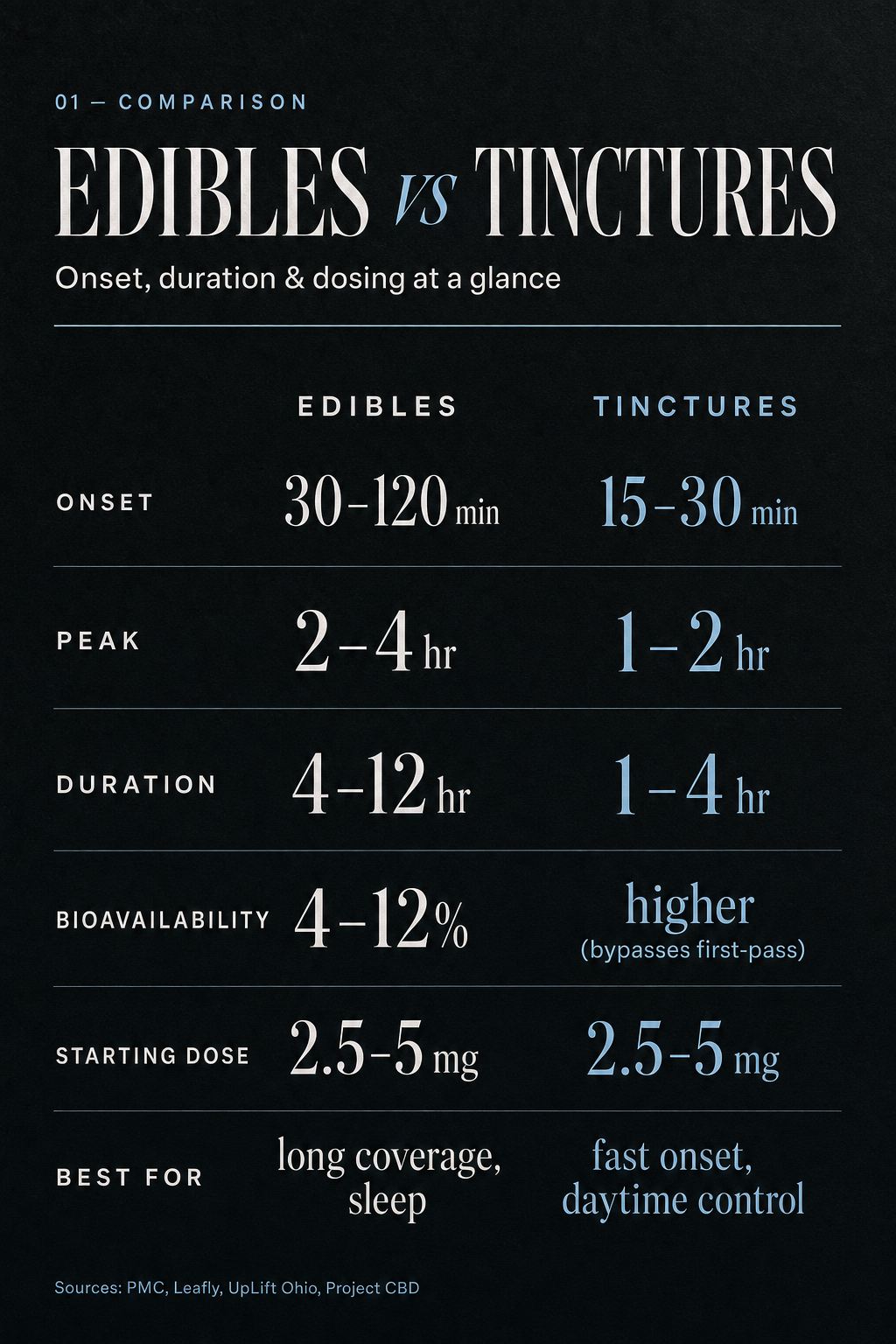
The wait time is the most practical difference between the two formats. Edibles typically take 30 to 120 minutes before any psychoactive effect becomes noticeable, with the strongest window landing at 2 to 4 hours after ingestion [1]. Tinctures taken sublingually begin working within about 15 to 30 minutes when held under the tongue for 30 to 45 seconds [4].
The reason comes down to where absorption happens:
- Digestion (edibles): THC has to travel through the stomach, the small intestine, and into the portal vein before reaching the liver, where it is converted into 11-hydroxy-THC — the metabolite responsible for the slower, heavier effect [3].
- Mucosal absorption (tinctures): Cannabinoids cross the thin tissue under the tongue directly into capillaries, reaching the brain before the liver has a chance to break much of the dose down.
- Swallowed tincture = edible: If a tincture is swallowed instead of held under the tongue, it routes through digestion and behaves like a gummy or capsule [4].
A quick-reference look at how the timing compares:
| Timing | Edibles | Tinctures (sublingual) |
|---|---|---|
| Onset window | 30–120 minutes | 15–30 minutes |
| Peak effect | 2–4 hours | 1–2 hours |
| Typical duration | 4–12 hours | 1–4 hours |
| First-dose redose danger zone | Up to 2 hours | Up to 1 hour |
That redose danger zone matters because the most common cause of over-intoxication is taking a second edible before the first one has had time to register [8]. With tinctures, the temptation is lower because the onset is fast and predictable, but the same caution still applies: wait at least an hour before adjusting the dose.
How Long Do Edibles vs Tincture Effects Last?
Key points:
- The duration gap between the two formats is just as large as the onset gap.
- Edible effects commonly last 4 to 12 hours, with the strongest window at 2 to 4 hours after ingestion, because 11 hydroxy THC is metabolized slowly by the li…
- Sublingual tincture effects generally last 1 to 4 hours, making the two formats suited to very different planning needs .
The duration gap between the two formats is just as large as the onset gap. Edible effects commonly last 4 to 12 hours, with the strongest window at 2 to 4 hours after ingestion, because 11-hydroxy-THC is metabolized slowly by the liver [5]. Sublingual tincture effects generally last 1 to 4 hours, making the two formats suited to very different planning needs [5].
Think of duration as a planning tool rather than a single number. The same edible dose can either anchor a full evening or run into the next morning if you take it too late, depending on how your body clears the active metabolites.
| Format | Typical Duration | Best-Fit Coverage Window |
|---|---|---|
| Edibles | 4–12 hours | Overnight sleep support, full-evening coverage |
| Tinctures (sublingual) | 1–4 hours | Daytime routines, predictable taper by dinner |
For storage and potency questions that affect how long a product stays effective before you even dose it, Do Edibles Expire? Potency & Safety Guide breaks down shelf life and how to read expiration dates.
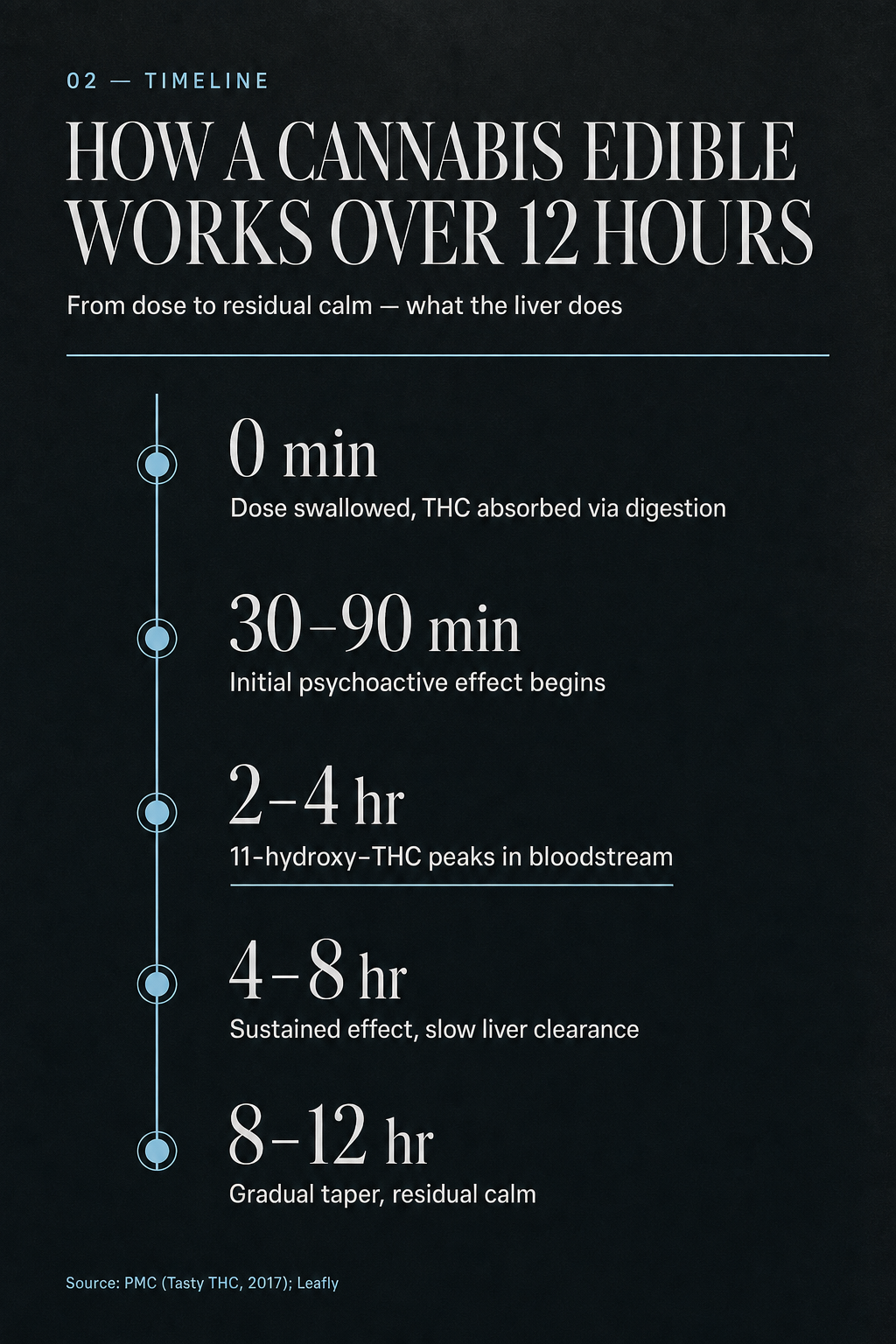
Tinctures, with their shorter window, fit more cleanly into daytime routines — a 2.5 mg dropper held under the tongue at 4 p.m. will typically taper by dinner. Edibles are better suited to situations where longer coverage is the goal, such as overnight sleep support or a full evening of symptom management where a single dose is preferable to redosing every few hours.
If you are weighing how long the raw material itself stays usable before opening — flower, oils, or other formats — How Long Does Weed Stay Fresh? covers storage basics that affect every cannabis product, not just the ones in this comparison.
Why Do Edibles Feel Stronger Than Tinctures at the Same Dose?
The same 5 mg dose can feel very different depending on whether you swallow it or hold it under your tongue. The reason is first-pass metabolism: when THC is swallowed, the liver converts a portion of it into 11-hydroxy-THC, a metabolite that crosses the blood-brain barrier readily and produces a longer-lasting and more intense effect than delta-9-THC [3].
The numbers put the difference into perspective. Orally ingested THC has a published bioavailability of only about 4 to 12 percent, because so much of the dose is lost to liver metabolism before it reaches systemic circulation [2]. Sublingual absorption bypasses most of that loss, so a higher percentage of the dose survives into the bloodstream.
Paradoxically, the lower bioavailability of edibles is part of why their milligram doses appear so high on product labels — manufacturers compensate for the loss by packing more THC into each serving.
What that means for label-reading:
- Edible milligrams are not directly comparable to tincture milligrams. A 10 mg gummy is not 1.5x stronger than a 10 mg tincture dose; it is just absorbed through a different pathway with a different active metabolite profile.
- 11-hydroxy-THC is pharmacologically active. Preclinical models suggest it can be equal to or greater than delta-9-THC in potency [1], which is why edible highs often feel heavier and longer.
- Empty-stomach absorption is faster, but not safer. Food in the stomach can delay edible onset further and make the experience less predictable — another reason most harm-reduction guidance starts with a low dose on a relatively normal stomach.
For readers considering cannabis topicals alongside these formats, the Tinctures category at Treehouse carries both flavored and unflavored options, all labeled with milligram-per-milliliter dosing that makes sublingual titration straightforward.
What Is a Safe Starting Dose for Edibles and Tinctures?
Published clinical guidance recommends starting with 2.5 to 5 mg of THC and waiting at least two hours before taking more [7]. The same range — 2.5 to 5 mg — applies to sublingual tinctures, with the caveat that you should hold the dose under the tongue for at least 30 seconds before swallowing and wait at least an hour between doses to evaluate the effect.
The logic behind low-and-slow dosing is simple: both formats build gradually, and the gap between "I feel something" and "I feel too much" can be surprisingly narrow, especially for first-time or low-tolerance customers.
Project CBD's harm-reduction guidance frames it the same way: start low, go slow, and titrate over multiple sessions rather than a single sitting [6].
A practical protocol for either format:
- Day one: Start with 2.5 mg. For tinctures, that is roughly half a dropper from a standard 5 mg/mL bottle. For edibles, it is half of a low-dose gummy or a single 2.5 mg piece.
- Day one to two: Wait the full onset window — at least two hours for edibles, one hour for tinctures — before deciding whether to take more.
- Day three or later: If the first dose was well tolerated but underwhelming, increase by 2.5 mg. Do not stack doses within the same session.
- Stop conditions: Anxiety, nausea, dizziness, or a heart rate that feels uncomfortably fast — those are signals to wait it out rather than take more.
For shoppers building a starter routine, the Edibles section groups products by milligrams per serving so the dose you read on the label matches the dose you actually take. Consensus clinical recommendations also call for up-titrating by 2.5 mg every 2 to 3 days at most, not daily [7].
How Do You Choose Between Edibles and Tinctures?
Once you understand the timing and the dose, the choice usually reduces to one question: do you want fast onset and a shorter window, or slow onset and longer coverage? Tinctures are generally the better fit for faster onset, typically within 15 to 30 minutes when held under the tongue [4]. Edibles are better suited to situations where longer coverage is the goal and you can wait an hour or two for the effect to build.
A short decision checklist that pulls the comparison together:
- Need fast, predictable timing? Tincture, held under the tongue for 30–45 seconds.
- Need long, hands-off coverage for sleep or an evening? Edible, dosed at least two hours before bed so the peak lines up with sleep onset.
- Sensitive to cannabis flavor? Tinctures — especially Unflavored Tinctures — carry a milder profile than most gummies or chocolates.
- Need discretion with no smoke or vapor? Both formats work; tinctures are particularly low-odor and dose-titratable in public-facing settings.
- Combining the two for layering effects? Possible, but the onsets do not line up — the sublingual tincture kicks in within 30 minutes while the edible peaks two to four hours later, so total THC milligrams across both products should be tracked carefully.
For customers who want a single product reference that pairs well with either format — say, a soothing strain to round out an evening routine — flower remains a familiar anchor; a well-stored eighth like Maui Wowie | Flower | 28g covers the inhalation side of the same comparison this guide covers for ingestible formats. The rule of thumb across all three routes is the same: start low, wait for the full onset window, and only adjust once you know how a single dose feels.
Frequently Asked Questions
How long does it take for edibles to kick in compared to tinctures?
Edibles typically take 30 to 120 minutes to begin producing effects because THC is absorbed through the digestive tract and metabolized by the liver. Tinctures held under the tongue usually begin working within 15 to 30 minutes because cannabinoids enter the bloodstream directly through the mouth's mucosal tissue, bypassing digestion and first-pass metabolism.
How long do the effects of edibles last versus tinctures?
Edible effects commonly last 4 to 12 hours, with the strongest window at 2 to 4 hours after ingestion, due to the slow release of 11-hydroxy-THC from the liver. Sublingual tincture effects generally last 1 to 4 hours, making the two formats suited to very different timing needs.
Why do edibles feel stronger than tinctures at the same dose?
When THC is swallowed, the liver converts a portion of it into 11-hydroxy-THC, a metabolite that crosses the blood-brain barrier readily and is pharmacologically active. Tinctures taken under the tongue absorb directly and skip most of that liver conversion, so the same milligrams typically feel milder.
What is a safe starting dose for someone new to edibles or tinctures?
Published clinical consensus recommends starting with 2.5 to 5 mg of THC and waiting at least two hours before taking more. For tinctures, 2.5 to 5 mg held under the tongue is a comparable starting point, with at least one hour between doses so the effect can be evaluated before adjusting.
Can you take a tincture and an edible at the same time?
You can, but the combined effect can be stronger and longer than either alone, and the onsets do not line up: the sublingual tincture kicks in within about 30 minutes while the edible peaks two to four hours later. Most harm-reduction guides recommend combining only with full awareness of the total THC milligram dose across both products.
Is sublingual absorption more efficient than swallowing an edible?
Yes. Sublingual absorption bypasses first-pass metabolism and is closer to inhalation in speed, while oral ingestion has a published bioavailability of only about 4 to 12 percent. That lower bioavailability is part of why edible milligram doses appear much higher than tincture milligram doses on product labels.
Which is better for fast-acting relief: edibles or tinctures?
Tinctures are generally the better choice for faster onset, typically within 15 to 30 minutes when held under the tongue. Edibles are better suited to situations where you want longer coverage and are willing to wait an hour or two for the effect to build, such as overnight sleep support.
Do edibles or tinctures last longer in the body for drug testing?
Both routes are processed by the liver and can produce positive results on drug tests for days to weeks depending on frequency of use. The subjective effects last longer for edibles (4 to 12 hours) than tinctures (1 to 4 hours), but how long THC metabolites remain detectable is more about frequency and dose than the specific route of ingestion.
Sources
- PubMed Central / PMC — Edibles take 30-90 minutes for initial psychoactive effect, peak at 2-4 hours, a
- PubMed Central / PMC — Orally ingested THC has a bioavailability of only 4-12% due to extensive first-p
- Leafly — Edibles are converted into 11-hydroxy-THC in the liver, a metabolite that crosse
- Leafly — Tinctures taken sublingually take effect within 15-30 minutes when held under th
- UpLift Ohio — Tincture onset is typically 15-60 minutes with effects lasting 1-3 hours, while
- Project CBD — Oral cannabis administration can take 60-90 minutes before effects are felt, and
- PubMed Central / PMC — Consensus clinical guidance recommends starting patients on 2.5-5 mg of each can
- Centers for Disease Control and Prevention — Edibles can take 30 minutes to 2 hours to take effect, and consuming more before
About Treehouse Cannabis
Treehouse Cannabis is an adult-use dispensary serving Rockland County, Orange County, and Westchester County from its Nanuet, NY location. The team curates a rotating menu of lab-tested flower, vapes, edibles, and tinctures and is available in-store to walk new customers through dosing, format selection, and product comparisons.
This article is intended for adults 21 and older. Cannabis is for adults 21 and older. Keep all cannabis products locked away from children and pets. Do not drive or operate heavy machinery under the influence of cannabis. If you are pregnant, nursing, or taking medication, consult a qualified clinician before using cannabis products.


Shop our products

Shop All

Flower
Pre-rolls
Vaporizers

Edibles
Drinks
Concentrates
Tinctures

Topicals

CBD

Pet CBD

Accessories