
Maui Wowie Strain: Hawaiian History and Genetics
Maui Wowie Strain: Hawaiian History and Genetics
The Maui Wowie strain is a sativa-type cultivar named for the Hawaiian island, catalogued by Leafly at an average of 19% THC and 0% CBD, and described as Hawaiian crossed with a parent that remains unknown. Its origin story rests on island oral history, and its original island genetics were largely scattered decades ago [1].
This guide separates what is documented from what is repeated. It covers the strain's reported chemistry, the printed record of cannabis in Hawaii, why the word landrace does not quite fit, what the terpene panels actually show, and how the eradication era reshaped the island's cannabis gene pool. Everything here is educational, written for adults, and drawn from published catalogues, museum flora records, state archives, and peer-reviewed reviews.
What Is the Maui Wowie Strain?
The Maui Wowie strain is a sativa-type cultivar named for the Hawaiian island. Leafly lists an average of 19% THC and 0% CBD, names Hawaiian as one parent and leaves the second unknown, and reports myrcene as dominant [1]. Those are catalogue figures, not a promise about any particular jar.
Be careful with the sativa label. It describes plant structure and reputation rather than a fixed chemical profile. Leafly notes the plant grows tall and lanky in warm tropical climates, which is a growth habit and a cultivation note, not a guarantee about what is inside the package in front of you [1].
| Quick fact | Reported detail |
|---|---|
| Type | Sativa-type cultivar |
| Reported average THC | 19% (Leafly catalogue average) |
| Reported CBD | 0% (Leafly catalogue average) |
| Listed parentage | Hawaiian crossed with a second parent that remains unknown |
| Dominant terpene | Myrcene, ahead of pinene and caryophyllene |
| Growth habit | Tall and lanky in warm tropical climates |
The essentials, in plain terms:
- Type and reported chemistry: sativa-type, 19% average THC and 0% CBD per Leafly's catalogue [1]
- Listed parentage: Hawaiian crossed with a second parent that remains unknown [1]
- Dominant terpenes in reported order: myrcene, then pinene, then caryophyllene [1]
- Aroma in plain terms: pineapple first, citrus behind it, resinous pine and earth underneath
- Growth habit: tall and lanky, which suits warm tropical climates and needs management indoors [1]
- What the name does not tell you: two batches from two growers can smell and test differently, so the batch label outranks the strain name
That last point is the throughline of this whole article. The name Maui Wowie is a lineage and a reputation, not a spec sheet. Two growers working from the same name can produce flower that shares almost nothing but the label, and that is true of plenty of older cultivars besides this one. For a sense of how other legacy lines carry their own histories, the Sour Diesel Strain Family: History, Genetics, and Terpenes is a useful comparison.
Where Did the Maui Wowie Strain Come From?
The usual account places the Maui Wowie strain on Maui in the late 1960s and 1970s, grown by small family operations in volcanic soil at elevation. That account rests on island oral history rather than on breeder records anyone can check [1] [2].
The plant's arrival on the islands predates the strain by more than a century. The first recorded written reference to cannabis in Hawaii appears in the Honolulu newspaper Ka Nonanona in 1842, which called the plant pakalolo [2]. What that record does not settle is how the plant got there. No theory of how cannabis first reached the islands has been proven, and the honest position is that the arrival route is genuinely unresolved [2].
- 1842: the Honolulu newspaper Ka Nonanona publishes the first recorded written reference to cannabis in Hawaii, calling it pakalolo [2]
- No theory of how cannabis first reached the islands has been proven, so the arrival is genuinely unsettled [2]
- The Bishop Museum records Cannabis sativa in Hawaii as found only in cultivation, never naturalized [3]
- The strain's own origin story: Maui, late 1960s and 1970s, small family operations in volcanic soil at elevation [1]
- Travelers carried it to the mainland, and Dutch and mainland breeders later adapted versions for indoor growing [1]
- Why the paper trail is thin: the line predates seed-company documentation, so the pedigree is oral history rather than a record
One detail from the flora record explains a great deal about the genetics. The Bishop Museum's database lists Cannabis sativa as cultivated on Kauai, Oahu, Maui, and Hawaii Island, and nowhere in the wild [3]. A plant that only exists where people keep it is a plant whose lineage depends entirely on who kept it and what they crossed it with. There was no wild reservoir to draw from and no isolated population drifting on its own. Every generation passed through human hands.
Once the line left the islands, mainland and Dutch breeders adapted versions of it for indoor growing. That is why the name survives on seed catalogues even where the original island genetics do not, a pattern that also shows up in the White Durban Strain: Genetics and Terpene Profile and in the terpene-first approach behind The Cannabis Terpene Wheel: A Visual Guide to Every Common Terpene.
Is the Maui Wowie Strain a True Landrace?
Strictly, no. Hawaii's cannabis arrived by ship within the last two centuries, crossed freely once it landed, and was never isolated long enough to stabilize into a landrace. That makes the Maui Wowie strain an heirloom assembled within living memory rather than a centuries-isolated population.
The flora record supports the first half. The Bishop Museum lists Cannabis sativa in Hawaii as present only in cultivation on Kauai, Oahu, Maui, and Hawaii Island, never naturalized, and assigns the plant a high Pacific weed-risk assessment score of 12 [3]. That score is an assessment of what could happen if the plant escaped cultivation, not a finding that it has taken over Hawaiian ecosystems. The museum's own record says it has not.
- What landrace actually requires: a population isolated long enough to stabilize on its own, in one place, under one set of conditions
- What Hawaii delivered instead: cannabis that arrived by ship and exists only in cultivation, per the Bishop Museum's flora database [3]
- The museum's weed-risk score for Cannabis sativa in Hawaii is 12 on the Pacific scale, a high rating for an introduced cultivated plant [3]
- Genomic evidence: seven pooled sequence datasets found extensive hybridization between landrace and modern cultivars [10]
- The honest label for Maui Wowie: heirloom, meaning an old line maintained by people rather than by geography
- Why it matters at the counter: seed companies sell their own versions under the same name, sometimes with different genetics entirely
The genomic side is just as clear. A University of Hawaii at Manoa study pooled seven independently developed Cannabis sequence datasets and found population structure by use type alongside evidence of extensive hybridization between landrace and modern cultivars [10]. The authors concluded the genus is more complex than a simple hemp-versus-drug-type split implies [10]. In other words, the categories people use in conversation do not map cleanly onto the plants themselves.
| Question | Landrace | Heirloom |
|---|---|---|
| How long isolated | Centuries in one place, without outside introductions | Generations, but with ongoing human selection and occasional new genetics |
| How it reproduced | Openly, in place, with the local population | Under human management, often with deliberate crosses |
| Documentation | Usually collected and catalogued by institutions | Often oral or commercial, and frequently lost |
| Is Maui Wowie this? | No | Yes |
None of this is an insult to the strain. It is a definitional correction, and it matters because the word landrace is doing marketing work it has not earned. Seed companies now sell their own lines under the Maui Wowie name, which means the label describes a lineage of names as much as a lineage of plants. The same distinction applies to the Acapulco Gold Strain: History, Genetics, and Terpene Profile, which carries a comparable reputation and a similarly thin paper trail.
What Are the Maui Wowie Terpenes?
Leafly reports myrcene as dominant in the Maui Wowie strain, followed by pinene and then caryophyllene [1]. That is one catalogue's order, and plenty of dispensary panels show terpinolene or limonene leading instead, which makes the batch panel the number that actually counts.
The disagreement is real, not sloppy. A peer-reviewed review of cannabis terpene chemistry reports that strains sort into five chemotype groups by predominant terpene: myrcene, pinene, caryophyllene with limonene, caryophyllene alone, and terpinolene [8]. The same review reports that terpene proportions vary with variety, plant part, environment, maturity, and analytical method [8]. That is the mechanism behind two panels disagreeing about the same strain name.
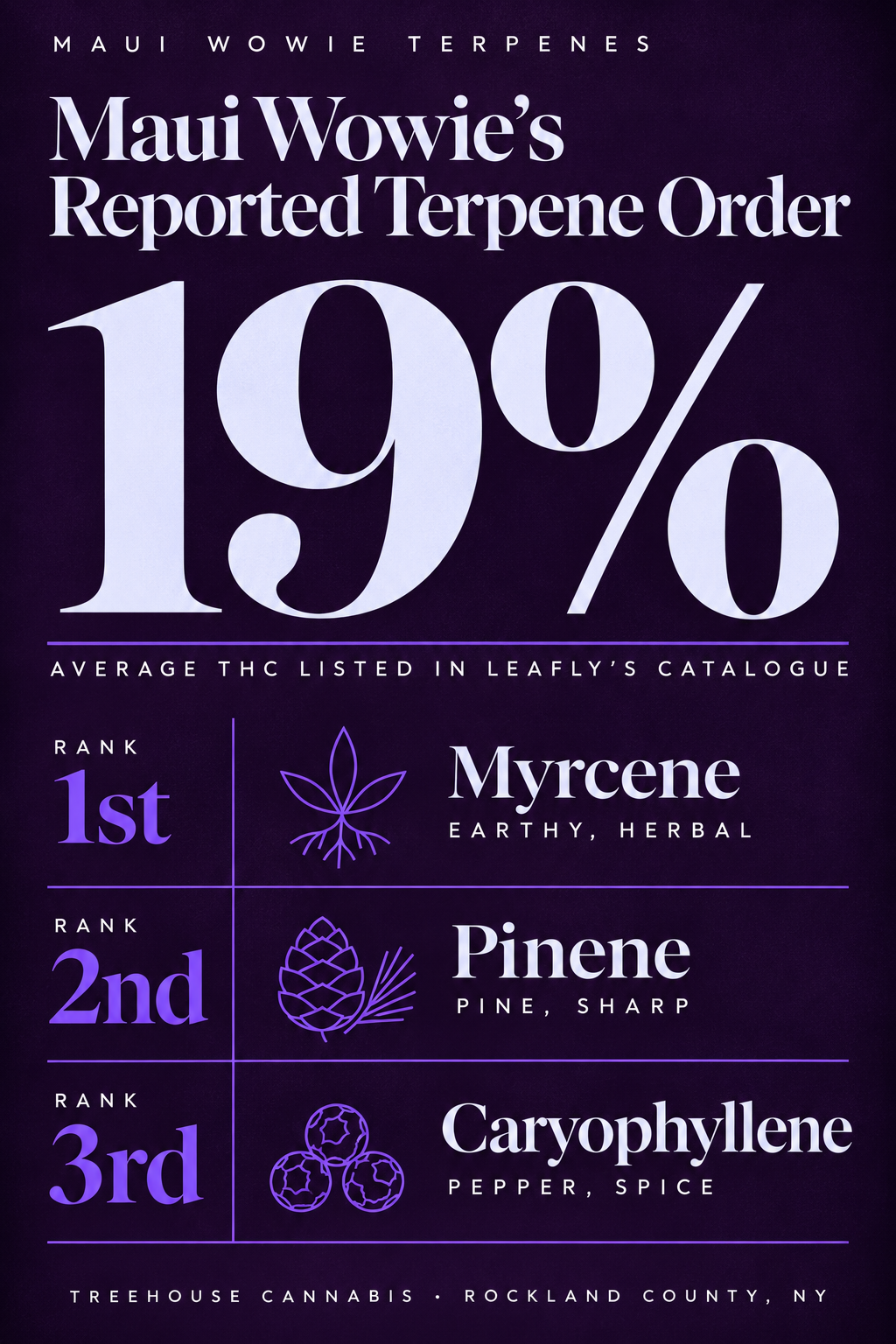
Here is each terpene in the reported order, with the aroma it carries:
- Myrcene: reported dominant, earthy and herbal, and the most prevalent terpene across cannabis varieties generally [9]
- Pinene: reported second, carrying the pine note and much of the sharpness in the aroma
- Caryophyllene: reported third, peppery and spiced, and the only terpene known to bind directly to the CB2 receptor [9]
- Five chemotype groups by predominant terpene: myrcene, pinene, caryophyllene with limonene, caryophyllene alone, and terpinolene [8]
- Why panels disagree: terpene proportions shift with variety, plant part, environment, maturity, and the analytical method used [8]
- The 0.5% myrcene line is a descriptive convention in the literature, not a prediction about any individual's experience [9]
One chemistry detail is worth knowing because it comes up constantly. Beta-caryophyllene is the only terpene known to bind directly to the CB2 receptor, which is why it appears so often in conversations about how terpenes interact with the body at all [9]. That is a receptor-binding observation from the literature, not a therapeutic claim, and it does not mean a peppery batch does anything in particular for anyone.
The sedation question needs the same care. The literature describes chemotypes above roughly 0.5% myrcene as sedative and lower-myrcene chemotypes as more energetic [9]. Those are descriptive labels used to sort samples, not rules about what any one person will feel. A strain name cannot predict where a given jar lands on that scale.
So what do you do with all of this? Ask for the batch's terpene panel and compare it against the aroma. If you want to see how terpene profiles are organized across the whole plant rather than one cultivar, the current Whole Flower Flower selection is a reasonable place to start reading labels.
Why Is the Maui Wowie Strain So Hard to Find?
Two forces made the original Maui Wowie strain nearly impossible to find: decades of helicopter eradication that began in 1977, and generations of crossing with mainland hybrids. Both pushed pure island lines toward extinction, which is why what sells as Maui Wowie today is usually a modern recreation.
Start with the eradication record, which the Hawaii National Guard documents in its own archive. Cannabis eradication began in 1977, when Hawaii became the first state to use National Guard equipment and personnel in drug enforcement. One documented 1978 phase confiscated nearly 22,000 pounds of marijuana on Maui, Molokai, and Kauai, and a single later fiscal year accounted for 434,905 destroyed plants across seven helicopter operations [7]. Each of those figures belongs to the specific operation it describes, not to a decade-wide average.
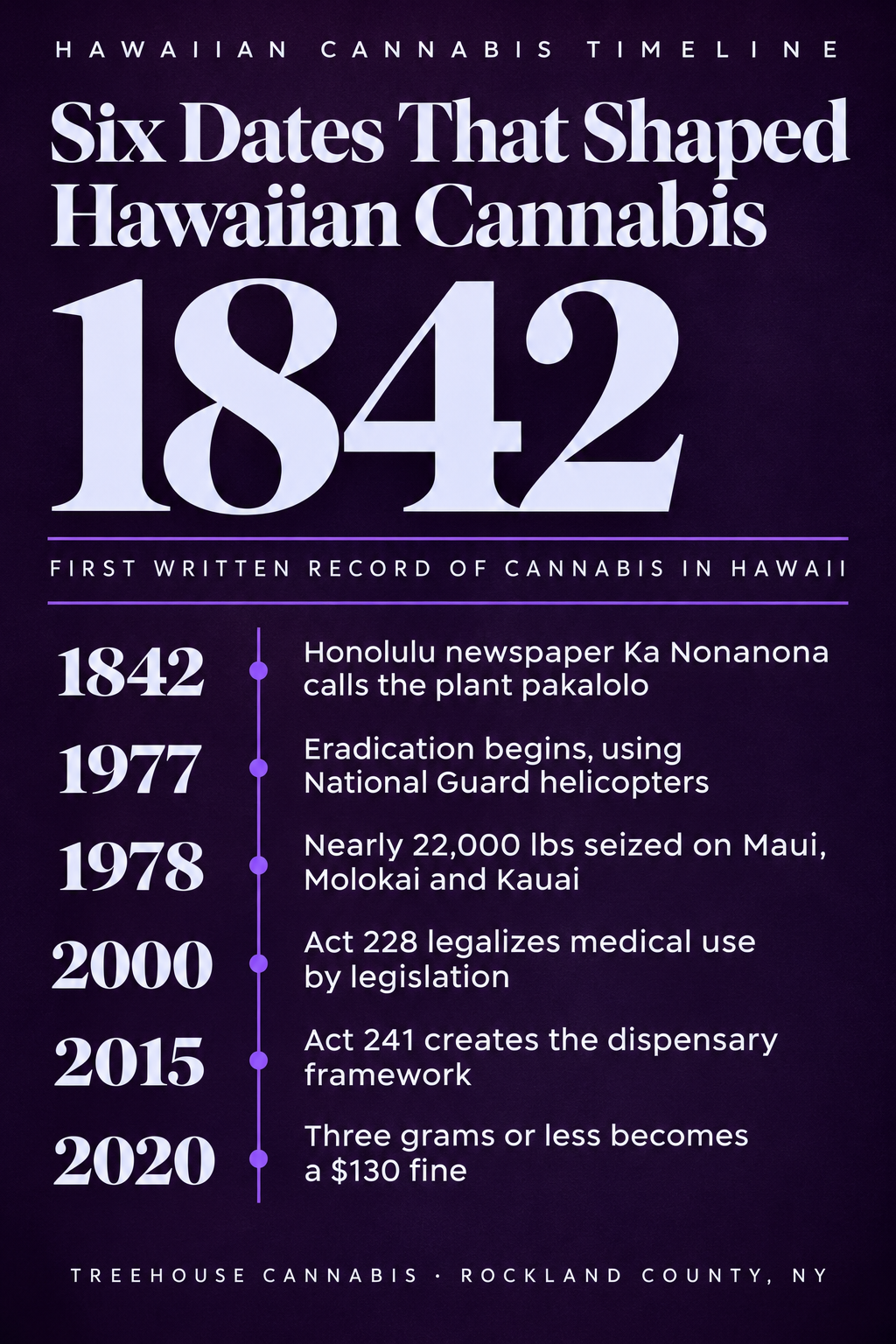
The legal arc that followed built the market customers shop in today:
- 1977: eradication begins, and Hawaii becomes the first state to use National Guard equipment and personnel in drug enforcement [7]
- 1978: one documented phase confiscates nearly 22,000 pounds of marijuana on Maui, Molokai, and Kauai [7]
- One later fiscal year alone: 434,905 plants destroyed across seven helicopter operations [7]
- 2000: Act 228 establishes Hawaii's medical program by legislation, the first state to do it that way rather than by ballot, effective June 14, 2000 [5]
- 2015: Act 241 creates the dispensary framework, codified as Chapter 329D of the Hawaii Revised Statutes [4]
- 2020: Act 273 makes three grams or less a violation carrying a $130 fine, effective January 11, 2020 [6]
On the first of those, the Legislature's research bureau is specific: Hawaii was the first state to establish a medical marijuana program through legislation rather than a ballot initiative, authorized by Act 228 and codified as part of chapter 329 of the Hawaii Revised Statutes [5]. The Department of Health's registry program publishes the same chain, including Act 241 of 2015 as the dispensary law codified as Chapter 329D [4]. The 2019 decriminalization act added the current threshold, making possession of three grams or less a violation punishable by a $130 fine, with expungement provisions, effective January 11, 2020 [6].
Put the two halves together and the outcome is easy to see. Eradication removed the plants. Hybridization replaced them, because every grower who kept a line going crossed it with whatever else was available. The legal market that finally arrived in 2015 inherited a name without the genetics that made the name mean something.
How Do You Choose a Maui Wowie Strain at a Dispensary?
Read the batch label instead of the strain name. Check the terpene panel, the harvest or package date, and the THC figure for that specific batch, because Maui Wowie describes lineage and reputation rather than a fixed chemical profile.
Be realistic about potency too. Leafly lists a 19% THC average for the strain [1], while contemporary flower often lands in the high teens to low twenties. Vape and concentrate versions test far higher because extraction concentrates cannabinoids, not because the plant itself changed. That is the single most useful thing to understand before comparing a flower jar to a cartridge: same lineage, different levels of concentration.
- Read the batch, not the name: the terpene panel and the THC figure belong to that harvest, not to the cultivar
- Ask which terpene leads, since myrcene, pinene, and caryophyllene are the reported order but batch panels vary [1]
- Check the package or harvest date, because terpene content shifts with maturity and handling [8]
- Flower and pre-rolls keep the full aroma profile, while vapes and concentrates test far higher because extraction concentrates cannabinoids
- Smell it when the shop allows, since the nose is the fastest read on freshness and on whether the panel matches the jar
- In New York, adult-use cannabis is for adults 21 and older, and the package label carries the potency and ingredient information
Format is the second decision, and the four common formats differ in ways the label can show you:
| Format | Aroma character | Reported cannabinoid level | Practical fit |
|---|---|---|---|
| Flower | Full terpene profile: pineapple, citrus, pine | The batch's own tested figures | A slower session where aroma is the point |
| Pre-rolls | Close to flower, though grind and dryness vary | The batch's own tested figures | Portability without carrying a grinder |
| Vapes | Muted terpene character, cannabinoid-forward | Tests far higher because extraction concentrates cannabinoids | Quick, discreet, and portable |
| Concentrates | Least plant aroma of the four formats | Highest of the formats listed | Comparing potency between batches |
Flower and pre-rolls preserve the full aroma profile, which is where the pineapple-and-pine character actually lives. Vapes and concentrates deliver a much higher cannabinoid number with far less of the plant's terpene character. Neither is better, but they are not interchangeable experiences, and treating a cartridge like a jar of flower is how people end up surprised. If the plan is a slow evening with a familiar aroma, flower is the honest choice; if the plan is something portable and quick, a vaporizer fits.
A higher THC number does not mean better cannabis, and it is worth saying plainly. A batch that tests at 22% with a terpene panel you like is a better purchase than a 27% batch that smells like hay, because aroma is a real signal about how the plant was grown, dried, and stored.
If you are shopping in Rockland, Orange, or Westchester County, the last practical step is the simplest one: ask the staff which batch is freshest and what leads in its terpene profile. A shop that can answer that question is a shop worth buying from. For a starting point on flower formats, the Bottomless Mints Flower - 70g is one option among many on the shelf.
Where Should You Start with the Maui Wowie Strain?
Maui Wowie is a name with a real history behind it and very little paperwork, which is exactly why the batch matters more than the label. The island origin is oral history, the landrace claim does not survive contact with the flora record, and the original genetics were scattered long before anyone catalogued them.
- Treat the strain name as a lineage and a reputation, not a chemical specification
- Read the batch terpene panel before the THC percentage, and check the package date for freshness
- Expect myrcene, pinene, and caryophyllene as the reported order, but believe the panel in front of you
- Understand that flower, pre-rolls, and vapes are the same lineage at different concentrations
- Ask staff which batch is freshest and what leads in its terpene profile
Treehouse Cannabis in Rockland County, NY carries flower, pre-rolls, and vape options for customers who want to compare a terpene panel against the aroma in their hand. Ask our staff which batch is freshest and what leads in its terpene profile before you choose. Browse the shelf or order online for pickup and delivery across Rockland, Orange, and Westchester Counties, for adults 21 and older.
Frequently Asked Questions
Is Maui Wowie indica or sativa?
Most catalogues call it a sativa, and Leafly lists a 19% THC average with 0% CBD. The label describes plant structure and reputation more than chemistry [1]. Two Maui Wowie batches from different growers can smell and test quite differently from each other.
What are Maui Wowie's parent strains?
Nobody can prove it. Leafly describes the cross as Hawaiian with a second parent that remains unknown, and no breeder record exists [1]. The line predates seed-company paperwork, so the pedigree rests on island oral history rather than documentation anyone can check.
What does Maui Wowie smell and taste like?
Pineapple leads, with citrus behind it and a resinous pine and earth base underneath. Reviews describe the fruit note as fresh rather than candy-sweet, which is the clearest difference between Maui Wowie and the dessert cultivars that dominate dispensary menus today [1].
What terpenes are in Maui Wowie?
Leafly reports myrcene as dominant, followed by pinene and caryophyllene [1]. Some dispensary panels instead show terpinolene or limonene leading. No single panel settles it, because terpene ratios shift with grower, batch, plant maturity, and the lab method used [8]. Reading a batch's own label beats trusting the strain name.
Where did Maui Wowie come from?
The usual account places it on Maui in the late 1960s and 1970s, grown by small family operations in volcanic soil at elevation [2]. Travelers carried it to the mainland, and Dutch and mainland breeders later adapted versions of it for indoor growing [1].
Is Maui Wowie a true landrace?
Strictly, no. Hawaii's cannabis arrived by ship and cross-pollinated freely, which makes it an heirloom assembled within living memory rather than a centuries-isolated landrace. The Bishop Museum records Cannabis in Hawaii as only found in cultivation, never naturalized [3]. Seed companies now sell their own lines under the name [10].
How strong is Maui Wowie?
Its reputation is mild by modern standards. Leafly lists a 19% THC average, while contemporary flower often lands in the high teens to low twenties [1]. Vape and concentrate versions test far higher because extraction concentrates cannabinoids, not because the plant itself changed.
Why are original Hawaiian strains so hard to find?
Operation Green Harvest began in 1977 with National Guard helicopters, and one documented 1978 phase seized nearly 22,000 pounds on Maui, Molokai, and Kauai [7]. Decades of eradication, plus crossing with mainland hybrids, pushed pure island lines toward extinction. What sells as Maui Wowie today is usually a modern recreation.
Sources
- Leafly — Leafly's strain catalogue lists Maui Wowie as a sativa averaging 19% THC and 0%
- Leaf Magazines — Traces the first recorded written reference to cannabis in Hawaii to the Honolul
- Bishop Museum, Plants of Hawai'i — The Bishop Museum's flora database records Cannabis sativa in Hawaii as only fou
- Hawaii State Department of Health, Medical Cannabis Registry Program — The Department of Health publishes the statutory chain behind legal cannabis in
- Hawaii Legislative Reference Bureau — The Legislature's research bureau documents that Hawaii was the first state to e
- Hawaii State Legislature — The 2019 decriminalization act made possession of three grams or less of marijua
- State of Hawaii Department of Defense — The Hawaii National Guard's historical archive records that cannabis eradication
- Molecules (MDPI), via PubMed Central — A peer-reviewed review of cannabis terpene chemistry reports that strains sort i
- Medical Cannabis and Cannabinoids (Karger), via PubMed Central — A peer-reviewed review reports that myrcene is the most prevalent terpene in mos
- University of Hawaii at Manoa, ScholarSpace — A University of Hawaii at Manoa study pooling seven independently developed Cann
About Treehouse Cannabis
Treehouse Cannabis is a licensed adult-use dispensary in Rockland County, New York, serving customers across Rockland, Orange, and Westchester Counties. The shop carries flower, pre-rolls, and vaporizers, and the team will walk you through terpene panels, potency labels, and packaging before you choose.
Cannabis is for adults 21 and older. Keep all cannabis products in their original labeled packaging, out of reach of children and pets. Do not drive or operate machinery after use, and do not combine cannabis with alcohol or other substances. This article is educational and is not medical advice. Cannabis affects people differently, and the research cited here describes measured findings in study samples rather than predictions about any individual.

Shop our products

Shop All

Deals
Flower

Pre-rolls
Vaporizers

Edibles
Drinks

Concentrates
Tinctures

Topicals

CBD

Pet CBD

Accessories