How Grind Size Changes the Way Cannabis Burns
How Grind Size Changes the Way Cannabis Burns
Cannabis grind size changes how cannabis burns by setting how much surface area meets heat. Smaller pieces burn hotter and faster with a harder hit per puff, while coarser pieces smolder longer and deliver more total THC across a session, and machine-smoked joints show it cleanly: 1 mm flower finished a 0.5 g joint in 28 puffs while the 3 mm and 5 mm joints needed 52 to 54 [1].
Grind size is the quiet variable in every smoke session. You pick it before the flame ever touches the flower, you rarely think about it, and it sets how hot the cherry runs, how hard each draw lands, and how long the whole thing lasts.
The research on this is unusually specific, and none of it depends on strain, brand, or price. What follows is what each cut actually does, why it does it, and how to pick one on purpose instead of by habit.
What Is Cannabis Grind Size and Why Does It Matter?
Cannabis grind size is the average particle size of flower after it has been broken up, usually described in millimeters or in shorthand as fine, medium, and coarse. It matters because the size of those pieces sets how much surface area meets heat when the flower burns.
A grinder exists for one reason: breaking cannabis into small pieces of similar size and consistency so joints, blunts, spliffs, and bowls behave the same way each time [9]. Consistency is the product. Size is the setting.
- Grind size is the average size of the pieces after flower is broken up, with fine, medium, and coarse as shorthand for roughly 1 mm, 3 mm, and 5 mm particles
- A grinder's job is consistency: small pieces of similar size so a joint, blunt, or bowl burns predictably
- Grind size is one variable, not the variable, because moisture content influences burn rate more than anything else
- Moisture in the 3% to 8% range is described as producing the most desirable burn, with grind consistency, packing, airflow, heat source, and draw frequency sitting right behind it [6]
- The three sizes used in the published joint research are 1 mm, 3 mm, and 5 mm, and those are the reference points for this article
That hierarchy is worth stating plainly, because it keeps expectations honest. Grind size changes the burn. It does not single-handedly control it. Flower that has dried out past the point of usefulness will run hot and fast no matter how carefully you cut it, and flower stored badly will do the same. If keeping flower in good condition is already on your mind, How Long Does Weed Stay Fresh? covers the storage side of the equation.
Where grind size earns its keep is repeatability. Two sessions with the same flower, the same roll, and different particle sizes are genuinely different experiences, and the difference is measurable rather than a matter of opinion.
Why Does Ground Weed Burn Faster Than Coarse Flower?
Ground weed burns faster because smaller pieces expose more surface area per gram, so heat reaches more material at the same moment. The ember does not have to work through the outside of a bud first.
Biomass pyrolysis experiments across particle sizes show the mechanism directly: as particle size decreases, the pyrolysis area increases and the influence of heat and mass transfer decreases, which facilitates and speeds the pyrolysis process itself [8]. Smaller particles also release volatiles faster than larger ones [8]. Less material to heat through means the reaction front moves sooner.
- Smaller particles mean more exposed surface per gram, so heat reaches more material at the same moment
- Pyrolysis research shows smaller biomass particles release volatiles faster and speed the pyrolysis process itself
- In a joint, THC is vaporized by hot air pulled through the unburned flower behind the ember, not at the burn site
- Roughly 20% of a joint's THC is estimated to reach the smoker at a five-second puff each minute, with the rest lost to pyrolysis and sidestream smoke
- THCA becomes active THC by heat-induced decarboxylation above 115 degrees Celsius, so heat contact is what makes the dose available at all
The joint-specific physics matter here, because most people picture the ember as the thing doing the work. It is not, exactly. THC is vaporized by hot air drawn through the unburned material behind the ember rather than at the burn site itself [7]. The cherry is a heat engine; the air moving past it is what carries cannabinoids into your mouth.
That pathway has real losses built in. NIDA researcher Richard Hawks estimated in 1982 that about 20% of the THC in a cannabis cigarette reaches the smoker when a five-second puff is taken every minute, with the remainder lost to pyrolysis and sidestream smoke [7]. Published estimates put up to 50% of THC lost in sidestream smoke, up to 30% destroyed by pyrolysis, and about 10% trapped in the butt [3].
Separately, more than 95% of the potentially active THC from smoking comes from THCA converted by heat-induced decarboxylation above 115 degrees Celsius [5]. Nothing is available until heat does that conversion, which is why the geometry of heat contact drives everything downstream.
The practical payoff: a finer grind pushes more material into the hot zone sooner. It hits harder per puff, runs hotter, and finishes faster. That is the whole trade in one sentence. If format choice is still open for you, Flower, Vapes, Edibles, or Concentrates: Which Format Fits You? compares flower against vapes, edibles, and concentrates on exactly this kind of timing question, and How Long Should You Wait Before Taking More Cannabis? covers how long the effects tend to run once they land.
What Changes With a Fine vs Coarse Weed Grind?
Fine burns hottest and fastest with the biggest hit per puff; coarse smolders slowly and hands over more total THC because it lasts nearly twice as long. Medium sits between them. The table below settles it in five seconds.
| Fine (about 1 mm) | Medium (about 3 mm) | Coarse (about 5 mm) | |
|---|---|---|---|
| Feel between fingers | Fine, almost sandy, packs dense | Granular, holds shape when pinched | Chunky, individual pieces still visible |
| How fast it burns | Fastest, stays lit easily | Moderate | Slowest, may need relighting early |
| Hit per puff | 0.67 mg THC | 0.31 mg THC | 0.51 mg THC |
| Puffs to finish a 0.5 g joint | 28 | 52 to 54 | 52 to 54 |
| Total THC delivered | 16 to 19 mg | 16 to 19 mg | 28 mg |
| Best for | A short, potent session | Joints, spliffs, the forgiving default | Long sessions, bongs, blunts |
Those figures come from machine-smoked 0.5 g joints in a controlled comparison, not from subjective ratings [1]. The puff counts are the cleanest illustration of the mechanism: fine flower finished in 28 puffs while both coarser sizes needed 52 to 54 [1].
- Fine, about 1 mm: burns hottest and fastest, 0.67 mg THC per puff, finished in 28 puffs
- Medium, about 3 mm: the middle setting, 0.31 mg THC per puff, 52 to 54 puffs to finish
- Coarse, about 5 mm: burns slowest, 0.51 mg THC per puff, 52 to 54 puffs but far more total THC delivered
- Fine wins on intensity per puff, coarse wins on total cannabinoids delivered per gram
- There is no universal best grind, because the choice trades session length against how hard each draw lands
Read the middle column carefully, though, because it is the one that surprises people. Medium delivered the least THC per puff of the three sizes at 0.31 mg, below both the fine and the coarse [1]. Fineness and coarseness each have a mechanism working for them; the middle setting has neither in full.
There is also a genuine quality floor underneath all of this. Flower that was never stored well, or that was harvested and cured poorly, will not be rescued by a better cut. What Makes Premium Cannabis Flower Cost More? breaks down what actually separates top-tier flower from the rest, and grind size is not on that list.
How Does Cannabis Grind Size Change Potency Per Puff and Puff Count?
Per puff, finer is stronger. Over a whole session, coarser delivers more. Both statements are true, and the confusion between them is where most grind advice goes wrong.
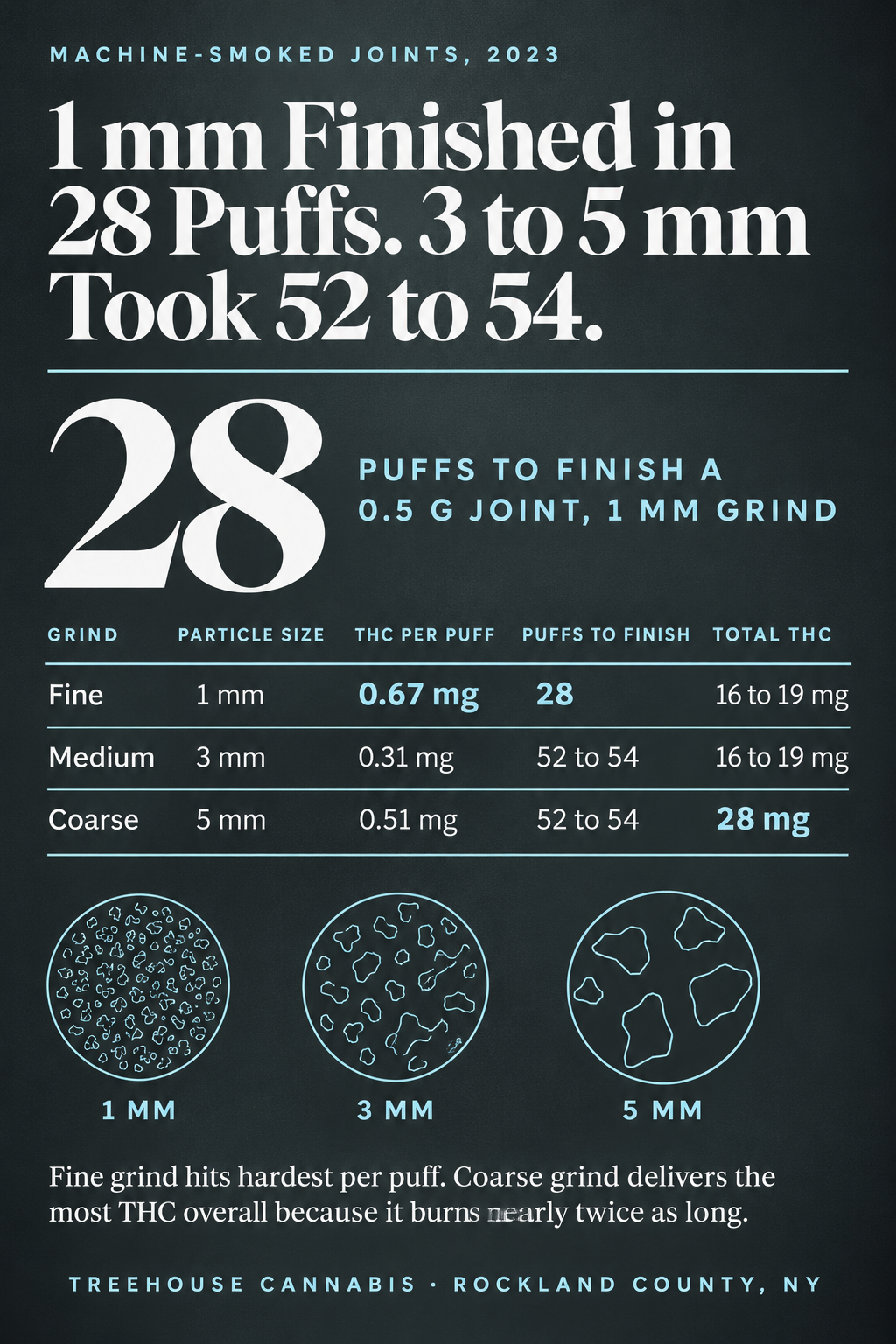
The per-puff numbers: 1 mm flower delivered 0.67 mg of THC per puff against 0.31 mg at 3 mm and 0.51 mg at 5 mm [1]. The same pattern held for CBD, where 1 mm joints delivered 4.75 mg per puff against 4.29 mg at 3 mm and 3.45 mg at 5 mm [1]. Smaller pieces, more surface, more cannabinoid per draw.
The per-session numbers invert it. The 5 mm joints delivered 28 mg of THC across the session versus 16 to 19 mg for the 1 mm and 3 mm joints, purely because they burned roughly twice as long [1].
| Measurement | Fine (1 mm) | Medium (3 mm) | Coarse (5 mm) |
|---|---|---|---|
| THC per puff | 0.67 mg | 0.31 mg | 0.51 mg |
| Total THC per 0.5 g joint | 16 to 19 mg | 16 to 19 mg | 28 mg |
| Puffs to finish | 28 | 52 to 54 | 52 to 54 |
| Rise from start to middle of joint | about 50% | about 50% | about 500% |
- Per puff: 1 mm delivered 0.67 mg THC, 3 mm delivered 0.31 mg, 5 mm delivered 0.51 mg
- Per session: 5 mm delivered 28 mg total THC versus 16 to 19 mg for the finer sizes because it burned twice as long
- Per-puff potency and total dose are different measurements, so the harder-hitting grind is not the bigger total
- THC delivery ranged from 0.09 mg to 0.88 mg per puff across a joint's lifecycle, lowest at the start
- Coarse joints ramped about 500% from beginning to middle while fine joints rose roughly 50%, so a coarse joint finds its stride halfway down
The within-joint variance is the part almost nobody accounts for. THC delivery swung from 0.09 to 0.88 mg per puff across a joint's lifecycle, lowest at the start, and 5 mm joints saw delivery rise about 500% from beginning to middle while the 1 mm and 3 mm joints rose roughly 50% [1].
That explains a familiar experience. The first draws of a coarse joint feel thin and slightly disappointing, then the middle of the joint hits noticeably harder. The roll did not change. The burn zone did. A joint heats up, the cherry widens, and more hot air moves through more material as it goes.
So the honest answer to "does a finer grind get you higher" is: per puff, usually yes. Across a full session, not necessarily. If you are buying flower to grind yourself, Whole Flower Flower gives you whole buds to work with, and whole flower is the only format where you control the particle size at all.
Why Does Grind Consistency Matter More Than Grind Size?
Consistency beats size. A joint made from a spread of interlocking pieces burns more evenly than one made from a single uniform cut, and the failures people blame on grind size are usually failures of consistency.
- Uneven burns trace back to inconsistent particle size, uneven packing, or a channel forming down one side
- A mix of fine and coarse pieces interlocks; one uniform cut leaves gaps between pieces
- Increasing pre-roll biomass from 0.5 g to 1.5 g produced uneven burning, darker ash, and unburned material in ashing trials
- Air follows the path of least resistance, so a gap on one side lets the cherry run ahead while the other side goes out
- Stop grinding before the flower turns to powder, pack snug rather than compressed, and check the roll feels even end to end
The mechanism is simple once you picture it. Gaps between mismatched pieces give air an easy path, so one side of the cherry runs ahead while the other lags or goes out entirely. That is what canoeing is: not bad flower, just a pressure gradient.
Packing compounds it. In ashing tests, increasing pre-roll biomass from 0.5 to 1.5 grams caused uneven burning, darker ash, and unburned cannabis material [2]. More material in the same tube means a denser column, less airflow, and a burn that cannot keep up with the draw.
Hand-grinding produces that spread of sizes naturally, which is the practical reason a hand-ground joint often outperforms a uniformly milled one. A grinder run too long produces something closer to powder, and powder packs into a dense plug that channels badly. The skill is stopping at the right point, not buying a different tool.
It also explains why moisture keeps showing up in this conversation. Water activity changes how readily material ignites and how much heat it absorbs before it burns, and the literature treats moisture content as the single biggest influence on burn rate, ahead of grind, packing, airflow, heat source, and draw frequency [6].
How to Grind Cannabis for Joints, Pipes, and Bongs?
Load loosely, rotate about ten times, and stop while the pieces still vary in size. That is the whole technique. Everything else is matching the cut to the method.
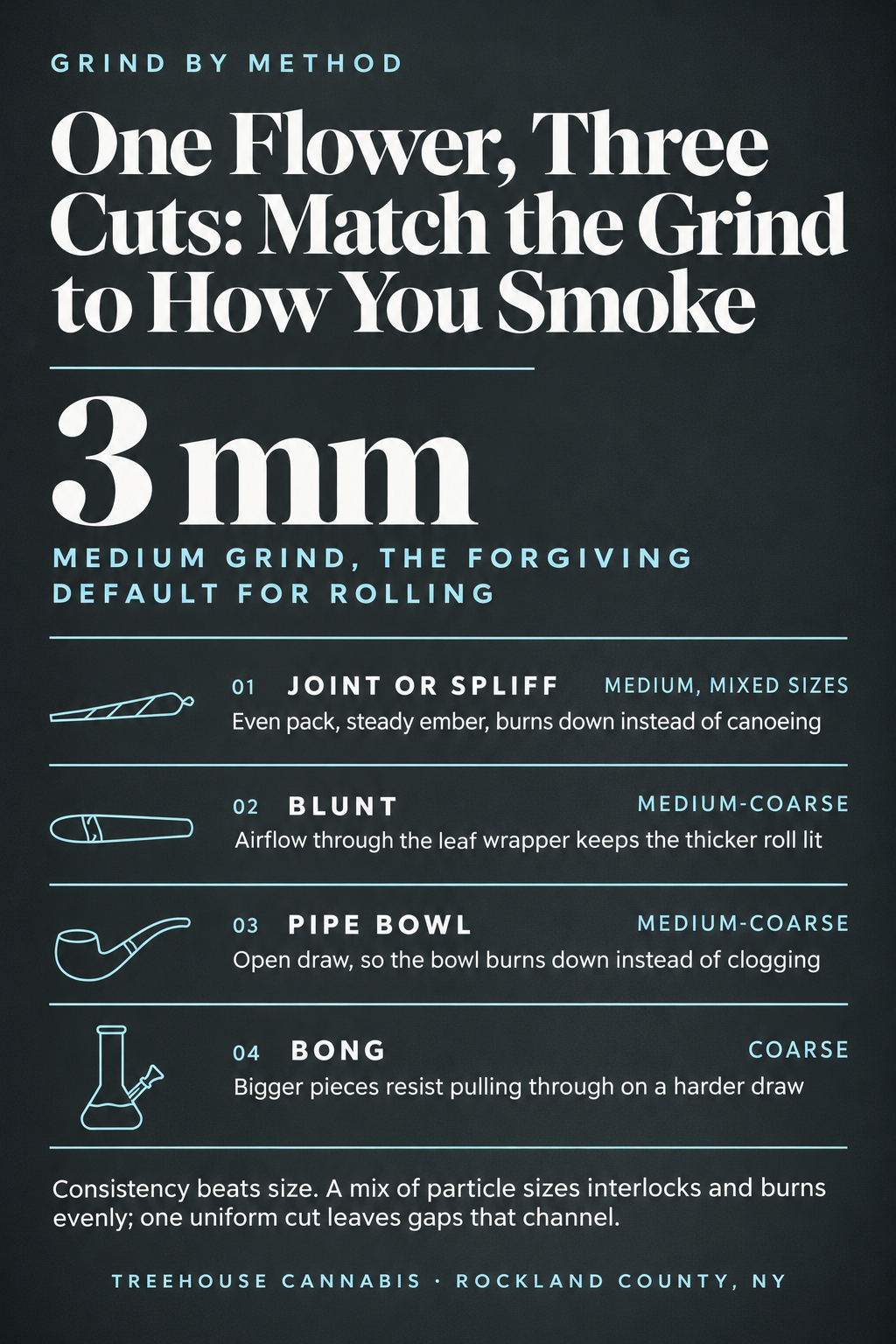
A four-piece grinder has teeth, a storage chamber, and a kief screen, and roughly 10 rotations is typical for a full load [9]. The number matters less than the stopping point. Open the chamber and look: a spread of sizes is right, dust is too far.
- Break larger buds down by hand first so the grinder works evenly instead of chopping some pieces to dust
- Load the chamber loosely, because cramming it compresses flower before the teeth ever touch it
- Rotate roughly 10 times for a full load, then open and check for a spread of sizes rather than powder
- Roll or pack from there, keeping the material loose enough that air can move through it
Then match the cut to the method:
- Joints and spliffs: medium with mixed sizes for an even pack and a steady ember
- Blunts: medium-coarse, because the leaf wrapper needs airflow through a thicker roll to stay lit
- Pipe bowls: medium-coarse so the draw stays open and the bowl burns down instead of clogging
- Bongs: coarse, so pieces resist pulling through under a harder draw
If rolling is not the appeal, Blunts Pre_rolls skips the step entirely, and a bulk flower option like Bottomless Mints Flower - 70g keeps a grinder busy for a long stretch without a restock.
Black | Slim Pen 510 Vape Battery
One caution on the how-to: dry herb vaporizers are a different machine with different requirements, and grind advice built around combustion does not automatically transfer. The consistency principle does.
Moisture still outranks everything in this section. The 3% to 8% range is described as producing the most desirable burn, and bone-dry flower will run hot and fast no matter how carefully it was cut [6]. If flower crumbles to dust between your fingers instead of holding together, the problem predates the grinder.
Does White Ash Mean Better Weed or Better Grind?
No. Ash color tracks combustion temperature, not grind quality, cure quality, or potency, and a controlled ashing study settles it directly.
- Black ash below 400 degrees Celsius, dark gray at 400, gray at 600 and above, so temperature sets the color
- Particle size did not influence ash color in ashing trials, and neither did water activity or moisture content
- Coarse, medium, and finely ground cannabis all produced the same gray ash at 600 degrees
- What did change the ash was biomass: 1.5 g pre-rolls burned unevenly with darker ash and unburned material versus 0.5 g
- Better signals than ash color: an even cherry, no canoeing, an open draw, and flower that is neither bone-dry nor damp
Ashing two cannabis accessions at 200, 400, 600, 800, and 1000 degrees Celsius produced black ash below 400 degrees, dark gray at 400, and gray at 600 and above, and the authors state that ash color was not influenced by particle size, water activity, or moisture content [2]. That is about as direct an answer as this question gets.
The one variable that did move the ash was how much material was packed into the roll. Increasing pre-roll biomass from 0.5 to 1.5 grams produced uneven burning, darker ash, and unburned cannabis material [2]. So a dark, patchy ash is a read on how completely and evenly the material burned, and on how much of it there was, not on how good it was.
The signals that actually mean something are visible while you smoke rather than after. An even cherry that does not run to one side. No canoeing. A draw that stays open from start to finish. Flower that is neither bone-dry nor damp.
Those cues tell you the cut, the pack, and the moisture were all in a reasonable range, and you can adjust any of them on the next roll. Judging a cut by its ash is the same mistake as judging flower by its price tag. Small Buds Flower is a useful reminder that smaller buds and larger buds burn the same way once they are ground to the same size, because the grinder does not care what the bud looked like.
What Grind Size Should You Start With?
Grind size is a decision you make before the flame ever touches the flower, and it is the cheapest variable to change. Nothing else in a session costs less to adjust.
The short version:
- Fine for intensity per puff, coarse for duration per gram, medium when you want a forgiving roll that behaves
- Stop grinding before the flower turns to powder, and keep a spread of sizes rather than one uniform cut
- Pack snug rather than compressed, so air can still move through the column
- Keep moisture in a sane range, because wet or bone-dry flower overrides everything above
Treehouse Cannabis in Rockland County, NY carries whole flower by the gram plus pre-roll options if you would rather skip the step entirely, and the accessories shelf stocks grinders so you can control the cut yourself. Ask the staff what they run in a joint versus a bowl, because most of them have a preference and a reason. Browse the menu or order online for pickup and delivery across Rockland, Orange, and Westchester Counties.
Frequently Asked Questions
Does grind size affect how cannabis burns?
Yes. Smaller pieces expose more surface area to the ember, so they heat faster and combust more readily. In machine-smoked joints, 1 mm flower finished in 28 puffs while 3 mm and 5 mm flower needed 52 to 54 [1]. Coarser flower burns slower and releases cannabinoids over a longer session instead.
Which burns faster, a fine grind or a coarse grind?
A fine grind burns faster. More surface area per gram means the ember pushes heat into the flower more quickly, so the joint stays lit and finishes sooner [8]. Coarse flower leaves larger pieces and bigger air gaps, so it smolders more slowly and often needs relighting early on [1].
Does a finer grind get you higher?
Per puff, usually yes, but not necessarily overall. One-millimeter flower delivered 0.67 mg of THC per puff versus 0.31 mg at 3 mm, yet the 5 mm joints delivered more total THC, 28 mg, because they burned far longer [1]. Potency per puff and total dose are different numbers.
Why does my joint burn unevenly?
Uneven burns usually trace back to inconsistent particle size, uneven packing, or a channel forming down one side. A mix of fine and coarse pieces interlocks better than one uniform cut, which is why hand-ground flower often outperforms milled flower. Overpacking also causes runs and unburned material [2].
What grind size is best for a joint?
Medium with a mix of sizes rather than one uniform cut. Joint research found 1 mm flower burned hottest and fastest while 5 mm burned slowest, which puts the middle setting in the most forgiving range [1]. A spread of particle sizes packs more evenly, so the roll burns down instead of canoeing [9].
What grind is best for a pipe or bong?
Medium to coarse. A bowl depends on air moving through the packed material, so a powdery fine grind can clog the screen or pull straight through into the water. Coarse ground flower keeps the draw open and burns down more evenly when you stir the bowl [9].
Does grinding make cannabis harsher?
It can. A finer grind puts more surface area against the flame, and hotter combustion drives more pyrolysis [8]. A 2026 study pyrolyzing THC between 400 and 800 degrees Celsius identified 79 breakdown products, peaking at 700 degrees [4]. Cooler, slower burns generally give a smoother draw than a raging cherry.
Does white ash mean better weed?
No. A 2026 study ashed two cannabis varieties from 200 to 1,000 degrees Celsius and found ash color tracked temperature, not quality [2]. Coarse, medium, and finely ground cannabis all produced the same gray ash at 600 degrees, and moisture content made no difference either.
Sources
- Cannabis Science and Technology (DELIC Labs) — DELIC Labs researchers machine-smoked THC and CBD joints packed with 1-, 3-, and
- Canadian Biosystems Engineering / CSBE-SCGAB — Ashing two cannabis accessions at 200, 400, 600, 800 and 1000 degrees Celsius pr
- Forensic Sciences Research (National Library of Medicine) — Machine-smoking 12 New Zealand cannabis samples with delta-9-THC contents from 1
- Journal of Cannabis Research (Springer Nature) — Pyrolyzing delta-9-THC at 400 to 800 degrees Celsius, the range reached in the p
- F1000Research — Describes a machine-rolled cannabis cigarette process in which filler particle s
- Leafly — Identifies moisture content as the single biggest influence on how fast cannabis
- Leafly — Explains that THC is vaporized by hot air drawn through the unburned material be
- BioResources (North Carolina State University) — Pyrolysis experiments across particle sizes show that as particle size decreases
- Leafly — Explains that a grinder breaks cannabis into small pieces of similar size and co
About Treehouse Cannabis
Treehouse Cannabis is a licensed adult-use dispensary in Rockland County, New York, serving customers across Rockland, Orange, and Westchester Counties. The shop carries whole flower, pre-rolls, and accessories including grinders, and the team will walk you through particle size, moisture, and packing before you roll.
Cannabis is for adults 21 and older. Keep all cannabis products out of reach of children and pets. This article is educational and is not medical advice. Do not drive or operate machinery while impaired.


Shop our products

Shop All

Deals
Flower
Pre-rolls
Vaporizers

Edibles
Drinks
Concentrates
Tinctures

Topicals

CBD

Pet CBD

Accessories