How Cannabis Became Part of Hip-Hop Culture
How Cannabis Became Part of Hip-Hop Culture
Cannabis and hip hop have been linked for roughly fifty years, from mid-1980s blunt culture in New York to Dr. Dre's 1992 album The Chronic and Snoop Dogg's 2015 branded flower line. The documented record shows a cultural partnership with a commercial upside and a criminal cost.
The link shows up in ethnography, content analysis and album history, not only in lyrics. What the research records is a shared neighborhood history, a distinctive smoking method, a slang term that went national, and an enforcement gap that fell hardest on the communities that made the music.
When Did Cannabis and Hip Hop First Cross Paths?
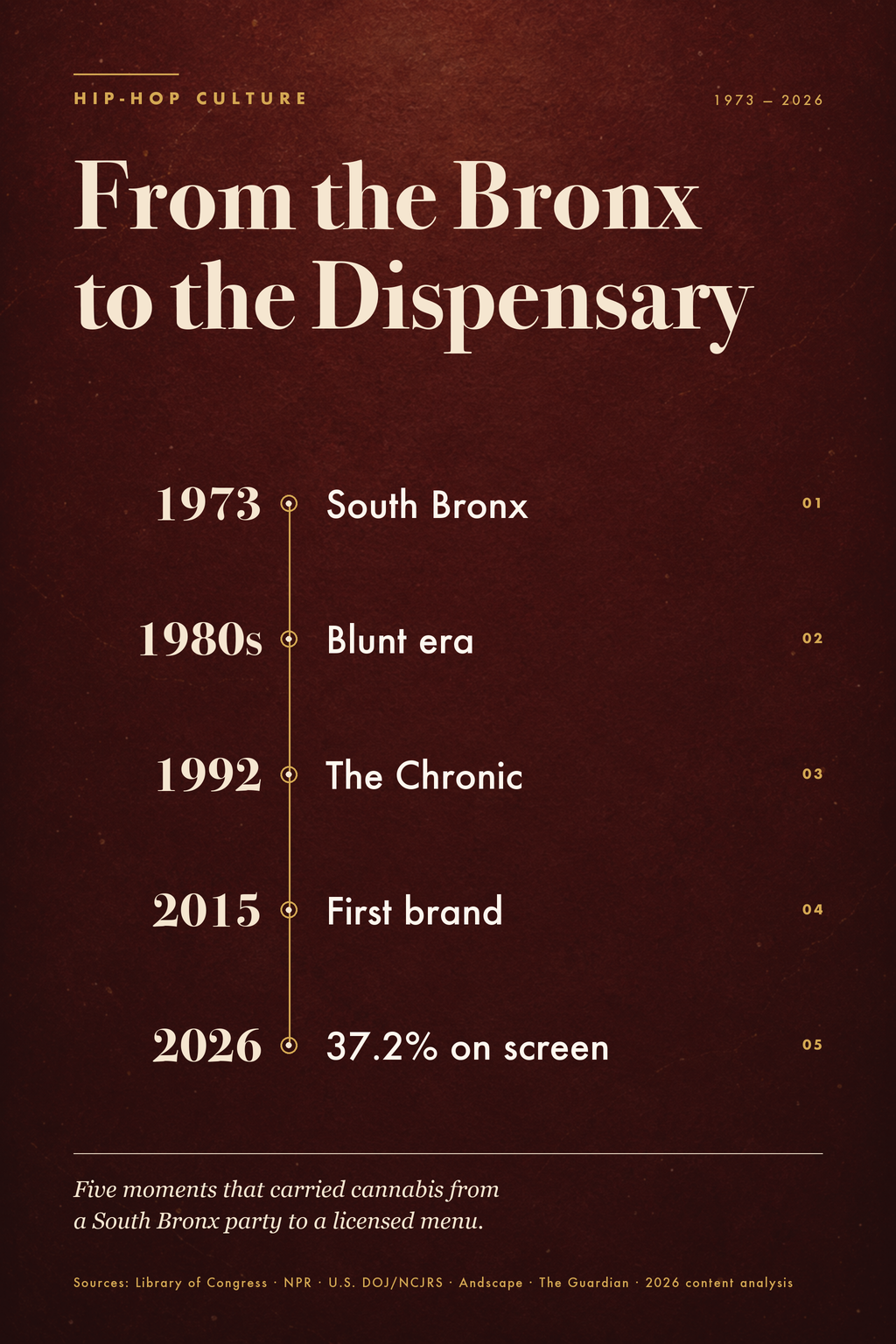
Hip hop dates to August 11, 1973, when DJ Kool Herc played a back-to-school party at 1520 Sedgwick Avenue in the South Bronx. Cannabis was already present in those neighborhoods, and by the mid-1980s the blunt had become part of the music's visual identity in New York.
That date is the widely accepted origin rather than a single proven one. The Library of Congress traces hip hop to a 1973 South Bronx party hosted by DJ Kool Herc, and describes the genre as growing out of African American music and spoken-word traditions that predate the breakbeat [1]. NPR fills in the setting: 18-year-old Herc played his sister Cindy's back-to-school fundraiser in a borough shaped by deep poverty and municipal disinvestment, not in a nightclub [2].
The party was a neighborhood fundraiser in a building with a rec room, not an industry launch. The music formed where cannabis was already ordinary: blunt smoking, rooted in Caribbean and African American inner-city smoking rituals, was a visible signature of hip-hop culture in New York by the mid-1980s, and a three-year ethnographic study of New York blunt smokers later documented hip-hop as a direct influence on the practice [3]. Cannabis references turn up in rap's earliest commercial recordings of the late 1970s and early 1980s, and the association hardened through the 1990s as the genre went national.
The timeline matters because it complicates the usual telling:
- August 11, 1973: DJ Kool Herc plays his sister's back-to-school fundraiser at 1520 Sedgwick Avenue
- The party happened in a South Bronx shaped by poverty and disinvestment, not in a nightclub
- Hip hop drew on African American music and spoken-word traditions that predate the breakbeat
- Blunt smoking came from Caribbean and African American inner-city smoking rituals
- By the mid-1980s the blunt was a recognizable part of hip-hop's visual identity in New York
None of that means cannabis caused hip hop, or the reverse. Both were already present in the same neighborhoods, and the music gave the plant a public vocabulary. If you want the legal backdrop that made the plant risky in the first place, Why Is Cannabis Illegal? A History of Marijuana Prohibition in America covers how prohibition took shape in the United States.
Why Are Blunts So Central to Weed Rap History?
The blunt is central to weed rap history because blunt smokers themselves named the culture as the reason. A three-year ethnography of 92 New York blunt smokers found hip-hop and Rastafarian subcultures repeatedly cited as the influence behind hollowing out a cigar instead of rolling a joint [3].
That was not a small sample of casual observers. Researchers spent three years interviewing people about which tobacco product they bought and why, and the answer kept returning to subculture rather than price or convenience alone. A separate NIH-funded study reached a compatible conclusion: blunt smoking is a subcultural practice distinct from joint smoking, closely associated with hip-hop culture, and the researchers found that rap music and hip-hop media helped legitimize marijuana use in that specific form [4].
There were practical pulls on top of the cultural ones:
- A hollowed cigar burns slowly, so a group can keep it lit through a whole album
- The format costs little relative to its size, which made it a shareable spend
- It passes easily from hand to hand, which suits a circle rather than a solo session
- The scale fit hip hop's larger-than-life aesthetic, where the visual gesture carries the message
In other words, the blunt worked as a social object first and a fashion statement second. Both properties happened to fit the way the music was being made and played.
The two formats differ in ways that matter beyond style:
| Feature | Joint | Blunt |
|---|---|---|
| Wrapping material | Rolling paper, usually thin wood pulp or rice paper | Tobacco leaf cigar, hollowed out |
| Tobacco content | None | Yes, the wrapper is tobacco leaf |
| Burn time | Faster, thinner paper | Slower, thicker leaf |
| Typical sharing | Often passed, but sized for one or two | Built for a group circle |
| Cultural association | Broad, older cannabis culture | Hip-hop and Rastafarian subcultures in the research |
The tradeoff is worth naming plainly. A blunt wrapper is tobacco leaf, so it delivers nicotine alongside cannabis, which is one reason public health researchers treat blunts as their own category rather than a variation on a joint [4]. That distinction is documented, not moralized.
For people tracing the New York side of this history in more detail, The History of Cannabis in New York follows the plant's local lineage from early apothecary sales through the modern market. The way a subculture attaches meaning to a consumption method is not unique to cannabis either; How Cannabis Became a Pride Month Tradition looks at how another community built a tradition around the same plant. For customers who want the long, shared session without the tobacco leaf, Gumball Diamond Infused | Pre-Rolls | 5 pack is the closest modern format on a licensed menu.
How Did The Chronic Change Cannabis and Hip Hop Forever?
Dr. Dre's The Chronic, released in December 1992, took its title from West Coast slang for high-grade cannabis and sold nearly eight million copies, turning a regional word into a national nickname for the plant [9].
The album was Dre's debut as a solo artist after leaving N.W.A, and its packaging did as much work as the title. According to Andscape, the cover reworked the Zig-Zag rolling paper logo, which tied the record's visual identity directly to smoking culture rather than treating cannabis as a background detail [9]. A buyer in Ohio or Georgia could recognize the reference without ever having rolled anything.
The regional contrast is the part that usually gets flattened. The blunt was an East Coast and Caribbean-rooted practice with its own social rules. "Chronic" carried a California vocabulary, a term for good weed that Los Angeles listeners used as a compliment about quality.
The album did not invent the word, and it did not invent cannabis in rap. It moved a local term into national circulation at the moment the genre was becoming the country's dominant popular music.
The measurable effect is straightforward, and it is more interesting than the vibe:
- The Chronic arrived in December 1992 as Dr. Dre's debut album
- The title came from West Coast slang for high-grade cannabis
- The cover reworked the Zig-Zag rolling paper logo
- The record sold nearly eight million copies
- The album turned a regional slang word into a national nickname for the plant
- East Coast blunt culture and West Coast "chronic" vocabulary were distinct traditions that the album merged in the mainstream
By the late 1990s, "chronic" was a word used by people who had never been to Los Angeles, and the album is the documented hinge for that shift [9].
What Does Cannabis Music Culture Look Like in Rap Videos Today?
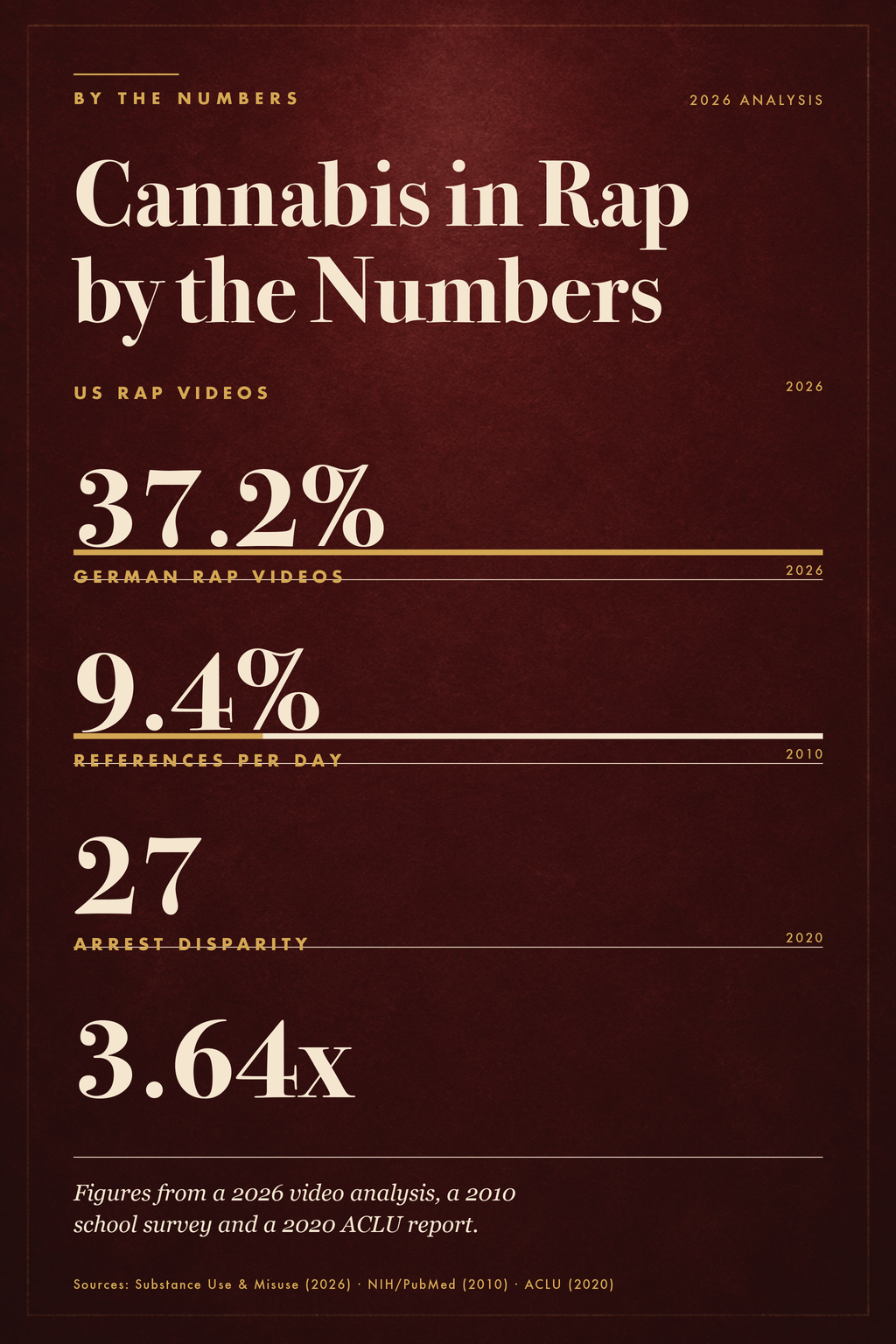
Cannabis music culture is now measurable. A 2026 content analysis of 1,160 videos from the 2024 YouTube Top 100 found cannabis in 37.2 percent of US hip-hop and rap videos, against 9.4 percent of German ones [6].
The genre gap is larger than the country gap:
| Measure | Hip-hop and rap videos | Other genres |
|---|---|---|
| Nicotine or cannabis depicted, full sample | 59.5 percent | 10.1 percent |
| Cannabis depicted, US videos | 37.2 percent | Not reported by genre |
| Cannabis depicted, German videos | 9.4 percent | Not reported by genre |
| Odds of depicting either, versus other genres | 13.11 times | Reference group |
Across the full sample, 59.5 percent of hip-hop and rap videos depicted nicotine or cannabis, compared with 10.1 percent of videos in other genres. The researchers put the odds of depiction in hip-hop and rap at roughly thirteen times the odds in other genres, and estimated cumulative cannabis impressions from the analyzed videos at 49 billion [6]. That impression figure is the researchers' estimate, not a measured count, but the direction is not ambiguous.
Earlier research looked at the audience rather than the screen. A survey of 959 ninth graders at three large urban high schools estimated that students heard about 27 cannabis references per day, and the highest-exposure group had roughly 1.8 times the odds of past-30-day cannabis use [5]. That study is a cross-sectional survey, so it shows an association and cannot establish that the music caused the use.
The key figures, in plain prose so they are readable outside an image:
- 1,160 videos from the 2024 YouTube Top 100 were analyzed
- 59.5 percent of hip-hop and rap videos depicted nicotine or cannabis, versus 10.1 percent of other genres
- Cannabis appeared in 37.2 percent of US hip-hop and rap videos and 9.4 percent of German ones
- Hip-hop and rap videos carried roughly thirteen times the odds of depiction
- Estimated cumulative impressions reached 49 billion
- An earlier survey of 959 ninth graders estimated 27 cannabis references heard per day and 1.8 times the odds of past-30-day use in the highest-exposure group
One cultural note worth adding: the imagery has become so standard that it now sells merchandise as easily as music. If you want the aesthetic without the smoke, Treehouse Womens Tank Top is on the Treehouse apparel menu.
Why Does the Racial Disparity in Arrests Matter to Cannabis and Hip Hop?
It matters because the plant that made the genre culturally valuable stayed a criminal risk in the neighborhoods that produced the genre. ACLU analysis found Black Americans were 3.64 times more likely than white Americans to be arrested for marijuana possession, despite similar usage rates [7].
That gap is not a regional artifact. The disparity appeared in every state, and it worsened in 31 states between 2010 and 2018, a period when legalization was expanding elsewhere [7]. Because self-reported usage rates across racial groups were broadly similar, enforcement rather than behavior explains the difference in arrest rates.
Set that beside the cultural record and the asymmetry is hard to miss. Hip hop made cannabis visible, cool and commercially valuable while the same plant remained a documented criminal exposure for the people listening. That is a description of a split incentive, not an accusation against any artist or company.
Three things are worth keeping separate:
- Black Americans faced 3.64 times the marijuana possession arrest rate of white Americans
- The disparity held in every state and worsened in 31 states between 2010 and 2018
- Usage rates were broadly similar across racial groups, so enforcement explains the gap
- Hip hop made cannabis culturally valuable while criminal risk stayed concentrated in the same communities
- Legalization depended on patient advocacy, polling and legislators, not on music alone
It is also worth being precise about what changed the law. Reform campaigns were built on medical patient advocacy, public polling, and legislators willing to carry bills, with pop culture softening the ground rather than writing the text.
For customers today, the practical legacy is a legal menu where price per gram is printed and potency is tested. Budget formats like Small Buds Flower exist precisely because the plant stopped being an illicit purchase for most New York adults, even as the enforcement history above remains part of the record.
How Did Rappers Turn Weed Rap History Into Cannabis Brands?
In November 2015, Snoop Dogg launched Leafs by Snoop in Colorado, becoming the first celebrity to front a personally branded line of cannabis flower, edibles and concentrates [8].
What changed was legal, not cultural. Artists had spent careers building cannabis into their public identity, and state-legal markets finally gave them a route to sell what they had been promoting for decades. Snoop was not the first celebrity to invest in the sector; he was the first to put his name on a branded product line [8].
Several models followed, and they are not equivalent:
- Owned brands, where the artist controls the product and the license
- Licensing deals, where a cultivator or manufacturer produces and the artist lends the name
- Dispensary and retail partnerships, where the artist's brand appears on a menu rather than in a package
- Equity and investment positions that carry no public-facing product at all
Cultural influence has not translated into proportional ownership across the industry. That point stays general because the research here does not support a specific figure, and inventing one would be worse than leaving it broad.
What a customer actually encounters today is more mundane than the marketing suggests. Celebrity-branded flower and pre-rolls sit on the same menu as everything else, priced per gram or per unit, lab-tested under the same state rules, and subject to the same return policies. A branded eighth is not automatically better than an unbranded one from the same tier, and whole-flower options like Whole Flower Flower compete on the same shelf.
That is the arc in one line: a South Bronx party, a blunt era, a 1992 album title, a 2015 product launch, and a licensed menu where the branding is familiar and the testing is boring. If you want to compare tiers before you buy, NY Diesel | Flower | 28g and GMO Cookies | Diamonds | 1g sit on the same menu as the branded lines, priced and labeled the same way.
Frequently Asked Questions
When did cannabis first appear in hip-hop?
Cannabis shows up in rap's earliest commercial recordings of the late 1970s and early 1980s, and the association hardened through the 1990s. Blunt smoking, rooted in Caribbean and African American inner-city smoking rituals, became a visible signature of hip-hop culture in New York by the mid-1980s.
Why are blunts so closely linked to hip-hop?
Ethnographic research found blunt smokers named hip-hop and Rastafarian subcultures as direct influences on their choice of cigars. A hollowed cigar burns slowly, costs little and passes easily around a group, which made it practical for sharing, while its size matched hip hop's larger-than-life aesthetic.
What does chronic mean in cannabis slang?
Chronic is West Coast slang for high-grade cannabis. Dr. Dre used it as the title of his 1992 debut album, whose cover reworked the Zig-Zag rolling paper logo. The record sold roughly eight million copies and pushed the word into everyday vocabulary far beyond California.
Did hip-hop help drive cannabis legalization?
Hip hop did not write the laws, but it normalized the subject. The genre made cannabis visible and conversational decades before reform, and content analysis shows the imagery is now mainstream. Legalization campaigns still depended on patient advocacy, polling and legislators, not on music alone.
Do you have to use cannabis to be part of hip-hop culture?
No. Cannabis is a recurring theme, not a membership requirement. Plenty of artists have never used it on record or off, and some have spoken publicly about quitting. Hip hop's influence comes from music, dance, style, language and community, and plenty of fans take part without touching the plant.
How much cannabis appears in rap music videos today?
A 2026 content analysis of 1,160 videos from the 2024 YouTube Top 100 found cannabis in 37.2 percent of US hip-hop and rap videos, compared with 9.4 percent of German ones. Hip-hop videos overall were about thirteen times more likely to depict nicotine or cannabis than other genres.
Why does the racial disparity in arrests matter to this story?
ACLU analysis found Black Americans were 3.64 times more likely than white Americans to be arrested for marijuana possession despite similar use rates. Hip hop made cannabis culturally cool while the same plant remained a criminal risk in the neighborhoods that created the music.
Sources
- Library of Congress — Hip-hop is dated to a 1973 South Bronx party hosted by DJ Kool Herc, and grew ou
- NPR — On August 11, 1973, 18-year-old DJ Kool Herc played his sister Cindy's back-to-s
- U.S. Department of Justice, Office of Justice Programs (NCJRS) — A three-year ethnographic study of 92 New York blunt smokers found hip-hop and R
- National Institutes of Health (PubMed Central) — Blunt smoking is a subcultural practice distinct from joint smoking that is clos
- National Institutes of Health (PubMed Central) — In a survey of 959 ninth graders at three large urban high schools, students wer
- National Library of Medicine (PubMed) - Substance Use & Misuse — Across 1,160 videos from the 2024 YouTube Top 100, 59.5% of hip-hop/rap videos d
- American Civil Liberties Union — Black people were 3.64 times more likely than white people to be arrested for ma
- The Guardian — In November 2015 Snoop Dogg launched Leafs by Snoop in Colorado, becoming the fi
- Andscape (ESPN) — Dr. Dre's 1992 album The Chronic took its title from West Coast slang for high-g
About Treehouse Cannabis
If the history is the draw, the plant is still the point. Treehouse Cannabis in Rockland County carries the flower and pre-rolls that this culture grew up around, and the team can walk you through what is on the menu today. Stop in, ask what is fresh, and see how far the blunt-era staples have come. Shoppers come in from Orange and Westchester Counties as well, and every listing states product type and batch details so you can compare what you are buying instead of guessing from a name.
Cannabis is for adults 21 and older. Keep all cannabis products in their original child-resistant packaging, store them out of reach of children and pets, and never drive under the influence. This article is educational and is not medical advice.

Shop our products

Shop All

Deals

Flower

Pre-rolls
Vaporizers
Edibles
Drinks

Concentrates
Tinctures

Topicals
CBD

Pet CBD

Accessories