How to Choose a Weed Pen Without Wasting Money
How to Choose a Weed Pen Without Wasting Money
A practical guide to comparing cartridges and batteries by price per gram, hardware quality, and New York label requirements.
A weed pen only costs what the oil inside it is worth, so the number to compare is price per gram, not sticker price. On one live New York menu, cartridges span $19.99 to $87.98 per gram, and the cheapest sticker is often nowhere near the best value.
Licensed New York dispensaries price cartridges from about $12 to $72 and disposables from $25 to $82, while the battery that runs them is a one-time $10 to $40 purchase. Most buyers skip the division, which is exactly how a $44 half-gram ends up costing nearly twice what a $20 full gram does.
How Much Does a Weed Pen Cost in New York?
Plan on roughly $20 to $80 for a gram of cannabis oil at a licensed New York dispensary, plus $10 to $40 once for a reusable battery. The oil is the recurring cost, and the device is not.
Treehouse's live vaporizer menu carries 243 in-stock vape products, and prices across that shelf show how wide the spread runs: cartridges list from $11.99 to $71.50 with a median of $38.99 per gram, while disposables list from $25.00 to $81.99 with a median of $43.99 per gram [15]. Those are medians from one live New York menu, not a market-wide average, and they move with brand, oil type, and package size.
Here is the full cost picture, split into one-time and recurring money:
- One-time hardware: a reusable 510 battery runs about $10 to $40 and outlives many cartridges [11]
- Recurring cost: cartridges on the live menu run $11.99 to $71.50, median $38.99 per gram [15]
- Recurring cost: disposables run $25.00 to $81.99, median $43.99 per gram, because each one contains a battery you throw away [15]
- Tax note: New York's 13% retail excise is built into the shelf price and adult-use cannabis is exempt from sales tax, so the sticker is the real number [5]
That tax note catches people. New York applies a 13% retail excise (9% state plus 4% local) on top of a 9% distributor tax, and both are already reflected in what the menu says [5]. Nothing extra appears at the register for the cannabis itself, so the number on the shelf is the number you pay.
What Is the Best Weed Pen for Beginners to Buy First?
Buy an adjustable 510 battery and one cartridge if you will still be vaping in three months. Buy a disposable if you are unsure, and treat the extra cost as a rental fee on the decision.
There are three delivery systems a beginner actually chooses between, and they cost very different amounts over time [10]:
- Setup A, a 510 cartridge plus a separate battery: lowest cost per gram over time and the widest brand choice, because almost every cartridge uses the same 510 thread [12]
- Setup B, a disposable: highest cost per gram and zero maintenance, useful only for testing whether you like vaping or trying one brand before committing
- Setup C, a proprietary pod: convenient, but it locks you into one brand's refills and usually one battery
- Beginner rule: buy the cheapest battery you can adjust, not the cheapest battery you can find
Side by side, the three setups separate on upfront money, per-gram money, and commitment [15]:
| Setup | Upfront cost | Cost per gram over time | Commitment |
|---|---|---|---|
| 510 cartridge plus separate battery | $10 to $40 battery, bought once | Lowest - cartridges run $11.99 to $71.50, median $38.99 per gram | Any 510-thread brand |
| Disposable | Baked into every single unit | Highest - units run $25.00 to $81.99, median $43.99 per gram | One brand per unit |
| Proprietary pod | Battery plus brand-specific pods | Brand-locked refills | One brand's pods only |
That rule is the whole money argument in one line. A $5 to $15 throwaway battery gets re-bought as an afterthought, often more than once a year, while a battery in the $16 to $26 range outlasts several cartridges [11]. Adjustability matters more than brand, because voltage is what decides whether the oil tastes right or tastes burnt.
If you are going the cartridge route and have never used one, walk through the mechanics before you buy anything: How to Use a Cannabis Vape Pen for the First Time. If you are stuck between the two main form factors, Disposable Vape vs Cartridge: Which Should You Choose? breaks the tradeoff down further.
One practical note that surprises first-time buyers: New York's possession limit applies to the cannabis you carry home, and a couple of carts count toward it. How Much Cannabis Can You Legally Possess in New York? covers the current rules.
Laughing Gas | House Of Sacci | Disposable Vape | 2g
Why Is a Weed Pen's Price Per Gram the Only Number That Matters?
Price per gram is the only weed pen number that matters: a sticker price says what a package costs, a per-gram price says what the oil costs. The gap between the two is where most weed pen money disappears.
The formula is one division: sticker price divided by grams of oil equals price per gram.
A cannabis vape cartridge typically holds 0.3 to 1.0 grams of oil [9], so the denominator swings by more than three times between packages. That is enough to flip the ranking of two carts that look obviously ordered by price.
| Package | Sticker price | Price per gram |
|---|---|---|
| 1.0 g cartridge | $19.99 | $19.99 |
| 0.5 g cartridge | $43.99 | $87.98 |
| 2.0 g disposable | $59.99 | $30.00 |
The first two rows are the same live New York menu, and they span roughly $19.99 to $87.98 per gram across cartridges alone [15]. The half-gram at $43.99 is not a mid-price cart. It is the most expensive oil on the shelf once you do the division, and it looks like the cheaper purchase right up until you check.
The money rules that fall out of that division:
- Divide the sticker price by the grams of oil to get the real price per gram
- Remember cartridges typically hold 0.3 to 1.0 grams, so the denominator changes the answer
- Treat a half-gram cart at $43.99 as an $87.98 per gram purchase, not a $43.99 one
- Read total THC per package as well as the percentage, because package size decides how much you get
- Use the $38.99 per gram median from the live menu as a reference point for whether a specific cart is fair
The same logic explains why some premium packages are not actually bad value, and the economics of a higher-grade product are worth understanding separately: What Makes Premium Cannabis Flower Cost More?. Larger formats help too. A two-gram disposable spreads its hardware cost across twice the oil, which is why Laughing Gas | House Of Sacci | Disposable Vape | 2g can undercut a half-gram cart per gram despite a higher sticker.
There is a second number hiding behind the first. New York labels state milligrams of total THC per package as well as per serving, calculated as THC plus THCA multiplied by 0.877 [2]. Two carts at the same price and the same percentage can still hand you different total THC, because package size decides how much you actually get.
None of this means a higher price equals better oil. It means a lower sticker does not equal a better deal.
Which Parts of a Weed Pen Hardware Fail First?
Three parts fail on a weed pen, and they fail in a predictable order: the battery, the coil, and the mouthpiece. Understanding that order is how you stop paying for the same mistake twice.
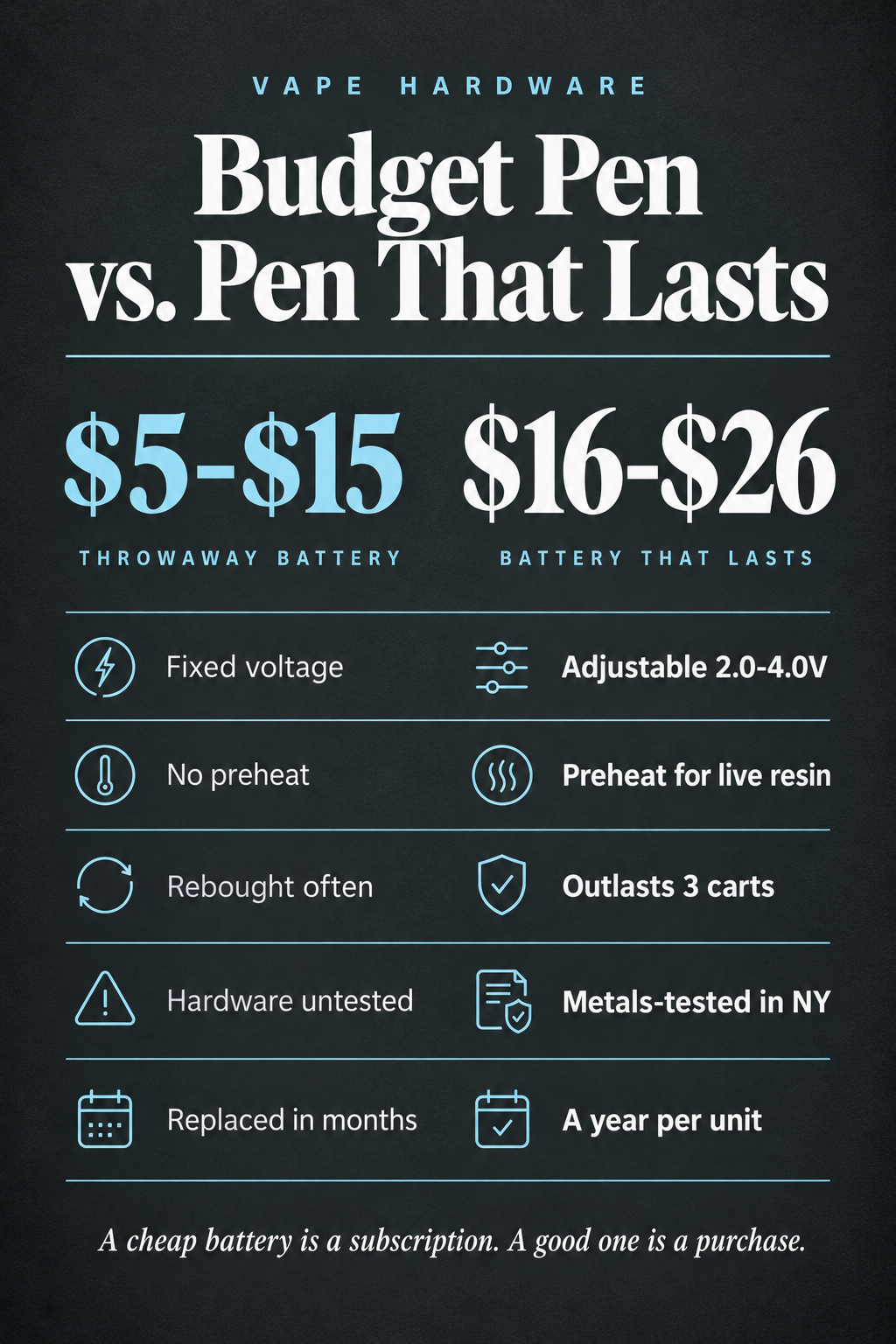
A $5 to $15 battery is the classic leak. It is cheap enough to buy without thinking, breaks or disappears, and gets replaced without thinking, so the annual total quietly passes what one $16 to $26 battery would have cost [11]. Pen batteries hold roughly 300 to 900 mAh and most run about 2.0 to 4.0 volts [12], and the cheap end of that range usually means a fixed voltage you cannot tune to the oil in front of you.
The failure points, in order:
- Battery: repeated $5 to $15 replacements cost more in a year than one $16 to $26 battery
- Coil and heat: too much voltage degrades the oil instead of delivering more of it, so you burn through a cart to get less effect
- Clogs: thick oil condenses in the mouthpiece when a pen sits on its side or somewhere cold
- Contamination path: metals can migrate from coils and metal cores into oil, which is why New York tests the apparatus, not only the oil
That last point is a hardware question with a testing answer. A 2025 peer-reviewed scoping review found nickel, chromium, copper, and lead migrating from cartridge heating coils and metal cores into cannabis oil and inhaled aerosol, with concentrations rising significantly in oil stored in cartridges for weeks to months [8]. New York's sampling standard, revised January 14, 2026, now requires a random subset of final-form vape cartridges and pens to be tested for metals in the same apparatus the oil is sold in [3]. The hardware is treated as a contamination source, not just a container.
Replacement batteries and accessories live in one place on the menu: Batteries Accessories.
How Do You Spot a Legal, Tested Weed Pen in New York?
Three checks verify a weed pen in New York: the dispensary's OCM verification QR code, the New York Universal Symbol on the package, and a Certificate of Analysis for that exact lot. All three take about five minutes [1].
That sequence matters because each step catches a different failure. The verification tool proves the store is licensed. The Universal Symbol proves the package went through the regulated system. The Certificate of Analysis proves this specific lot was tested, which is not the same thing as the brand being legitimate.
A compliant New York label has to show more than a logo. It must state milligrams of total THC per single serving and per package, where total THC equals THC plus THCA multiplied by 0.877, along with total CBD, serving count, and the Universal Symbol on the outermost packaging layer [2]. Vape cartridges also report percent cannabinoid plus total THC and total CBD per package rather than per serving [4]. For inhaled products specifically, New York caps terpenes at 10% [4].
The checklist, in store order:
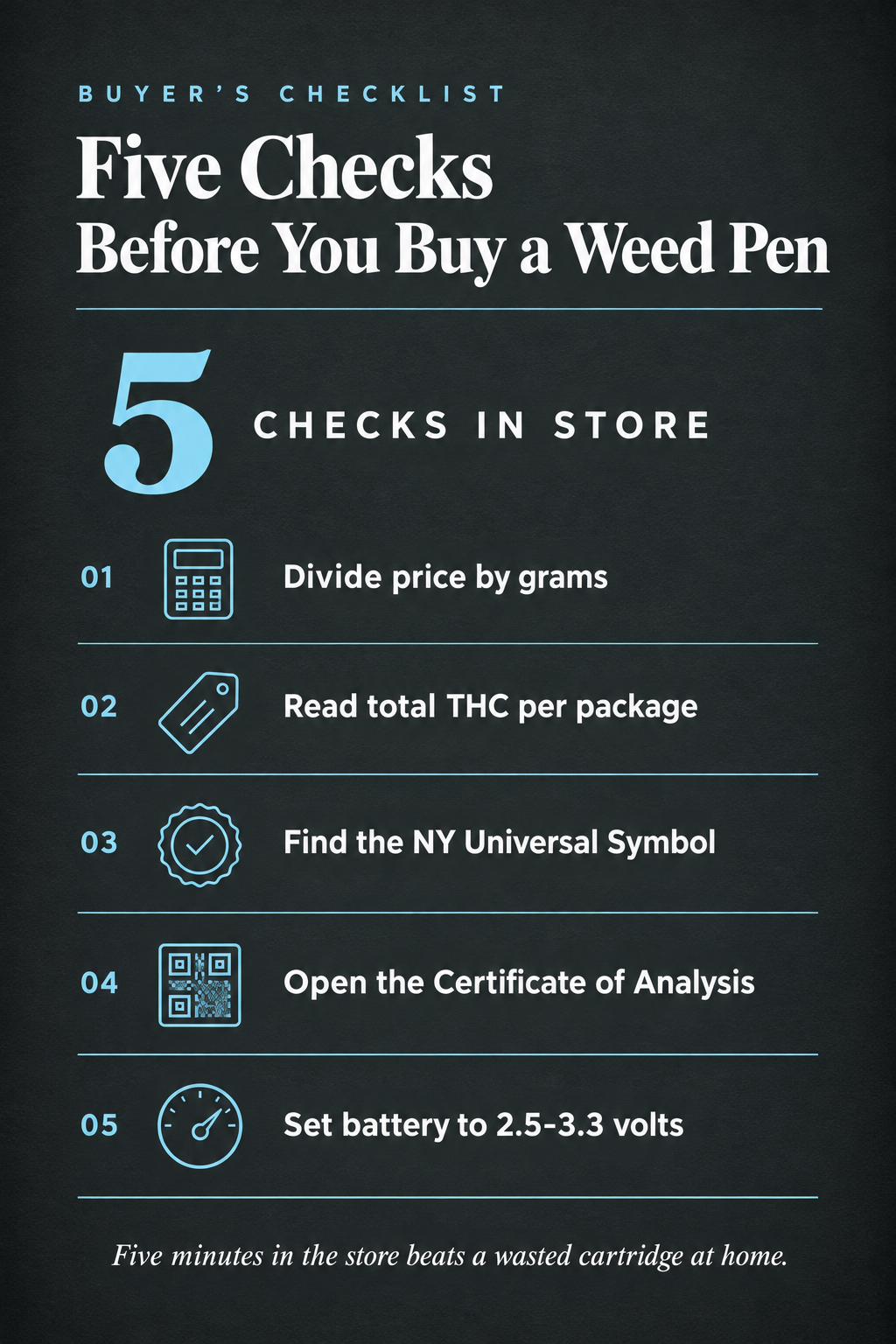
- Step 1: scan the dispensary's OCM verification QR code before you shop the case
- Step 2: find the New York Universal Symbol on the outermost package
- Step 3: open the Certificate of Analysis from the label QR code or link, and confirm it matches this lot
- Label check: total THC per serving and per package, total CBD, serving count, and no more than 10% terpenes in inhaled products
Why bother with a licensed shelf at all? The 2019-2020 EVALI outbreak is the plainest answer available. CDC reported 2,668 hospitalized cases and found that 82% of patients reported using THC-containing vaping products [6]. A separate CDC tally counted 2,807 hospitalized cases and 68 confirmed deaths across 29 states and the District of Columbia, and among THC-using patients who named a product source, only 16% bought exclusively from commercial sources [7]. Most of the rest used informal sources.
That does not make licensed products risk-free, and no one should read it that way. It makes the source of the oil the first question rather than the last, because the products tied to the outbreak were overwhelmingly not the ones that came with a Certificate of Analysis.
What Voltage and Habits Keep a Weed Pen From Wasting Oil?
Start low and move up one setting at a time. THC oil performs best between 2.5 and 3.3 volts, with denser oils staying below 4.0 volts [14].
Most 510 batteries run about 2.0 to 4.0 volts, so the range is wide [12]. Higher heat does not deliver more effect, it degrades the oil and burns through the cart faster [14].
Match the setting to the oil rather than to habit. Thick live resin benefits from a preheat pulse, while thin distillate rarely needs more than the lowest setting that produces vapor. Draw-activated batteries with no button cannot preheat at all, which is one reason a button model is worth the extra few dollars [12].
The habits that protect a cartridge:
- Start low: begin around 2.4 to 2.8 volts and step up one level at a time
- Sweet spot: most THC oil performs between 2.5 and 3.3 volts, denser oils below 4.0 volts
- Storage: upright at room temperature, never a hot car, because heat thins oil and pushes it into the mouthpiece
- Draw technique: shorter draws with a pause, plus a preheat pulse for live resin
- Dose check: oil can reach 90% THC, so one short draw then a wait beats a long pull you regret
Storage gets underestimated because it looks like nothing. A cartridge left on its side in a cold car condenses oil into the mouthpiece, and the clog you fight at the end of the cart is often oil you already paid for and cannot reach. Keeping carts upright and out of heat is free, and it recovers the last of a package more often than any hardware upgrade. A basic storage container for carts and batteries is here: Storage Containers Accessories.
The dose reality is the last money lesson in the article. Vaporized oil is far more concentrated than flower, commonly 70% to 90% THC against roughly 20% to 30% in bud [9], and vaporizing concentrated oils and extracts delivers large amounts of THC to the body quickly, which raises the risk of negative side effects [13]. The cannabis plant holds at least 125 cannabinoids [13], so a single potency number never describes the whole experience. A short draw followed by a wait costs less than a long draw you did not need.
Frequently Asked Questions
How much does a weed pen cost in New York?
Plan on roughly $20 to $80 for a gram of cannabis oil at a licensed New York dispensary, depending on whether it is distillate, live resin, or live rosin. A reusable 510 battery adds $10 to $40 one time. New York's 13% retail excise is already reflected in the sticker price. [15]
Is a disposable or a cartridge cheaper in the long run?
A cartridge plus a separate battery wins if you vape regularly. Disposables bury a cheap battery inside every purchase and often cost more per gram, while a $20 to $40 battery outlives several cartridges. Disposables make sense for occasional use or trying a brand. [11]
Why do half-gram carts cost more per gram than full grams?
Because buyers compare sticker prices instead of unit prices. On one live New York menu, a 1-gram cartridge worked out to $19.99 per gram while a half-gram cartridge cost $43.99 for half the oil, nearly $88 per gram. Always divide the price by the grams. [15]
Does a higher THC percentage mean a better weed pen?
Not for value. THC percentage climbs as terpenes and other cannabinoids come out, so a 90% distillate cart can read flatter and fade faster than a 70% live resin with a real terpene profile. Judge the full label, not one number. [9]
Why does my vape cartridge keep clogging?
Thick oil condenses in the mouthpiece between draws, especially when the pen lies on its side or sits somewhere cold. Store it upright, keep it out of a hot car, use a preheat setting for live resin, and take shorter draws. Repeated clogs usually mean the cart is nearly done. [12]
What voltage should I use on a weed pen?
Start at the lowest setting, roughly 2.4 to 2.8 volts. Most 510 batteries run about 2.0 to 4.0 volts and THC oil tends to perform best between 2.5 and 3.3 volts. Thick live resin may need a preheat pulse; thin distillate rarely needs more heat. [12]
Is a weed pen stronger than smoking flower?
It can be. Vaporized oil is far more concentrated than flower, often 70% to 90% THC against roughly 20% to 30% in bud, and one long draw can deliver a large dose quickly. That is why new users should take a single short draw and wait. [9]
How can I tell a vape cartridge is legal and tested in New York?
Check three things: the dispensary displays the OCM Dispensary Verification Tool, the package carries the New York Universal Symbol, and the label has a QR code or link to a Certificate of Analysis. The label must also state total THC per package. [1]
Sources
- New York State Office of Cannabis Management — OCM publishes a three-step consumer check for any New York purchase: find the Di
- New York State Office of Cannabis Management — Every adult-use cannabis label must show milligrams of total THC per single serv
- New York State Office of Cannabis Management — New York's sampling standard (revised January 14, 2026) requires a random subset
- New York State Office of Cannabis Management — Vape cartridges and flower must report percent cannabinoid plus total THC and to
- New York State Department of Taxation and Finance — Since June 1, 2024, New York imposes a 9% distributor tax and a 13% retail tax (
- Centers for Disease Control and Prevention (MMWR) — Of 2,668 hospitalized EVALI patients reported to CDC, 82% reported using THC-con
- Centers for Disease Control and Prevention — CDC tallied 2,807 hospitalized EVALI cases and 68 confirmed deaths in 29 states
- The Scientific World Journal (Gaur et al., peer-reviewed scoping review) — Across the reviewed studies, metals including nickel, chromium, copper and lead
- RSC Advances (Meehan-Atrash et al., peer-reviewed) — A cannabis vape cartridge typically holds 0.3 to 1.0 grams of oil that can reach
- Leafly — Leafly separates the delivery systems buyers actually choose between: universal
- Leafly — Cheap 510-thread batteries sell for about $5-15 and get re-bought as an aftertho
- Leafly — Most cannabis oil carts use the 510 thread; pen batteries hold roughly 300 to 90
- National Institute on Drug Abuse (NIH) — NIDA notes the cannabis plant contains at least 125 cannabinoids and that vapori
- Vaping360 — The optimal voltage for THC oil usually falls between 2.5 and 3.3 volts, denser
- Treehouse Cannabis — Treehouse's live vaporizer menu carries 243 in-stock vape SKUs; cartridges run $
About Treehouse Cannabis
Treehouse Cannabis serves Rockland, Orange, and Westchester Counties with licensed adult-use flower, vapes, edibles, and concentrates. The live vaporizer menu lists every in-stock cartridge and disposable with current pricing, so you can divide price by grams before you leave the house.
Cannabis is for adults 21 and older. Keep all cannabis products in their original child-resistant packaging, store them out of reach of children and pets, and never drive under the influence. This article is educational and is not medical advice.



Shop our products

Shop All

Deals

Flower
Pre-rolls
Vaporizers

Edibles
Drinks

Concentrates
Tinctures

Topicals

CBD

Pet CBD

Accessories