
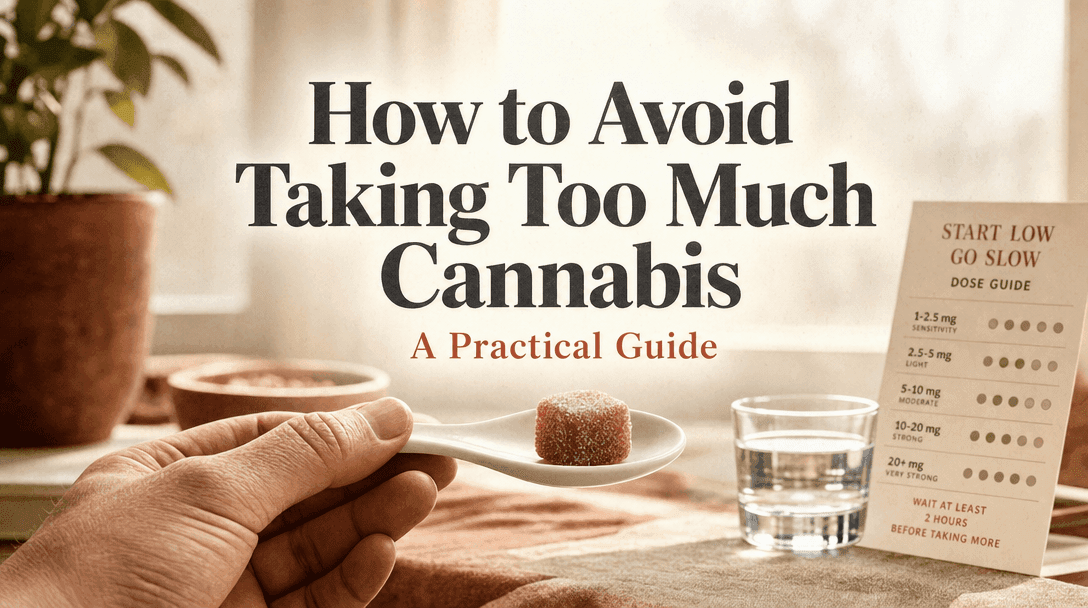
How to Avoid Taking Too Much Cannabis
How to Avoid Taking Too Much Cannabis
A practical, evidence-based guide to staying in control — from dosing fundamentals to what to do if you've already overdone it.
Taking too much cannabis happens to adults more often than expected. The cleanest prevention: start with 2.5 mg THC or less, wait at least two hours before redosing, know your tolerance, and skip alcohol. Fatal overdose from cannabis alone has never been documented in healthy adults, but the discomfort is avoidable with the right dose.
What Counts as "Too Much Cannabis"?
Too much cannabis happens when the THC dose overwhelms your body's tolerance and produces distressing — but rarely dangerous — symptoms. The overconsumption experience usually includes anxiety, paranoia, racing heart, nausea, dizziness, confusion, and slowed time perception [9].
For most healthy adults, the experience is unpleasant and temporary rather than life-threatening. No fatal cannabis-only overdose has ever been documented in adults without other risk factors [10]. That framing matters, but it does not mean overconsumption is harmless — cannabis-related calls to the California Poison Control System more than doubled from 2016 to 2024, with a 61% increase among adults 19 and older [5].
The symptoms most adults describe look like this:
- Racing heart or chest tightness
- Anxiety, panic, or paranoia
- Nausea or vomiting
- Dizziness, lightheadedness, or loss of balance
- Slowed reaction time and distorted perception
- Confusion or short-term memory trouble
Adults who use cannabis are far from rare. An estimated 61.9 million people used cannabis in the United States in 2022, and approximately 3 in 10 of those users develop some form of cannabis use disorder over time [2]. The risk climbs with higher-THC products, which makes dose literacy one of the most useful harm-reduction skills an adult-use customer can build.
Knowing what overconsumption actually feels like is the first step. If you're brand new to a product format and want a deeper primer on what your body is processing, our A Guide to Terpenes and Their Effects walks through how cannabinoids and terpenes shape the high.
Why Do Edibles Cause Most Overconsumption Incidents?
Edibles cause most overconsumption incidents because they take 30 minutes to 2 hours to take effect, while smoked or vaped THC reaches the brain within minutes. That gap is the entire problem: customers re-dose before the first dose has peaked, and when the liver finishes metabolizing both doses, the result is an unexpectedly strong high several hours later.
The numbers back this up. A retrospective study of 303 acute-cannabis emergency department visits found that 80.5% involved oral (edible) products, compared to 19.5% that involved inhaled products [7]. Edible-related visits were also more likely to lead to hospital admission — 6.2% versus 0% for inhaled visits in the same dataset.
Here is how inhaled THC compares with edible THC in practice:
| Factor | Inhaled THC | Edible THC |
|---|---|---|
| Onset time | 1 to 5 minutes | 30 minutes to 2 hours |
| Peak effects | Within 30 minutes | 2 to 4 hours after ingestion |
| Duration | Up to 6 hours | 4 to 12 hours (residuals up to 24 hours) |
| Active metabolite | THC | 11-hydroxy-THC (crosses the blood-brain barrier more easily, longer effect) |
| Share of ED visits (n=303) | 19.5% | 80.5% |
| Hospital admission rate | 0% | 6.2% |
| Wait rule before redosing | 15 minutes | At least 2 hours |
The pharmacokinetics explain the pattern:
- Inhaled THC crosses into the bloodstream through the lungs and reaches the brain within 1 to 5 minutes.
- Edible THC has to pass through the digestive system and the liver, where it is converted into 11-hydroxy-THC — a metabolite that crosses the blood-brain barrier more easily and produces a stronger, longer effect.
- Peak edible effects land between 2 and 4 hours after ingestion, and residuals can linger up to 24 hours.
Because of this delay, the CDC and most public-health agencies treat edible labels with caution — printed THC amounts are sometimes inaccurate or unknown, and a single labeled "serving" may still feel too strong for a new user [1].
The universal harm-reduction rule exists for exactly this reason: start with a low dose, and wait at least two hours before any additional edible. Customers who skip the wait are the customers who end up in Poison Control data.
For a wider look at the format, our Edibles collection breaks down gummies, chocolates, drinks, mints, and dissolvables by dose, ratio, and on-set timing so you can pick something that matches your tolerance .
If you want the opposite profile — fast on-set, easier dose titration — inhaled formats let you take a single small puff, wait 10 to 15 minutes, and decide whether to continue Mango Gelato x Strawberry Kush | Disposable Live Resin Vape | 1g.
What's a Safe Starting Dose of THC for Beginners?
A safe starting dose for an adult new to edible cannabis is 2.5 mg THC or less, with at least a two-hour wait before any additional dose. For inhaled flower, choose products testing 10% THC or below and take one small puff at a time [6].
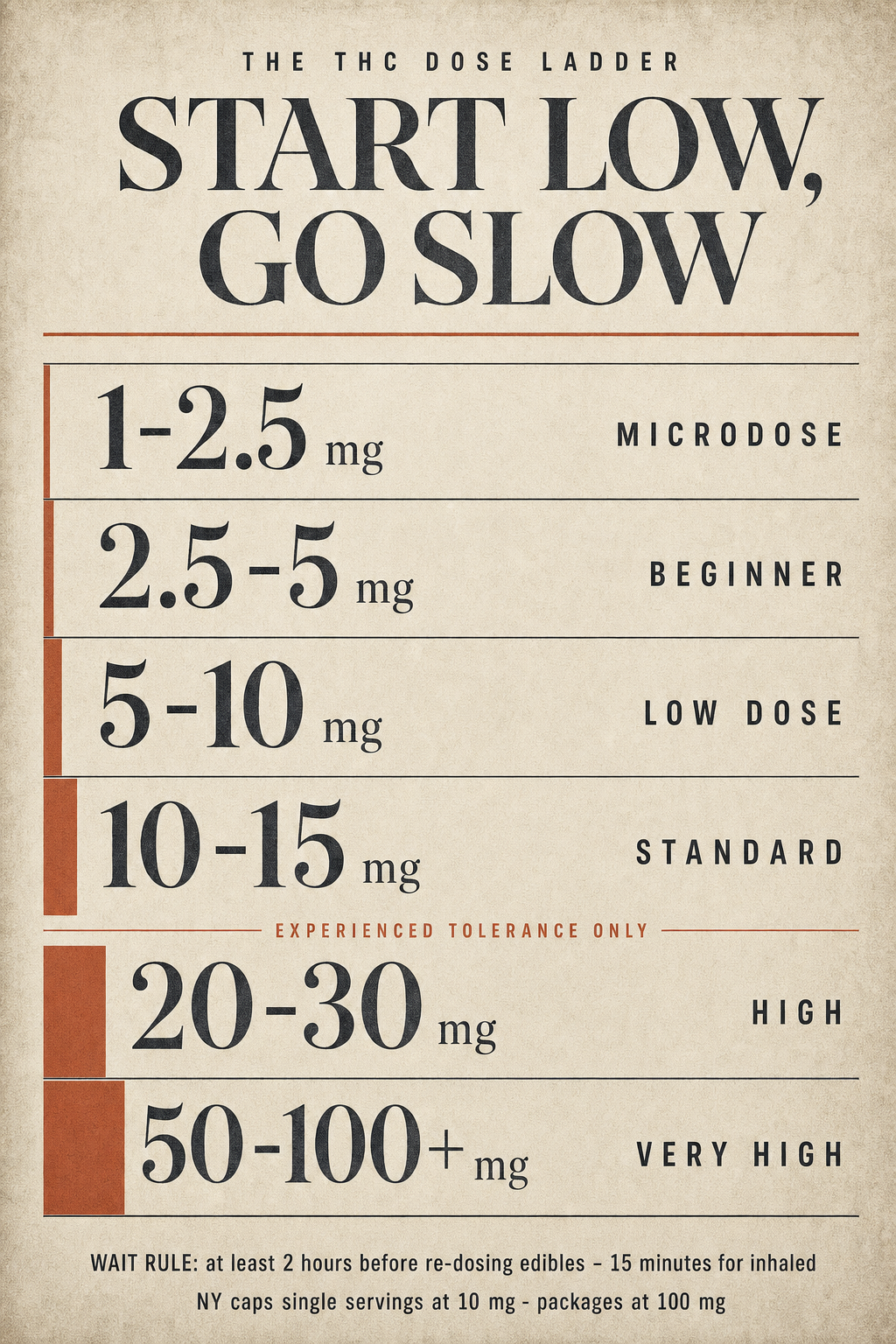
The dose ladder is the same one used by the CDC, the Canadian Centre on Substance Use, and the BC Ministry of Public Safety. New York State builds it into the law: single edible servings are capped at 10 mg THC, and full packages at 100 mg THC [6]. Those caps exist as a built-in safety floor for adult-use customers, not as a recommendation to take the maximum.
Here is the standard ladder, low to high:
- 1 to 2.5 mg THC — microdose. Sub-perceptual or barely perceptible; a gentle daytime option.
- 2.5 to 5 mg THC — beginner edible dose. Mild effects for new customers; the standard starting point.
- 5 to 10 mg THC — low dose. Noticeable effects; the New York single-serving cap.
- 10 to 15 mg THC — standard adult-use serving. Clear psychoactive effects for most adults.
- 20 to 30 mg THC — high dose. Reserved for experienced customers with established tolerance.
- 50 to 100+ mg THC — very high. Generally for medical patients or very high-tolerance consumers.
Products with higher THC concentrations are tied to stronger intoxicating effects and an increased overconsumption risk [3]. If you are unsure where to start, our Microdosing Cannabis: The Complete Guide to Low-Dose Wellness covers the same ladder from a beginner-friendly angle, including how to read Treehouse product labels and what "1:1 THC:CBD" actually means.
How Does Tolerance Affect Your Overconsumption Risk?
Tolerance affects overconsumption risk because frequent cannabis use downregulates CB1 receptors in the endocannabinoid system, so the same dose produces a smaller effect over time. The practical consequence is that you need more THC to feel the same high, and your personal "safe" dose creeps upward without you noticing.
After a tolerance break of two to four weeks, CB1 receptor sensitivity recovers — and your previous dose may suddenly feel much stronger. The safe move after any break is to halve your previous dose, not maintain it.
Two kinds of tolerance are worth knowing:
- Functional tolerance — you feel less high at the same dose, even though blood THC levels are similar.
- Physiological tolerance — your body actually processes THC differently with regular exposure.
Growing tolerance is also one of the clinical markers of cannabis use disorder, alongside using more than intended and difficulty cutting back [3]. The National Academies' comprehensive evidence review confirms that acute risks from cannabis — including overconsumption and impaired driving — track closely with dose and frequency [10].
If you have built up tolerance over time and want to dial it back without losing the benefits, our Microdosing Cannabis: How to Do It Right walks through taper schedules, journaling, and how to use a low-THC flower like Out The Office • Flower • 70g as a session-friendly baseline.
What Should You Do If You've Had Too Much Cannabis?
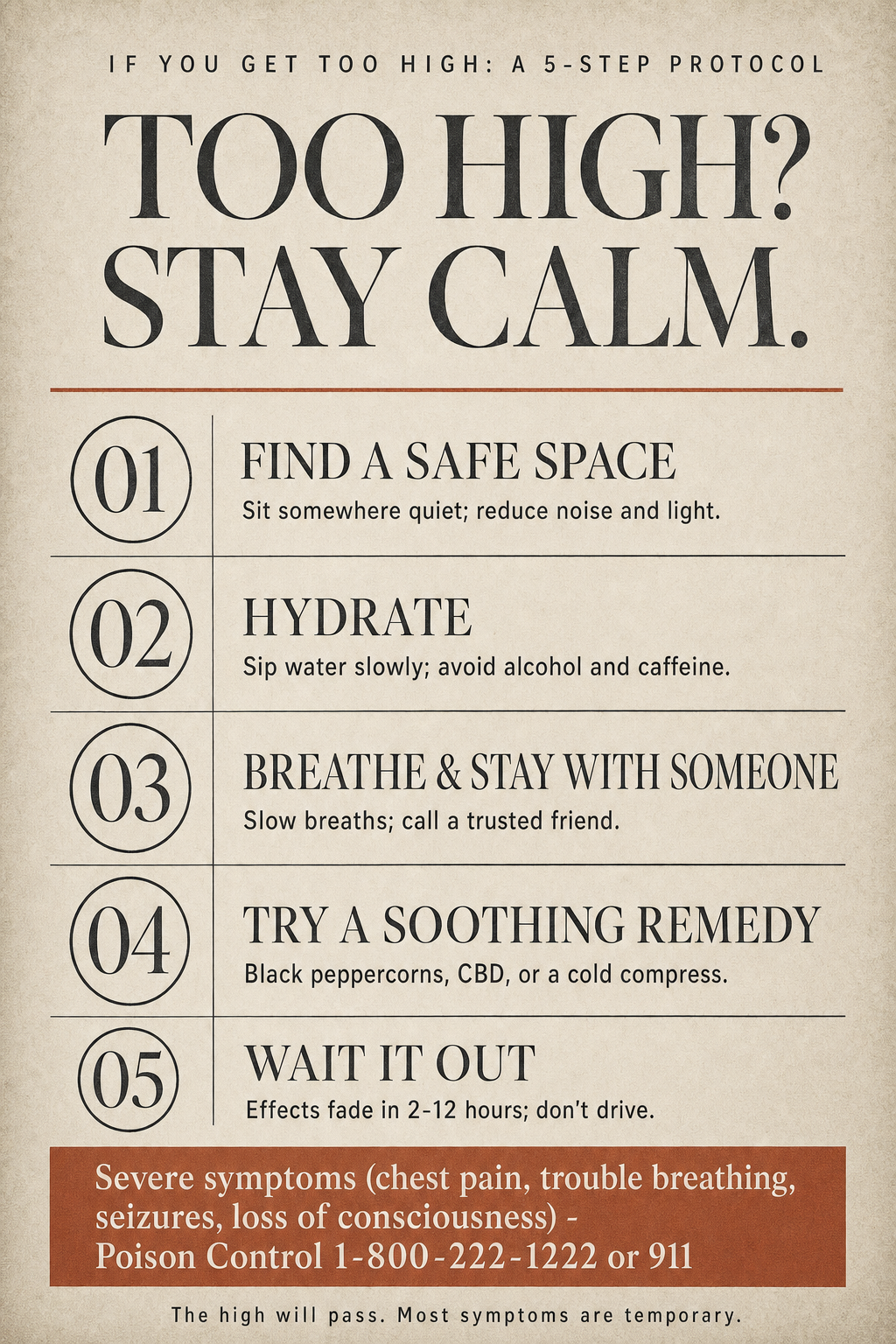
If you've had too much cannabis, the calm-down protocol is straightforward: find a quiet safe space, hydrate with water, stay with a trusted person, breathe slowly, and remember the high will pass. Do not take more cannabis, do not mix in alcohol, and do not drive.
The acute symptoms are distressing but temporary. Inhaled effects typically fade within 2 to 6 hours; edible effects can last 4 to 12 hours with residual effects lingering up to 24 hours [9]. Most symptoms peak within the first 2 to 4 hours and gradually subside if you stay calm, hydrated, and grounded.
A simple step-by-step plan to follow:
- Step 1: Move to a quiet, safe space. Sit or lie down somewhere familiar; reduce noise, lights, and stimulation.
- Step 2: Hydrate with water. Sip slowly. Avoid alcohol, caffeine, or more cannabis. Dry mouth is one of the most common symptoms.
- Step 3: Breathe and stay with someone. Slow, deep breaths. Call or stay near a trusted friend and tell them what is happening.
- Step 4: Try a soothing remedy. Chew or sniff two to three black peppercorns — a folk remedy using beta-caryophyllene, a cannabis terpene. Some people find CBD or a cold compress on the forehead helps.
- Step 5: Wait it out and don't drive. Do not drive, operate machinery, or make major decisions until fully recovered.
A few home remedies are widely shared but worth framing honestly: the black-pepper trick is anecdotal but grounded in beta-caryophyllene's interaction with the endocannabinoid system, and CBD may blunt some of the anxiety for some users [9]. They are comfort measures, not medicines.
The escalation rule matters. Severe symptoms — chest pain, trouble breathing, seizures, extreme confusion, loss of consciousness, or uncontrollable vomiting — mean call Poison Control at 1-800-222-1222 or 911 immediately [5].
How Can You Mix Cannabis and Alcohol Safely (Or Not At All)?
The safest answer is: don't mix them. Cannabis and alcohol compound each other's impairment, slow reaction time, distort perception, and increase nausea and vomiting risk [4].
Polydrug use is one of the highest-leverage ways a routine cannabis session escalates into an emergency-room visit. After Canadian legalization, cannabis-related presentations to emergency departments rose alongside broader use, with combined-substance cases disproportionately represented [8].
The CDC also notes that cannabis is the substance most often associated with impaired driving after alcohol, and that combining them sharply increases crash risk [4].
A simple rule covers most situations:
- If you're drinking, skip the cannabis.
- If you're using cannabis, skip the alcohol.
- Never drive after using either — and especially not after using both.
For most adult-use customers, the choice is binary: choose one substance for the evening, not both.
Frequently Asked Questions
What does it feel like when you've had too much cannabis?
Common symptoms include rapid heart rate, anxiety or panic, paranoia, nausea, dizziness, confusion, slowed time perception, and sometimes hallucinations. The experience is genuinely unpleasant but temporary — fatal overdose from cannabis alone has never been documented in adults without other risk factors.
How long does a bad cannabis high usually last?
Inhaled effects typically fade within 2 to 6 hours, while edible effects can last 4 to 12 hours with residual effects lasting up to 24 hours. Most symptoms peak within the first 2 to 4 hours and gradually subside if you stay calm, hydrated, and in a safe place.
What should you do if you get too high?
Move to a quiet, safe space, drink water, stay with a trusted person, and remember the high will pass. Don't drive, don't take more cannabis, and avoid additional substances. Sniffing or chewing black peppercorns (a folk remedy using beta-caryophyllene) and taking CBD may help some people.
How much THC should a beginner start with?
Adults new to edible cannabis should start with 2.5 mg THC or less and wait at least 2 hours before any additional dose. For inhaled flower, choose products testing 10% THC or below and take one small puff at a time. The universal mantra is "start low, go slow."
Why do edibles cause overconsumption more often than smoking?
Edibles take 30 minutes to 2 hours to take effect because THC must pass through the digestive system and be metabolized by the liver into 11-hydroxy-THC. Customers often re-dose before the first dose peaks, then both doses hit at once — producing an unexpectedly strong high several hours later.
When should someone go to the ER for too much cannabis?
Seek immediate medical help for severe warning signs: chest pain, trouble breathing, seizures, extreme confusion, loss of consciousness, or uncontrollable vomiting. Call Poison Control at 1-800-222-1222 or 911. Cannabis-related hospital admissions have doubled in some jurisdictions since legalization, with acute intoxication being the most common reason.
How does tolerance affect overconsumption risk?
Frequent cannabis use downregulates CB1 receptors, requiring more THC for the same effect. After a tolerance break of 2 to 4 weeks, your previous dose may feel much stronger — so always reduce your dose after any break rather than maintaining it. Growing tolerance is also a clinical marker of cannabis use disorder.
Can you really die from a cannabis overdose?
No fatal overdose from cannabis alone has ever been documented in adults. Unlike opioids or alcohol, cannabis has no documented lethal dose threshold for adults without other risk factors. The experience is distressing and uncomfortable but not life-threatening for most healthy adults — though it can trigger panic attacks, severe anxiety, or ER visits in vulnerable people.
Sources
- Centers for Disease Control and Prevention (CDC) — Edibles carry a greater risk of cannabis poisoning than smoked cannabis because
- Centers for Disease Control and Prevention (CDC) — An estimated 61.9 million people used cannabis in the United States in 2022, and
- Centers for Disease Control and Prevention (CDC) — Approximately 3 in 10 cannabis users develop cannabis use disorder; products wit
- Centers for Disease Control and Prevention (CDC) — Cannabis slows reaction time, impairs coordination, and distorts perception; aft
- California Poison Control System (CPCS) — Cannabis-related calls to CPCS more than doubled from 2016 to 2024, with a 61% i
- BC Ministry of Public Safety and Solicitor General (reproduced from CCSA) — Adults new to edible cannabis should start with 2.5 mg THC or less, wait at leas
- PubMed Central (PMC) — Emergency Department Cannabis Study — Of 303 acute-cannabis ED visits analyzed, 80.5% involved oral (edible) cannabis
- PubMed Central (PMC) — Cannabis-Associated Emergencies Review — After Canadian legalization, cannabis use rose from 15% (2017) to 25% (2021) and
- PreventEd — Overconsumption symptoms include panic, anxiety, rapid heart rate, nausea, dizzi
- National Academies of Sciences, Engineering, and Medicine — Comprehensive evidence review concluding that cannabis use carries acute risks i
About Treehouse Cannabis
Treehouse Cannabis is an adult-use dispensary serving Rockland County from Nanuet, NY. Customers across the Hudson Valley visit Treehouse for low-dose gummies, balanced THC:CBD ratios, and precisely dosed tinctures — and for staff who can walk them through product labels, serving sizes, and timing. Want to start low with confidence? Stop in and ask about our beginner-friendly dosing guides.
Cannabis is for adults 21 and older. Keep all cannabis products securely stored and out of reach of children and pets. Do not drive or operate machinery after using cannabis, and avoid mixing cannabis with alcohol or other substances. If you or someone you know is struggling with cannabis use, SAMHSA's National Helpline is available 24/7 at 1-800-662-HELP (4357).

Shop our products

Shop All

Flower

Pre-rolls
Vaporizers

Edibles
Drinks

Concentrates
Tinctures

Topicals

CBD

Pet CBD

Accessories