
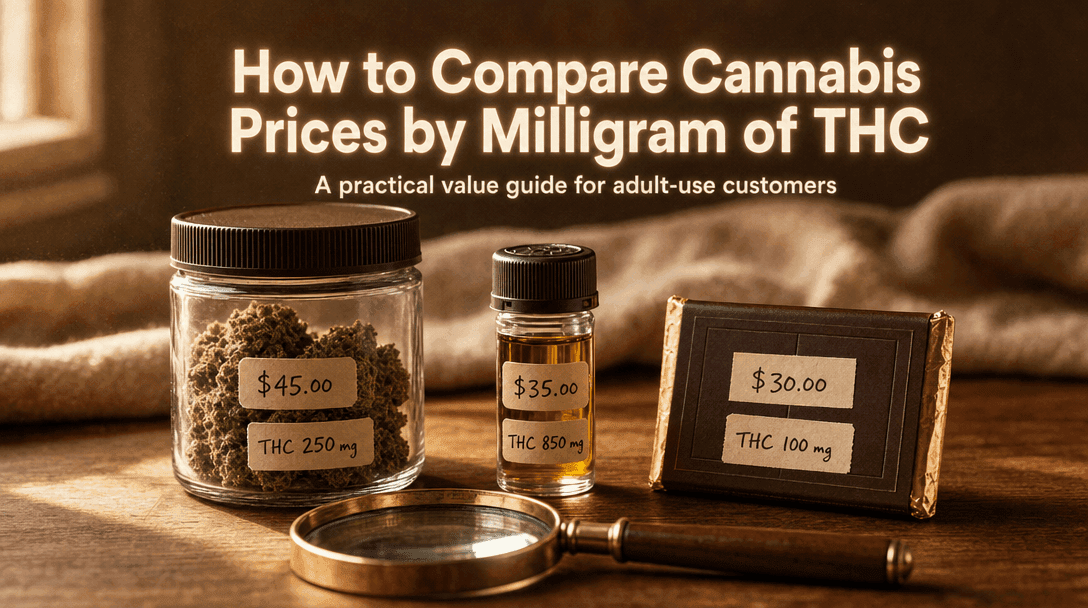
How to Compare Cannabis Prices by Milligram of THC
How to Compare Cannabis Prices by Milligram of THC
Price per milligram of THC is the dollar cost of one milligram of THC in a product. You find it by dividing the pre-tax price by the total milligrams of THC the product actually contains, and it is the only number that fairly compares a $30 eighth of flower against a $25 pack of gummies or a $40 vape cartridge.
What Is Price Per Milligram of THC and Why Does It Matter?
Price per milligram of THC is the cost of a single milligram of THC inside whatever product you are buying. For an edible or a vape, you divide the package price by the total mg of THC printed on the label. For flower and concentrates, you convert the package weight into milligrams and multiply by the THC percentage from the certificate of analysis (COA) before dividing.
Headline dollar prices mislead customers because they ignore potency. A $25 ten-pack of 100 mg gummies and a $40 eighth of flower look similar on a menu until you realize the flower holds roughly 700 mg of THC at a moderate 20% potency while the gummies hold exactly 100 mg [6]. Same shelf, different value.
This metric also matters because THC percentages in legal flower have been climbing for a decade, with DEA seizure data showing average retail potency well above 10% and over 20% in some regions [4]. Two flower products at the same dollar price today can deliver meaningfully different milligrams of THC than they would have five years ago, and price-per-mg math is how you see that drift.
What price per mg actually captures (and what it leaves out):
- Total THC in the package — the real denominator behind every sticker price.
- Category parity — flower, vapes, edibles, and concentrates on the same number line.
- Potency drift over time — accounts for the fact that today's 22% eighth is stronger than a 2018 eighth at the same THC percentage.
- Doesn't capture: terpene profile, freshness, cultivation method, or feel — those are separate inputs from the same COA.
The framework also lets you compare across very different product types, which is exactly the problem the Treehouse post You're Not Lazy — Your Edible Just Peaked at the Wrong Time walks through from the other side: timing your edible dose is the second variable after you have picked the right per-mg price.
Terpene profile and aroma are not captured by this number, which is why the Treehouse explainer on What Is Humulene and Why Does It Show Up in Herbs, Black Pepper, and Cannabis? is a useful companion read for customers who want to anchor on more than the math.
Related guide: You’re Not Lazy—Your Edible Just Peaked at the Wrong Time.
Related guide: What Is Humulene and Why Does It Show Up in Herbs, Black Pepper, and Cannabis?.
How Do You Calculate Price Per Milligram in Flower?
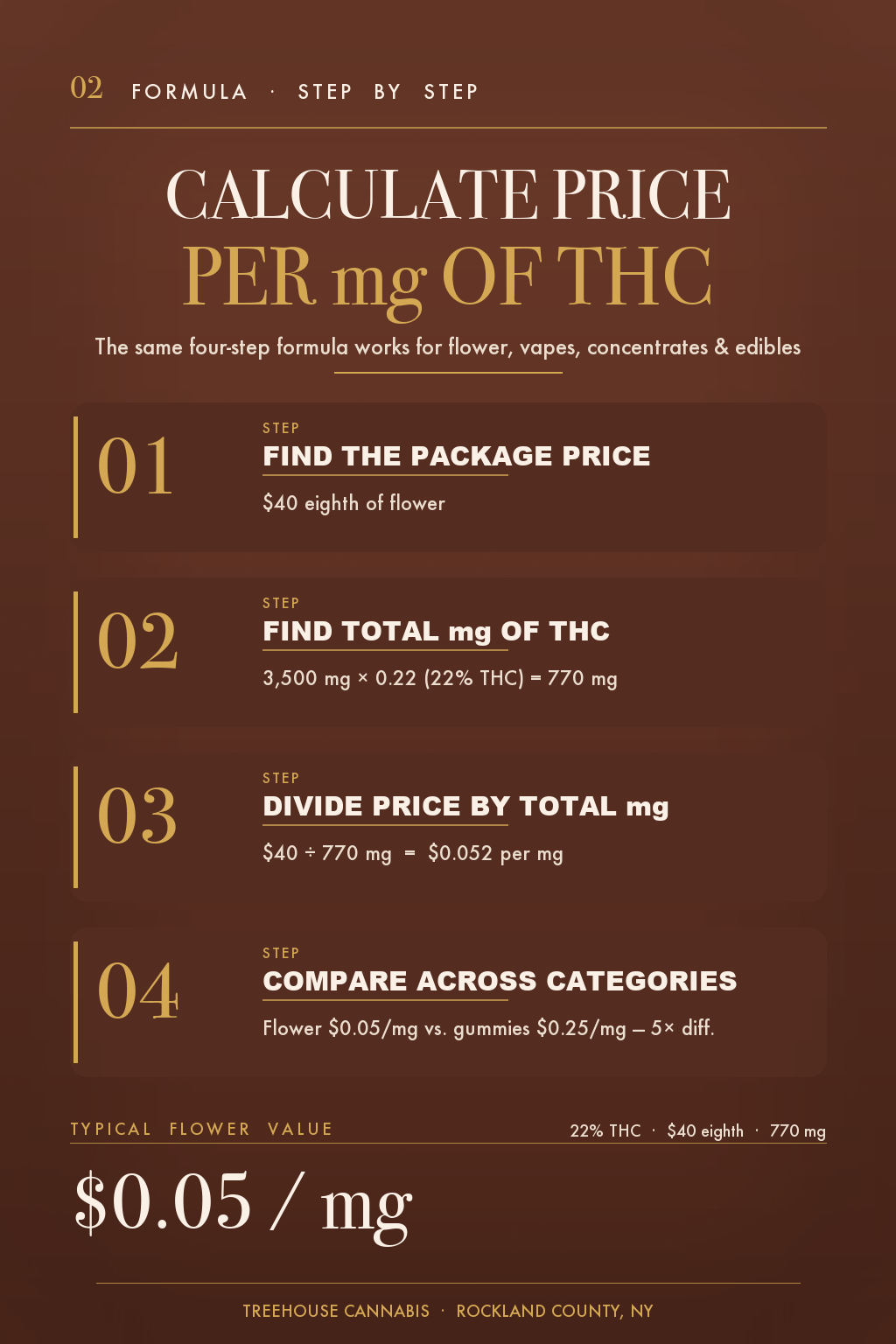
Flower math is a two-step process because you have to translate both weight and potency into a milligram count. Step one is the unit conversion: one gram equals 1,000 mg, so an eighth of 3.5 grams equals 3,500 mg of biomass. Step two is the potency multiplier: take the THC percentage from the COA, convert it to a decimal (22% becomes 0.22), and multiply.
A worked example makes this concrete. Take a $40 eighth at 22% THC. The total milligrams of THC in the jar is 3,500 mg × 0.22 = 770 mg. Divide $40 by 770 mg and the price per mg is roughly $0.052, or about five cents per milligram [6].
That same calculation flips when the price or potency changes. A $35 eighth at 18% THC is 3,500 × 0.18 = 630 mg of THC, which works out to $0.056 per mg. A $45 eighth at 28% THC is 3,500 × 0.28 = 980 mg of THC, or $0.046 per mg. The math decides which eighth is actually the better buy, and the answer is not always the cheapest sticker price.
This is also where the Treehouse menu helps. Treehouse's full Flower collection sorts by strain, weight, and lab-tested THC percentage so the COA is one click away. With that number on screen, the per-mg formula takes about ten seconds to run in your head.
A quick checklist for any eighth on the shelf:
- Note the weight in grams and convert to mg (3.5 g × 1,000 = 3,500 mg).
- Pull the THC percentage from the COA and convert to a decimal.
- Multiply weight in mg by the decimal to get total mg of THC.
- Divide the package price by total mg for your $/mg number.
- Compare that number against the next jar before you choose.
Browse the full lineup: Flower.
Which Cannabis Category Has the Lowest Price Per Milligram?
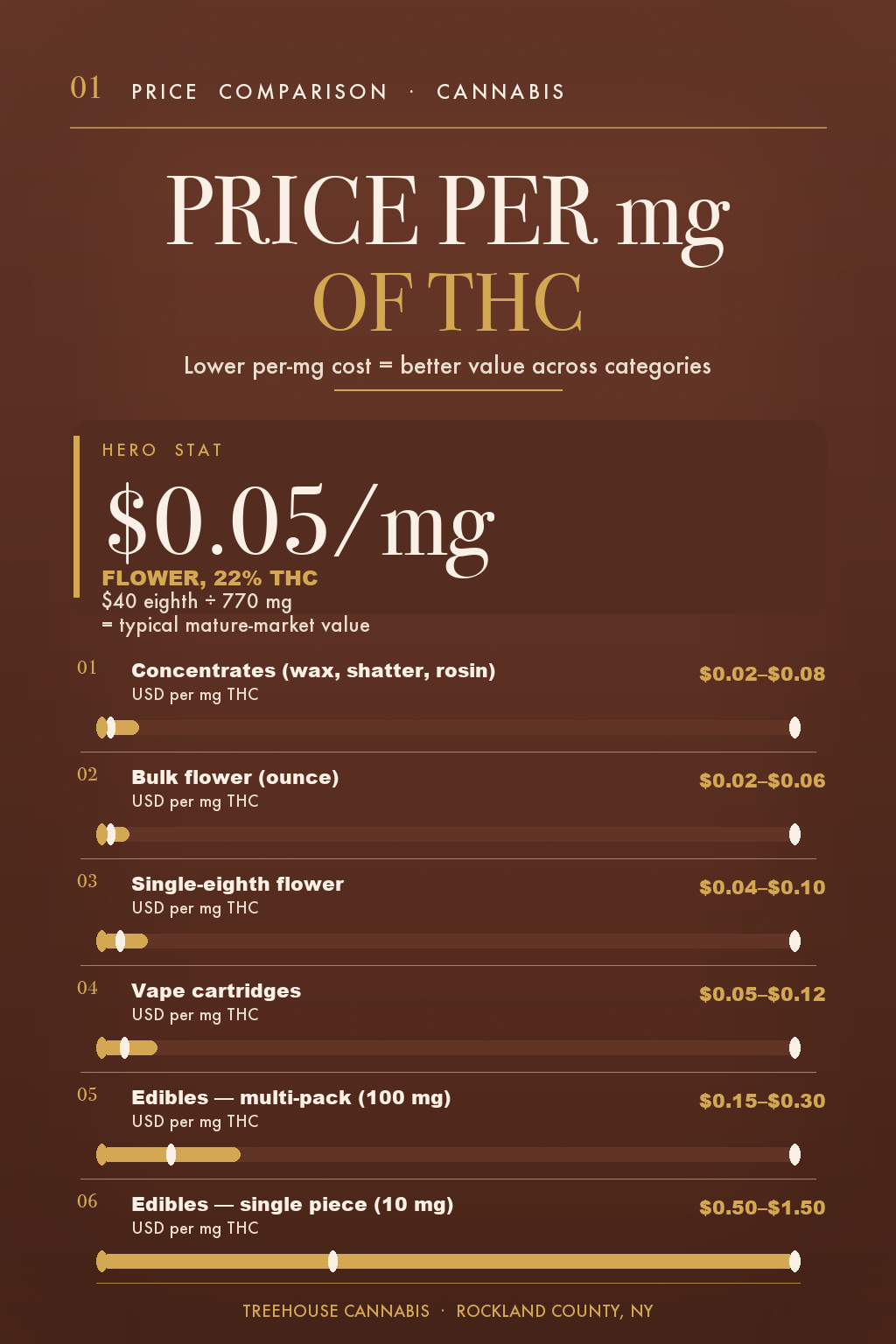
Concentrates almost always deliver the lowest price per milligram of any legal category, but the spread across categories is wide enough that customers should check the math on every category instead of assuming. Mature-market data from Headset and industry calculators consistently puts concentrates between $0.02 and $0.08 per mg, while bulk flower (ounce tier) sits at roughly $0.02 to $0.06, single-eighth flower at about $0.04 to $0.10, vapes at $0.05 to $0.12, and edible multipacks at $0.15 to $0.30 [2] [6].
Typical price-per-mg ranges by product category (mature legal markets):
| Category | Typical $/mg range | Notes |
|---|---|---|
| Concentrates (wax, shatter, rosin) | $0.02 – $0.08 | Lowest $/mg; potency 60–90% THC |
| Bulk flower (ounce tier) | $0.02 – $0.06 | Strong value when potency is high |
| Single-eighth flower | $0.04 – $0.10 | The everyday reference point |
| Vape cartridges | $0.05 – $0.12 | Total mg printed on the label |
| Edibles — multi-pack (100 mg total) | $0.15 – $0.30 | Fixed cost spread across more THC |
| Edibles — single piece (10 mg) | $0.50 – $1.50 | Heaviest convenience premium |
The trade-off is potency tolerance and consumption style. A gram of wax at 80% THC costs less per milligram but delivers far more THC per session than a joint, so a single $35 gram can last a heavy consumer weeks and a casual consumer many months. Concentrates only "win" on raw value if you actually consume the THC in the jar.
How the four main categories rank on value:
- Concentrates — lowest price per mg; best $/mg if you actually consume the jar.
- Bulk flower (ounce tier) — strong value when potency is high; commits you to a large jar.
- Single-eighth flower — the everyday reference; mid-range $/mg with full flavor.
- Vape cartridges — convenient and consistent; $/mg usually slightly above flower.
- Multi-pack edibles — $0.15–$0.30/mg; predictable dosing, slower onset.
The Treehouse Concentrates shelf carries wax, rosin, badder, hash, and live rosin across multiple price points, so customers can run the formula on a budget gram and a premium gram side by side. The per-mg numbers are almost always lower than any flower eighth on the same menu.
Concentrate value comes with one important caveat: only buy tested product with a published COA. A bargain gram with no lab data is not a better deal than a tested eighth, even if the per-mg sticker looks attractive.
Browse the full lineup: Concentrates.
How Do Price Per mg Numbers Work for Vapes and Edibles?
For vapes and edibles the math is much simpler because the total milligrams of THC are already printed on the label. You do not have to convert weight or multiply by a potency percentage, you just divide the package price by the total mg number.
Take a $40 half-gram vape cartridge labeled at 800 mg of THC. Divide $40 by 800 mg and the per-mg price is $0.05, putting it roughly in line with single-eighth flower. A $25 ten-pack of 10 mg gummies (100 mg total) divides to $0.25 per mg, which is about five times more expensive per milligram than that same vape cart [6].
The same logic applies to capsules, tinctures, drinks, and chocolates. Anywhere the package has a total-mg number on it, the per-mg price is a one-step division. This is why Treehouse shoppers who want the simplest version of the formula browse the Edibles menu and look for the total-mg label before anything else.
Multi-pack gummies are the obvious sweet spot here. A $25 pack of ten 10 mg pieces gives you 100 mg of THC at $0.25 per mg, while a single $10 chocolate bar with the same 100 mg total works out to $0.10 per mg. Both are still more expensive than flower or concentrates, but the multi-pack is roughly half the per-mg price of buying the same THC dose as five separate 10 mg singles.
Vape and edible quick reference:
- Vape cartridge ($40, 800 mg total) → $0.05/mg, in line with single-eighth flower.
- Multi-pack gummies ($25, 100 mg total) → $0.25/mg, about 5× the vape cart.
- Single chocolate bar ($10, 100 mg total) → $0.10/mg, roughly half the gummy multi-pack.
- Capsules and tinctures → same one-step formula, look for the printed total-mg number.
Browse the full lineup: Edibles.
Why Do Single-Serving Edibles Cost So Much More Per mg?
Single-serving edibles carry a heavy convenience premium because the same packaging, infusion labor, and flavoring cost gets spread across a much smaller amount of THC. A single 10 mg gummy at $10 to $12 is $1.00 to $1.20 per mg, while a 10-pack of 100 mg total at $20 to $30 is $0.20 to $0.30 per mg [6].
The math is brutal for the single piece. At $1.00 per mg, you are paying roughly 20× what you would pay for the same milligram of THC in a concentrate. Multipacks bring the per-mg price down by a factor of four to five because the fixed costs of bottling, boxing, and infusing get amortized over more total THC.
Industry data also shows the per-mg cost of edibles has been falling as markets mature. MJBizDaily reported a 7.88% drop in edible price per mg across California, Colorado, Nevada, and Washington between January 2020 and May 2021 [5]. The convenience premium on single-serve products has not disappeared, but it has narrowed.
Why the convenience premium is so steep on a single 5–10 mg piece:
- Packaging cost — the jar, label, and child-resistant closure are the same whether the pack holds 10 mg or 100 mg.
- Infusion labor — mixing, dosing, and quality control are per-batch, not per-milligram.
- Flavoring and sugar — uniform across the batch, so smaller packs amortize over less THC.
- Retail handling — single SKUs take the same shelf space as a 10-pack.
- Margin expectations — dispensaries price single-serve products to match grab-and-go demand, not raw mg cost.
For customers who actually want one piece at a time, there is a middle path. Buy a 100 mg multi-pack, portion it into single servings at home, and store them in a child-resistant container. You get the dosing control of single-serve packaging at a per-mg price roughly five times cheaper.
If you do want to browse single-serve options, the Premium Flower shelf pairs nicely with micro-dose edible SKUs on the Treehouse menu. A 5 mg edible plus a small bowl of a moderate-THC eighth can stretch a session further than either product alone, and the per-mg math on both is straightforward.
Browse the full lineup: Premium Flower.
Does Higher THC Percentage Always Mean a Better Deal?
A higher THC percentage only delivers better value if the price per milligram actually comes out lower. Run the formula on any two eighths and the answer is not always the one with the bigger number on the label.
Take two real examples. An 18% eighth at $35 works out to 3,500 × 0.18 = 630 mg, or $0.056 per mg. A 28% eighth at $45 works out to 3,500 × 0.28 = 980 mg, or $0.046 per mg. The 28% eighth costs $10 more but delivers 350 extra mg of THC and a meaningfully better per-mg price [6].
Reverse the prices and the answer flips. A 28% eighth at $65 is 980 mg, or $0.066 per mg. The 18% eighth at $35 is still $0.056 per mg, which is now the better deal despite the lower THC percentage. The COA percentage is one input to the formula, not the answer by itself.
Three rules for reading the higher-THC-better debate:
- Compare the same weight. An eighth at any potency is 3,500 mg of biomass, so the only variable is potency and price.
- Compute the denominator yourself. Run weight in mg × THC % as a decimal to get total mg of THC, then divide price.
- Don't anchor on the lab number. A higher percentage only wins when the price is comparable; otherwise the cheaper eighth with less THC can still beat it per mg.
| Scenario | THC % | Price | Total mg THC | $/mg | Verdict |
|---|---|---|---|---|---|
| A | 18% | $35 | 630 mg | $0.056 | Higher per-mg price |
| B | 28% | $45 | 980 mg | $0.046 | Better deal |
| C | 28% | $65 | 980 mg | $0.066 | Worse deal — too expensive for the potency |
| D | 18% | $35 | 630 mg | $0.056 | Wins again — lower per-mg despite less THC |
Freshness and terpene content also matter. A 22% eighth harvested last week will usually feel stronger than a 28% eighth that has been on the shelf for six months, even though the lab numbers say otherwise. Customers chasing raw THC percentage can overpay for old, dry flower that has lost volatile terpenes and oxidized cannabinoids.
The Treehouse blog goes deeper on this question in Is High THC Percentage Really Better? Debunking the Potency Myth, which walks through how lab percentages translate into the experience you actually feel. The short version: use the per-mg math first, then look at the COA date and terpene panel before deciding.
Related guide: Is High THC Percentage Really Better? Debunking the Potency Myth.
How Does New York's Cannabis Pricing Compare to Other States?
New York is one of the most expensive legal cannabis markets in the United States. The 2024 New York Office of Cannabis Management Annual Market Report placed the weighted average price for legal flower at $10.61 per gram, roughly 80% higher than the nationwide Headset average of $5.90 per gram for an eighth of flower [3] [2].
That price gap matters at the per-mg level. A $40 eighth at 22% THC in New York is the same 770 mg of THC as a $40 eighth in Oregon, but customers in mature Oregon markets often see that eighth priced closer to $20 to $25 because the per-gram average is about $3.30 [2]. Same milligrams of THC, very different dollars.
Rockland County sits inside the New York market, so local Treehouse customers should expect menu prices above the national average and use per-mg math to make sure they are getting the right value out of every visit. The mature-market ranges cited elsewhere in this article are useful as a benchmark, not as the local price.
What New York customers should know about the local price gap:
- New York flower: ~$10.61/g weighted average (2024 OCM) — among the most expensive legal markets.
- National flower average: ~$5.90/g (Headset, June 2026) — the benchmark to compare against.
- Oregon flower (lowest tracked): ~$11.55 per eighth — the cheap end of legal cannabis.
- Ohio flower (highest tracked): ~$31.11 per eighth — the expensive end of legal cannabis.
- Local impact: Rockland County menus track New York averages, so the per-mg math is especially important here.
For a sense of the spread: the same Headset dataset puts Oregon's average eighth at $11.55 (lowest tracked) and Ohio's at $31.11 (highest tracked), with New York's gram equivalent somewhere in the upper tier of that range [2]. Knowing the local anchor is the only way to interpret whether a concentrate or edible menu price is fair.
If you are planning a 4/20 visit or any larger holiday menu, the Treehouse guide to The Ultimate 4/20 Guide covers the seasonal pricing patterns in the New York market and is a useful companion read alongside this article.
Related guide: The Ultimate 4/20 Guide.
Is Price Per mg of THC the Only Thing That Matters?
Price per milligram is the best single number for value, but it is not the only thing to look at. Terpene profile, harvest freshness, lab-tested purity, cultivation method, and how a product actually feels for you still matter. A concentrate with no published COA at $0.03 per mg is not a better deal than a tested flower at $0.06 per mg.
Terpenes drive aroma and modulate effect, so a 20% eighth with a rich terpene panel can feel more enjoyable than a 28% eighth with a flat lab sheet. The COA percentage does not capture that. Customers who care about flavor and effect should weight the per-mg number against the terpene data on the same COA.
Practical shortlist for when to override pure per-mg math:
- A product without a published COA, even at a very low per-mg price.
- Flower harvested more than six months ago, regardless of potency.
- Edibles or vapes without a printed total-mg number on the label.
- A strain format you already know does not work for you, even at a bargain per-mg.
- A category you do not actually consume (a great per-mg concentrate deal is wasted if you never dab).
Use price per mg as the tiebreaker between two viable products, not as the only input. For most Rockland County customers, the workflow is the same: confirm the COA, run the formula, then decide.
Treehouse Cannabis is a locally owned dispensary serving Rockland County and the surrounding New York market. Shop the current menu online, ask a budtender to pull the COA on any product, and run the formula together before you buy. The math works the same on every shelf, and it works just as well for an eighth as it does for a 100 mg gummy pack.
Sources
- Washington State Liquor and Cannabis Board (LCB) — In 2022 the average THC concentration for legal flower in Washington State was 2
- Headset — As of June 2026, an eighth of flower averages $20.64 nationwide ($5.90 per gram)
- New York State Office of Cannabis Management (OCM) — The 2024 New York OCM Annual Market Report placed the weighted average price for
- ElSohly, M.A., Majumdar, C.G., Chandra, S. — Frontiers in Public Health (PMC11484017) — Ten-year analysis (2013–2022) of cannabis seized by the DEA finds average THC co
- MJBizDaily (Andrew Long, May 25 2021) — Headset analysis of adult-use pricing in CA, CO, NV and WA from January 2020 to
- ColoradoCrop Price Per MG Calculator — The price-per-mg formula is Total Product Price ÷ Total mg THC = $/mg. Worked ex
About Treehouse Cannabis
Treehouse Cannabis is a New York State licensed adult-use dispensary serving customers across Rockland, Orange, and Westchester Counties. Our team helps adult customers navigate the cannabis category with practical, evidence-based guidance — from running the price-per-mg math on a $40 eighth to picking the right edible multipack for predictable dosing. Browse our full menu online or visit any of our locations to talk with a budtender about value, dosing, and product selection.
Cannabis is for adults 21 and older. Keep all cannabis products out of reach of children and pets, never drive under the influence, and consult a qualified professional if you have questions about how cannabis interacts with any health condition or medication you are taking. This article is educational and is not medical or legal advice.
Shop our products

Shop All

Flower

Pre-rolls
Vaporizers

Edibles
Drinks

Concentrates
Tinctures

Topicals

CBD

Pet CBD

Accessories