

How to Shop for Cannabis by Terpene Profile
How to Shop for Cannabis by Terpene Profile
To shop cannabis by terpene profile, read the Certificate of Analysis (COA) on the specific jar, identify the one or two dominant terpenes in the breakdown, and pick flower with the aroma and character you want. THC percentage alone tells you very little about how a batch will smell or taste — the terpene profile is the data point most directly tied to your experience in the jar.
What Is a Cannabis Terpene Profile?
A cannabis terpene profile is the list of aromatic compounds measured in a specific batch of flower, pre-roll, or concentrate, usually reported on the product's Certificate of Analysis as a percentage of total weight or in milligrams per gram. Terpenes themselves are volatile organic compounds produced in the same resin glands (trichomes) as THC and CBD, and they are what give a strain its smell — citrus, pine, diesel, fruit, floral, earthy, or some layered combination of those notes [3]. A peer-reviewed review of the plant catalogues more than 120 terpenes and terpenoids identified in cannabis so far, although only a handful of them appear on most dispensary COAs [1].
The key data points a terpene profile covers:
- The total terpene percentage — the sum of all measured terpenes by weight, usually 1 to 3 percent for quality flower
- The top three to five individual terpenes — broken out by name and amount, with one or two clearly dominant
- The ratio between them — which determines the qualitative character (citrus vs. earthy, bright vs. grounded)
Terpenes are not the same thing as cannabinoids, even though the plant makes both in the same trichomes. Cannabinoids like THC and CBD interact with the body's endocannabinoid system; terpenes are responsible for aroma and flavor and may also play a supporting role in shaping the qualitative character of a product, an idea sometimes called the entourage effect [4] [5]. That hypothesis is still under active scientific debate, but the aroma-and-flavor side of the equation is settled science — your nose knows whether the jar is citrusy or earthy long before you light it.
For shoppers, the practical takeaway is that two jars with the same THC percentage can test with completely different terpene profiles, and the terpene profile is the data point most directly tied to what you will actually smell and taste. If you have ever wondered why a 22 percent THC jar of one strain felt more relaxing than a 22 percent THC jar of another, the terpene panel is usually where the answer lives.
For a deeper look at the underlying science and the rest of the terpene family, our guide A Guide to Terpenes and Their Effects covers the basics in more detail. And if you are shopping with someone who has just started exploring cannabis and would respond well to a more curated gift-style introduction, our Valentine’s Day Cannabis Gifts: Thoughtful Ideas for Every Cannabis Lover walks through thoughtful options organized by the kind of experience they tend to enjoy.
How Do You Read a Cannabis Certificate of Analysis (COA)?
A Certificate of Analysis is the lab report tied to a specific batch of cannabis. In regulated U.S. markets like New York, every tested batch has one, and it is the most reliable way to see what is actually in the jar you are holding rather than relying on the strain name printed on the label. Most COAs break terpenes down in two ways.
The first number is total terpenes, expressed as a percentage of the product's dry weight. This is the sum of every terpene the lab measured, and for most quality dried flower it lands somewhere between 1 and 3 percent [6]. A practical way to convert that percentage into a number you can compare: a flower at 2.3 percent total terpenes contains roughly 23 milligrams of terpenes per gram [2].
The second part of the panel is the breakdown of the top three to five individual terpenes, usually listed by name and amount. This is where the actionable information actually lives. A jar that totals 2.1 percent terpenes but is dominated by limonene will smell and taste completely different from a jar that also totals 2.1 percent but is dominated by myrcene, even though the headline number looks the same.
You can usually find the COA in one of three places:
- A QR code printed on the label or the outer packaging, which links directly to the lab report for that batch
- The dispensary's menu page or point-of-sale system, which often pulls the COA in alongside the price and weight
- A budtender, who can pull the COA on a tablet or print it out for the specific jar on the shelf
Once you have the COA open, the question to ask is not "what is the total number" — it is "which one or two terpenes dominate, and what is the total." The dominant terpenes drive the character; the total tells you how loud the aroma will be when you open the jar.
If you are new to reading these and want a broader product-selection primer at the same time, How to Choose Your First Cannabis Product: A Complete Guide for Beginners walks through the first-time shopper workflow end to end.
Which Terpenes Should a Shopper Know by Name?
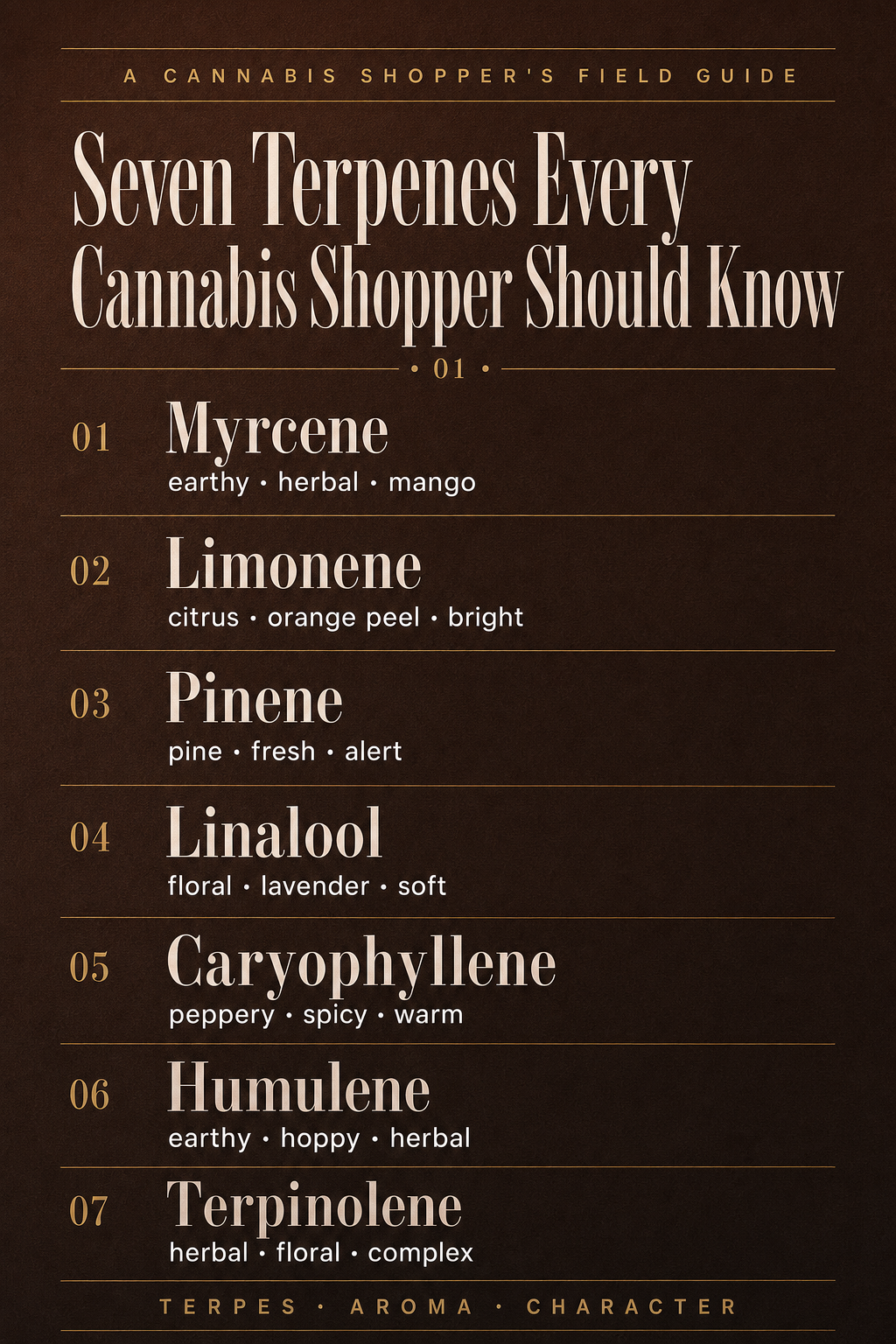
Most dispensary COAs in regulated U.S. markets share a common cast of characters. A 2021 peer-reviewed catalogue of cannabis chemistry lists myrcene, caryophyllene, limonene, linalool, pinene, terpinolene, and humulene as the seven most prevalent terpenes across analyzed cultivars [1], and these are the names you will see over and over again on store shelves.
Each one has a recognizable aroma, a typical strain example, and a qualitative character that experienced shoppers tend to associate with it. Here is the cheat sheet:
- Myrcene — earthy, herbal, with a hint of mango; the most common terpene in many dried-flower cultivars, often associated with a more grounded character
- Limonene — citrus, orange peel, bright; common in citrus-leaning cultivars and associated with a brighter, more lifted feel
- Pinene — pine, fresh, forest; common in cultivars like Jack Herer and associated with alertness
- Linalool — floral, lavender; common in softer-smelling cultivars and associated with a calmer character
- Caryophyllene — peppery, spicy, clove-like; common in cultivars like GSC and notable because it is the only terpene known to also interact with cannabinoid receptors in the body [5]
- Humulene — earthy, hoppy; found in many cultivars and named for its similarity to the aroma of hops
- Terpinolene — herbal, floral, layered; less common as a top-three terpene, but when it dominates the jar it gives a more complex aroma than any single descriptor captures
For a closer look at terpinolene specifically — its aroma, where it tends to show up, and what sets it apart from the rest of the list — our What Is Terpinene in Cannabis? An Educational Overview dives in.
A quick note on framing: aroma and flavor are directly driven by terpenes, and that part is well established. Whether terpenes independently change how cannabis makes you feel beyond aroma is a hypothesis under active scientific debate — supported by some preclinical research and questioned by others [4] [5]. Treat terpene-led shopping as a reliable cue for aroma, flavor, and qualitative character first, and as an educated hypothesis about effect second.
What Does a Good Total Terpene Percentage Look Like?
Translating the COA numbers into a shopping rule of thumb:
- Below 1 percent total terpenes — typically a muted aroma; the jar will likely smell faint or grassy
- 1 to 1.5 percent — noticeable aroma; this is the baseline for most quality flower on a regulated shelf
- 1.5 to 2 percent — strong aroma; this is the band where most experienced shoppers start calling a batch "loud"
- 2 to 3 percent — terpene-rich; these batches tend to be more aromatic on first open and hold their nose through a session
- Above 3 percent — uncommon; usually indicates a particularly aromatic cultivar or an exceptionally well-cured batch
These are practical shop-floor ranges, not hard rules. The total number also depends on storage, cure quality, and how long the jar has been sitting on the shelf.
The most important caveat is this: the highest total does not automatically mean the best product for you. Two jars can both test at 2.4 percent total terpenes and smell nothing like each other because the underlying ratio of terpenes is different. A flower dominated by limonene and pinene will lean bright and sharp; a flower dominated by myrcene and linalool will lean softer and earthier. The total tells you how loud the aroma will be; the breakdown tells you what the aroma actually is.
If you want a more direct way to experience terpene character without sorting through COAs, terpene-infused accessories are a fun intermediate step — for example, our Terpene-Infused Blunt Cones | King Size are king-size cones that bring added terpene character into the session.
How Should You Compare Products in the Dispensary?
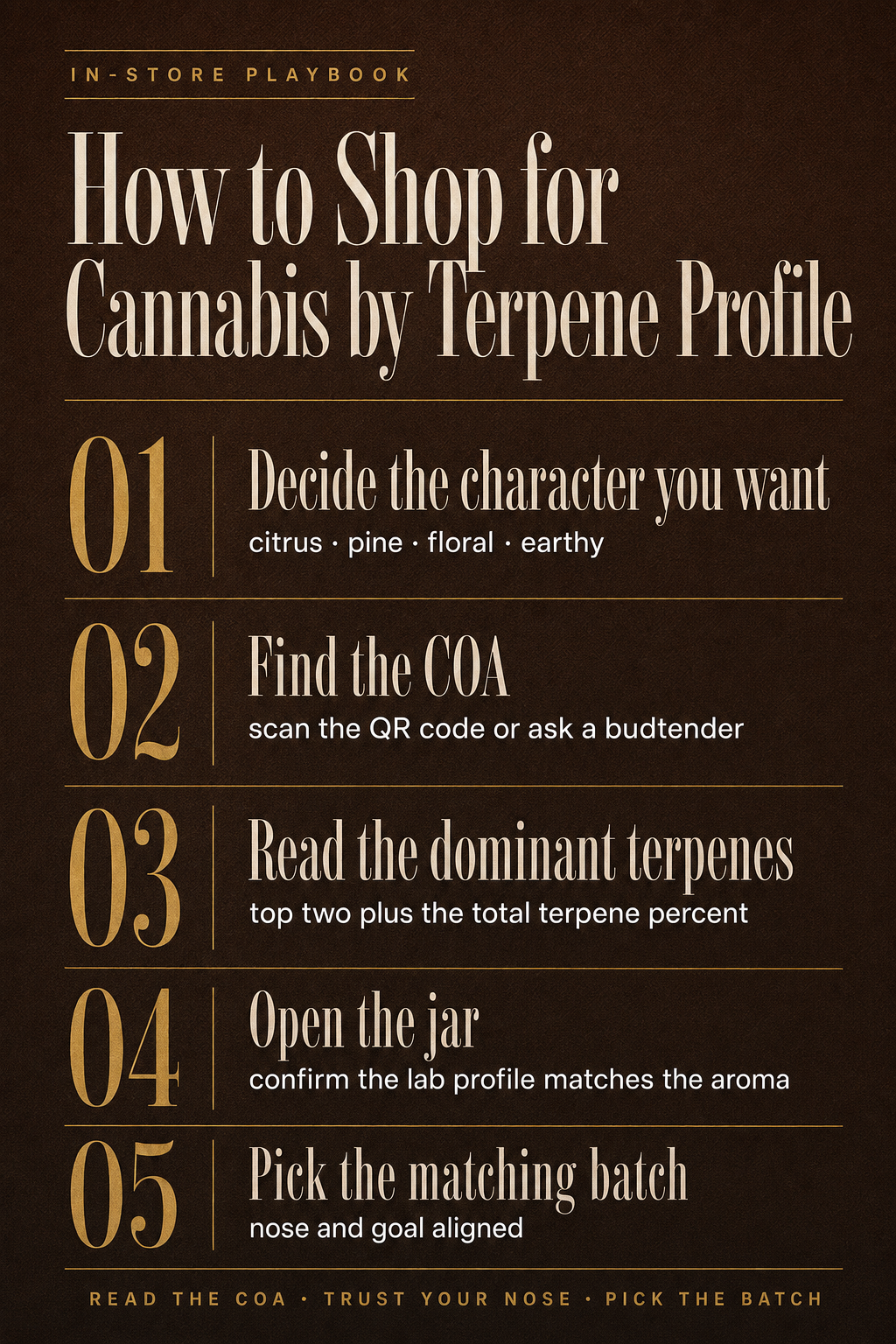
When you are standing at the counter with a few jars in front of you, here is a five-step workflow that takes most of the guesswork out of terpene-led shopping:
- Decide the character you want. Before you look at any jars, pick the aroma family you are in the mood for — citrus, pine, floral, or earthy. This is faster than reading every COA on the menu and gives the budtender a real direction to work with.
- Find the COA for the specific jar. Strain names are unreliable batch to batch — the same name can test with completely different terpene content from one harvest to the next, and two different strain names can test with nearly identical profiles. Always read the COA for the specific batch you are holding, not the printed strain name on the jar.
- Read the top two dominant terpenes and the total. Look at the individual terpene breakdown and note which one or two are at the top of the list. Then look at the total. You want a clear top terpene that matches the character you want, and a total above roughly 1.5 percent if you care about aroma intensity.
- Open the jar and confirm the lab profile matches your nose. This step catches the cases where the lab says one thing and the cure, age, or storage changed the actual aroma. If the jar smells muted but the COA says 2.2 percent limonene, trust your nose — that batch has likely been sitting out.
- Pick the batch that matches both your nose and your goal. When the lab profile and the aroma line up, you have found a well-handled batch with the character you wanted. If a flower like Northern Lights | Flower | 3.5g is on the shelf, ask the budtender to walk you through its terpene panel and then smell it before you commit.
A good budtender will know which batches on the shelf have which dominant terpene profiles, which jars came in this week, and which cultivars in stock match the character you described. Use that knowledge — it is the part of the in-store experience that terpene-led shopping is designed to take advantage of.
What Are the Most Common Terpene Profile Questions?
Quick answers:
- Terpene profile: A batch's aromatic compound list on the COA — the most useful data point for choosing by aroma and character.
- Reading labels: Total terpenes shows the sum; the top one or two dominant terpenes in the breakdown shape the character.
- Most common terpenes: Myrcene, limonene, pinene, linalool, caryophyllene, humulene, and terpinolene dominate U.S. dispensary COAs.
- Highest % is not always best: A higher total means a louder aroma, but the dominant terpene ratio — not the total — drives the character.
- Shop by COA, not strain name: Strain names vary batch to batch, so the specific batch's COA is the reliable signal.
What is a cannabis terpene profile? A cannabis terpene profile is the list of aromatic compounds measured in a specific batch, reported as a percentage of total weight or milligrams per gram on the Certificate of Analysis. It shows which terpenes are present and in what proportion, and is the single most useful data point for choosing by aroma and character.
How do I read terpene percentages on a cannabis label? Terpene percentages are shown two ways: total terpenes (the sum of all measured terpenes) and a breakdown of the top three to five individual terpenes in milligrams per gram or as a percentage. A product with 1.5 to 3 percent total terpenes typically has a strong aroma. The top one or two dominant terpenes shape the character.
Which cannabis terpenes are the most common? The seven most common cannabis terpenes on dispensary shelves are myrcene (earthy, herbal), limonene (citrus), pinene (pine), linalool (floral, lavender), caryophyllene (peppery, spicy), humulene (earthy, hoppy), and terpinolene (herbal, floral).
Does the highest terpene percentage mean the best product? Not necessarily. A higher total terpene percentage usually means a stronger aroma, but the qualitative character depends on which terpenes are dominant and in what ratio. A flower at 1.5 percent total terpenes with a clear limonene and pinene profile can feel very different from a flower at 2.5 percent dominated by myrcene, even though the second is numerically larger.
Should I shop by strain name or by terpene profile? Shop by terpene profile when you can. The same strain name can test with different terpene content from one batch to the next, and two different strain names can test with nearly identical terpene profiles. Reading the COA for the specific batch you are buying gives you a more reliable picture than the printed strain name on the jar.
What is a good total terpene percentage for dried flower? Most quality dried flower in regulated U.S. markets tests between 1 and 3 percent total terpenes. Anything above 1 percent typically has a noticeable aroma, anything above 2 percent is generally considered terpene-rich, and numbers above 3 percent are uncommon and usually indicate a particularly aromatic cultivar or an exceptionally well-cured batch.
Sources
- Molecules (MDPI) via PMC — Catalogues more than 100 terpenes and terpenoids identified in Cannabis sativa,
- Molecules (PMC) — Reviews how cannabis terpenes contribute to sensory attributes and the consumer
- Project CBD — Defines cannabis terpenes, explains that they are produced in the same trichomes
- Project CBD — Discusses the proposed entourage effect, the hypothesis that terpenes may modula
- Frontiers in Plant Science — Argues for whole-plant synergy between cannabinoids and terpenoids and provides
- Leafly — Defines terpene, lists the most common cannabis terpenes and their characteristi
- Healthline — Explains what cannabis terpenes are, how they differ from cannabinoids, and prov
About Treehouse Cannabis
Treehouse Cannabis is a licensed adult-use dispensary serving Rockland County, NY and surrounding areas. Stop by and ask a budtender to walk you through a terpene panel — we'll point you to the jars that match the character you actually want.
Cannabis is for adults 21 and older. Keep all cannabis products out of the reach of children and pets. The content in this article is intended for educational and informational purposes only and is not medical advice. Consult a qualified healthcare professional with any questions about cannabis use, health conditions, or medications. Do not drive or operate machinery after consuming cannabis. Effects may be delayed when consumed in edible form.


Shop our products

Shop All

Flower

Pre-rolls

Vaporizers

Edibles

Drinks

Concentrates

Tinctures

Topicals

CBD

Pet CBD

Accessories