
Indica vs Sativa vs Hybrid: What the Labels Really Tell You
Indica vs Sativa vs Hybrid: What the Labels Really Tell You
Indica, sativa, and hybrid are dispensary shorthand for plant shape and breeding intent, not reliable effect predictors. Genetic research shows the labels do not consistently predict THC content, and most modern dispensary flower is technically a hybrid. What actually shapes a strain's effect is the cannabinoid ratio and the dominant terpene profile.
What Is the Difference Between Indica and Sativa?
Indica and sativa were both coined as plant-shape terms long before anyone sold cannabis in a dispensary. Indica describes short, broad-leaf plants adapted to cooler climates, while sativa describes tall, narrow-leaf plants adapted to warmer, equatorial climates. Both names belong to the same species, Cannabis sativa L., with two subspecies, which is part of why the words have been applied inconsistently for centuries. [2] [5]
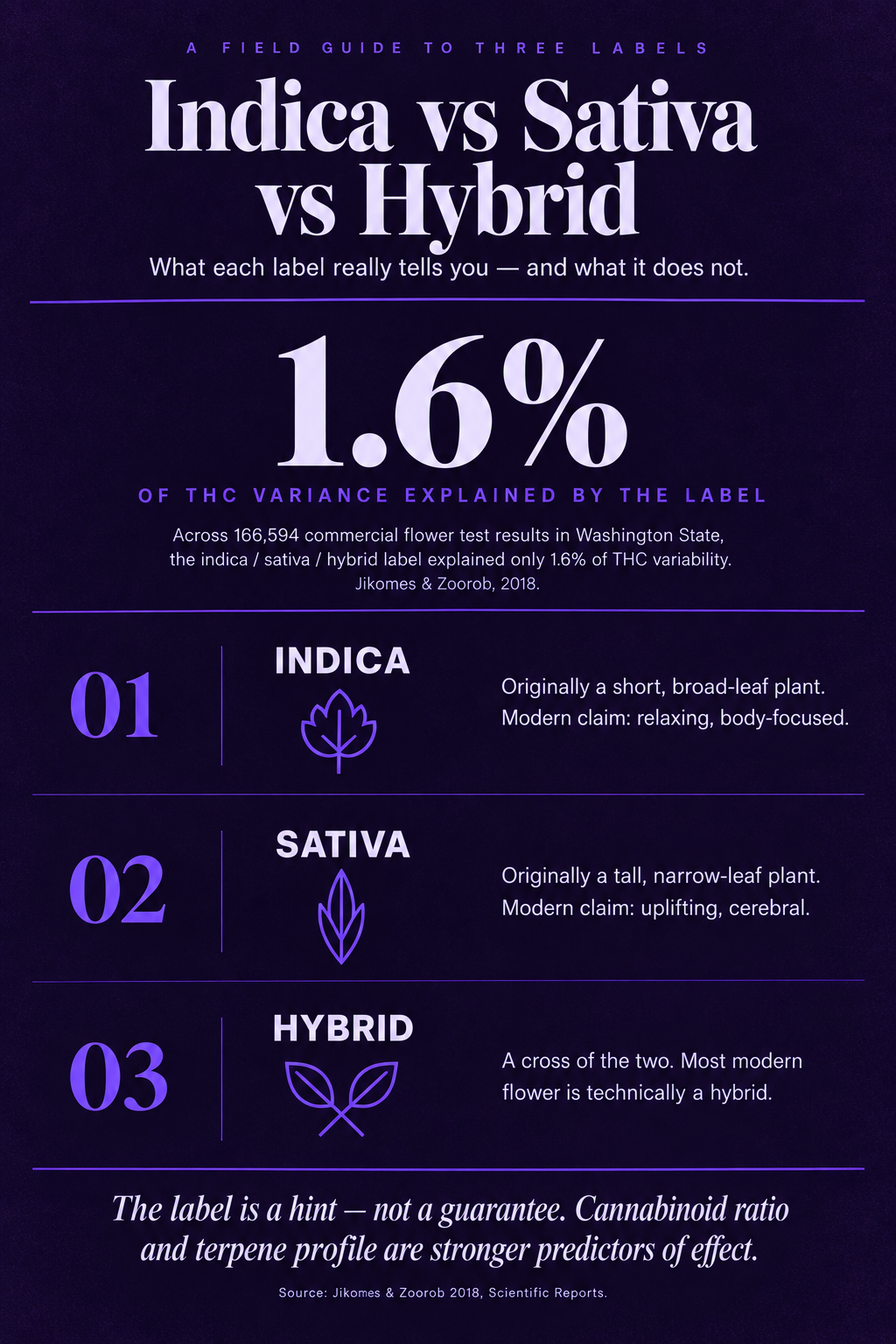
The original taxonomy is still useful for plant morphology, but it is not a useful effect category. A 2018 chemical survey of more than 166,000 Washington-state flower samples found the indica/sativa label explained only about 1.6% of the variation in THC content, and the average THC gap between indica- and sativa-labeled flower was just 0.33%, a difference that was not statistically meaningful. [8] The shape of the plant and the way a strain makes you feel are two different questions.
For a deeper look at how the labels drifted away from their botanical roots, Treehouse's Indica vs Sativa: Why the Labels Are Mostly Meaningless post walks through the same history. The companion piece, Indica Vs Sativa, gives a customer-friendly view of the same topic.
A short recap of the original meanings:
- Indica — short, bushy, broad-leaf plant, cool-climate origin.
- Sativa — tall, narrow-leaf plant, warm-climate origin.
- Both are Cannabis sativa L., distinguished at the subspecies level, not by effect.
- The dispensary use of the words has drifted far from the 18th-century meaning.
Do Indica and Sativa Really Produce Different Effects?
The folkloric split, indica for a heavy body high and sativa for an energizing head high, does not hold up well when researchers test it at scale. A 2018 study analyzing 166,594 Washington-state cannabis flower samples found the indica/sativa label explained only about 1.6% of THC variability, and the average THC content of indica-labeled flower (15.9%) was essentially identical to sativa-labeled flower (16.7%). [1] [8] The 0.33% absolute gap was not statistically distinguishable from noise.
Modest terpene differences do exist. Indica-labeled flower tends to run slightly higher in myrcene and other hydroxylated terpenes, while sativa-labeled flower tends to run slightly higher in terpinolene and 3-carene. [9] Those are average correlations across thousands of samples, not guarantees for any one jar, and a single "sativa" can easily test higher in myrcene than another "indica" from the same shelf.
What this means in practice: the body-high-versus-head-high split is a starting heuristic, not a reliable rule. A quick side-by-side of what the data actually shows:
| Label | Common claim | THC reality | Terpene trend |
|---|---|---|---|
| Indica | Relaxing, body-focused | ~15.9% average | Slightly higher myrcene |
| Sativa | Uplifting, cerebral | ~16.7% average | Slightly higher terpinolene, 3-carene |
| Hybrid | Balanced or leans one way | Varies | Varies |
The numbers come from large commercial datasets, not from any one jar. [8] When the question is "what will this actually feel like," the label is a weak starting signal. The most important takeaways from the data:
- The indica/sativa label explains only ~1.6% of THC variability in commercial flower.
- Average THC for indica-labeled (15.9%) and sativa-labeled (16.7%) flower is essentially identical.
- The only real chemical trend is a modest difference in dominant terpenes, not a guaranteed effect.
- Any single jar can break the average, so check the lab-tested numbers on the label.
What Is a Hybrid Cannabis Strain?
A hybrid is a cross between indica-type and sativa-type plants, and on a modern dispensary shelf, hybrid is closer to the default than the exception. Decades of cross-breeding have blurred the genetic lines so thoroughly that almost every strain sold today is technically a hybrid, then labeled indica-dominant, sativa-dominant, or balanced based on the breeder's intent and the dominant traits of the parent cultivars. [3]
A whole-genome analysis of hundreds of cannabis samples published in Nature Plants in 2021 found that sativa-labeled plants are no more genetically similar to each other than they are to indica-labeled plants, and the chemical overlap across the categories is broad. [3] The takeaway: the "indica-dominant" or "sativa-dominant" sub-label is a hint about the breeder's intent, not a guarantee about the chemistry in the jar.
For a more grounded walk through the three-way distinction, Treehouse's The Real Deal About Cannabis: Breaking Down Indicas, Sativas, and Everything in Between post covers how modern breeders actually classify their cuts. A short recap on what "hybrid" means in practice:
- Hybrid = a cross between indica-type and sativa-type parent plants.
- Most modern dispensary flower is technically a hybrid by default.
- Indica-dominant, sativa-dominant, and balanced are marketing shorthand for the breeder's intent.
- The sub-label is a hint, not a chemistry report.
What Actually Determines How a Cannabis Strain Feels?
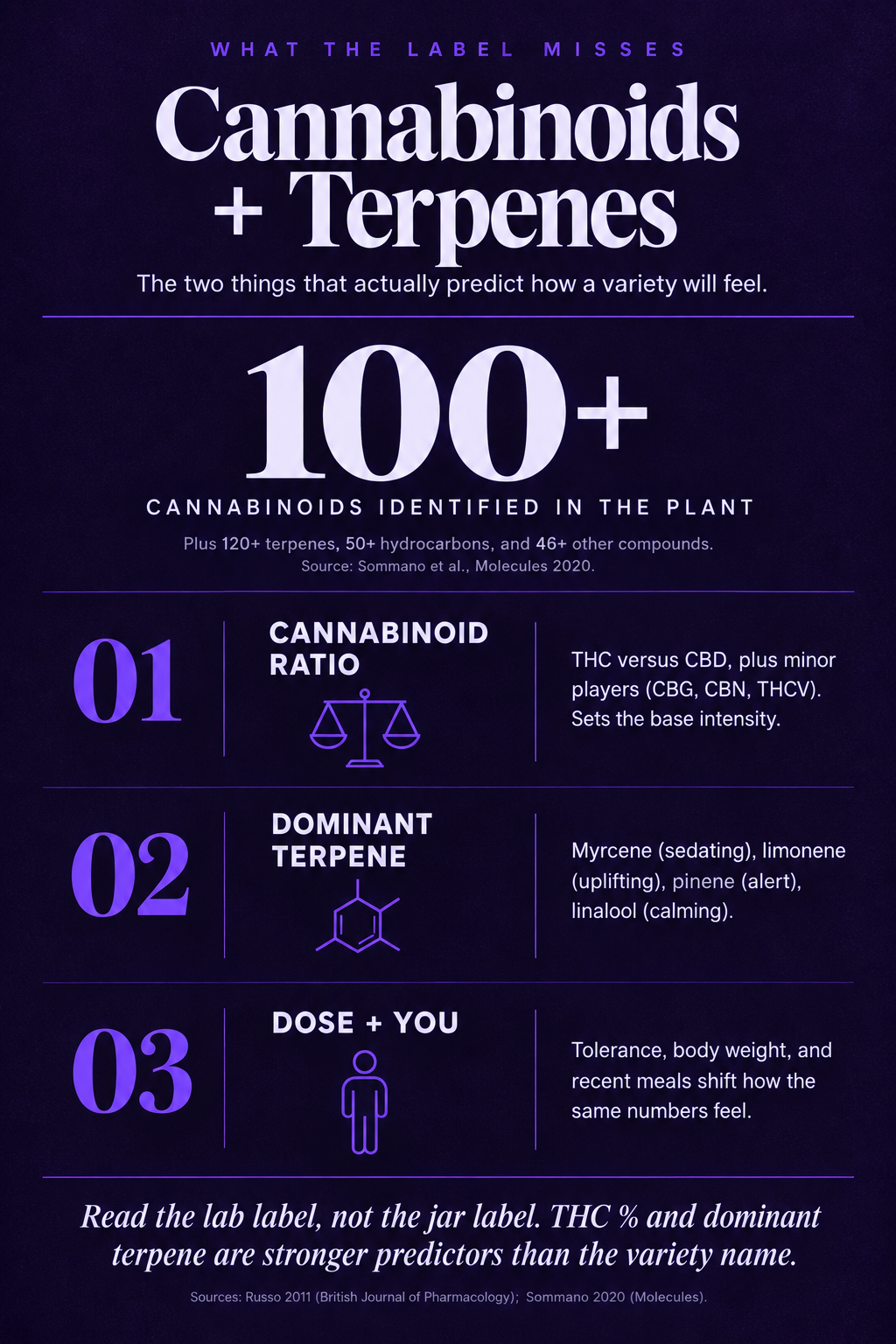
Two things matter more than the indica/sativa label: the cannabinoid ratio and the dominant terpene profile. The cannabinoid ratio is the balance of THC, CBD, and minor cannabinoids like CBG, CBN, and THCV, and it sets the base intensity and duration of the experience. The dominant terpene profile shapes the aroma and modulates the subjective direction, and the framework that ties them together is Ethan Russo's 2011 "entourage effect" hypothesis. [6] [7]
A practical terpene cheat sheet:
- Myrcene — earthy, musky aroma; often associated with a sedating, body-heavy feel.
- Limonene — citrus aroma; often associated with an uplifting, mood-lifting feel.
- Pinene — pine aroma; often associated with alertness and a clearer head.
- Linalool — floral, lavender aroma; often associated with a calming, anxiety-easing feel.
- Beta-caryophyllene — peppery, spicy aroma; binds to CB2 receptors and is often associated with body ease.
Cannabis produces more than 100 distinct cannabinoids and over 120 terpenes, and the same cannabinoid ratio can feel very different depending on which terpenes dominate. [7] A high-THC jar that is also high in myrcene and linalool is a different evening than a high-THC jar that is high in limonene and pinene, even with identical THC percentages on the label.
A simple way to think about it: the indica/sativa label is the genre, the cannabinoid ratio is the dosage strength, and the terpene profile is the actual plot. For customers exploring balanced cannabinoid options, Ratio Tinctures are a way to sample THC:CBD combinations without committing to flower.
What Are Cannabis Chemotypes (Type I, II, and III)?
Chemotype is a more reliable classification than indica/sativa/hybrid, and it is the framework the industry is gradually moving toward. The three main chemotypes are:
- Type I — high THC, low CBD. The classic adult-use flower profile.
- Type II — roughly balanced THC and CBD. Often marketed as a "1:1" ratio product.
- Type III — high CBD, low THC. Hemp-dominant flower and most CBD products. [10]
Chemotype tracks the actual chemistry of the plant, not its morphology, which is why it is a more useful predictor of effects. Leafly, the largest consumer cannabis reference, has publicly moved toward classifying strains by chemovar and terpene profile rather than the old three-label shorthand, in part because the published science does not support an effect-based split between indica and sativa. [4]
For customers who want to explore higher-potency chemovars on the flower side, Infused Bud Flower sits at the Type I end of the spectrum and is one way to compare chemovars directly. A practical chemotype quick-reference:
- Type I — high THC, low CBD. Most adult-use flower.
- Type II — balanced THC and CBD. Often labeled "1:1."
- Type III — high CBD, low THC. Hemp flower and CBD products.
- Chemotype tracks chemistry, not plant shape, so it is a more reliable predictor of effect.
How Should a New Customer Use the Indica vs Sativa vs Hybrid Labels?
The labels are a quick filter, not a guarantee, and the most useful way to use them is as a starting point and then verify with the numbers on the jar. A practical decision flow:
- For a relaxing evening, start with an indica-dominant strain and check the lab-tested numbers for myrcene on the dominant terpene line.
- For a more energizing daytime experience, start with a sativa-dominant strain and look for limonene or pinene.
- For a balanced middle ground, look for a labeled hybrid with a roughly 1:1 THC:CBD chemotype and a moderate terpene percentage.
- Start low, especially if you are new to dispensary flower, and adjust based on the actual THC and terpene numbers, not the jar's color or name.
If you are comparing options at a Rockland County dispensary, NY Diesel | Flower | 28g is a high-THC flower that lists its lab-tested terpene profile on the label, which is exactly the kind of detail that makes the indica/sativa label secondary. Treehouse Cannabis in Rockland County carries a range of flower and pre-rolls side by side, and our budtenders can walk you through the THC and terpene numbers on every jar so you can choose with confidence. [11]
A few habits that make the labels more useful:
- Read the lab-tested total THC and dominant terpenes before deciding.
- Treat the label as a hint, not a contract.
- Track what you actually feel after trying a strain and compare against the numbers next time.
Frequently Asked Questions
What is the actual difference between indica and sativa?
Indica and sativa were originally botanical descriptions, not effect categories. Indica plants are short and broad-leafed, adapted to cooler climates; sativa plants are tall and narrow-leafed, adapted to warmer climates. Modern genetic research shows the labels no longer reliably predict a strain's chemistry or its effects on the user. [3]
Do indica and sativa really produce different effects?
Consumer folklore says yes, but large chemical analyses do not support it. A 2018 study of more than 166,594 Washington-state cannabis samples found the indica/sativa label explained only about 1.6% of THC variability, and modest terpene differences are the only real chemical trend. [8]
What is a hybrid cannabis strain?
A hybrid is a cross between indica- and sativa-type plants. Because the modern gene pool has been interbred for generations, almost every strain on a dispensary shelf is technically a hybrid, then labeled indica-dominant, sativa-dominant, or balanced based on breeding intent. [3]
What actually determines how a cannabis strain will feel?
Two things matter more than the label: the cannabinoid ratio (how much THC versus CBD and minor cannabinoids) and the dominant terpene profile. A strain high in myrcene often feels sedating, while one high in limonene or pinene often feels more uplifting, regardless of the indica or sativa label. [6]
What is a cannabis chemotype, and what are Type I, II, and III?
Chemotype means chemical type. Type I cannabis is high in THC and low in CBD, Type II has roughly equal THC and CBD, and Type III is high in CBD and low in THC. Chemotype is a more reliable predictor of effects than the indica/sativa/hybrid label and is increasingly used by researchers and budtenders. [10]
How much THC is in typical dispensary flower?
Adult-use cannabis flower in legal U.S. markets typically tests between 15% and 30% total THC, with most strains falling in the high-teens to low-twenties. Premium indoor flower can exceed 25%. THC percentage is far more predictive of potency than whether the jar is labeled indica or sativa. [10]
Why do dispensaries still use the indica/sativa/hybrid labels?
The labels persist because customers find them useful as a starting point, and because they map loosely onto average terpene trends. They are a quick filter, not a guarantee. For more accuracy, check the lab-tested cannabinoid and terpene percentages printed on the product label. [4]
How should a new cannabis customer use the indica vs sativa vs hybrid labels?
Treat them as a rough starting point. For a relaxing evening, begin with an indica-dominant strain and look for myrcene on the label. For a more energizing daytime experience, start with a sativa-dominant strain and look for limonene or pinene. Start low, go slow, and adjust based on the actual terpene and THC numbers on the jar. [11]
Sources
- Frontiers in Psychiatry / PMC — Survey of regular cannabis consumers found no meaningful difference in average T
- Cannabis and Cannabinoid Research (Mary Ann Liebert) / PMC — All cannabis is one species, Cannabis sativa L., with two subspecies (subsp. sat
- Bedrocan International (summarizing van Velzen et al., Nature Plants 2021) — Whole-genome analysis of hundreds of cannabis samples found that sativa-labeled
- Leafly — Leafly, the largest consumer cannabis reference, now classifies strains by chemo
- Therapeutic Advances in Psychopharmacology (SAGE) / PMC — Cannabis contains more than 400 chemical entities and over 60 cannabinoids; THC
- British Journal of Pharmacology / PubMed — Russo's influential review proposed that cannabinoids and terpenoids act synergi
- Molecules (MDPI) / PMC — Terpenes are the primary aromatic constituents of cannabis and interact with can
- Scientific Reports (Nature) / PMC — Analysis of 166,594 Washington-state cannabis flower test results found the indi
- PubMed (Toxicology and Applied Pharmacology) — Independent verification that cultivars labeled 'sativa' versus 'indica' show on
- Healthline — Cannabis strains are broadly categorized into Type I (high THC/low CBD), Type II
- New York State Office of Cannabis Management — Cannabis is legal in New York State for adults 21 and older for adult-use posses
About Treehouse Cannabis
Treehouse Cannabis is a licensed adult-use dispensary serving customers 21 and older in Rockland County, New York. We carry a curated selection of lab-tested flower, pre-rolls, vapes, edibles, and tinctures, and our budtenders help customers compare THC percentages, terpene profiles, and chemotypes side by side. Cannabis is for adults 21 and older. Keep all cannabis products out of the reach of children and pets, store in a cool dry place, and never drive under the influence. Effects vary by individual; consume responsibly and consult a healthcare professional if you have questions about interactions with medications or existing health conditions.
Shop our products

Shop All

Deals

Flower

Pre-rolls
Vaporizers

Edibles
Drinks

Concentrates
Tinctures

Topicals

CBD

Pet CBD
Accessories