
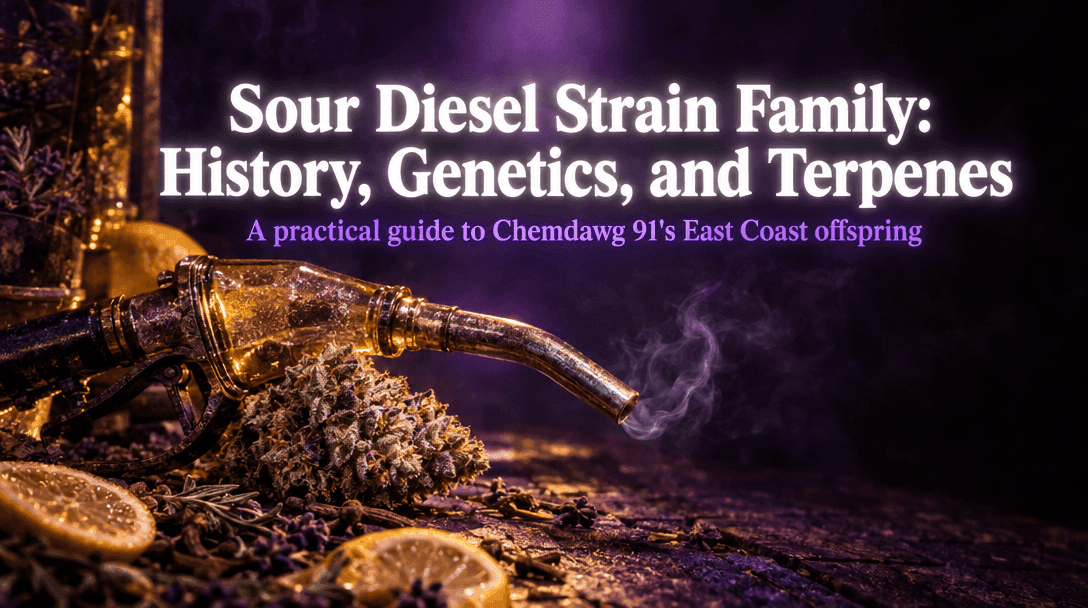
Sour Diesel Strain Family: History, Genetics, and Terpenes
{
  "@context": "https://schema.org",
  "@type": "FAQPage",
  "mainEntity": [
    {
      "@type": "Question",
      "name": "What is the Sour Diesel strain?",
      "acceptedAnswer": {
        "@type": "Answer",
        "text": "Sour Diesel is a sativa-dominant cannabis cultivar that emerged from the New York City underground in the early 1990s, credited to breeder A.J. (Joe Murray). It is widely documented as Chemdawg 91 crossed with Super Skunk (or, by A.J.'s own account, DNL, a Northern Lights x Skunk x Hawaiian hybrid). The strain is prized for sharp diesel-and-citrus aroma and a high-resin, energizing effect."
      }
    },
    {
      "@type": "Question",
      "name": "What are the genetics of Sour Diesel?",
      "acceptedAnswer": {
        "@type": "Answer",
        "text": "Chemdawg 91 — the most prized phenotype from a 1991 bag-seed batch purchased at a Grateful Dead concert in Indiana — is consistently named as one parent. The second parent is disputed: the most widely cited account names Super Skunk; A.J.'s own account names DNL. Both accounts agree on Chemdawg 91, which supplies the signature diesel-fuel aroma."
      }
    },
    {
      "@type": "Question",
      "name": "What does Sour Diesel smell like?",
      "acceptedAnswer": {
        "@type": "Answer",
        "text": "Sour Diesel smells like pungent diesel fuel layered with sharp, sour citrus — lemon and lime rather than sweet fruit. The aroma is dominated by caryophyllene (the chemical-fuel note), myrcene (earthy body), and limonene (citrus brightness). Some consumers describe the scent as acrid or industrial; it is one of the most polarizing bouquets in cannabis."
      }
    },
    {
      "@type": "Question",
      "name": "Is Sour Diesel a sativa or indica?",
      "acceptedAnswer": {
        "@type": "Answer",
        "text": "Sour Diesel is sativa-dominant. Most accounts describe it as roughly 90% sativa / 10% indica in phenotype and effect, despite the indica genetics present in its Super Skunk or Northern Lights ancestry. The cut produces a fast, cerebral onset rather than the heavy body effects of an indica."
      }
    },
    {
      "@type": "Question",
      "name": "What terpenes are in Sour Diesel?",
      "acceptedAnswer": {
        "@type": "Answer",
        "text": "The documented Sour Diesel terpene triad is caryophyllene as the dominant terpene, supported by myrcene and limonene as secondary contributors. Authentic phenotypes typically express caryophyllene at 10-17% of total terpenes, myrcene at 9-20%, and limonene at 8-20%. Pinene appears at lower concentrations in some panels."
      }
    },
    {
      "@type": "Question",
      "name": "What is the difference between Sour Diesel and NYC Diesel?",
      "acceptedAnswer": {
        "@type": "Answer",
        "text": "Sour Diesel is the original East Coast strain from the early 1990s. NYC Diesel was bred by Soma of Soma's Sacred Seeds in Amsterdam in the late 1990s by crossing a Sour Diesel-type mother with an Afghani/Hawaiian male. NYC Diesel was named in 2001 in tribute to New York following 9/11 and won High Times Cannabis Cup awards in 2001, 2003, and 2004."
      }
    },
    {
      "@type": "Question",
      "name": "Who originally bred Sour Diesel?",
      "acceptedAnswer": {
        "@type": "Answer",
        "text": "Sour Diesel is credited to a New York cultivator known as A.J. (Joe Murray), who became one of the primary keepers and distributors of the cut in the early 1990s. A.J. ran the genetics through New York and Western Massachusetts and the broader Grateful Dead-tour network before the cut spread more widely around 2002-2003."
      }
    },
    {
      "@type": "Question",
      "name": "What are the most popular Sour Diesel descendants?",
      "acceptedAnswer": {
        "@type": "Answer",
        "text": "The most documented Sour Diesel descendants are East Coast Sour Diesel (the clone-only original), NYC Diesel, Headband, Strawberry Diesel, Chocolate Diesel, and Sour OG. Each picks up a different piece of the parent cut's character, from the citrus of NYC Diesel to the Chemdawg-concentrated profile of Headband."
      }
    }
  ]
}
Sour Diesel Strain Family: History, Genetics, and Terpenes
The Sour Diesel strain is a sativa-dominant cannabis cultivar that emerged from the New York City underground in the early 1990s, defined by its pungent diesel-fuel aroma, sharp sour-citrus top notes, and a fast, energizing onset. It is both a specific clone-only cut — East Coast Sour Diesel (ECSD) — and a genetic umbrella that has produced a recognizable family of descendants ranging from NYC Diesel to Headband and Strawberry Diesel [1] [2].
What Is the Sour Diesel Strain?
Sour Diesel is a sativa-leaning cultivar credited to a New York cultivator known as A.J. (Joe Murray), who kept and distributed the cut through the early-1990s East Coast grower network [2]. The name covers two related things: the original ECSD clone-only cut, and a wider genetic family of Sour Diesel-type cultivars that share its Chemdawg-driven profile.
- Sour Diesel is both a single clone-only cut (East Coast Sour Diesel) and a broader genetic family of related cultivars.
- The cut expresses a caryophyllene-forward terpene profile, THC typically between 19 and 25 percent, and a fast cerebral onset.
- Most adult-use consumers meet the cut as flower or pre-roll, but the same genetics appear in concentrates, vapes, and infused products.
- For context on how Sour Diesel sits inside the broader landscape of legendary landrace and hybrid cultivars, the Acapulco Gold Strain: History, Genetics, and Terpene Profile piece traces a parallel lineage through another storied cultivar.
At a licensed New York dispensary, an authentic Sour Diesel should always arrive with a third-party certificate of analysis (COA) showing the caryophyllene, myrcene, and limonene split. That COA is the most reliable signal that the jar on the shelf actually expresses the ECSD profile rather than a generic "sour" hybrid.
Where Did Sour Diesel Come From?
The cut surfaced in the early 1990s through the same Grateful Dead-tour network that had carried Chemdawg genetics up and down the East Coast. A.J. ran the cut through New York and Western Massachusetts before the genetics spread more widely through the East Coast grower scene around 2002 and 2003 [2]. The most-cited upstream event is a single Grateful Dead show: the band's August 1991 stop at Deer Creek Music Center in Noblesville, Indiana, where a grower known as Chemdog (Gregory Krzanowski) bought a bag of what was informally called "Dog Bud" and found 13 seeds inside [3].
- The 1991 Deer Creek Music Center Grateful Dead show in Indiana is the documented origin point of Chemdawg genetics upstream of Sour Diesel.
- Thirteen seeds from that bag produced the three Chemdawg phenotypes still circulating: Chem 91, Chem D, and Chem 4.
- Chem 91 is consistently named as the parent of both Sour Diesel and OG Kush, which is why those two share a diesel-and-fuel character despite their very different effects.
- The New York City grower scene in the early 1990s drove most of Sour Diesel's early distribution through clone-only propagation.
- For a wider survey of how terpene profiles drive cultivar identity, the A Guide to Terpenes and Their Effects guide lays out the framework in more detail.
What Are Sour Diesel's Genetics?
The documented Sour Diesel parentage is Chemdawg 91 crossed with Super Skunk, by the most widely cited account, though A.J.'s own version names DNL (a Northern Lights x Skunk x Hawaiian hybrid) as the second parent [1] [3]. Both accounts agree on Chemdawg 91, and that is the more important parent for understanding the strain: Chemdawg 91 supplies the diesel-fuel aroma and most of the caryophyllene that defines the cultivar.
- Chemdawg 91 (1991 Grateful Dead show, Indiana) is the upstream parent of both Sour Diesel and OG Kush.
- The second parent is contested: Super Skunk (most reports) versus DNL (A.J.'s own account).
- East Coast Sour Diesel itself is a clone-only phenotype, meaning every authentic cut traces back to the same original plant.
- To dig deeper into how individual terpenes shape cultivar character, the Understanding Terpenes in Cannabis explainer walks through the chemistry without oversimplifying it.

What Does Sour Diesel Smell and Taste Like?
Sour Diesel smells like pungent diesel fuel layered with sharp, sour citrus — lemon and lime rather than sweet fruit — with an earthy base underneath. The bouquet is one of the most polarizing in cannabis: consumers who like it tend to love it fiercely, and consumers who do not tend to find it acrid or industrial. The aroma carries over into the flavor, which adds a slightly chemical or peppery bite on the exhale.
- The diesel-and-fuel character comes from caryophyllene, the same terpene that gives black pepper and cloves their bite.
- The earthy body underneath is myrcene, which is also the dominant terpene in mangoes and hops.
- The bright lemon-lime top note is limonene, the same terpene that drives the scent of citrus peel.
- A small amount of pinene (where it shows up in the panel) adds a sharp pine edge that keeps the citrus from going flat.
The split is roughly 40 percent caryophyllene, 30 percent myrcene, and 30 percent limonene across authentic phenotypes, with pinene appearing at lower concentrations in some panels [1]. The exact ratios vary by phenotype and grow environment, but the caryophyllene-dominant signature is the single most reliable marker of an authentic Sour Diesel.
Which Terpenes Drive Sour Diesel's Effects?
Caryophyllene drives most of Sour Diesel's distinctive effect and is the only terpene known to bind directly to the body's CB2 receptors [6] [5]. That binding behavior is the molecular reason behind the cultivar's reported anti-inflammatory and analgesic character: caryophyllene acts as what researchers call a "dietary cannabinoid," engaging the same receptor system as THC but through a different pathway [7].
- Caryophyllene sits at 10 to 17 percent of total terpenes in authentic panels and is the only terpene that binds CB2 receptors.
- Myrcene sits at 9 to 20 percent and contributes an earthy, sedative quality at higher concentrations while also enhancing THC uptake across the blood-brain barrier [8].
- Limonene sits at 8 to 20 percent and is the source of the bright, mood-lifting citrus character.
- Pinene appears at 5 to 22 percent in some panels and adds a sharp pine top note that keeps the experience from skewing too heavy.
The interplay between caryophyllene, myrcene, and limonene is what most consumers actually perceive when they say Sour Diesel feels different from other caryophyllene-heavy cultivars. For customers who want that caryophyllene-driven character in a non-flower format, the Ratio Tinctures category offers a different route to a similar terpene profile.

What Are the Most Popular Sour Diesel Descendants?
The Sour Diesel family is wide, and the most-documented descendants each pick up a different piece of the parent cut's character. NYC Diesel leans into the citrus, Headband doubles down on the Chemdawg backbone, Strawberry Diesel trades some of the fuel for ripe fruit, and Chocolate Diesel pushes toward the darker, almost-coffee side of the spectrum [1] [4].
- East Coast Sour Diesel (ECSD) is the clone-only original cut, kept alive by growers through the 1990s and 2000s.
- NYC Diesel is Sour Diesel crossed with an Afghani/Hawaiian male, bred by Soma of Soma's Sacred Seeds in Amsterdam and named in 2001.
- Headband is OG Kush crossed with Sour Diesel, effectively an inbred Chemdawg line that concentrates the caryophyllene character.
- Strawberry Diesel is Sour Diesel crossed with Strawberry Cough, trading some fuel for ripe berry sweetness.
- Chocolate Diesel is Sour Diesel crossed with Chocolate Thai and is one of the documented parents of Gorilla Glue #4 (GG4).
- Sour OG, sometimes called 818 Headband, is Sour Diesel crossed with SFV OG Kush, bred by The Cali Connection.
Most of these are available in the same flower and pre-roll formats as the parent cut. For customers who want the convenience of an already-broken-down jar, the Pre Ground Flower options offer the same genetics in a different format. The current menu also carries related cultivars like the NY Diesel | Flower | 28g listing for a New York-grown expression of the Diesel family that pairs the original profile with a heavier jar size.
Sour Diesel vs NYC Diesel: What's the Difference?
Sour Diesel is the original East Coast clone-only cut from the early 1990s, while NYC Diesel is a separate hybrid bred by Soma of Soma's Sacred Seeds in Amsterdam in the late 1990s and named in 2001 as a tribute to New York following the September 11 attacks [4]. NYC Diesel took a Sour Diesel-type mother and crossed her with an Afghani/Hawaiian male, which shifted the terpene profile noticeably toward grapefruit and orange citrus rather than the parent's sharper lemon-lime character.
| Attribute | Sour Diesel (ECSD) | NYC Diesel |
|---|---|---|
| Origin | Early 1990s NYC underground, breeder A.J. | Late 1990s Amsterdam, bred by Soma of Soma's Sacred Seeds |
| Named | Through East Coast grower network by 2002-2003 | Named in 2001 as a tribute to New York after 9/11 |
| Parent cross | Chemdawg 91 x Super Skunk (or DNL) | Sour Diesel-type mother x Afghani/Hawaiian male |
| Dominant terpenes | Caryophyllene, myrcene, limonene (sharper lemon-lime) | Caryophyllene, myrcene, limonene (rounder grapefruit-orange) |
| Recognition | Standard clone-only cut, no major awards documented | High Times Cannabis Cup 2001, 2003, and 2004 |
| Seed availability | Clone-only (no commercial seed line) | Seed line via Soma's Sacred Seeds |
- NYC Diesel won High Times Cannabis Cup awards in 2001, 2003, and 2004, which is the main reason it became a separate named cultivar rather than staying a Sour Diesel phenotype.
- The Afghani/Hawaiian parent pulls the terpene profile toward rounder, sweeter citrus compared to Sour Diesel's sharper fuel-and-lemon.
- Both share the Chemdawg-derived diesel character, but the effect profiles differ enough that consumers who dislike one often enjoy the other.
The two cultivars are related but not interchangeable. A licensed New York dispensary will usually carry one or both, and the COA tells the rest of the story. For shoppers who want a smaller-format expression of the same genetics, the Small Buds Flower jars offer a lower-commitment option that still reflects the documented lineage.
How Does Treehouse Verify a Sour Diesel?
Treehouse Cannabis verifies every flower on the menu through a third-party laboratory that issues a certificate of analysis, and the COA is the single most useful tool for telling authentic Sour Diesel apart from a generic dispensary listing. An authentic cut will show a caryophyllene-dominant terpene panel in the 10 to 17 percent range, myrcene and limonene as secondary contributors, and a THC percentage in the 19 to 25 percent range [1].
- A genuine COA names the testing lab, the harvest batch, and the date the test was run.
- The terpene section should list caryophyllene, myrcene, and limonene as the top three contributors.
- The THC and total cannabinoid numbers should fall within the documented range for the cultivar.
- Contaminant panels should show "pass" for pesticides, heavy metals, microbials, and residual solvents.
The licensed New York market makes this verification easier than it was in the legacy era, but it still requires the customer to actually look at the COA. Treehouse customers who want the heaviest possible expression of the Sour Diesel terpene profile can also browse the Infused Bud Flower options for flower formats that concentrate the caryophyllene character further. Either way, the verification step is what separates a documented Sour Diesel from a generic "sour" label.
Frequently Asked Questions
What is the Sour Diesel strain? Sour Diesel is a sativa-dominant cannabis cultivar that emerged from the New York City underground in the early 1990s, credited to breeder A.J. (Joe Murray). It is widely documented as Chemdawg 91 crossed with Super Skunk, though A.J.'s own account names a Northern Lights x Skunk x Hawaiian hybrid called DNL as the second parent.
What are the genetics of Sour Diesel? Chemdawg 91, the most prized phenotype from a 1991 bag-seed batch purchased at a Grateful Dead concert in Indiana, is consistently named as one parent. The second parent is disputed: most accounts name Super Skunk, while A.J.'s own account names DNL.
What does Sour Diesel smell like? Sour Diesel smells like pungent diesel fuel layered with sharp, sour citrus, primarily lemon and lime, with an earthy body underneath. The bouquet is dominated by caryophyllene (fuel), myrcene (earth), and limonene (citrus), and is one of the most polarizing aromas in cannabis.
Is Sour Diesel a sativa or indica? Sour Diesel is sativa-dominant. Most accounts describe it as roughly 90 percent sativa and 10 percent indica in phenotype and effect, despite the indica genetics present in its Super Skunk or Northern Lights ancestry.
What terpenes are in Sour Diesel? The documented Sour Diesel terpene triad is caryophyllene as the dominant terpene, supported by myrcene and limonene. Authentic phenotypes typically express caryophyllene at 10 to 17 percent, myrcene at 9 to 20 percent, and limonene at 8 to 20 percent of total terpenes.
What is the difference between Sour Diesel and NYC Diesel? Sour Diesel is the original East Coast strain from the early 1990s. NYC Diesel was bred by Soma of Soma's Sacred Seeds in Amsterdam in the late 1990s by crossing a Sour Diesel-type mother with an Afghani/Hawaiian male, was named in 2001 in tribute to New York, and won Cannabis Cup awards in 2001, 2003, and 2004.
Who originally bred Sour Diesel? Sour Diesel is credited to a New York cultivator known as A.J. (Joe Murray), who became one of the primary keepers and distributors of the cut in the early 1990s. A.J. ran the genetics through New York and Western Massachusetts and the broader Grateful Dead-tour network before the cut spread more widely around 2002 and 2003.
What are the most popular Sour Diesel descendants? The most documented descendants are East Coast Sour Diesel (the clone-only original), NYC Diesel, Headband, Strawberry Diesel, Chocolate Diesel, and Sour OG. Each picks up a different piece of the parent cut's character, from the citrus of NYC Diesel to the Chemdawg-concentrated profile of Headband.
Sources
- Leafly — Comprehensive Sour Diesel strain profile documenting the cultivar's lineage (Che
- Wikipedia — Outlines Sour Diesel's emergence in 1990s New York City underground cannabis net
- Weedpedia — Documents Chemdawg's emergence from 13 bag seeds found in 1991 Dog Bud at a Grat
- Grokipedia — Maps NYC Diesel's breeding by Soma of Soma's Sacred Seeds in Amsterdam from a So
- Leafly — Caryophyllene's unique cyclobutane ring structure and CB2 receptor binding behav
- National Center for Biotechnology Information (PMC) — Peer-reviewed evidence that beta-caryophyllene acts as a dietary cannabinoid by
- National Center for Biotechnology Information (PMC) — Documents caryophyllene's measurable anti-inflammatory and analgesic effects via
- National Center for Biotechnology Information (PMC) — Reviews myrcene's role as a terpene-modulating monoterpene with sedative effects
About Treehouse Cannabis
Treehouse Cannabis is an adult-use dispensary serving Rockland County, Orange County, and Westchester County from its location in Spring Valley, New York. The store carries a curated flower menu, pre-rolls, vapes, edibles, and concentrates from licensed New York producers, with every product backed by a third-party certificate of analysis. Customers can browse the current Sour Diesel and Diesel-family lineup in-store or through the online menu at treehousecannabis.com.
Cannabis is for adults 21 and older. Keep all cannabis products out of reach of children and pets. Do not drive or operate machinery while under the influence of cannabis. Consult a qualified healthcare professional before combining cannabis with any medication or if you are pregnant or nursing.



Shop our products

Shop All

Deals

Flower
Pre-rolls
Vaporizers

Edibles
Drinks

Concentrates
Tinctures

Topicals
CBD

Pet CBD

Accessories