
Acapulco Gold Strain: History, Genetics, and Terpene Profile
title: Acapulco Gold Strain: History, Genetics, and Terpene Profile slug: acapulco-gold-strain-history-genetics-and-terpene-profile
Acapulco Gold Strain: History, Genetics, and Terpene Profile
Acapulco Gold is a celebrated Mexican landrace sativa traditionally cultivated in the Guerrero Mountains east of Acapulco. First documented in the United States in 1964, the strain is known for golden-amber flowers, an earthy-citrus aroma, and a clear-headed, energetic character reported by modern consumers. [1]
What Is the Acapulco Gold Strain?
The Acapulco Gold strain is a Cannabis sativa landrace traditionally linked to the Guerrero Mountains east of Acapulco, Mexico. It is often described as roughly 80% sativa and 20% indica, although one source presents it as a 100% sativa. That difference is a useful reminder that the name covers more than one version. [1] [6]
Its reputation rests on several recognizable qualities:
- Golden or amber-colored flowers
- An earthy, citrus, pepper, honey, chestnut, and coffee aroma
- Consumer reports of focused, energetic, and creative effects
- A long-running connection to Mexican cannabis and 1960s counterculture
Leafly classifies Acapulco Gold as a rare sativa and lists focus, energy, and creativity among its most reported effects. Its reported flavor notes include honey, chestnut, and coffee. These are consumer-reported impressions, not a guarantee that every sample will smell or taste the same. [2]
A landrace is a cannabis population that developed in a particular place through local environmental pressures and human cultivation. It is not necessarily a laboratory-pure line with one fixed chemical profile. Acapulco Gold's identity therefore comes from its Mexican origin, its history, and the traits associated with it as much as from a single genetic formula.
For another perspective on how product type and timing can shape an experience, read You’re Not Lazy—Your Edible Just Peaked at the Wrong Time. That comparison is useful because Acapulco Gold is generally associated with flower, while many modern products are designed around very different use patterns.
| Trait | Description |
|---|---|
| Type | Cannabis sativa landrace |
| Reported ratio | ~80% sativa / 20% indica (one source: 100% sativa) |
| Origin | Guerrero Mountains near Acapulco, Mexico |
| First recorded in U.S. | 1964 |
| Reported effects | Focus, energy, creativity |
| Reported aromas | Earth, citrus, pepper, honey, chestnut, coffee |
Where Did Acapulco Gold Originally Come From?
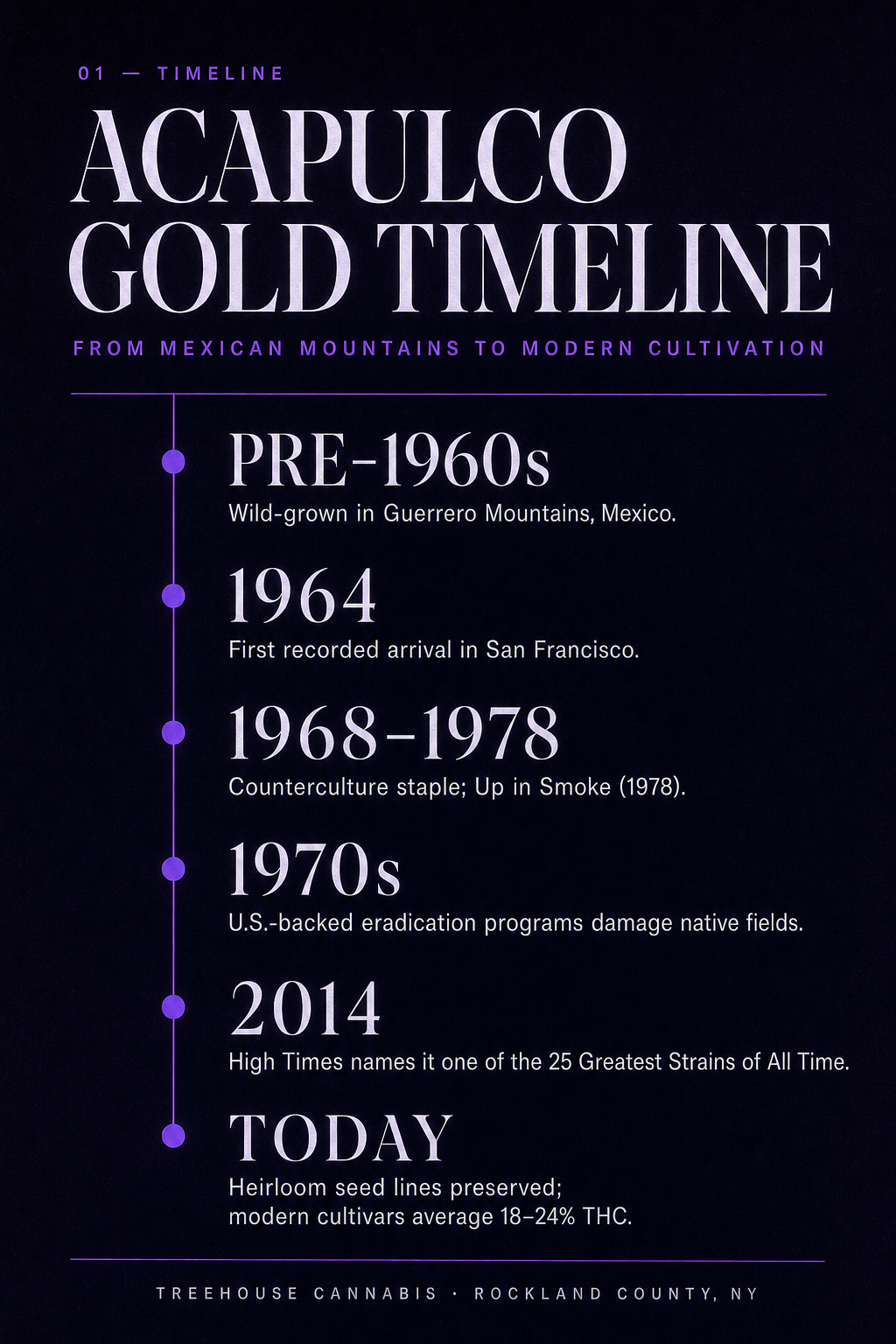
Acapulco Gold takes its name from the area around Acapulco in Guerrero, Mexico. Historical accounts place its traditional cultivation in the Guerrero Mountains, where the environment helped shape the aromatic, sun-grown cannabis that became famous abroad. [3]
The strain was first recorded in the United States in 1964, when it reached San Francisco. It then became part of the wider North American cannabis counterculture of the late 1960s and 1970s. [1] [3]
Its cultural history includes several defining moments:
- Pre-1960s: Traditional cultivation in the Guerrero Mountains
- 1964: First recorded appearance in the United States
- Late 1960s–1970s: Growth as a symbol of Mexican cannabis culture
- 1978: Association with the film Up in Smoke
- 2014: High Times named it one of its 25 Greatest Strains of All Time
The appearance in Up in Smoke helped carry the Acapulco Gold name into popular culture. The movie did not document the plant's entire history, but it added an instantly recognizable reference to a generation already encountering imported and domestically grown cannabis at unprecedented scale. [3]
High Times later named Acapulco Gold one of the 25 Greatest Strains of All Time in 2014. That recognition reflected both its cultural reputation and its influence on breeding conversations decades after its first documented American appearance. [5]
The historical record also includes a sharp loss of traditional growing grounds. Crop-eradication programs in Mexico during the 1970s disrupted native fields and made original material increasingly difficult to find. The loss of place-based cultivation helps explain why Acapulco Gold is now often described as rare or as an heirloom rather than as an everyday commodity. [3]
The name has also survived because it was never tied to a single breeder or stable commercial package. It described cannabis from a region and the reputation surrounding that cannabis, allowing the term to remain recognizable even as the original supply changed.
Readers interested in another terpene's sweet, herbal character can explore What Is Ocimene? The Sweet, Uplifting Terpene in Cannabis. Acapulco Gold is commonly led by caryophyllene, myrcene, and limonene, while ocimene offers a useful comparison with a different aromatic profile.
What Are the Genetics of Acapulco Gold?
The genetics of Acapulco Gold are best understood as landrace genetics tied to southern Mexico. Rather than being created from a named breeder's cross, a landrace develops over time within a local environment and cultivation community. That history can produce distinctive traits, but it does not mean every plant labeled Acapulco Gold has the same ancestry. [1]
Accounts of the strain's precise family tree are not completely consistent. Some historical descriptions connect Mexican sativa with a Nepalese indica influence, while modern sources may describe Acapulco Gold as a pure or nearly pure sativa. The disagreement is a reason to treat percentage labels as approximate rather than as proof of a single controlled lineage.
What is clearer is the strain's documented place in breeding history. Acapulco Gold was one of the parent strains associated with Skunk No. 1, the influential hybrid that helped establish many of the genetic patterns seen in modern cannabis breeding. [4]
That role makes Acapulco Gold more than a nostalgic name. It represents a bridge between:
- Regionally adapted landrace cannabis
- Early hybrid breeding experiments
- The development of stable cultivars
- Modern naming and classification systems
| Genetic claim | Source framing | Confidence level |
|---|---|---|
| Pure Cannabis sativa landrace | Modern consumer databases | High (for original Mexican material) |
| ~80% sativa / 20% indica | Wikipedia summary | Moderate (descriptive ratio) |
| 100% sativa | Cannagram strain guide | Moderate (alternative framing) |
| Mexican sativa × Nepalese indica | Some historical accounts | Low (debated origin theory) |
| Parent of Skunk No. 1 | Wikipedia (Skunk No. 1 entry) | High (documented lineage role) |
Preservation is therefore not just a matter of keeping an old seed in a container. Growers and historians also have to maintain accurate information about origin, storage conditions, and the difference between a documented line and a modern reinterpretation. Readers evaluating older flower can review How Long Does Weed Stay Fresh? for practical background on freshness and storage.
The term "heirloom" is especially important here. It suggests continuity with an older genetic or cultural lineage, but the label alone cannot verify that a sample descended directly from Guerrero-grown Acapulco Gold. Provenance matters when discussing a strain whose history has been interrupted by eradication, hybridization, and changing markets.
Modern breeding has also separated the name from any single phenotype. Breeders may use Acapulco Gold as inspiration or lineage, then select for traits that perform better indoors, finish sooner, or produce a more predictable aroma. Those cultivars can be legitimate descendants, but they should not be assumed to be chemically identical to historical Mexican material.
What Is the Terpene Profile of Acapulco Gold?
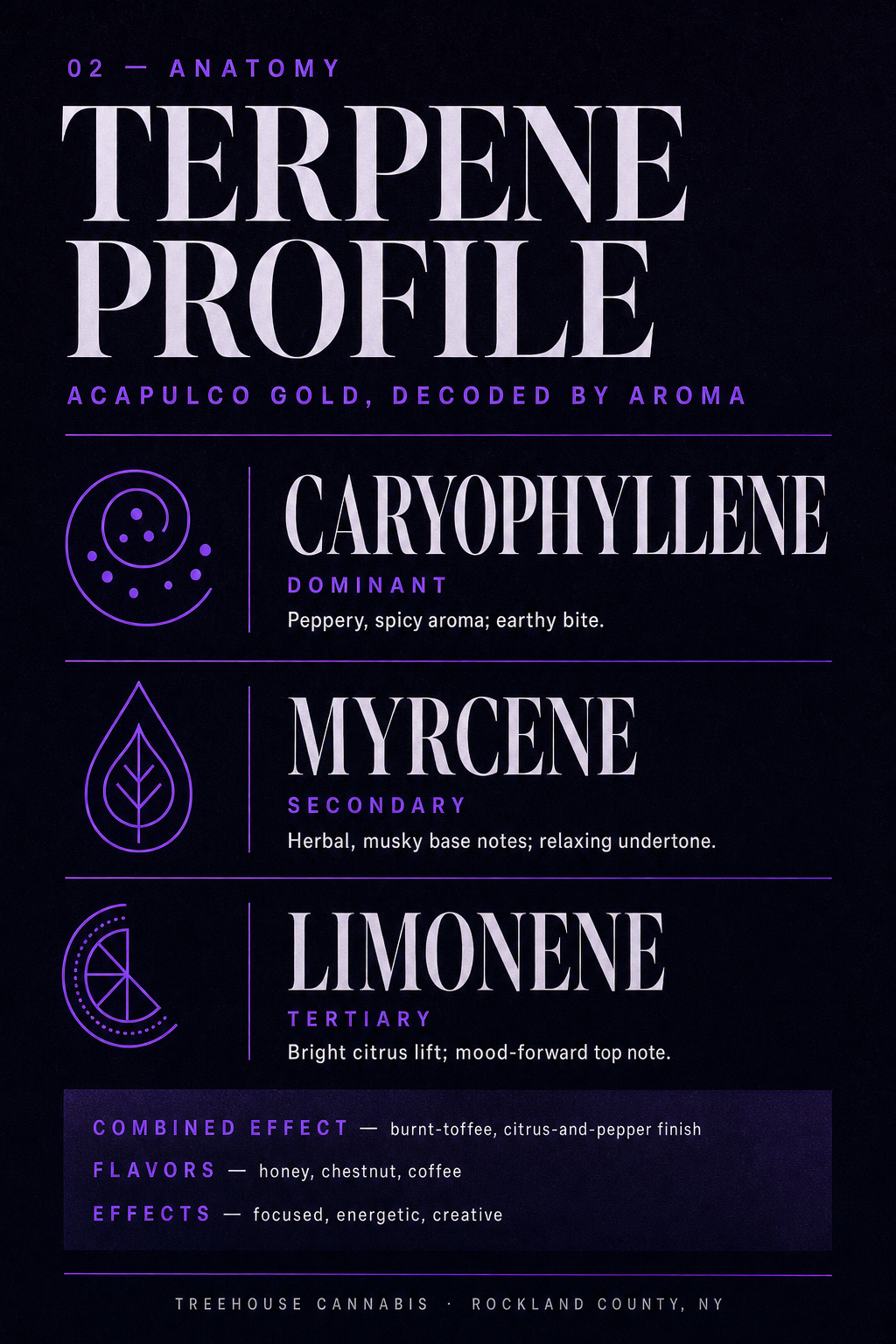
The most commonly reported Acapulco Gold terpenes are caryophyllene, myrcene, and limonene. Together, they are associated with the strain's peppery spice, earthy base, and bright citrus top note. [1] [2]
Each compound contributes a different part of the aromatic profile:
- Caryophyllene: Pepper, spice, and an earthy bite; it is the dominant reported terpene
- Myrcene: Herbal and musky depth beneath the sharper top notes
- Limonene: A citrus lift that brightens the overall aroma
- Combined profile: Burnt-toffee sweetness, citrus, earth, and pepper
| Terpene | Aroma contribution | Reported role |
|---|---|---|
| Caryophyllene | Pepper, spice, earthy bite | Dominant reported terpene |
| Myrcene | Herbal, musky depth | Base note beneath sharper top notes |
| Limonene | Citrus lift | Bright top note |
| Combined effect | Burnt-toffee, citrus, pepper, honey, coffee | Reported overall profile |
Terpenes are aromatic compounds found in cannabis and many other plants. They do not work like a simple recipe: concentration, preservation, and the rest of the sample's chemistry can all affect what a person notices. Leafly's reported order of caryophyllene followed by myrcene and limonene is a useful general description, not a lab result for every modern sample. [2]
The flavor descriptions can sound unusual together. Pepper, citrus, honey, chestnut, and coffee are not separate layers that arrive in a fixed order; they are shorthand for a complex aroma. Temperature, storage, curing, and individual sensitivity can change which note seems most prominent.
Caryophyllene supplies the strain's familiar peppery edge. Myrcene gives the profile an herbal foundation, while limonene adds the citrus character implied by the strain's name and its coffee-and-honey descriptions. The result is better understood as a balance than as three isolated effects.
For a wider educational view of terpinene and how it differs from the terpenes most often listed for Acapulco Gold, see What Is Terpinene in Cannabis? An Educational Overview. Comparing compounds is more accurate than treating any one terpene as a complete explanation of a strain.
Aromatic terms can also be affected by how flower is stored. Exposure to light, heat, and air can flatten volatile compounds, so the same cultivar may present differently depending on age and handling. The profile described in strain databases is therefore a reference point rather than a permanent fingerprint.
How Strong Is Acapulco Gold in THC?
Modern published figures place cultivated Acapulco Gold at roughly 18% to 24% THC. The higher end is often described as around 24%, while Cannagram reports a common range of 20% to 24% THC. [1] [6]
The important distinction is between the historical product and today's regulated market. Cannabis from the 1960s is sometimes discussed in the range of 8% to 12% THC, whereas modern cultivation and testing have produced stronger flowers. Those older figures are broad historical estimates, not a verified THC result from a surviving 1960s laboratory sample.
| Era / product type | Reported THC range | Notes |
|---|---|---|
| 1960s Mexican-grown flower (historical estimate) | ~8%–12% | Broad estimate, not a lab-verified range |
| Modern cultivated flower (general) | ~18%–24% | Higher end reported near 24% |
| Cannagram-reported modern range | 20%–24% | Common modern cultivated band |
| Leafly-reported modern average | ~18% | User-reported average |
Several factors explain why modern numbers can look much higher:
- Selective breeding for greater resin production
- Better control of light, nutrients, and temperature
- Widespread testing of finished flower
- Hybrids that carry Acapulco Gold-associated names
- Different standards for what counts as "Acapulco Gold"
The original was a geographically associated landrace, while today's version may be an heirloom selection or a modern cross. A product with the same name can therefore have a different potency range from the Mexican flower that built the original reputation.
Treehouse Cannabis organizes current options in its Flower collection, where shoppers can see products such as Gas Lit • Flower • 70g. Any listing should be read as a modern adult-use product, not proof of direct historical Acapulco Gold ancestry. Labels from a current batch are the meaningful source for that specific product's cannabinoid content.
The broad 18%–24% range is useful for orientation, but it cannot predict one person's experience or substitute for the package label. THC percentage measures one part of the flower's chemistry, while aroma, cultivar identity, serving method, and individual factors can all shape how a product is perceived.
For adults comparing products, a current certificate of analysis is more reliable than a strain nickname. It can show the tested THC and CBD amounts, while the product description and ingredient panel provide the other information needed to distinguish historical inspiration from present-day formulation.
Why Is Acapulco Gold So Rare Today?
Acapulco Gold is rare because the landrace and the conditions that sustained it no longer exist in the same form. Crop-eradication efforts, changing cultivation patterns, and decades of hybridization all reduced access to original Mexican material. [3]
Its scarcity comes from several connected pressures:
- Disruption of traditional growing areas
- Replacement of landrace populations with commercial hybrids
- Loss of provenance when seeds circulate without records
- Variation among modern products using the Acapulco Gold name
- The small number of preserved heirloom selections
The 1970s eradication programs are especially significant because they targeted cultivated cannabis as a supply chain, not just a particular strain. Destroying fields removed living plant populations and the knowledge held by the people who maintained them. A name can survive that disruption, but the underlying regional lineage becomes harder to protect.
Hybridization created a second form of rarity. Once Acapulco Gold genetics entered breeding programs, valuable traits could be carried into new cultivars while the original line became less common. This is part of the strain's legacy, but it can also make the word "original" difficult to define in a commercial catalog.
| Pressure | Effect on availability |
|---|---|
| 1970s crop-eradication programs | Native fields destroyed; traditional knowledge lost |
| Commercial hybridization | Original genetics diluted into new cultivars |
| Untracked seed circulation | Provenance records lost across generations |
| Inconsistent modern naming | Same name attached to multiple distinct products |
| Few preserved heirloom lines | Verified original material is scarce |
Preservation efforts therefore focus on documentation as much as storage. A meaningful heirloom record should connect seeds or plants to an origin, breeder, grower, or documented lineage. Without that context, an old line and a modern Acapulco Gold-inspired cross can look similar to a buyer even when their histories are very different.
The strain's cultural status adds another layer. High Times recognized it among the 25 Greatest Strains of All Time in 2014, while its name continues to evoke a specific place and era. That visibility keeps Acapulco Gold in circulation, but recognition does not restore the original landrace habitat or guarantee that modern products reproduce its historical chemical profile. [5]
Rarity should also not be confused with superiority. The best reason to value Acapulco Gold is its documented place in cannabis history and its influence on later breeding, not a claim that every modern example is stronger, more authentic, or better than current flower.
The lasting story of Acapulco Gold is one of geography becoming identity. A plant from Guerrero became a counterculture reference, a breeding contributor, and eventually a name found across modern cannabis conversations. Its future depends on preserving accurate records and recognizing that history, aroma, and current retail products are related but not identical.
What Are the Most Common Acapulco Gold Questions?
Quick answers:
- Acapulco Gold is a sativa-dominant landrace (around 80% sativa / 20% indica) tied to the Guerrero Mountains near Acapulco, Mexico.
- Common aromas include citrus, earth, pepper, honey, chestnut, and coffee, with caryophyllene, myrcene, and limonene as the most reported terpenes.
- Modern cultivated flower typically tests between 18% and 24% THC, higher than broad historical estimates for 1960s Mexican-grown material.
- It was first recorded in the United States in 1964, became a counterculture symbol, and appeared in Up in Smoke (1978).
- Acapulco Gold is documented as one of the parent strains associated with Skunk No. 1, an influential hybrid in modern breeding.
Is Acapulco Gold a sativa or an indica?
Acapulco Gold is most often described as sativa-dominant, commonly around 80% sativa and 20% indica. Other sources call it a 100% sativa, so exact percentage claims should be treated as approximate. [1] [6]
What does Acapulco Gold taste and smell like?
Common descriptions include citrus, earth, pepper, honey, chestnut, and coffee. Caryophyllene, myrcene, and limonene are the most frequently reported dominant terpenes, though storage and individual sensitivity can change the aroma. [2]
Is Acapulco Gold considered a landrace strain?
Yes. Acapulco Gold is traditionally associated with a Cannabis sativa landrace cultivated in the Guerrero Mountains near Acapulco, Mexico. [1] [3]
What is the average THC level of Acapulco Gold?
Modern sources commonly place cultivated Acapulco Gold between 18% and 24% THC. A current product's tested label is more reliable than a general strain average. [1] [2] [6]
Why did Acapulco Gold become famous?
Its Mexican origin, 1964 American record, counterculture reputation, appearance in Up in Smoke, and later recognition from High Times all contributed to its fame. [3] [5]
What is Acapulco Gold's connection to Skunk No. 1?
Acapulco Gold is documented as one of the parent strains associated with Skunk No. 1, a foundational hybrid in modern cannabis breeding. [4]
Sources
- Wikipedia — Acapulco Gold is a Cannabis sativa landrace strain first recorded in the United
- Leafly — Leafly classifies Acapulco Gold as a rare sativa with reported effects of focus,
- High Times — High Times documents Acapulco Gold's origin in the Guerrero Mountains east of Ac
- Wikipedia — Acapulco Gold was one of the parent strains of Skunk No. 1, the hybrid considere
- High Times — In 2014, High Times named Acapulco Gold one of the greatest strains of all time,
- Cannagram — Acapulco Gold is described as a 100% sativa strain with THC content typically ra
About Treehouse Cannabis
Treehouse Cannabis is an adult-use dispensary serving Rockland County, NY and the surrounding Hudson Valley region. This educational content is intended for adults 21 and older. Keep all cannabis products out of reach of children and pets. This content is not medical advice.



Shop our products

Shop All

Flower

Pre-rolls

Vaporizers

Edibles

Drinks

Concentrates

Tinctures

Topicals

CBD

Pet CBD

Accessories