
THCA Flower: What You're Actually Buying
THCA Flower: What You're Actually Buying
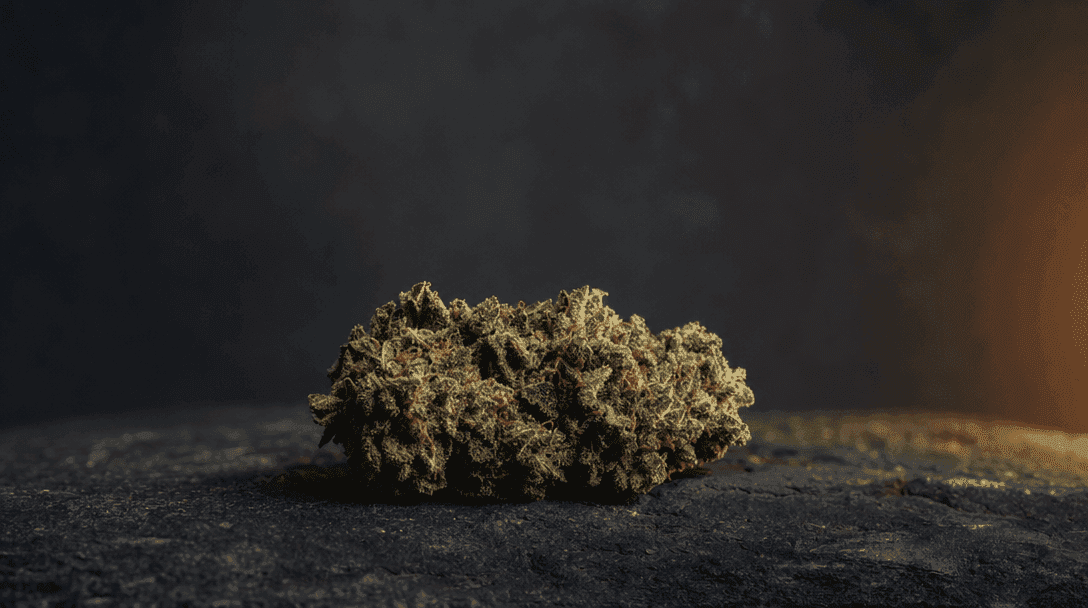
THCA flower is dried cannabis bud whose dominant cannabinoid is tetrahydrocannabinolic acid (THCA), not already-activated delta-9 THC. In its raw form THCA is non-intoxicating; heat — smoking, vaping, or baking — converts it into delta-9 THC. That gap makes THCA flower federally legal hemp today, and what changes on November 12, 2026.
What Is THCA Flower and How Is It Different From Marijuana?
THCA flower is cannabis bud whose dominant cannabinoid is the acidic precursor THCA, while "marijuana" is typically the same bud labeled by its delta-9 THC content after decarboxylation. Raw THCA binds the brain's CB1 receptor poorly — at least 62 times weaker than delta-9 THC according to receptor binding studies [6] — so it does not produce the cannabis "high" on its own.
Cannabis plants do not actually produce delta-9 THC in meaningful quantities. The living plant synthesizes THCA, the acidic precursor molecule, and stores it in the trichomes. Over time, whether through curing, heat exposure, or aging, some of that THCA decarboxylates into delta-9 THC, the molecule most people associate with cannabis's effects.
In modern commercial cannabis, dispensary-grade "marijuana" usually tests 20 to 30 percent THCA on the COA, with delta-9 THC under 1 percent before combustion. Same molecule, different labeling: when growers and retailers want the product to read as hemp, they stop short of full decarboxylation and keep the THCA dominant. The dried bud itself looks, smells, and grinds identically. Aroma profiles carry through regardless of how the dominant cannabinoid is labeled, and pinene, myrcene, and a terpene like limonene What Is Limonene? A Citrus-Scented Guide to One of Cannabis’s Most Recognizable Terpenes are responsible for much of the citrus-and-pine character that defines many popular strains.
Key ways THCA flower and dispensary marijuana are the same product:
- Both come from the same Cannabis sativa L. plant and the same trichome structures
- Both test 15 to 30 percent total cannabinoids on a compliant COA
- Both produce equivalent effects once heated, because heat converts THCA into delta-9 THC
- Both fail a standard urine drug screen for the same reason — the metabolite THC-COOH is identical
For a deeper side-by-side breakdown of the chemistry and the consumer experience, see our guide to THCA vs THC THCA vs THC: What's Actually in Your Weed? (2026 Guide). The short version: if you heat THCA flower, the effects are functionally indistinguishable from dispensary marijuana. If you consume raw THCA flower without heating it, the pharmacology is different. THCA shows anti-inflammatory activity through PPARy receptors in preclinical models [6] but does not produce the cannabis "high."
Why Does THCA Flower Sit in a Federal Hemp Loophole?
The 2018 Farm Bill defined hemp as Cannabis sativa L. with no more than 0.3 percent delta-9 THC on a dry-weight basis, and that flower slipped into a legal gray area because the threshold measures only delta-9 THC, not total THC. A flower that tests 25 percent THCA but only 0.2 percent delta-9 THC passes the federal compliance screen — and decarboxylates into something functionally equivalent to marijuana the moment a customer lights it.
The 2018 Farm Bill defined hemp as Cannabis sativa L. with no more than 0.3 percent delta-9 THC on a dry-weight basis, written into the U.S. Code at 7 U.S.C. section 1639o [1]. The full statute includes derivatives, extracts, cannabinoids, isomers, acids, salts, and salts of isomers, but the 0.3 percent threshold applies only to delta-9 THC.
A flower that tests 25 percent THCA and 0.2 percent delta-9 THC passes the federal compliance screen. The same flower, once a customer lights it, decarboxylates almost entirely into delta-9 THC and produces effects a marijuana user would recognize immediately. The Congressional Research Service describes this as a direct consequence of the 2018 Farm Bill's chemistry-agnostic drafting [3], and legal commentators have labeled the resulting market structure the "hemp loophole" [4].
Three reasons the loophole survived a decade of federal enforcement:
- The 2018 Farm Bill explicitly names "acids" among the hemp derivatives it legalized
- Total-THC testing was left to state regulators, not codified federally
- Federal agencies (DEA, USDA) prioritized enforcement against synthetic cannabinoids, leaving high-THCA flower under-prioritized
This is also why storage conditions matter. Even without intent, a poorly stored jar of THCA flower can slowly climb toward the 0.3 percent delta-9 line through ambient decarboxylation. Our piece on how long weed stays fresh How Long Does Weed Stay Fresh? explains the storage conditions that keep delta-9 THC low. If a COA was issued months ago and the flower sat in a warm car, the on-the-shelf number may now fall outside the legal threshold.
How Does the 0.877 Conversion Factor and Total THC Test Work?
The 0.877 conversion factor is the ratio that accounts for the mass of carbon dioxide lost when THCA decarboxylates into delta-9 THC, and the Total THC test applies that ratio plus any pre-existing delta-9 THC to compute the regulatory potency of a sample.
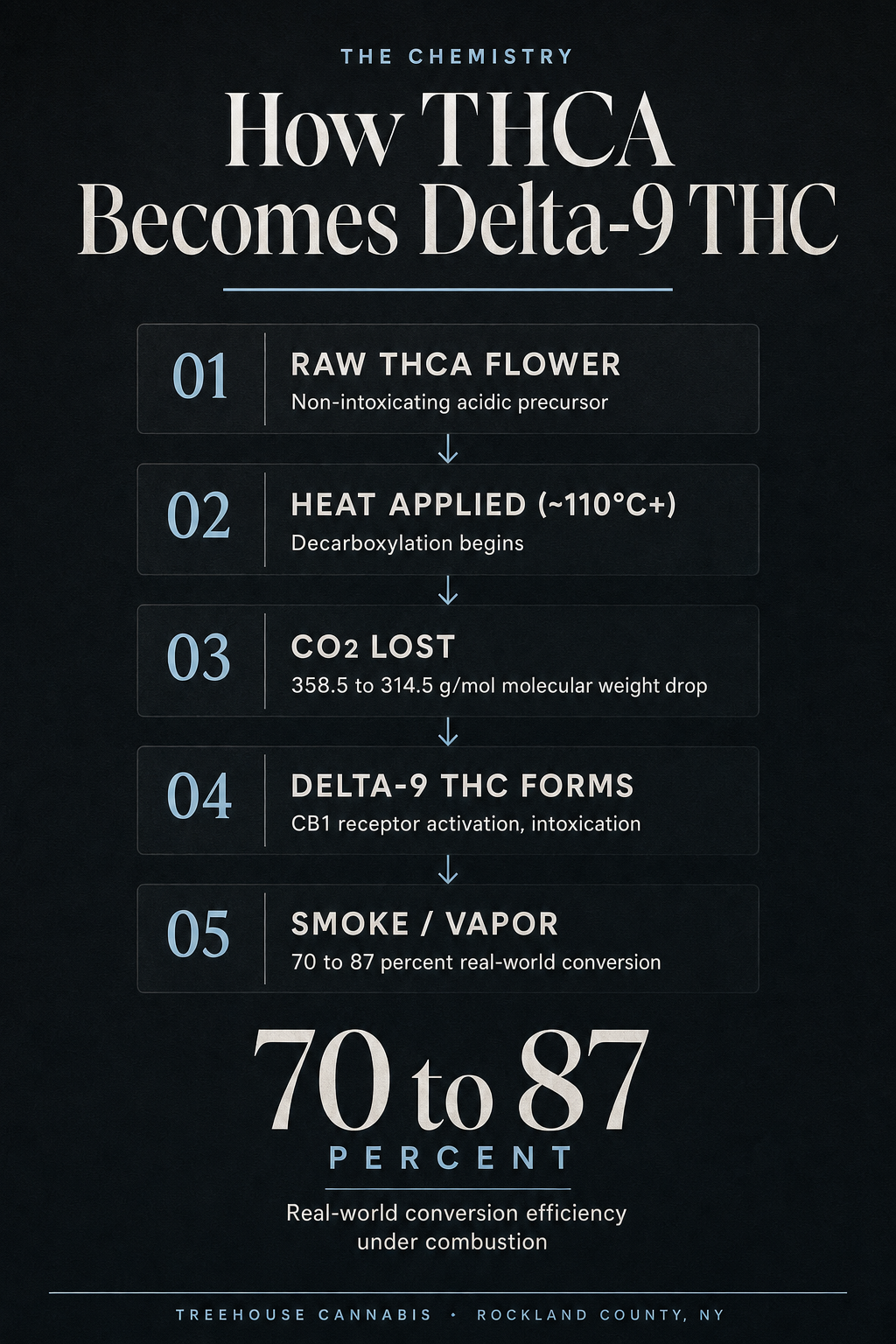
Decarboxylation is the chemical reaction that converts THCA into delta-9 THC by removing a carboxyl group (a CO2 molecule). That loss of mass is exactly what the 0.877 conversion factor accounts for.
THCA has a molecular weight of about 358.5 grams per mole. Delta-9 THC weighs about 314.5 grams per mole. The difference, roughly 44 grams per mole, is the CO2 that leaves. Mathematically, 314.5 divided by 358.5 equals 0.877, the ratio the USDA codified in 7 CFR 990.1 for hemp compliance testing [2]. The federal Total THC formula reads:
Total THC = (0.877 x THCA%) + delta-9 THC%
Run that against a 25 percent THCA flower with negligible pre-existing delta-9 THC and you get roughly 21.9 percent total THC. Most commercial THCA flower sits in the 15 to 30 percent THCA range [9], so under a total-THC standard these products compute to 13 to 26 percent total THC, many multiples above the 0.3 percent cap.
Quick reference: potency under each standard at common THCA levels:
- 15% THCA flower → ~13.2% Total THC under a total-THC standard (delta-9 unchanged)
- 20% THCA flower → ~17.5% Total THC under a total-THC standard (delta-9 unchanged)
- 25% THCA flower → ~21.9% Total THC under a total-THC standard (delta-9 unchanged)
- 30% THCA flower → ~26.3% Total THC under a total-THC standard (delta-9 unchanged)
- All four products still pass the current federal screen if delta-9 THC stays under 0.3%
The same chemistry explains how psychoactive effects arise when a customer lights a THCA joint. Heat pushes the reaction forward, and in real-world smoking and vaporizing the conversion efficiency lands somewhere between 70 and 87 percent rather than 100 [6]. Even at the lower end of that band, a 25 percent THCA flower delivers more delta-9 THC than a typical dispensary eighth.
For a broader look at how the endocannabinoid system responds to THC and CBD once they are absorbed, our explainer on how THC and CBD work How THC and CBD Work covers the receptor science.
What Changes on November 12, 2026 Under Public Law 119-37?
On November 12, 2026, Section 781 of Public Law 119-37 takes effect and replaces the delta-9-only hemp threshold with a total-THC standard at the same 0.3 percent level, plus a 0.4 milligram per-container cap on finished retail products. After that date, most current THCA flower falls outside the federal definition of hemp regardless of state law.
Section 781 of Public Law 119-37 takes effect on November 12, 2026, and replaces the delta-9-only threshold with a total-THC standard at the same 0.3 percent level [4]. The same section also caps finished retail products at 0.4 milligrams of total THC per container.
The practical consequence is straightforward. A jar of THCA flower testing 25 percent THCA would need to weigh roughly 5.4 grams to fit under the 0.4 mg cap, and even then the flower itself exceeds the 0.3 percent total-THC threshold by orders of magnitude. By either rule, the potency ceiling or the per-container dose, typical commercial THCA flower fails the new definition. After November 12, 2026, federal law treats it as a Schedule I controlled substance under the Controlled Substances Act, regardless of state-level cannabis programs.
What changes for retailers and consumers on November 12, 2026:
- Hemp compliance switches from a delta-9-only test to a Total THC test (0.877 × THCA + delta-9)
- Finished retail products cap at 0.4 mg of total THC per container
- High-THCA flower that previously passed under 0.3% delta-9 now fails federal hemp screening
- Enforcement defaults to the Controlled Substances Act where state law does not preempt
Two pending bills, H.R. 6209 and H.R. 1287, propose to repeal or delay the change. As of mid-2026 neither had cleared committee. If you live outside a state-licensed dispensary channel, the safe assumption for after November 12, 2026 is that general-retail THCA flower is no longer federally legal.
Anyone shopping a dispensary menu for cannabis flower under the new rules can browse regulated products in our flower category Flower the same way they would for any adult-use cannabis purchase.
Will THCA Flower Make You Fail a Drug Test?
Yes, under any normal use pattern — smoking or vaping THCA flower decarboxylates it into delta-9 THC in the lungs, and the resulting metabolite (THC-COOH) is identical to that produced by marijuana.
Standard urine drug screens detect THC-COOH, the inactive metabolite of delta-9 THC. When you smoke or vaporize THCA flower, the heat decarboxylates it into delta-9 THC in your lungs before absorption. From there, the metabolic path is identical to smoking marijuana. Liver enzymes convert delta-9 THC into 11-hydroxy-THC and then into THC-COOH, the molecule the test actually reads.
Raw, never-heated THCA is a different story. If the THCA you consumed never decarboxylates, for example a refrigerated raw-juice preparation, the metabolite profile and downstream drug-test behavior diverge. But for the typical use case of inhaling combusted or vaporized flower, THCA flower and dispensary marijuana are indistinguishable on a standard panel.
Drug-test scenarios for THCA flower consumers:
- Smoked or vaped THCA → indistinguishable from marijuana on a urine panel (THC-COOH positive)
- Eaten raw THCA (cold preparation) → potentially below detection limits, but unstudied
- Topical THCA → unlikely to register, but product-specific data is sparse
- Heavy chronic use → detection window extends to 30+ days regardless of source
Caveats still apply. Lab cutoffs vary (commonly 50 ng/mL for an immunoassay screen, 15 ng/mL for GC-MS confirmation), detection windows depend on frequency of use, and individual metabolism plays a role. The conclusion is consistent across scenarios: assume THCA flower will register on a panel designed to detect cannabis use, and plan accordingly. For those who do consume and want properly labeled, lab-tested product, regulated whole-flower menus Whole Flower Flower show what dispensary options look like.
How Should You Read a THCA Certificate of Analysis?
A THCA Certificate of Analysis (COA) is the lab report that confirms potency and safety, and you should read it by checking the lab's accreditation, the analytical method (HPLC, not GC-MS), and a complete calculated Total THC alongside mandatory safety panels.
A Certificate of Analysis (COA) is the lab report that backs every reputable cannabis product. For THCA flower specifically, the COA tells you how much THCA and delta-9 THC the flower contains, and whether it passed the safety panels required by state regulators.
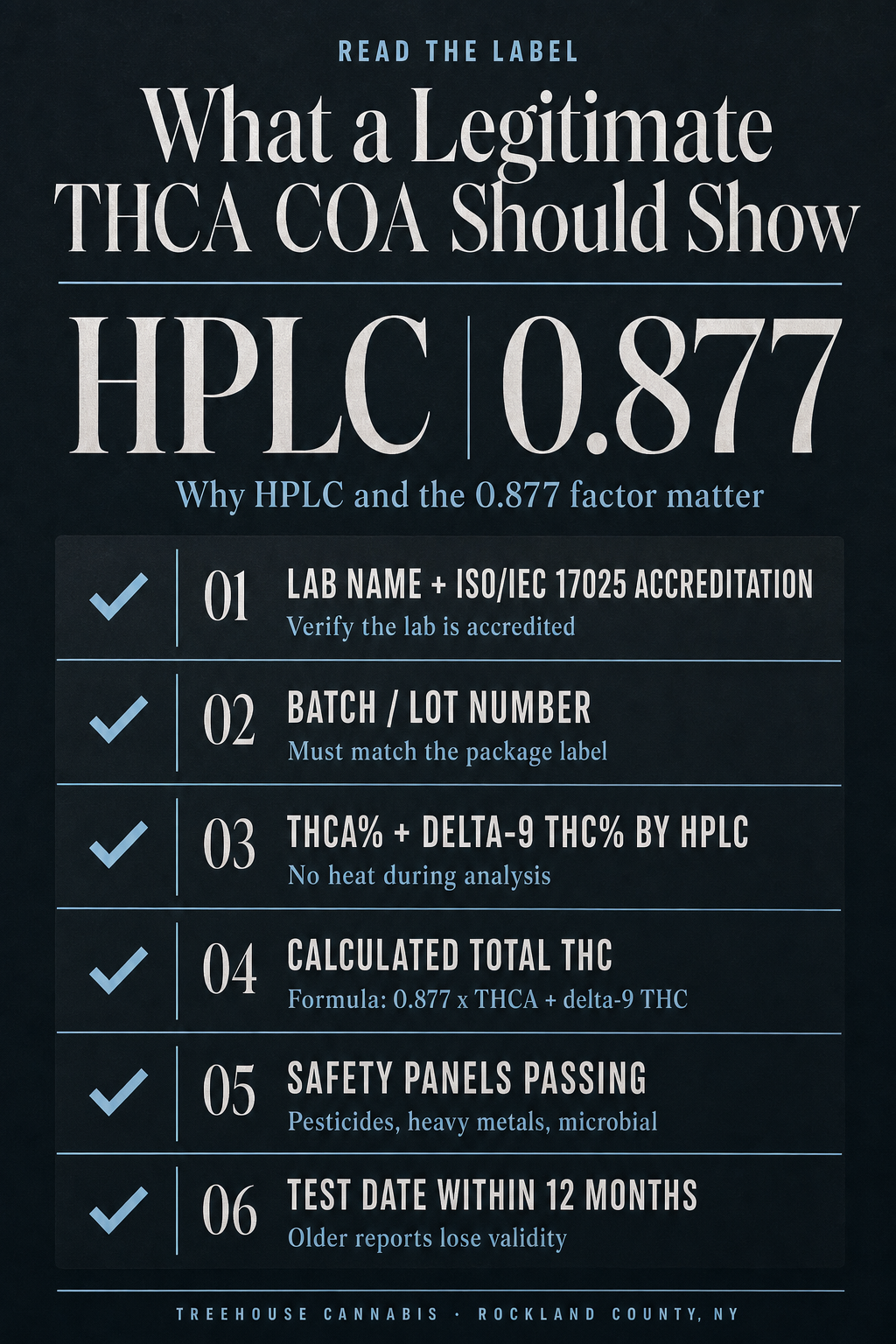
The minimum checks for a legitimate COA:
- The lab name and its ISO/IEC 17025 accreditation status. Any COA without an accreditation note is a yellow flag.
- A batch or lot number that matches the package. Mismatched lot numbers mean you cannot confirm the report is for what is in the jar.
- A potency panel run on HPLC, not GC-MS. HPLC keeps the sample at room temperature so THCA does not decarboxylate in the instrument; GC-MS heat-treats the sample and historically under-reports total THC because the conversion is incomplete in the inlet [5].
- A calculated Total THC using the formula (THCA x 0.877) + delta-9 THC. A label that only states "THC" is ambiguous. Does it mean delta-9 only or total?
- Safety panels: pesticides, heavy metals, and microbial contamination (yeast, mold, Salmonella, E. coli, and Aspergillus for inhalable products). For extracts, residual solvents too.
- A test date within the last 12 months.
Why HPLC matters more than GC-MS for THCA potency:
- HPLC holds the sample at room temperature, so THCA does not decarboxylate during analysis
- GC-MS heat-treats the sample in the inlet, which can convert some THCA into delta-9 THC inside the instrument
- A GC-MS report can under-report total THC if the conversion is incomplete before measurement
- Forensic Chemistry (2025) confirmed the systematic under-reporting across multiple commercial GC-MS methods [5]
The FDA has noted that the 2018 Farm Bill removed certain cannabis materials from the Controlled Substances Act but did not create a general regulatory framework for products like THCA flower. There is no FDA approval of THCA flower as a food, supplement, or drug [7]. State-level programs shoulder most of the consumer-protection workload in practice.
Where Can You Legally Buy THCA Flower Right Now?
THCA flower's legal status depends on the channel: federally, the 0.3% delta-9 THC screen holds until November 12, 2026, but a growing number of states apply a total-THC standard that disqualifies high-THCA flower regardless of the federal test, and New York routes most retail through licensed dispensaries.
The federal baseline treats THCA flower as legal hemp if the delta-9 THC is under 0.3 percent by dry weight. But the layer below federal law is a patchwork. Several states (Texas under 25 TAC 300.101, Tennessee under HB 1376, Virginia under SB 903, and Arkansas, among others) apply total-THC standards that classify high-THCA flower outside their hemp definitions regardless of the federal delta-9-only test [9].
New York treats high-THCA inhalable hemp as restricted under its Cannabinoid Hemp Regulation (N.Y. Cannabis Law section 99-FF) and routes most cannabis products through licensed dispensaries [8]. So in New York State, the practical path for customers is to buy from a licensed adult-use dispensary rather than a general retailer that sells "hemp" flower. For those shopping a regulated dispensary, products like Breakfast of Champions - Standard - 3.5g Breakfast of Champions - Standard - 3.5g illustrate the kind of properly tested, labeled flower that complies with state program rules.
State-level THCA flower status as of mid-2026:
- New York: restricted to licensed dispensaries under N.Y. Cannabis Law § 99-FF
- Texas: high-THCA flower excluded from hemp under 25 TAC 300.101
- Tennessee: total-THC standard applied under HB 1376, disqualifying most commercial flower
- Virginia: high-THCA flower restricted under SB 903
- Arkansas: total-THC standard applied; high-THCA flower generally excluded
- States without explicit total-THC rules: defer to the federal 0.3% delta-9 standard until 11/12/2026
NORML maintains a live index of state marijuana and hemp laws [8] if you want to verify the current rules for a specific state before purchase. After November 12, 2026, even the states currently relying on the federal baseline will see their general-retail THCA market close unless Congress acts.
Sources
- U.S. Code (Cornell Legal Information Institute) — Sets the federal definition of hemp as Cannabis sativa L. with no more than 0.3%
- U.S. Government Publishing Office / USDA — Codifies the formula Total THC = (0.877 × THCA) + delta-9 THC for federal pre-ha
- Congressional Research Service (CRS Report R48637) — Authoritative, non-partisan summary of how the 2018 Farm Bill carved hemp out of
- Wikipedia (sourced to primary statutes, DEA letters, and federal court decisions) — Defines the THCA flower loophole as a direct consequence of the 2018 Farm Bill's
- PubMed Central / National Institutes of Health (Forensic Chemistry, 2025) — Peer-reviewed study demonstrating that gas chromatography systematically under-r
- Journal of Cannabis Research (Springer Nature, open access) — Review summarizing preclinical evidence that THCA activates PPARγ (potent agonis
- U.S. Food and Drug Administration — FDA's official position that the 2018 Farm Bill removed certain cannabis materia
- NORML (National Organization for the Reform of Marijuana Laws) — Live index of state-by-state cannabis and hemp laws, including the patchwork of
- Hemp Industry Lawyer Aggregator (sourced to state statutes and federal rules) — Detailed state-level matrix applying USDA's total-THC formula (0.877 × THCA + de
About Treehouse Cannabis
Treehouse Cannabis is a licensed adult-use dispensary serving Rockland, Orange, and Westchester Counties in New York. The team focuses on lab-tested flower, transparent Certificates of Analysis, and a curated menu of pre-rolls, vapes, edibles, and concentrates. Customers can browse the live menu and verify product COAs at treehousecannabis.com.
Cannabis is for adults 21 and older. Keep all cannabis products out of reach of children and pets. This article is intended for educational purposes and is not a substitute for professional medical advice. Possession and use of cannabis are subject to state and local laws, which vary. Check the rules that apply where you live before purchasing or consuming any cannabis product.
Shop our products

Shop All
Flower

Pre-rolls
Vaporizers

Edibles
Drinks

Concentrates
Tinctures

Topicals
CBD

Pet CBD
Accessories