
THCA vs THC: What Actually Changes When You Heat It
THCA vs THC: What Actually Changes When You Heat It
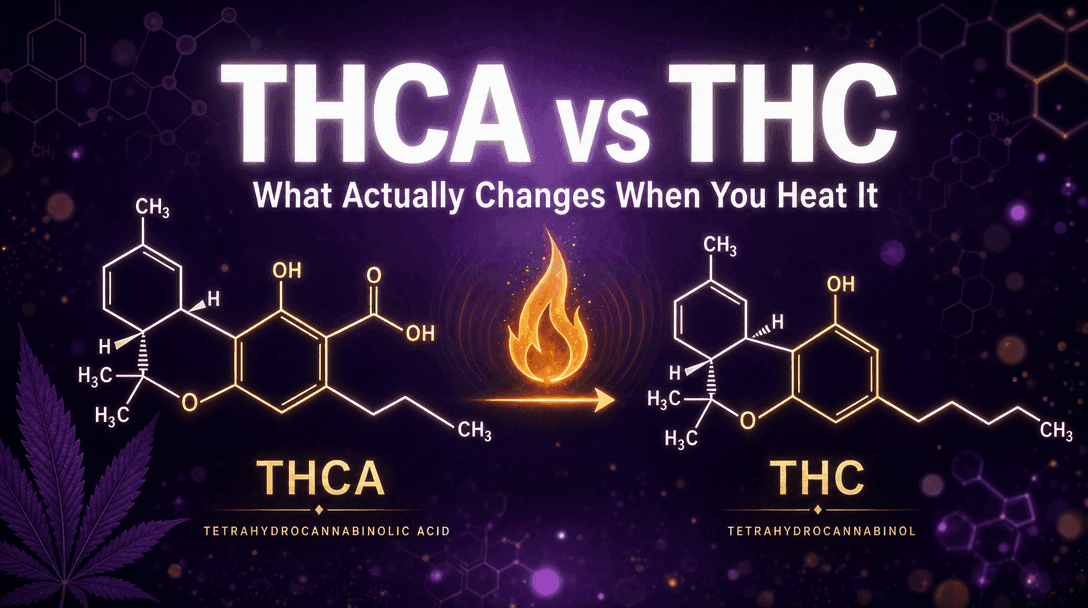
THCA vs THC is one molecule in two states: raw cannabis carries a carboxyl (-COOH) group that heat strips off as carbon dioxide, leaving delta-9 THC, the form that binds CB1 receptors and produces cannabis's intoxicating effects. This guide explains the heat thresholds and why the dose on a Certificate of Analysis is never quite the dose you feel. The primer is THCA vs THC: What's Actually in Your Weed? (2026 Guide).
What Is THCA, and How Is It Different From THC at the Molecular Level?
THCA is the acidic precursor that every fresh cannabis flower actually contains — not the molecule that gets you high. The two molecules are separated by exactly one carboxyl group, and that one group drives every percentage on every Certificate of Analysis [1].
- THCA molecular formula: C₂₂H₃₀O₄, molecular weight 358.47 g/mol — the raw, acidic precursor.
- Delta-9 THC formula: C₂₁H₃₀O₂, molecular weight 314.46 g/mol — the decarbed, active form.
- The difference: one carboxyl group (-COOH) that THCA carries as a pendant and THC does not.
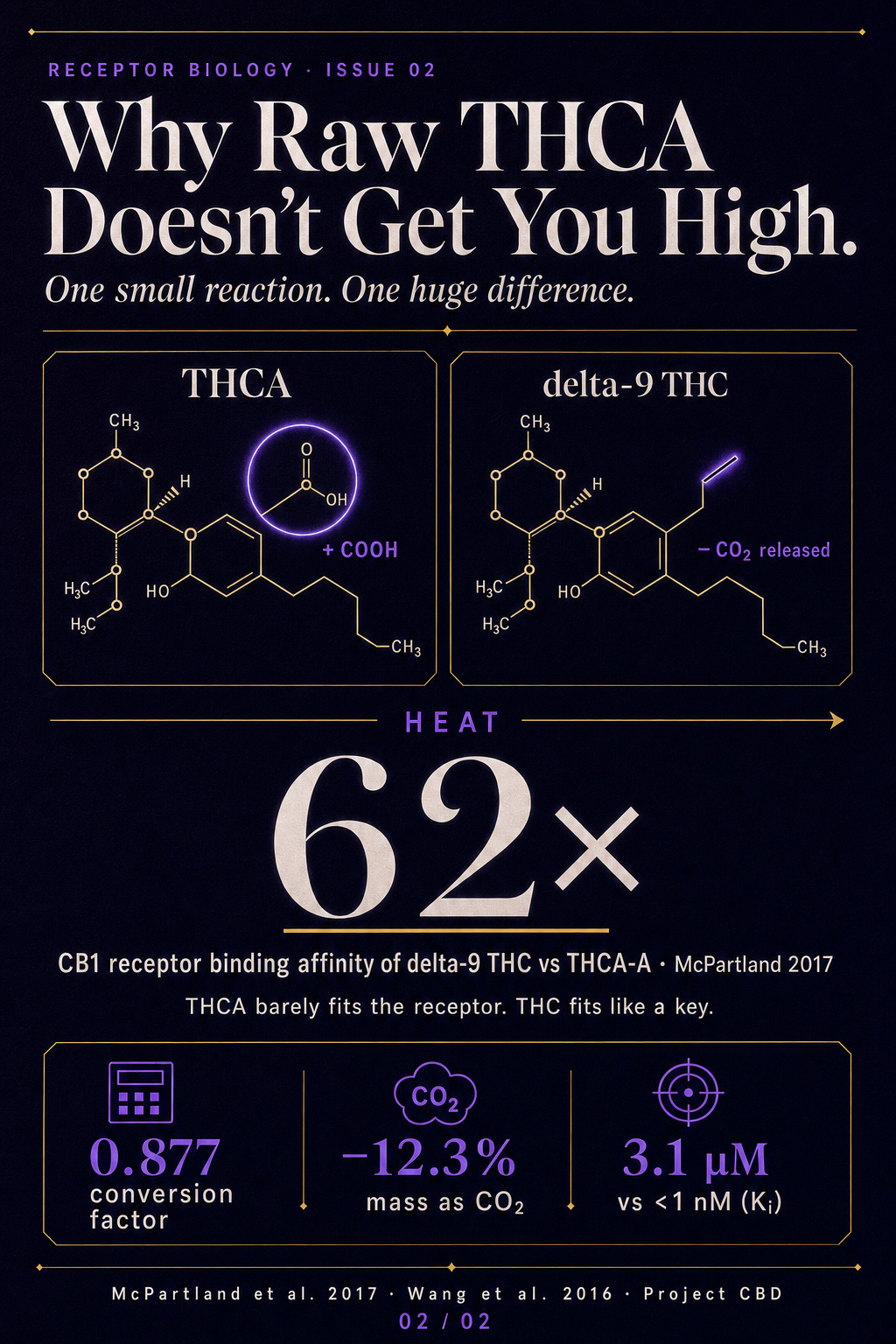
- Mass lost as CO₂: about 12.3% of the molecule's weight leaves during conversion.
- Conversion factor: 314.46 ÷ 358.47 = 0.877 — every lab's "total potential THC" multiplier.
- Practical example: a flower labeled "22% THCA" can yield at most ~19.3% usable THC by mass.
The practical implication is straightforward: fresh-harvest, cold-stored flower is almost entirely THCA. Labs detect it, label it, and price it accordingly.
The molecule is real and abundant — it is just not the molecule that produces the effect most adult-use customers are after. That is also why the same plant can produce wildly different experiences across delivery methods: a joint, a vaporizer at 200°C, and an oven at 110°C are all running the same chemistry, just at different rates and with different losses.
For a deeper walk through how THCA and THC interact with the rest of the plant, the companion primer covers receptors, entourage effects, and the rest of the picture.
Does THCA Actually Turn Into THC When You Heat It?
Yes — and the reaction is a one-way door. Decarboxylation is a first-order, irreversible chemical step in which the carboxyl group on THCA leaves as carbon dioxide and the remaining molecule is delta-9 THC. There is no equilibrium to push back the other way; cooling, adding water, or freezing the sample will not reverse it [2].
The kinetics of that one-way door have been mapped precisely. The Wang 2016 study measured THCA decarboxylation as a first-order Arrhenius process, and the headline numbers translate directly into how hot and how long to run an oven or a vaporizer [1]:
- Activation energy: 84.8 kJ/mol, with a pre-exponential factor near 3.7 × 10⁸ s⁻¹.
- Rate rule: reaction rate roughly doubles every 10°C added inside the working window.
- Time-temperature math: a 30-minute hold at one temperature can be matched by a 6-minute hold at a temperature about 35°C higher.
- First-order half-life: at any given temperature the first 50% converts in the same span as the next 50%, then the next, and so on.
- Real-world cap: a 25% THCA flower cannot exceed ~21.9% usable THC by mass, and in practice it produces less.
One consequence worth flagging: because decarboxylation is first-order and irreversible, the "dose on the label" is the upper bound of what any THCA percentage can ever deliver. The flower that tests at 25% THCA cannot produce more than about 21.9% usable THC by mass no matter how aggressively it is heated, and in practice it produces less because some of that THC is lost to combustion, evaporation, or degradation into CBN along the way.
That is one reason repeated use shifts how the same product feels over time — and it is worth reading up on how Can You Build THC Tolerance? tolerance compounds that gap.
What Temperature and Time Does THCA Need to Fully Decarboxylate?
The canonical answer comes straight from the Wang 2016 time-temperature curve. The working sweet spot for home decarboxylation sits between 110°C and 145°C, where conversion is fast and cannabinoid degradation is still minimal [1].
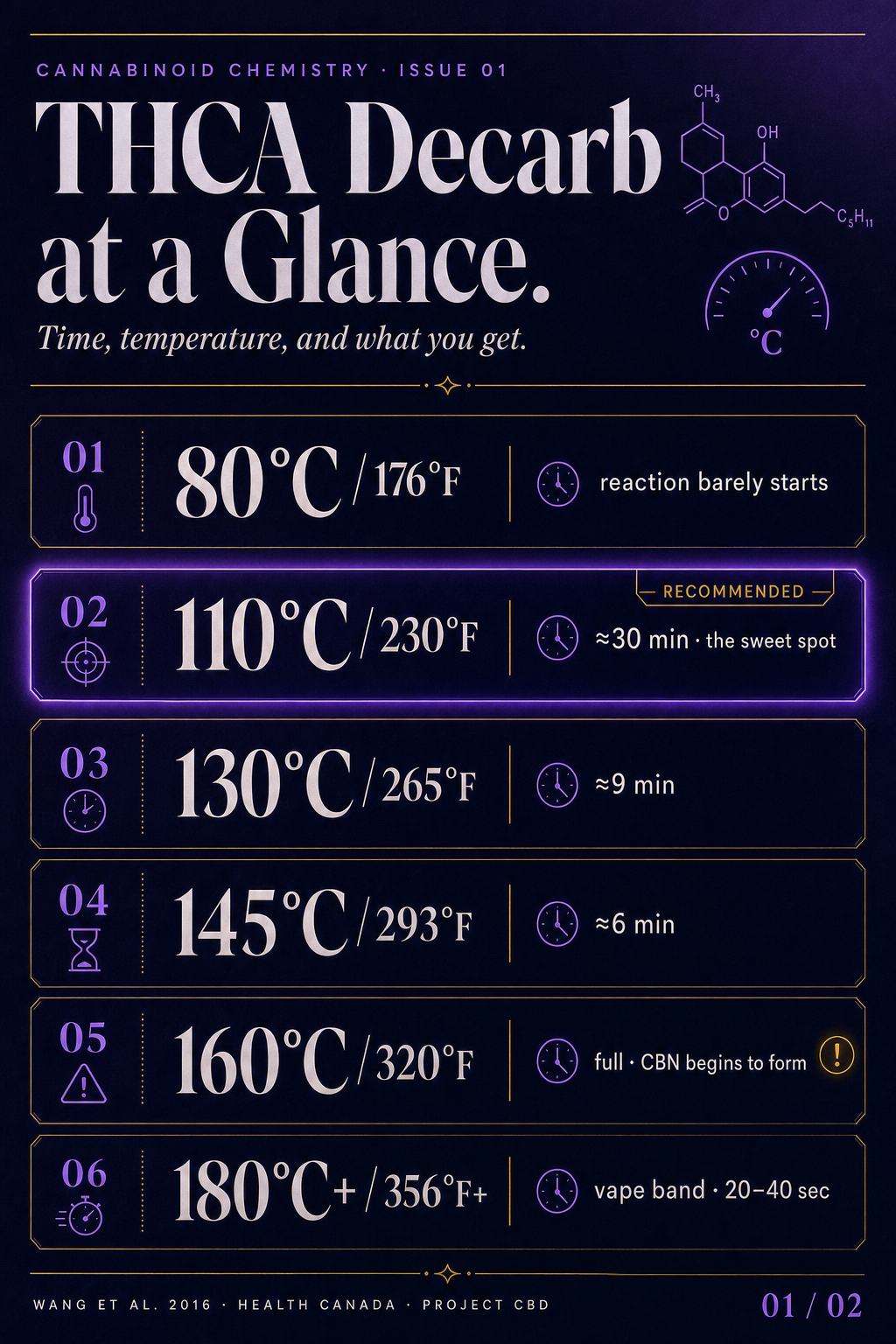
The full time-temperature table, ready for an oven or a vaporizer:
- 110°C / 230°F — ~30 minutes for near-complete conversion (Project CBD home-infusion anchor).
- 130°C / 265°F — ~9 minutes for near-complete conversion.
- 145°C / 293°F — ~6 minutes for near-complete conversion.
- 160°C / 320°F — conversion plateau, but THC oxidation into CBN begins.
- 180°C+ / 356°F+ — vaporizer band; full conversion in 20–40 seconds.
Health Canada's regulatory guidance places full decarboxylation anywhere in the broad 98°C to 200°C band, bounded at the high end by cannabinoid degradation rather than conversion efficiency [2]. Project CBD's home-infusion recommendation of 230°F / 110°C for 40 minutes sits squarely inside that window and gives enough margin for oven hot spots and grind inconsistencies [3].
The reason 110 to 145°C is the working sweet spot is not just speed — it is also the band in which the other cannabinoids behave predictably. A comparative Arrhenius study found that THCA decarboxylates 2.2 to 3.6 times faster than CBDA at the same temperature, and 1.8 to 3 times faster than CBGA [4].
In practice that means a 30-minute hold at 110°C fully activates the THCA in a sample while leaving a small residual of CBDA behind. If a formulation is designed for CBDA activation (a raw CBD tincture, for example), the same window under-converts the acid — which is why some manufacturers run longer, hotter cycles and accept the terpene loss that comes with them.
The numbers on a Certificate of Analysis also matter here. A flower that reads "30% THCA" on the label sounds more potent than one that reads "22% THCA", but the gap in actual delivered THC is smaller than the percentages suggest once decarboxylation efficiency and degradation losses are accounted for. The Is High THC Percentage Really Better? Debunking the Potency Myth post digs into that gap in detail and explains why higher COA numbers do not always translate into a stronger experience.
How Do Smoking, Vaping, and Cooking Compare for Converting THCA Into Usable THC?
All three delivery methods reach temperatures high enough to decarboxylate THCA in seconds, but they do so at very different rates and with very different side losses. The method you choose changes how much of that 22% THCA on the label actually reaches your receptors.
The three delivery methods, side by side:
| Method | Peak temperature | Time to full conversion | THCA → THC | Side losses |
|---|---|---|---|---|
| Joint or bowl (combustion) | 600–900°F (315–482°C) | Seconds | Complete | CBN formation + combustion destruction |
| Dry-flower vaporizer | 315–440°F (157–227°C) | 20–40 seconds | ~93% residual at 180°C, near-zero at 220°C | Terpene evaporation, partial CBN at high end |
| Oven decarb (cooking) | 220–240°F (104–116°C) | 30–40 minutes | Near-complete | Minimal |
Combustion in a joint or bowl peaks at roughly 600 to 900°F (315 to 482°C) — far above the 160°C degradation threshold — which means a fraction of the THC formed is immediately destroyed by oxidation into CBN before the smoke even leaves the cherry.
Vaporizers operate in a much narrower band, typically 315 to 440°F (157 to 227°C). The Osmokrovic 2022 dataset quantified exactly what that buys you: at 180°C residual THCA drops to roughly 7% of starting material within 40 seconds; at 220°C it approaches zero within 20 seconds [5].
Cooking, by contrast, is the slowest of the three but the most controlled: a 220°F (104°C) oven hold for 30 to 40 minutes is the canonical home-infusion decarb and gives the most reproducible conversion without pushing the material into CBN territory [6].
What all three delivery methods share is that the dose you feel is always lower than the dose on the label, for three reasons that act together [9]:
- Incomplete decarboxylation — real kitchen conditions lose 5 to 10% of the THCA to incomplete conversion.
- THC oxidation into CBN — once temperatures climb above about 160°C, the THC that did form starts oxidizing into CBN, which is heavier, sleepier, and far less intoxicating than delta-9 THC.
- Combustion destruction — a meaningful fraction of the THC is destroyed in a joint or bowl before it ever leaves the cherry.
The same 25% THCA flower can therefore deliver a noticeably different dose depending on how it is heated. For a sense of how that plays out in practice across flower formats, the Flower menu shows the range of THCA percentages Treehouse currently carries, and the NY Diesel | Flower | 28g listing is a real-world example of the kind of indoor flower profile this chemistry describes.
Why Does Raw THCA Not Get You High, and Does It Stay THCA Forever?
The receptor biology closes the loop. THCA-A binds human CB1 receptors weakly, and delta-9 THC binds them strongly — the gap is the receptor-level reason raw cannabis is non-intoxicating and heated cannabis is [7].
The binding numbers, in plain language:
- THCA-A at CB1: roughly 3.1 µM (micromolar) — very weak binding.
- THCA-A at CB2: roughly 12.5 µM — even weaker.
- Delta-9 THC at CB1: single-digit nanomolar — strong binding.
- The ratio: roughly 62-fold weaker CB1 signal and 125-fold weaker CB2 signal for the acidic form.
- The reason: the bulky carboxyl group physically prevents the molecule from settling into the receptor's hydrophobic pocket the way THC fits.
The authors also flagged that even this comparison likely overstates THCA's intrinsic affinity, because the reference standards used in such assays routinely contain 2 to 3% delta-9 THC as a contaminant from ambient-temperature decarboxylation, and the real affinity gap may be wider still.
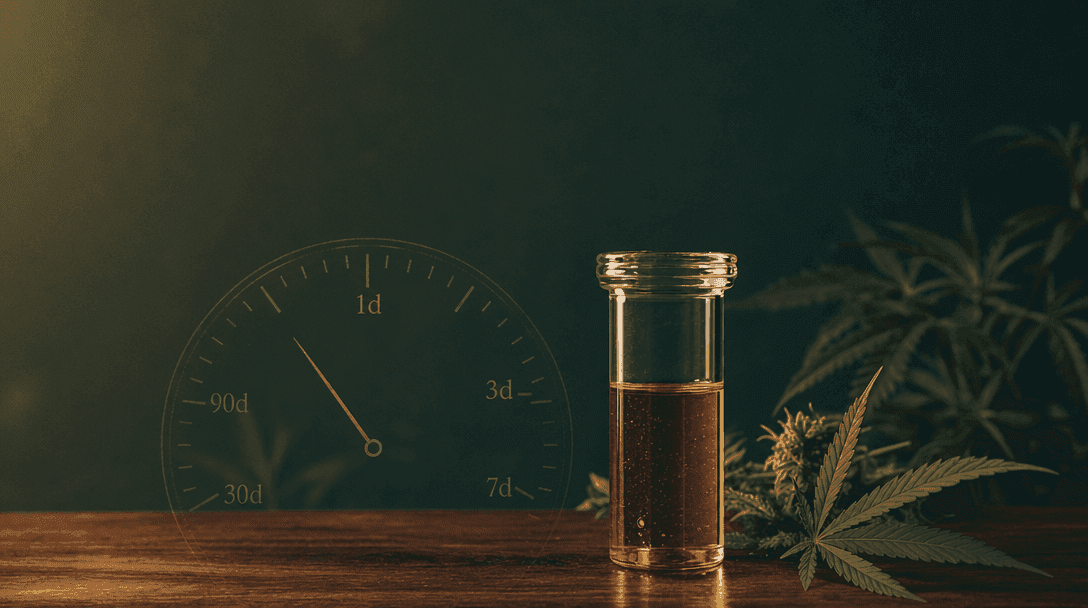
Time alone, without any external heat, will slowly convert THCA into THC at room temperature — but very slowly, and with diminishing returns. The Anresco twelve-month storage study tracked cannabis trimmings under controlled conditions and gave the cleanest picture yet of how temperature and time interact without external heat [8]:
- First 30 days: roughly 11.8% THCA loss on average regardless of jar type.
- Cold storage (4°C): samples stayed within 25% of their starting THCA through 210 days.
- Warm storage (30°C): decarboxylated fastest of the conditions tested.
- Full conversion: still took 60 to 150 days even at room temperature.
- After conversion: the THC formed then began oxidizing into CBN, dragging total potential THC downward.
The practical takeaway is that cold storage preserves potency for months, time alone is too slow to rely on for activation, and heat is the only on-switch that matters at consumer timescales. For anyone trying to keep their flower potent across a long winter, the Storage Containers Accessories collection covers storage jars and humidity-control packs designed for exactly this purpose.
What Should You Take Away from THCA vs THC?
THCA and THC are not two different cannabinoids so much as the same cannabinoid at two different stages of its life cycle. The carboxyl group is the lock; heat is the key. Smoke, vapor, and oven decarb all turn that key, just at different speeds and with different losses, and what reaches your receptors is always a fraction of what the Certificate of Analysis implied. Understanding that fraction is the gap between reading a label and dialing in the dose you actually feel.
Key points:
- THCA and THC are the same molecule at two stages — fresh flower carries THCA's carboxyl lock; heat strips it off as CO₂ to release THC.
- Decarboxylation is one-way and irreversible — no equilibrium to push back; cooling or freezing cannot reverse the conversion.
- The 110–145°C sweet spot balances speed and yield — below 100°C is too slow, above 160°C starts oxidizing THC into CBN.
- The dose you feel is always lower than the COA — incomplete decarb, CBN oxidation, and combustion each cut the labeled percentage.
- Time alone won't activate THCA fast enough — heat is the only practical on-switch; cold storage preserves potency for months.
Sources
- National Library of Medicine (PMC) / Wang et al., Journal of Chromatography B, 2016 — First-order kinetic study reporting THCA-A decarboxylation with an activation en
- Health Canada / Cannabis Legalization and Regulation Branch — States that complete decarboxylation of Δ9-THCA to Δ9-THC has been demonstrated
- Project CBD — Walking-level consumer explainer: the carboxyl group on raw THCA is what keeps i
- American Chemical Society — Industrial & Engineering Chemistry Research (2022) — Comparative Arrhenius study finding THCA decarboxylation rates are 2.2- to 3.6-f
- PubMed Central / National Library of Medicine (Osmokrović et al., ACS Omega, 2022) — Quantitative decarboxylation table from dry-flower vaporizers at three temperatu
- Leafly — Consumer-facing summary that decarboxylation is essential before edible or oral
- PubMed Central / McPartland et al., Cannabis and Cannabinoid Research, 2017 — Receptor-binding measurements in transfected human cells showing THCA-A binds hu
- Anresco Laboratories (cannabis analytical chemistry) — Twelve-month controlled study: at 30°C THCA decarboxylated most rapidly, samples
- Weedmaps — Plain-language synthesis of why COA total-THC percentages overstate real-world d
About Treehouse Cannabis
Treehouse Cannabis is an adult-use dispensary serving Rockland County, Orange County, and Westchester County, NY. Our menu carries flower, concentrates, vaporizers, and edibles from licensed New York growers and processors, with Certificate of Analysis-backed THCA percentages published on every product page. Stop in to talk through decarb temperatures, storage, and how the chemistry of THCA vs THC plays out across the formats we carry.
Cannabis is for adults 21 and older. Keep all cannabis products out of the reach of children and pets. The content in this article is for informational purposes only and is not intended as medical advice; consult a qualified healthcare professional before using cannabis for any therapeutic purpose. Do not drive or operate heavy machinery while under the influence of cannabis. Treehouse Cannabis serves adult-use customers in Rockland County, Orange County, and Westchester County, NY.
Shop our products

Shop All
Flower

Pre-rolls
Vaporizers

Edibles
Drinks

Concentrates
Tinctures

Topicals

CBD

Pet CBD

Accessories